QUALITY CONTROL IN
BLOOD BANK
Content
• Definition
• Types
• Need
• Inclusions
• How to do that?
Quality Assurance
• It is the sum total of the organized arrangements with the objective
of ensuring that products will be of the quality required for their
intended use.
• It includes retrospective review and analysis of operational
performance data to determine that the overall process is in a state of
control and to detect shift or trends that require attention.
Quality Control
• Testing routinely performed tests/activities on materials and
equipments to check their proper function
• The monitoring system that checks the effectiveness of existing
process/steps by testing the quality of final products
Quality System Essentials (QSEs)
1. Organization and leadership
2. Facilities work environment and safety
3. Human resources
4. Customer focus
5. Suppliers and material management
6. Equipment management
7. Process management
8. Documents and records
9. Information management
10. Management of non conforming events
11. Monitoring and assessment
12. Process improvement
Types
• Internal Quality control
• External Quality Control
Internal Control
• The internal quality control can be maintained by
going through a complete checklist of items or test
daily to make sure that all systems are being
monitored and in control.
• Immediate decisions can be taken to accept or reject
results / products.
External Quality Control
• External quality control is a way to compare the
performance of a laboratory with reference to other
laboratories
• External Quality Assurance also know as ‘proficiency
testing’ or External Quality control
Quality in Blood Transfusion Services
In blood transfusion service, the primary goal of quality
is 'transfusion of safe unit of blood.'
The quality system deals with all aspects to ensure that
the product or 'safe unit of blood' is as safe as possible.
Objectives of Quality in Blood Bank
• To ensure availability of a sufficient supply of blood,
blood components of high quality with maximum
efficacy and minimum risk to both donors and patients.
• To determine problems in the whole transfusion chain
and solve it to achieve the goal .
Quality Management System in Blood Bank
In a blood transfusion center, it means that a management system should
exist to look into provision of a safe unit of blood and if any errors are
identified, these should be corrected.
Steps involving Quality Control in
Blood Bank
• Donor selection and Blood collection
• Serology Laboratory
• Transfusion transmitted Infection
• Component preparation
• Cross-match & Antibody screening
• Storage , issue and transportation
Need for Quality
A failure in the quality of blood collected or screening of donated
blood unit can be very serious and may result in fatal
consequences.
1. Failure to identify the patient correctly
2. Wrong sample labeling
3. Mix-up of results amongst different patients
4. Failure to detect presence of an abnormality in the patient's sample
5. Issue of unscreened blood due to clerical or technical errors
Quality Control for Reagents
The primary objective of a reagent quality control is to ensure that reagent
is functioning as expected.
Quality Control for Reagents
Reagent requirements
• All reagents should be clearly labeled with batch
number, expiry date and storage temp;
• Instructions for use should be in-form of SOP’s
with training.
• All reagents and kit should be used according to
the manufacturer’s instructions.
• FIFO shall be maintained
Quality Control for Reagents
• Use of positive & negative controls should be done with each
batch to show that reagents are potent and specific.
• All reagents must be carefully stored at recommended temp.
• Reagents to be kept at 4-6oC should never be frozen and are
stored according to manufacturer’s instructions only
• Supply, storage and transportation of kits and reagents should
be strictly standardized & manufacturer’s instructions should be
followed with ensured continuous power supply and periodic
temperature monitoring.
Log of Reagents
• Reagent records should include:
• The name of each reagent with
• Lot number
• Batch number
• Expiry date
• Name of manufacturer
• Date of receipt and put in use
• Grade and strength of reactions at time of receipt (Kit
verification).
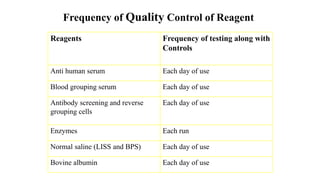
Reagents Frequency of testing along with
Controls
Anti human serum Each day of use
Blood grouping serum Each day of use
Antibody screening and reverse
grouping cells
Each day of use
Enzymes Each run
Normal saline (LISS and BPS) Each day of use
Bovine albumin Each day of use
Frequency of Quality Control of Reagent
Parameters Quality
Requirement
Frequency of
Control
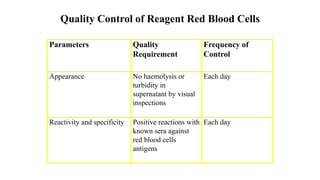
Appearance No haemolysis or
turbidity in
supernatant by visual
inspections
Each day
Reactivity and specificity Positive reactions with
known sera against
red blood cells
antigens
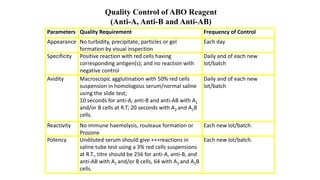
Each day
Quality Control of Reagent Red Blood Cells
Quality Control of ABO Reagent
(Anti-A, Anti-B and Anti-AB)
Parameters Quality Requirement Frequency of Control
Appearance No turbidity, precipitate, particles or gel
formation by visual inspection
Each day
Specificity Positive reaction with red cells having
corresponding antigen(s); and no reaction with
negative control
Daily and of each new
lot/batch
Avidity Macroscopic agglutination with 50% red cells
suspension in homologous serum/normal saline
using the slide test;
10 seconds for anti-A, anti-B and anti-AB with A1
and/or B cells at R.T; 20 seconds with A2 and A2B
cells.
Daily and of each new
lot/batch
Reactivity No immune haemolysis, rouleaux formation or
Prozone
Each new lot/batch.
Potency Undiluted serum should give +++reactions in
saline tube test using a 3% red cells suspensions
at R.T., titre should be 256 for anti-A, anti-B, and
anti-AB with A1 and/or B cells, 64 with A2 and A2B
cells.
Each new lot/batch.
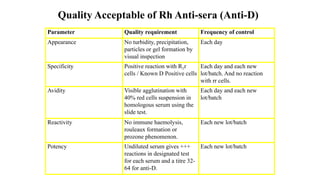
Quality Acceptable of Rh Anti-sera (Anti-D)
Parameter Quality requirement Frequency of control
Appearance No turbidity, precipitation,
particles or gel formation by
visual inspection
Each day
Specificity Positive reaction with R1r
cells / Known D Positive cells
Each day and each new
lot/batch. And no reaction
with rr cells.
Avidity Visible agglutination with
40% red cells suspension in
homologous serum using the
slide test.
Each day and each new
lot/batch
Reactivity No immune haemolysis,
rouleaux formation or
prozone phenomenon.
Each new lot/batch
Potency Undiluted serum gives +++
reactions in designated test
for each serum and a titre 32-
64 for anti-D.
Each new lot/batch
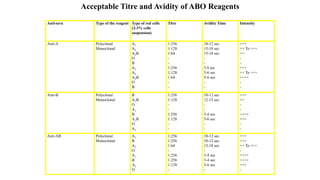
Acceptable Titre and Avidity of ABO Reagents
Anti-sera Type of the reagent Type of red cells
(2-3% cells
suspension)
Titre Avidity Time Intensity
Anti-A Polyclonal
Monoclonal
A1
A2
A2B
O
B
A1
A2
A2B
O
B
1:256
1:128
1:64
-
-
1:256
1:128
1:64
-
-
10-12 sec
15-18 sec
15-18 sec
-
-
3.4 sec
5-6 sec
5-6 sec
-
-
+++
++ To +++
++
-
-
+++
++ To +++
++++
-
-
Anti-B Polyclonal
Monoclonal
B
A1B
O
A1
B
A1B
O
A1
1:256
1:128
-
-
1:256
1:128
-
-
10-12 sec
12-15 sec
-
-
3-4 sec
5-6 sec
-
-
+++
++
-
-
++++
+++
-
-
Anti-AB Polyclonal
Monoclonal
A1
B
A2
O
A1
B
A2
O
1:256
1:256
1:64
-
1:256
1:256
1:128
-
10-12 sec
10-12 sec
15-18 sec
-
3-4 sec
3-4 sec
5-6 sec
-
+++
+++
++ To +++
-
++++
++++
+++
-
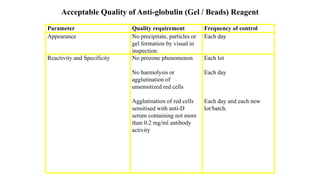
Acceptable Quality of Anti-globulin (Gel / Beads) Reagent
Parameter Quality requirement Frequency of control
Appearance No precipitate, particles or
gel formation by visual in
inspection.
Each day
Reactivity and Specificity No prozone phenomenon
No haemolysis or
agglutination of
unsensitized red cells
Agglutination of red cells
sensitised with anti-D
serum containing not more
than 0.2 mg/ml antibody
activity
Each lot
Each day
Each day and each new
lot/batch.
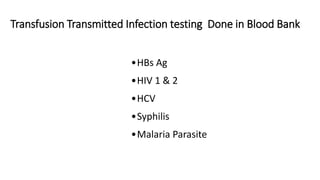
Transfusion Transmitted Infection testing Done in Blood Bank
•HBs Ag
•HIV 1 & 2
•HCV
•Syphilis
•Malaria Parasite
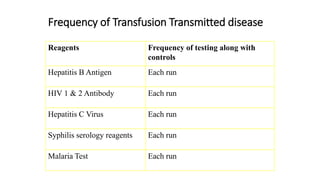
Frequency of Transfusion Transmitted disease
Reagents Frequency of testing along with
controls
Hepatitis B Antigen Each run
HIV 1 & 2 Antibody Each run
Hepatitis C Virus Each run
Syphilis serology reagents Each run
Malaria Test Each run
Assuring quality of examination procedure
• The daily QC values shall be documented on Levey
Jennings curve and CV % from monthly QC data must
be calculated.
Flow chart should be made to manage “Out of control situation”
• If a reagent produces results outside the limits set by the manufacturer
or Blood Bank, the deficiency should be reported to the Quality
Manager.
• Search for recent events that could have caused changes
• Examine environmental condition
• Follow manufactures troubleshooting guide
• Refer to manufacturer of equipment, reagents or QC/Calibrator vendor.
Quality Control in Blood/ Blood Components
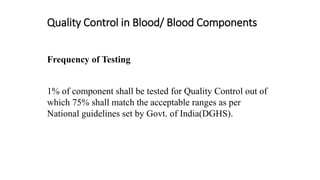
Frequency of Testing
1% of component shall be tested for Quality Control out of
which 75% shall match the acceptable ranges as per
National guidelines set by Govt. of India(DGHS).
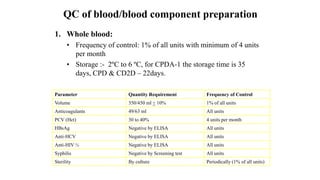
QC of blood/blood component preparation
1. Whole blood:
• Frequency of control: 1% of all units with minimum of 4 units
per month
• Storage :- 2ºC to 6 ºC, for CPDA-1 the storage time is 35
days, CPD & CD2D – 22days.
Parameter Quantity Requirement Frequency of Control
Volume 350/450 ml + 10% 1% of all units
Anticoagulants 49/63 ml All units
PCV (Hct) 30 to 40% 4 units per month
HBsAg Negative by ELISA All units
Anti-HCV Negative by ELISA All units
Anti-HIV ½ Negative by ELISA All units
Syphilis Negative by Screening test All units
Sterility By culture Periodically (1% of all units)
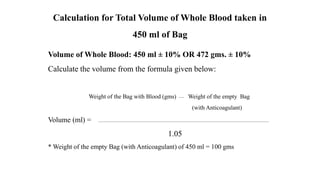
Volume of Whole Blood: 450 ml ± 10% OR 472 gms. ± 10%
Calculate the volume from the formula given below:
Weight of the Bag with Blood (gms) Weight of the empty Bag
(with Anticoagulant)
Volume (ml) =
1.05
* Weight of the empty Bag (with Anticoagulant) of 450 ml = 100 gms
Calculation for Total Volume of Whole Blood taken in
450 ml of Bag
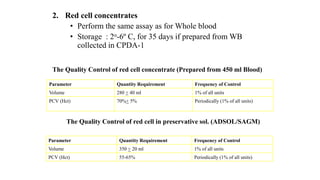
2. Red cell concentrates
• Perform the same assay as for Whole blood
• Storage : 2o-6º C, for 35 days if prepared from WB
collected in CPDA-1
Parameter Quantity Requirement Frequency of Control
Volume 280 + 40 ml 1% of all units
PCV (Hct) 70%+ 5% Periodically (1% of all units)
Parameter Quantity Requirement Frequency of Control
Volume 350 + 20 ml 1% of all units
PCV (Hct) 55-65% Periodically (1% of all units)
The Quality Control of red cell in preservative sol. (ADSOL/SAGM)
The Quality Control of red cell concentrate (Prepared from 450 ml Blood)
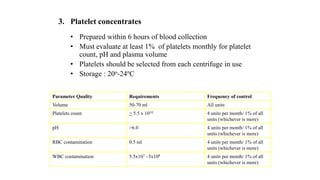
3. Platelet concentrates
• Prepared within 6 hours of blood collection
• Must evaluate at least 1% of platelets monthly for platelet
count, pH and plasma volume
• Platelets should be selected from each centrifuge in use
• Storage : 20o-24ºC
Parameter Quality Requirements Frequency of control
Volume 50-70 ml All units
Platelets count > 5.5 x 10¹⁰ 4 units per month/ 1% of all
units (whichever is more)
pH >6.0 4 units per month/ 1% of all
units (whichever is more)
RBC contamination 0.5 ml 4 units per month/ 1% of all
units (whichever is more)
WBC contamination 5.5x10⁷ –5x10⁸ 4 units per month/ 1% of all
units (whichever is more)
4. Quality of Platelet concentrate by Apheresis
Parameter Quality requirement
Volume >200 ml
Platelets count > 3.0 – 7.0 x 10¹¹
pH > 6.0 (at the end of permissible
storage period)
Residual leucocytes < 5.0 x 10⁶
Red cells Traces to 0.5 ml
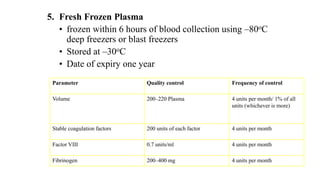
5. Fresh Frozen Plasma
• frozen within 6 hours of blood collection using –80oC
deep freezers or blast freezers
• Stored at –30oC
• Date of expiry one year
Parameter Quality control Frequency of control
Volume 200–220 Plasma 4 units per month/ 1% of all
units (whichever is more)
Stable coagulation factors 200 units of each factor 4 units per month
Factor VIII 0.7 units/ml 4 units per month
Fibrinogen 200–400 mg 4 units per month
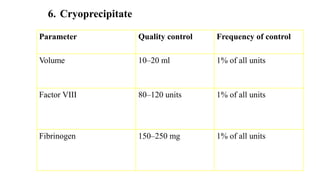
6. Cryoprecipitate
Parameter Quality control Frequency of control
Volume 10–20 ml 1% of all units
Factor VIII 80–120 units 1% of all units
Fibrinogen 150–250 mg 1% of all units
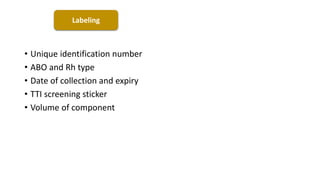
• Unique identification number
• ABO and Rh type
• Date of collection and expiry
• TTI screening sticker
• Volume of component
Labeling
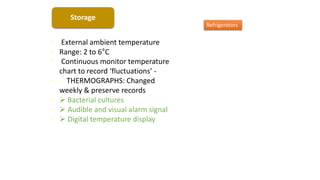
Storage
• External ambient temperature
• Range: 2 to 6°C
• Continuous monitor temperature
chart to record ‘fluctuations’ -
• THERMOGRAPHS: Changed
weekly & preserve records
•  Bacterial cultures
•  Audible and visual alarm signal
•  Digital temperature display
Refrigerators
• Temperature recording : Range: -35°C to -40°C
• Cooling down time: A full load of plasma packs at +25°C takes
a max. of 5 hrs for all the packs to reach below -5°C and 30 hrs
to below -20°C
Deep freezers
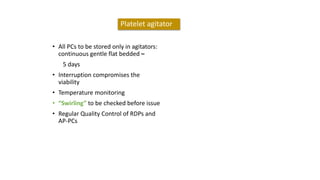
• All PCs to be stored only in agitators:
continuous gentle flat bedded –
5 days
• Interruption compromises the
viability
• Temperature monitoring
• “Swirling” to be checked before issue
• Regular Quality Control of RDPs and
AP-PCs
Platelet agitator
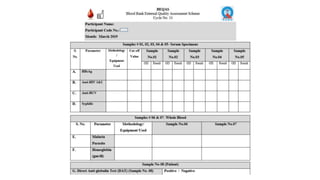
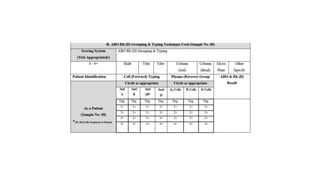
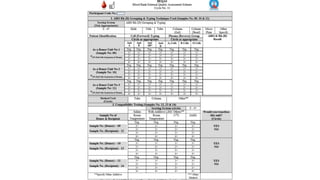
External Quality Assurance (EQA)
• Proficiency Testing Programme is designed to evaluate
the overall performance and accuracy engaged in blood
banking testing.
• Determine the performance of Individual Blood banks
for specific tests or measurement and to monitor Blood
Banks continual performance and improvement.
• To provide additional confidence to Blood Bank /
Laboratory clients.
• It is a blind testing
• The internal QC should be complemented by regular external quality
assurance e.g. participation in a proficiency testing programme
• Proficiency programme test, coded “normal” and “problem” blood
samples are distributed from national or regional reference laboratory
to the participants usually 2x to 4x a year.
External Quality Assurance
Parameters / test covered under EQA
1. HBsAg
2. Anti- HIV 1&2
3. Anti- HCV
4. Syphilis (VDRL)
5. Malarial Parasite
6. NAT ( HBV/ HCV/ HIV-1, HIV-2, HIV-O & HIV-M)
7. Hemoglobin
8. Blood Group
9. Cross-match
10. Antibody Screening & Identification
11. Factor VIII
12. Fibrinogen
13. Sterility Testing
14. APTT
THANK YOU

Quality-Control-in-Blood-Bank.pptx

  • 1.
  • 2.
    Content • Definition • Types •Need • Inclusions • How to do that?
  • 3.
    Quality Assurance • Itis the sum total of the organized arrangements with the objective of ensuring that products will be of the quality required for their intended use. • It includes retrospective review and analysis of operational performance data to determine that the overall process is in a state of control and to detect shift or trends that require attention.
  • 4.
    Quality Control • Testingroutinely performed tests/activities on materials and equipments to check their proper function • The monitoring system that checks the effectiveness of existing process/steps by testing the quality of final products
  • 5.
    Quality System Essentials(QSEs) 1. Organization and leadership 2. Facilities work environment and safety 3. Human resources 4. Customer focus 5. Suppliers and material management 6. Equipment management 7. Process management 8. Documents and records 9. Information management 10. Management of non conforming events 11. Monitoring and assessment 12. Process improvement
  • 6.
    Types • Internal Qualitycontrol • External Quality Control
  • 7.
    Internal Control • Theinternal quality control can be maintained by going through a complete checklist of items or test daily to make sure that all systems are being monitored and in control. • Immediate decisions can be taken to accept or reject results / products.
  • 8.
    External Quality Control •External quality control is a way to compare the performance of a laboratory with reference to other laboratories • External Quality Assurance also know as ‘proficiency testing’ or External Quality control
  • 9.
    Quality in BloodTransfusion Services In blood transfusion service, the primary goal of quality is 'transfusion of safe unit of blood.' The quality system deals with all aspects to ensure that the product or 'safe unit of blood' is as safe as possible.
  • 10.
    Objectives of Qualityin Blood Bank • To ensure availability of a sufficient supply of blood, blood components of high quality with maximum efficacy and minimum risk to both donors and patients. • To determine problems in the whole transfusion chain and solve it to achieve the goal .
  • 11.
    Quality Management Systemin Blood Bank In a blood transfusion center, it means that a management system should exist to look into provision of a safe unit of blood and if any errors are identified, these should be corrected.
  • 12.
    Steps involving QualityControl in Blood Bank • Donor selection and Blood collection • Serology Laboratory • Transfusion transmitted Infection • Component preparation • Cross-match & Antibody screening • Storage , issue and transportation
  • 13.
    Need for Quality Afailure in the quality of blood collected or screening of donated blood unit can be very serious and may result in fatal consequences. 1. Failure to identify the patient correctly 2. Wrong sample labeling 3. Mix-up of results amongst different patients 4. Failure to detect presence of an abnormality in the patient's sample 5. Issue of unscreened blood due to clerical or technical errors
  • 14.
    Quality Control forReagents The primary objective of a reagent quality control is to ensure that reagent is functioning as expected.
  • 15.
    Quality Control forReagents Reagent requirements • All reagents should be clearly labeled with batch number, expiry date and storage temp; • Instructions for use should be in-form of SOP’s with training. • All reagents and kit should be used according to the manufacturer’s instructions. • FIFO shall be maintained
  • 16.
    Quality Control forReagents • Use of positive & negative controls should be done with each batch to show that reagents are potent and specific. • All reagents must be carefully stored at recommended temp. • Reagents to be kept at 4-6oC should never be frozen and are stored according to manufacturer’s instructions only • Supply, storage and transportation of kits and reagents should be strictly standardized & manufacturer’s instructions should be followed with ensured continuous power supply and periodic temperature monitoring.
  • 17.
    Log of Reagents •Reagent records should include: • The name of each reagent with • Lot number • Batch number • Expiry date • Name of manufacturer • Date of receipt and put in use • Grade and strength of reactions at time of receipt (Kit verification).
  • 18.
    Reagents Frequency oftesting along with Controls Anti human serum Each day of use Blood grouping serum Each day of use Antibody screening and reverse grouping cells Each day of use Enzymes Each run Normal saline (LISS and BPS) Each day of use Bovine albumin Each day of use Frequency of Quality Control of Reagent
  • 19.
    Parameters Quality Requirement Frequency of Control AppearanceNo haemolysis or turbidity in supernatant by visual inspections Each day Reactivity and specificity Positive reactions with known sera against red blood cells antigens Each day Quality Control of Reagent Red Blood Cells
  • 20.
    Quality Control ofABO Reagent (Anti-A, Anti-B and Anti-AB) Parameters Quality Requirement Frequency of Control Appearance No turbidity, precipitate, particles or gel formation by visual inspection Each day Specificity Positive reaction with red cells having corresponding antigen(s); and no reaction with negative control Daily and of each new lot/batch Avidity Macroscopic agglutination with 50% red cells suspension in homologous serum/normal saline using the slide test; 10 seconds for anti-A, anti-B and anti-AB with A1 and/or B cells at R.T; 20 seconds with A2 and A2B cells. Daily and of each new lot/batch Reactivity No immune haemolysis, rouleaux formation or Prozone Each new lot/batch. Potency Undiluted serum should give +++reactions in saline tube test using a 3% red cells suspensions at R.T., titre should be 256 for anti-A, anti-B, and anti-AB with A1 and/or B cells, 64 with A2 and A2B cells. Each new lot/batch.
  • 21.
    Quality Acceptable ofRh Anti-sera (Anti-D) Parameter Quality requirement Frequency of control Appearance No turbidity, precipitation, particles or gel formation by visual inspection Each day Specificity Positive reaction with R1r cells / Known D Positive cells Each day and each new lot/batch. And no reaction with rr cells. Avidity Visible agglutination with 40% red cells suspension in homologous serum using the slide test. Each day and each new lot/batch Reactivity No immune haemolysis, rouleaux formation or prozone phenomenon. Each new lot/batch Potency Undiluted serum gives +++ reactions in designated test for each serum and a titre 32- 64 for anti-D. Each new lot/batch
  • 22.
    Acceptable Titre andAvidity of ABO Reagents Anti-sera Type of the reagent Type of red cells (2-3% cells suspension) Titre Avidity Time Intensity Anti-A Polyclonal Monoclonal A1 A2 A2B O B A1 A2 A2B O B 1:256 1:128 1:64 - - 1:256 1:128 1:64 - - 10-12 sec 15-18 sec 15-18 sec - - 3.4 sec 5-6 sec 5-6 sec - - +++ ++ To +++ ++ - - +++ ++ To +++ ++++ - - Anti-B Polyclonal Monoclonal B A1B O A1 B A1B O A1 1:256 1:128 - - 1:256 1:128 - - 10-12 sec 12-15 sec - - 3-4 sec 5-6 sec - - +++ ++ - - ++++ +++ - - Anti-AB Polyclonal Monoclonal A1 B A2 O A1 B A2 O 1:256 1:256 1:64 - 1:256 1:256 1:128 - 10-12 sec 10-12 sec 15-18 sec - 3-4 sec 3-4 sec 5-6 sec - +++ +++ ++ To +++ - ++++ ++++ +++ -
  • 23.
    Acceptable Quality ofAnti-globulin (Gel / Beads) Reagent Parameter Quality requirement Frequency of control Appearance No precipitate, particles or gel formation by visual in inspection. Each day Reactivity and Specificity No prozone phenomenon No haemolysis or agglutination of unsensitized red cells Agglutination of red cells sensitised with anti-D serum containing not more than 0.2 mg/ml antibody activity Each lot Each day Each day and each new lot/batch.
  • 24.
    Transfusion Transmitted Infectiontesting Done in Blood Bank •HBs Ag •HIV 1 & 2 •HCV •Syphilis •Malaria Parasite
  • 25.
    Frequency of TransfusionTransmitted disease Reagents Frequency of testing along with controls Hepatitis B Antigen Each run HIV 1 & 2 Antibody Each run Hepatitis C Virus Each run Syphilis serology reagents Each run Malaria Test Each run
  • 26.
    Assuring quality ofexamination procedure • The daily QC values shall be documented on Levey Jennings curve and CV % from monthly QC data must be calculated.
  • 27.
    Flow chart shouldbe made to manage “Out of control situation” • If a reagent produces results outside the limits set by the manufacturer or Blood Bank, the deficiency should be reported to the Quality Manager. • Search for recent events that could have caused changes • Examine environmental condition • Follow manufactures troubleshooting guide • Refer to manufacturer of equipment, reagents or QC/Calibrator vendor.
  • 28.
    Quality Control inBlood/ Blood Components Frequency of Testing 1% of component shall be tested for Quality Control out of which 75% shall match the acceptable ranges as per National guidelines set by Govt. of India(DGHS).
  • 29.
    QC of blood/bloodcomponent preparation 1. Whole blood: • Frequency of control: 1% of all units with minimum of 4 units per month • Storage :- 2ºC to 6 ºC, for CPDA-1 the storage time is 35 days, CPD & CD2D – 22days. Parameter Quantity Requirement Frequency of Control Volume 350/450 ml + 10% 1% of all units Anticoagulants 49/63 ml All units PCV (Hct) 30 to 40% 4 units per month HBsAg Negative by ELISA All units Anti-HCV Negative by ELISA All units Anti-HIV ½ Negative by ELISA All units Syphilis Negative by Screening test All units Sterility By culture Periodically (1% of all units)
  • 30.
    Volume of WholeBlood: 450 ml ± 10% OR 472 gms. ± 10% Calculate the volume from the formula given below: Weight of the Bag with Blood (gms) Weight of the empty Bag (with Anticoagulant) Volume (ml) = 1.05 * Weight of the empty Bag (with Anticoagulant) of 450 ml = 100 gms Calculation for Total Volume of Whole Blood taken in 450 ml of Bag
  • 31.
    2. Red cellconcentrates • Perform the same assay as for Whole blood • Storage : 2o-6º C, for 35 days if prepared from WB collected in CPDA-1 Parameter Quantity Requirement Frequency of Control Volume 280 + 40 ml 1% of all units PCV (Hct) 70%+ 5% Periodically (1% of all units) Parameter Quantity Requirement Frequency of Control Volume 350 + 20 ml 1% of all units PCV (Hct) 55-65% Periodically (1% of all units) The Quality Control of red cell in preservative sol. (ADSOL/SAGM) The Quality Control of red cell concentrate (Prepared from 450 ml Blood)
  • 32.
    3. Platelet concentrates •Prepared within 6 hours of blood collection • Must evaluate at least 1% of platelets monthly for platelet count, pH and plasma volume • Platelets should be selected from each centrifuge in use • Storage : 20o-24ºC Parameter Quality Requirements Frequency of control Volume 50-70 ml All units Platelets count > 5.5 x 10¹⁰ 4 units per month/ 1% of all units (whichever is more) pH >6.0 4 units per month/ 1% of all units (whichever is more) RBC contamination 0.5 ml 4 units per month/ 1% of all units (whichever is more) WBC contamination 5.5x10⁷ –5x10⁸ 4 units per month/ 1% of all units (whichever is more)
  • 33.
    4. Quality ofPlatelet concentrate by Apheresis Parameter Quality requirement Volume >200 ml Platelets count > 3.0 – 7.0 x 10¹¹ pH > 6.0 (at the end of permissible storage period) Residual leucocytes < 5.0 x 10⁶ Red cells Traces to 0.5 ml
  • 34.
    5. Fresh FrozenPlasma • frozen within 6 hours of blood collection using –80oC deep freezers or blast freezers • Stored at –30oC • Date of expiry one year Parameter Quality control Frequency of control Volume 200–220 Plasma 4 units per month/ 1% of all units (whichever is more) Stable coagulation factors 200 units of each factor 4 units per month Factor VIII 0.7 units/ml 4 units per month Fibrinogen 200–400 mg 4 units per month
  • 35.
    6. Cryoprecipitate Parameter Qualitycontrol Frequency of control Volume 10–20 ml 1% of all units Factor VIII 80–120 units 1% of all units Fibrinogen 150–250 mg 1% of all units
  • 36.
    • Unique identificationnumber • ABO and Rh type • Date of collection and expiry • TTI screening sticker • Volume of component Labeling
  • 37.
    Storage • External ambienttemperature • Range: 2 to 6°C • Continuous monitor temperature chart to record ‘fluctuations’ - • THERMOGRAPHS: Changed weekly & preserve records •  Bacterial cultures •  Audible and visual alarm signal •  Digital temperature display Refrigerators
  • 38.
    • Temperature recording: Range: -35°C to -40°C • Cooling down time: A full load of plasma packs at +25°C takes a max. of 5 hrs for all the packs to reach below -5°C and 30 hrs to below -20°C Deep freezers
  • 39.
    • All PCsto be stored only in agitators: continuous gentle flat bedded – 5 days • Interruption compromises the viability • Temperature monitoring • “Swirling” to be checked before issue • Regular Quality Control of RDPs and AP-PCs Platelet agitator
  • 40.
    External Quality Assurance(EQA) • Proficiency Testing Programme is designed to evaluate the overall performance and accuracy engaged in blood banking testing. • Determine the performance of Individual Blood banks for specific tests or measurement and to monitor Blood Banks continual performance and improvement. • To provide additional confidence to Blood Bank / Laboratory clients. • It is a blind testing
  • 41.
    • The internalQC should be complemented by regular external quality assurance e.g. participation in a proficiency testing programme • Proficiency programme test, coded “normal” and “problem” blood samples are distributed from national or regional reference laboratory to the participants usually 2x to 4x a year. External Quality Assurance
  • 42.
    Parameters / testcovered under EQA 1. HBsAg 2. Anti- HIV 1&2 3. Anti- HCV 4. Syphilis (VDRL) 5. Malarial Parasite 6. NAT ( HBV/ HCV/ HIV-1, HIV-2, HIV-O & HIV-M) 7. Hemoglobin 8. Blood Group 9. Cross-match 10. Antibody Screening & Identification 11. Factor VIII 12. Fibrinogen 13. Sterility Testing 14. APTT
  • 46.