Blood group systems
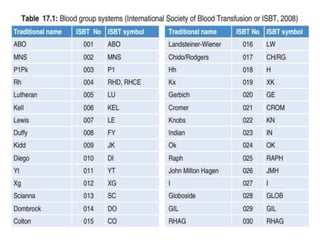
• Red cell antigens that are produced by alleles
(alternative forms of a specified gene) at a single
gene locus or very closely linked loci constitute a
blood group system.
• Blood group genes are inherited in a Mendelian
manner and are mostly located on autosomes.
• Most of the blood group genes are expressed in a
codominant manner (i.e. the two allelic forms are
expressed equally if inherited in a heterozygous
state).
• In blood transfusion practice, most important
blood group systems are ABO and Rh.
• This is because A, B, and Rh D antigens are the
most immunogenic (i.e. capable of eliciting a
strong antibody response on stimulation) and
their alloantibodies can cause destruction of
transfused red cells or induce haemolytic disease
of newborn (HDN).
• ABO antigens are also important in organ
transplantation.
‰
‰
‰
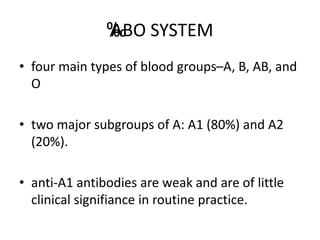
ABO SYSTEM
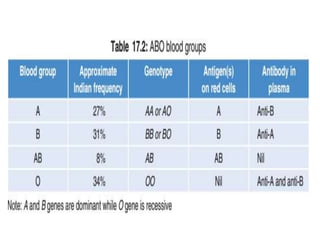
• four main types of blood groups–A, B, AB, and
O
• two major subgroups of A: A1 (80%) and A2
(20%).
• anti-A1 antibodies are weak and are of little
clinical signifiance in routine practice.
Antigens of the ABO System:
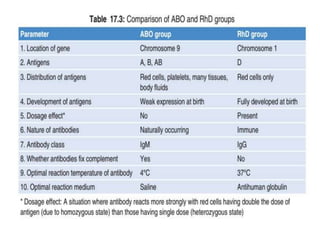
• ABO antigens are carbohydrate structures on
glycoproteins and glycolipids.
• ABO antigens are poorly expressed at birth,
increase gradually in strength and become fully
expressed around 1 year of age.
• In older age, they become slightly weak.
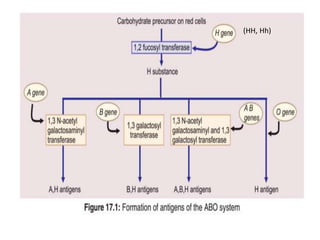
(HH, Hh)
• Some persons do not inherit the H gene
(genotype hh) and thus cannot synthesise H
substance.
• Such persons may inherit the A or B gene but
cannot express it, as they are unable to
produce the H substance.
• Such individuals are said to have Bombay
phenotype or Bombay blood group (Oh).
Antibodies of the ABO System
• naturally occurring antibodies because they arise
without immune stimulation (i.e. transfusion or
pregnancy) by relevant blood group antigens.
• not detectable in the blood of newborn infants
due to their underdeveloped immune system and
appear around 3 to 6 months of life.
• produced in response to A- and B-like antigens of
bacteria, which are present in the intestine and
certain foods.
‰
‰
‰
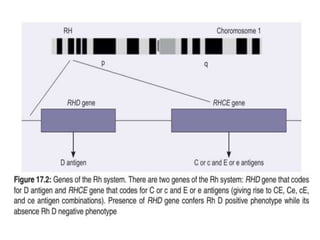
THE Rh SYSTEM
• high immunogenicity of Rh D antigen,
which readily induces formation of anti-D
antibodies in Rh D-negative individuals.
• Anti-D antibodies can cause haemolytic
transfusion reaction or, in pregnant women,
Rh haemolytic disease of newborn.
Antigens of the Rh System
• important antigens of the Rh system are C, D,
E, c, and e.
• D antigen is the most immunogenic.
• The presence of D in either homozygous (D/D)
or heterozygous (D/d) state makes that
individual Rh positive, while Rh negative
persons are homozygous for d (d/d).
• In Rh negative persons, deletions, point
mutations, or partial mutations of D gene have
been found.
• Rh antigens are expressed only on red cells and
not on any other tissues.
• They are also not secreted in body fluids.
• In contrast to ABO antigens, Rh antigens are fully
expressed on red cells before birth and also on
red cells of early foetuses.
weak D antigen:
• react weakly with anti-D reagent
• There is a quantitative reduction in the
number of D antigen sites on such red cells.
• Du recipients do not make anti-D antibodies
following stimulation by D antigen (e.g.
following D+ve blood transfusion)
• Du donors should be considered as Rh positive
and their blood should not be transfused to
Rh-negative donors
partial D antigen
• parts of D antigen are missing.
• Variants of partial D antigen exist.
• Individuals with DVI variant are able to produce
anti-D antibody against the missing part of the
antigen if exposed to D+ve antigen.
• Such recipients should be considered as Rh
negative, while donors should be regarded as Rh
positive.
• in practice, individuals with partial D antigen
are typed as D negative and are identifid only
after they have produced anti-D antibodies.
Rh Antibodies
• Rh antibodies are of immune type, i.e. they
are the result of immunisation by blood
transfusion or pregnancy.
• Most of these antibodies are of IgG class.
• In practice, Rh antibodies can cause haemolytic
transfusion reaction or haemolytic disease of
newborn.
• Since Rh antibodies do not activate complement,
haemolysis is extravascular and predominantly
occurs in spleen.
• Due to high immunogenicity of D antigen, Rh-
negative persons (especially women of child
bearing age) should be transfused only with Rh-
negative blood
blood group systems.pptx

blood group systems.pptx

  • 1.
  • 2.
    • Red cellantigens that are produced by alleles (alternative forms of a specified gene) at a single gene locus or very closely linked loci constitute a blood group system. • Blood group genes are inherited in a Mendelian manner and are mostly located on autosomes. • Most of the blood group genes are expressed in a codominant manner (i.e. the two allelic forms are expressed equally if inherited in a heterozygous state).
  • 4.
    • In bloodtransfusion practice, most important blood group systems are ABO and Rh. • This is because A, B, and Rh D antigens are the most immunogenic (i.e. capable of eliciting a strong antibody response on stimulation) and their alloantibodies can cause destruction of transfused red cells or induce haemolytic disease of newborn (HDN). • ABO antigens are also important in organ transplantation.
  • 5.
    ‰ ‰ ‰ ABO SYSTEM • fourmain types of blood groups–A, B, AB, and O • two major subgroups of A: A1 (80%) and A2 (20%). • anti-A1 antibodies are weak and are of little clinical signifiance in routine practice.
  • 7.
    Antigens of theABO System: • ABO antigens are carbohydrate structures on glycoproteins and glycolipids. • ABO antigens are poorly expressed at birth, increase gradually in strength and become fully expressed around 1 year of age. • In older age, they become slightly weak.
  • 8.
  • 9.
    • Some personsdo not inherit the H gene (genotype hh) and thus cannot synthesise H substance. • Such persons may inherit the A or B gene but cannot express it, as they are unable to produce the H substance. • Such individuals are said to have Bombay phenotype or Bombay blood group (Oh).
  • 10.
    Antibodies of theABO System • naturally occurring antibodies because they arise without immune stimulation (i.e. transfusion or pregnancy) by relevant blood group antigens. • not detectable in the blood of newborn infants due to their underdeveloped immune system and appear around 3 to 6 months of life. • produced in response to A- and B-like antigens of bacteria, which are present in the intestine and certain foods.
  • 11.
    ‰ ‰ ‰ THE Rh SYSTEM •high immunogenicity of Rh D antigen, which readily induces formation of anti-D antibodies in Rh D-negative individuals. • Anti-D antibodies can cause haemolytic transfusion reaction or, in pregnant women, Rh haemolytic disease of newborn.
  • 12.
    Antigens of theRh System • important antigens of the Rh system are C, D, E, c, and e. • D antigen is the most immunogenic. • The presence of D in either homozygous (D/D) or heterozygous (D/d) state makes that individual Rh positive, while Rh negative persons are homozygous for d (d/d).
  • 13.
    • In Rhnegative persons, deletions, point mutations, or partial mutations of D gene have been found. • Rh antigens are expressed only on red cells and not on any other tissues. • They are also not secreted in body fluids. • In contrast to ABO antigens, Rh antigens are fully expressed on red cells before birth and also on red cells of early foetuses.
  • 15.
    weak D antigen: •react weakly with anti-D reagent • There is a quantitative reduction in the number of D antigen sites on such red cells. • Du recipients do not make anti-D antibodies following stimulation by D antigen (e.g. following D+ve blood transfusion)
  • 16.
    • Du donorsshould be considered as Rh positive and their blood should not be transfused to Rh-negative donors
  • 17.
    partial D antigen •parts of D antigen are missing. • Variants of partial D antigen exist. • Individuals with DVI variant are able to produce anti-D antibody against the missing part of the antigen if exposed to D+ve antigen. • Such recipients should be considered as Rh negative, while donors should be regarded as Rh positive.
  • 18.
    • in practice,individuals with partial D antigen are typed as D negative and are identifid only after they have produced anti-D antibodies.
  • 19.
    Rh Antibodies • Rhantibodies are of immune type, i.e. they are the result of immunisation by blood transfusion or pregnancy. • Most of these antibodies are of IgG class.
  • 20.
    • In practice,Rh antibodies can cause haemolytic transfusion reaction or haemolytic disease of newborn. • Since Rh antibodies do not activate complement, haemolysis is extravascular and predominantly occurs in spleen. • Due to high immunogenicity of D antigen, Rh- negative persons (especially women of child bearing age) should be transfused only with Rh- negative blood