Plant Breeding
Shree Krishna Adhikari
©Shree Krishna Adhikari
Based on PCR:
a. PCR based Marker
- RAPD, AFLP, SSR, CAPS
b. Non PCR based Marker
- RFLP
Based on :
a. Morphology
b. Biochemical
c. Molecular
Based on :
a. Dominant
RAPD
b. Codominant
RFLP, SSR, CAPS
Based on :
a. Positive Selecable marker
b. Negative selectable marker
©Shree Krishna Adhikari
• Restriction Fragment Length Polymorphism (RFLP) is a difference in homologous
DNA sequences that can be detected by the presence of fragments of different lengths
after digestion of the DNA samples in question with specific restriction
endonucleases. RFLP, as a molecular marker, is specific to a single clone/restriction
enzyme combination.
• Based on southern hybridization
• Used to describe the variation in the length of fragments obtained from the digestion of
DNA from two or more organisms with the same endonuclease.
• The restriction sites for a particular enzymes are present at several places throughout the
entire genome with the result that a large number of fragments of DNA are produced.
• The length of the each segment depends on the distance between two adjacent restriction
sites.
• Simple base pair changes or large scale changes, as a result of inversion, translocation,
deletions, transposition, will result in loss or gain of recognition site and in turn lead to
restriction fragments of different lengths.
©Shree Krishna Adhikari
GGATCC GGATCCGGATCC
9Kb
5 kb 4 kb
DNA segment of Plant-1
Restriction sites where endonuclease cuts the segment
Endonuclease: BamHI
Lets see an example…..
©Shree Krishna Adhikari
GGATCC GGATCCGGATCC
9Kb
DNA segment of Plant-2
This loci is mutated so endonuclease doesn’t find the restriction site to cut
Endonuclease: BamHI
GGGTCC
©Shree Krishna Adhikari
GGATCC GGATCCGGATCC
9Kb
5 kb 4 kb
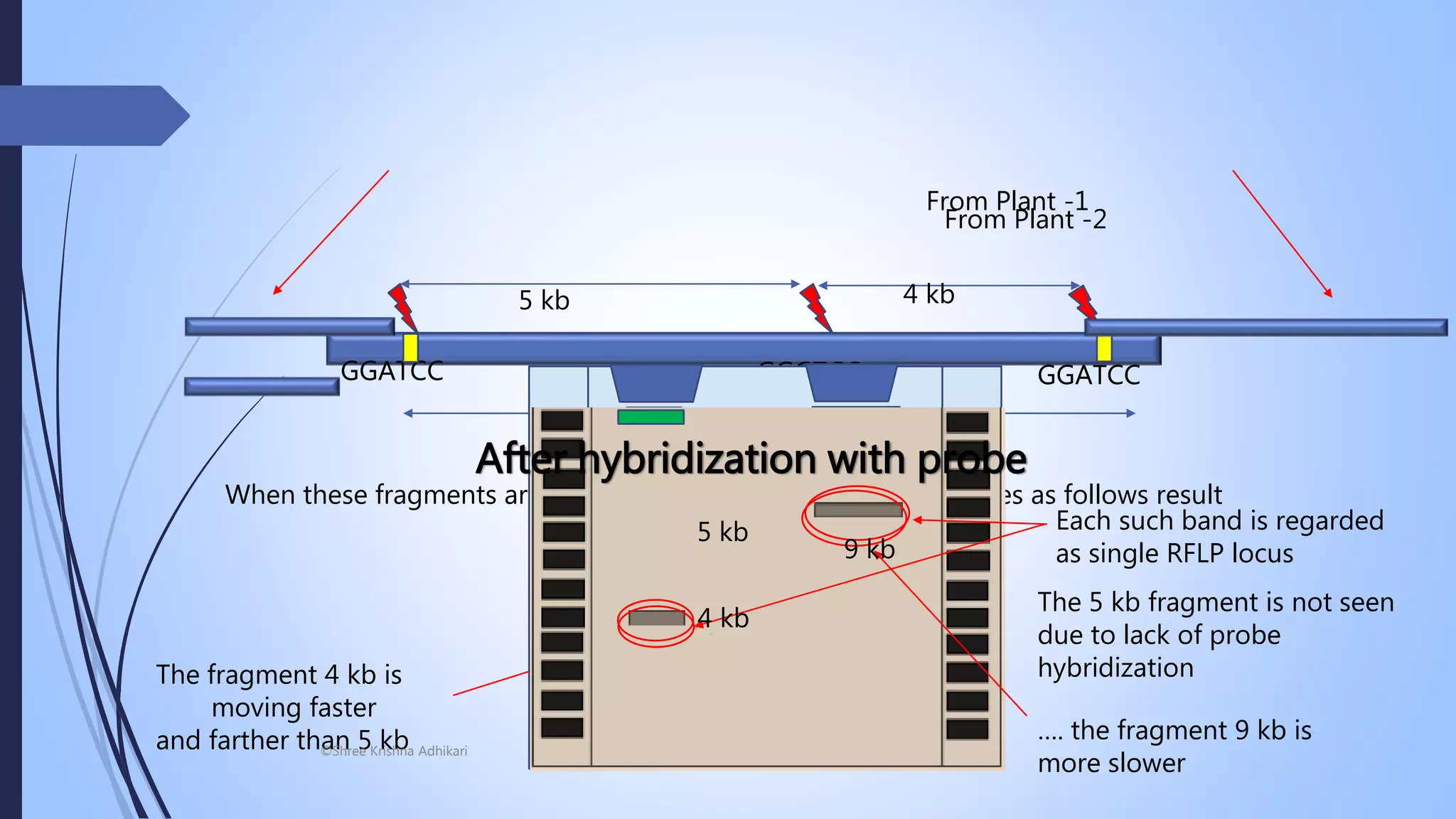
From Plant -1
GGATCC GGATCCGGGTCC
9Kb
From Plant -2
When these fragments are run into the electrophoresis gel, it gives as follows result
The fragment 4 kb is
moving faster
and farther than 5 kb …. the fragment 9 kb is
more slower
The 5 kb fragment is not seen
due to lack of probe
hybridization
Each such band is regarded
as single RFLP locus
5 kb
9 kb
4 kb
After hybridization with probe
©Shree Krishna Adhikari
• After probe hybridization, 4 kb fragment’s band is seen farther than
that of 9 kb band due to the small in size.
• Both plants of same length of DNA segments were allowed to cut by
endonuclease.
• DNA segment from plant-1 have one more recognition site but in plant-
2 the recognition site was mutated and so the enzyme couldn’t
recognize the site to dissect.
• Due to variation in size of fragments that is loaded on gel
electrophoresis, the band pattern were seen different which
phenomenon is called as Restricted fragment length polymorphism.
©Shree Krishna Adhikari
• An RFLP is a sequence of DNA that has a restriction site on
each end with a "target" sequence in between.
• A target sequence is any segment of DNA that bind to
a probe by forming complementary base pairs.
• A probe is a sequence of single-stranded DNA that has been
tagged with radioactivity or an enzyme so that the probe can
be detected.
• When a probe base pairs to its target, the investigator can
detect this binding and know where the target sequence is
since the probe is detectable.
©Shree Krishna Adhikari
• Most RFLP markers are co-dominant (both alleles in
heterozygous sample will be detected) and
highly locus-specific.
• An RFLP probe is a labeled DNA sequence that
hybridizes with one or more fragments of the digested
DNA sample after they were separated by gel
electrophoresis, thus revealing a unique blotting
pattern characteristic to a specific genotype at a
specific locus.
• Short, single- or low-copy genomic DNA or cDNA
clones are typically used as RFLP probes.
©Shree Krishna Adhikari
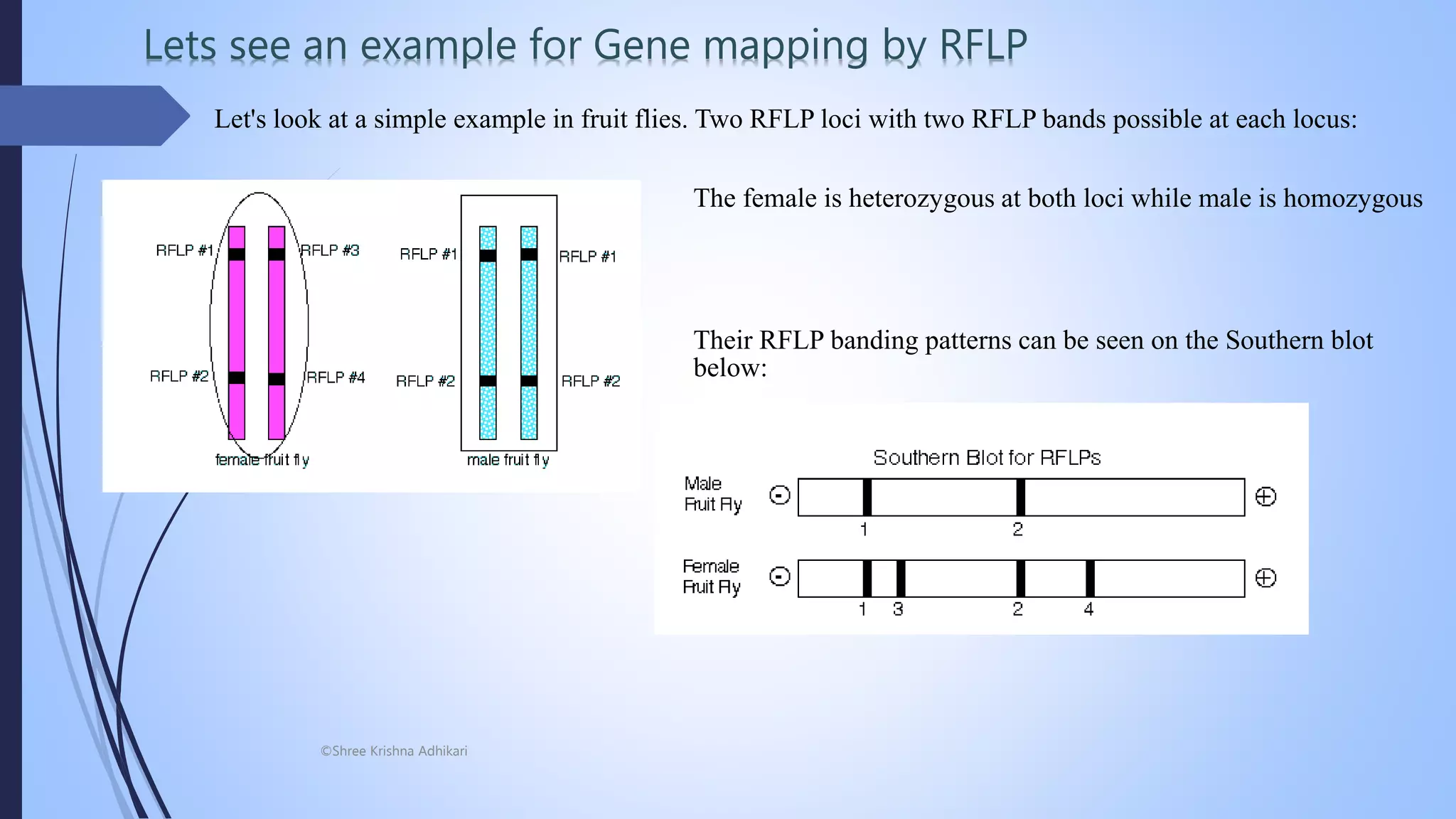
Let's look at a simple example in fruit flies. Two RFLP loci with two RFLP bands possible at each locus:
The female is heterozygous at both loci while male is homozygous
Their RFLP banding patterns can be seen on the Southern blot
below:
Lets see an example for Gene mapping by RFLP
©Shree Krishna Adhikari
The male can only produce one type of gamete (1 and 2) but the female can produce
four different gametes. Two of the possible four are called parental because they
carry both RFLP bands from the same chromosome; 1 and 2 from the left
chromosome or 3 and 4 from the right chromosome. The other two chromosomes are
recombinant because recombination has occurred between the two loci and thus the
RFLP bands are mixed so that 1 is now linked to 4 and 3 is linked to 2.
©Shree Krishna Adhikari
In this example, 70% of the progeny were produce from
parental genotype eggs and 30% were produced by
recombinant genotype eggs. Therefore, these two RFLP
loci are 30 centiMorgans apart from each other.
When these two flies mate, the frequency of the four possible
progeny can be measured and from this information, the
genetic distance between the two RFLP loci (upper and lower)
can be determined.
©Shree Krishna Adhikari

Rflp

  • 1.
    Plant Breeding Shree KrishnaAdhikari ©Shree Krishna Adhikari
  • 2.
    Based on PCR: a.PCR based Marker - RAPD, AFLP, SSR, CAPS b. Non PCR based Marker - RFLP Based on : a. Morphology b. Biochemical c. Molecular Based on : a. Dominant RAPD b. Codominant RFLP, SSR, CAPS Based on : a. Positive Selecable marker b. Negative selectable marker ©Shree Krishna Adhikari
  • 3.
    • Restriction FragmentLength Polymorphism (RFLP) is a difference in homologous DNA sequences that can be detected by the presence of fragments of different lengths after digestion of the DNA samples in question with specific restriction endonucleases. RFLP, as a molecular marker, is specific to a single clone/restriction enzyme combination. • Based on southern hybridization • Used to describe the variation in the length of fragments obtained from the digestion of DNA from two or more organisms with the same endonuclease. • The restriction sites for a particular enzymes are present at several places throughout the entire genome with the result that a large number of fragments of DNA are produced. • The length of the each segment depends on the distance between two adjacent restriction sites. • Simple base pair changes or large scale changes, as a result of inversion, translocation, deletions, transposition, will result in loss or gain of recognition site and in turn lead to restriction fragments of different lengths. ©Shree Krishna Adhikari
  • 4.
    GGATCC GGATCCGGATCC 9Kb 5 kb4 kb DNA segment of Plant-1 Restriction sites where endonuclease cuts the segment Endonuclease: BamHI Lets see an example….. ©Shree Krishna Adhikari
  • 5.
    GGATCC GGATCCGGATCC 9Kb DNA segmentof Plant-2 This loci is mutated so endonuclease doesn’t find the restriction site to cut Endonuclease: BamHI GGGTCC ©Shree Krishna Adhikari
  • 6.
    GGATCC GGATCCGGATCC 9Kb 5 kb4 kb From Plant -1 GGATCC GGATCCGGGTCC 9Kb From Plant -2 When these fragments are run into the electrophoresis gel, it gives as follows result The fragment 4 kb is moving faster and farther than 5 kb …. the fragment 9 kb is more slower The 5 kb fragment is not seen due to lack of probe hybridization Each such band is regarded as single RFLP locus 5 kb 9 kb 4 kb After hybridization with probe ©Shree Krishna Adhikari
  • 7.
    • After probehybridization, 4 kb fragment’s band is seen farther than that of 9 kb band due to the small in size. • Both plants of same length of DNA segments were allowed to cut by endonuclease. • DNA segment from plant-1 have one more recognition site but in plant- 2 the recognition site was mutated and so the enzyme couldn’t recognize the site to dissect. • Due to variation in size of fragments that is loaded on gel electrophoresis, the band pattern were seen different which phenomenon is called as Restricted fragment length polymorphism. ©Shree Krishna Adhikari
  • 8.
    ©Shree Krishna Adhikari •An RFLP is a sequence of DNA that has a restriction site on each end with a "target" sequence in between. • A target sequence is any segment of DNA that bind to a probe by forming complementary base pairs. • A probe is a sequence of single-stranded DNA that has been tagged with radioactivity or an enzyme so that the probe can be detected. • When a probe base pairs to its target, the investigator can detect this binding and know where the target sequence is since the probe is detectable.
  • 9.
  • 10.
    • Most RFLPmarkers are co-dominant (both alleles in heterozygous sample will be detected) and highly locus-specific. • An RFLP probe is a labeled DNA sequence that hybridizes with one or more fragments of the digested DNA sample after they were separated by gel electrophoresis, thus revealing a unique blotting pattern characteristic to a specific genotype at a specific locus. • Short, single- or low-copy genomic DNA or cDNA clones are typically used as RFLP probes. ©Shree Krishna Adhikari
  • 11.
  • 12.
    ©Shree Krishna Adhikari Let'slook at a simple example in fruit flies. Two RFLP loci with two RFLP bands possible at each locus: The female is heterozygous at both loci while male is homozygous Their RFLP banding patterns can be seen on the Southern blot below: Lets see an example for Gene mapping by RFLP
  • 13.
    ©Shree Krishna Adhikari Themale can only produce one type of gamete (1 and 2) but the female can produce four different gametes. Two of the possible four are called parental because they carry both RFLP bands from the same chromosome; 1 and 2 from the left chromosome or 3 and 4 from the right chromosome. The other two chromosomes are recombinant because recombination has occurred between the two loci and thus the RFLP bands are mixed so that 1 is now linked to 4 and 3 is linked to 2.
  • 14.
    ©Shree Krishna Adhikari Inthis example, 70% of the progeny were produce from parental genotype eggs and 30% were produced by recombinant genotype eggs. Therefore, these two RFLP loci are 30 centiMorgans apart from each other. When these two flies mate, the frequency of the four possible progeny can be measured and from this information, the genetic distance between the two RFLP loci (upper and lower) can be determined.
  • 15.