Submitted to
Dr. mrs. Kantishree dey
(internal)
Submitted by
Akansha soni
M.Sc. 2nd sem
Bioscience dept.
Blotting
Types of blotting
Southern blotting
Principle
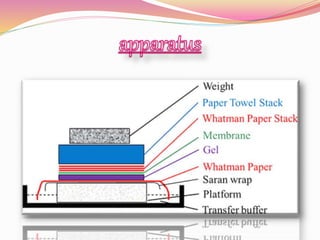
Apparatus
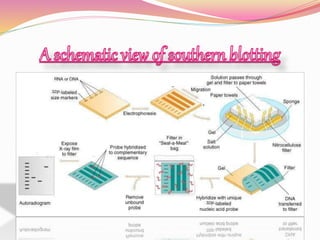
Steps involved in southern blotting
A schematic view of southern blotting
Application
Advantages and Disadvantages
A blot, in molecular biology and genetics, is a method of
transferring proteins, DNA or RNA, onto a carrier.
The term "blotting" refers to the transfer of biological
samples from a gel to a membrane and their subsequent
detection on the surface of the membrane.
Technique for transferring DNA ,RNA and Proteins onto a
carrier so they can be separated, and often follows the use
of a gel electrophoresis.
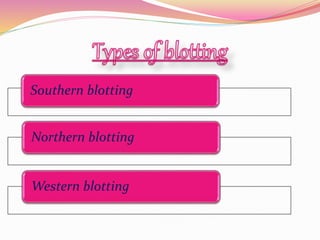
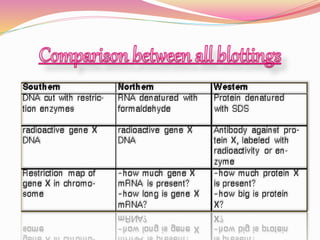
Southern blotting
Northern blotting
Western blotting
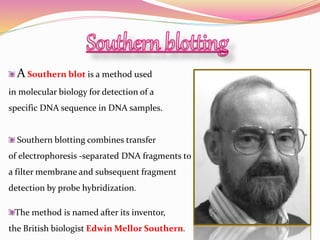
A Southern blot is a method used
in molecular biology for detection of a
specific DNA sequence in DNA samples.
Southern blotting combines transfer
of electrophoresis -separated DNA fragments to
a filter membrane and subsequent fragment
detection by probe hybridization.
The method is named after its inventor,
the British biologist Edwin Mellor Southern.
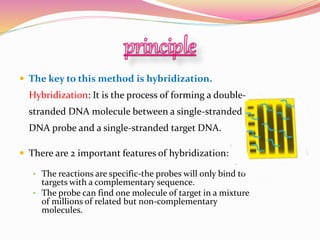
 The key to this method is hybridization.
Hybridization: It is the process of forming a double-
stranded DNA molecule between a single-stranded
DNA probe and a single-stranded target DNA.
 There are 2 important features of hybridization:
• The reactions are specific-the probes will only bind to
targets with a complementary sequence.
• The probe can find one molecule of target in a mixture
of millions of related but non-complementary
molecules.
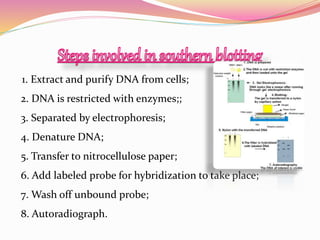
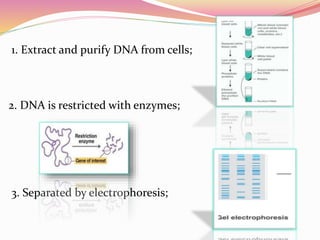
1. Extract and purify DNA from cells;
2. DNA is restricted with enzymes;;
3. Separated by electrophoresis;
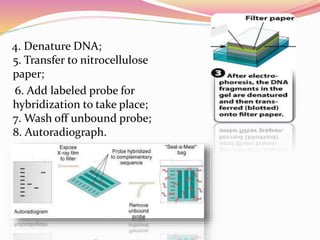
4. Denature DNA;
5. Transfer to nitrocellulose paper;
6. Add labeled probe for hybridization to take place;
7. Wash off unbound probe;
8. Autoradiograph.
1. Extract and purify DNA from cells;
2. DNA is restricted with enzymes;
3. Separated by electrophoresis;
4. Denature DNA;
5. Transfer to nitrocellulose
paper;
6. Add labeled probe for
hybridization to take place;
7. Wash off unbound probe;
8. Autoradiograph.
 To identify specific DNA in a DNA sample.
 To Isolate desired DNA for construction of rDNA.
 Identify mutations, deletions, and gene rearrangements.
 Used in prognosis of cancer and in prenatal diagnosis of genetic
diseases.
 In RFLP.
 Diagnosis of HIV-1 and infectious disease.
 In DNA fingerprinting:
 Paternity and Maternity Testing
 Criminal Identification and Forensics
 Personal Identification
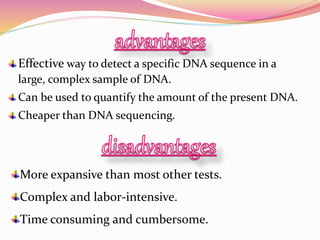
Effective way to detect a specific DNA sequence in a
large, complex sample of DNA.
Can be used to quantify the amount of the present DNA.
Cheaper than DNA sequencing.
More expansive than most other tests.
Complex and labor-intensive.
Time consuming and cumbersome.
Southern blotting ori

Southern blotting ori

  • 1.
    Submitted to Dr. mrs.Kantishree dey (internal) Submitted by Akansha soni M.Sc. 2nd sem Bioscience dept.
  • 2.
    Blotting Types of blotting Southernblotting Principle Apparatus Steps involved in southern blotting A schematic view of southern blotting Application Advantages and Disadvantages
  • 3.
    A blot, inmolecular biology and genetics, is a method of transferring proteins, DNA or RNA, onto a carrier. The term "blotting" refers to the transfer of biological samples from a gel to a membrane and their subsequent detection on the surface of the membrane. Technique for transferring DNA ,RNA and Proteins onto a carrier so they can be separated, and often follows the use of a gel electrophoresis.
  • 4.
  • 5.
    A Southern blotis a method used in molecular biology for detection of a specific DNA sequence in DNA samples. Southern blotting combines transfer of electrophoresis -separated DNA fragments to a filter membrane and subsequent fragment detection by probe hybridization. The method is named after its inventor, the British biologist Edwin Mellor Southern.
  • 6.
     The keyto this method is hybridization. Hybridization: It is the process of forming a double- stranded DNA molecule between a single-stranded DNA probe and a single-stranded target DNA.  There are 2 important features of hybridization: • The reactions are specific-the probes will only bind to targets with a complementary sequence. • The probe can find one molecule of target in a mixture of millions of related but non-complementary molecules.
  • 8.
    1. Extract andpurify DNA from cells; 2. DNA is restricted with enzymes;; 3. Separated by electrophoresis; 4. Denature DNA; 5. Transfer to nitrocellulose paper; 6. Add labeled probe for hybridization to take place; 7. Wash off unbound probe; 8. Autoradiograph.
  • 9.
    1. Extract andpurify DNA from cells; 2. DNA is restricted with enzymes; 3. Separated by electrophoresis;
  • 10.
    4. Denature DNA; 5.Transfer to nitrocellulose paper; 6. Add labeled probe for hybridization to take place; 7. Wash off unbound probe; 8. Autoradiograph.
  • 12.
     To identifyspecific DNA in a DNA sample.  To Isolate desired DNA for construction of rDNA.  Identify mutations, deletions, and gene rearrangements.  Used in prognosis of cancer and in prenatal diagnosis of genetic diseases.  In RFLP.  Diagnosis of HIV-1 and infectious disease.  In DNA fingerprinting:  Paternity and Maternity Testing  Criminal Identification and Forensics  Personal Identification
  • 13.
    Effective way todetect a specific DNA sequence in a large, complex sample of DNA. Can be used to quantify the amount of the present DNA. Cheaper than DNA sequencing. More expansive than most other tests. Complex and labor-intensive. Time consuming and cumbersome.