

LABOUR WASTAGE
Aravind.T.S
Assistant Professor
aravindcanon@gmail.com
Absenteeism
&
Labor Turn Over
Absenteeism
When an employee fails to report for duty on
time
without prior
intimation or
approval , then the employee is marked
as absent
PRESENTEEISM
 The circumstances in which employees
come to work even though they are
ill, posing potential problems of infection
and lower productivity.
ABSENTEEISM
 In every organisation an employee / worker
has some definite working hours with
certain responsibility (work assigned) and
if the worker is not present in their working
hours that called absenteeism in the
organisation.
CAUSES OF ABSENTEEISM :
 Personal Factors -age, marital
status, health, education, hobbies, extra
curricular activities.
 Work Environment – working
conditions, relation with co-workers &
seniors and their attitude
 Home Conditions – distance from
residence, mode of conveyance, family
size, family problems & responsibilities
 Economic Issues – subsidiary economic
interests
 Regional Aspects –
legislations, politics, geographical
situations
 Organisational Features – type & size of
company, work load, nature of work, shift
arrangements, management
attitude, personnel policies, leave facilities
and medical benefits
 Social Reasons – religion, community
obligations, customs festivals, marriage
and death
Measures to minimise
absenteeism
 Adopting a humanistic approach in dealing
with the personnel problem of employees .
 Proactive approach to grievance redressel of
employees
 Provide Fair and good wages, good working
environment , T&D ,Motivation
Labor Turn-Over
LABOUR TURNOVER
 Turnover means “change”.
 A change in the number of employees of an
organization is called “The labor turnover”
:
REASON FOR LABOUR
TURNOVER
Avoidable Reasons
 low job satisfaction
 low pay
 risky or repetitive work etc.
Unavoidable reasons
 Death
 Retirement
 Accident
 poor health etc
Methods Used To Estimate Turnover
Its better to have a labour turn over chart in
every organisation
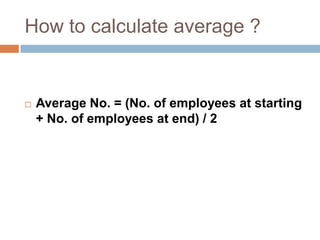
How to calculate average ?
 Average No. = (No. of employees at starting
+ No. of employees at end) / 2
Methods Used To Estimate
Turnover
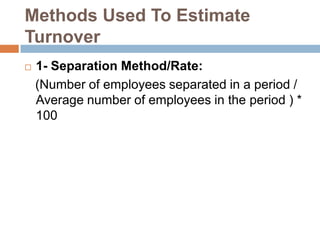
 1- Separation Method/Rate:
(Number of employees separated in a period /
Average number of employees in the period ) *
100
Methods Used To Estimate
Turnover
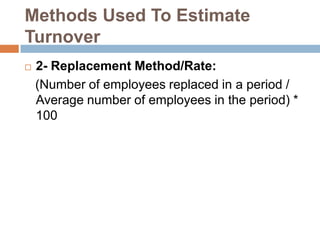
 2- Replacement Method/Rate:
(Number of employees replaced in a period /
Average number of employees in the period) *
100
Methods Used To Estimate
Turnover
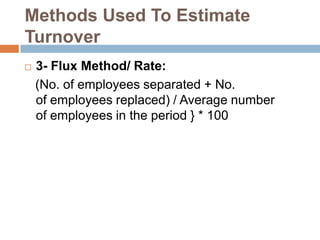
 3- Flux Method/ Rate:
(No. of employees separated + No.
of employees replaced) / Average number
of employees in the period } * 100
Factors for Labour Turn-over
 Dissatisfaction on account of insufficient
wages leading to
employees moving to competitors
 Low level of motivation from employers’ side a
nd Poor morale within the workforce in a
specific industry.
Factors for Labour Turn-over
 Recruiting and misplacement of employees
resulting in their mobility in search of suitable
employment.
 A floating local labour market offering
better and more attractive opportunities
to employees.
HOW TO REDUCE LABOUR
TURNOVER
 Pay Problem – increasing pay scale &
improving pay structure to remove
inequities
 Employees Learning to further their Career
– providing better career opportunities&
ensuring the job, opportunities for training
&development program, implement
promotion
 Employees Leaving due to Conflict – more
effective procedure for handling
grievances
& improving communication, using
resolution &teambuilding
techniques, reorganisation of work.
 The Induction Crisis – improving
recruitment & selection process, ensure
job requirement, developing better
induction & initial training program
 Shortage of Labour – improving
recruitment , selection &
training,intoducing better method of
planning & scheduling work smooth
outpeak
“Love your job but don’t love your company
because you may not know when your
company stops loving you” – Dr.APJ.Abdhul
Kalam
Dear Future HR Managers try to change his
thought by retaining your employee friends
Thankyou
aravindcanon@gmail.com

5 labour wastage

  • 1.
  • 2.
  • 3.
    Absenteeism When an employeefails to report for duty on time without prior intimation or approval , then the employee is marked as absent
  • 4.
    PRESENTEEISM  The circumstancesin which employees come to work even though they are ill, posing potential problems of infection and lower productivity.
  • 5.
    ABSENTEEISM  In everyorganisation an employee / worker has some definite working hours with certain responsibility (work assigned) and if the worker is not present in their working hours that called absenteeism in the organisation.
  • 6.
    CAUSES OF ABSENTEEISM:  Personal Factors -age, marital status, health, education, hobbies, extra curricular activities.
  • 7.
     Work Environment– working conditions, relation with co-workers & seniors and their attitude
  • 8.
     Home Conditions– distance from residence, mode of conveyance, family size, family problems & responsibilities
  • 9.
     Economic Issues– subsidiary economic interests
  • 10.
     Regional Aspects– legislations, politics, geographical situations
  • 11.
     Organisational Features– type & size of company, work load, nature of work, shift arrangements, management attitude, personnel policies, leave facilities and medical benefits
  • 12.
     Social Reasons– religion, community obligations, customs festivals, marriage and death
  • 13.
    Measures to minimise absenteeism Adopting a humanistic approach in dealing with the personnel problem of employees .  Proactive approach to grievance redressel of employees  Provide Fair and good wages, good working environment , T&D ,Motivation
  • 14.
  • 15.
    LABOUR TURNOVER  Turnovermeans “change”.  A change in the number of employees of an organization is called “The labor turnover” :
  • 16.
    REASON FOR LABOUR TURNOVER AvoidableReasons  low job satisfaction  low pay  risky or repetitive work etc. Unavoidable reasons  Death  Retirement  Accident  poor health etc
  • 17.
    Methods Used ToEstimate Turnover
  • 18.
    Its better tohave a labour turn over chart in every organisation
  • 19.
    How to calculateaverage ?  Average No. = (No. of employees at starting + No. of employees at end) / 2
  • 20.
    Methods Used ToEstimate Turnover  1- Separation Method/Rate: (Number of employees separated in a period / Average number of employees in the period ) * 100
  • 21.
    Methods Used ToEstimate Turnover  2- Replacement Method/Rate: (Number of employees replaced in a period / Average number of employees in the period) * 100
  • 22.
    Methods Used ToEstimate Turnover  3- Flux Method/ Rate: (No. of employees separated + No. of employees replaced) / Average number of employees in the period } * 100
  • 23.
    Factors for LabourTurn-over  Dissatisfaction on account of insufficient wages leading to employees moving to competitors  Low level of motivation from employers’ side a nd Poor morale within the workforce in a specific industry.
  • 24.
    Factors for LabourTurn-over  Recruiting and misplacement of employees resulting in their mobility in search of suitable employment.  A floating local labour market offering better and more attractive opportunities to employees.
  • 25.
    HOW TO REDUCELABOUR TURNOVER  Pay Problem – increasing pay scale & improving pay structure to remove inequities
  • 26.
     Employees Learningto further their Career – providing better career opportunities& ensuring the job, opportunities for training &development program, implement promotion
  • 27.
     Employees Leavingdue to Conflict – more effective procedure for handling grievances & improving communication, using resolution &teambuilding techniques, reorganisation of work.
  • 28.
     The InductionCrisis – improving recruitment & selection process, ensure job requirement, developing better induction & initial training program
  • 29.
     Shortage ofLabour – improving recruitment , selection & training,intoducing better method of planning & scheduling work smooth outpeak
  • 30.
    “Love your jobbut don’t love your company because you may not know when your company stops loving you” – Dr.APJ.Abdhul Kalam
  • 31.
    Dear Future HRManagers try to change his thought by retaining your employee friends
  • 32.