Presented By:
Pratish Rawat
Poornima University, Jaipur
Inventory Management
• Inventory Management Systems is a key instrument for
businesses when tracking their inventory
• Inventory Management Systems are used by firms that
either sell a product or manufacture a product.
• There are three main reasons why an Inventory
Management System is needed such as
 timing/lead time,
 forecasting, and
 utilizing economies of scale.
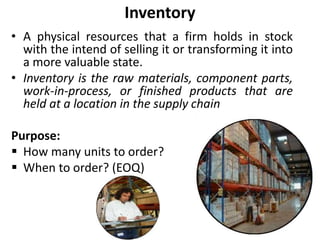
Inventory
• A physical resources that a firm holds in stock
with the intend of selling it or transforming it into
a more valuable state.
• Inventory is the raw materials, component parts,
work-in-process, or finished products that are
held at a location in the supply chain
Purpose:
 How many units to order?
 When to order? (EOQ)
• Raw material.
• Purchased parts & supplier.
• Finished goods.
• Work-in-process.
• Items being transport.
• Tools and equipment.
Types of Inventories
• To meet anticipated demand
• To smooth production requirements
• To protect against stock-outs
• To take advantage of order cycles
• To permit operations
• To take advantage of quantity discounts
Functions of Inventory
• To achieve satisfactory levels of customer
service while keeping inventory costs within
reasonable bounds
– Level of customer service
– Costs of ordering and carrying inventory
Objective of Inventory Control
Inventory turnover is the ratio of
average cost of goods sold to
average inventory investment.
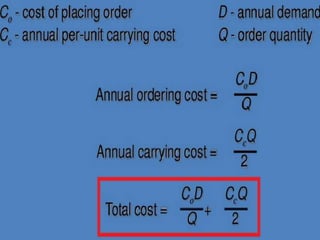
• The EOQ is one of the oldest and most
commonly known as inventory control
techniques.
• EOQ is still used by a large number of
organization today.
• We need to determine the optimal number of
units to order so that we minimize the total
cost associated with the purchase, delivery
and storage of the product.
EOQ- Economic Order Quantity
• Demand is known, constant and independent.
• Lead time is known and constant.
• Order quantity received is instantaneous and
complete.
• No storage is allowed.
Assumption of Basic Model
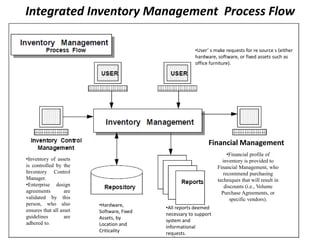
Integrated Inventory Management Process Flow
•Inventory of assets
is controlled by the
Inventory Control
Manager.
•Enterprise design
agreements are
validated by this
person, who also
ensures that all asset
guidelines are
adhered to.
•Financial profile of
inventory is provided to
Financial Management, who
recommend purchasing
techniques that will result in
discounts (i.e., Volume
Purchase Agreements, or
specific vendors).
Financial Management
•User’ s make requests for re source s (either
hardware, software, or fixed assets such as
office furniture).
•Hardware,
Software, Fixed
Assets, by
Location and
Criticality
•All reports deemed
necessary to support
system and
informational
requests.

Inventory management

  • 1.
  • 2.
    Inventory Management • InventoryManagement Systems is a key instrument for businesses when tracking their inventory • Inventory Management Systems are used by firms that either sell a product or manufacture a product. • There are three main reasons why an Inventory Management System is needed such as  timing/lead time,  forecasting, and  utilizing economies of scale.
  • 3.
    Inventory • A physicalresources that a firm holds in stock with the intend of selling it or transforming it into a more valuable state. • Inventory is the raw materials, component parts, work-in-process, or finished products that are held at a location in the supply chain Purpose:  How many units to order?  When to order? (EOQ)
  • 4.
    • Raw material. •Purchased parts & supplier. • Finished goods. • Work-in-process. • Items being transport. • Tools and equipment. Types of Inventories
  • 5.
    • To meetanticipated demand • To smooth production requirements • To protect against stock-outs • To take advantage of order cycles • To permit operations • To take advantage of quantity discounts Functions of Inventory
  • 6.
    • To achievesatisfactory levels of customer service while keeping inventory costs within reasonable bounds – Level of customer service – Costs of ordering and carrying inventory Objective of Inventory Control Inventory turnover is the ratio of average cost of goods sold to average inventory investment.
  • 7.
    • The EOQis one of the oldest and most commonly known as inventory control techniques. • EOQ is still used by a large number of organization today. • We need to determine the optimal number of units to order so that we minimize the total cost associated with the purchase, delivery and storage of the product. EOQ- Economic Order Quantity
  • 8.
    • Demand isknown, constant and independent. • Lead time is known and constant. • Order quantity received is instantaneous and complete. • No storage is allowed. Assumption of Basic Model
  • 10.
    Integrated Inventory ManagementProcess Flow •Inventory of assets is controlled by the Inventory Control Manager. •Enterprise design agreements are validated by this person, who also ensures that all asset guidelines are adhered to. •Financial profile of inventory is provided to Financial Management, who recommend purchasing techniques that will result in discounts (i.e., Volume Purchase Agreements, or specific vendors). Financial Management •User’ s make requests for re source s (either hardware, software, or fixed assets such as office furniture). •Hardware, Software, Fixed Assets, by Location and Criticality •All reports deemed necessary to support system and informational requests.