POLYMERS
Topics
Introduction              PAN
Classification            PET
Physical Properties       Poly amides
Types of Polymerization   Polyethylene
Copolymers                Polypropylene
Vulcanization             Resins(Phenol-Formaldehyde)
PVC                       Polymethylmethacrylate
Polyurethane
POLYMERS
Contents:


Types of polymers
Physical properties
Types of polymerisation
Some important polymers
Terminology

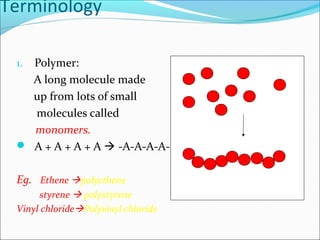
 1.Polymer:
   A long molecule made
   up from lots of small
   molecules called
   monomers.
  A + A + A + A  -A-A-A-A-


 Eg. Ethene polyethene
      styrene  polystyrene
 Vinyl chloridePolyvinyl chloride
Eg. PE ( Polyethene )
Terminology…
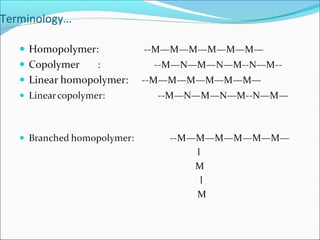
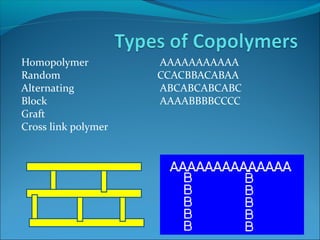
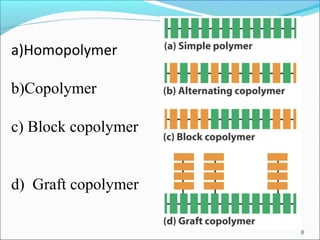
Homopolymer          AAAAAAAAAAA
Random               CCACBBACABAA
Alternating          ABCABCABCABC
Block                AAAABBBBCCCC
Graft
Cross link polymer
a)Homopolymer

b)Copolymer

c) Block copolymer


d) Graft copolymer

                     8
The number of repeating units
 in chain formed in a polymer is
 known as the "degree of
 polymerization(DP)
Degree of polymerisation: The number of
 repeating units in a polymer molecule.
 5,000 – 2,00,000 malecular mass range.
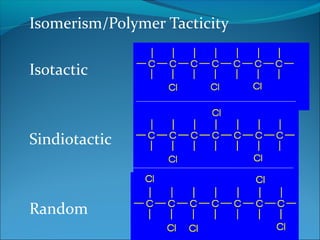
The configuration of monomeric units in a
polymer molecule
Isomerism/Polymer Tacticity

Isotactic


Sindiotactic


Random
Functionality


The number of bonding
 sites/active sites
Types of Polymerisation
Addition or Chain Polymerisation
Condensation or step- Polymerisation
Copolymerisation
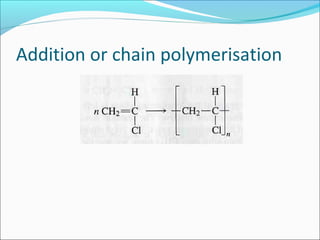
Addition or chain polymerisation
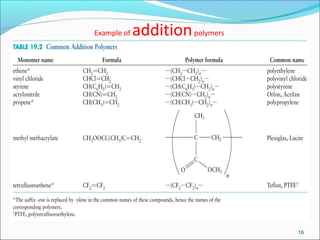
Example of   addition polymers


                                 16
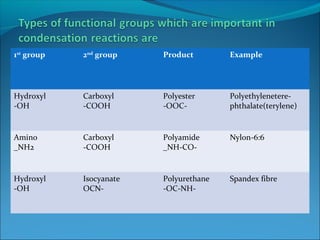
1st group   2nd group    Product        Example


Hydroxyl    Carboxyl     Polyester      Polyethylenetere-
-OH         -COOH        -OOC-          phthalate(terylene)


Amino       Carboxyl     Polyamide      Nylon-6:6
_NH2        -COOH        _NH-CO-


Hydroxyl    Isocyanate   Polyurethane   Spandex fibre
-OH         OCN-         -OC-NH-
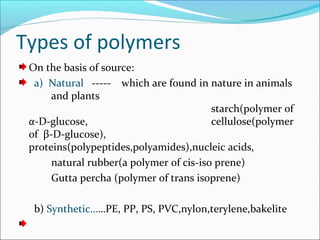
Types of polymers
 On the basis of source:
  a) Natural ----- which are found in nature in animals
      and plants
                                         starch(polymer of
 α-D-glucose,                            cellulose(polymer
 of β-D-glucose),
 proteins(polypeptides,polyamides),nucleic acids,
      natural rubber(a polymer of cis-iso prene)
      Gutta percha (polymer of trans isoprene)

  b) Synthetic……PE, PP, PS, PVC,nylon,terylene,bakelite
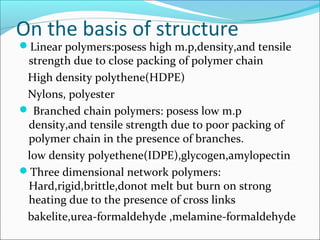
On the basis of structure
Linear polymers:posess high m.p,density,and tensile
 strength due to close packing of polymer chain
 High density polythene(HDPE)
 Nylons, polyester
 Branched chain polymers: posess low m.p
 density,and tensile strength due to poor packing of
 polymer chain in the presence of branches.
 low density polyethene(IDPE),glycogen,amylopectin
Three dimensional network polymers:
 Hard,rigid,brittle,donot melt but burn on strong
 heating due to the presence of cross links
 bakelite,urea-formaldehyde ,melamine-formaldehyde
On the basis of molecular forces:
  a) Thermoplastic polymers:
   Linear long chain polymers which can be
  softened on heating and hardened on cooling
  Hardness is temporary property
  Can be prosessed again and again
   PE, PP, PVC, PS, Teflon, Nylon
b) Thermosetting polymers:
   Permanent setting polymers
   Three dimensional cross linked structure with
  strong covalent bonds
   Cannot be reprocessed
Polyester,bakelite,epoxy resins,urea formaldehyde
 resin
Elastomers: (or synthetic rubber)
Any rubber like structure which can be stretched at
 least thrice its length

Fibres: whose chains are held together by strong
 intermolecular forces like hydrogen bonding.
  Cryatalline,High tensile strength
Thermoplastics vs. Thermosetting plastics
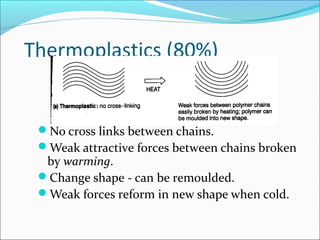
Thermoplastics (80%)


 No cross links between chains.
 Weak attractive forces between chains broken
  by warming.
 Change shape - can be remoulded.
 Weak forces reform in new shape when cold.
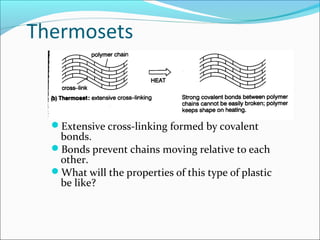
Thermosets


  Extensive cross-linking formed by covalent
   bonds.
  Bonds prevent chains moving relative to each
   other.
  What will the properties of this type of plastic
   be like?
Addition polymerisation
Monomers contain C=C bonds
Double bond opens to (link) bond to next monomer
 molecule
Chain forms when same basic unit is repeated over
 and over.
Modern polymers also developed based on alkynes R-
 C C - R’
Copolymerisation
when more than one monomer is used.
 An irregular chain structure will result eg
 propene/ethene/propene/propene/ethene
Why many polymers designers want to design a
 polymer in this way?
(Hint) Intermolecular bonds!
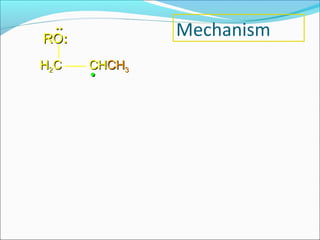
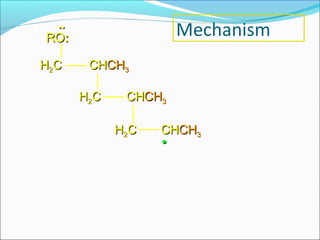
..
RO:
              Mechanism
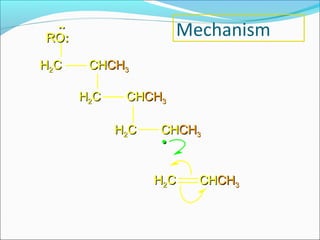
H2C   CHCH3
      •
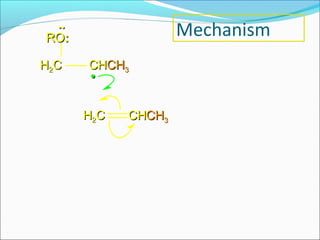
..
RO:                 Mechanism
H2C   CHCH3
      •


      H2C   CHCH3
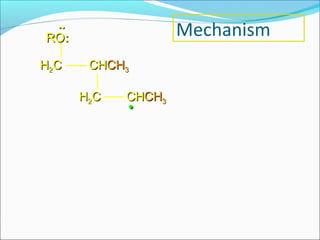
..
RO:                 Mechanism
H2C    CHCH3

      H2C   CHCH3
            •
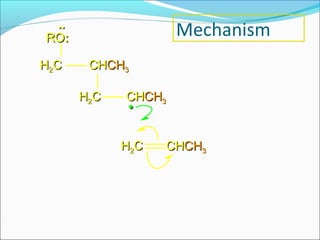
..
RO:                 Mechanism
H2C    CHCH3

      H2C   CHCH3
            •


            H2C   CHCH3
..
RO:                  Mechanism
H2C    CHCH3

      H2C    CHCH3

            H2C   CHCH3
                  •
..
RO:                  Mechanism
H2C    CHCH3

      H2C    CHCH3

            H2C   CHCH3
                  •


                  H2C   CHCH3
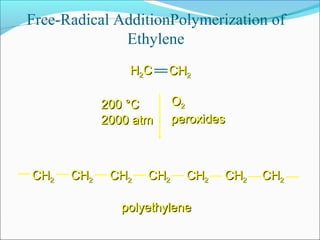
Free-Radical AdditionPolymerization of
              Ethylene
                H2C    CH2

            200 °C       O2
            2000 atm     peroxides


CH2   CH2    CH2   CH2     CH2   CH2   CH2

               polyethylene
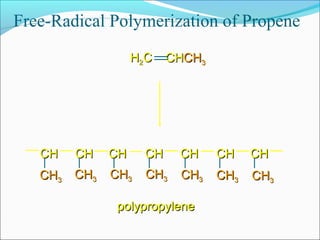
Free-Radical Polymerization of Propene
                    H2C   CHCH3


   CH    CH    CH    CH     CH    CH    CH
   CH3   CH3   CH3    CH3   CH3   CH3   CH3

               polypropylene
..
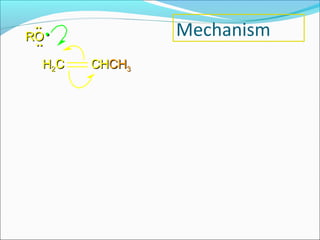
RO •            Mechanism
 ..
  H2C   CHCH3
..
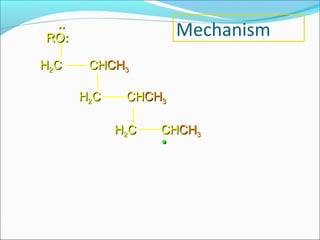
RO:                  Mechanism
H2C    CHCH3

      H2C    CHCH3

            H2C   CHCH3
                  •
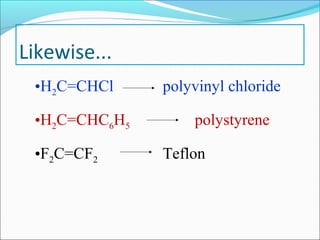
Likewise...
 •H2C=CHCl     polyvinyl chloride

 •H2C=CHC6H5       polystyrene

 •F2C=CF2      Teflon
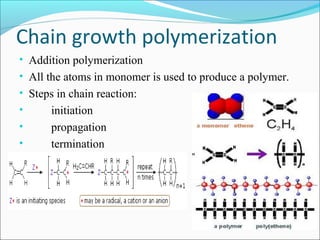
Chain growth polymerization
• Addition polymerization
• All the atoms in monomer is used to produce a polymer.
• Steps in chain reaction:
•     initiation
•      propagation
•      termination
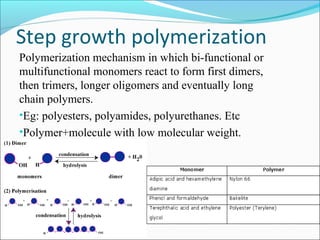
Step growth polymerization
Polymerization mechanism in which bi-functional or
multifunctional monomers react to form first dimers,
then trimers, longer oligomers and eventually long
chain polymers.
•Eg: polyesters, polyamides, polyurethanes. Etc
•Polymer+molecule with low molecular weight.
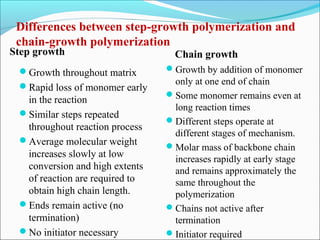
Differences between step-growth polymerization and
 chain-growth polymerization
Step growth                       Chain growth
 Growth throughout matrix      Growth by addition of monomer
                                 only at one end of chain
 Rapid loss of monomer early
                                Some monomer remains even at
  in the reaction
                                 long reaction times
 Similar steps repeated
                                Different steps operate at
  throughout reaction process
                                 different stages of mechanism.
 Average molecular weight
                                Molar mass of backbone chain
  increases slowly at low        increases rapidly at early stage
  conversion and high extents    and remains approximately the
  of reaction are required to    same throughout the
  obtain high chain length.      polymerization
 Ends remain active (no        Chains not active after
  termination)                   termination
 No initiator necessary        Initiator required
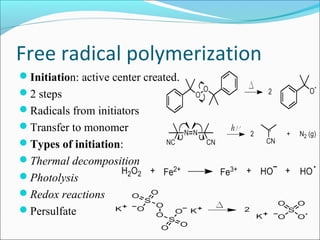
Free radical polymerization
Initiation: active center created.
2 steps
Radicals from initiators
Transfer to monomer
Types of initiation:
Thermal decomposition
Photolysis
Redox reactions
Persulfate
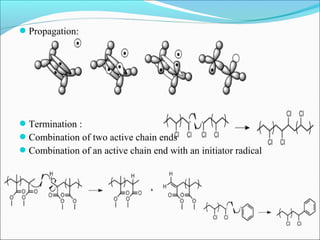
Propagation:


Termination :
Combination of two active chain ends
Combination of an active chain end with an initiator radical
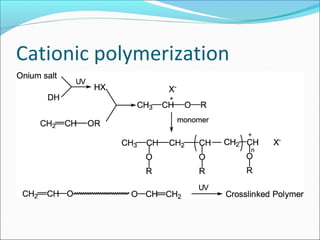
Cationic polymerization
• Cationic initiator binds & transfers charge to monomer.
• Reactive monomer reacts with other monomer to form a
    polymer.
•   Active site: carboniumion ,
     oxonium, sulfonium or phosphonium ion
•   Monomers: alkoxy. phenyl, vinyl, 1,1-dialkyl-substituted
    alkene monomers.
•   Initiator: provide electrophile
    eg: bronsted acids(acetic acid,HCL), Lewis acids+electron
    donor.
•   Application :polyisobutylene.
Cationic polymerization
Anionic polymerization
Carried out through carbanion active species.
Monomer: vinyl monomers with substituents on double
 bond able to stabilise a –ve charge.
  Eg: styrene, dienes, methacrylate,
     vinyl pyridine, aldehydes, epoxide, episulfide
     cyclic siloxane, and lactones
Polar monomers:
  eg: acrylonitrile, cyanoacrylate, propylene oxide,
     vinyl ketone, acrolein, vinyl sulfone,
     vinyl sulfoxide, vinylsilane andisocyanate.
.
Solvents- polar solvents decrease stability.
initiation : electron transfer, strong acids.
Propagation: very fast,low temp, heat is released.
Termination: quenching, water, alcohol, chain transfer.
Application :polydiene synthetic rubbers, solution
  styrene/butadiene rubbers (SBR), and styrenic
  thermoplastic elastomers
Polymerization techniques
Bulk polymerization
Solution polymerization
Suspension polymerization
Emulsion polymerization
Bulk polymerization
• Mass or bulk polymerization: Polymerization of the undiluted
  monomer.
• carried out by adding a soluble initiator to pure monomer into
  liquid state.
• Viscosity increases dramatically during conversion
• 2 types
    Quiescent bulk polymerization
    Eg: phenol- formaldehyde condensation
    Stirred bulk polymerization
    Eg: nylon 66.
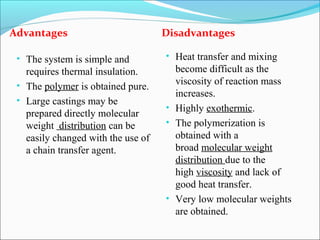
Advantages                          Disadvantages

 • The system is simple and         • Heat transfer and mixing
   requires thermal insulation.       become difficult as the
 • The polymer is obtained pure.      viscosity of reaction mass
                                      increases.
 • Large castings may be
                                    • Highly exothermic.
   prepared directly molecular
   weight distribution can be       • The polymerization is
   easily changed with the use of     obtained with a
   a chain transfer agent.            broad molecular weight
                                      distribution due to the
                                      high viscosity and lack of
                                      good heat transfer.
                                    • Very low molecular weights
                                      are obtained.
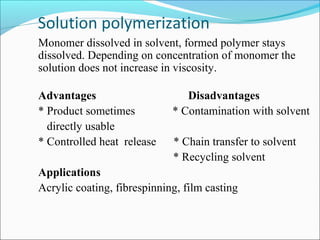
Solution polymerization
Monomer dissolved in solvent, formed polymer stays
dissolved. Depending on concentration of monomer the
solution does not increase in viscosity.

Advantages                      Disadvantages
* Product sometimes          * Contamination with solvent
  directly usable
* Controlled heat release    * Chain transfer to solvent
                             * Recycling solvent
Applications
Acrylic coating, fibrespinning, film casting
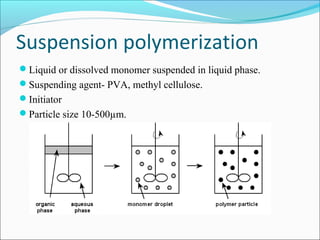
Suspension polymerization
Liquid or dissolved monomer suspended in liquid phase.
Suspending agent- PVA, methyl cellulose.
Initiator
Particle size 10-500µm.
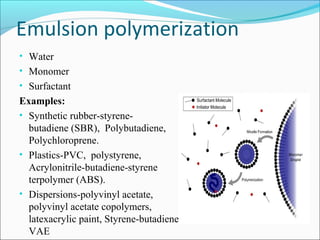
Emulsion polymerization
• Water
• Monomer
• Surfactant
Examples:
• Synthetic rubber-styrene-
  butadiene (SBR), Polybutadiene,
  Polychloroprene.
• Plastics-PVC, polystyrene,
  Acrylonitrile-butadiene-styrene
  terpolymer (ABS).
• Dispersions-polyvinyl acetate,
  polyvinyl acetate copolymers,
  latexacrylic paint, Styrene-butadiene,
  VAE
Advantages                       Disadvantages

                                 Surfactants and
High molecular
                                  polymerization adjuvants -
 weight polymers
                                  difficult to remove
fast polymerization rates.
                                 For dry (isolated) polymers,
allows removal of heat from      water removal is an energy-
 the system.                      intensive process
 viscosity remains close to     Designed to operate at high
 that of water and is not         conversion of monomer to
 dependent on molecular           polymer. This can result in
 weight.                          significant chain transfer to
The final product can be used    polymer.
 as such ,does not need to be    Can not be used for
 altered or processed             condensation, ionic or
                                  Ziegler-Natta polymerization.
Polyethylene
The liquid gases under high pressure is pumped into
 a heated pressure vessel maintained 150 to 250c .
By the catalytic effect of traces of oxygen present
 ethylene is polymerized in to poly ethylene.
Properties:
A rigid waxy solid
 white, transulent non polar meterial
Chemically resistant to strong acids, alkalies and salt
 solutions
Good insulator of electricirty
Swollen and permeable to most oils and organic
 solvents particularly to kerosene
Due to its high symmetrical structure polyethylene
 crystallizes very easily
Polyethylene produced by high pressure process has a
 branched structure and therefore flexible and tough
Low pressure process results in a completely linear PE
 having high density and better chemical resistance
Commercial PE is divided in to 3 types
Type I or low density PE (0.91-0.925g/cm3)
Type II or medium density PE(0.925 -0.940 g/cm3)
Type III or high density PE (0.941- 0.965 g /cm3)
USES
For making high frequency insulator parts
Bottle caps
Flexible bottles
Kitchen and domestic appliances
Toys
Sheets for packing materials
Tubes pipes
Coated wires and cables
Bags for packing
Poly propylene
Isomer of propylene by Zeigler natta reaction
Properties
Stereo regular ( iso tactic)
Highly crystalline polymer (M.P 160-170 c)
Better hardness
Strength
Stiff than PE
More resistant than PE
USES
In producing moulded parts and fibers
Its fibers are used in making ropes(extremely strong
 by weight)
Carpets
Furniture upholstery,Blankets,Hand bags, etc
Water pipes
Washing machine parts
Sterilizable hospital equipment
Poly Vinyl Chloride
Is obtained by heating a water emulsion of Vinyl
 chloride in presence of small amounts of benzyl
 peroxide or hydrogen peroxide in an auto clave under
 pressure
Vinyl chlodire so needed is prepared by treating
 acetylene at 1 to 1.5 atm with hydrogen chloride at 60-
 80 °C in the presence of metal chloride as catalyst
Properties
PVC is acolourless ,Odourless ,inflammable
 chemically inert ,resistant to
 light,atmospheric oxygen,inorganic
 acids,alkalies but soluble in hot chlorinated
 hydrocarbons such as ethyl chloride
Greater stiffness and rigidity compared to
 PE but is brittle
Most widely used synthetic plastic
USES
Rigid PVC has superior chemical
 resistance and high rigidity but is brittle
Used for making sheets which are
 employed for tank lining
Light fittings, safety helmets
Refrigerator components
Tyres
Cycle and motor cycle mudguards
Poly vinyl Acetate
Properties
It is colorless, transparent material
Resistant to water, atmospheric oxygen
 and chemicals
It is fairly soluble in organic solvents
Good heat resistance but slight yellowing
 takes place after prolonged storage above
 120 C
It is harmless if taken orally
USES
Under the influence of compressive or
 tensile forces articles made from polyvinyl
 acetate are distorted, even at room
 temperature, so it is not used for moulding
 purposes
However used for making records,
chewing gums
surgical dressings,
paints,
 lacquors,
plastic emulsions,
coatings,
 card-boards,
wrap-ping papers,
finishing textiles and other fabric and
bonding paper,
leather,
textiles
Poly Styrene
It is transparent
Light
Excellent moisture-resistant
It can be nitrated by fuming nitric acid and
 sulphonated by Conc.sulphuric acid, at 100 C it
 yields water soluble emulsions
It is highly electric insulating
Highly resistant to acids and good chemical
 resistant
Brittle
It has a unique property of transmitting light
 through curved sections
Uses
In moulding articles like toys, combs,
Buttons, buckles, radio and television patrs
Refrigerator parts, battery cases
High frequency electrical insulators,
Lenses,
Indoor lightening panels
Poly methyl methacrylate or
Lucite or plexiglass
Is obtained by the polymerisation of
 methyl methacryalate (ester of methyl
 acrylic acid) in presence of acetyl peroxide
 or hydrogen peroxide.
It is an acrylic polymer
Properties
PMMA is hard fairly rigid material with
 high softening point of about 130-140 C but
 it becomes rubbber like at 65 C
This relatively wide span of temperature
 from its rigid state to viscous consistency
 accounts for outstanding shape forming
 properties of PMMA.
It has high optical transperancy
High resistance to sun light and ability of
 transmitting light accurately even in curved
 sections
Uses
For making lenses          Artificial eyes
Air craft light fixtures   Dentures
Bomber noses               Emulsions
Gun turrets                Paints
Cockpit canopies           Adhesives
Transparent models of      Automotive appliances
 complicated                Jewellery
 mechanisms                 Wind screens
Bone splints
                            T.V screens
                            guards
Poly acrylonitrile
I t is obtained by the polymerisation of acrylonitrile
 in the presence of a peroxide
It is an acrylic polymer


Properties:
It is a high melting , hard and horny solid.
Uses
As a substituent for wool for making fibres like
 acrilan. Thus it is used for making warm clothes,
 carpets , blankets etc
Phenolic resins or Phenoplasts
They are the condensation polymerisation products
 of phenolic derivatives(like phenol, resorcinol) with
 aldehydes (like formaldehyde).
Most important member of this class is Bakelite
It is prepared by condensing phenol with
 formaldehyde in presence of acidic/alkaline catalyst
The initial reaction results in the formation of o- and
 P-hydroxy methyl phenol, which reacts to form liner
 polymer navolac
During moulding hexamethylene tetra amine is
 added , this provides formaldehyde, which converts
 the soluble , fusible navolac in to a hard infusible and
 insoluble solid of cross linked structure

Properties:
Rigid
Hard
Scratch resistant
Infusible
Water resistant
Insoluble solid
Resistant to non oxidising acids, salts and many
 organic solvents but are attached by alkaliesbecause
 of the presence of free hydroxy group in their
 structure
They posses excellent insulating character
Uses
For making electrical insulating partslike switches,
 plugs, switch boars, heater handles etc
For making moulded articles like telephone parts,
 cabinets of radio and television
As adhesives for grinding wheels used in propeller
 shafts for paper industry for rolling mills
Properties
Polycarbonates are charecteriseed by impact and
 tensile strength over a wide a range of tempetature.
They are soluble in organic solvents and alkalies


Uses:
For preparing moulded domestic ware
Electric insulators in electronics and electrical
 industries.

Revised polymer 2011

  • 1.
  • 2.
    Topics Introduction PAN Classification PET Physical Properties Poly amides Types of Polymerization Polyethylene Copolymers Polypropylene Vulcanization Resins(Phenol-Formaldehyde) PVC Polymethylmethacrylate Polyurethane
  • 3.
    POLYMERS Contents: Types of polymers Physicalproperties Types of polymerisation Some important polymers
  • 4.
    Terminology 1.Polymer: A long molecule made up from lots of small molecules called monomers.  A + A + A + A  -A-A-A-A- Eg. Ethene polyethene styrene  polystyrene Vinyl chloridePolyvinyl chloride
  • 5.
    Eg. PE (Polyethene )
  • 6.
  • 7.
    Homopolymer AAAAAAAAAAA Random CCACBBACABAA Alternating ABCABCABCABC Block AAAABBBBCCCC Graft Cross link polymer
  • 8.
  • 9.
    The number ofrepeating units in chain formed in a polymer is known as the "degree of polymerization(DP)
  • 10.
    Degree of polymerisation:The number of repeating units in a polymer molecule. 5,000 – 2,00,000 malecular mass range.
  • 11.
    The configuration ofmonomeric units in a polymer molecule
  • 12.
  • 13.
    Functionality The number ofbonding sites/active sites
  • 14.
    Types of Polymerisation Additionor Chain Polymerisation Condensation or step- Polymerisation Copolymerisation
  • 15.
    Addition or chainpolymerisation
  • 16.
    Example of addition polymers 16
  • 17.
    1st group 2nd group Product Example Hydroxyl Carboxyl Polyester Polyethylenetere- -OH -COOH -OOC- phthalate(terylene) Amino Carboxyl Polyamide Nylon-6:6 _NH2 -COOH _NH-CO- Hydroxyl Isocyanate Polyurethane Spandex fibre -OH OCN- -OC-NH-
  • 18.
    Types of polymers On the basis of source: a) Natural ----- which are found in nature in animals and plants starch(polymer of α-D-glucose, cellulose(polymer of β-D-glucose), proteins(polypeptides,polyamides),nucleic acids, natural rubber(a polymer of cis-iso prene) Gutta percha (polymer of trans isoprene) b) Synthetic……PE, PP, PS, PVC,nylon,terylene,bakelite
  • 19.
    On the basisof structure Linear polymers:posess high m.p,density,and tensile strength due to close packing of polymer chain High density polythene(HDPE) Nylons, polyester  Branched chain polymers: posess low m.p density,and tensile strength due to poor packing of polymer chain in the presence of branches. low density polyethene(IDPE),glycogen,amylopectin Three dimensional network polymers: Hard,rigid,brittle,donot melt but burn on strong heating due to the presence of cross links bakelite,urea-formaldehyde ,melamine-formaldehyde
  • 21.
    On the basisof molecular forces: a) Thermoplastic polymers: Linear long chain polymers which can be softened on heating and hardened on cooling Hardness is temporary property Can be prosessed again and again PE, PP, PVC, PS, Teflon, Nylon b) Thermosetting polymers: Permanent setting polymers Three dimensional cross linked structure with strong covalent bonds Cannot be reprocessed
  • 22.
    Polyester,bakelite,epoxy resins,urea formaldehyde resin Elastomers: (or synthetic rubber) Any rubber like structure which can be stretched at least thrice its length Fibres: whose chains are held together by strong intermolecular forces like hydrogen bonding. Cryatalline,High tensile strength
  • 23.
  • 24.
    Thermoplastics (80%) Nocross links between chains. Weak attractive forces between chains broken by warming. Change shape - can be remoulded. Weak forces reform in new shape when cold.
  • 25.
    Thermosets Extensivecross-linking formed by covalent bonds. Bonds prevent chains moving relative to each other. What will the properties of this type of plastic be like?
  • 26.
    Addition polymerisation Monomers containC=C bonds Double bond opens to (link) bond to next monomer molecule Chain forms when same basic unit is repeated over and over. Modern polymers also developed based on alkynes R- C C - R’
  • 27.
    Copolymerisation when more thanone monomer is used.  An irregular chain structure will result eg propene/ethene/propene/propene/ethene Why many polymers designers want to design a polymer in this way? (Hint) Intermolecular bonds!
  • 28.
    .. RO: Mechanism H2C CHCH3 •
  • 29.
    .. RO: Mechanism H2C CHCH3 • H2C CHCH3
  • 30.
    .. RO: Mechanism H2C CHCH3 H2C CHCH3 •
  • 31.
    .. RO: Mechanism H2C CHCH3 H2C CHCH3 • H2C CHCH3
  • 32.
    .. RO: Mechanism H2C CHCH3 H2C CHCH3 H2C CHCH3 •
  • 33.
    .. RO: Mechanism H2C CHCH3 H2C CHCH3 H2C CHCH3 • H2C CHCH3
  • 34.
    Free-Radical AdditionPolymerization of Ethylene H2C CH2 200 °C O2 2000 atm peroxides CH2 CH2 CH2 CH2 CH2 CH2 CH2 polyethylene
  • 35.
    Free-Radical Polymerization ofPropene H2C CHCH3 CH CH CH CH CH CH CH CH3 CH3 CH3 CH3 CH3 CH3 CH3 polypropylene
  • 36.
    .. RO • Mechanism .. H2C CHCH3
  • 37.
    .. RO: Mechanism H2C CHCH3 H2C CHCH3 H2C CHCH3 •
  • 38.
    Likewise... •H2C=CHCl polyvinyl chloride •H2C=CHC6H5 polystyrene •F2C=CF2 Teflon
  • 39.
    Chain growth polymerization •Addition polymerization • All the atoms in monomer is used to produce a polymer. • Steps in chain reaction: • initiation • propagation • termination
  • 40.
    Step growth polymerization Polymerizationmechanism in which bi-functional or multifunctional monomers react to form first dimers, then trimers, longer oligomers and eventually long chain polymers. •Eg: polyesters, polyamides, polyurethanes. Etc •Polymer+molecule with low molecular weight.
  • 41.
    Differences between step-growthpolymerization and chain-growth polymerization Step growth Chain growth Growth throughout matrix Growth by addition of monomer only at one end of chain Rapid loss of monomer early Some monomer remains even at in the reaction long reaction times Similar steps repeated Different steps operate at throughout reaction process different stages of mechanism. Average molecular weight Molar mass of backbone chain increases slowly at low increases rapidly at early stage conversion and high extents and remains approximately the of reaction are required to same throughout the obtain high chain length. polymerization Ends remain active (no Chains not active after termination) termination No initiator necessary Initiator required
  • 42.
    Free radical polymerization Initiation:active center created. 2 steps Radicals from initiators Transfer to monomer Types of initiation: Thermal decomposition Photolysis Redox reactions Persulfate
  • 43.
    Propagation: Termination : Combination oftwo active chain ends Combination of an active chain end with an initiator radical
  • 44.
    Cationic polymerization • Cationicinitiator binds & transfers charge to monomer. • Reactive monomer reacts with other monomer to form a polymer. • Active site: carboniumion , oxonium, sulfonium or phosphonium ion • Monomers: alkoxy. phenyl, vinyl, 1,1-dialkyl-substituted alkene monomers. • Initiator: provide electrophile eg: bronsted acids(acetic acid,HCL), Lewis acids+electron donor. • Application :polyisobutylene.
  • 45.
  • 46.
    Anionic polymerization Carried outthrough carbanion active species. Monomer: vinyl monomers with substituents on double bond able to stabilise a –ve charge. Eg: styrene, dienes, methacrylate, vinyl pyridine, aldehydes, epoxide, episulfide cyclic siloxane, and lactones Polar monomers: eg: acrylonitrile, cyanoacrylate, propylene oxide, vinyl ketone, acrolein, vinyl sulfone, vinyl sulfoxide, vinylsilane andisocyanate. .
  • 47.
    Solvents- polar solventsdecrease stability. initiation : electron transfer, strong acids. Propagation: very fast,low temp, heat is released. Termination: quenching, water, alcohol, chain transfer. Application :polydiene synthetic rubbers, solution styrene/butadiene rubbers (SBR), and styrenic thermoplastic elastomers
  • 48.
    Polymerization techniques Bulk polymerization Solutionpolymerization Suspension polymerization Emulsion polymerization
  • 49.
    Bulk polymerization • Massor bulk polymerization: Polymerization of the undiluted monomer. • carried out by adding a soluble initiator to pure monomer into liquid state. • Viscosity increases dramatically during conversion • 2 types Quiescent bulk polymerization Eg: phenol- formaldehyde condensation Stirred bulk polymerization Eg: nylon 66.
  • 50.
    Advantages Disadvantages • The system is simple and • Heat transfer and mixing requires thermal insulation. become difficult as the • The polymer is obtained pure. viscosity of reaction mass increases. • Large castings may be • Highly exothermic. prepared directly molecular weight distribution can be • The polymerization is easily changed with the use of obtained with a a chain transfer agent. broad molecular weight distribution due to the high viscosity and lack of good heat transfer. • Very low molecular weights are obtained.
  • 51.
    Solution polymerization Monomer dissolvedin solvent, formed polymer stays dissolved. Depending on concentration of monomer the solution does not increase in viscosity. Advantages Disadvantages * Product sometimes * Contamination with solvent directly usable * Controlled heat release * Chain transfer to solvent * Recycling solvent Applications Acrylic coating, fibrespinning, film casting
  • 54.
    Suspension polymerization Liquid ordissolved monomer suspended in liquid phase. Suspending agent- PVA, methyl cellulose. Initiator Particle size 10-500µm.
  • 55.
    Emulsion polymerization • Water •Monomer • Surfactant Examples: • Synthetic rubber-styrene- butadiene (SBR), Polybutadiene, Polychloroprene. • Plastics-PVC, polystyrene, Acrylonitrile-butadiene-styrene terpolymer (ABS). • Dispersions-polyvinyl acetate, polyvinyl acetate copolymers, latexacrylic paint, Styrene-butadiene, VAE
  • 56.
    Advantages Disadvantages Surfactants and High molecular polymerization adjuvants - weight polymers difficult to remove fast polymerization rates. For dry (isolated) polymers, allows removal of heat from water removal is an energy- the system. intensive process  viscosity remains close to Designed to operate at high that of water and is not conversion of monomer to dependent on molecular polymer. This can result in weight. significant chain transfer to The final product can be used polymer. as such ,does not need to be Can not be used for altered or processed condensation, ionic or Ziegler-Natta polymerization.
  • 57.
    Polyethylene The liquid gasesunder high pressure is pumped into a heated pressure vessel maintained 150 to 250c . By the catalytic effect of traces of oxygen present ethylene is polymerized in to poly ethylene. Properties: A rigid waxy solid  white, transulent non polar meterial Chemically resistant to strong acids, alkalies and salt solutions Good insulator of electricirty
  • 58.
    Swollen and permeableto most oils and organic solvents particularly to kerosene Due to its high symmetrical structure polyethylene crystallizes very easily Polyethylene produced by high pressure process has a branched structure and therefore flexible and tough Low pressure process results in a completely linear PE having high density and better chemical resistance Commercial PE is divided in to 3 types Type I or low density PE (0.91-0.925g/cm3) Type II or medium density PE(0.925 -0.940 g/cm3) Type III or high density PE (0.941- 0.965 g /cm3)
  • 59.
    USES For making highfrequency insulator parts Bottle caps Flexible bottles Kitchen and domestic appliances Toys Sheets for packing materials Tubes pipes Coated wires and cables Bags for packing
  • 60.
    Poly propylene Isomer ofpropylene by Zeigler natta reaction Properties Stereo regular ( iso tactic) Highly crystalline polymer (M.P 160-170 c) Better hardness Strength Stiff than PE More resistant than PE
  • 61.
    USES In producing mouldedparts and fibers Its fibers are used in making ropes(extremely strong by weight) Carpets Furniture upholstery,Blankets,Hand bags, etc Water pipes Washing machine parts Sterilizable hospital equipment
  • 62.
    Poly Vinyl Chloride Isobtained by heating a water emulsion of Vinyl chloride in presence of small amounts of benzyl peroxide or hydrogen peroxide in an auto clave under pressure Vinyl chlodire so needed is prepared by treating acetylene at 1 to 1.5 atm with hydrogen chloride at 60- 80 °C in the presence of metal chloride as catalyst
  • 63.
    Properties PVC is acolourless,Odourless ,inflammable chemically inert ,resistant to light,atmospheric oxygen,inorganic acids,alkalies but soluble in hot chlorinated hydrocarbons such as ethyl chloride Greater stiffness and rigidity compared to PE but is brittle Most widely used synthetic plastic
  • 64.
    USES Rigid PVC hassuperior chemical resistance and high rigidity but is brittle Used for making sheets which are employed for tank lining Light fittings, safety helmets Refrigerator components Tyres Cycle and motor cycle mudguards
  • 65.
    Poly vinyl Acetate Properties Itis colorless, transparent material Resistant to water, atmospheric oxygen and chemicals It is fairly soluble in organic solvents Good heat resistance but slight yellowing takes place after prolonged storage above 120 C It is harmless if taken orally
  • 66.
    USES Under the influenceof compressive or tensile forces articles made from polyvinyl acetate are distorted, even at room temperature, so it is not used for moulding purposes However used for making records, chewing gums surgical dressings, paints,  lacquors,
  • 67.
    plastic emulsions, coatings,  card-boards, wrap-pingpapers, finishing textiles and other fabric and bonding paper, leather, textiles
  • 68.
    Poly Styrene It istransparent Light Excellent moisture-resistant It can be nitrated by fuming nitric acid and sulphonated by Conc.sulphuric acid, at 100 C it yields water soluble emulsions It is highly electric insulating Highly resistant to acids and good chemical resistant Brittle It has a unique property of transmitting light through curved sections
  • 69.
    Uses In moulding articleslike toys, combs, Buttons, buckles, radio and television patrs Refrigerator parts, battery cases High frequency electrical insulators, Lenses, Indoor lightening panels
  • 70.
    Poly methyl methacrylateor Lucite or plexiglass Is obtained by the polymerisation of methyl methacryalate (ester of methyl acrylic acid) in presence of acetyl peroxide or hydrogen peroxide. It is an acrylic polymer
  • 71.
    Properties PMMA is hardfairly rigid material with high softening point of about 130-140 C but it becomes rubbber like at 65 C This relatively wide span of temperature from its rigid state to viscous consistency accounts for outstanding shape forming properties of PMMA. It has high optical transperancy High resistance to sun light and ability of transmitting light accurately even in curved sections
  • 72.
    Uses For making lenses Artificial eyes Air craft light fixtures Dentures Bomber noses Emulsions Gun turrets Paints Cockpit canopies Adhesives Transparent models of Automotive appliances complicated Jewellery mechanisms Wind screens Bone splints T.V screens guards
  • 73.
    Poly acrylonitrile I tis obtained by the polymerisation of acrylonitrile in the presence of a peroxide It is an acrylic polymer Properties: It is a high melting , hard and horny solid.
  • 74.
    Uses As a substituentfor wool for making fibres like acrilan. Thus it is used for making warm clothes, carpets , blankets etc
  • 75.
    Phenolic resins orPhenoplasts They are the condensation polymerisation products of phenolic derivatives(like phenol, resorcinol) with aldehydes (like formaldehyde). Most important member of this class is Bakelite It is prepared by condensing phenol with formaldehyde in presence of acidic/alkaline catalyst The initial reaction results in the formation of o- and P-hydroxy methyl phenol, which reacts to form liner polymer navolac
  • 76.
    During moulding hexamethylenetetra amine is added , this provides formaldehyde, which converts the soluble , fusible navolac in to a hard infusible and insoluble solid of cross linked structure Properties: Rigid Hard Scratch resistant Infusible Water resistant Insoluble solid
  • 77.
    Resistant to nonoxidising acids, salts and many organic solvents but are attached by alkaliesbecause of the presence of free hydroxy group in their structure They posses excellent insulating character
  • 78.
    Uses For making electricalinsulating partslike switches, plugs, switch boars, heater handles etc For making moulded articles like telephone parts, cabinets of radio and television As adhesives for grinding wheels used in propeller shafts for paper industry for rolling mills
  • 79.
    Properties Polycarbonates are charecteriseedby impact and tensile strength over a wide a range of tempetature. They are soluble in organic solvents and alkalies Uses: For preparing moulded domestic ware Electric insulators in electronics and electrical industries.

Editor's Notes