Polymers
• General Introduction
• Polymer Types
• Polymerisation: Mechanism & Kinetics
• Polymer molecular weight: Averages &
Determination
• Size of polymer chains
General Introduction
What is a Polymer?
• A high molar mass material (103 - 106 Daltons or
more)
• A polymer is formed by the combination of a large
number of smaller units called ‘monomers’ linked
through covalent linkages
• Monomers should have minimum bifunctionality
i.e.two functional groups or one double bond
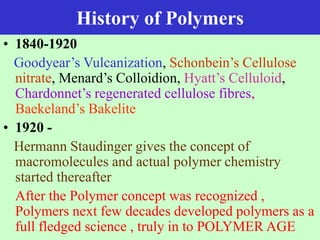
History of Polymers
• 1840-1920
Goodyear’s Vulcanization, Schonbein’s Cellulose
nitrate, Menard’s Colloidion, Hyatt’s Celluloid,
Chardonnet’s regenerated cellulose fibres,
Baekeland’s Bakelite
• 1920 -
Hermann Staudinger gives the concept of
macromolecules and actual polymer chemistry
started thereafter
After the Polymer concept was recognized ,
Polymers next few decades developed polymers as a
full fledged science , truly in to POLYMER AGE
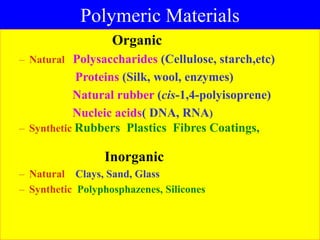
Polymeric Materials
Organic
– Natural Polysaccharides (Cellulose, starch,etc)
Proteins (Silk, wool, enzymes)
Natural rubber (cis-1,4-polyisoprene)
Nucleic acids( DNA, RNA)
– Synthetic Rubbers Plastics Fibres Coatings,
Inorganic
– Natural Clays, Sand, Glass
– Synthetic Polyphosphazenes, Silicones
Nomenclature
Source name IUPAC name
Polyethylene Poly(methylene)
Polytetrafluoroethylene Poly(difluoromethane)
Polystyrene Poly(1-phenylethene)
Poly(acrylic acid) Poly(1-carboxylatoethene)
Poly(-methylstyrene) Poly(1-methyl-1-phenylethene)
Poly(1-pentene) Poly[1-(1-propyl)ethylene]
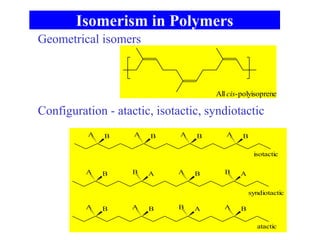
Isomerism in Polymers
Geometrical isomers
Configuration - atactic, isotactic, syndiotactic
B B B B
A A A A
B A B A
A B A B
B B A B
A A B A
isotactic
syndiotactic
atactic
All cis-polyisoprene
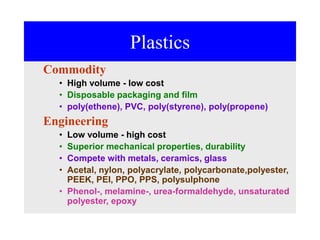
Plastics
Commodity
• High volume - low cost
• Disposable packaging and film
• poly(ethene), PVC, poly(styrene), poly(propene)
Engineering
• Low volume - high cost
• Superior mechanical properties, durability
• Compete with metals, ceramics, glass
• Acetal, nylon, polyacrylate, polycarbonate,polyester,
PEEK, PEI, PPO, PPS, polysulphone
• Phenol-, melamine-, urea-formaldehyde, unsaturated
polyester, epoxy
Uses of Polymers
Elastomers Plastics Fibres
Polyisoprene Polyethylene Polyamide
SBR Polystyrene Polyester
Polyisobutylene Teflon Cellulosics
Polyurethanes PVC Polyacrylonitrile
Silicones Polyurethane Polypropylene
Formaldehyde resins
Polymer Types
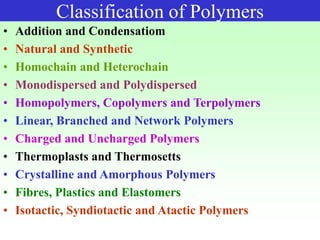
Classification of Polymers
• Addition and Condensatiom
• Natural and Synthetic
• Homochain and Heterochain
• Monodispersed and Polydispersed
• Homopolymers, Copolymers and Terpolymers
• Linear, Branched and Network Polymers
• Charged and Uncharged Polymers
• Thermoplasts and Thermosetts
• Crystalline and Amorphous Polymers
• Fibres, Plastics and Elastomers
• Isotactic, Syndiotactic and Atactic Polymers
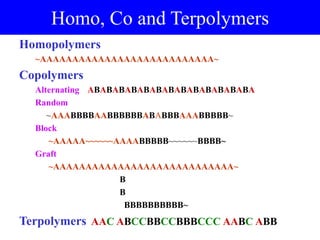
Homo, Co and Terpolymers
Homopolymers
~AAAAAAAAAAAAAAAAAAAAAAAAAAA~
Copolymers
Alternating ABABABABABABABABABABABABABA
Random
~AAABBBBAABBBBBBABABBBAAABBBBB~
Block
~AAAAA~~~~~~AAAABBBBB~~~~~~BBBB~
Graft
~AAAAAAAAAAAAAAAAAAAAAAAAAAAA~
B
B
BBBBBBBBBB~
Terpolymers AAC ABCCBBCCBBBCCC AABC ABB
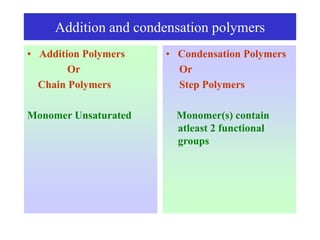
Addition and condensation polymers
• Addition Polymers
Or
Chain Polymers
Monomer Unsaturated
• Condensation Polymers
Or
Step Polymers
Monomer(s) contain
atleast 2 functional
groups
Monomer, Constitutional Repeat Unit,
Degree of Polymerization
CH2 CH
[ ]
Cl
1000
( i ) Monomer : Vinyl Chloride
Cl
CH
CH2
( ii ) DP : 1000
( ii )
i Molecular Weight of Polymer
= Mol. Wt. of Monomer x DP
= 62.5 x 1000
= 62,500
( iv ) CRU :
Cl
CH
CH2
( )
PVC
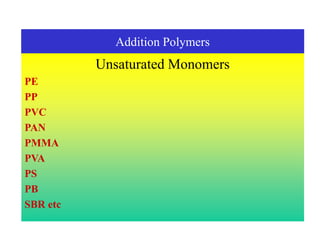
Addition Polymers
Unsaturated Monomers
PE
PP
PVC
PAN
PMMA
PVA
PS
PB
SBR etc
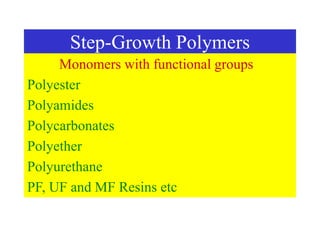
Step-Growth Polymers
Monomers with functional groups
Polyester
Polyamides
Polycarbonates
Polyether
Polyurethane
PF, UF and MF Resins etc
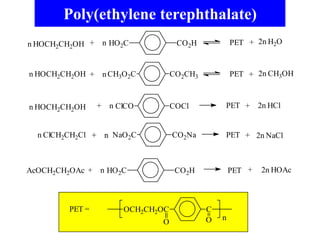
Poly(ethylene terephthalate)
OCH2CH2OC C
O O n
PET =
n HOCH2CH2OH CO2H
HO2C
+ n PET 2n H2O
+
n HOCH2CH2OH
PET
CH3O2C CO2CH3
+ n
2n CH3OH
+
n HOCH2CH2OH COCl
ClCO
PET +
2n HCl
+ n
n ClCH2CH2Cl NaO2C CO2Na
+ n
+ n
PET + 2n NaCl
CO2H
HO2C
+ n
AcOCH2CH2OAc PET 2n HOAc
+
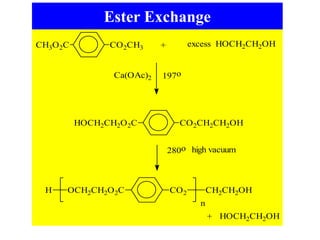
Ester Exchange
CH3O2C CO2CH3 excess HOCH2CH2OH
+
Ca(OAc)2 197o
HOCH2CH2O2C CO2CH2CH2OH
280o high vacuum
OCH2CH2O2C CO2
H CH2CH2OH
n
HOCH2CH2OH
+
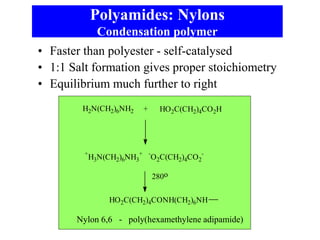
Polyamides: Nylons
Condensation polymer
• Faster than polyester - self-catalysed
• 1:1 Salt formation gives proper stoichiometry
• Equilibrium much further to right
Nylon 6,6 - poly(hexamethylene adipamide)
H2N(CH2)6NH2 HO2C(CH2)4CO2H
+
+
H3N(CH2)6NH3
+ -
O2C(CH2)4CO2
-
280o
HO2C(CH2)4CONH(CH2)6NH
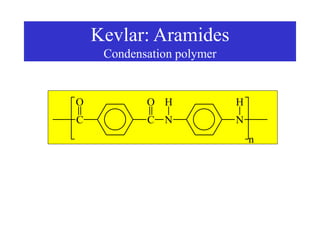
Kevlar: Aramides
Condensation polymer
C
C N N
H
O
O H
n
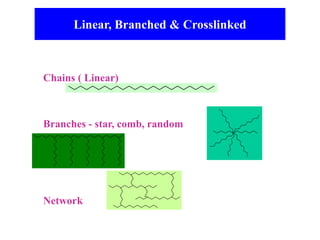
Linear, Branched & Crosslinked
Chains ( Linear)
Branches - star, comb, random
Network
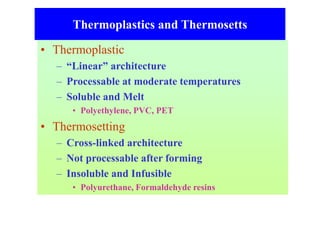
Thermoplastics and Thermosetts
• Thermoplastic
– “Linear” architecture
– Processable at moderate temperatures
– Soluble and Melt
• Polyethylene, PVC, PET
• Thermosetting
– Cross-linked architecture
– Not processable after forming
– Insoluble and Infusible
• Polyurethane, Formaldehyde resins
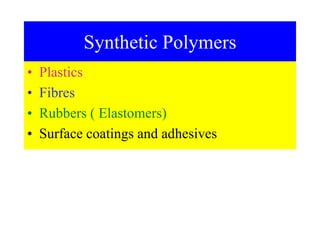
Synthetic Polymers
• Plastics
• Fibres
• Rubbers ( Elastomers)
• Surface coatings and adhesives
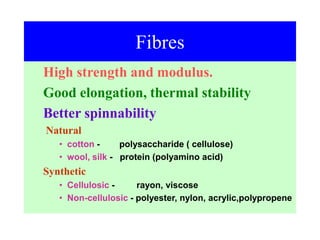
Fibres
High strength and modulus.
Good elongation, thermal stability
Better spinnability
Natural
• cotton - polysaccharide ( cellulose)
• wool, silk - protein (polyamino acid)
Synthetic
• Cellulosic - rayon, viscose
• Non-cellulosic - polyester, nylon, acrylic,polypropene
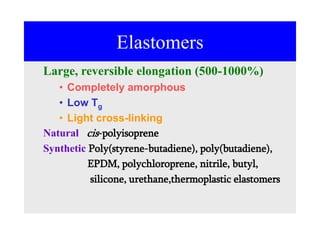
Elastomers
Large, reversible elongation (500-1000%)
• Completely amorphous
• Low Tg
• Light cross-linking
Natural cis-polyisoprene
Synthetic Poly(styrene-butadiene), poly(butadiene),
EPDM, polychloroprene, nitrile, butyl,
silicone, urethane,thermoplastic elastomers
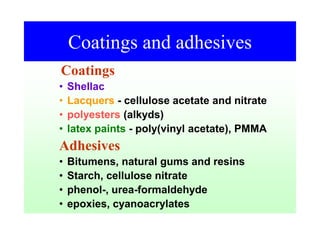
Coatings and adhesives
Coatings
• Shellac
• Lacquers - cellulose acetate and nitrate
• polyesters (alkyds)
• latex paints - poly(vinyl acetate), PMMA
Adhesives
• Bitumens, natural gums and resins
• Starch, cellulose nitrate
• phenol-, urea-formaldehyde
• epoxies, cyanoacrylates
Polymerization
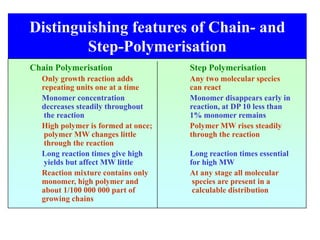
Distinguishing features of Chain- and
Step-Polymerisation
Chain Polymerisation Step Polymerisation
Only growth reaction adds Any two molecular species
repeating units one at a time can react
Monomer concentration Monomer disappears early in
decreases steadily throughout reaction, at DP 10 less than
the reaction 1% monomer remains
High polymer is formed at once; Polymer MW rises steadily
polymer MW changes little through the reaction
through the reaction
Long reaction times give high Long reaction times essential
yields but affect MW little for high MW
Reaction mixture contains only At any stage all molecular
monomer, high polymer and species are present in a
about 1/100 000 000 part of calculable distribution
growing chains
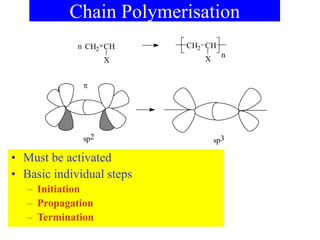
Chain Polymerisation
• Must be activated
• Basic individual steps
– Initiation
– Propagation
– Termination
CH2 CH
X
CH2 CH
X
n
n
sp3
sp2

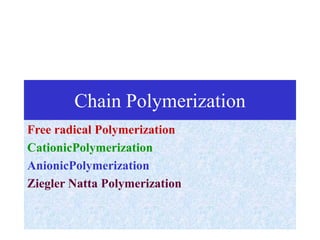
Chain Polymerization
Free radical Polymerization
CationicPolymerization
AnionicPolymerization
Ziegler Natta Polymerization
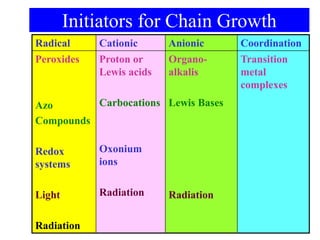
Initiators for Chain Growth
Radical Cationic Anionic Coordination
Peroxides
Azo
Compounds
Redox
systems
Light
Radiation
Proton or
Lewis acids
Carbocations
Oxonium
ions
Radiation
Organo-
alkalis
Lewis Bases
Radiation
Transition
metal
complexes
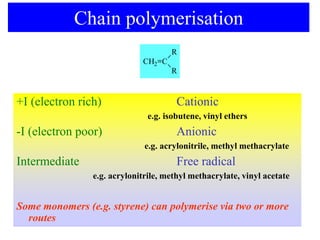
Chain polymerisation
+I (electron rich) Cationic
e.g. isobutene, vinyl ethers
-I (electron poor) Anionic
e.g. acrylonitrile, methyl methacrylate
Intermediate Free radical
e.g. acrylonitrile, methyl methacrylate, vinyl acetate
Some monomers (e.g. styrene) can polymerise via two or more
routes
CH2 C
R
R
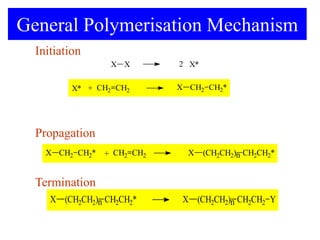
General Polymerisation Mechanism
Initiation
Propagation
Termination
CH2 CH2
X* + X CH2 CH2*
X CH2 CH2* CH2 CH2
+ X (CH2CH2)n CH2CH2*
X (CH2CH2)n CH2CH2* X (CH2CH2)n CH2CH2 Y
X X X*
2
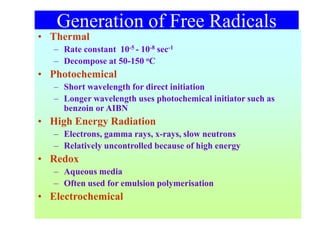
Generation of Free Radicals
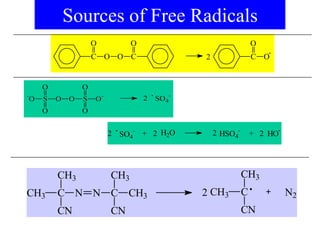
• Thermal
– Rate constant 10-5 - 10-8 sec-1
– Decompose at 50-150 oC
• Photochemical
– Short wavelength for direct initiation
– Longer wavelength uses photochemical initiator such as
benzoin or AIBN
• High Energy Radiation
– Electrons, gamma rays, x-rays, slow neutrons
– Relatively uncontrolled because of high energy
• Redox
– Aqueous media
– Often used for emulsion polymerisation
• Electrochemical
Sources of Free Radicals
C O
O
O C
O
C
O
O
2
S O
O
O
O S
O
O
-
O O-
SO4
-
2
2 H2O
2 HSO4
-
+ +
SO4
- 2 HO
2
C
CH3
CH3
CN
N N C
CH3
CH3
CN
C
CH3
CH3
CN
N2
2
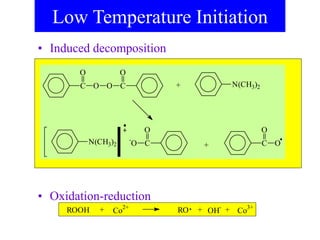
Low Temperature Initiation
• Induced decomposition
• Oxidation-reduction
C O
O
O C
O
N(CH3)2
+
N(CH3)2 C
O
-
O C O
O
+
ROOH Co
2+
RO OH
-
Co
3+
+ + +
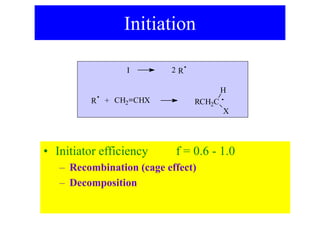
Initiation
• Initiator efficiency f = 0.6 - 1.0
– Recombination (cage effect)
– Decomposition
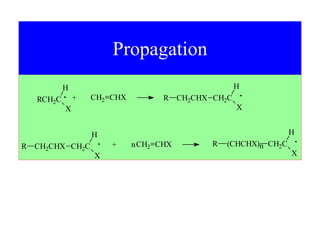
I 2
R CH2 CHX
+ RCH2C
H
X
R
Propagation
CH2 CHX
RCH2C
H
X
+
R CH2CHX
X
H
CH2C
R CH2CHX
X
H
CH2C n R (CHCHX)n
X
H
CH2C
CH2 CHX
+
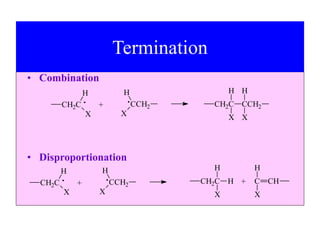
Termination
• Combination
• Disproportionation
+
CH2C
H
X
CCH2
H
X
CH2C CCH2
H H
X X
+
CH2C
H
X
CCH2
H
X
CH2C
H
H
X
C CH
H
X
+
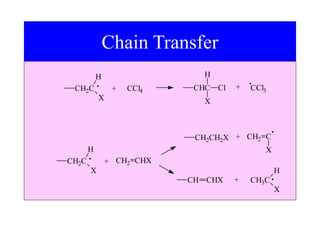
Chain Transfer
+
CH2C
H
X
CCl4 CHC
H
X
Cl CCl3
+
+
CH2C
H
X
CH2 CHX
CH2CH2X + CH2 C
X
CH CHX + CH3C
H
X
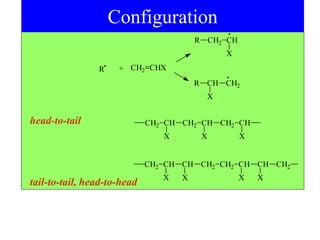
Configuration
head-to-tail
tail-to-tail, head-to-head
CH2 CHX
+
R
R CH2 CH
X
R CH CH2
X
CH2 CH CH2 CH CH2 CH
X X X
CH2 CH CH CH2 CH2 CH CH CH2
X X X X
Cationic Chain Polymerisation
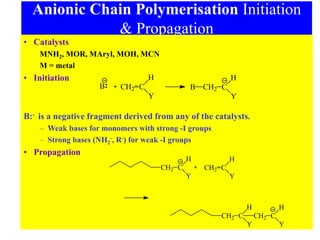
Anionic Chain Polymerisation Initiation
& Propagation
• Catalysts
MNH2, MOR, MAryl, MOH, MCN
M = metal
• Initiation
B:- is a negative fragment derived from any of the catalysts.
– Weak bases for monomers with strong -I groups
– Strong bases (NH2
-, R-) for weak -I groups
• Propagation
B CH2 C
H
Y
CH2 C
H
Y
B
CH2 C
H
Y
CH2 C
H
Y
CH2 C
H
Y Y
H
C
CH2
Non-Terminating Anionic Polymerisation
• Conditions needed to form “living” polymers
– Solvents inactive to transferring positive charge to propagating anion, e.g.
dioxan, tetrahydrofuran
– Absence of O2, CO2, water, other impurities
• Termination by chain transfer agent
• Block copolymers
– Add a second monomer to living polymer
Narrow molecular weight distribution
– Mw/Mn is 1.1 or less
• Controlled MW
– xn = [M]/[I]
X SSSSSSS-
X- S B
X SSSSSSSBBBBBBBB-
Kinetics of Vinyl Radical
Polymerisation
• Initiation
Two Chains started
EA ~ 25-30 kcal
I 2
R CH2 CHX
+ RCH2C
H
X
R
R
d
dt
fk
i d



[ ]
[ ]
M
I
2
kd
Kinetics of Chain Polymerisation
• Propagation
All chains have same reactivity
EA ~ 5-10 kcal
CH2 CHX
RCH2C
H
X
+
R CH2CHX
X
H
CH2C
R CH2CHX
X
H
CH2C n R (CHCHX)n
X
H
CH2C
CH2 CHX
+
]
M
][
M
[
 p
p k
R
kp
Kinetics of Chain Polymerisation
• Termination
EA ~ 3-5 kcal
+
CH2C
H
X
CCH2
H
X
CH2C CCH2
H H
X X
+
CH2C
H
X
CCH2
H
X
CH2C
H
H
X
C CH
H
X
+
2
]
M
[
2
 t
t k
R
kt
kt
Kinetics of Chain Polymerisation
ki Low rate constant
kp 102-103 l mol-1 sec-1
kt 107-109 l mol-1 sec-1
Hence a steady state of free radicals,
i.e. R R
fk k
fk
k
R k
fk
k
i t
d t
d
t
p p
d
t


















2 2
2
2
1
2
1
2
[ ] [ ]
[ ] [ ]
[ ]
[ ]
I M
M I
I
M
Kinetic Chain Length
Number of Monomer Units Consumed / Active Centre
For initiated polymerisation:
   

R
R
R
R
k
k
p
i
p
t
p
t
[ ]
[ ]
M
M
2
 
k
k R
p
t p
2 2
2
[ ]
M
2
1
2
1
]
I
[
)
(
2
]
M
[
t
d
p
k
fk
k


R k
p p
 
[ ][ ]
M M
2
1
]
I
[
]
M
[ 









t
d
k
fk
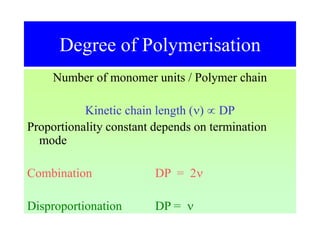
Degree of Polymerisation
Number of monomer units / Polymer chain
Kinetic chain length ()  DP
Proportionality constant depends on termination
mode
Combination DP = 2
Disproportionation DP = 
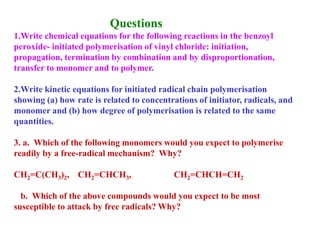
Questions
1.Write chemical equations for the following reactions in the benzoyl
peroxide- initiated polymerisation of vinyl chloride: initiation,
propagation, termination by combination and by disproportionation,
transfer to monomer and to polymer.
2.Write kinetic equations for initiated radical chain polymerisation
showing (a) how rate is related to concentrations of initiator, radicals, and
monomer and (b) how degree of polymerisation is related to the same
quantities.
3. a. Which of the following monomers would you expect to polymerise
readily by a free-radical mechanism? Why?
CH2=C(CH3)2, CH2=CHCH3, CH2=CHCH=CH2
b. Which of the above compounds would you expect to be most
susceptible to attack by free radicals? Why?
A monomer with molecular weight 100 and density 1 photopolymerises in bulk
at a rate of 3.6 wt.% per hour when the rate of initiation is 1 x 10⁻⁹, mole/litre-
sec. The radical lifetime is 10 sec. Calculate [M], kp, kt, Mn., and Mw,
assuming termination by combination and no transfer.
Molarity of monomer = 10 (l litre = 1000g = 10 moles, so conc. is 10 moles/litre)
Rate of propagation = (0.036 x 10) /3600 moles/litre/sec = 10-6
Radical life = 10 seconds = 1/2kt[M ], so [M ] = 1/20 kt (1)
Rate of initiation = Rate of termination = kt[M ]2 = 1 x 10⁻⁹ (2)
Combining (1) and (2), [M] = 20 x 10-9
kp = rate of propagation/( [M][M] ) = 10-6 / 10 / 2 x 10-8 = 0.05
Everything else is easy - only need to substitute in standard equations for
termination and kinetic chain length. For termination by combination, Mw = 1.5
Mn.
Molecular Weights of Polymers
Never monodispersed
Can be of different mol wt
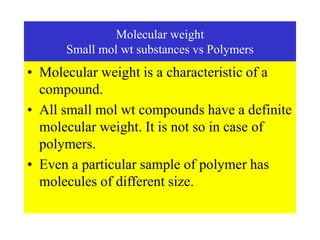
Molecular weight
Small mol wt substances vs Polymers
• Molecular weight is a characteristic of a
compound.
• All small mol wt compounds have a definite
molecular weight. It is not so in case of
polymers.
• Even a particular sample of polymer has
molecules of different size.
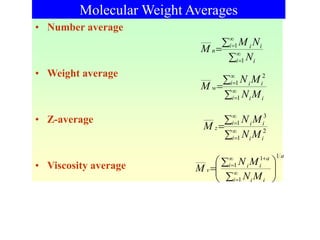
Molecular Weight Averages
• Number average
• Weight average
• Z-average
• Viscosity average


 



1
1
i i
i
i
i
n
N
N
M
M


 



1
2
1
i i
i
i
i
i
w
M
N
M
N
M


 



1
2
3
1
i i
i
i
i
i
z
M
N
M
N
M
a
i i
i
a
i
i
i
v
M
N
M
N
M
1
1
1
1










 




Equal number of molecules with M1 = 10,000 and M2 =
1,00,000 are mixed. Calculate Mn and Mw.
Solution - Let n1 = n2 = 10 (say), then,
n1M1 + n2M2 (10  10,000) + (10  100,000)
Mn = __________________ = _____________________________________
n1 + n2 (10 + 10)
105 + 106 105 (1 + 10) 11  104
= _____________ = _________________ = _____________ = 55,000 g mol-1
20 20 2
n1M1
2 + n1M2
2 [ 10  (10,000)2 ] + [ 10  (1,00,000)2 ]
Mw = _____________________ = __________________________________________________
n1M1 + n2M2 [ 10  10,000 ] + [ 10  1,00,000 ]
109 + 1011 109(1 + 100) 101  104
= _________________ = __________________ = _______________
105 + 106 105 (1 + 10) 11
= 91,818  92,000 g mol-1
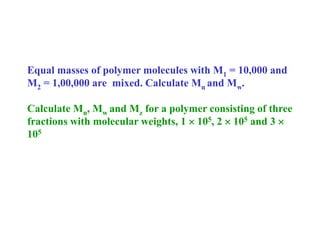
Equal masses of polymer molecules with M1 = 10,000 and
M2 = 1,00,000 are mixed. Calculate Mn and Mw.
Calculate Mn, Mw and Mz for a polymer consisting of three
fractions with molecular weights, 1  105, 2  105 and 3 
105
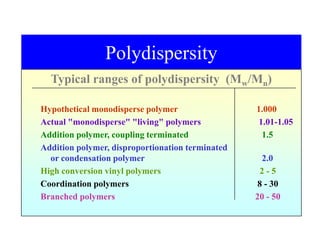
Polydispersity
Typical ranges of polydispersity (Mw/Mn)
Hypothetical monodisperse polymer 1.000
Actual "monodisperse" "living" polymers 1.01-1.05
Addition polymer, coupling terminated 1.5
Addition polymer, disproportionation terminated
or condensation polymer 2.0
High conversion vinyl polymers 2 - 5
Coordination polymers 8 - 30
Branched polymers 20 - 50
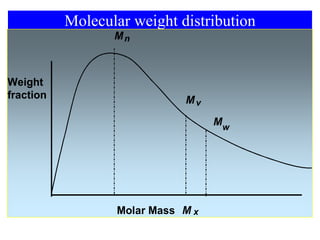
Molecular weight distribution
Molar Mass
M
M
M
n
v
w
Weight
fraction
M x
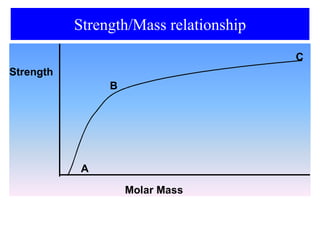
Strength/Mass relationship
Strength
Molar Mass
A
B
C
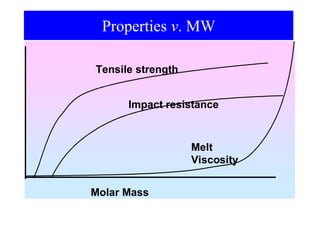
Properties v. MW
Molar Mass
Tensile strength
Impact resistance
Melt
Viscosity
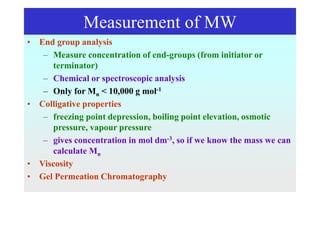
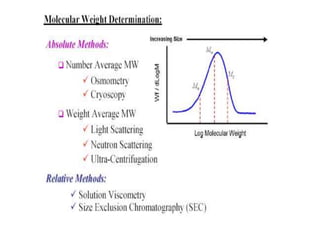
Measurement of MW
• End group analysis
– Measure concentration of end-groups (from initiator or
terminator)
– Chemical or spectroscopic analysis
– Only for Mn < 10,000 g mol-1
• Colligative properties
– freezing point depression, boiling point elevation, osmotic
pressure, vapour pressure
– gives concentration in mol dm-3, so if we know the mass we can
calculate Mn
• Viscosity
• Gel Permeation Chromatography
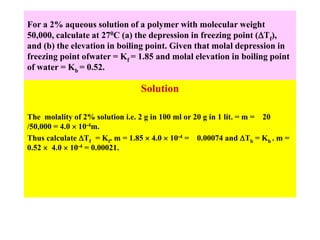
For a 2% aqueous solution of a polymer with molecular weight
50,000, calculate at 270C (a) the depression in freezing point (Tf),
and (b) the elevation in boiling point. Given that molal depression in
freezing point ofwater = Kf = 1.85 and molal elevation in boiling point
of water = Kb = 0.52.
Solution
The molality of 2% solution i.e. 2 g in 100 ml or 20 g in 1 lit. = m = 20
/50,000 = 4.0  10-4m.
Thus calculate Tf = Kf. m = 1.85  4.0  10-4 = 0.00074 and Tb = Kb . m =
0.52  4.0  10-4 = 0.00021.
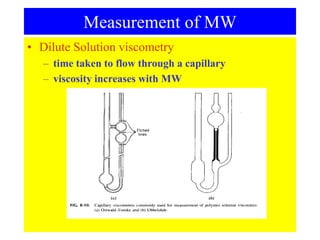
• Dilute Solution viscometry
– time taken to flow through a capillary
– viscosity increases with MW
Measurement of MW
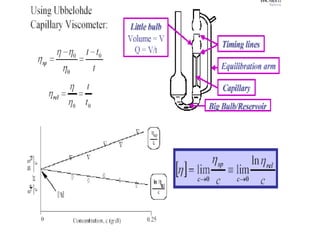
Ubblehode viscometer has the advantage that the
dilution of the polymer solutions can be done
within the viscometer itself.
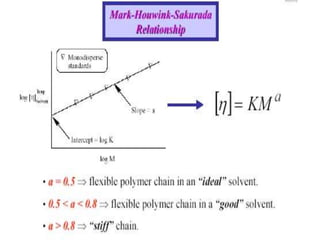
• Viscosity method is not a dirct method. It need the
values of constants of Mark-Houwink equation.
• The method is simple, inexpensive and not much
time consuming.
• Routinely employed in polymer mol wt
determination.
The intrinsic viscosity of myosin is 217 cm3 g-1. Calculate the approximate
concentration of myosin in water, which would have a relative viscosity of
1.5.
The intrinsic viscosity of a solution of polyisobutylene at 20oC is 180 cm3 g-1.
If [] is related to the viscosity - average molecular weight Mv by the
expression [] = 3.60  10-4 (Mv
0.64), calculate the molecular weight, Mv of
the polymer.
Solution [] = (sp/C)C0 = 217 cm3 g-1 and rel = 1.5, Since
sp = nrel – 1 = 1.5 – 1 = 0.5,
so introducing sp as 0.5 in (sp/C) and equating the whole term
to 217 cm3 g-1 , we get 0.5 / C = 217 cm3 g-1 ; C = 0.5/217 = 2.30
 10-3 g cm-3.
Solution [] = 3.60  10-4 (Mv)0.64 or 180 cm3. g-1 = 3.60  10-
4 (Mv)0.64, (Mv)0.64 = 180 cm3 g-1/ 3.60  10-4 = 5.0  105
taking the log form, 0.64 log Mv = log (5.0  105) and hence Mv
= 8.03  106 g mol-1
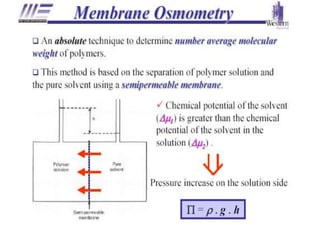
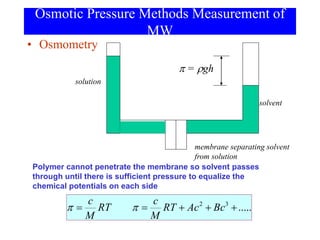
• Osmometry
 = rgh
membrane separating solvent
from solution
solution
solvent
Polymer cannot penetrate the membrane so solvent passes
through until there is sufficient pressure to equalize the
chemical potentials on each side
.....
3
2




 Bc
Ac
RT
M
c
RT
M
c


Osmotic Pressure Methods Measurement of
MW
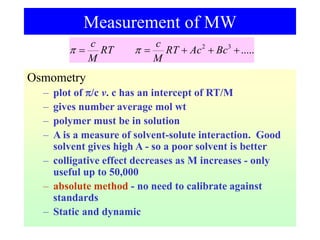
Osmometry
– plot of /c v. c has an intercept of RT/M
– gives number average mol wt
– polymer must be in solution
– A is a measure of solvent-solute interaction. Good
solvent gives high A - so a poor solvent is better
– colligative effect decreases as M increases - only
useful up to 50,000
– absolute method - no need to calibrate against
standards
– Static and dynamic
Measurement of MW
.....
3
2




 Bc
Ac
RT
M
c
RT
M
c


Polymer, Mn = 20,000 g mol-1, c = 0.01 g cm3
Property Size of effect
V.P. Lowering 4 x 10⁻³ mm Hg
B.P. Elevation 1.3 x 10⁻³ oC
F.P. Depression 2.5 x 10⁻³ oC
Osmotic pressure 15 cm solvent
Osmotic pressure is most sensitive
Measurement of MW - comparisons
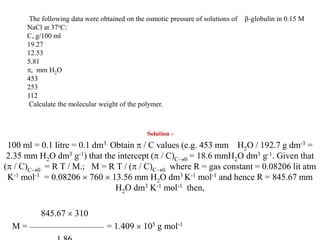
. The following data were obtained on the osmotic pressure of solutions of -globulin in 0.15 M
NaCl at 37oC:
C, g/100 ml
19.27
12.53
5.81
, mm H2O
453
253
112
Calculate the molecular weight of the polymer.
Solution –
100 ml = 0.1 litre = 0.1 dm3. Obtain  / C values (e.g. 453 mm H2O / 192.7 g dm-3 =
2.35 mm H2O dm3 g-1) that the intercept ( / C)C0 = 18.6 mmH2O dm3 g-1. Given that
( / C)C0 = R T / M.; M = R T / ( / C)C0 where R = gas constant = 0.08206 lit atm
K-1 mol-1 = 0.08206  760  13.56 mm H2O dm3 K-1 mol-1 and hence R = 845.67 mm
H2O dm3 K-1 mol-1 then,
845.67  310
M = _________________________ = 1.409  105 g mol-1
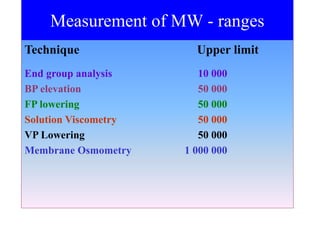
Technique Upper limit
End group analysis 10 000
BP elevation 50 000
FP lowering 50 000
Solution Viscometry 50 000
VP Lowering 50 000
Membrane Osmometry 1 000 000
Measurement of MW - ranges
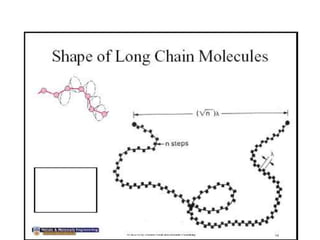
Fully Extended Chains
Contour length
End to end distance
Radius of gyration
Thank you

MSC I PIII Polymer Chem.ppt

  • 1.
    Polymers • General Introduction •Polymer Types • Polymerisation: Mechanism & Kinetics • Polymer molecular weight: Averages & Determination • Size of polymer chains
  • 2.
  • 3.
    What is aPolymer? • A high molar mass material (103 - 106 Daltons or more) • A polymer is formed by the combination of a large number of smaller units called ‘monomers’ linked through covalent linkages • Monomers should have minimum bifunctionality i.e.two functional groups or one double bond
  • 4.
    History of Polymers •1840-1920 Goodyear’s Vulcanization, Schonbein’s Cellulose nitrate, Menard’s Colloidion, Hyatt’s Celluloid, Chardonnet’s regenerated cellulose fibres, Baekeland’s Bakelite • 1920 - Hermann Staudinger gives the concept of macromolecules and actual polymer chemistry started thereafter After the Polymer concept was recognized , Polymers next few decades developed polymers as a full fledged science , truly in to POLYMER AGE
  • 5.
    Polymeric Materials Organic – NaturalPolysaccharides (Cellulose, starch,etc) Proteins (Silk, wool, enzymes) Natural rubber (cis-1,4-polyisoprene) Nucleic acids( DNA, RNA) – Synthetic Rubbers Plastics Fibres Coatings, Inorganic – Natural Clays, Sand, Glass – Synthetic Polyphosphazenes, Silicones
  • 6.
    Nomenclature Source name IUPACname Polyethylene Poly(methylene) Polytetrafluoroethylene Poly(difluoromethane) Polystyrene Poly(1-phenylethene) Poly(acrylic acid) Poly(1-carboxylatoethene) Poly(-methylstyrene) Poly(1-methyl-1-phenylethene) Poly(1-pentene) Poly[1-(1-propyl)ethylene]
  • 7.
    Isomerism in Polymers Geometricalisomers Configuration - atactic, isotactic, syndiotactic B B B B A A A A B A B A A B A B B B A B A A B A isotactic syndiotactic atactic All cis-polyisoprene
  • 8.
    Plastics Commodity • High volume- low cost • Disposable packaging and film • poly(ethene), PVC, poly(styrene), poly(propene) Engineering • Low volume - high cost • Superior mechanical properties, durability • Compete with metals, ceramics, glass • Acetal, nylon, polyacrylate, polycarbonate,polyester, PEEK, PEI, PPO, PPS, polysulphone • Phenol-, melamine-, urea-formaldehyde, unsaturated polyester, epoxy
  • 9.
    Uses of Polymers ElastomersPlastics Fibres Polyisoprene Polyethylene Polyamide SBR Polystyrene Polyester Polyisobutylene Teflon Cellulosics Polyurethanes PVC Polyacrylonitrile Silicones Polyurethane Polypropylene Formaldehyde resins
  • 10.
  • 11.
    Classification of Polymers •Addition and Condensatiom • Natural and Synthetic • Homochain and Heterochain • Monodispersed and Polydispersed • Homopolymers, Copolymers and Terpolymers • Linear, Branched and Network Polymers • Charged and Uncharged Polymers • Thermoplasts and Thermosetts • Crystalline and Amorphous Polymers • Fibres, Plastics and Elastomers • Isotactic, Syndiotactic and Atactic Polymers
  • 12.
    Homo, Co andTerpolymers Homopolymers ~AAAAAAAAAAAAAAAAAAAAAAAAAAA~ Copolymers Alternating ABABABABABABABABABABABABABA Random ~AAABBBBAABBBBBBABABBBAAABBBBB~ Block ~AAAAA~~~~~~AAAABBBBB~~~~~~BBBB~ Graft ~AAAAAAAAAAAAAAAAAAAAAAAAAAAA~ B B BBBBBBBBBB~ Terpolymers AAC ABCCBBCCBBBCCC AABC ABB
  • 13.
    Addition and condensationpolymers • Addition Polymers Or Chain Polymers Monomer Unsaturated • Condensation Polymers Or Step Polymers Monomer(s) contain atleast 2 functional groups
  • 14.
    Monomer, Constitutional RepeatUnit, Degree of Polymerization CH2 CH [ ] Cl 1000 ( i ) Monomer : Vinyl Chloride Cl CH CH2 ( ii ) DP : 1000 ( ii ) i Molecular Weight of Polymer = Mol. Wt. of Monomer x DP = 62.5 x 1000 = 62,500 ( iv ) CRU : Cl CH CH2 ( ) PVC
  • 15.
  • 16.
    Step-Growth Polymers Monomers withfunctional groups Polyester Polyamides Polycarbonates Polyether Polyurethane PF, UF and MF Resins etc
  • 17.
    Poly(ethylene terephthalate) OCH2CH2OC C OO n PET = n HOCH2CH2OH CO2H HO2C + n PET 2n H2O + n HOCH2CH2OH PET CH3O2C CO2CH3 + n 2n CH3OH + n HOCH2CH2OH COCl ClCO PET + 2n HCl + n n ClCH2CH2Cl NaO2C CO2Na + n + n PET + 2n NaCl CO2H HO2C + n AcOCH2CH2OAc PET 2n HOAc +
  • 18.
    Ester Exchange CH3O2C CO2CH3excess HOCH2CH2OH + Ca(OAc)2 197o HOCH2CH2O2C CO2CH2CH2OH 280o high vacuum OCH2CH2O2C CO2 H CH2CH2OH n HOCH2CH2OH +
  • 19.
    Polyamides: Nylons Condensation polymer •Faster than polyester - self-catalysed • 1:1 Salt formation gives proper stoichiometry • Equilibrium much further to right Nylon 6,6 - poly(hexamethylene adipamide) H2N(CH2)6NH2 HO2C(CH2)4CO2H + + H3N(CH2)6NH3 + - O2C(CH2)4CO2 - 280o HO2C(CH2)4CONH(CH2)6NH
  • 20.
  • 21.
    Linear, Branched &Crosslinked Chains ( Linear) Branches - star, comb, random Network
  • 22.
    Thermoplastics and Thermosetts •Thermoplastic – “Linear” architecture – Processable at moderate temperatures – Soluble and Melt • Polyethylene, PVC, PET • Thermosetting – Cross-linked architecture – Not processable after forming – Insoluble and Infusible • Polyurethane, Formaldehyde resins
  • 23.
    Synthetic Polymers • Plastics •Fibres • Rubbers ( Elastomers) • Surface coatings and adhesives
  • 24.
    Fibres High strength andmodulus. Good elongation, thermal stability Better spinnability Natural • cotton - polysaccharide ( cellulose) • wool, silk - protein (polyamino acid) Synthetic • Cellulosic - rayon, viscose • Non-cellulosic - polyester, nylon, acrylic,polypropene
  • 25.
    Elastomers Large, reversible elongation(500-1000%) • Completely amorphous • Low Tg • Light cross-linking Natural cis-polyisoprene Synthetic Poly(styrene-butadiene), poly(butadiene), EPDM, polychloroprene, nitrile, butyl, silicone, urethane,thermoplastic elastomers
  • 26.
    Coatings and adhesives Coatings •Shellac • Lacquers - cellulose acetate and nitrate • polyesters (alkyds) • latex paints - poly(vinyl acetate), PMMA Adhesives • Bitumens, natural gums and resins • Starch, cellulose nitrate • phenol-, urea-formaldehyde • epoxies, cyanoacrylates
  • 27.
  • 28.
    Distinguishing features ofChain- and Step-Polymerisation Chain Polymerisation Step Polymerisation Only growth reaction adds Any two molecular species repeating units one at a time can react Monomer concentration Monomer disappears early in decreases steadily throughout reaction, at DP 10 less than the reaction 1% monomer remains High polymer is formed at once; Polymer MW rises steadily polymer MW changes little through the reaction through the reaction Long reaction times give high Long reaction times essential yields but affect MW little for high MW Reaction mixture contains only At any stage all molecular monomer, high polymer and species are present in a about 1/100 000 000 part of calculable distribution growing chains
  • 29.
    Chain Polymerisation • Mustbe activated • Basic individual steps – Initiation – Propagation – Termination CH2 CH X CH2 CH X n n sp3 sp2 
  • 30.
    Chain Polymerization Free radicalPolymerization CationicPolymerization AnionicPolymerization Ziegler Natta Polymerization
  • 31.
    Initiators for ChainGrowth Radical Cationic Anionic Coordination Peroxides Azo Compounds Redox systems Light Radiation Proton or Lewis acids Carbocations Oxonium ions Radiation Organo- alkalis Lewis Bases Radiation Transition metal complexes
  • 32.
    Chain polymerisation +I (electronrich) Cationic e.g. isobutene, vinyl ethers -I (electron poor) Anionic e.g. acrylonitrile, methyl methacrylate Intermediate Free radical e.g. acrylonitrile, methyl methacrylate, vinyl acetate Some monomers (e.g. styrene) can polymerise via two or more routes CH2 C R R
  • 33.
    General Polymerisation Mechanism Initiation Propagation Termination CH2CH2 X* + X CH2 CH2* X CH2 CH2* CH2 CH2 + X (CH2CH2)n CH2CH2* X (CH2CH2)n CH2CH2* X (CH2CH2)n CH2CH2 Y X X X* 2
  • 34.
    Generation of FreeRadicals • Thermal – Rate constant 10-5 - 10-8 sec-1 – Decompose at 50-150 oC • Photochemical – Short wavelength for direct initiation – Longer wavelength uses photochemical initiator such as benzoin or AIBN • High Energy Radiation – Electrons, gamma rays, x-rays, slow neutrons – Relatively uncontrolled because of high energy • Redox – Aqueous media – Often used for emulsion polymerisation • Electrochemical
  • 35.
    Sources of FreeRadicals C O O O C O C O O 2 S O O O O S O O - O O- SO4 - 2 2 H2O 2 HSO4 - + + SO4 - 2 HO 2 C CH3 CH3 CN N N C CH3 CH3 CN C CH3 CH3 CN N2 2
  • 36.
    Low Temperature Initiation •Induced decomposition • Oxidation-reduction C O O O C O N(CH3)2 + N(CH3)2 C O - O C O O + ROOH Co 2+ RO OH - Co 3+ + + +
  • 37.
    Initiation • Initiator efficiencyf = 0.6 - 1.0 – Recombination (cage effect) – Decomposition I 2 R CH2 CHX + RCH2C H X R
  • 38.
    Propagation CH2 CHX RCH2C H X + R CH2CHX X H CH2C RCH2CHX X H CH2C n R (CHCHX)n X H CH2C CH2 CHX +
  • 39.
    Termination • Combination • Disproportionation + CH2C H X CCH2 H X CH2CCCH2 H H X X + CH2C H X CCH2 H X CH2C H H X C CH H X +
  • 40.
    Chain Transfer + CH2C H X CCl4 CHC H X ClCCl3 + + CH2C H X CH2 CHX CH2CH2X + CH2 C X CH CHX + CH3C H X
  • 41.
    Configuration head-to-tail tail-to-tail, head-to-head CH2 CHX + R RCH2 CH X R CH CH2 X CH2 CH CH2 CH CH2 CH X X X CH2 CH CH CH2 CH2 CH CH CH2 X X X X
  • 42.
  • 43.
    Anionic Chain PolymerisationInitiation & Propagation • Catalysts MNH2, MOR, MAryl, MOH, MCN M = metal • Initiation B:- is a negative fragment derived from any of the catalysts. – Weak bases for monomers with strong -I groups – Strong bases (NH2 -, R-) for weak -I groups • Propagation B CH2 C H Y CH2 C H Y B CH2 C H Y CH2 C H Y CH2 C H Y Y H C CH2
  • 44.
    Non-Terminating Anionic Polymerisation •Conditions needed to form “living” polymers – Solvents inactive to transferring positive charge to propagating anion, e.g. dioxan, tetrahydrofuran – Absence of O2, CO2, water, other impurities • Termination by chain transfer agent • Block copolymers – Add a second monomer to living polymer Narrow molecular weight distribution – Mw/Mn is 1.1 or less • Controlled MW – xn = [M]/[I] X SSSSSSS- X- S B X SSSSSSSBBBBBBBB-
  • 45.
    Kinetics of VinylRadical Polymerisation • Initiation Two Chains started EA ~ 25-30 kcal I 2 R CH2 CHX + RCH2C H X R R d dt fk i d    [ ] [ ] M I 2 kd
  • 46.
    Kinetics of ChainPolymerisation • Propagation All chains have same reactivity EA ~ 5-10 kcal CH2 CHX RCH2C H X + R CH2CHX X H CH2C R CH2CHX X H CH2C n R (CHCHX)n X H CH2C CH2 CHX + ] M ][ M [  p p k R kp
  • 47.
    Kinetics of ChainPolymerisation • Termination EA ~ 3-5 kcal + CH2C H X CCH2 H X CH2C CCH2 H H X X + CH2C H X CCH2 H X CH2C H H X C CH H X + 2 ] M [ 2  t t k R kt kt
  • 48.
    Kinetics of ChainPolymerisation ki Low rate constant kp 102-103 l mol-1 sec-1 kt 107-109 l mol-1 sec-1 Hence a steady state of free radicals, i.e. R R fk k fk k R k fk k i t d t d t p p d t                   2 2 2 2 1 2 1 2 [ ] [ ] [ ] [ ] [ ] [ ] I M M I I M
  • 49.
    Kinetic Chain Length Numberof Monomer Units Consumed / Active Centre For initiated polymerisation:      R R R R k k p i p t p t [ ] [ ] M M 2   k k R p t p 2 2 2 [ ] M 2 1 2 1 ] I [ ) ( 2 ] M [ t d p k fk k   R k p p   [ ][ ] M M 2 1 ] I [ ] M [           t d k fk
  • 50.
    Degree of Polymerisation Numberof monomer units / Polymer chain Kinetic chain length ()  DP Proportionality constant depends on termination mode Combination DP = 2 Disproportionation DP = 
  • 51.
    Questions 1.Write chemical equationsfor the following reactions in the benzoyl peroxide- initiated polymerisation of vinyl chloride: initiation, propagation, termination by combination and by disproportionation, transfer to monomer and to polymer. 2.Write kinetic equations for initiated radical chain polymerisation showing (a) how rate is related to concentrations of initiator, radicals, and monomer and (b) how degree of polymerisation is related to the same quantities. 3. a. Which of the following monomers would you expect to polymerise readily by a free-radical mechanism? Why? CH2=C(CH3)2, CH2=CHCH3, CH2=CHCH=CH2 b. Which of the above compounds would you expect to be most susceptible to attack by free radicals? Why?
  • 52.
    A monomer withmolecular weight 100 and density 1 photopolymerises in bulk at a rate of 3.6 wt.% per hour when the rate of initiation is 1 x 10⁻⁹, mole/litre- sec. The radical lifetime is 10 sec. Calculate [M], kp, kt, Mn., and Mw, assuming termination by combination and no transfer. Molarity of monomer = 10 (l litre = 1000g = 10 moles, so conc. is 10 moles/litre) Rate of propagation = (0.036 x 10) /3600 moles/litre/sec = 10-6 Radical life = 10 seconds = 1/2kt[M ], so [M ] = 1/20 kt (1) Rate of initiation = Rate of termination = kt[M ]2 = 1 x 10⁻⁹ (2) Combining (1) and (2), [M] = 20 x 10-9 kp = rate of propagation/( [M][M] ) = 10-6 / 10 / 2 x 10-8 = 0.05 Everything else is easy - only need to substitute in standard equations for termination and kinetic chain length. For termination by combination, Mw = 1.5 Mn.
  • 53.
    Molecular Weights ofPolymers Never monodispersed Can be of different mol wt
  • 54.
    Molecular weight Small molwt substances vs Polymers • Molecular weight is a characteristic of a compound. • All small mol wt compounds have a definite molecular weight. It is not so in case of polymers. • Even a particular sample of polymer has molecules of different size.
  • 55.
    Molecular Weight Averages •Number average • Weight average • Z-average • Viscosity average        1 1 i i i i i n N N M M        1 2 1 i i i i i i w M N M N M        1 2 3 1 i i i i i i z M N M N M a i i i a i i i v M N M N M 1 1 1 1                
  • 56.
    Equal number ofmolecules with M1 = 10,000 and M2 = 1,00,000 are mixed. Calculate Mn and Mw. Solution - Let n1 = n2 = 10 (say), then, n1M1 + n2M2 (10  10,000) + (10  100,000) Mn = __________________ = _____________________________________ n1 + n2 (10 + 10) 105 + 106 105 (1 + 10) 11  104 = _____________ = _________________ = _____________ = 55,000 g mol-1 20 20 2 n1M1 2 + n1M2 2 [ 10  (10,000)2 ] + [ 10  (1,00,000)2 ] Mw = _____________________ = __________________________________________________ n1M1 + n2M2 [ 10  10,000 ] + [ 10  1,00,000 ] 109 + 1011 109(1 + 100) 101  104 = _________________ = __________________ = _______________ 105 + 106 105 (1 + 10) 11 = 91,818  92,000 g mol-1
  • 57.
    Equal masses ofpolymer molecules with M1 = 10,000 and M2 = 1,00,000 are mixed. Calculate Mn and Mw. Calculate Mn, Mw and Mz for a polymer consisting of three fractions with molecular weights, 1  105, 2  105 and 3  105
  • 58.
    Polydispersity Typical ranges ofpolydispersity (Mw/Mn) Hypothetical monodisperse polymer 1.000 Actual "monodisperse" "living" polymers 1.01-1.05 Addition polymer, coupling terminated 1.5 Addition polymer, disproportionation terminated or condensation polymer 2.0 High conversion vinyl polymers 2 - 5 Coordination polymers 8 - 30 Branched polymers 20 - 50
  • 59.
    Molecular weight distribution MolarMass M M M n v w Weight fraction M x
  • 60.
  • 61.
    Properties v. MW MolarMass Tensile strength Impact resistance Melt Viscosity
  • 62.
    Measurement of MW •End group analysis – Measure concentration of end-groups (from initiator or terminator) – Chemical or spectroscopic analysis – Only for Mn < 10,000 g mol-1 • Colligative properties – freezing point depression, boiling point elevation, osmotic pressure, vapour pressure – gives concentration in mol dm-3, so if we know the mass we can calculate Mn • Viscosity • Gel Permeation Chromatography
  • 63.
    For a 2%aqueous solution of a polymer with molecular weight 50,000, calculate at 270C (a) the depression in freezing point (Tf), and (b) the elevation in boiling point. Given that molal depression in freezing point ofwater = Kf = 1.85 and molal elevation in boiling point of water = Kb = 0.52. Solution The molality of 2% solution i.e. 2 g in 100 ml or 20 g in 1 lit. = m = 20 /50,000 = 4.0  10-4m. Thus calculate Tf = Kf. m = 1.85  4.0  10-4 = 0.00074 and Tb = Kb . m = 0.52  4.0  10-4 = 0.00021.
  • 65.
    • Dilute Solutionviscometry – time taken to flow through a capillary – viscosity increases with MW Measurement of MW
  • 66.
    Ubblehode viscometer hasthe advantage that the dilution of the polymer solutions can be done within the viscometer itself.
  • 69.
    • Viscosity methodis not a dirct method. It need the values of constants of Mark-Houwink equation. • The method is simple, inexpensive and not much time consuming. • Routinely employed in polymer mol wt determination.
  • 70.
    The intrinsic viscosityof myosin is 217 cm3 g-1. Calculate the approximate concentration of myosin in water, which would have a relative viscosity of 1.5. The intrinsic viscosity of a solution of polyisobutylene at 20oC is 180 cm3 g-1. If [] is related to the viscosity - average molecular weight Mv by the expression [] = 3.60  10-4 (Mv 0.64), calculate the molecular weight, Mv of the polymer. Solution [] = (sp/C)C0 = 217 cm3 g-1 and rel = 1.5, Since sp = nrel – 1 = 1.5 – 1 = 0.5, so introducing sp as 0.5 in (sp/C) and equating the whole term to 217 cm3 g-1 , we get 0.5 / C = 217 cm3 g-1 ; C = 0.5/217 = 2.30  10-3 g cm-3. Solution [] = 3.60  10-4 (Mv)0.64 or 180 cm3. g-1 = 3.60  10- 4 (Mv)0.64, (Mv)0.64 = 180 cm3 g-1/ 3.60  10-4 = 5.0  105 taking the log form, 0.64 log Mv = log (5.0  105) and hence Mv = 8.03  106 g mol-1
  • 72.
    • Osmometry  =rgh membrane separating solvent from solution solution solvent Polymer cannot penetrate the membrane so solvent passes through until there is sufficient pressure to equalize the chemical potentials on each side ..... 3 2      Bc Ac RT M c RT M c   Osmotic Pressure Methods Measurement of MW
  • 73.
    Osmometry – plot of/c v. c has an intercept of RT/M – gives number average mol wt – polymer must be in solution – A is a measure of solvent-solute interaction. Good solvent gives high A - so a poor solvent is better – colligative effect decreases as M increases - only useful up to 50,000 – absolute method - no need to calibrate against standards – Static and dynamic Measurement of MW ..... 3 2      Bc Ac RT M c RT M c  
  • 74.
    Polymer, Mn =20,000 g mol-1, c = 0.01 g cm3 Property Size of effect V.P. Lowering 4 x 10⁻³ mm Hg B.P. Elevation 1.3 x 10⁻³ oC F.P. Depression 2.5 x 10⁻³ oC Osmotic pressure 15 cm solvent Osmotic pressure is most sensitive Measurement of MW - comparisons
  • 75.
    . The followingdata were obtained on the osmotic pressure of solutions of -globulin in 0.15 M NaCl at 37oC: C, g/100 ml 19.27 12.53 5.81 , mm H2O 453 253 112 Calculate the molecular weight of the polymer. Solution – 100 ml = 0.1 litre = 0.1 dm3. Obtain  / C values (e.g. 453 mm H2O / 192.7 g dm-3 = 2.35 mm H2O dm3 g-1) that the intercept ( / C)C0 = 18.6 mmH2O dm3 g-1. Given that ( / C)C0 = R T / M.; M = R T / ( / C)C0 where R = gas constant = 0.08206 lit atm K-1 mol-1 = 0.08206  760  13.56 mm H2O dm3 K-1 mol-1 and hence R = 845.67 mm H2O dm3 K-1 mol-1 then, 845.67  310 M = _________________________ = 1.409  105 g mol-1
  • 76.
    Technique Upper limit Endgroup analysis 10 000 BP elevation 50 000 FP lowering 50 000 Solution Viscometry 50 000 VP Lowering 50 000 Membrane Osmometry 1 000 000 Measurement of MW - ranges
  • 81.
    Fully Extended Chains Contourlength End to end distance Radius of gyration
  • 82.