Methods of
polymerization of
homo and hetero
    polymers
            M.Shravani
          M.Pharm 1st year
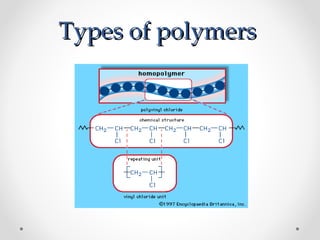
Types of polymers
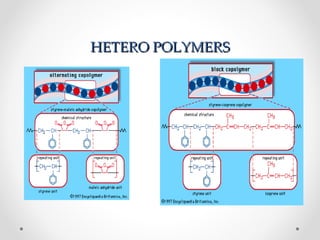
HETERO POLYMERS
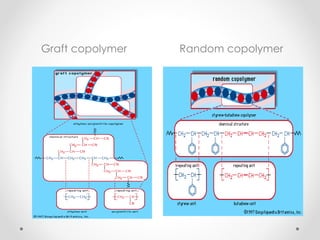
Graft copolymer   Random copolymer
TYPES OF
      POLYMERIZATION
•   CHAIN GROWTH POLYMERIZATION
•   Free radical
•   Ionic
•   Cationic
•   Anionic
•   Insertion
•   Ring opening polymerization
•   STEP GROWTH POLYMERIZATION
Chain growth
             polymerization
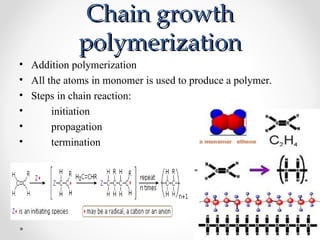
• Addition polymerization
• All the atoms in monomer is used to produce a polymer.
• Steps in chain reaction:
•      initiation
•      propagation
•      termination
Step growth
             polymerization
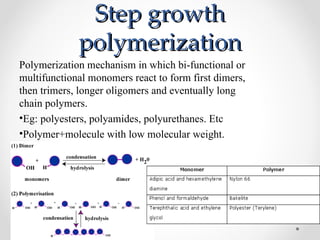
Polymerization mechanism in which bi-functional or
multifunctional monomers react to form first dimers,
then trimers, longer oligomers and eventually long
chain polymers.
•Eg: polyesters, polyamides, polyurethanes. Etc
•Polymer+molecule with low molecular weight.
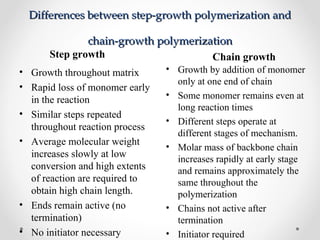
Differences between step-growth polymerization and

              chain-growth polymerization
      Step growth                    Chain growth
• Growth throughout matrix      • Growth by addition of monomer
                                  only at one end of chain
• Rapid loss of monomer early
  in the reaction               • Some monomer remains even at
                                  long reaction times
• Similar steps repeated
                                • Different steps operate at
  throughout reaction process
                                  different stages of mechanism.
• Average molecular weight
                                • Molar mass of backbone chain
  increases slowly at low         increases rapidly at early stage
  conversion and high extents     and remains approximately the
  of reaction are required to     same throughout the
  obtain high chain length.       polymerization
• Ends remain active (no        • Chains not active after
  termination)                    termination
• No initiator necessary        • Initiator required
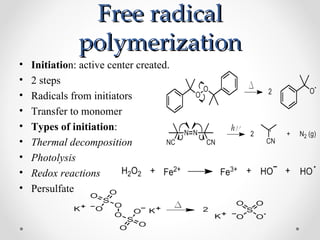
Free radical
               polymerization
•   Initiation: active center created.
•   2 steps
•   Radicals from initiators
•   Transfer to monomer
•   Types of initiation:
•   Thermal decomposition
•   Photolysis
•   Redox reactions
•   Persulfate
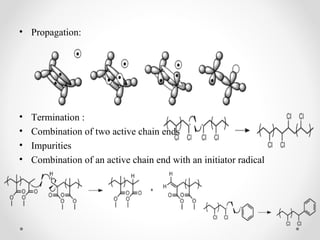
• Propagation:


•   Termination :
•   Combination of two active chain ends
•   Impurities
•   Combination of an active chain end with an initiator radical
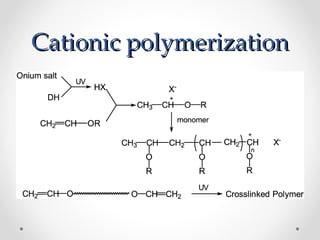
Cationic polymerization
• Cationic initiator binds & transfers charge to monomer.
• Reactive monomer reacts with other monomer to form a
  polymer.
• Active site: carboniumion ,
   oxonium, sulfonium or phosphonium ion
• Monomers: alkoxy. phenyl, vinyl, 1,1-dialkyl-substituted
  alkene monomers.
• Initiator: provide electrophile
  eg: bronsted acids(acetic acid,HCL), Lewis acids+electron
  donor.
• Application :polyisobutylene.
Cationic polymerization
Anionic polymerization
• Carried out through carbanion active species.
• Monomer: vinyl monomers with substituents on double bond
  able to stabilise a –ve charge.
    o Eg: styrene, dienes, methacrylate,
      vinyl pyridine, aldehydes, epoxide, episulfide
      cyclic siloxane, and lactones
• Polar monomers:
    o eg: acrylonitrile, cyanoacrylate, propylene oxide,
      vinyl ketone, acrolein, vinyl sulfone,
      vinyl sulfoxide, vinylsilane andisocyanate.
• .
•   Solvents- polar solvents decrease stability.
•   initiation : electron transfer, strong acids.
•   Propagation: very fast,low temp, heat is released.
•   Termination: quenching, water, alcohol, chain transfer.
•   Application :polydiene synthetic rubbers, solution
    styrene/butadiene rubbers (SBR), and styrenic
    thermoplastic elastomers
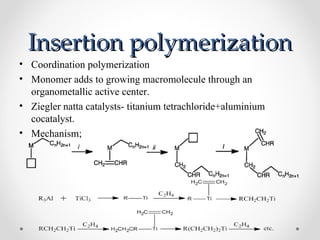
Insertion polymerization
• Coordination polymerization
• Monomer adds to growing macromolecule through an
  organometallic active center.
• Ziegler natta catalysts- titanium tetrachloride+aluminium
  cocatalyst.
• Mechanism;
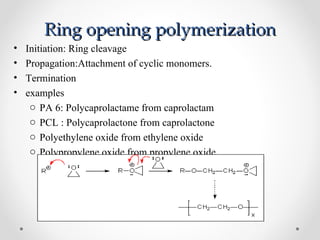
Ring opening polymerization
•   Initiation: Ring cleavage
•   Propagation:Attachment of cyclic monomers.
•   Termination
•   examples
     o PA 6: Polycaprolactame from caprolactam
     o PCL : Polycaprolactone from caprolactone
     o Polyethylene oxide from ethylene oxide
     o Polypropylene oxide from propylene oxide
Polymerization
                techniques
•   Bulk polymerization
•   Solution polymerization
•   Suspension polymerization
•   Emulsion polymerization
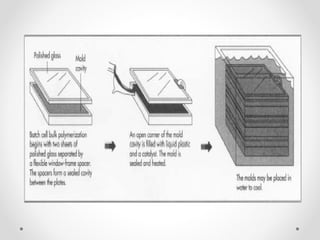
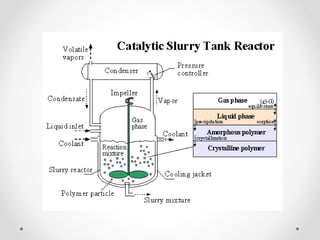
Bulk polymerization
• Mass or block polymerization: Polymerization of the undiluted
  monomer.
• carried out by adding a soluble initiator to pure monomer into
  liquid state.
• Viscosity increases dramatically during conversion
• 2 types
   o Quiescent bulk polymerization
   o Eg: phenol- formaldehyde condensation
   o Stirred bulk polymerization
   o Eg: nylon 66.
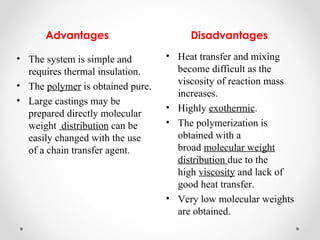
Advantages                       Disadvantages

• The system is simple and        • Heat transfer and mixing
  requires thermal insulation.      become difficult as the
• The polymer is obtained pure.     viscosity of reaction mass
                                    increases.
• Large castings may be
                                  • Highly exothermic.
  prepared directly molecular
  weight distribution can be      • The polymerization is
  easily changed with the use       obtained with a
  of a chain transfer agent.        broad molecular weight
                                    distribution due to the
                                    high viscosity and lack of
                                    good heat transfer.
                                  • Very low molecular weights
                                    are obtained.
Solution polymerization
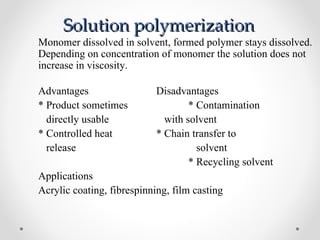
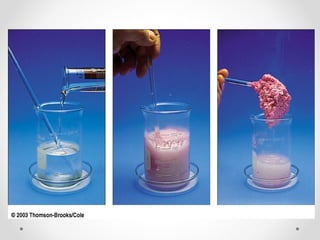
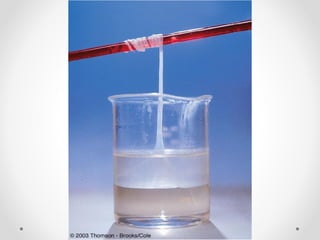
Monomer dissolved in solvent, formed polymer stays dissolved.
Depending on concentration of monomer the solution does not
increase in viscosity.

Advantages                  Disadvantages
* Product sometimes                 * Contamination
  directly usable             with solvent
* Controlled heat           * Chain transfer to
  release                             solvent
                                    * Recycling solvent
Applications
Acrylic coating, fibrespinning, film casting
Suspension
               polymerization
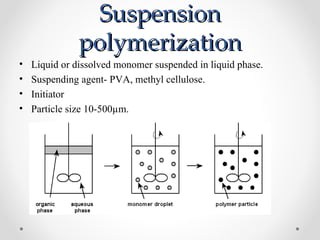
•   Liquid or dissolved monomer suspended in liquid phase.
•   Suspending agent- PVA, methyl cellulose.
•   Initiator
•   Particle size 10-500µm.
Emulsion polymerization
• Water
• Monomer
• Surfactant
Examples:
• Synthetic rubber-styrene-
  butadiene (SBR), Polybutadiene,
  Polychloroprene.
• Plastics-PVC, polystyrene,
  Acrylonitrile-butadiene-styrene
  terpolymer (ABS).
• Dispersions-polyvinyl acetate,
  polyvinyl acetate copolymers,
  latexacrylic paint, Styrene-butadiene,
  VAE
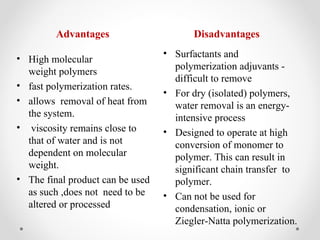
Advantages                      Disadvantages
                                  • Surfactants and
• High molecular
                                    polymerization adjuvants -
  weight polymers
                                    difficult to remove
• fast polymerization rates.
                                  • For dry (isolated) polymers,
• allows removal of heat from       water removal is an energy-
  the system.                       intensive process
• viscosity remains close to      • Designed to operate at high
  that of water and is not          conversion of monomer to
  dependent on molecular            polymer. This can result in
  weight.                           significant chain transfer to
• The final product can be used     polymer.
  as such ,does not need to be    • Can not be used for
  altered or processed              condensation, ionic or
                                    Ziegler-Natta polymerization.

892162 634358293912422500

  • 1.
    Methods of polymerization of homoand hetero polymers M.Shravani M.Pharm 1st year
  • 2.
  • 3.
  • 4.
    Graft copolymer Random copolymer
  • 5.
    TYPES OF POLYMERIZATION • CHAIN GROWTH POLYMERIZATION • Free radical • Ionic • Cationic • Anionic • Insertion • Ring opening polymerization • STEP GROWTH POLYMERIZATION
  • 6.
    Chain growth polymerization • Addition polymerization • All the atoms in monomer is used to produce a polymer. • Steps in chain reaction: • initiation • propagation • termination
  • 7.
    Step growth polymerization Polymerization mechanism in which bi-functional or multifunctional monomers react to form first dimers, then trimers, longer oligomers and eventually long chain polymers. •Eg: polyesters, polyamides, polyurethanes. Etc •Polymer+molecule with low molecular weight.
  • 8.
    Differences between step-growthpolymerization and chain-growth polymerization Step growth Chain growth • Growth throughout matrix • Growth by addition of monomer only at one end of chain • Rapid loss of monomer early in the reaction • Some monomer remains even at long reaction times • Similar steps repeated • Different steps operate at throughout reaction process different stages of mechanism. • Average molecular weight • Molar mass of backbone chain increases slowly at low increases rapidly at early stage conversion and high extents and remains approximately the of reaction are required to same throughout the obtain high chain length. polymerization • Ends remain active (no • Chains not active after termination) termination • No initiator necessary • Initiator required
  • 9.
    Free radical polymerization • Initiation: active center created. • 2 steps • Radicals from initiators • Transfer to monomer • Types of initiation: • Thermal decomposition • Photolysis • Redox reactions • Persulfate
  • 10.
    • Propagation: • Termination : • Combination of two active chain ends • Impurities • Combination of an active chain end with an initiator radical
  • 11.
    Cationic polymerization • Cationicinitiator binds & transfers charge to monomer. • Reactive monomer reacts with other monomer to form a polymer. • Active site: carboniumion , oxonium, sulfonium or phosphonium ion • Monomers: alkoxy. phenyl, vinyl, 1,1-dialkyl-substituted alkene monomers. • Initiator: provide electrophile eg: bronsted acids(acetic acid,HCL), Lewis acids+electron donor. • Application :polyisobutylene.
  • 12.
  • 13.
    Anionic polymerization • Carriedout through carbanion active species. • Monomer: vinyl monomers with substituents on double bond able to stabilise a –ve charge. o Eg: styrene, dienes, methacrylate, vinyl pyridine, aldehydes, epoxide, episulfide cyclic siloxane, and lactones • Polar monomers: o eg: acrylonitrile, cyanoacrylate, propylene oxide, vinyl ketone, acrolein, vinyl sulfone, vinyl sulfoxide, vinylsilane andisocyanate. • .
  • 14.
    Solvents- polar solvents decrease stability. • initiation : electron transfer, strong acids. • Propagation: very fast,low temp, heat is released. • Termination: quenching, water, alcohol, chain transfer. • Application :polydiene synthetic rubbers, solution styrene/butadiene rubbers (SBR), and styrenic thermoplastic elastomers
  • 15.
    Insertion polymerization • Coordinationpolymerization • Monomer adds to growing macromolecule through an organometallic active center. • Ziegler natta catalysts- titanium tetrachloride+aluminium cocatalyst. • Mechanism;
  • 16.
    Ring opening polymerization • Initiation: Ring cleavage • Propagation:Attachment of cyclic monomers. • Termination • examples o PA 6: Polycaprolactame from caprolactam o PCL : Polycaprolactone from caprolactone o Polyethylene oxide from ethylene oxide o Polypropylene oxide from propylene oxide
  • 17.
    Polymerization techniques • Bulk polymerization • Solution polymerization • Suspension polymerization • Emulsion polymerization
  • 18.
    Bulk polymerization • Massor block polymerization: Polymerization of the undiluted monomer. • carried out by adding a soluble initiator to pure monomer into liquid state. • Viscosity increases dramatically during conversion • 2 types o Quiescent bulk polymerization o Eg: phenol- formaldehyde condensation o Stirred bulk polymerization o Eg: nylon 66.
  • 21.
    Advantages Disadvantages • The system is simple and • Heat transfer and mixing requires thermal insulation. become difficult as the • The polymer is obtained pure. viscosity of reaction mass increases. • Large castings may be • Highly exothermic. prepared directly molecular weight distribution can be • The polymerization is easily changed with the use obtained with a of a chain transfer agent. broad molecular weight distribution due to the high viscosity and lack of good heat transfer. • Very low molecular weights are obtained.
  • 22.
    Solution polymerization Monomer dissolvedin solvent, formed polymer stays dissolved. Depending on concentration of monomer the solution does not increase in viscosity. Advantages Disadvantages * Product sometimes * Contamination directly usable with solvent * Controlled heat * Chain transfer to release solvent * Recycling solvent Applications Acrylic coating, fibrespinning, film casting
  • 25.
    Suspension polymerization • Liquid or dissolved monomer suspended in liquid phase. • Suspending agent- PVA, methyl cellulose. • Initiator • Particle size 10-500µm.
  • 26.
    Emulsion polymerization • Water •Monomer • Surfactant Examples: • Synthetic rubber-styrene- butadiene (SBR), Polybutadiene, Polychloroprene. • Plastics-PVC, polystyrene, Acrylonitrile-butadiene-styrene terpolymer (ABS). • Dispersions-polyvinyl acetate, polyvinyl acetate copolymers, latexacrylic paint, Styrene-butadiene, VAE
  • 27.
    Advantages Disadvantages • Surfactants and • High molecular polymerization adjuvants - weight polymers difficult to remove • fast polymerization rates. • For dry (isolated) polymers, • allows removal of heat from water removal is an energy- the system. intensive process • viscosity remains close to • Designed to operate at high that of water and is not conversion of monomer to dependent on molecular polymer. This can result in weight. significant chain transfer to • The final product can be used polymer. as such ,does not need to be • Can not be used for altered or processed condensation, ionic or Ziegler-Natta polymerization.