Content
 Introduction
 Advantages and uses of polymers
 Classification of polymers
 Mechanism of polymerization
 Polymerization techniques
 Molecular weight determination
 Conducting and biodegradable polymers
Introduction
 Term “Polymer” derived from Greek word polus, means
“many much”.
 Long chain molecules formed by joining together of
thousands of small molecular units by chemical bonds.
 Molecular weight 103-107
 Properties entirely different from its monomers.
 Contains structural identity, repeating itself several
times.
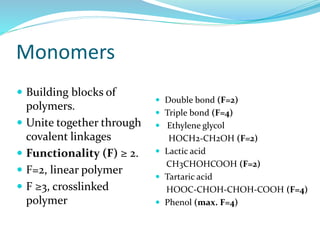
Monomers
 Double bond (F=2)
 Triple bond (F=4)
 Ethylene glycol
HOCH2-CH2OH (F=2)
 Lactic acid
CH3CHOHCOOH (F=2)
 Tartaric acid
HOOC-CHOH-CHOH-COOH (F=4)
 Phenol (max. F=4)
 Building blocks of
polymers.
 Unite together through
covalent linkages
 Functionality (F) ≥ 2.
 F=2, linear polymer
 F ≥3, crosslinked
polymer
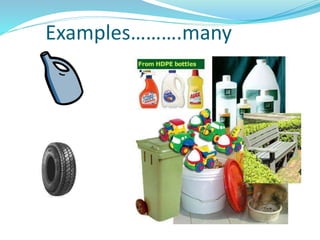
Examples……….many
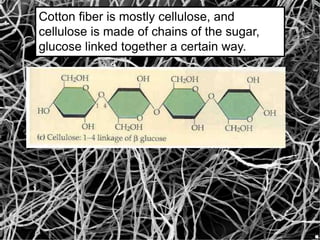
Cotton fiber is mostly cellulose, and
cellulose is made of chains of the sugar,
glucose linked together a certain way.
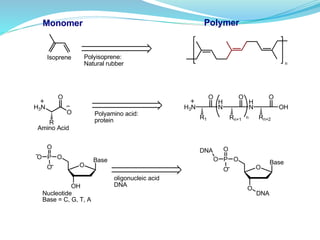
Monomer Polymer
Isoprene
n
Polyisoprene:
Natural rubber
H3N
O
O
R
Polyamino acid:
protein
H3N
O
H
N
R1
O
H
N
Rn+1
O
OH
Rn+2
n
Amino Acid
Base
O
OH
O
P
O
O
O
oligonucleic acid
DNA
Nucleotide
Base = C, G, T, A
Base
O
O
O
P
O
O
O
DNA
DNA
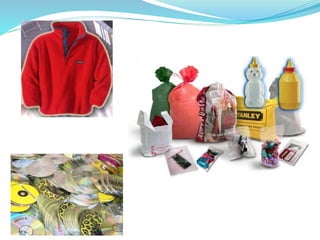
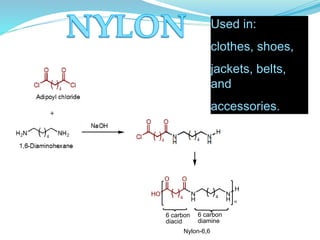
Used in:
clothes, shoes,
jackets, belts,
and
accessories.
HO N
H
N
H
H
O O
4 4
n
6 carbon
diacid
6 carbon
diamine
Nylon-6,6
+
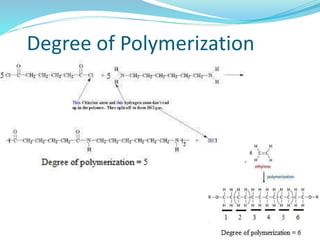
Degree of Polymerization
Advantages of polymers over
traditional materials
 Resistant to corrosion
 Thermal and electrical insulators
 Low density hence light weight
 Possess elasticity (rubber)
 Flexible so easily mouldable into complex shapes
 Take variety of colours and shades
Uses of polymers
 Vehicle parts
 Electrical wire covers
 Clothes
 Furnitures
 Matraces
 Crockery
 Electrical appliances (TV, Radio, Phone body)
 Damaged human body organs can be repaired (heart
transplantation)
 Coating (adhesives for plywood)
 Bottles, buckets, toys, pipes, etc.
Classification of polymers
 Based on origin:
1. Natural (Cotton, Rubber, Proteins, DNA)
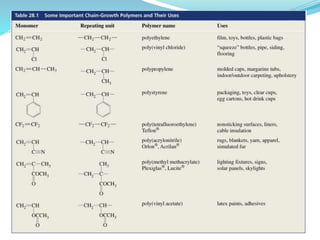
2. Synthetic (PE, PVC, PP, nylon)
3. Semi-synthetic (Nitrocellulose, Cellulose
acetate)
 Based on monomer unit:
1. Homo polymer (-AAAAAA-)
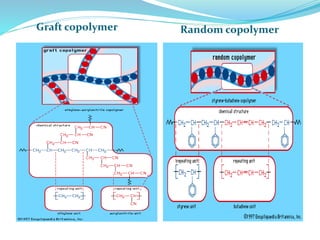
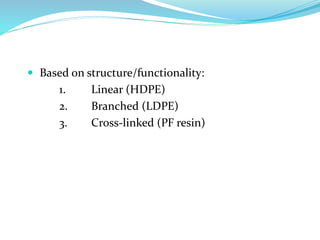
2. Copolymer
(Alternate, Block, Random, Graft)
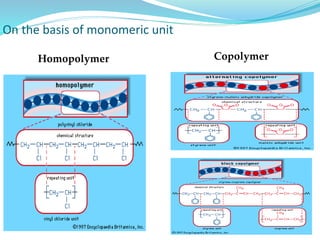
On the basis of monomeric unit
Homopolymer Copolymer
Graft copolymer Random copolymer
 Based on structure/functionality:
1. Linear (HDPE)
2. Branched (LDPE)
3. Cross-linked (PF resin)
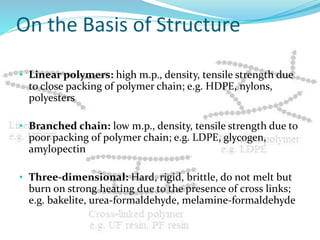
On the Basis of Structure
• Linear polymers: high m.p., density, tensile strength due
to close packing of polymer chain; e.g. HDPE, nylons,
polyesters
• Branched chain: low m.p., density, tensile strength due to
poor packing of polymer chain; e.g. LDPE, glycogen,
amylopectin
• Three-dimensional: Hard, rigid, brittle, do not melt but
burn on strong heating due to the presence of cross links;
e.g. bakelite, urea-formaldehyde, melamine-formaldehyde
 Based on thermal response/molecular forces:
1. Thermoplastic (PE, PVC)
2. Thermosets (UF, PF)
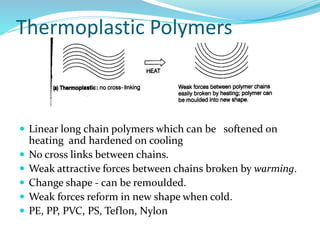
Thermoplastic Polymers
 Linear long chain polymers which can be softened on
heating and hardened on cooling
 No cross links between chains.
 Weak attractive forces between chains broken by warming.
 Change shape - can be remoulded.
 Weak forces reform in new shape when cold.
 PE, PP, PVC, PS, Teflon, Nylon
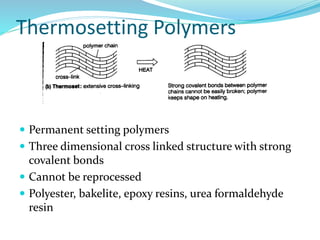
Thermosetting Polymers
 Permanent setting polymers
 Three dimensional cross linked structure with strong
covalent bonds
 Cannot be reprocessed
 Polyester, bakelite, epoxy resins, urea formaldehyde
resin
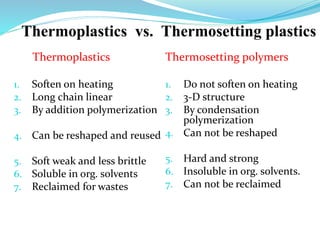
Thermoplastics vs. Thermosetting plastics
Thermoplastics
1. Soften on heating
2. Long chain linear
3. By addition polymerization
4. Can be reshaped and reused
5. Soft weak and less brittle
6. Soluble in org. solvents
7. Reclaimed for wastes
Thermosetting polymers
1. Do not soften on heating
2. 3-D structure
3. By condensation
polymerization
4. Can not be reshaped
5. Hard and strong
6. Insoluble in org. solvents.
7. Can not be reclaimed
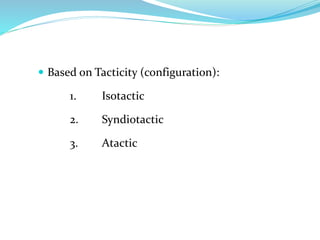
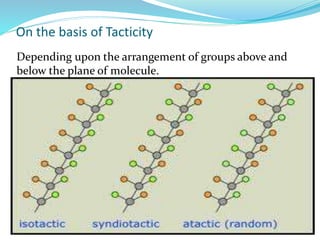
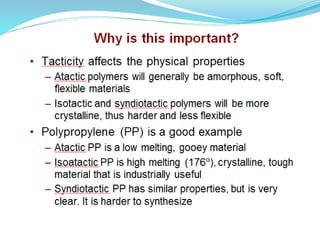
 Based on Tacticity (configuration):
1. Isotactic
2. Syndiotactic
3. Atactic
On the basis of Tacticity
Depending upon the arrangement of groups above and
below the plane of molecule.
 Based on polymerization reaction/mode of
reaction:
1. Addition polymerization
2. Condensation polymerization
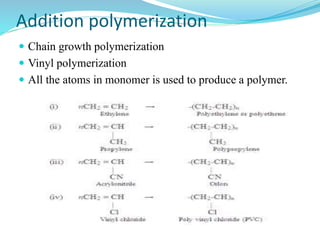
Addition polymerization
 Chain growth polymerization
 Vinyl polymerization
 All the atoms in monomer is used to produce a polymer.
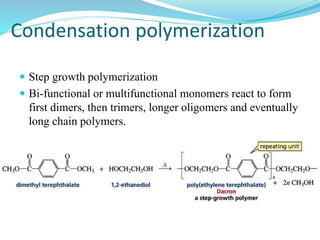
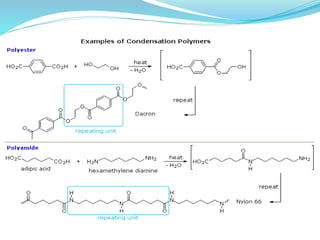
Condensation polymerization
 Step growth polymerization
 Bi-functional or multifunctional monomers react to form
first dimers, then trimers, longer oligomers and eventually
long chain polymers.
 E.g: polyesters, polyamides, polyurethanes, etc.
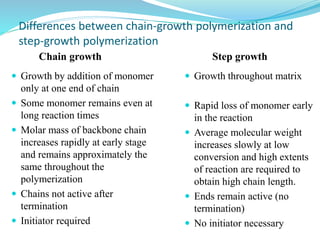
Differences between chain-growth polymerization and
step-growth polymerization
Step growth
Chain growth
 Growth throughout matrix
 Rapid loss of monomer early
in the reaction
 Average molecular weight
increases slowly at low
conversion and high extents
of reaction are required to
obtain high chain length.
 Ends remain active (no
termination)
 No initiator necessary
 Growth by addition of monomer
only at one end of chain
 Some monomer remains even at
long reaction times
 Molar mass of backbone chain
increases rapidly at early stage
and remains approximately the
same throughout the
polymerization
 Chains not active after
termination
 Initiator required
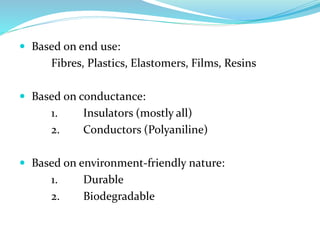
 Based on end use:
Fibres, Plastics, Elastomers, Films, Resins
 Based on conductance:
1. Insulators (mostly all)
2. Conductors (Polyaniline)
 Based on environment-friendly nature:
1. Durable
2. Biodegradable
Mechanism of polymerization
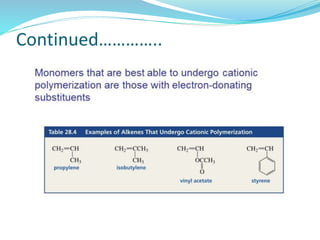
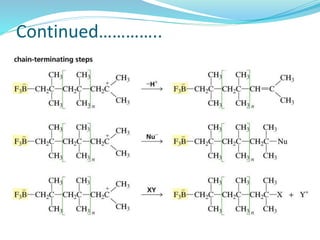
 Cationic polymerization
 Anionic polymerization
 Free radical polymerization
Cationic polymerization
 Initiation
 Propagation
 Termination
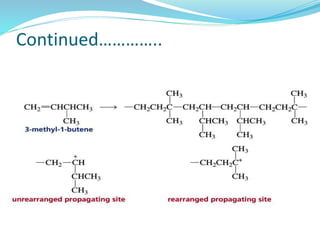
Continued…………..
Continued…………..
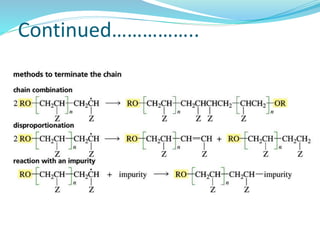
Continued…………..
Continued…………..
Continued…………..
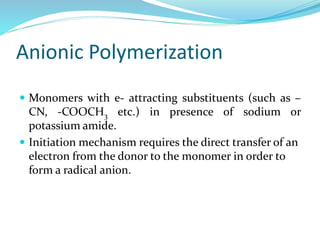
Anionic Polymerization
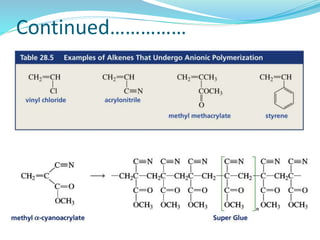
 Monomers with e- attracting substituents (such as –
CN, -COOCH3 etc.) in presence of sodium or
potassium amide.
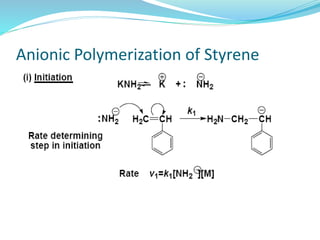
 Initiation mechanism requires the direct transfer of an
electron from the donor to the monomer in order to
form a radical anion.
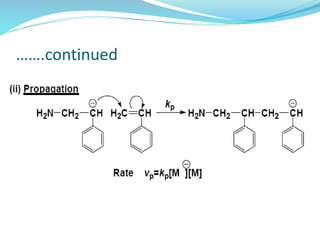
Anionic Polymerization of Styrene
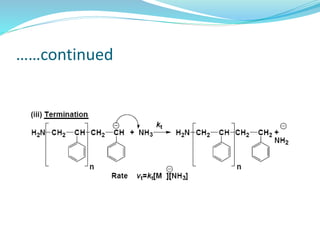
…….continued
……continued
Continued……………
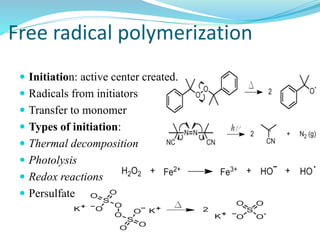
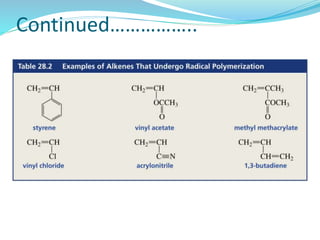
Free radical polymerization
 Initiation: active center created.
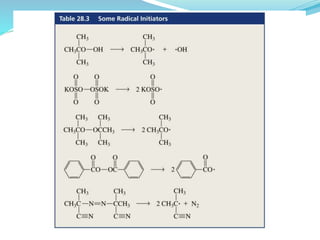
 Radicals from initiators
 Transfer to monomer
 Types of initiation:
 Thermal decomposition
 Photolysis
 Redox reactions
 Persulfate
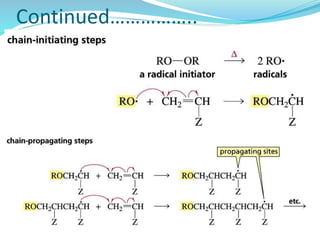
Continued……………..
Continued……………..
Continued……………..
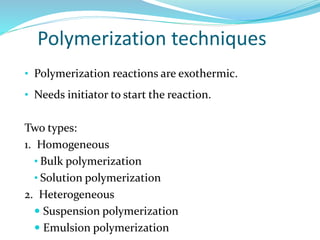
Polymerization techniques
• Polymerization reactions are exothermic.
• Needs initiator to start the reaction.
Two types:
1. Homogeneous
• Bulk polymerization
• Solution polymerization
2. Heterogeneous
 Suspension polymerization
 Emulsion polymerization
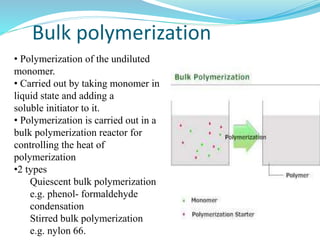
Bulk polymerization
• Polymerization of the undiluted
monomer.
• Carried out by taking monomer in
liquid state and adding a
soluble initiator to it.
• Polymerization is carried out in a
bulk polymerization reactor for
controlling the heat of
polymerization
•2 types
Quiescent bulk polymerization
e.g. phenol- formaldehyde
condensation
Stirred bulk polymerization
e.g. nylon 66.
Continued……………..
Disadvantage
• Broad m.w. distribution.
• Heat transfer and mixing become difficult
as the viscosity of reaction mass
increases.
• Exothermic reaction.
• The reaction is auto-accelerated and
sometimes leads to explosion.
 During reaction, the medium becomes
viscous, diffusibility of growing polymer
chain becomes restricted, probability of
chain collision becomes less, termination
becomes difficult, active radical sites
accumulate and rate of polymerization
increases enormously
Advantage
Pure polymer with good
insulation properties
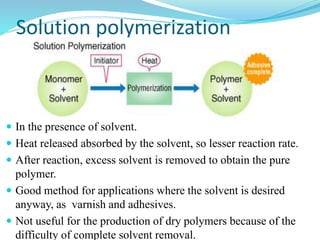
Solution polymerization
 In the presence of solvent.
 Heat released absorbed by the solvent, so lesser reaction rate.
 After reaction, excess solvent is removed to obtain the pure
polymer.
 Good method for applications where the solvent is desired
anyway, as varnish and adhesives.
 Not useful for the production of dry polymers because of the
difficulty of complete solvent removal.
Continued……………..
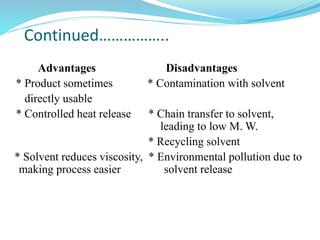
Advantages Disadvantages
* Product sometimes * Contamination with solvent
directly usable
* Controlled heat release * Chain transfer to solvent,
leading to low M. W.
* Recycling solvent
* Solvent reduces viscosity, * Environmental pollution due to
making process easier solvent release
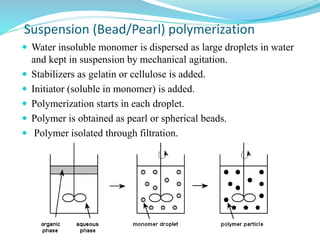
Suspension (Bead/Pearl) polymerization
 Water insoluble monomer is dispersed as large droplets in water
and kept in suspension by mechanical agitation.
 Stabilizers as gelatin or cellulose is added.
 Initiator (soluble in monomer) is added.
 Polymerization starts in each droplet.
 Polymer is obtained as pearl or spherical beads.
 Polymer isolated through filtration.
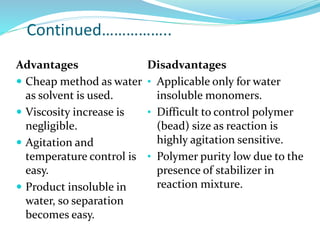
Continued……………..
Disadvantages
• Applicable only for water
insoluble monomers.
• Difficult to control polymer
(bead) size as reaction is
highly agitation sensitive.
• Polymer purity low due to the
presence of stabilizer in
reaction mixture.
Advantages
 Cheap method as water
as solvent is used.
 Viscosity increase is
negligible.
 Agitation and
temperature control is
easy.
 Product insoluble in
water, so separation
becomes easy.
 Disadvantage
 Applicable only for water
insoluble monomers.
 Difficult to control polymer
(bead) size as reaction is
highly agitation sensitive.
 Polymer purity low due to the
presence of stabilizer in
reaction mixture.
 Advantages
 Cheap method as water
as solvent is used.
 Viscosity increase is
negligible.
 Agitation and
temperature control is
easy.
 Product insoluble in
water, so separation
becomes easy.
 Disadvantage
 Applicable only for water
insoluble monomers.
 Difficult to control polymer
(bead) size as reaction is
highly agitation sensitive.
 Polymer purity low due to the
presence of stabilizer in
reaction mixture.
 Disadvantage
 Applicable only for water
insoluble monomers.
 Difficult to control polymer
(bead) size as reaction is
highly agitation sensitive.
 Polymer purity low due to the
presence of stabilizer in
reaction mixture.
Continued……………..
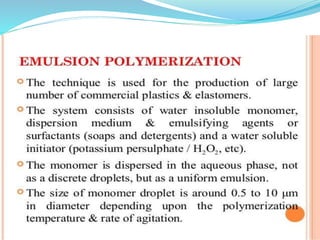
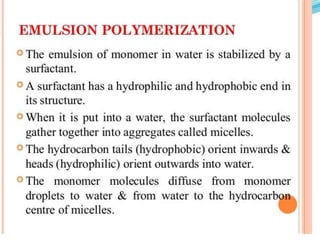
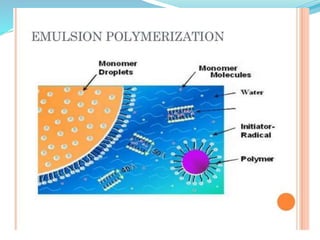
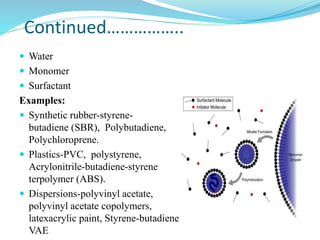
 Water
 Monomer
 Surfactant
Examples:
 Synthetic rubber-styrene-
butadiene (SBR), Polybutadiene,
Polychloroprene.
 Plastics-PVC, polystyrene,
Acrylonitrile-butadiene-styrene
terpolymer (ABS).
 Dispersions-polyvinyl acetate,
polyvinyl acetate copolymers,
latexacrylic paint, Styrene-butadiene,
VAE
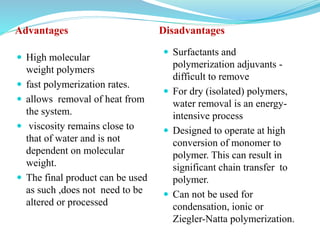
Advantages Disadvantages
 High molecular
weight polymers
 fast polymerization rates.
 allows removal of heat from
the system.
 viscosity remains close to
that of water and is not
dependent on molecular
weight.
 The final product can be used
as such ,does not need to be
altered or processed
 Surfactants and
polymerization adjuvants -
difficult to remove
 For dry (isolated) polymers,
water removal is an energy-
intensive process
 Designed to operate at high
conversion of monomer to
polymer. This can result in
significant chain transfer to
polymer.
 Can not be used for
condensation, ionic or
Ziegler-Natta polymerization.
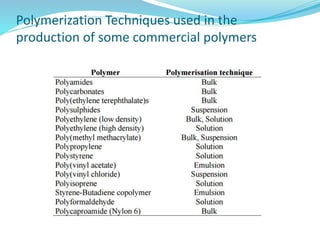
Polymerization Techniques used in the
production of some commercial polymers
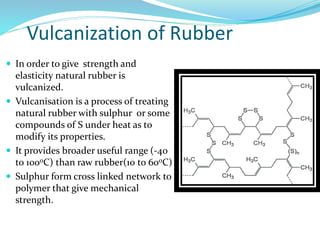
Vulcanization of Rubber
 In order to give strength and
elasticity natural rubber is
vulcanized.
 Vulcanisation is a process of treating
natural rubber with sulphur or some
compounds of S under heat as to
modify its properties.
 It provides broader useful range (-40
to 1000C) than raw rubber(10 to 600C)
 Sulphur form cross linked network to
polymer that give mechanical
strength.
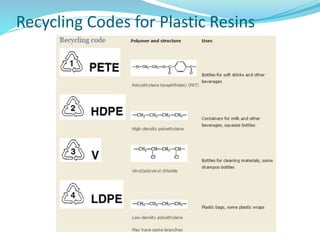
Recycling Codes for Plastic Resins
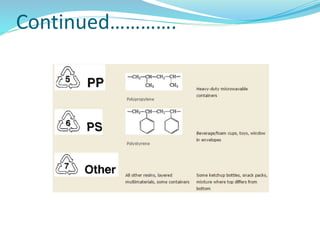
Continued………….
Conducting polymers
Intrinsically conducting: Having extensive conjugation in
the backbone responsible for conductance.
 Conducting polymers having conjugation
 Doped conducting polymers
Extrinsically conducting: Owe conductivity due to presence
of externally added ingredients in them.
 Conducting element filled polymers
 Blended conducting polymers
Applications of conducting polymers:
 In rechargeable batteries
 In analytical sensors
 For making ion exchangers
 In electrochromic displays
 In photovoltaic devices

polymers for btech 1st year sem 1/2 chemistry

  • 2.
    Content  Introduction  Advantagesand uses of polymers  Classification of polymers  Mechanism of polymerization  Polymerization techniques  Molecular weight determination  Conducting and biodegradable polymers
  • 3.
    Introduction  Term “Polymer”derived from Greek word polus, means “many much”.  Long chain molecules formed by joining together of thousands of small molecular units by chemical bonds.  Molecular weight 103-107  Properties entirely different from its monomers.  Contains structural identity, repeating itself several times.
  • 4.
    Monomers  Double bond(F=2)  Triple bond (F=4)  Ethylene glycol HOCH2-CH2OH (F=2)  Lactic acid CH3CHOHCOOH (F=2)  Tartaric acid HOOC-CHOH-CHOH-COOH (F=4)  Phenol (max. F=4)  Building blocks of polymers.  Unite together through covalent linkages  Functionality (F) ≥ 2.  F=2, linear polymer  F ≥3, crosslinked polymer
  • 5.
  • 8.
    Cotton fiber ismostly cellulose, and cellulose is made of chains of the sugar, glucose linked together a certain way.
  • 9.
    Monomer Polymer Isoprene n Polyisoprene: Natural rubber H3N O O R Polyaminoacid: protein H3N O H N R1 O H N Rn+1 O OH Rn+2 n Amino Acid Base O OH O P O O O oligonucleic acid DNA Nucleotide Base = C, G, T, A Base O O O P O O O DNA DNA
  • 11.
    Used in: clothes, shoes, jackets,belts, and accessories. HO N H N H H O O 4 4 n 6 carbon diacid 6 carbon diamine Nylon-6,6 +
  • 12.
  • 13.
    Advantages of polymersover traditional materials  Resistant to corrosion  Thermal and electrical insulators  Low density hence light weight  Possess elasticity (rubber)  Flexible so easily mouldable into complex shapes  Take variety of colours and shades
  • 14.
    Uses of polymers Vehicle parts  Electrical wire covers  Clothes  Furnitures  Matraces  Crockery  Electrical appliances (TV, Radio, Phone body)  Damaged human body organs can be repaired (heart transplantation)  Coating (adhesives for plywood)  Bottles, buckets, toys, pipes, etc.
  • 15.
    Classification of polymers Based on origin: 1. Natural (Cotton, Rubber, Proteins, DNA) 2. Synthetic (PE, PVC, PP, nylon) 3. Semi-synthetic (Nitrocellulose, Cellulose acetate)  Based on monomer unit: 1. Homo polymer (-AAAAAA-) 2. Copolymer (Alternate, Block, Random, Graft)
  • 16.
    On the basisof monomeric unit Homopolymer Copolymer
  • 17.
  • 18.
     Based onstructure/functionality: 1. Linear (HDPE) 2. Branched (LDPE) 3. Cross-linked (PF resin)
  • 19.
    On the Basisof Structure • Linear polymers: high m.p., density, tensile strength due to close packing of polymer chain; e.g. HDPE, nylons, polyesters • Branched chain: low m.p., density, tensile strength due to poor packing of polymer chain; e.g. LDPE, glycogen, amylopectin • Three-dimensional: Hard, rigid, brittle, do not melt but burn on strong heating due to the presence of cross links; e.g. bakelite, urea-formaldehyde, melamine-formaldehyde
  • 20.
     Based onthermal response/molecular forces: 1. Thermoplastic (PE, PVC) 2. Thermosets (UF, PF)
  • 21.
    Thermoplastic Polymers  Linearlong chain polymers which can be softened on heating and hardened on cooling  No cross links between chains.  Weak attractive forces between chains broken by warming.  Change shape - can be remoulded.  Weak forces reform in new shape when cold.  PE, PP, PVC, PS, Teflon, Nylon
  • 22.
    Thermosetting Polymers  Permanentsetting polymers  Three dimensional cross linked structure with strong covalent bonds  Cannot be reprocessed  Polyester, bakelite, epoxy resins, urea formaldehyde resin
  • 23.
    Thermoplastics vs. Thermosettingplastics Thermoplastics 1. Soften on heating 2. Long chain linear 3. By addition polymerization 4. Can be reshaped and reused 5. Soft weak and less brittle 6. Soluble in org. solvents 7. Reclaimed for wastes Thermosetting polymers 1. Do not soften on heating 2. 3-D structure 3. By condensation polymerization 4. Can not be reshaped 5. Hard and strong 6. Insoluble in org. solvents. 7. Can not be reclaimed
  • 24.
     Based onTacticity (configuration): 1. Isotactic 2. Syndiotactic 3. Atactic
  • 25.
    On the basisof Tacticity Depending upon the arrangement of groups above and below the plane of molecule.
  • 27.
     Based onpolymerization reaction/mode of reaction: 1. Addition polymerization 2. Condensation polymerization
  • 28.
    Addition polymerization  Chaingrowth polymerization  Vinyl polymerization  All the atoms in monomer is used to produce a polymer.
  • 30.
    Condensation polymerization  Stepgrowth polymerization  Bi-functional or multifunctional monomers react to form first dimers, then trimers, longer oligomers and eventually long chain polymers.  E.g: polyesters, polyamides, polyurethanes, etc.
  • 32.
    Differences between chain-growthpolymerization and step-growth polymerization Step growth Chain growth  Growth throughout matrix  Rapid loss of monomer early in the reaction  Average molecular weight increases slowly at low conversion and high extents of reaction are required to obtain high chain length.  Ends remain active (no termination)  No initiator necessary  Growth by addition of monomer only at one end of chain  Some monomer remains even at long reaction times  Molar mass of backbone chain increases rapidly at early stage and remains approximately the same throughout the polymerization  Chains not active after termination  Initiator required
  • 33.
     Based onend use: Fibres, Plastics, Elastomers, Films, Resins  Based on conductance: 1. Insulators (mostly all) 2. Conductors (Polyaniline)  Based on environment-friendly nature: 1. Durable 2. Biodegradable
  • 34.
    Mechanism of polymerization Cationic polymerization  Anionic polymerization  Free radical polymerization
  • 35.
    Cationic polymerization  Initiation Propagation  Termination
  • 36.
  • 37.
  • 38.
  • 39.
  • 40.
  • 41.
    Anionic Polymerization  Monomerswith e- attracting substituents (such as – CN, -COOCH3 etc.) in presence of sodium or potassium amide.  Initiation mechanism requires the direct transfer of an electron from the donor to the monomer in order to form a radical anion.
  • 42.
  • 43.
  • 44.
  • 45.
  • 46.
    Free radical polymerization Initiation: active center created.  Radicals from initiators  Transfer to monomer  Types of initiation:  Thermal decomposition  Photolysis  Redox reactions  Persulfate
  • 47.
  • 48.
  • 49.
  • 51.
    Polymerization techniques • Polymerizationreactions are exothermic. • Needs initiator to start the reaction. Two types: 1. Homogeneous • Bulk polymerization • Solution polymerization 2. Heterogeneous  Suspension polymerization  Emulsion polymerization
  • 52.
    Bulk polymerization • Polymerizationof the undiluted monomer. • Carried out by taking monomer in liquid state and adding a soluble initiator to it. • Polymerization is carried out in a bulk polymerization reactor for controlling the heat of polymerization •2 types Quiescent bulk polymerization e.g. phenol- formaldehyde condensation Stirred bulk polymerization e.g. nylon 66.
  • 53.
    Continued…………….. Disadvantage • Broad m.w.distribution. • Heat transfer and mixing become difficult as the viscosity of reaction mass increases. • Exothermic reaction. • The reaction is auto-accelerated and sometimes leads to explosion.  During reaction, the medium becomes viscous, diffusibility of growing polymer chain becomes restricted, probability of chain collision becomes less, termination becomes difficult, active radical sites accumulate and rate of polymerization increases enormously Advantage Pure polymer with good insulation properties
  • 54.
    Solution polymerization  Inthe presence of solvent.  Heat released absorbed by the solvent, so lesser reaction rate.  After reaction, excess solvent is removed to obtain the pure polymer.  Good method for applications where the solvent is desired anyway, as varnish and adhesives.  Not useful for the production of dry polymers because of the difficulty of complete solvent removal.
  • 56.
    Continued…………….. Advantages Disadvantages * Productsometimes * Contamination with solvent directly usable * Controlled heat release * Chain transfer to solvent, leading to low M. W. * Recycling solvent * Solvent reduces viscosity, * Environmental pollution due to making process easier solvent release
  • 57.
    Suspension (Bead/Pearl) polymerization Water insoluble monomer is dispersed as large droplets in water and kept in suspension by mechanical agitation.  Stabilizers as gelatin or cellulose is added.  Initiator (soluble in monomer) is added.  Polymerization starts in each droplet.  Polymer is obtained as pearl or spherical beads.  Polymer isolated through filtration.
  • 58.
    Continued…………….. Disadvantages • Applicable onlyfor water insoluble monomers. • Difficult to control polymer (bead) size as reaction is highly agitation sensitive. • Polymer purity low due to the presence of stabilizer in reaction mixture. Advantages  Cheap method as water as solvent is used.  Viscosity increase is negligible.  Agitation and temperature control is easy.  Product insoluble in water, so separation becomes easy.
  • 59.
     Disadvantage  Applicableonly for water insoluble monomers.  Difficult to control polymer (bead) size as reaction is highly agitation sensitive.  Polymer purity low due to the presence of stabilizer in reaction mixture.  Advantages  Cheap method as water as solvent is used.  Viscosity increase is negligible.  Agitation and temperature control is easy.  Product insoluble in water, so separation becomes easy.
  • 60.
     Disadvantage  Applicableonly for water insoluble monomers.  Difficult to control polymer (bead) size as reaction is highly agitation sensitive.  Polymer purity low due to the presence of stabilizer in reaction mixture.
  • 61.
     Disadvantage  Applicableonly for water insoluble monomers.  Difficult to control polymer (bead) size as reaction is highly agitation sensitive.  Polymer purity low due to the presence of stabilizer in reaction mixture.
  • 62.
    Continued……………..  Water  Monomer Surfactant Examples:  Synthetic rubber-styrene- butadiene (SBR), Polybutadiene, Polychloroprene.  Plastics-PVC, polystyrene, Acrylonitrile-butadiene-styrene terpolymer (ABS).  Dispersions-polyvinyl acetate, polyvinyl acetate copolymers, latexacrylic paint, Styrene-butadiene, VAE
  • 63.
    Advantages Disadvantages  Highmolecular weight polymers  fast polymerization rates.  allows removal of heat from the system.  viscosity remains close to that of water and is not dependent on molecular weight.  The final product can be used as such ,does not need to be altered or processed  Surfactants and polymerization adjuvants - difficult to remove  For dry (isolated) polymers, water removal is an energy- intensive process  Designed to operate at high conversion of monomer to polymer. This can result in significant chain transfer to polymer.  Can not be used for condensation, ionic or Ziegler-Natta polymerization.
  • 64.
    Polymerization Techniques usedin the production of some commercial polymers
  • 65.
    Vulcanization of Rubber In order to give strength and elasticity natural rubber is vulcanized.  Vulcanisation is a process of treating natural rubber with sulphur or some compounds of S under heat as to modify its properties.  It provides broader useful range (-40 to 1000C) than raw rubber(10 to 600C)  Sulphur form cross linked network to polymer that give mechanical strength.
  • 66.
    Recycling Codes forPlastic Resins
  • 67.
  • 68.
    Conducting polymers Intrinsically conducting:Having extensive conjugation in the backbone responsible for conductance.  Conducting polymers having conjugation  Doped conducting polymers Extrinsically conducting: Owe conductivity due to presence of externally added ingredients in them.  Conducting element filled polymers  Blended conducting polymers
  • 69.
    Applications of conductingpolymers:  In rechargeable batteries  In analytical sensors  For making ion exchangers  In electrochromic displays  In photovoltaic devices