UREA Formaldehyde
Polymers Manufacture
Review
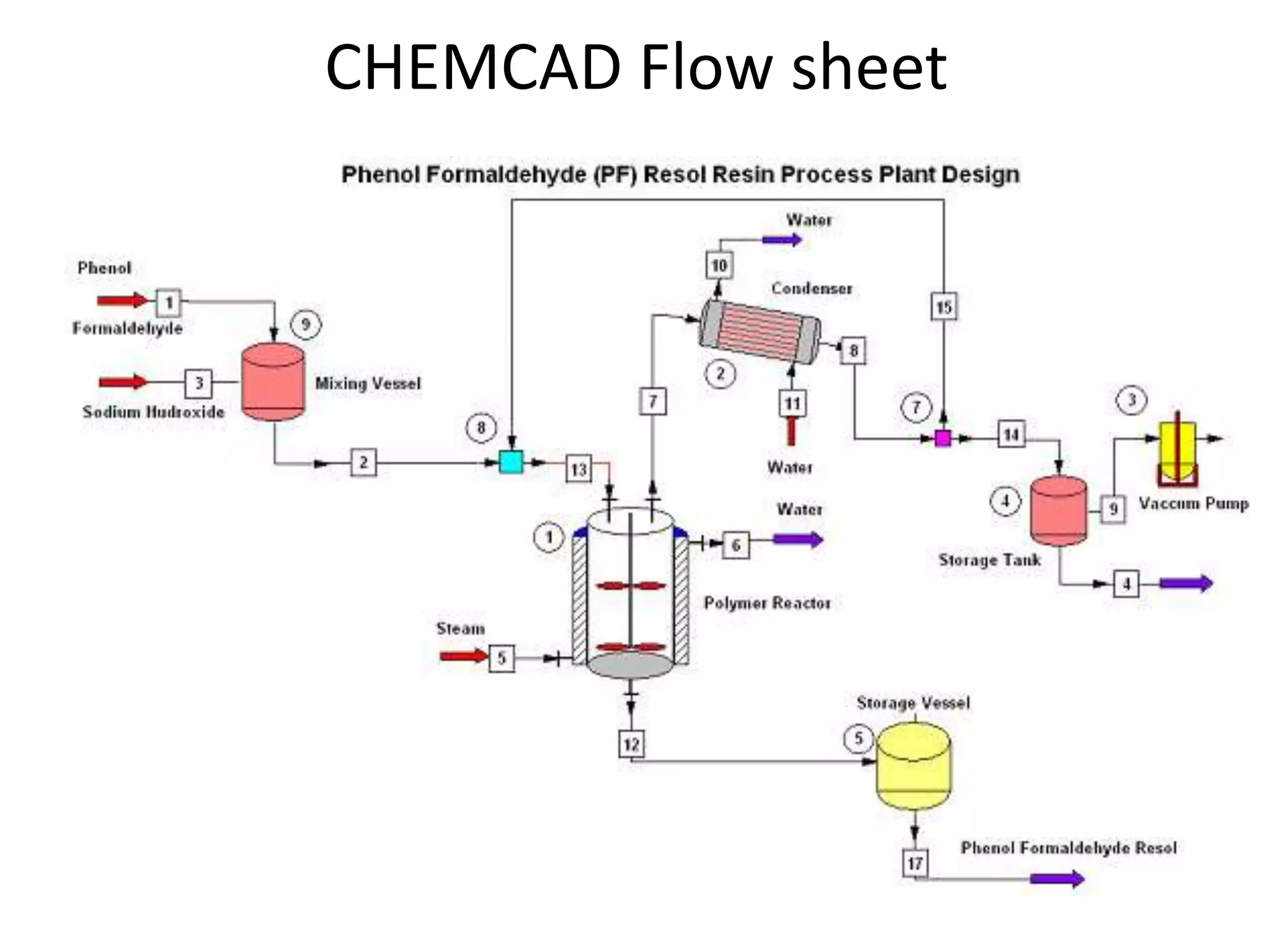
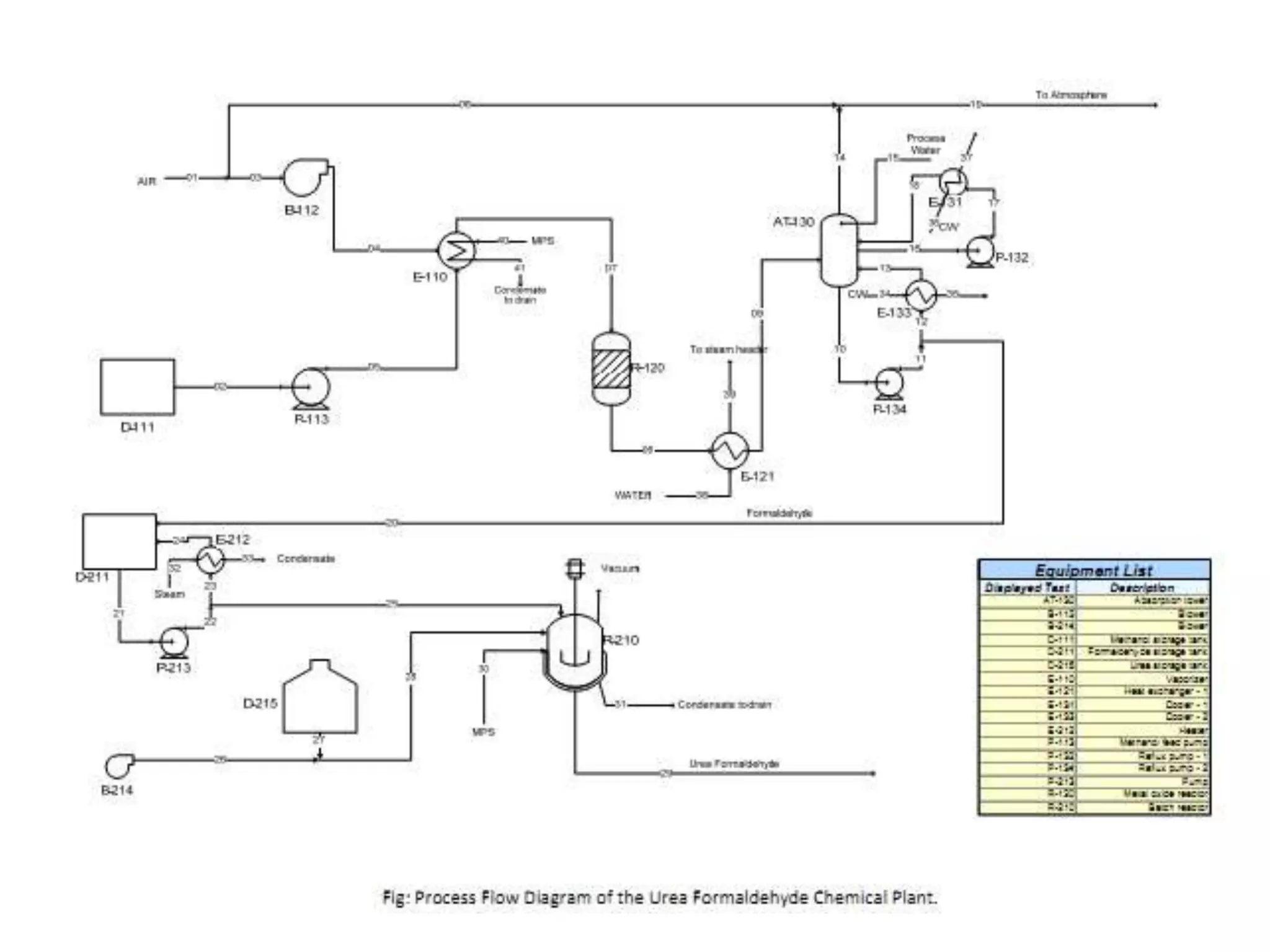
CHEMCAD Flow sheet
UREA FORMALDEHYDE
• A non transparent resin, used for a variety of
applications. Wood glue.
• urea formaldehyde resins are prepared by
treating urea with formaldehyde in an alkaline
or neutral medium to produce dimethylol
urea, which then undergoes
polycondensation, a chemical process that
results in a polymer, when heated in an acidic
medium.
• This resin is primarily used as an adhesive
UREA FORMALDEHYDE
A condensation polymer is one in which the repeating unit lacks
certain atoms,
which were present in the monomer(s) from which the polymer
was formed or to which it can be degraded by chemical means.
Condensation polymers are formed from bi- or poly
functional monomers by reactions which involve elimination of
some smaller molecule.
Examples:
1- Thermoplastics :Polyesters and polyamides are examples of
such thermoplastic polymers.
2- Thermosetting condensation polymers
Phenol-formaldehyde, Urea-formaldehyde resins are
thermosetting condensation polymers.
All these polymers are directly synthesized by condensation
reactions.
• MAJOR APPLICATIONS Molding
resins, adhesives, coatings,
treatment of paper and textiles,
automobile tires
• PROPERTIES OF SPECIAL INTEREST
Hardness, non-flammability,,
thermal properties, light fastness
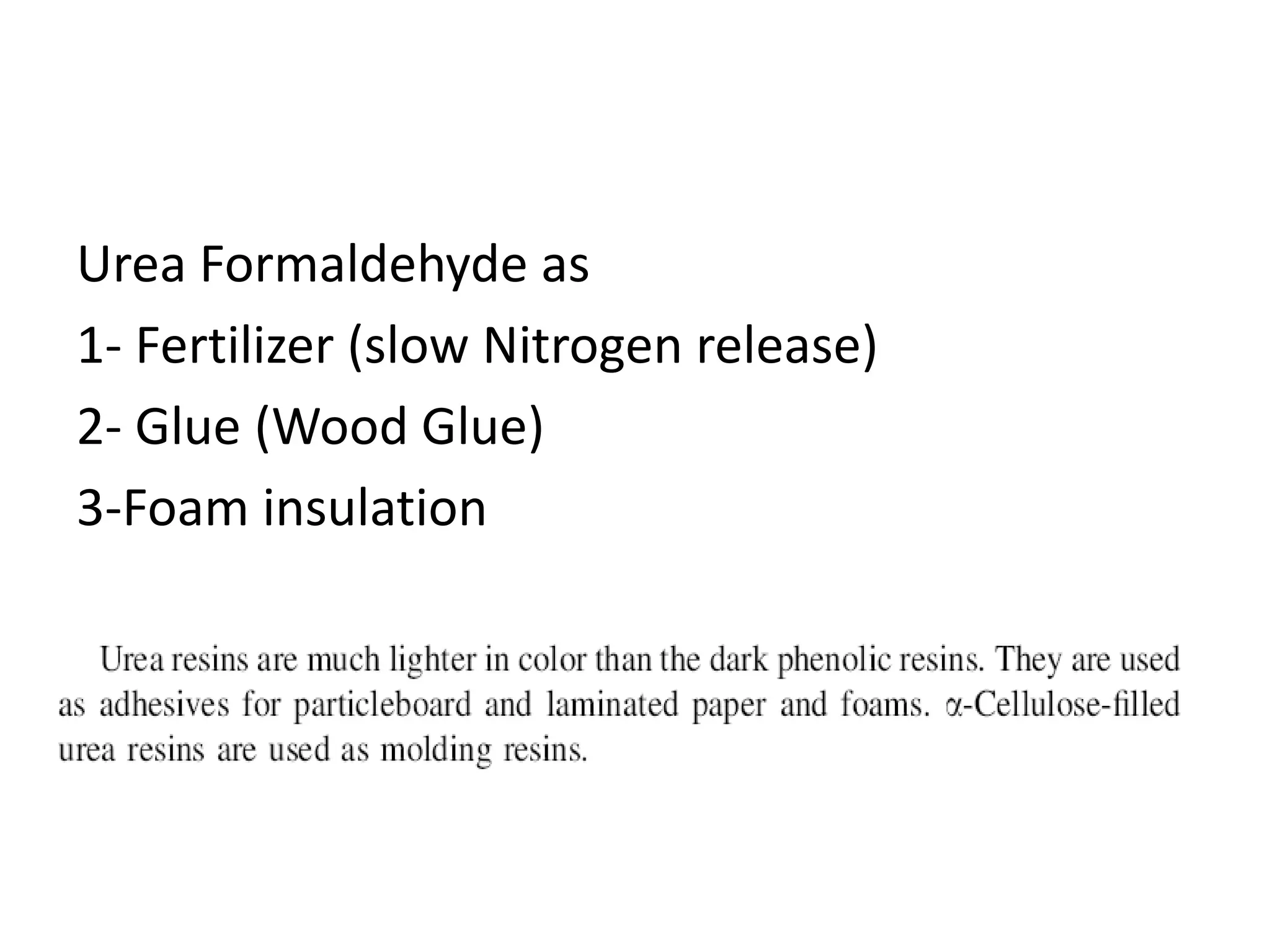
Urea Formaldehyde as
1- Fertilizer (slow Nitrogen release)
2- Glue (Wood Glue)
3-Foam insulation
• The major drawback of this resin is that it
hydrolyzes, or decomposes, in extremely
humid conditions and at high temperatures.
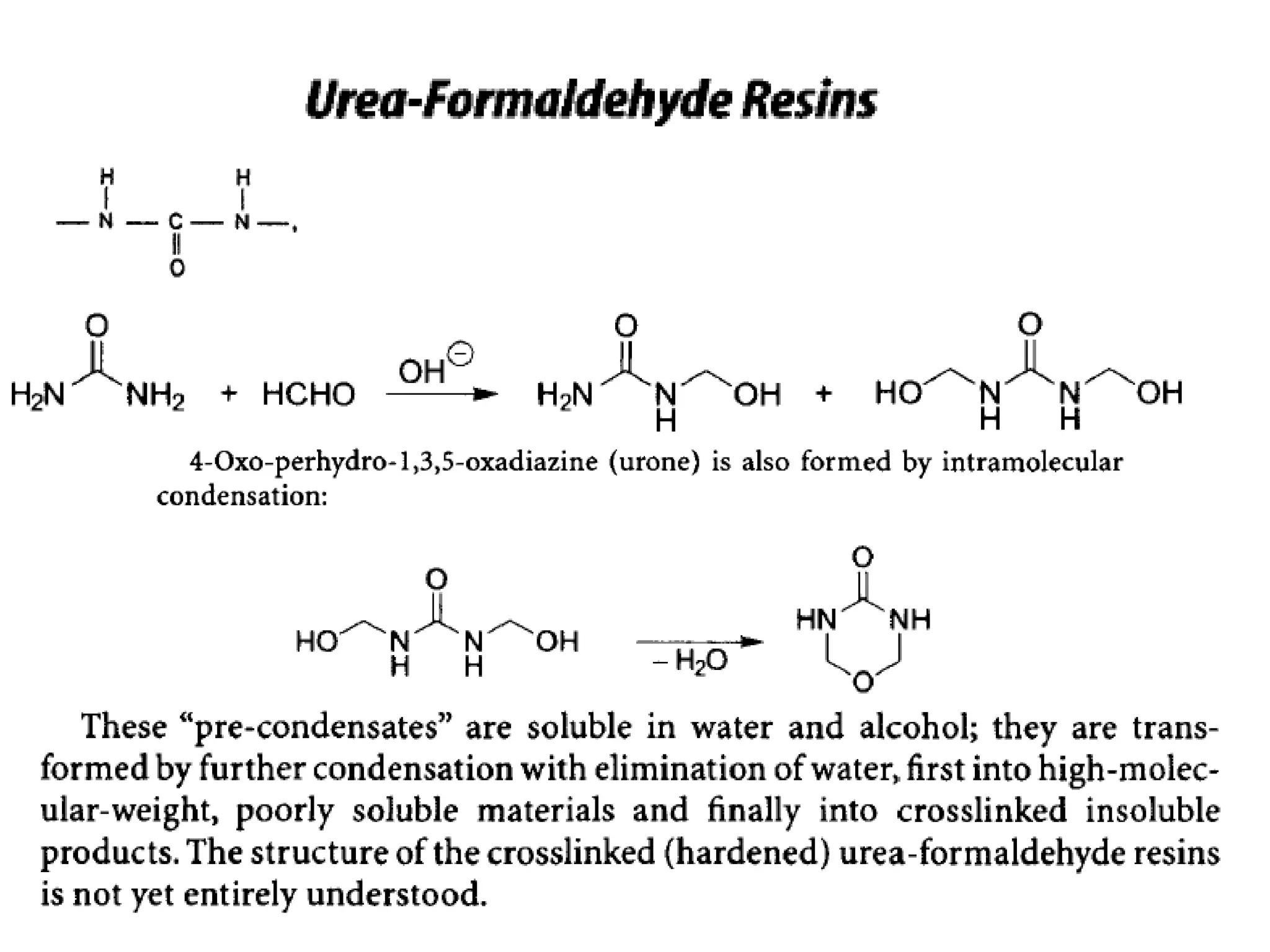
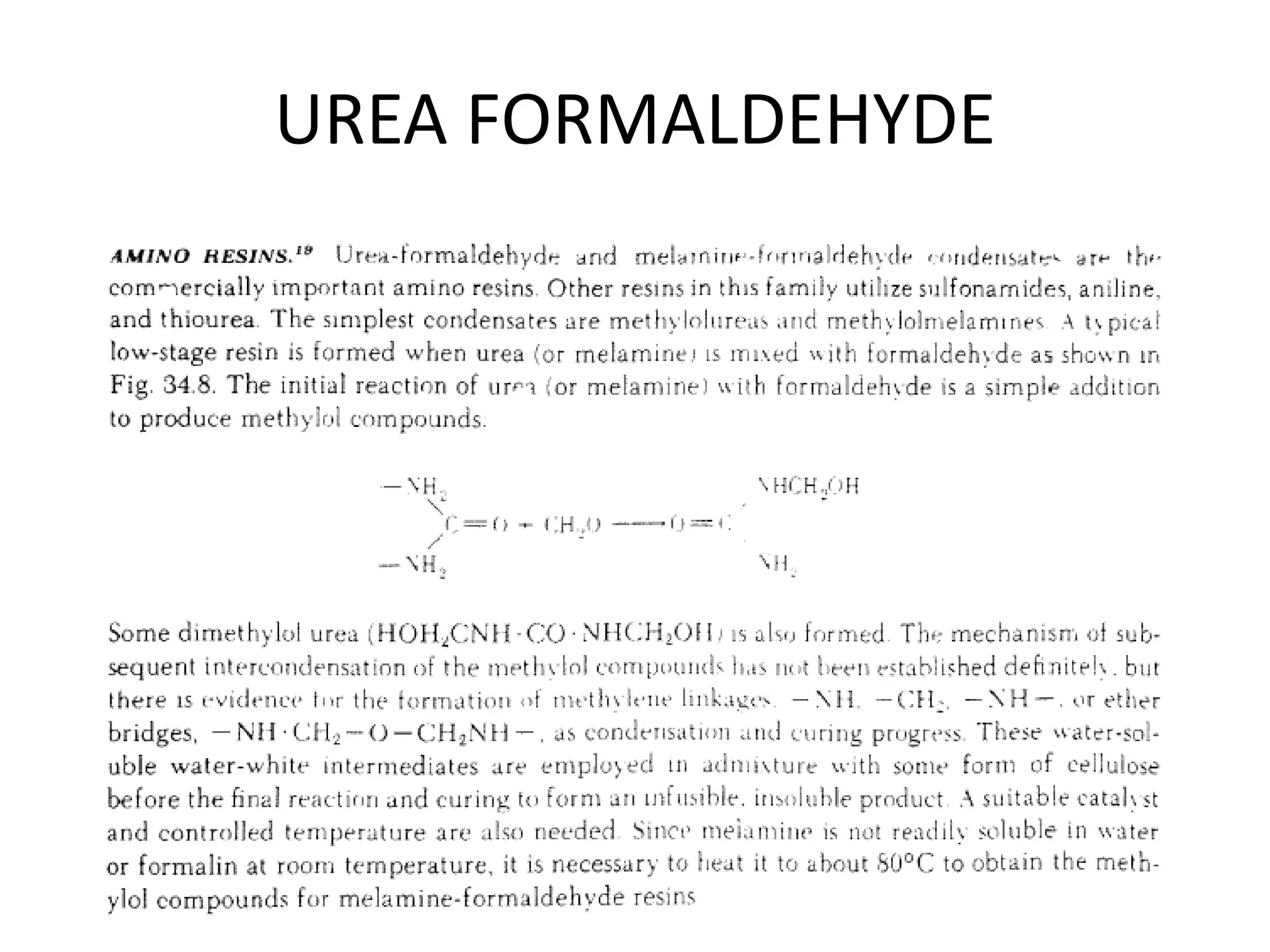
Condensation of urea with formaldehyde leads to products of
various structures and properties according to the
experimental conditions (pH, temperature, reaction time,
molar ratio of components).
The condensation is generally carried out in basic medium,
resulting essentially in the formation of hydroxymethyl
compounds; some oxymethylene groups are also formed,
particularly on heating. Mono-, di-, and trihydroxymethyl-
urea have been proved to be primary products of this
condensation; whether tetrahydroxymethyl-urea is also
formed is as yet uncertain:
• Urea-formaldehyde resins are generally prepared
by condensation in aqueous basic medium.
Depending on the intended application, a 50-
100% excess of formaldehyde is used. All bases
are suitable as catalysts provided they are
partially soluble in water. The most commonly
used catalysts are the alkali hydroxides. The pH
value of the alkaline solution should not exceed
8-9, Since the alkalinity of the solution drops in
the course of the reaction, it is necessary either
to use a buffer solution or to keep the pH
constant by repeated additions of aqueous alkali
hydroxide. Under these conditions the reaction
time is about 10-20 min at 50- 60 °C
UREA FORMALDEHYDE
Urea formaldehyde..
Urea formaldehyde..
Urea formaldehyde..
Urea formaldehyde..
Urea formaldehyde..
Urea formaldehyde..
Urea formaldehyde..

Urea formaldehyde..

  • 1.
  • 2.
  • 7.
  • 8.
    UREA FORMALDEHYDE • Anon transparent resin, used for a variety of applications. Wood glue.
  • 9.
    • urea formaldehyderesins are prepared by treating urea with formaldehyde in an alkaline or neutral medium to produce dimethylol urea, which then undergoes polycondensation, a chemical process that results in a polymer, when heated in an acidic medium. • This resin is primarily used as an adhesive
  • 10.
    UREA FORMALDEHYDE A condensationpolymer is one in which the repeating unit lacks certain atoms, which were present in the monomer(s) from which the polymer was formed or to which it can be degraded by chemical means. Condensation polymers are formed from bi- or poly functional monomers by reactions which involve elimination of some smaller molecule. Examples: 1- Thermoplastics :Polyesters and polyamides are examples of such thermoplastic polymers. 2- Thermosetting condensation polymers Phenol-formaldehyde, Urea-formaldehyde resins are thermosetting condensation polymers. All these polymers are directly synthesized by condensation reactions.
  • 11.
    • MAJOR APPLICATIONSMolding resins, adhesives, coatings, treatment of paper and textiles, automobile tires • PROPERTIES OF SPECIAL INTEREST Hardness, non-flammability,, thermal properties, light fastness
  • 12.
    Urea Formaldehyde as 1-Fertilizer (slow Nitrogen release) 2- Glue (Wood Glue) 3-Foam insulation
  • 13.
    • The majordrawback of this resin is that it hydrolyzes, or decomposes, in extremely humid conditions and at high temperatures.
  • 14.
    Condensation of ureawith formaldehyde leads to products of various structures and properties according to the experimental conditions (pH, temperature, reaction time, molar ratio of components). The condensation is generally carried out in basic medium, resulting essentially in the formation of hydroxymethyl compounds; some oxymethylene groups are also formed, particularly on heating. Mono-, di-, and trihydroxymethyl- urea have been proved to be primary products of this condensation; whether tetrahydroxymethyl-urea is also formed is as yet uncertain:
  • 17.
    • Urea-formaldehyde resinsare generally prepared by condensation in aqueous basic medium. Depending on the intended application, a 50- 100% excess of formaldehyde is used. All bases are suitable as catalysts provided they are partially soluble in water. The most commonly used catalysts are the alkali hydroxides. The pH value of the alkaline solution should not exceed 8-9, Since the alkalinity of the solution drops in the course of the reaction, it is necessary either to use a buffer solution or to keep the pH constant by repeated additions of aqueous alkali hydroxide. Under these conditions the reaction time is about 10-20 min at 50- 60 °C
  • 21.