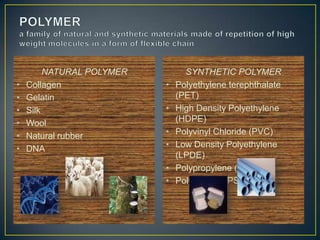
• Collagen
• Gelatin
• Silk
• Wool
• Natural rubber
• DNA
NATURAL POLYMER SYNTHETIC POLYMER
• Polyethylene terephthalate
(PET)
• High Density Polyethylene
(HDPE)
• Polyvinyl Chloride (PVC)
• Low Density Polyethylene
(LPDE)
• Polypropylene (PP)
• Polystyrene (PS)
• The word polymer comes from the Greek ‘poly’ meaning many, and
‘meros’ is parts or units.
• A polymer is organic substance made up of many repeating units or
building blocks of molecules called mers.
• Combine many monomers to create a polymer.
• Polymer is often used as a synonym for ‘plastic’. All plastic are
polymers, but not all polymers are plastics.
Poly mers are made up of many Mono mer
↓ ↓ ↓ ↓
Many Units One Unit
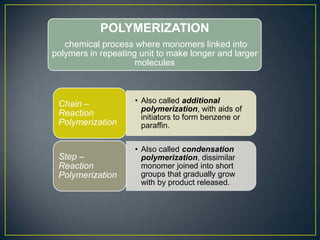
POLYMERIZATION
chemical process where monomers linked into
polymers in repeating unit to make longer and larger
molecules
• Also called additional
polymerization, with aids of
initiators to form benzene or
paraffin.
Chain –
Reaction
Polymerization
• Also called condensation
polymerization, dissimilar
monomer joined into short
groups that gradually grow
with by product released.
Step –
Reaction
Polymerization
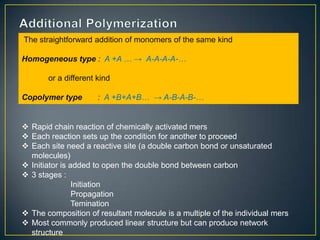
The straightforward addition of monomers of the same kind
Homogeneous type : A +A … → A-A-A-A-…
or a different kind
Copolymer type : A +B+A+B… → A-B-A-B-…
 Rapid chain reaction of chemically activated mers
 Each reaction sets up the condition for another to proceed
 Each site need a reactive site (a double carbon bond or unsaturated
molecules)
 Initiator is added to open the double bond between carbon
 3 stages :
Initiation
Propagation
Temination
 The composition of resultant molecule is a multiple of the individual mers
 Most commonly produced linear structure but can produce network
structure
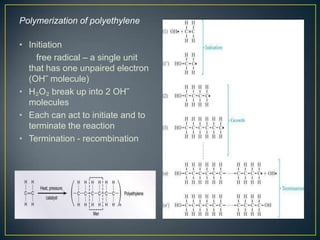
• Initiation
free radical – a single unit
that has one unpaired electron
(OH‾ molecule)
• H₂O₂ break up into 2 OH‾
molecules
• Each can act to initiate and to
terminate the reaction
• Termination - recombination
Polymerization of polyethylene
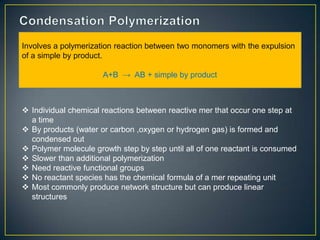
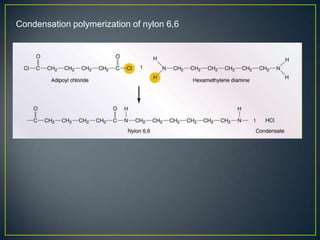
Involves a polymerization reaction between two monomers with the expulsion
of a simple by product.
A+B → AB + simple by product
 Individual chemical reactions between reactive mer that occur one step at
a time
 By products (water or carbon ,oxygen or hydrogen gas) is formed and
condensed out
 Polymer molecule growth step by step until all of one reactant is consumed
 Slower than additional polymerization
 Need reactive functional groups
 No reactant species has the chemical formula of a mer repeating unit
 Most commonly produce network structure but can produce linear
structures
Condensation polymerization of nylon 6,6
The properties of the polymer depends on:
i. Structures of individual polymer molecules
ii. Molecule shape and size
iii. Arrangement of molecules to form a polymer structure
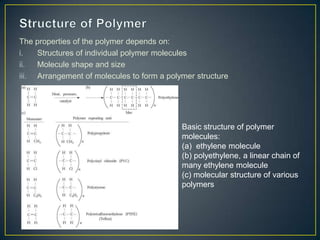
Basic structure of polymer
molecules:
(a) ethylene molecule
(b) polyethylene, a linear chain of
many ethylene molecule
(c) molecular structure of various
polymers
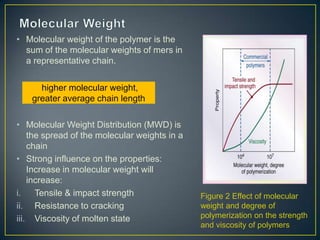
• Molecular weight of the polymer is the
sum of the molecular weights of mers in
a representative chain.
• Molecular Weight Distribution (MWD) is
the spread of the molecular weights in a
chain
• Strong influence on the properties:
Increase in molecular weight will
increase:
i. Tensile & impact strength
ii. Resistance to cracking
iii. Viscosity of molten state
higher molecular weight,
greater average chain length
Figure 2 Effect of molecular
weight and degree of
polymerization on the strength
and viscosity of polymers
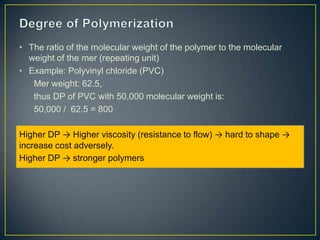
• The ratio of the molecular weight of the polymer to the molecular
weight of the mer (repeating unit)
• Example: Polyvinyl chloride (PVC)
Mer weight: 62.5,
thus DP of PVC with 50,000 molecular weight is:
50,000 / 62.5 = 800
Higher DP → Higher viscosity (resistance to flow) → hard to shape →
increase cost adversely.
Higher DP → stronger polymers
• During polymerization, the monomers are linked together by covalent
bond forming a polymer chain (high strength at primary bond)
• The polymer chains are held together by secondary bonds (low
strength):
i. Van der Waals bonds
ii. Hydrogen bonds
iii. Ionic bonds
• In polymer, the increase in strength and viscosity → the longer the
polymer chain → the greater is energy needed to overcome
secondary bonds
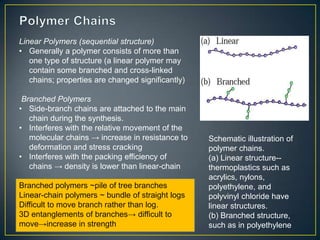
Linear Polymers (sequential structure)
• Generally a polymer consists of more than
one type of structure (a linear polymer may
contain some branched and cross-linked
chains; properties are changed significantly)
Branched Polymers
• Side-branch chains are attached to the main
chain during the synthesis.
• Interferes with the relative movement of the
molecular chains → increase in resistance to
deformation and stress cracking
• Interferes with the packing efficiency of
chains → density is lower than linear-chain
Branched polymers ~pile of tree branches
Linear-chain polymers ~ bundle of straight logs
Difficult to move branch rather than log.
3D entanglements of branches→ difficult to
move→increase in strength
Schematic illustration of
polymer chains.
(a) Linear structure--
thermoplastics such as
acrylics, nylons,
polyethylene, and
polyvinyl chloride have
linear structures.
(b) Branched structure,
such as in polyethylene
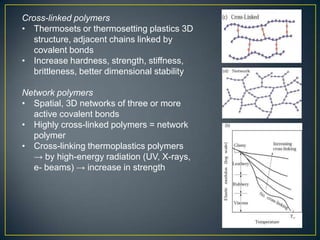
Cross-linked polymers
• Thermosets or thermosetting plastics 3D
structure, adjacent chains linked by
covalent bonds
• Increase hardness, strength, stiffness,
brittleness, better dimensional stability
Network polymers
• Spatial, 3D networks of three or more
active covalent bonds
• Highly cross-linked polymers = network
polymer
• Cross-linking thermoplastics polymers
→ by high-energy radiation (UV, X-rays,
e- beams) → increase in strength
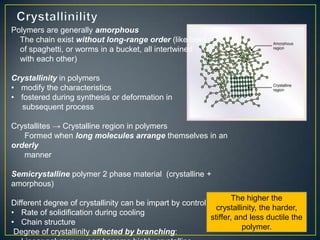
Polymers are generally amorphous
The chain exist without long-range order (like bowl
of spaghetti, or worms in a bucket, all intertwined
with each other)
Crystallinity in polymers
• modify the characteristics
• fostered during synthesis or deformation in
subsequent process
Crystallites → Crystalline region in polymers
Formed when long molecules arrange themselves in an
orderly
manner
Semicrystalline polymer 2 phase material (crystalline +
amorphous)
Different degree of crystallinity can be impart by controlling:
• Rate of solidification during cooling
• Chain structure
Degree of crystallinity affected by branching:
The higher the
crystallinity, the harder,
stiffer, and less ductile the
polymer.
1. S. Kalpakjian, S. R. Schmid, “Manufacturing Engineering and
Technology”, 6th ed, 2010

Polymerization and structure of polymers

  • 2.
    • Collagen • Gelatin •Silk • Wool • Natural rubber • DNA NATURAL POLYMER SYNTHETIC POLYMER • Polyethylene terephthalate (PET) • High Density Polyethylene (HDPE) • Polyvinyl Chloride (PVC) • Low Density Polyethylene (LPDE) • Polypropylene (PP) • Polystyrene (PS)
  • 3.
    • The wordpolymer comes from the Greek ‘poly’ meaning many, and ‘meros’ is parts or units. • A polymer is organic substance made up of many repeating units or building blocks of molecules called mers. • Combine many monomers to create a polymer. • Polymer is often used as a synonym for ‘plastic’. All plastic are polymers, but not all polymers are plastics. Poly mers are made up of many Mono mer ↓ ↓ ↓ ↓ Many Units One Unit
  • 4.
    POLYMERIZATION chemical process wheremonomers linked into polymers in repeating unit to make longer and larger molecules • Also called additional polymerization, with aids of initiators to form benzene or paraffin. Chain – Reaction Polymerization • Also called condensation polymerization, dissimilar monomer joined into short groups that gradually grow with by product released. Step – Reaction Polymerization
  • 5.
    The straightforward additionof monomers of the same kind Homogeneous type : A +A … → A-A-A-A-… or a different kind Copolymer type : A +B+A+B… → A-B-A-B-…  Rapid chain reaction of chemically activated mers  Each reaction sets up the condition for another to proceed  Each site need a reactive site (a double carbon bond or unsaturated molecules)  Initiator is added to open the double bond between carbon  3 stages : Initiation Propagation Temination  The composition of resultant molecule is a multiple of the individual mers  Most commonly produced linear structure but can produce network structure
  • 6.
    • Initiation free radical– a single unit that has one unpaired electron (OH‾ molecule) • H₂O₂ break up into 2 OH‾ molecules • Each can act to initiate and to terminate the reaction • Termination - recombination Polymerization of polyethylene
  • 7.
    Involves a polymerizationreaction between two monomers with the expulsion of a simple by product. A+B → AB + simple by product  Individual chemical reactions between reactive mer that occur one step at a time  By products (water or carbon ,oxygen or hydrogen gas) is formed and condensed out  Polymer molecule growth step by step until all of one reactant is consumed  Slower than additional polymerization  Need reactive functional groups  No reactant species has the chemical formula of a mer repeating unit  Most commonly produce network structure but can produce linear structures
  • 8.
  • 9.
    The properties ofthe polymer depends on: i. Structures of individual polymer molecules ii. Molecule shape and size iii. Arrangement of molecules to form a polymer structure Basic structure of polymer molecules: (a) ethylene molecule (b) polyethylene, a linear chain of many ethylene molecule (c) molecular structure of various polymers
  • 10.
    • Molecular weightof the polymer is the sum of the molecular weights of mers in a representative chain. • Molecular Weight Distribution (MWD) is the spread of the molecular weights in a chain • Strong influence on the properties: Increase in molecular weight will increase: i. Tensile & impact strength ii. Resistance to cracking iii. Viscosity of molten state higher molecular weight, greater average chain length Figure 2 Effect of molecular weight and degree of polymerization on the strength and viscosity of polymers
  • 11.
    • The ratioof the molecular weight of the polymer to the molecular weight of the mer (repeating unit) • Example: Polyvinyl chloride (PVC) Mer weight: 62.5, thus DP of PVC with 50,000 molecular weight is: 50,000 / 62.5 = 800 Higher DP → Higher viscosity (resistance to flow) → hard to shape → increase cost adversely. Higher DP → stronger polymers
  • 12.
    • During polymerization,the monomers are linked together by covalent bond forming a polymer chain (high strength at primary bond) • The polymer chains are held together by secondary bonds (low strength): i. Van der Waals bonds ii. Hydrogen bonds iii. Ionic bonds • In polymer, the increase in strength and viscosity → the longer the polymer chain → the greater is energy needed to overcome secondary bonds
  • 13.
    Linear Polymers (sequentialstructure) • Generally a polymer consists of more than one type of structure (a linear polymer may contain some branched and cross-linked chains; properties are changed significantly) Branched Polymers • Side-branch chains are attached to the main chain during the synthesis. • Interferes with the relative movement of the molecular chains → increase in resistance to deformation and stress cracking • Interferes with the packing efficiency of chains → density is lower than linear-chain Branched polymers ~pile of tree branches Linear-chain polymers ~ bundle of straight logs Difficult to move branch rather than log. 3D entanglements of branches→ difficult to move→increase in strength Schematic illustration of polymer chains. (a) Linear structure-- thermoplastics such as acrylics, nylons, polyethylene, and polyvinyl chloride have linear structures. (b) Branched structure, such as in polyethylene
  • 14.
    Cross-linked polymers • Thermosetsor thermosetting plastics 3D structure, adjacent chains linked by covalent bonds • Increase hardness, strength, stiffness, brittleness, better dimensional stability Network polymers • Spatial, 3D networks of three or more active covalent bonds • Highly cross-linked polymers = network polymer • Cross-linking thermoplastics polymers → by high-energy radiation (UV, X-rays, e- beams) → increase in strength
  • 15.
    Polymers are generallyamorphous The chain exist without long-range order (like bowl of spaghetti, or worms in a bucket, all intertwined with each other) Crystallinity in polymers • modify the characteristics • fostered during synthesis or deformation in subsequent process Crystallites → Crystalline region in polymers Formed when long molecules arrange themselves in an orderly manner Semicrystalline polymer 2 phase material (crystalline + amorphous) Different degree of crystallinity can be impart by controlling: • Rate of solidification during cooling • Chain structure Degree of crystallinity affected by branching: The higher the crystallinity, the harder, stiffer, and less ductile the polymer.
  • 16.
    1. S. Kalpakjian,S. R. Schmid, “Manufacturing Engineering and Technology”, 6th ed, 2010