PRINCIPLES OF RETENTION, SUPPORT AND STABILITY IN 
COMPLETE DENTURES. 
MWANGI S.K 
NGURUNGU W.N 
02/09/2014
 “Hii meno yako daktari inatoka nikikula na nikiongea”
RETENTION 
 Definition 
 Types 
 Factors affecting retention 
 Primary, secondary and mechanical retention
 Retention in complete dentures refer to the ability of that denture to resist 
displacement in a direction opposite the path of insertion 
 Vertical forces are involved in retention e.g. sticky food gravity chewing action and 
oral musculature tongue cheeks etc. 
 Retention in complete dentures can be primary secondary. 
 Primary retention involve both physical and mechanical means.
Primary retention 
 Physical forces 
 Cohesion 
 Adhesion 
 Interfacial surface tension 
 Capillarity 
 Atmospheric pressure 
 Gravity
Adhesion 
 Force of attraction between two unlike molecules 
 Denture-saliva-mucosa 
 Cohesion 
 Force of attraction between two molecules of the same type 
 Molecules of saliva; force between them maintain its continuity enhancing 
retention.
 Interfacial surface tension 
 Force between two parallel surfaces separated by a thin film of liquid. 
 Saliva act as a separating media between denture flanges and the mucosa. A 
concave meniscus is formed between saliva and air reducing their pressure on that 
side. When denture sits on that side an intimate contact is formed. This contribute 
to the retention of the denture
 Capillarity action 
 When the space between the denture and mucosa is narrow enough it act as a 
tube that sucks saliva and distributes it throughout the denture bearing area 
increasing retention. 
 Gravity 
 Beneficial for mandibular denture but may be detrimental for the upper denture
 Atmospheric pressure 
 Suction effect. When a force is exerted perpendicular and away from fully seated 
denture the p between the denture and the mucosa falls below the ambient 
pressure resisting displacement. Proportional to the size of the denture bearing 
area 
 Good fit ,bolder molding and good impression must be ensured.
 Muscular forces harmony must be created between the denture and the oral 
musculature. Tongue frenal relieve mylohyoid, buccinators masticatory muscles 
play a role. Denture must be well polished. Depend on the ability of the patient to 
adapt to the new prosthesis. 
 Secondary retention 
 Indirect retention obtained when stability and support of the denture is optimum 
i.e. when other forces which tend to unseat the denture are eliminated.
Factors affecting physical forces 
 Saliva 
 Quantity and quality:xerostomia? excessive salivation? type of saliva? 
 Surface area 
 The greater the surface area the better the retention maxillary denture 
mandibular denture 
 Intimacy of contact the closer the denture and the denture bearing area are the 
better the retention
 Peripheral seal 
 Good peripheral seal improves retention; good bolder molding posterior seal and 
peripheral seal prevent air entry into the denture and denture bearing area.
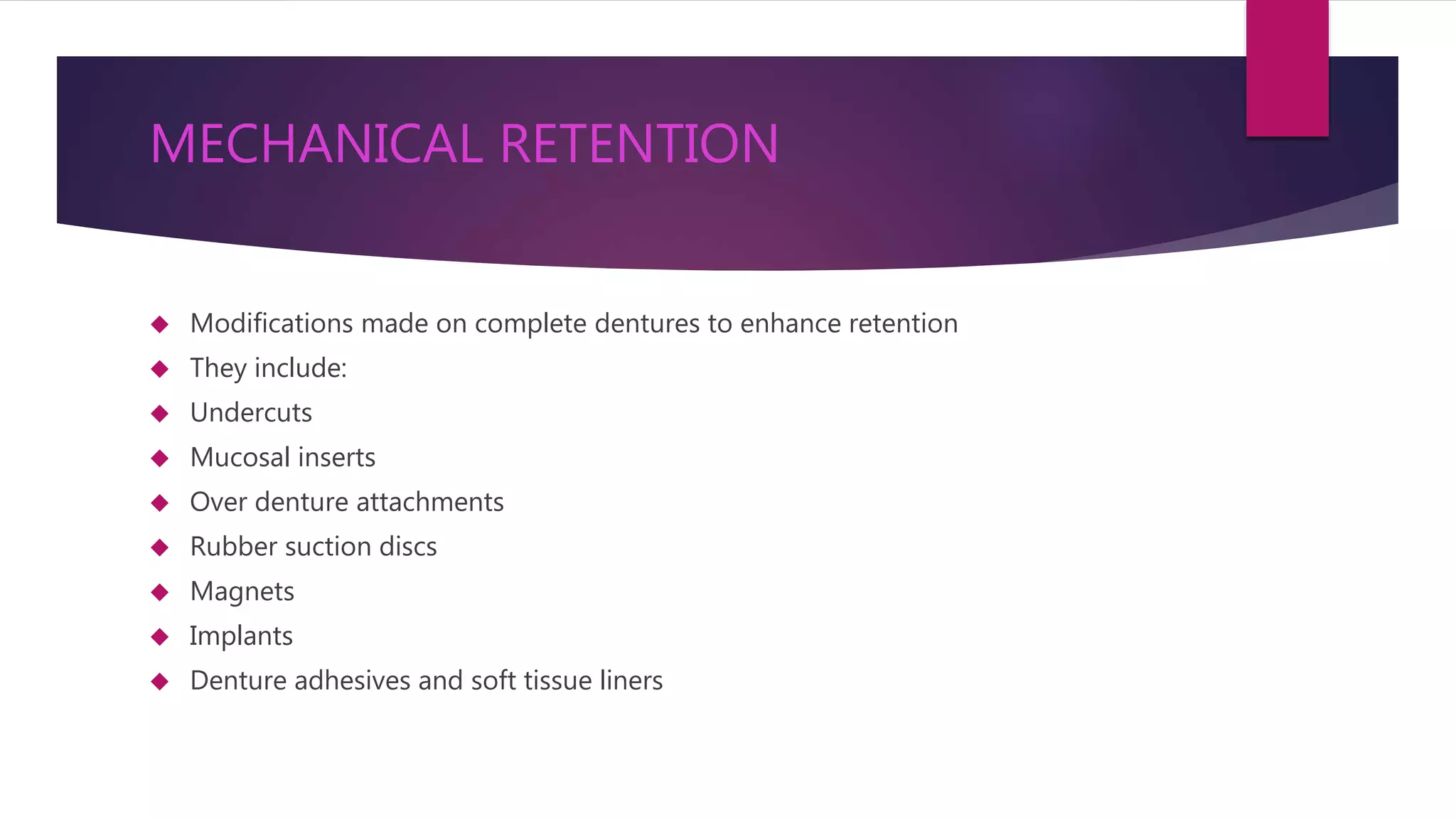
MECHANICAL RETENTION 
 Modifications made on complete dentures to enhance retention 
 They include: 
 Undercuts 
 Mucosal inserts 
 Over denture attachments 
 Rubber suction discs 
 Magnets 
 Implants 
 Denture adhesives and soft tissue liners
??
STABILITY 
 The ability of a prosthesis to resist displacement by functional horizontal or 
rotational forces.
Stability is affected by; 
 Residual ridge size and contour 
 Residual ridge quality 
 Palatal vault 
 Neutral zone and surrounding musculature 
 Abnormal ridge relationships 
 Occlusal factors 
 Intimate contact 
 Direct bone anchorage 
 Flange shape and contour
SUPPORT 
 Resistance to vertical movement or displacement of the dentures towards the 
basal seat area
Sources of support 
All denture bearing areas 
 Maxilla – hard palate, maxillary tuberosity, residual alveolar ridge 
 Mandible – buccal shelf, residual alveolar ridge. 
Thus impressions must cover as much area as possible, with relief of the limiting 
structures.
Factors that enhance support 
 Basal bone resistant to resorption 
 Firm, resilient and keratinized tissues well attached to the underlying bone 
 Tissues of uniform thickness 
 Support should be at right angle or near right angle to the occlusal forces
Factors affecting support 
 Bone support- implants/abutments vs mucosal support 
 Surface area 
 Impression technique 
 Accuracy of fit 
 Nature of the supporting mucosa
 ???

Principles of support stability and retention in complete dentures

  • 1.
    PRINCIPLES OF RETENTION,SUPPORT AND STABILITY IN COMPLETE DENTURES. MWANGI S.K NGURUNGU W.N 02/09/2014
  • 2.
     “Hii menoyako daktari inatoka nikikula na nikiongea”
  • 3.
    RETENTION  Definition  Types  Factors affecting retention  Primary, secondary and mechanical retention
  • 4.
     Retention incomplete dentures refer to the ability of that denture to resist displacement in a direction opposite the path of insertion  Vertical forces are involved in retention e.g. sticky food gravity chewing action and oral musculature tongue cheeks etc.  Retention in complete dentures can be primary secondary.  Primary retention involve both physical and mechanical means.
  • 5.
    Primary retention Physical forces  Cohesion  Adhesion  Interfacial surface tension  Capillarity  Atmospheric pressure  Gravity
  • 6.
    Adhesion  Forceof attraction between two unlike molecules  Denture-saliva-mucosa  Cohesion  Force of attraction between two molecules of the same type  Molecules of saliva; force between them maintain its continuity enhancing retention.
  • 7.
     Interfacial surfacetension  Force between two parallel surfaces separated by a thin film of liquid.  Saliva act as a separating media between denture flanges and the mucosa. A concave meniscus is formed between saliva and air reducing their pressure on that side. When denture sits on that side an intimate contact is formed. This contribute to the retention of the denture
  • 8.
     Capillarity action  When the space between the denture and mucosa is narrow enough it act as a tube that sucks saliva and distributes it throughout the denture bearing area increasing retention.  Gravity  Beneficial for mandibular denture but may be detrimental for the upper denture
  • 9.
     Atmospheric pressure  Suction effect. When a force is exerted perpendicular and away from fully seated denture the p between the denture and the mucosa falls below the ambient pressure resisting displacement. Proportional to the size of the denture bearing area  Good fit ,bolder molding and good impression must be ensured.
  • 10.
     Muscular forcesharmony must be created between the denture and the oral musculature. Tongue frenal relieve mylohyoid, buccinators masticatory muscles play a role. Denture must be well polished. Depend on the ability of the patient to adapt to the new prosthesis.  Secondary retention  Indirect retention obtained when stability and support of the denture is optimum i.e. when other forces which tend to unseat the denture are eliminated.
  • 11.
    Factors affecting physicalforces  Saliva  Quantity and quality:xerostomia? excessive salivation? type of saliva?  Surface area  The greater the surface area the better the retention maxillary denture mandibular denture  Intimacy of contact the closer the denture and the denture bearing area are the better the retention
  • 12.
     Peripheral seal  Good peripheral seal improves retention; good bolder molding posterior seal and peripheral seal prevent air entry into the denture and denture bearing area.
  • 13.
    MECHANICAL RETENTION Modifications made on complete dentures to enhance retention  They include:  Undercuts  Mucosal inserts  Over denture attachments  Rubber suction discs  Magnets  Implants  Denture adhesives and soft tissue liners
  • 15.
  • 16.
    STABILITY  Theability of a prosthesis to resist displacement by functional horizontal or rotational forces.
  • 17.
    Stability is affectedby;  Residual ridge size and contour  Residual ridge quality  Palatal vault  Neutral zone and surrounding musculature  Abnormal ridge relationships  Occlusal factors  Intimate contact  Direct bone anchorage  Flange shape and contour
  • 18.
    SUPPORT  Resistanceto vertical movement or displacement of the dentures towards the basal seat area
  • 19.
    Sources of support All denture bearing areas  Maxilla – hard palate, maxillary tuberosity, residual alveolar ridge  Mandible – buccal shelf, residual alveolar ridge. Thus impressions must cover as much area as possible, with relief of the limiting structures.
  • 20.
    Factors that enhancesupport  Basal bone resistant to resorption  Firm, resilient and keratinized tissues well attached to the underlying bone  Tissues of uniform thickness  Support should be at right angle or near right angle to the occlusal forces
  • 21.
    Factors affecting support  Bone support- implants/abutments vs mucosal support  Surface area  Impression technique  Accuracy of fit  Nature of the supporting mucosa
  • 22.