RETENTIONRETENTION,,
STABILITYSTABILITY
&&
SUPPORTSUPPORT
ININ COMPLETECOMPLETE
DENTUREDENTURE
SUBHAM DUTTASUBHAM DUTTA
BDS IV YR
Specific learning objectivesSpecific learning objectives
1.Definition and importance of Retention , stability and
support in complete denture.
2.Factors affecting Retention , stability and support in
complete denture.
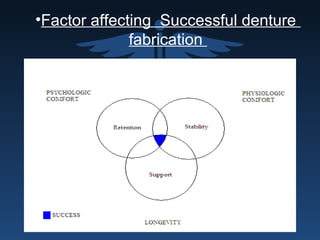
•Factor affecting Successful denture
fabrication
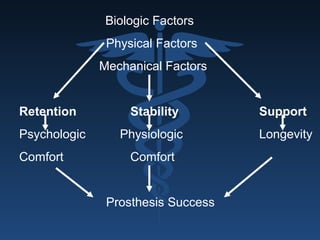
Biologic Factors
Physical Factors
Mechanical Factors
Retention Stability Support
Psychologic Physiologic Longevity
Comfort Comfort
Prosthesis Success
RETENTIONRETENTION
• It is the resistance to removal of a dental
prosthesis in a direction opposite to that of
insertion. (GPT8)
• BOUCHER described retention as the most
spectacular yet probably the least important of
all complete denture objectives. This property
may indeed be least important, it provides
psychologic comfort to patient..
Factors affecting retention
.. Anatomical factors
. Physiological factors
. Physical factors
. Mechanical factors
. Oral& facial musculature
. Psychological effects and patient’s tolerance
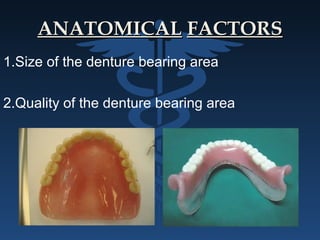
ANATOMICALANATOMICAL FACTORSFACTORS
1.Size of the denture bearing area
2.Quality of the denture bearing area
PHYSIOLOGICAL FACTORS
• Saliva- Amount & consistencySaliva- Amount & consistency
- Quality & viscosity- Quality & viscosity
PHYSICAL FACTORS
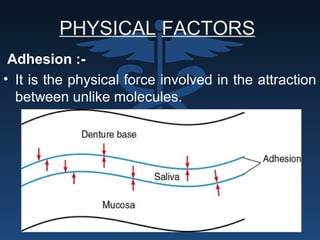
Adhesion :-
• It is the physical force involved in the attraction
between unlike molecules..
Cohesion :-
• It is the physical attraction of like
molecules for each other.
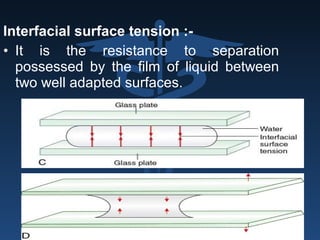
Interfacial surface tension :-
• It is the resistance to separation
possessed by the film of liquid between
two well adapted surfaces.
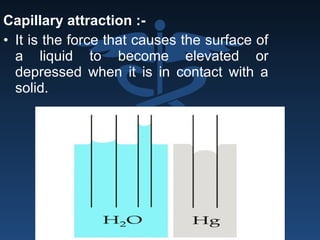
Capillary attraction :-
• It is the force that causes the surface of
a liquid to become elevated or
depressed when it is in contact with a
solid.
Atmospheric pressure :-
• It is the physical factor of hydrostatic pressure
due to the weight of the atmosphere on the
earth’s surface.
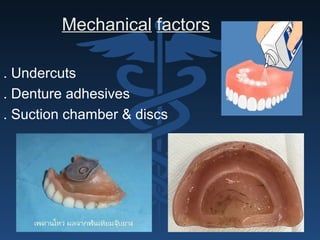
Mechanical factors
. Undercuts
. Denture adhesives
. Suction chamber & discs
Biologic factors
Intimate tissue contact :–
It is the biologic factor that refers to the close
adaptation of the denture base to the
underlying soft tissues.
STABILITY
• “The resistance against horizontal movements
and forces that tends to alter the relationships
between the denture base and its supporting
foundation in horizontal or rotatory direction.”
(GPT8)
• In simpler words stability is defined as “the
quality of a denture to resists displacement by
functional stresses.”
The qualities necessary to create and
maintain stability are dependent
upon the following factors :-
1) Vertical height of residual ridge
2) Quality of soft tissue covering the
ridge
3) Adaptation of denture to the tissue
4) Occlusal plane
5) Teeth arrangement
6) Contour of polished surface
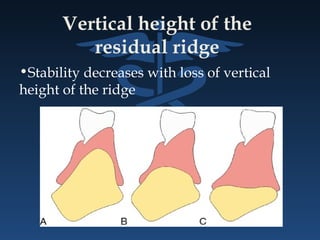
Vertical height of the
residual ridge
•Stability decreases with loss of vertical
height of the ridge
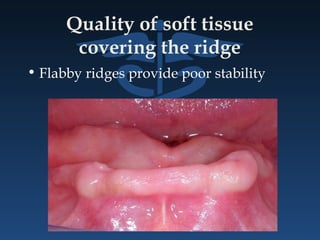
Quality of soft tissue
covering the ridge
• Flabby ridges provide poor stability
Adaptation of denture to the
tissues
• Close adaptation of the denture to the
basal seat tissues is very important to
ensure proper stability. An accurate
impression is essential to achieve this.
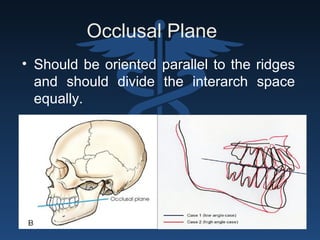
Occlusal Plane
• Should be oriented parallel to the ridges
and should divide the interarch space
equally.
• An occlusal plane if too high
• Forces the tongue into new position i.e. higher position
• Loss of tongue accuracy.
• Causes raise of floor of mouth.
• Undue pressure on the border of the lingual flange
• Partial loss of border seal.
• An occlusal plane slightly low
• Causes no problems for denture patients.
• If Occlusal plane is too low
• Destabilizes the denture
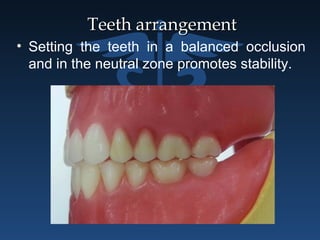
Teeth arrangementTeeth arrangement
• Setting the teeth in a balanced occlusion
and in the neutral zone promotes stability.
Contour of the polished
surface
•The polished denture surface should be in
harmony and with the functioning of oral
muscles to promote stability.
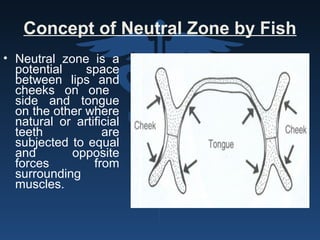
Concept of Neutral Zone by Fish
• Neutral zone is a
potential space
between lips and
cheeks on one
side and tongue
on the other where
natural or artificial
teeth are
subjected to equal
and opposite
forces from
surrounding
muscles.

Education of the patient
• Every patient should be informed regarding the care &
proper use of his denture.
• Failure to heed the dentist’s advice will eventually lead
to damage to the supporting tissues.
• It is usually obvious to them that their failure to master
their denture problem in not the fault of the dentist but
rather the fault of their own inability to master the
normal tongue position
SUPPORT
• The foundation area on which a dental
prosthesis rests.
• With respect to dental prosthesis, the
resistance to displacement away from the basal
tissue or underlying structure. (GPT-8)
• Complete denture support is “the
resistance to vertical movement of the
denture base towards the ridge.”
• To provide adequate support, the denture
base should cover as much as denture-
bearing area as possible. This distributes
the forces over a large area and is known
as SNOWSHOE PRINCIPLE
SNOWSHOE PRINCIPLE
• The basic “snowshoe principle” of maximal
extension is applied for support.
• It states that given a constant occlusal force, a
broader denture-bearing area decreases the
stress/unit area under the denture base.
Take home message……
• SUPPORT, STABILITY & RETENTION are
very important features in complete denture
fabrication that ensure the best possible
treatment for the patient, carefully conserving
what remains & replacing what is lost.
MCQsMCQs
1.1. Adequate retention in complete dentureAdequate retention in complete denture
provides?provides?
a. Physiologic comforta. Physiologic comfort
b. Psychological comfortb. Psychological comfort
c. Physical comfortc. Physical comfort
d. Longivityd. Longivity
2. Which of the following factor is primarily2. Which of the following factor is primarily
essential for longevity of complete denture?essential for longevity of complete denture?
a.a.RetentionRetention
b.b.StabilityStability
c.c. SupportSupport
d.d.EstheticsEsthetics
3. The factor necessary in complete denture to be3. The factor necessary in complete denture to be
firm , stable and constant while resistingfirm , stable and constant while resisting
horizontal and chewing forces is?horizontal and chewing forces is?
a.a.RetentionRetention
b.b.StabilityStability
c.c. SupportSupport
d.d.EstheticsEsthetics
4. BOUCHER4. BOUCHER described which factor as the mostdescribed which factor as the most
spectacular yet probably the least important ofspectacular yet probably the least important of
all complete denture objectives?all complete denture objectives?
a.a.RetentionRetention
b.b.StabilityStability
c.c. SupportSupport
d.d.EstheticsEsthetics
5.5. Physical force involved in the attraction
between unlike molecules is known as?
a.Cohesion
b.Adhesion
c.Surface tension
d.Capillary attraction
6. The quality to resist separation possessed by
the film of liquid between two well adapted
surfaces is known as?
a.Cohesion
b.Adhesion
c.Surface tension
d.Capillary attraction
7. Snowshoe principle is related with?
a.a.RetentionRetention
b.b.StabilityStability
c.c. SupportSupport
d.d.EstheticsEsthetics
8. Neutral zone concept was given by?8. Neutral zone concept was given by?
a. Bouchera. Boucher
b. Neilb. Neil
c. Fishc. Fish
d.Winkler.d.Winkler.
References
•Textbook of prosthodontics –
V
RANGARAJAN, T V PADMANABHAN
•Posthodontic treatment for edentulous patients
– ZARB,JACOB,HOBKIRK,ECKERT
•Essential of complete denture prosthodontics –
Sheldon Winkler
Retention stability support in complete dentures

Retention stability support in complete dentures

  • 2.
  • 3.
    Specific learning objectivesSpecificlearning objectives 1.Definition and importance of Retention , stability and support in complete denture. 2.Factors affecting Retention , stability and support in complete denture.
  • 4.
    •Factor affecting Successfuldenture fabrication
  • 5.
    Biologic Factors Physical Factors MechanicalFactors Retention Stability Support Psychologic Physiologic Longevity Comfort Comfort Prosthesis Success
  • 6.
    RETENTIONRETENTION • It isthe resistance to removal of a dental prosthesis in a direction opposite to that of insertion. (GPT8) • BOUCHER described retention as the most spectacular yet probably the least important of all complete denture objectives. This property may indeed be least important, it provides psychologic comfort to patient..
  • 7.
    Factors affecting retention ..Anatomical factors . Physiological factors . Physical factors . Mechanical factors . Oral& facial musculature . Psychological effects and patient’s tolerance
  • 8.
    ANATOMICALANATOMICAL FACTORSFACTORS 1.Size ofthe denture bearing area 2.Quality of the denture bearing area
  • 9.
    PHYSIOLOGICAL FACTORS • Saliva-Amount & consistencySaliva- Amount & consistency - Quality & viscosity- Quality & viscosity
  • 10.
    PHYSICAL FACTORS Adhesion :- •It is the physical force involved in the attraction between unlike molecules..
  • 11.
    Cohesion :- • Itis the physical attraction of like molecules for each other.
  • 12.
    Interfacial surface tension:- • It is the resistance to separation possessed by the film of liquid between two well adapted surfaces.
  • 13.
    Capillary attraction :- •It is the force that causes the surface of a liquid to become elevated or depressed when it is in contact with a solid.
  • 14.
    Atmospheric pressure :- •It is the physical factor of hydrostatic pressure due to the weight of the atmosphere on the earth’s surface.
  • 15.
    Mechanical factors . Undercuts .Denture adhesives . Suction chamber & discs
  • 16.
    Biologic factors Intimate tissuecontact :– It is the biologic factor that refers to the close adaptation of the denture base to the underlying soft tissues.
  • 17.
    STABILITY • “The resistanceagainst horizontal movements and forces that tends to alter the relationships between the denture base and its supporting foundation in horizontal or rotatory direction.” (GPT8)
  • 18.
    • In simplerwords stability is defined as “the quality of a denture to resists displacement by functional stresses.”
  • 19.
    The qualities necessaryto create and maintain stability are dependent upon the following factors :- 1) Vertical height of residual ridge 2) Quality of soft tissue covering the ridge 3) Adaptation of denture to the tissue 4) Occlusal plane 5) Teeth arrangement 6) Contour of polished surface
  • 20.
    Vertical height ofthe residual ridge •Stability decreases with loss of vertical height of the ridge
  • 21.
    Quality of softtissue covering the ridge • Flabby ridges provide poor stability
  • 22.
    Adaptation of dentureto the tissues • Close adaptation of the denture to the basal seat tissues is very important to ensure proper stability. An accurate impression is essential to achieve this.
  • 23.
    Occlusal Plane • Shouldbe oriented parallel to the ridges and should divide the interarch space equally.
  • 24.
    • An occlusalplane if too high • Forces the tongue into new position i.e. higher position • Loss of tongue accuracy. • Causes raise of floor of mouth. • Undue pressure on the border of the lingual flange • Partial loss of border seal.
  • 25.
    • An occlusalplane slightly low • Causes no problems for denture patients.
  • 26.
    • If Occlusalplane is too low • Destabilizes the denture
  • 27.
    Teeth arrangementTeeth arrangement •Setting the teeth in a balanced occlusion and in the neutral zone promotes stability.
  • 28.
    Contour of thepolished surface •The polished denture surface should be in harmony and with the functioning of oral muscles to promote stability.
  • 29.
    Concept of NeutralZone by Fish • Neutral zone is a potential space between lips and cheeks on one side and tongue on the other where natural or artificial teeth are subjected to equal and opposite forces from surrounding muscles.
  • 30.
    Education of thepatient • Every patient should be informed regarding the care & proper use of his denture. • Failure to heed the dentist’s advice will eventually lead to damage to the supporting tissues. • It is usually obvious to them that their failure to master their denture problem in not the fault of the dentist but rather the fault of their own inability to master the normal tongue position
  • 31.
    SUPPORT • The foundationarea on which a dental prosthesis rests. • With respect to dental prosthesis, the resistance to displacement away from the basal tissue or underlying structure. (GPT-8)
  • 32.
    • Complete denturesupport is “the resistance to vertical movement of the denture base towards the ridge.” • To provide adequate support, the denture base should cover as much as denture- bearing area as possible. This distributes the forces over a large area and is known as SNOWSHOE PRINCIPLE
  • 33.
    SNOWSHOE PRINCIPLE • Thebasic “snowshoe principle” of maximal extension is applied for support. • It states that given a constant occlusal force, a broader denture-bearing area decreases the stress/unit area under the denture base.
  • 34.
    Take home message…… •SUPPORT, STABILITY & RETENTION are very important features in complete denture fabrication that ensure the best possible treatment for the patient, carefully conserving what remains & replacing what is lost.
  • 36.
    MCQsMCQs 1.1. Adequate retentionin complete dentureAdequate retention in complete denture provides?provides? a. Physiologic comforta. Physiologic comfort b. Psychological comfortb. Psychological comfort c. Physical comfortc. Physical comfort d. Longivityd. Longivity
  • 37.
    2. Which ofthe following factor is primarily2. Which of the following factor is primarily essential for longevity of complete denture?essential for longevity of complete denture? a.a.RetentionRetention b.b.StabilityStability c.c. SupportSupport d.d.EstheticsEsthetics
  • 38.
    3. The factornecessary in complete denture to be3. The factor necessary in complete denture to be firm , stable and constant while resistingfirm , stable and constant while resisting horizontal and chewing forces is?horizontal and chewing forces is? a.a.RetentionRetention b.b.StabilityStability c.c. SupportSupport d.d.EstheticsEsthetics
  • 39.
    4. BOUCHER4. BOUCHERdescribed which factor as the mostdescribed which factor as the most spectacular yet probably the least important ofspectacular yet probably the least important of all complete denture objectives?all complete denture objectives? a.a.RetentionRetention b.b.StabilityStability c.c. SupportSupport d.d.EstheticsEsthetics
  • 40.
    5.5. Physical forceinvolved in the attraction between unlike molecules is known as? a.Cohesion b.Adhesion c.Surface tension d.Capillary attraction
  • 41.
    6. The qualityto resist separation possessed by the film of liquid between two well adapted surfaces is known as? a.Cohesion b.Adhesion c.Surface tension d.Capillary attraction
  • 42.
    7. Snowshoe principleis related with? a.a.RetentionRetention b.b.StabilityStability c.c. SupportSupport d.d.EstheticsEsthetics
  • 43.
    8. Neutral zoneconcept was given by?8. Neutral zone concept was given by? a. Bouchera. Boucher b. Neilb. Neil c. Fishc. Fish d.Winkler.d.Winkler.
  • 44.
    References •Textbook of prosthodontics– V RANGARAJAN, T V PADMANABHAN •Posthodontic treatment for edentulous patients – ZARB,JACOB,HOBKIRK,ECKERT •Essential of complete denture prosthodontics – Sheldon Winkler