RETENTION IN
COMPLETE DENTURE
Prepared by:
Dr. KAVAN Y. DOSHI
MAXILLOFACIAL PROSTHODONTIST AND IMPLANTOLOGIST
OBJECTIVES OF IMPRESSION MAKING
1. Retention
2. Stability
3. Support
4. Preservation of residual structures
5. Aesthetics
CONTENTS
• DEFINITION
• FACTORS AFFECTING RETENTION-
1. Anatomical factors
2. Physiological factors
3. Physical factors
4. Mechanical factors
5. Muscular factors
DEFINITION
• RETENTION - According to
(GPT 9 ),
• That quality inherent in the
dental prosthesis acting to resist
the forces of dislodgment along
the path of placement.
FACTORS AFFECTING RETENTION
• The factors that affect the retention can be classified as are-
1. Anatomical factors
2. Physiological factors
3. Physical factors
4. Mechanical factors
5. Muscular factors
I. ANATOMICAL FACTORS
• The various anatomical factors that affect
the retention are-
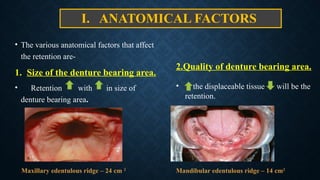
1. Size of the denture bearing area.
• Retention with in size of
denture bearing area.
2.Quality of denture bearing area.
• the displaceable tissue will be the
retention.
Maxillary edentulous ridge – 24 cm 2
Mandibular edentulous ridge – 14 cm2
II. PHYSIOLOGICAL FACTORS
• SALIVA-
• The amount and consistency of saliva affects retention .
• Thin watery saliva affords best retention.
• saliva – that is thick and ropy accumulate between the
tissue surface of the denture and the palate leading to loss of
retention.
• saliva - affects retention and can also cause irritation and
soreness of the denture bearing tissues.
III. PHYSICAL FACTORS
• The various physical factors which affect retention are :-
1. Adhesion
2. Cohesion
3. Interfacial surface tension
4. Capillarity or capillary attraction
5. Atmospheric pressure and peripheral seal
6. Gravity
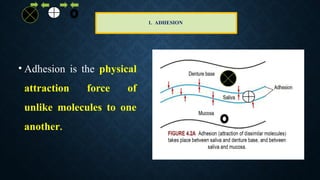
1. ADHESION
• Adhesion is the physical
attraction force of
unlike molecules to one
another.
• Saliva is present in between the denture base and the
mucosa, and its contact with both these surfaces creates
adhesion.
• It is achieved by ionic forces between the salivary
glycoproteins and surface epithelium or acrylic resin.
It depends on:
• Close adaptation of denture
• Size of denture-bearing area
• Type of saliva
• Adhesion also takes place directly between the denture base and
mucosa in case of xerostomia (lack of saliva), but this leads to
ulcerations and abrasions in the mucosa.
2.COHESION
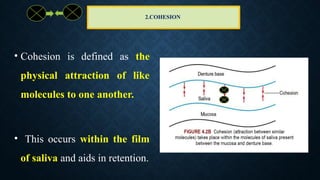
• Cohesion is defined as the
physical attraction of like
molecules to one another.
• This occurs within the film
of saliva and aids in retention.
• Normal saliva is not very cohesive; hence, retention from
mucosa interface is more dependent on adhesion and surface
tension.
• As viscosity of saliva increases, greater is the cohesion
• Very thick, mucous saliva can physically push the
denture out, resulting in loss of retention.
3. INTERFACIAL SURFACE TENSION
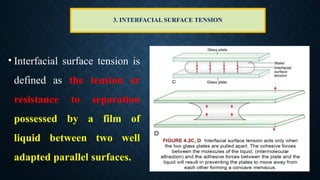
• Interfacial surface tension is
defined as the tension or
resistance to separation
possessed by a film of
liquid between two well
adapted parallel surfaces.
Stefan`s Law :
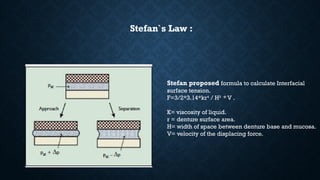
Stefan proposed formula to calculate Interfacial
surface tension.
F=3/2*3.14*kr4
/ H3
* V .
K= viscosity of liquid.
r = denture surface area.
H= width of space between denture base and mucosa.
V= velocity of the displacing force.
• These forces are found within the thin film of saliva that is
present between the denture base and tissues.
• It is dependent on the ability of the liquid to ‘wet’ the
surfaces. The ‘wettability’ of the fluid is inversely
proportional to the surface tension of the surfaces.
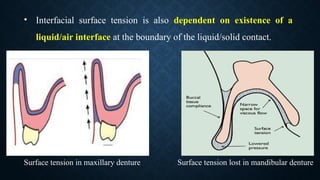
Surface tension in maxillary denture Surface tension lost in mandibular denture
• Interfacial surface tension is also dependent on existence of a
liquid/air interface at the boundary of the liquid/solid contact.
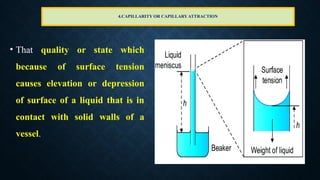
4.CAPILLARITY OR CAPILLARYATTRACTION
• That quality or state which
because of surface tension
causes elevation or depression
of surface of a liquid that is in
contact with solid walls of a
vessel.
• When adaptation of denture base to mucosa is close the space filled with
saliva acts like a capillary tube and helps retain the denture.
• This force like others is directly proportional to area of basal seat coverage.
• Factors that aid to improve capillary attraction are-
1. Closeness of adaptation of denture base to soft tissue.
2. Greater surface of the denture bearing area.
3. Thin film of saliva should be present.
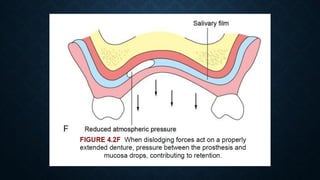
5.ATMOSPHERIC PRESSURE
• This can help resist dislodging forces if the dentures have an
effective border seal.
• Peripheral seal or border seal is defined as the contact of the
denture border with the underlying or adjacent tissues to
prevent the passage of air or other substances (GPT8).
• Retention due to atmospheric pressure is proportional to the
denture base area.
• Proper border moulding is essential for this retention mechanism to
function.
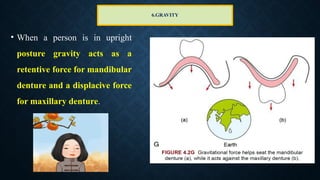
6.GRAVITY
• When a person is in upright
posture gravity acts as a
retentive force for mandibular
denture and a displacive force
for maxillary denture.
IV . MECHANICAL FACTORS
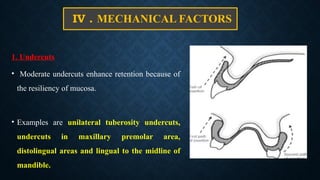
1. Undercuts
• Moderate undercuts enhance retention because of
the resiliency of mucosa.
• Examples are unilateral tuberosity undercuts,
undercuts in maxillary premolar area,
distolingual areas and lingual to the midline of
mandible.
• Severe undercuts covered with thin mucosa compromise retention and need
to be surgically eliminated.
• Undercuts like those present in the retromolar areas and maxillary
anterior ridge allow insertion of denture with a rotational path with the
undercut area seated first.
• They provide good resistance to displacement in a vertical direction.
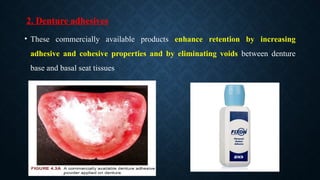
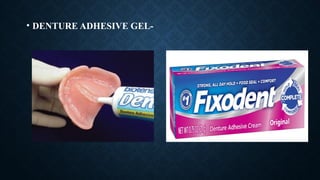
2. Denture adhesives
• These commercially available products enhance retention by increasing
adhesive and cohesive properties and by eliminating voids between denture
base and basal seat tissues
• DENTURE ADHESIVE GEL-
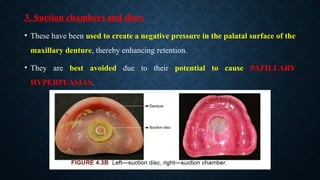
3. Suction chambers and discs
• These have been used to create a negative pressure in the palatal surface of the
maxillary denture, thereby enhancing retention.
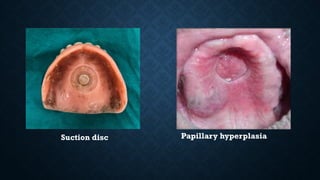
• They are best avoided due to their potential to cause PAPILLARY
HYPERPLASIAS.
Suction disc Papillary hyperplasia
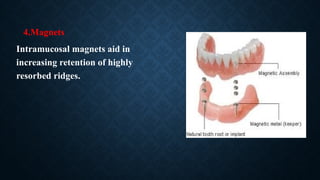
4.Magnets
Intramucosal magnets aid in
increasing retention of highly
resorbed ridges.
V. MUSCULAR FACTORS
• The oral and facial musculature and tongue supply supplementary retentive forces.
• For this to be effective:
• Teeth must be positioned in the ‘neutral zone’ between the tongue and cheeks.
• Polished surfaces of the dentures should be properly contoured.
• Denture bases must be extended to cover maximum area.
• Occlusal plane must be at correct level.
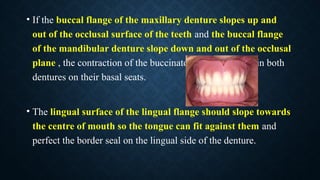
• If the buccal flange of the maxillary denture slopes up and
out of the occlusal surface of the teeth and the buccal flange
of the mandibular denture slope down and out of the occlusal
plane , the contraction of the buccinator will tend to retain both
dentures on their basal seats.
• The lingual surface of the lingual flange should slope towards
the centre of mouth so the tongue can fit against them and
perfect the border seal on the lingual side of the denture.
• The base of the tongue serve as a emergency retentive force
for some patient.
• It rises up at the back and presses against the distal border of
the maxillary denture during incision of food by anterior
teeth.
QUESTION FROM UNIVERSITY POINT OF VIEW
1. Define impression. Mention objectives of impression making.

Explain retention in complete denture in detail. ( 7 marks )
2. Atmospheric pressure ( 5 marks )
3. Interfacial surface tension ( 5 marks )
4. Adhesion ( 1 mark )
5. Cohesion (1 mark )
TEXT BOOK YOU SHOULD REFER
•Boucher
•Nallaswamy 2nd
edition.
THANK YOU

Retention in complete denture BY DR KAVAN DOSHI.pptx

  • 1.
    RETENTION IN COMPLETE DENTURE Preparedby: Dr. KAVAN Y. DOSHI MAXILLOFACIAL PROSTHODONTIST AND IMPLANTOLOGIST
  • 2.
    OBJECTIVES OF IMPRESSIONMAKING 1. Retention 2. Stability 3. Support 4. Preservation of residual structures 5. Aesthetics
  • 3.
    CONTENTS • DEFINITION • FACTORSAFFECTING RETENTION- 1. Anatomical factors 2. Physiological factors 3. Physical factors 4. Mechanical factors 5. Muscular factors
  • 4.
    DEFINITION • RETENTION -According to (GPT 9 ), • That quality inherent in the dental prosthesis acting to resist the forces of dislodgment along the path of placement.
  • 6.
    FACTORS AFFECTING RETENTION •The factors that affect the retention can be classified as are- 1. Anatomical factors 2. Physiological factors 3. Physical factors 4. Mechanical factors 5. Muscular factors
  • 7.
    I. ANATOMICAL FACTORS •The various anatomical factors that affect the retention are- 1. Size of the denture bearing area. • Retention with in size of denture bearing area. 2.Quality of denture bearing area. • the displaceable tissue will be the retention. Maxillary edentulous ridge – 24 cm 2 Mandibular edentulous ridge – 14 cm2
  • 8.
    II. PHYSIOLOGICAL FACTORS •SALIVA- • The amount and consistency of saliva affects retention . • Thin watery saliva affords best retention. • saliva – that is thick and ropy accumulate between the tissue surface of the denture and the palate leading to loss of retention. • saliva - affects retention and can also cause irritation and soreness of the denture bearing tissues.
  • 9.
    III. PHYSICAL FACTORS •The various physical factors which affect retention are :- 1. Adhesion 2. Cohesion 3. Interfacial surface tension 4. Capillarity or capillary attraction 5. Atmospheric pressure and peripheral seal 6. Gravity
  • 10.
    1. ADHESION • Adhesionis the physical attraction force of unlike molecules to one another.

  • 11.
    • Saliva ispresent in between the denture base and the mucosa, and its contact with both these surfaces creates adhesion. • It is achieved by ionic forces between the salivary glycoproteins and surface epithelium or acrylic resin.
  • 12.
    It depends on: •Close adaptation of denture • Size of denture-bearing area • Type of saliva • Adhesion also takes place directly between the denture base and mucosa in case of xerostomia (lack of saliva), but this leads to ulcerations and abrasions in the mucosa.
  • 13.
    2.COHESION • Cohesion isdefined as the physical attraction of like molecules to one another. • This occurs within the film of saliva and aids in retention.
  • 14.
    • Normal salivais not very cohesive; hence, retention from mucosa interface is more dependent on adhesion and surface tension. • As viscosity of saliva increases, greater is the cohesion • Very thick, mucous saliva can physically push the denture out, resulting in loss of retention.
  • 15.
    3. INTERFACIAL SURFACETENSION • Interfacial surface tension is defined as the tension or resistance to separation possessed by a film of liquid between two well adapted parallel surfaces.
  • 16.
    Stefan`s Law : Stefanproposed formula to calculate Interfacial surface tension. F=3/2*3.14*kr4 / H3 * V . K= viscosity of liquid. r = denture surface area. H= width of space between denture base and mucosa. V= velocity of the displacing force.
  • 17.
    • These forcesare found within the thin film of saliva that is present between the denture base and tissues. • It is dependent on the ability of the liquid to ‘wet’ the surfaces. The ‘wettability’ of the fluid is inversely proportional to the surface tension of the surfaces.
  • 18.
    Surface tension inmaxillary denture Surface tension lost in mandibular denture • Interfacial surface tension is also dependent on existence of a liquid/air interface at the boundary of the liquid/solid contact.
  • 19.
    4.CAPILLARITY OR CAPILLARYATTRACTION •That quality or state which because of surface tension causes elevation or depression of surface of a liquid that is in contact with solid walls of a vessel.
  • 20.
    • When adaptationof denture base to mucosa is close the space filled with saliva acts like a capillary tube and helps retain the denture. • This force like others is directly proportional to area of basal seat coverage. • Factors that aid to improve capillary attraction are- 1. Closeness of adaptation of denture base to soft tissue. 2. Greater surface of the denture bearing area. 3. Thin film of saliva should be present.
  • 21.
    5.ATMOSPHERIC PRESSURE • Thiscan help resist dislodging forces if the dentures have an effective border seal. • Peripheral seal or border seal is defined as the contact of the denture border with the underlying or adjacent tissues to prevent the passage of air or other substances (GPT8).
  • 23.
    • Retention dueto atmospheric pressure is proportional to the denture base area. • Proper border moulding is essential for this retention mechanism to function.
  • 24.
    6.GRAVITY • When aperson is in upright posture gravity acts as a retentive force for mandibular denture and a displacive force for maxillary denture.
  • 25.
    IV . MECHANICALFACTORS 1. Undercuts • Moderate undercuts enhance retention because of the resiliency of mucosa. • Examples are unilateral tuberosity undercuts, undercuts in maxillary premolar area, distolingual areas and lingual to the midline of mandible.
  • 26.
    • Severe undercutscovered with thin mucosa compromise retention and need to be surgically eliminated. • Undercuts like those present in the retromolar areas and maxillary anterior ridge allow insertion of denture with a rotational path with the undercut area seated first. • They provide good resistance to displacement in a vertical direction.
  • 27.
    2. Denture adhesives •These commercially available products enhance retention by increasing adhesive and cohesive properties and by eliminating voids between denture base and basal seat tissues
  • 28.
  • 29.
    3. Suction chambersand discs • These have been used to create a negative pressure in the palatal surface of the maxillary denture, thereby enhancing retention. • They are best avoided due to their potential to cause PAPILLARY HYPERPLASIAS.
  • 30.
  • 31.
    4.Magnets Intramucosal magnets aidin increasing retention of highly resorbed ridges.
  • 32.
    V. MUSCULAR FACTORS •The oral and facial musculature and tongue supply supplementary retentive forces. • For this to be effective: • Teeth must be positioned in the ‘neutral zone’ between the tongue and cheeks. • Polished surfaces of the dentures should be properly contoured. • Denture bases must be extended to cover maximum area. • Occlusal plane must be at correct level.
  • 33.
    • If thebuccal flange of the maxillary denture slopes up and out of the occlusal surface of the teeth and the buccal flange of the mandibular denture slope down and out of the occlusal plane , the contraction of the buccinator will tend to retain both dentures on their basal seats. • The lingual surface of the lingual flange should slope towards the centre of mouth so the tongue can fit against them and perfect the border seal on the lingual side of the denture.
  • 34.
    • The baseof the tongue serve as a emergency retentive force for some patient. • It rises up at the back and presses against the distal border of the maxillary denture during incision of food by anterior teeth.
  • 35.
    QUESTION FROM UNIVERSITYPOINT OF VIEW 1. Define impression. Mention objectives of impression making. Explain retention in complete denture in detail. ( 7 marks ) 2. Atmospheric pressure ( 5 marks ) 3. Interfacial surface tension ( 5 marks ) 4. Adhesion ( 1 mark ) 5. Cohesion (1 mark )
  • 36.
    TEXT BOOK YOUSHOULD REFER •Boucher •Nallaswamy 2nd edition.
  • 37.

Editor's Notes

  • #1 Retention is one of the objective in impression making. Which when incorporated leads to successful denture.
  • #2 RETENTION – the resistance to displacement of the denture base away from the ridge. It provides psychologic comfort to the patient. If a denture is easily dislodged during speech or eating, the embarrassment experienced can be mentally traumatic. A retentive denture contributes dramatically to patient acceptance of the finished prosthesis. STABILITY- is the resistance to horizontal and rotational forces. This property prevents lateral or anteroposterior shunting of the denture base. Stability has been cited as the most significant property in providing for the physiologic comfort of the patient. Denture instability adversely affects support and retention and results in deleterious forces on the edentulous ridges during function. SUPPORT - Support is the resistance to vertical movement of the denture base toward the ridge. This property maintains the occlusal relationships established on the articulator. A complete denture may continue to function ideally only as long as sufficient support is present to resist tissue ward movement under loading.
  • #5 Incorporating retention , stability and support factor during denture fabrication will give patient a psychologic and physiologic comfort and longevity of the prosthesis which will ultimately have a successful prosthesis.
  • #6 Anatomical factors ( size of denture bearing area and tissue displaceability) Physiological factors (amount and consistency of saliva ) Physical factors ( adhesion, cohesion, interfacial surface tension ,capillarity, atmospheric pressure , gravity) Mechanical factors ( undercuts, denture adhesives, suction chamber and discs) Muscular factors
  • #7 More the denture bearing area more will be the retention. Maxilla has more denture bearing area then the mandible so there is more retention in maxilla then mandible. Where average size of maxillary DBA is 24 cm2 and mandible 14 cm2. 2.Tissue displaceability The displaceability of the tissues affects the retention of the denture. Tissues displaced during impression making will rebound during function and lead to loss of retention.
  • #10 takes place between saliva and denture base, and between saliva and mucosa. A drop of water introduced on the surface of a solid glass plate will resist movement away from the glass in proportion to the adhesion between the unlike molecules.
  • #13 A molecule within a fluid has an attraction exerted on it on all sides by neighbouring molecules. The same molecule exerts an attractive force on the neighbouring molecules equal in magnitude but opposite in direction. Forces of cohesion are responsible for maintaining the continuity of a water droplet when placed in contact with another material The layer of saliva must be thin if it is to be effective for the retention
  • #17 Low surface tension better will be the wettability thin film of saliva will form High ST low wettability. The oral mucosa has low surface tension and hence the saliva ‘wets’ it well, spreading out in a thin film. Denture base materials demonstrate less wettability than oral mucosa, with heat-cured resins showing better wetting than autopolymerized resins. But once coated with salivary pellicle, the surface tension of the denture base material decreases and contact increases.
  • #18 If two plates with a fluid between them are immersed in the same fluid, then there is no interfacial surface tension and they can be separated easily. The external boundary of the mandibular denture is always filled (immersed) in saliva, thereby reducing the surface tension effect . Hence, interfacial surface tension plays a significant role in retention of only the maxillary denture.
  • #19 When adaptation of denture base to mucosa is close the space filled with saliva acts like a capillary tube and helps retain the denture.
  • #22 When a force is exerted perpendicular to and away from the basal seat of a denture which is properly extended and fully seated, pressure between the prosthesis and mucosa drops below the ambient pressure, resisting displacement. referred to as ‘suction’.