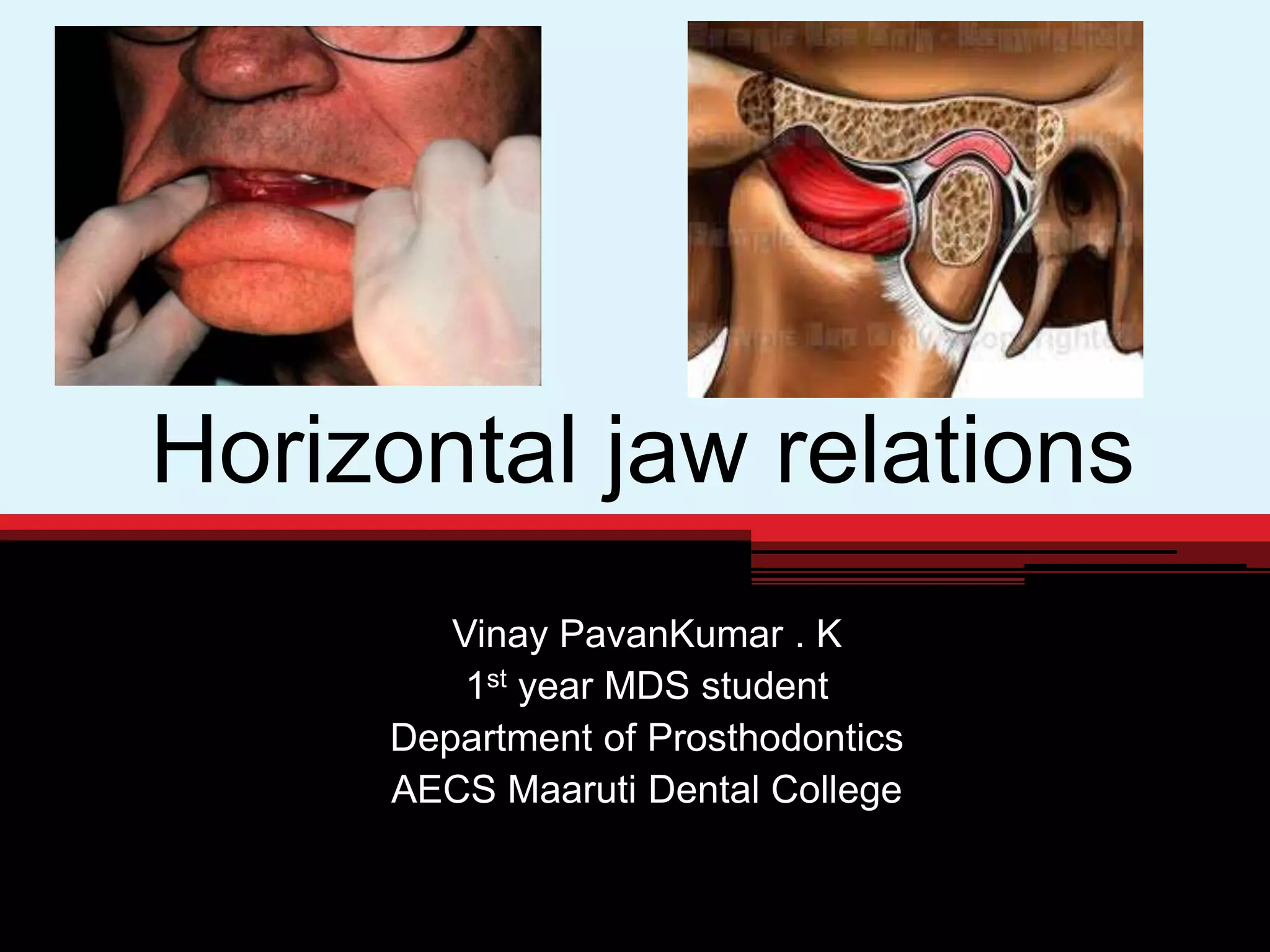
Horizontal jaw relations
Vinay PavanKumar . K
1st year MDS student
Department of Prosthodontics
AECS Maaruti Dental College
Jaw Relation
• It is described as any spatial relationship of the
mandible to the maxilla
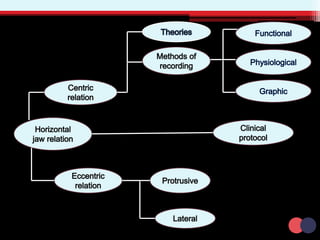
Horizontal jaw relation
• Horizontal Jaw relation is the relationship of the
mandible to the maxilla in a horizontal plane or it is
the relationship of the mandible to the maxilla in an
antero-posterior direction.
•Centric relation
•Eccentric relation
•Protrusive relation
•Lateral relation
•Left lateral
•Right lateral
It can be of two types
Centric relation
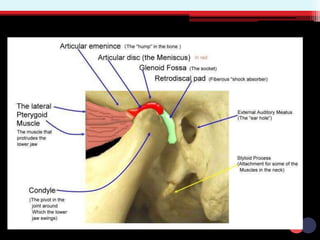
The most retruded relation of the mandible to the
maxilla when the condyles are in the most
posterior unrestrained position in the glenoid
fossa from which lateral movements can be
made, at any given degree of jaw separation.
GPT-8
• A maxillomandibular relationship in which the
condyles articulate with the thinnest avascular
portion of their respective disks with the complex in
the anteriorsuperior position against the slopes of
the articular eminences. This position is
independent of tooth contact. This position is
clinically discernible when the mandible is directed
superiorly and anteriorly and restricted to a purely
rotary movement about a transverse horizontal axis.
Purpose of recording centric relation
• It is a bone to bone relation and it is constant
• It is repeatable and recordable and thus serves as a
reliable guide for developing centric occlusion in
complete dentures
• It is related to the terminal hinge axis ,in CR condyles
exhibit pure rotation without any translation
• Functional movements like chewing and swallowing can
be carried out since it is the most unstrained position.
Final act of masticatory stroke ends in centric relation
• Reference relation
• It is more definite than vertical relation since it is
independent of tooth contact
Criterias for mandible to be in centric
• Disk properly aligned on both condyles
• Condyle-disk assembly at the highest point against the
posterior slopes of eminentia
• Medial pole of condyle-disk assembly braced by bone
Theories of centric relation
• The Muscle theory
• The Ligament theory
• The Osteofiber theory
• The Meniscus theory
Saizer P. Centric relation and condylar movement: anatomic
mechanism. J Prosthet Dent 1971;26(6):581-91.
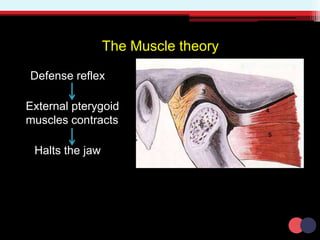
The Muscle theory
Defense reflex
External pterygoid
muscles contracts
Halts the jaw
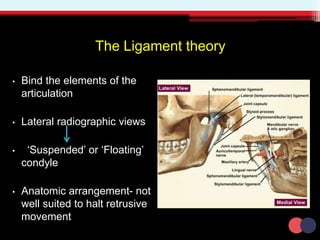
The Ligament theory
• Bind the elements of the
articulation
• Lateral radiographic views
• ‘Suspended’ or ‘Floating’
condyle
• Anatomic arrangement- not
well suited to halt retrusive
movement
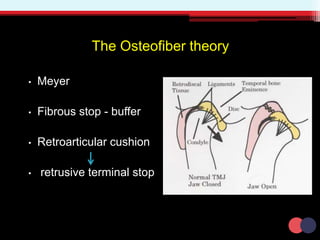
The Osteofiber theory
• Meyer
• Fibrous stop - buffer
• Retroarticular cushion
• retrusive terminal stop
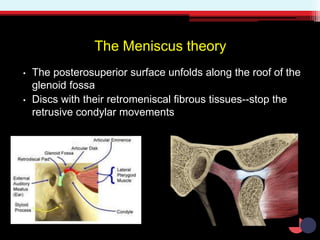
The Meniscus theory
• The posterosuperior surface unfolds along the roof of the
glenoid fossa
• Discs with their retromeniscal fibrous tissues--stop the
retrusive condylar movements
Factors influencing centric relation records
• The resiliency of the supporting tissues
• Fit of the denture bases
• Residual alveolar arch
• Saliva
• Tongue
Yurkstas AA, Kapur KK. Factors influencing centric relation
records in edentulous mouths. J Prosthet Dent 2005;93:305-10.
• The health and cooperation of the patient
• The posture of the patient
• The temporomandibular joint and its associated neuromuscular
mechanisms
• The skill of the dentist
• Pressure applied in making the recording
• The technique used and the recording devices used
Difficulties in obtaining mandibular retrusion
• Biologic difficulties
• Mechanical difficulties
• Psychological difficulties
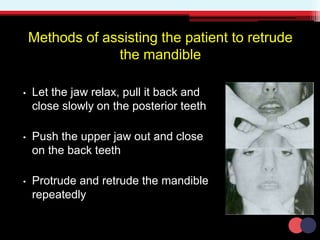
Methods of assisting the patient to retrude
the mandible
• Let the jaw relax, pull it back and
close slowly on the posterior teeth
• Push the upper jaw out and close
on the back teeth
• Protrude and retrude the mandible
repeatedly
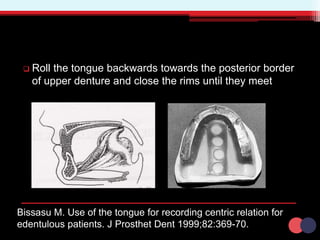
 Roll the tongue backwards towards the posterior border
of upper denture and close the rims until they meet
Bissasu M. Use of the tongue for recording centric relation for
edentulous patients. J Prosthet Dent 1999;82:369-70.
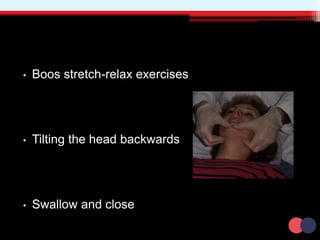
• Boos stretch-relax exercises
• Tilting the head backwards
• Swallow and close
Recording the Centric relation
• Primary requirements -
• accuracy
• equalized vertical pressure
• recording medium - uniform consistency
• retain the record in an undistorted condition
Pressure used while recording the centric relation
• Minimum closing pressure Opposing teeth to
touch uniformly and simultaneously at their first
contact
• Heavy closing pressure To produce same
displacement of the soft tissues as on the
dentures during function
Methods used for recording centric relation
• Tactile or interocclusal check record method
• Functional (chew-in) methods
• Meyer’s method
• Patterson’s method
• Needles-House method
• Excursive (graphic) methods
• Intraoral tracing
• Extraoral tracing
• Terminal hinge axis method
• Other methods
• Deglutition
• Pantography
Tactile or interocclusal check record method
• Philip Pfaff – “biscuit bite”
• Patient’s proprioception and tactile sense
• Indications:
• abnormally related jaws
• excessively displaceable supporting tissues
• large tongue
• abnormal mandibular movements
• verify occlusion in existing dentures
Interocclusal check record can be made-
• Between upper and lower rims
• Between upper and lower artificial or natural
teeth
• Between a central bearing plate and pin
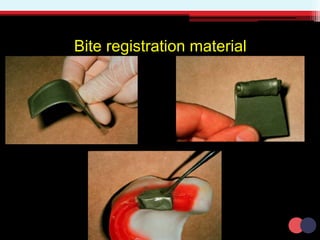
Bite registration/recording materials
• Waxes
• Quick setting plaster
• Impression compound
• Bite registration paste (ZnO-E)
• Bite registration silicone
Technique
• Two steps-
• Tentative records using occlusion rims
• Interocclusal check records with the teeth
arranged for try-in
• Anterior try-in
• Posterior try-in
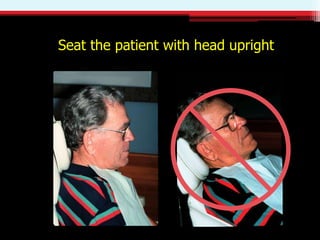
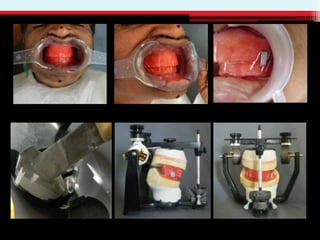
Seat the patient with head upright
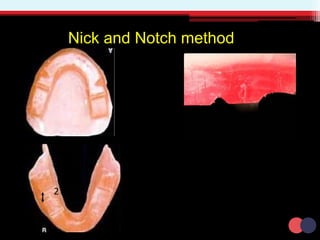
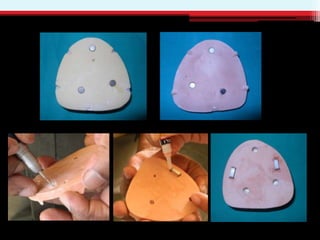
Nick and Notch method
Too shallow
2 mm
Bite registration material
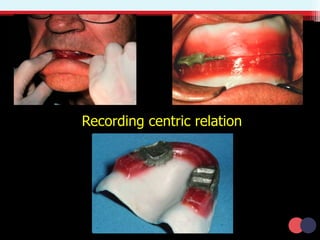
Recording centric relation
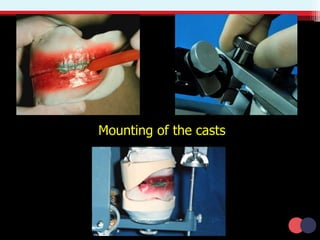
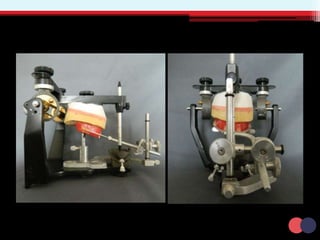
Mounting of the casts
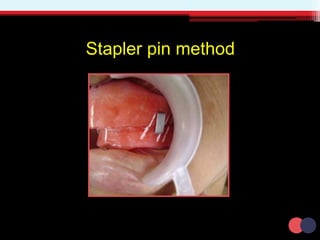
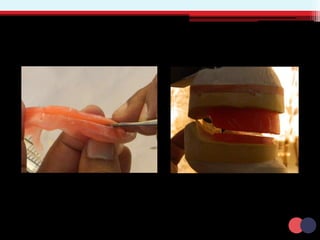
Stapler pin method
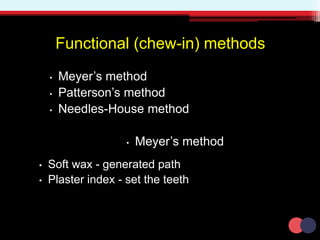
Functional (chew-in) methods
• Meyer’s method
• Patterson’s method
• Needles-House method
• Meyer’s method
• Soft wax - generated path
• Plaster index - set the teeth
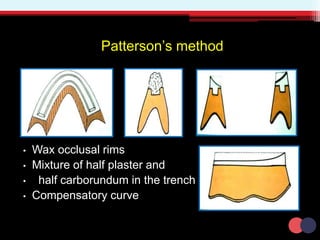
Patterson’s method
• Wax occlusal rims
• Mixture of half plaster and
• half carborundum in the trench
• Compensatory curve
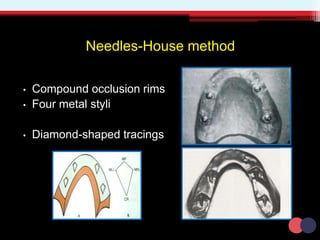
Needles-House method
• Compound occlusion rims
• Four metal styli
• Diamond-shaped tracings
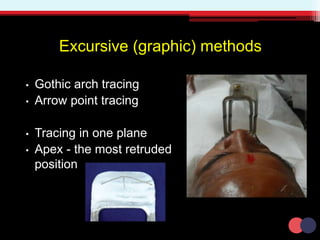
Excursive (graphic) methods
• Gothic arch tracing
• Arrow point tracing
• Tracing in one plane
• Apex - the most retruded
position
• Uses-
• Verify centric relation
• Obtain protrusive and lateral records
• Types-
• Intraoral tracer
• Extraoral tracer
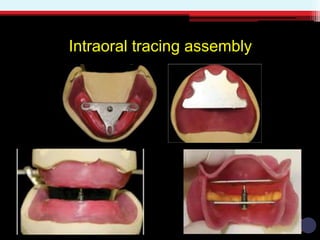
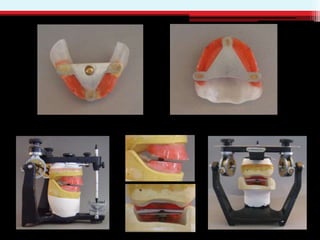
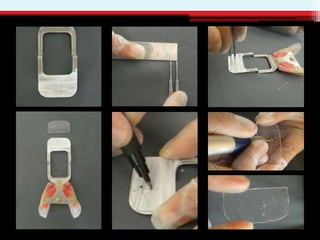
Intraoral tracing assembly
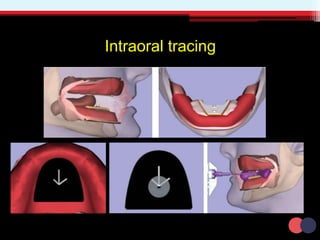
Intraoral tracing
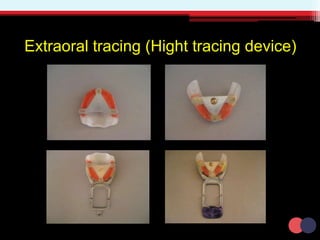
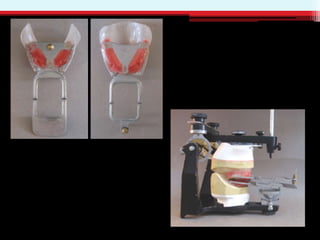
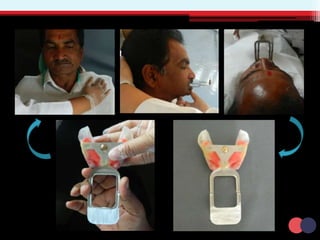
Extraoral tracing (Hight tracing device)
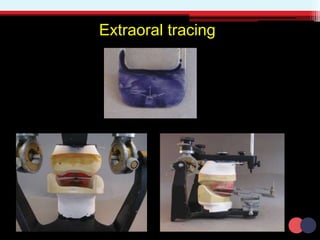
Extraoral tracing
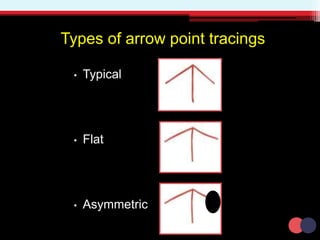
Types of arrow point tracings
• Typical
• Flat
• Asymmetric
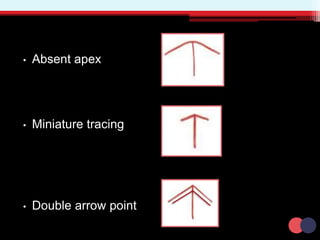
• Absent apex
• Miniature tracing
• Double arrow point
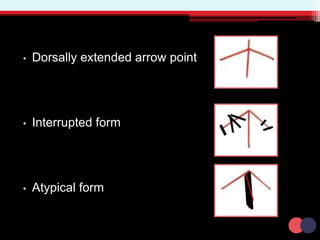
• Dorsally extended arrow point
• Interrupted form
• Atypical form
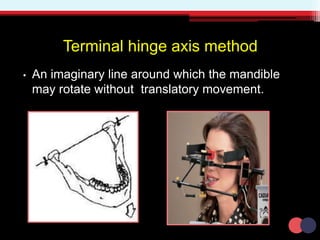
Terminal hinge axis method
• An imaginary line around which the mandible
may rotate without translatory movement.
Other methods-
• Deglutition
• Pantography
• Deglutition
• Physiologic method
• ‘swallow and hold’
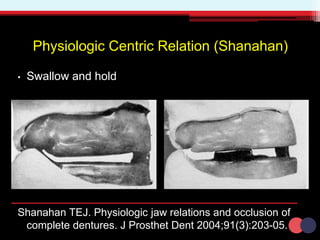
Physiologic Centric Relation (Shanahan)
• Swallow and hold
Shanahan TEJ. Physiologic jaw relations and occlusion of
complete dentures. J Prosthet Dent 2004;91(3):203-05.
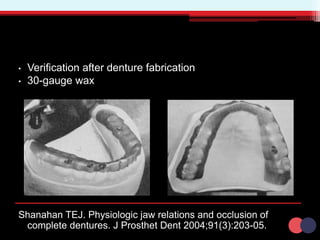
• Verification after denture fabrication
• 30-gauge wax
Shanahan TEJ. Physiologic jaw relations and occlusion of
complete dentures. J Prosthet Dent 2004;91(3):203-05.
Centric-relation recording techniques
• Swallowing or free closure (Shanahan)
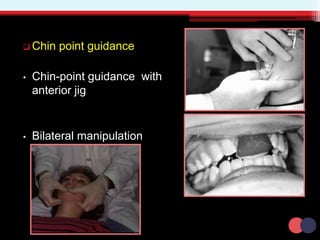
• Chin point guidance
• Chin-point guidance with anterior jig
• Bilateral manipulation
Kantor ME, Silverman SI and Garfinkel L. Centric-relation recording
techniques-a comparative investigation. J Prosthet Dent 1972;28(6):593-
600.
 Chin point guidance
• Chin-point guidance with
anterior jig
• Bilateral manipulation
Median variability
• Swallowing or free-closure records - 0.40 mm
• Chin-point guidance - 0.14 mm
• Chin-point guidance with an anterior jig - 0.07 mm
• Bilateral manipulation - 0.05 mm
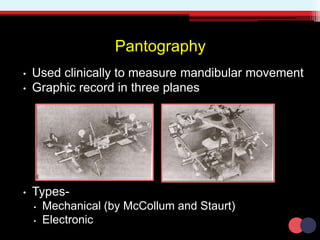
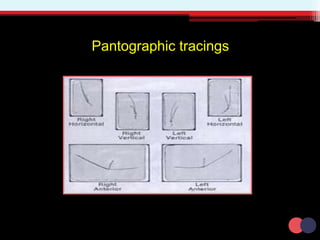
Pantography
• Used clinically to measure mandibular movement
• Graphic record in three planes
• Types-
• Mechanical (by McCollum and Staurt)
• Electronic
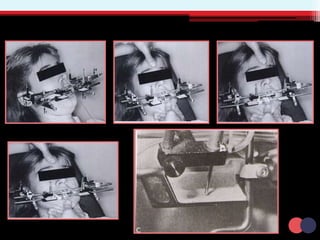
Pantographic tracings
Eccentric relation records
• Protrusive relation
• Lateral relation
• Left lateral
• Right lateral
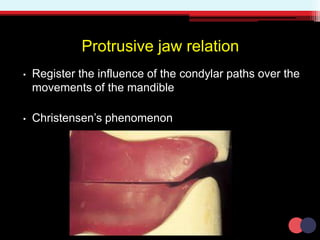
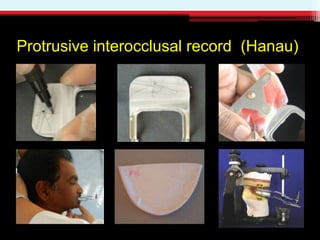
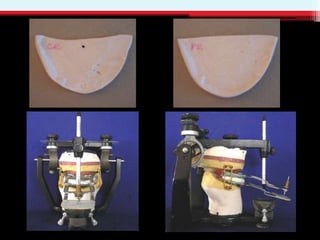
Protrusive jaw relation
• Register the influence of the condylar paths over the
movements of the mandible
• Christensen’s phenomenon
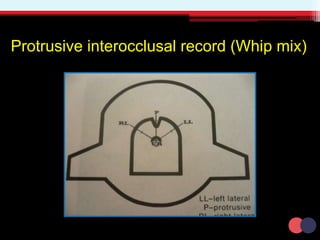
Protrusive interocclusal record (Whip mix)
Protrusive interocclusal record (Hanau)
Lateral jaw relations
• Influence the intercuspation of teeth in working
mastication
• Used to program the articulator
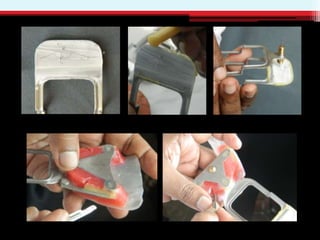
Lateral interocclusal records (Whip mix)
• Set side shift guide at 45o
• Mark 6mm from centric relation along Left Lateral
tracing and centre the hole of plastic piece over it
• Right condylar ball is in protrusion
• Side shift guide brought in contact with the ball
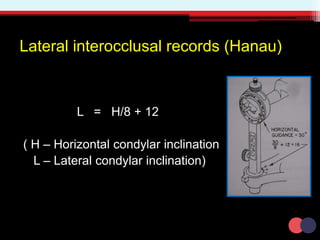
Lateral interocclusal records (Hanau)
L = H/8 + 12
( H – Horizontal condylar inclination
L – Lateral condylar inclination)
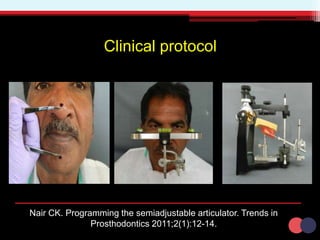
Clinical protocol
Nair CK. Programming the semiadjustable articulator. Trends in
Prosthodontics 2011;2(1):12-14.
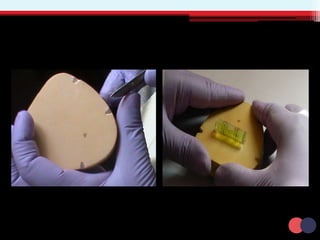
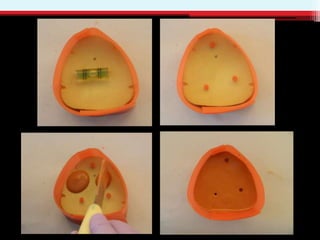
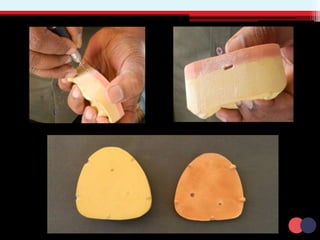
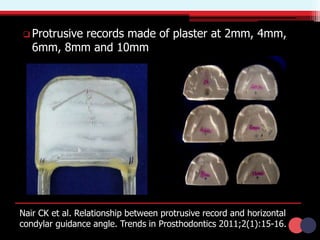
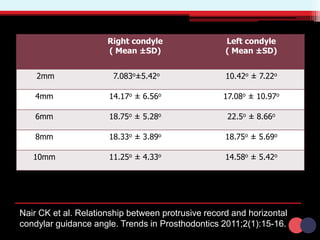
 Protrusive records made of plaster at 2mm, 4mm,
6mm, 8mm and 10mm
Nair CK et al. Relationship between protrusive record and horizontal
condylar guidance angle. Trends in Prosthodontics 2011;2(1):15-16.
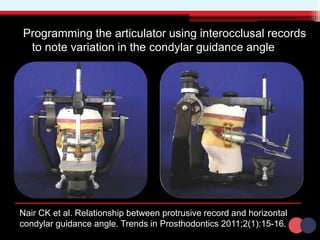
Programming the articulator using interocclusal records
to note variation in the condylar guidance angle
Nair CK et al. Relationship between protrusive record and horizontal
condylar guidance angle. Trends in Prosthodontics 2011;2(1):15-16.
Nair CK et al. Relationship between protrusive record and horizontal
condylar guidance angle. Trends in Prosthodontics 2011;2(1):15-16.
Right condyle
( Mean ±SD)
Left condyle
( Mean ±SD)
2mm 7.083o±5.42o 10.42o ± 7.22o
4mm 14.17o ± 6.56o 17.08o ± 10.97o
6mm 18.75o ± 5.28o 22.5o ± 8.66o
8mm 18.33o ± 3.89o 18.75o ± 5.69o
10mm 11.25o ± 4.33o 14.58o ± 5.42o
References:
 Nair KC, A primer on complete denture fabrication,
1st edition, 2013, Ahuja publication, India Pp 67-77
 Winkler S, Essentials of Complete Denture
Prosthodontics, 2nd edition, India, A.I.B.T.S
Publishers and distributors, 2009, pp 192-201.
 Sharry JJ, Complete Denture Prosthodontics, 3rd
edition, USA, Mcgraw-Hill Book Company, 1974,
pp 215-222.
 Manappallil JJ, Complete Denture Prosthodontics,
1st edition, India, Arya (Medi) Publishing House,
2006, pp 145-67, 181-83, 194-98.
 Saizer P. Centric relation and condylar movement:
anatomic mechanism. J Prosthet Dent
1971;26(6):581-91.
 Avant WE. Using the term centric. J Prosthet Dent
1971;25(1):12-15.
 Yurkstas AA, Kapur KK. Factors influencing centric
relation records in edentulous mouths. J Prosthet
Dent 2005;93:305-10.
 Shanahan TEJ. Physiologic jaw relations and
occlusion of complete dentures. J Prosthet Dent
2004;91(3):203-5.
 Kantor ME, Silverman SI and Garfinkel L. Centric-
relation recording techniques-a comparative
investigation. J Prosthet Dent 1972;28(6):593-600
 Kingery RH. A review of sone of the problems
associated with centric relation. J Prosthet Dent
1952;2(3):307-19.
 Bissasu M. Use of the tongue for recording centric
relation for edentulous patients. J Prosthet Dent
1999;82:369-70.
 Gothic arch tracing ppt.
 Nair CK. Programming the semiadjustable
articulator. Trends in Prosthodontics 2011;2(1):12-
14.
 Nair CK et al. Relationship between protrusive
record and horizontal condylar guidance angle.
Trends in Prosthodontics 2011;2(1):15-16.

Horizontal jaw relation in complete denture

  • 1.
    Horizontal jaw relations VinayPavanKumar . K 1st year MDS student Department of Prosthodontics AECS Maaruti Dental College
  • 3.
    Jaw Relation • Itis described as any spatial relationship of the mandible to the maxilla
  • 4.
    Horizontal jaw relation •Horizontal Jaw relation is the relationship of the mandible to the maxilla in a horizontal plane or it is the relationship of the mandible to the maxilla in an antero-posterior direction.
  • 5.
    •Centric relation •Eccentric relation •Protrusiverelation •Lateral relation •Left lateral •Right lateral It can be of two types
  • 6.
    Centric relation The mostretruded relation of the mandible to the maxilla when the condyles are in the most posterior unrestrained position in the glenoid fossa from which lateral movements can be made, at any given degree of jaw separation.
  • 7.
    GPT-8 • A maxillomandibularrelationship in which the condyles articulate with the thinnest avascular portion of their respective disks with the complex in the anteriorsuperior position against the slopes of the articular eminences. This position is independent of tooth contact. This position is clinically discernible when the mandible is directed superiorly and anteriorly and restricted to a purely rotary movement about a transverse horizontal axis.
  • 9.
    Purpose of recordingcentric relation • It is a bone to bone relation and it is constant • It is repeatable and recordable and thus serves as a reliable guide for developing centric occlusion in complete dentures • It is related to the terminal hinge axis ,in CR condyles exhibit pure rotation without any translation
  • 10.
    • Functional movementslike chewing and swallowing can be carried out since it is the most unstrained position. Final act of masticatory stroke ends in centric relation • Reference relation • It is more definite than vertical relation since it is independent of tooth contact
  • 11.
    Criterias for mandibleto be in centric • Disk properly aligned on both condyles • Condyle-disk assembly at the highest point against the posterior slopes of eminentia • Medial pole of condyle-disk assembly braced by bone
  • 12.
    Theories of centricrelation • The Muscle theory • The Ligament theory • The Osteofiber theory • The Meniscus theory Saizer P. Centric relation and condylar movement: anatomic mechanism. J Prosthet Dent 1971;26(6):581-91.
  • 13.
    The Muscle theory Defensereflex External pterygoid muscles contracts Halts the jaw
  • 14.
    The Ligament theory •Bind the elements of the articulation • Lateral radiographic views • ‘Suspended’ or ‘Floating’ condyle • Anatomic arrangement- not well suited to halt retrusive movement
  • 15.
    The Osteofiber theory •Meyer • Fibrous stop - buffer • Retroarticular cushion • retrusive terminal stop
  • 16.
    The Meniscus theory •The posterosuperior surface unfolds along the roof of the glenoid fossa • Discs with their retromeniscal fibrous tissues--stop the retrusive condylar movements
  • 17.
    Factors influencing centricrelation records • The resiliency of the supporting tissues • Fit of the denture bases • Residual alveolar arch • Saliva • Tongue Yurkstas AA, Kapur KK. Factors influencing centric relation records in edentulous mouths. J Prosthet Dent 2005;93:305-10.
  • 18.
    • The healthand cooperation of the patient • The posture of the patient • The temporomandibular joint and its associated neuromuscular mechanisms • The skill of the dentist • Pressure applied in making the recording • The technique used and the recording devices used
  • 19.
    Difficulties in obtainingmandibular retrusion • Biologic difficulties • Mechanical difficulties • Psychological difficulties
  • 20.
    Methods of assistingthe patient to retrude the mandible • Let the jaw relax, pull it back and close slowly on the posterior teeth • Push the upper jaw out and close on the back teeth • Protrude and retrude the mandible repeatedly
  • 21.
     Roll thetongue backwards towards the posterior border of upper denture and close the rims until they meet Bissasu M. Use of the tongue for recording centric relation for edentulous patients. J Prosthet Dent 1999;82:369-70.
  • 22.
    • Boos stretch-relaxexercises • Tilting the head backwards • Swallow and close
  • 23.
    Recording the Centricrelation • Primary requirements - • accuracy • equalized vertical pressure • recording medium - uniform consistency • retain the record in an undistorted condition
  • 24.
    Pressure used whilerecording the centric relation • Minimum closing pressure Opposing teeth to touch uniformly and simultaneously at their first contact • Heavy closing pressure To produce same displacement of the soft tissues as on the dentures during function
  • 25.
    Methods used forrecording centric relation • Tactile or interocclusal check record method • Functional (chew-in) methods • Meyer’s method • Patterson’s method • Needles-House method • Excursive (graphic) methods • Intraoral tracing • Extraoral tracing
  • 26.
    • Terminal hingeaxis method • Other methods • Deglutition • Pantography
  • 27.
    Tactile or interocclusalcheck record method • Philip Pfaff – “biscuit bite” • Patient’s proprioception and tactile sense • Indications: • abnormally related jaws • excessively displaceable supporting tissues • large tongue • abnormal mandibular movements • verify occlusion in existing dentures
  • 28.
    Interocclusal check recordcan be made- • Between upper and lower rims • Between upper and lower artificial or natural teeth • Between a central bearing plate and pin
  • 29.
    Bite registration/recording materials •Waxes • Quick setting plaster • Impression compound • Bite registration paste (ZnO-E) • Bite registration silicone
  • 30.
    Technique • Two steps- •Tentative records using occlusion rims • Interocclusal check records with the teeth arranged for try-in • Anterior try-in • Posterior try-in
  • 31.
    Seat the patientwith head upright
  • 32.
    Nick and Notchmethod Too shallow 2 mm
  • 33.
  • 34.
  • 35.
  • 36.
  • 37.
    Functional (chew-in) methods •Meyer’s method • Patterson’s method • Needles-House method • Meyer’s method • Soft wax - generated path • Plaster index - set the teeth
  • 38.
    Patterson’s method • Waxocclusal rims • Mixture of half plaster and • half carborundum in the trench • Compensatory curve
  • 39.
    Needles-House method • Compoundocclusion rims • Four metal styli • Diamond-shaped tracings
  • 40.
    Excursive (graphic) methods •Gothic arch tracing • Arrow point tracing • Tracing in one plane • Apex - the most retruded position
  • 41.
    • Uses- • Verifycentric relation • Obtain protrusive and lateral records • Types- • Intraoral tracer • Extraoral tracer
  • 42.
  • 43.
  • 44.
    Extraoral tracing (Highttracing device)
  • 45.
  • 46.
    Types of arrowpoint tracings • Typical • Flat • Asymmetric
  • 47.
    • Absent apex •Miniature tracing • Double arrow point
  • 48.
    • Dorsally extendedarrow point • Interrupted form • Atypical form
  • 49.
    Terminal hinge axismethod • An imaginary line around which the mandible may rotate without translatory movement.
  • 50.
    Other methods- • Deglutition •Pantography • Deglutition • Physiologic method • ‘swallow and hold’
  • 51.
    Physiologic Centric Relation(Shanahan) • Swallow and hold Shanahan TEJ. Physiologic jaw relations and occlusion of complete dentures. J Prosthet Dent 2004;91(3):203-05.
  • 52.
    • Verification afterdenture fabrication • 30-gauge wax Shanahan TEJ. Physiologic jaw relations and occlusion of complete dentures. J Prosthet Dent 2004;91(3):203-05.
  • 53.
    Centric-relation recording techniques •Swallowing or free closure (Shanahan) • Chin point guidance • Chin-point guidance with anterior jig • Bilateral manipulation Kantor ME, Silverman SI and Garfinkel L. Centric-relation recording techniques-a comparative investigation. J Prosthet Dent 1972;28(6):593- 600.
  • 54.
     Chin pointguidance • Chin-point guidance with anterior jig • Bilateral manipulation
  • 55.
    Median variability • Swallowingor free-closure records - 0.40 mm • Chin-point guidance - 0.14 mm • Chin-point guidance with an anterior jig - 0.07 mm • Bilateral manipulation - 0.05 mm
  • 56.
    Pantography • Used clinicallyto measure mandibular movement • Graphic record in three planes • Types- • Mechanical (by McCollum and Staurt) • Electronic
  • 58.
  • 59.
    Eccentric relation records •Protrusive relation • Lateral relation • Left lateral • Right lateral
  • 60.
    Protrusive jaw relation •Register the influence of the condylar paths over the movements of the mandible • Christensen’s phenomenon
  • 61.
  • 62.
  • 63.
    Lateral jaw relations •Influence the intercuspation of teeth in working mastication • Used to program the articulator
  • 64.
    Lateral interocclusal records(Whip mix) • Set side shift guide at 45o • Mark 6mm from centric relation along Left Lateral tracing and centre the hole of plastic piece over it • Right condylar ball is in protrusion • Side shift guide brought in contact with the ball
  • 65.
    Lateral interocclusal records(Hanau) L = H/8 + 12 ( H – Horizontal condylar inclination L – Lateral condylar inclination)
  • 66.
    Clinical protocol Nair CK.Programming the semiadjustable articulator. Trends in Prosthodontics 2011;2(1):12-14.
  • 80.
     Protrusive recordsmade of plaster at 2mm, 4mm, 6mm, 8mm and 10mm Nair CK et al. Relationship between protrusive record and horizontal condylar guidance angle. Trends in Prosthodontics 2011;2(1):15-16.
  • 81.
    Programming the articulatorusing interocclusal records to note variation in the condylar guidance angle Nair CK et al. Relationship between protrusive record and horizontal condylar guidance angle. Trends in Prosthodontics 2011;2(1):15-16.
  • 82.
    Nair CK etal. Relationship between protrusive record and horizontal condylar guidance angle. Trends in Prosthodontics 2011;2(1):15-16. Right condyle ( Mean ±SD) Left condyle ( Mean ±SD) 2mm 7.083o±5.42o 10.42o ± 7.22o 4mm 14.17o ± 6.56o 17.08o ± 10.97o 6mm 18.75o ± 5.28o 22.5o ± 8.66o 8mm 18.33o ± 3.89o 18.75o ± 5.69o 10mm 11.25o ± 4.33o 14.58o ± 5.42o
  • 83.
    References:  Nair KC,A primer on complete denture fabrication, 1st edition, 2013, Ahuja publication, India Pp 67-77  Winkler S, Essentials of Complete Denture Prosthodontics, 2nd edition, India, A.I.B.T.S Publishers and distributors, 2009, pp 192-201.  Sharry JJ, Complete Denture Prosthodontics, 3rd edition, USA, Mcgraw-Hill Book Company, 1974, pp 215-222.
  • 84.
     Manappallil JJ,Complete Denture Prosthodontics, 1st edition, India, Arya (Medi) Publishing House, 2006, pp 145-67, 181-83, 194-98.  Saizer P. Centric relation and condylar movement: anatomic mechanism. J Prosthet Dent 1971;26(6):581-91.  Avant WE. Using the term centric. J Prosthet Dent 1971;25(1):12-15.
  • 85.
     Yurkstas AA,Kapur KK. Factors influencing centric relation records in edentulous mouths. J Prosthet Dent 2005;93:305-10.  Shanahan TEJ. Physiologic jaw relations and occlusion of complete dentures. J Prosthet Dent 2004;91(3):203-5.  Kantor ME, Silverman SI and Garfinkel L. Centric- relation recording techniques-a comparative investigation. J Prosthet Dent 1972;28(6):593-600
  • 86.
     Kingery RH.A review of sone of the problems associated with centric relation. J Prosthet Dent 1952;2(3):307-19.  Bissasu M. Use of the tongue for recording centric relation for edentulous patients. J Prosthet Dent 1999;82:369-70.  Gothic arch tracing ppt.
  • 87.
     Nair CK.Programming the semiadjustable articulator. Trends in Prosthodontics 2011;2(1):12- 14.  Nair CK et al. Relationship between protrusive record and horizontal condylar guidance angle. Trends in Prosthodontics 2011;2(1):15-16.