Visit https://testbankdeal.com to download the full version and
explore more testbank or solutions manual
Retailing Management 9th Edition Michael Levy
Solutions Manual
_____ Click the link below to download _____
https://testbankdeal.com/product/retailing-management-9th-
edition-michael-levy-solutions-manual/
Explore and download more testbank or solutions manual at testbankdeal.com
Here are some recommended products that we believe you will be
interested in. You can click the link to download.
Retailing Management 9th Edition Michael Levy Test Bank
https://testbankdeal.com/product/retailing-management-9th-edition-
michael-levy-test-bank/
Retailing Management Canadian 5th Edition Levy Solutions
Manual
https://testbankdeal.com/product/retailing-management-canadian-5th-
edition-levy-solutions-manual/
Retailing Management Canadian 5th Edition Levy Test Bank
https://testbankdeal.com/product/retailing-management-canadian-5th-
edition-levy-test-bank/
Microbiology A Human Perspective 7th Edition Nester
Solutions Manual
https://testbankdeal.com/product/microbiology-a-human-perspective-7th-
edition-nester-solutions-manual/
Engineering Fundamentals An Introduction to Engineering SI
Edition 5th Edition Moaveni Solutions Manual
https://testbankdeal.com/product/engineering-fundamentals-an-
introduction-to-engineering-si-edition-5th-edition-moaveni-solutions-
manual/
Trigonometry 11th Edition Lial Test Bank
https://testbankdeal.com/product/trigonometry-11th-edition-lial-test-
bank/
Practical Research Planning and Design 12th Edition Leedy
Test Bank
https://testbankdeal.com/product/practical-research-planning-and-
design-12th-edition-leedy-test-bank/
Retailing 8th Edition Dunne Solutions Manual
https://testbankdeal.com/product/retailing-8th-edition-dunne-
solutions-manual/
Financial Accounting 3rd Edition Weygandt Solutions Manual
https://testbankdeal.com/product/financial-accounting-3rd-edition-
weygandt-solutions-manual/
Fluid Mechanics 8th Edition White Solutions Manual
https://testbankdeal.com/product/fluid-mechanics-8th-edition-white-
solutions-manual/
Chapter 07 - Retail Locations
7-1
Copyright © 2014 McGraw-Hill Education. All rights reserved. No reproduction or distribution without the prior written consent of McGraw-Hill
Education.
CHAPTER 7
RETAIL LOCATIONS
ANNOTATED OUTLINE INSTRUCTOR NOTES
I. Types of Locations
• Store location is often the most important
decision made by a retailer.
• Location is typically the prime consideration
in a customer's store choice.
• Location decisions have strategic
importance because they can be used to
develop a sustainable competitive
advantage.
• Location decisions are generally risky. They
are hard to change because retailers
frequently have to either make substantial
investments to buy and develop real estate
or commit to long-term leases with
developers.
• Many types of locations are available for
retail stores – each with their own strengths
and weaknesses. Choosing a particular
location type involves evaluating a series of
trade-offs.
• These trade-offs generally concern the cost
of the location versus its value to customers.
• Trade area is the geographic area
encompassing most of the customers who
would patronize a specific site.
See PPT 7-5
Discuss the importance of store location
based on students' shopping preferences. For
the following types of products, how far
would they travel to reach a store:
1. Eggs and milk
2. Socks
3. Running shoes
4. Home theater system
Ask students to evaluate the best location in
the area around the university. What are the
characteristics of the location that make it so
attractive?
See PPT 7-8 and 7-9
II. Unplanned Retail Locations
• Some retailers put their stores in unplanned
locations. In an unplanned location, there is
no centralized management to determine
where specific stores are and how they are
operated.
A. Freestanding Sites
• A freestanding site is a retail location that's
not connected to other retailers, although
many are located adjacent to malls.
See PPT 7-11
Chapter 07 - Retail Locations
7-2
Copyright © 2014 McGraw-Hill Education. All rights reserved. No reproduction or distribution without the prior written consent of McGraw-Hill
Education.
• Retailers with large space requirements,
such as warehouse clubs and hypermarkets,
are often freestanding.
• Outparcels, which are stores that are not
connected to other stores in a shopping
center but are located on the premises,
typically in a parking area, are freestanding
locations that are popular for fast food
restaurants or banks.
• These locations enable retailers to have a
drive-through window, dedicated parking,
and clear visibility from the street.
• Advantages of freestanding locations are
greater visibility, lower rents, ample
parking, no direct competition, greater
convenience for customers, fewer
restrictions on signs, hours, or merchandise,
and ease of expansion.
• The most serious disadvantage is the lack of
synergy with other stores. A retailer in a
freestanding location must be a primary
destination point for customers. It must
offer customers something special in terms
of merchandise, price, promotion, or
services to get them into the store.
Have the students visited a retailer in a
freestanding site? What made them travel to such
a retailer? What retailers are best suited for a
freestanding site?
B. City or Town Locations
• Some retailers are finding urban locations
attractive, particularly in cities that are
redeveloping their downtowns and
surrounding urban areas.
• In general, urban areas have low occupancy
costs, and locations in the central business
districts often have high pedestrian traffic.
• Many urban areas are going through a
process of gentrification – the renewal and
rebuilding of offices, housing, and retailers
in deteriorating areas – coupled with an
influx of more affluent people that displaces
the former poorer residents.
• Redevelopment opportunities for retailers
are also emerging in so-called brownfields –
former industrial locations with a history of
See PPT 7-12
Chapter 07 - Retail Locations
7-3
Copyright © 2014 McGraw-Hill Education. All rights reserved. No reproduction or distribution without the prior written consent of McGraw-Hill
Education.
chemical pollutants, as developers and
investors give these areas serious
consideration for clean-up.
1. Central Business Districts
• The central business district (CBD) is the
traditional downtown business area in a city
or town.
• Although CBD locations in the United
States declined in popularity among retailers
and their customers for years, many are
experiencing revival as they become
gentrified, drawing in new residents and
retailers.
• Because shoplifting can be common and
parking is often limited, CBDs generally
require the retailers to hire security.
• Shopping flow in the CBD may be slow on
evenings and weekends when area
businesses are closed as parking problems
and driving time discourage customers from
driving in from the suburbs.
See PPT 7-13
Ask students whether they shop in the CBD of
the town/city in which they live. Ask them in
which city(s) they love to shop in the CBD.
Why? If they were going to open a shop,
would they consider a CBD location? Why or
why not?
We would expect cities like San Francisco,
New York, London, Paris to be mentioned as
great “shopping cities.”
2. Main Street Locations
• Main Street is the traditional shopping area
in smaller towns, or a secondary business
district in a suburb or within a larger city.
Their occupancy costs are lower than those
of the primary CBD. They do not draw as
many people and offer smaller overall
selection through fewer stores. Main Streets
typically don't off the entertainment and
recreational activities available in the more
successful primary CBDs.
Ask students if national retailers have started
to invade the “Main Street” in their
neighborhoods.
See PPT 7-14 for a comparison of CBDs and
Main Street locations.
3. Inner-City Locations
• The inner city in the United States refers to
high density urban areas that have higher
unemployment and lower median incomes
than the surrounding metropolitan area.
Some retailers have avoided opening stores
in the inner city because they believe it is
riskier and achieves lower returns than other
areas. As a result, inner city consumers often
have to travel to the suburbs to shop, even
What are the various ethical issues in retailers
charging higher margins in inner cities? What
are the reasons retailers remain successful even
though their prices may be higher in inner cities?
See PPT 7-15
Chapter 07 - Retail Locations
7-4
Copyright © 2014 McGraw-Hill Education. All rights reserved. No reproduction or distribution without the prior written consent of McGraw-Hill
Education.
for food items.
• That said, retailing can play an important
role in inner city redevelopment activities by
bringing needed services and jobs to inner
city residents, as well as property taxes to
support redevelopment efforts.
III. Shopping Centers
• A shopping center is a group of retail and
other commercial establishments that is
planned, developed, owned, and managed as
a single property.
• By combining many stores at one location,
the developer attracts more consumers to the
shopping center than if the stores were at
separate locations.
• Shopping center management maintains
common facilities (common area
maintenance, or CAM) such as the parking
area and restrooms, and is responsible for
security, outdoor signage and advertising for
the center.
• Most shopping centers have at least one or
two major retailers, referred to as anchors.
• In strip shopping centers, supermarkets are
typically the anchors, whereas department
stores traditionally anchor enclosed
shopping malls. Lifestyle centers may not
have anchors, while power centers are often
made of “anchors” exclusively.
See PPT 7-16
A. Neighborhood and Community Shopping
Centers (Strip Centers)
• Strip centers are attached rows of stores
managed as units, with onsite parking
usually located at the front of the stores.
• The primary advantages of these centers are
that they offer customers convenient
locations and easy parking. They also offer
relatively low rents for retailers.
• The primary disadvantages are that there is
no protection from the weather. Strip
centers also offer less assortment and
See PPT 7-18
Ask students for examples of neighborhood and
community shopping centers in the campus area
and discuss. What are the pros and cons of these
locations?
Chapter 07 - Retail Locations
7-5
Copyright © 2014 McGraw-Hill Education. All rights reserved. No reproduction or distribution without the prior written consent of McGraw-Hill
Education.
entertainment options for customers than
malls.
B. Power centers
• A power center is a shopping center that is
dominated by several large anchors,
including discount stores, off-price stores,
warehouse clubs, or category specialists.
• Unlike traditional strip centers, power
centers often include several freestanding
(unconnected) anchors and only a minimum
number of specialty tenants.
• Now many power centers are larger than
regional malls and have trade areas as large
as regional malls.
• Power centers offer low occupancy costs
and modest levels of consumer convenience
and vehicular and pedestrian traffic.
See PPT 7-19
Why would a smaller retailer locate in a power
center anchored by discount stores and off-price
stores? What types of merchandise would likely
be carried by the smaller retailer?
C. Shopping Malls
• Shopping malls are enclosed, climate
controlled, lighted shopping centers with
retail stores on one or both sides of an
enclosed walkway.
• Shopping malls are classified as either
regional malls (less than 1 million square
feet) or super regional malls (more than 1
million square feet).
• Shopping malls have several advantages
over alternative locations.
• First, because of the many different types of
stores, the merchandise assortments
available within those stores, and the
opportunity to combine shopping with
entertainment, shopping malls attract many
shoppers and have a large trade area.
• Second, retailers and their customers don’t
have to worry about the weather.
• Third, malls offer retailers a strong level of
homogeneous operations with the other
stores, such as uniform hours of operation.
See PPT 7-20, 7-21
Ask students if they spend more/less time in
shopping malls than they did 5 years ago. [ It
will probably be less. Ask them why.]
Do students notice some significant differences
between one shopping mall and another? If so,
what are these? [Prompt students on differences
in types of stores, overall ambience and
environment of the shopping mall, general levels
of service through the various stores in the
shopping mall, etc.]
Chapter 07 - Retail Locations
7-6
Copyright © 2014 McGraw-Hill Education. All rights reserved. No reproduction or distribution without the prior written consent of McGraw-Hill
Education.
• Although shopping centers are an excellent
site option for many retailers, they have
some disadvantages.
• First, mall rents are higher than those of
strip centers, freestanding sites, and most
central business districts.
• Second, some tenants may not like mall
management’s control of their operations.
Managers can, for instance, dictate store
hours and window displays.
• Third, competition within shopping centers
can be intense.
• Shopping malls are facing several
challenges, leading to declining mall traffic
and sales.
• First, many people simply do not have time
to stroll through a mall. Strip centers,
freestanding locations, and power centers
are more convenient as they offer
convenient parking and easy access.
• Second, most retailers in shopping malls sell
fashionable apparel, a merchandise category
that has seen limited growth due to more
casual lifestyles.
• Third, many malls are getting old and have
not been subject to any significant
remodeling, making them somewhat
rundown and less appealing to customers
than they once were.
• Fourth, the consolidation in retailing,
particularly in the department store segment,
has decreased the number of potential
anchor tenants, leaving some malls with
diminished drawing power.
D. Lifestyle Centers
• Lifestyle centers, the fastest growing type of
retail development, are shopping centers
with an open-air configuration of specialty
stores, entertainment and restaurants with
design ambience and amenities such as
fountains and street furniture.
See PPTs 7-23
Chapter 07 - Retail Locations
7-7
Copyright © 2014 McGraw-Hill Education. All rights reserved. No reproduction or distribution without the prior written consent of McGraw-Hill
Education.
• Lifestyle centers resemble the main streets
in small towns, where people stroll from
store to store, have lunch, sit for a while on a
park bench talking to friends. Thus, they
cater to the “lifestyles” of consumers in their
trade areas.
• Due to the ease of parking, lifestyle centers
are very convenient for shoppers. But they
typically have less retail space than enclosed
malls and thus smaller trade areas, attracting
fewer customers than enclosed malls. Many
are located near higher income areas so the
higher purchases per visit compensate for
the fewer number of shoppers.
E. Mixed-Use Developments
• Mixed-use developments (MXDs) combine
several different uses in one complex,
including shopping centers, office towers,
hotels, residential complexes, civic centers,
and convention centers.
See PPT 7- 24
F. Outlet Centers
• Outlet centers are shopping centers that
consist mostly of manufacturers’ outlets.
• Outlet centers have progressed from no-frills
warehouses to well-designed buildings with
landscaping, gardens, and food courts that
make them hard to distinguish from more
traditional shopping and lifestyle centers.
• Outlet centers are larger in size today than
they were a decade ago, with some outlets
having more the one million square feet.
• In the U.S. only two or three new outlet
centers open each year, yet outlet centers are
becoming very popular outside the U.S.
• Tourism is an important factor in generating
traffic for many outlet centers. Thus, many
are located in with convenient interstate
access and close to popular tourist
attractions.
See PPT 7-25
Ask students if they have been to an outlet center.
What types of products have they purchased from
such centers? Was the visit an everyday shopping
trip or part of a vacation?
G. Theme / Festival Centers See PPT 7-26
Chapter 07 - Retail Locations
7-8
Copyright © 2014 McGraw-Hill Education. All rights reserved. No reproduction or distribution without the prior written consent of McGraw-Hill
Education.
• Theme/festival centers are shopping
centers that typically employ a unifying
theme that is carried out by the individual
shops in their architectural design, and to an
extent, in their merchandise. The biggest
appeal of these centers is to tourists.
• These centers typically contain tenants
similar to specialty centers, except there
usually are no large specialty stores or
department stores.
H. Larger, Multiformat Developments -
Omnicenters
• New shopping center developments are
combining enclosed malls, lifestyle centers,
and power centers. Although centers of this
type do not have an official name, they may
be referred to as omnicenters.
• Omnicenters represent a response to several
trends in retailing, including the desire of
tenants to lower common area maintenance
charges by spreading the costs among more
tenants and function inside larger
developments that generate more pedestrian
traffic and longer shopping trips.
• In addition these centers reflect the growing
tendency of consumers to cross-shop, as
well as the desire for time-scarce consumers
to participate in one-stop shopping.
See PPT 7-27
IV. Other Location Opportunities
• Airports, resorts, stores within a store, and
temporary stores are interesting location
alternatives for many retailers.
See PPT 7-28
A. Temporary Stores
• Retailers and manufacturers sometimes open
temporary or pop-up stores to a focus on a
new product or a limited group of products.
These temporary stores introduce and
remind consumers of a brand or store, but
they are not designed primarily to sell the
product.
See PPT 7-29
B. Store within a Store See PPT 7-30
Chapter 07 - Retail Locations
7-9
Copyright © 2014 McGraw-Hill Education. All rights reserved. No reproduction or distribution without the prior written consent of McGraw-Hill
Education.
• Another nontraditional location for retailers
is within other, larger stores. Retailers,
particularly department stores, have
traditionally leased space to other retailers
such as sellers of fine jewelry or furs.
• Grocery stores have been experimenting
with the store-within-a-store concept for
years with service providers like banks, film
processors, and video outlets.
C. Merchandise Kiosks
• Merchandise kiosks are small, temporary
selling spaces typically located in the
walkways of enclosed malls, airports, train
stations, or office building lobbies.
• They usually have short-term leases and are
often operated seasonally.
• Some are staffed and represent a miniature
store or cart that could be easily moved.
Others are twenty-first century versions of a
vending machine.
• For mall operators, kiosks are an
opportunity to generate rental income in
otherwise vacant space and to offer a broad
assortment of merchandise for visitors. They
also can generate excitement leading to
additional sales for the entire mall.
See PPT 7-31
Ask students which categories of merchandise are
best suited for sale in merchandise kiosks. Discuss
some of the merchandise kiosks that students most
frequently see in the mall.
D. Airports
• One important high-pedestrian area that has
become popular with national retail chains is
airports.
• Sales per square foot at airport malls are
often three to four times as high as at regular
mall stores. However, rents are higher too.
Also, costs can be higher – hours are longer,
and since the location is often inconvenient
for workers, businesses have to pay higher
wages.
• The best airport locations tend to be ones
where there are many layovers and
international flights.
See PPT 7-32
Are airports good places to buy products? Why
or why not? Which products have students
purchased from an airport retailer?
Chapter 07 - Retail Locations
7-10
Copyright © 2014 McGraw-Hill Education. All rights reserved. No reproduction or distribution without the prior written consent of McGraw-Hill
Education.
V. Location and Retail Strategy
• Location type decisions need to be
consistent with the shopping behavior and
size of the retailer’s target market and its
positioning.
PPT 7-33 illustrates the need to match the
retailer’s strategy with its location type.
A. Shopping Behavior of Consumers in
Retailer’s Target Market
• A critical factor affecting the location
consumers select to visit is the shopping
situation in which they are involved.
• Three shopping situations are: (1)
convenience shopping, (2) comparison
shopping, and (3) specialty shopping.
See PPT 7-34
Ask students how the nature of the consumer’s
shopping behavior will affect their preferred store
location.
1. Convenience Shopping
• When consumers are engaged in
convenience shopping situations, they are
primarily concerned with minimizing their
effort to get the product or service they
want.
• Stores selling primarily convenience goods
usually locate their stores close to where
their customers are and make it easy for
them to park, find what they want, and go
about their other business.
See PPT 7-35
Ask students where they are most likely to
purchase convenience items such as soda, gum
and milk. Why do they select those particular
locations?
2. Comparison Shopping
• Consumers involved in comparison
shopping situations have a general idea
about the type of product or service they
want, but they do not have a strong
preference for a brand, model or specific
retailer to patronize.
• Enclosed malls or shopping districts devoted
to one type of merchandise attract
consumers by facilitating their comparison
shopping activities.
• Category specialists offer the same benefit
of comparison shopping as a collection of
co-located specialty stores because
consumers can see almost all of the brands
See PPT 7-36
Ask students to discuss product categories
they often comparison shop for. Where do
they go to compare? Describe the types of
retailers they patronize for comparison
shopping situations.
Chapter 07 - Retail Locations
7-11
Copyright © 2014 McGraw-Hill Education. All rights reserved. No reproduction or distribution without the prior written consent of McGraw-Hill
Education.
and models in a particular product category.
• This comparison shopping makes category
killers destination stores, places where
consumers will go even if it is inconvenient.
3. Specialty Shopping
• When consumers go specialty shopping,
they know what they want and will not
accept a substitute.
• The retailer becomes a destination store.
Thus, consumers are willing to travel to an
inconvenient location.
Discuss specialty stores students have been to.
Would those stores improve their business by
being more conveniently located? Why or why
not?
See PPT 7-37
VI. Legal Considerations
• The legal issues that affect site decision
include environmental issues, zoning,
building codes, signs, and licensing
requirements.
A. Environmental Issues
• Two environmental issues have received
particular attention in recent years. First is
“above-ground risks” such as asbestos-
containing materials or lead pipes used in
construction. The second issue is hazardous
materials that have been stored in the
ground. This issue may be of particular
importance to a dry cleaner or an auto repair
shop.
• Retailers may protect themselves against
environmental hazards with protective lease
clauses in their leases, and/or by purchasing
environmental protection insurance policies.
See PPT 7-38 for a review of these issues.
B. Zoning and Building Codes
• Zoning determines how a particular site can
be used. Building codes are similar legal
restrictions that can determine the type of
building, signs, size and type of parking lot,
etc. that can be used at a particular location.
See PPT 7-39 for a review of other legal
issues retailers must consider.
C. Signs
• Restrictions on the use of signs can impact a
particular site's desirability. Size and style
Chapter 07 - Retail Locations
7-12
Copyright © 2014 McGraw-Hill Education. All rights reserved. No reproduction or distribution without the prior written consent of McGraw-Hill
Education.
may be restricted by building codes, zoning
ordinances, or even the shopping center
management.
D. Licensing Requirements
• Licensing requirements may vary in
different parts of a region. For instance,
some Dallas neighborhoods are "dry,"
meaning no alcoholic beverages can be sold;
and in other areas, only wine and beer can
be sold.
VI Summary
• Location decisions are particularly important
because of their high-cost, long-term
commitment and impact on customer
patronage.
• Choosing a particular location type involves
evaluating a series of trade-offs including
the occupancy costs of the location, the
pedestrian and vehicle traffic associated
with the location, the restrictions placed on
store operations by the property
management, and the convenience of the
location for customers.
Chapter 07 - Retail Locations
7-13
Copyright © 2014 McGraw-Hill Education. All rights reserved. No reproduction or distribution without the prior written consent of McGraw-Hill
Education.
ANSWERS TO “GET OUT AND DO ITS”
2. INTERNET EXERCISE Go to the web page for Faneuil Hall Marketplace at:
www.faneuilhallmarketplace.com and the online site for CocoWalk at: http://www.cocowalk.net.
What kinds of centers are these? List their similarities and differences. Who is the target market
for each of these retail locations?
Faneuil Hall Marketplace – “It's the seat of American history and the site of one of America's
most famous shopping and dining experiences, Faneuil Hall Marketplace. For over 250
years, the marketplace has played an integral role in the life of Boston's residents.”
Restaurants, shopping, history (close to the Freedom Trail) events and entertainment. This
urban market place is located in Boston, Massachusetts and it attracts both locals and tourist
of all ages.
CocoWalk – “Miami’s ultimate destination for shopping, dining & entertainment. As the first
lifestyle center in Florida, CocoWalks’ unique grounds and buildings were carefully
designed to blend seamlessly into the surroundings of Coconut Grove, a bayside boating
village known for being eclectic, sometimes eccentric and always exciting”.
Shops, boutiques, a movie theater, restaurants, cafes, bars and live entertainment. This center
caters to Miami residents and international visitors with upscale shops and sophisticated
restaurants.
3. GO SHOPPING Go to your favorite shopping center, and analyze the tenant mx. Do the
tenants appear to complement one another? What changes would you make in the tenant mix to
increase the overall performance of the center?
Students’ answers will vary. Typically, in most shopping centers, the tenant mix is
complementary. Many retailers want to open locations close to their competitors, especially for
comparison shopping purposes. Ask students if there is a retailer that they would like to see in
their favorite shopping center that isn’t currently there now. What stores would they remove
from the shopping center to improve the overall quality of the shopping experience at the
shopping center?
4. GO SHOPPING Visit a lifestyle center. What tenants are found in this location? Describe
the population characteristics around this center? How far would people drive to shop at this
lifestyle center? What other types of retail locations does this lifestyle center compete with?
Students’ answers will vary. In most lifestyle centers, the tenants are going to be a mix of
higher-end specialty stores with a few smaller format department stores. Stores like Williams-
Sonoma and Pottery Barn tend to locate in lifestyle centers. When describing the population
surrounding the center, it will likely be in a more affluent part of town versus other shopping
centers. Lifestyle centers typically compete with other lifestyle centers or regional shopping
malls, and in some instances, power centers.
5. INTERNET EXERCISE Go to the home page for Simon Property Group,
www.simon.com/about_simon/our_business/default.aspx, and read about the business that
Simon is in. What is the difference between their businesses?
Chapter 07 - Retail Locations
7-14
Copyright © 2014 McGraw-Hill Education. All rights reserved. No reproduction or distribution without the prior written consent of McGraw-Hill
Education.
Simon Malls is a property management group specializing in three different types of properties:
malls, premium outlets, and The Mills. The malls of Simon are “premier malls that provide an
unparalleled retail and dining experience for guests.” While, the premium outlets provide guests
with outlet shopping experiences for designer and name brands like Coach, Gap, Nike, and Polo
Ralph Lauren. The Mills are totally unique to Simon. Simon operates 15 of The Mills facilities.
The Mills offers outlet shopping, value retail, dining, and entertainment in 12 states.
6. INTERNET EXERCISE Go to the homepage of your favorite enclosed mall and describe it
in terms of the following characteristics: number of anchor stores, number and categories of
specialty stores, number of sit-down and quick service restaurants, and types of entertainment
offered. What are the strengths and weaknesses of this assortment of retailers? What are the
unique features of this particular mall?
Student answers will vary depending on the mall selected. Students should be able to
categorize the different retailers (anchor stores versus specialty stores, etc.). How much
entertainment does the mall provide? Does that appeal to students? Do students visit the
malls because of the stores or because of the supplementary services like dining and
entertainment?
7. GO SHOPPING Visit a power center that contains a Target, Staples, Sports Authority, Home
Depot, or other category specialists. What other retailers are in the same location? How is this
mix of stores beneficial to both shoppers and retailers?
Other retailers in this type of shopping center may include a food store, clothing stores such
as Old Navy, a book store, craft store, and possibly some quick service and family
restaurants. Students should consider how the retailers prefer low occupancy costs, high
traffic levels and are trying to reach the same target customers. Shoppers enjoy the
convenience of easy parking and many retailers located together.
8. INTERNET EXERCISE Go to www.pbs.org/itvs/storewars/ . This site contains information
about the Ashland’s town council’s decision to allow Walmart to open a store in Ashland,
Virginia. Summarize the pros and cons of allowing Walmart to open a store in town. Were you
surprised by the town council’s decision? Why or why not?
The people of Ashland that were in favor of the new Walmart said that they liked it because of
the convenience of one-stop shopping, the creation of new jobs, improvement in the roads and
infrastructure of the town, and a larger selection of products at better prices. The residents that
were against the new Walmart said that it would increase traffic, decrease city revenue, and
destroy the unique character of downtown Ashland. Eventually, the town council approved the
building of Walmart. Students should discuss if they were surprised or not by this decision.
Chapter 07 - Retail Locations
7-15
Copyright © 2014 McGraw-Hill Education. All rights reserved. No reproduction or distribution without the prior written consent of McGraw-Hill
Education.
ANSWERS TO DISCUSSION QUESTIONS AND PROBLEMS
1. Why is store location such an important decision for retailers?
Location decisions are particularly important because of their high-cost, long-term
commitment and impact on customer patronage. Location is typically one of the most
influential considerations in a consumer’s store choice decision. Further, location decisions
have strategic importance because they can be used to develop a sustainable competitive
advantage.
2. Pick your favorite store. Describe the advantages and disadvantages of its current
location, given its target market.
Students store choices will likely vary considerably. The store’s target market must be clearly
defined. And then the location should give the store a competitive advantage with the target
market they have defined.
Store: Urban Outfitters
The target market for this store can be defined as young men and women from ages 16 to 25
that live in the city or want the urban look. The best location for this store would be in a
central business district. This is a traditional downtown business area in a city or a town.
The store will draw from the business activity of the downtown area. There is an inflow of
people from public transportation and a high level of pedestrian traffic.
Store: The GAP
The primary target market segments for this store are men and women ranging from as young
as 15 to 40 years old looking for value in basic clothing. The best location for this store
would be in a shopping center, particularly a mall. A shopping center consists of a group of
retail and other commercial establishments that is planned, developed, owned, and managed
as a single property. A mall focuses on pedestrians and gains its advantage because it can
have a set of stores that carry similar merchandise assortments. The target market looking
for basics, can shop at the GAP and also shop at complementary stores nearby. This allows
the target market to have a one stop shopping experience.
Store: Verizon
The target market segments of Verizon are men and women ages 18 and up looking for a
cellular phone for convenience and safety. A great location for Verizon would be a kiosk. A
kiosk is located in mall common areas, is stationary, and has many conveniences of a store
such as telephones, electricity, and moveable shelves. Advantages of these selling spaces are
the prime mall locations, the relative inexpensiveness, and the short-term leases available,
which reduce owner’s risk. This is a perfect location for a Verizon store because the items
are very small and require little shelf space. A customer looking to get a phone, does not
need a lot of frills, but instead wants the information and the phone at a convenience. Also
this location will appeal to their target market. As they walk down the mall they may be
induced to purchase without previous planning.
Chapter 07 - Retail Locations
7-16
Copyright © 2014 McGraw-Hill Education. All rights reserved. No reproduction or distribution without the prior written consent of McGraw-Hill
Education.
3. Home Depot typically locates in either a power center or a freestanding site. What are
the strengths of each location for this home improvement retailer?
The tenant mix of a power center lends itself to attracting customers who would want to shop
at Home Depot. Home Depot will also benefit from this location due to increased traffic flow
of customers who will shop at a power center.
Home Depot will benefit from a free-standing location due to probable lower rent, abundant
parking, lack of direct competition, and the ability to design and operate the store with few or
no restrictions.
4. As a consultant to 7-Eleven convenience stores, American Eagle Outfitters, and Porsche
of America, what would you say is the single most important factor in choosing a site
for these three very different types of stores?
The most important criterion that is common to all types of stores is a location that attracts
the right segment of consumers. However, since the segments targeted are different and the
merchandise/services offered are also different, these differences would also affect the
location decision for each of the retailers. For 7-Eleven, consumers who are shopping for
convenience products – food as well as non food items – are the primary target. Since these
consumers do not wish to travel far and are willing to pay a slightly higher price as compared
to grocery stores, the best locations for 7-Eleven stores are smaller, neighborhood strip
centers. For American Eagle Outfitters, the CBDs, Main Street or regional and super
regional shopping centers may attract their target consumers, while for Porsche of America,
upscale commercial neighborhoods – typically a commercial avenue further away from
downtown – will likely appeal to their target customers.
5. Retailers are locating in shopping centers and free-standing locations in central
business districts that have suffered decay. As a result, these areas are rejuvenating, a
process known as gentrification. Some people have questioned the ethical and social
ramifications of this process. Discuss the benefits and detriments of gentrification.
The benefits of gentrification include the redevelopment of urban areas that are in a state of
decay. Usually, these areas would continue to decay if it weren’t for the interested retailers.
Some retail developers argue that gentrification projects have positive effects on fighting
crime and drugs. Gentrification also allows retailers to develop buildings that would be
financially impossible to duplicate in today’s market. These structures often have significant
historical value. Finally, retail gentrification promotes the development of projects such as
housing and offices. This allows whole neighborhoods to make a comeback.
Gentrification may negatively impact the historical and/or cultural makeup of an area. In
addition, gentrification may be so successful that neighboring properties may increase in
value to the point that existing tenants may not be able to afford the higher rents and/or taxes.
This is especially controversial in terms of displacement of lower income individuals and
families. Gentrification projects are often highly speculative due to the expensive financing
and high risks usually associated with projects of this kind. When financing is a problem, a
project may have to be temporarily stopped or abandoned before completion, which results in
Chapter 07 - Retail Locations
7-17
Copyright © 2014 McGraw-Hill Education. All rights reserved. No reproduction or distribution without the prior written consent of McGraw-Hill
Education.
further accelerating decay of empty buildings and an uncertain future for existing businesses
and people.
6. Staples, OfficeMax and Office Depot all have strong multichannel strategies. How do
competition and the Internet affect their strategies for locating stores?
Since all three stores sell mostly standardized and easily specified office supplies, the
products stocked by them can be conveniently and easily sold through the Internet. The
primary target markets for this type of retail outlets are small office/home office businesses.
The Internet enables these firms to target medium and large firms as well. At the same time,
the Internet is also an opportunity to target customers far removed from their primary
concentration areas (Southeast for Office Depot and Northeast for Staples) without incurring
the additional costs of each store location in markets where consumers may be sparse. While
it does cost a tremendous amount of capital to set up and successfully operate an Internet site,
the costs of the site are spread to a wider target market and trading area as compared to the
costs of setting up individual stores in multiple locations. So the Internet enables these firms
to optimize on marketing efforts to various target markets as well as the costs of setting up
new stores in locations that may not generate sufficient traffic. Since these three competitors
offer similar merchandise it is import to offer some type of rewards program to build store
loyalty. Another way to differentiate in this industry is to offer unique customer services such
as delivery, printing and computer support.
7. In many malls, quick service food retailers are located together in an area known as a
food court. What are the advantages and disadvantages of this location for the food
retailers? What is the new trend for food retailers in the shopping environment?
Mall food courts allow customers to find the fast-food retailers in the center of the shopping
mall. Since food courts usually have public seating in one area within the food court, each
fast-food retailer does not have to provide separate seating room for customers. The common
area charges associated with these kinds of arrangements are significantly less than if each
fast-food retailer provided a separate seating area. This arrangement enables the fast-food
retailers to lease a smaller amount of expensive space. Finally, food courts provide a variety
of alternatives therefore creating a synergy that attracts a larger group of potential customers.
Groups of potential customers, such as families, can patronize a variety of fast-food retailers
at one time.
In terms of disadvantages, food courts require the fast-food retailers to be located next to
each other, thus making the immediate environment extremely competitive. In addition, since
malls with food courts usually insist that the fast-food retailers locate within the food court,
there is no opportunity to try to locate to a better position within the mall. Also, food courts
tend to have limited space, therefore creating less flexibility in store design and expansion.
Chapter 07 - Retail Locations
7-18
Copyright © 2014 McGraw-Hill Education. All rights reserved. No reproduction or distribution without the prior written consent of McGraw-Hill
Education.
The new trend for food retail in malls is providing a more upscale, sit-down dining
experience in sit down restaurants. Mall developers have learned that good food options can
be a powerful attractor of customer traffic.
8. Why would a Payless ShoeSource store locate in a neighborhood shopping center
instead of a regional shopping mall?
A Payless Shoe Source might locate in a strip shopping center because these centers offer
customers convenient locations and easy parking, and offer retailers relatively lower rents
than regional shopping centers. This may enable Payless to offer lower prices than a store
offering comparable merchandise at the mall, and may also serve to offset the opportunity
cost of being located in a lower traffic location.
9. How does the mall near you home or university combine the shopping and
entertainment experience?
Answers here will vary widely. Students may describe efforts at traditional shopping centers,
such as special promotions, food courts, holiday events or music/video offerings. Others may
respond with entertainment features typically found at lifestyle centers, including concerts
and events, more restaurants and clubs, and recreation centers.
10. Consider a big city that has invested in an urban renaissance. What components of the
gentrification project attract both local residents and visiting tourists to spend time
shopping, eating and sightseeing in this location?
Local residents will likely be attracted to the convenience of retailers located in or nearby
their neighborhoods, along with the needed services, jobs, enhanced safety, visibility and
choices among retailers that would accompany the gentrification project. Visiting tourists
may be more attracted to the historical significance and unique entertainment elements built
into the project.
Another Random Scribd Document
with Unrelated Content
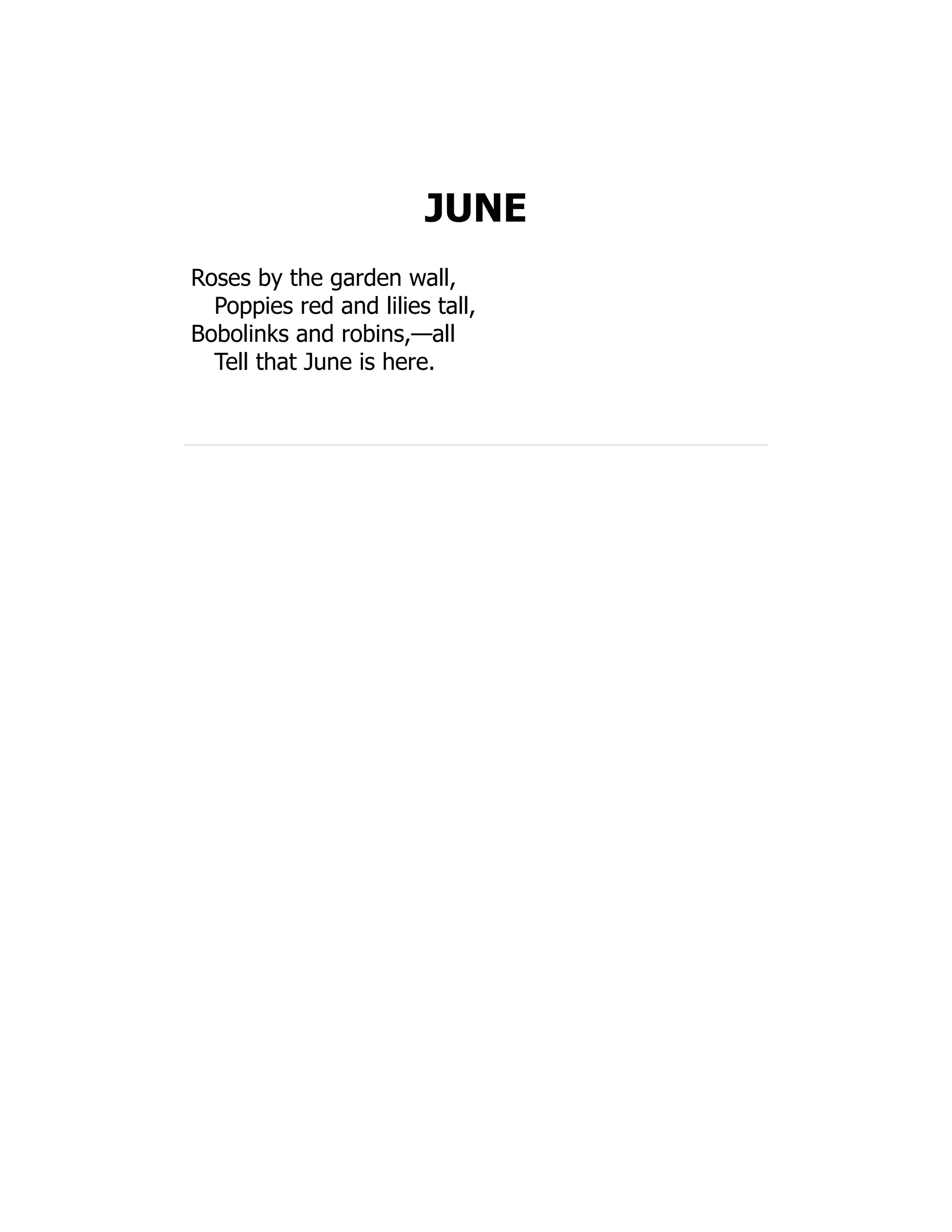
JUNE
Roses by the garden wall,
Poppies red and lilies tall,
Bobolinks and robins,—all
Tell that June is here.
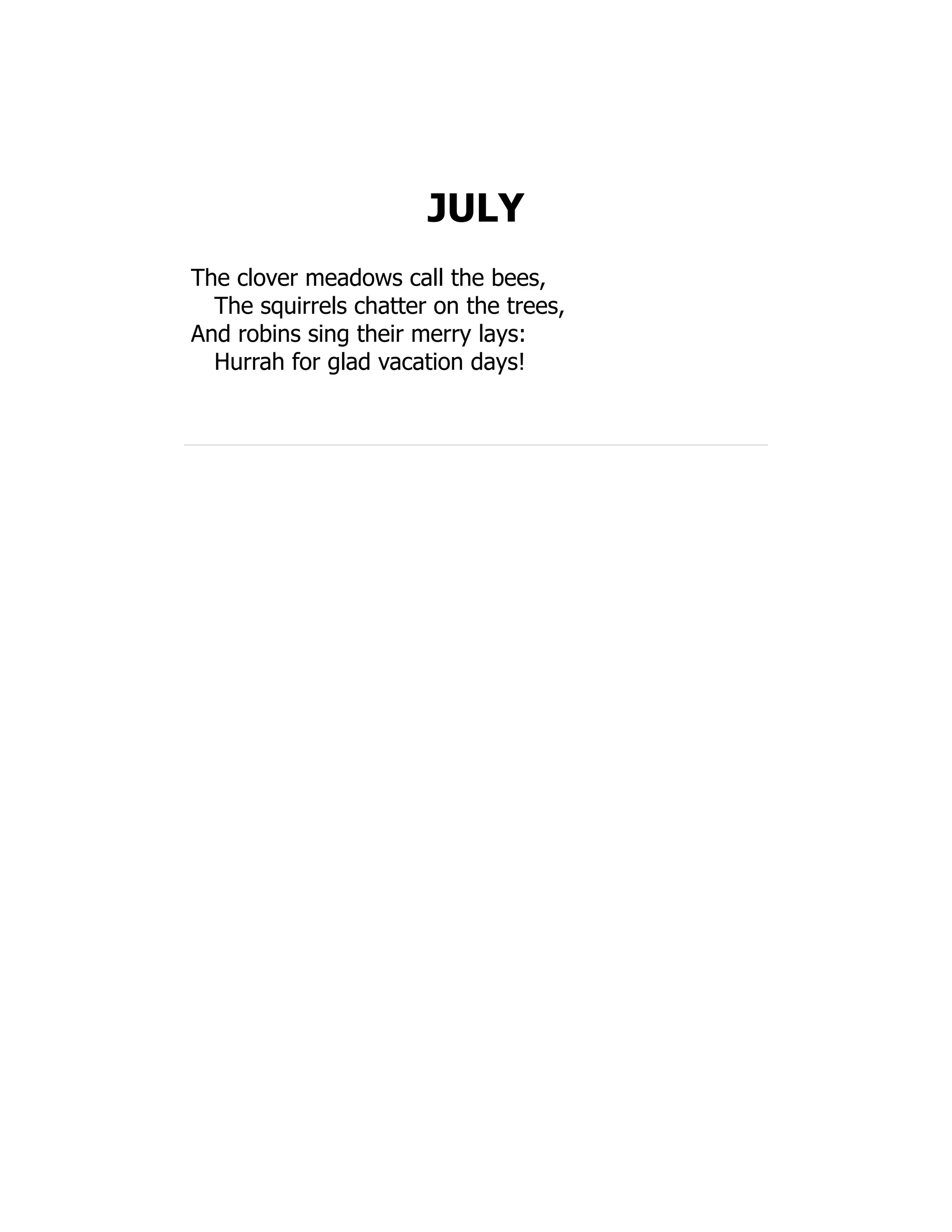
JULY
The clover meadows call the bees,
The squirrels chatter on the trees,
And robins sing their merry lays:
Hurrah for glad vacation days!
AUGUST
Sing a song of harvest time,
When the golden grain is high,
When the blossoms blow,
And the sun in a glow
Sweeps over a cloudless sky.
THE SEASONS
Sing a song of seasons,
Something bright in all,
Flowers in the summer,
Fires in the fall.
—Robert Louis Stevenson.
THE MONTHS
In January falls the snow,
In February cold winds blow.
In March peep out the early flowers,
In April fall the sunny showers.
In May the tulips bloom so gay,
In June the farmer mows his hay.
In July harvest is begun,
In August hotly shines the sun.
September turns the green leaves brown,
October winds then shake them down.
November fields are brown and sere,
December comes and ends the year.
FOR THE GIRLS
My fairest child, I have no song to give you,
No lark could pipe to skies so dull and gray.
Yet, ere we part, one lesson I can leave you
For every day:—
Be good, sweet maid,
And let who will be clever;
Do noble things, not dream them, all day long;
And so make life, death, and that vast forever,
One grand, sweet song.
—Charles Kingsley.
FOR THE BOYS
Dare to be right! Dare to be true!
You have a work that no other can do;
Do it so bravely, so kindly, so well,
Angels will hasten the story to tell.
Dare to be right! Dare to be true!
The failings of others can never save you.
Stand by your conscience, your honor, your faith;
Stand like a hero and battle till death.
WHAT WOULD I DO?
If I were a bird I would warble a song,
The sweetest and finest that ever was heard,
And build me a nest in the old elm tree;
Oh, that's what I'd do if I were a bird!
If I were a flower I'd hasten to bloom,
And make myself beautiful all the day through,
With drinking the sunshine, the wind, and the rain;
Oh, if I were a flower, that's what I'd do!
If I were a brook I would sparkle and dance
Among the green fields where sheep and lambs
stray,
And call, "Little lambkins, come hither and drink;"
Oh, if I were a brook, that is what I would say!
If I were a star I would shine wide and bright
To guide the lone sailor on ocean afar,
And travelers, lost in the desert and woods;
Oh, that's what I'd do if I were a star!
But I know that for me other tasks have been set,
For I am a child and can nothing else be;
I must sit at my lessons, and, day after day,
Learn to read and to spell, and to add one, two, and
three.
Yet perhaps if I try I shall sometime find out
How the birds sing so sweetly, how the roses grow
red,
What the merry brook says to the moss-covered
stones,
And what makes the stars stay so high overhead.
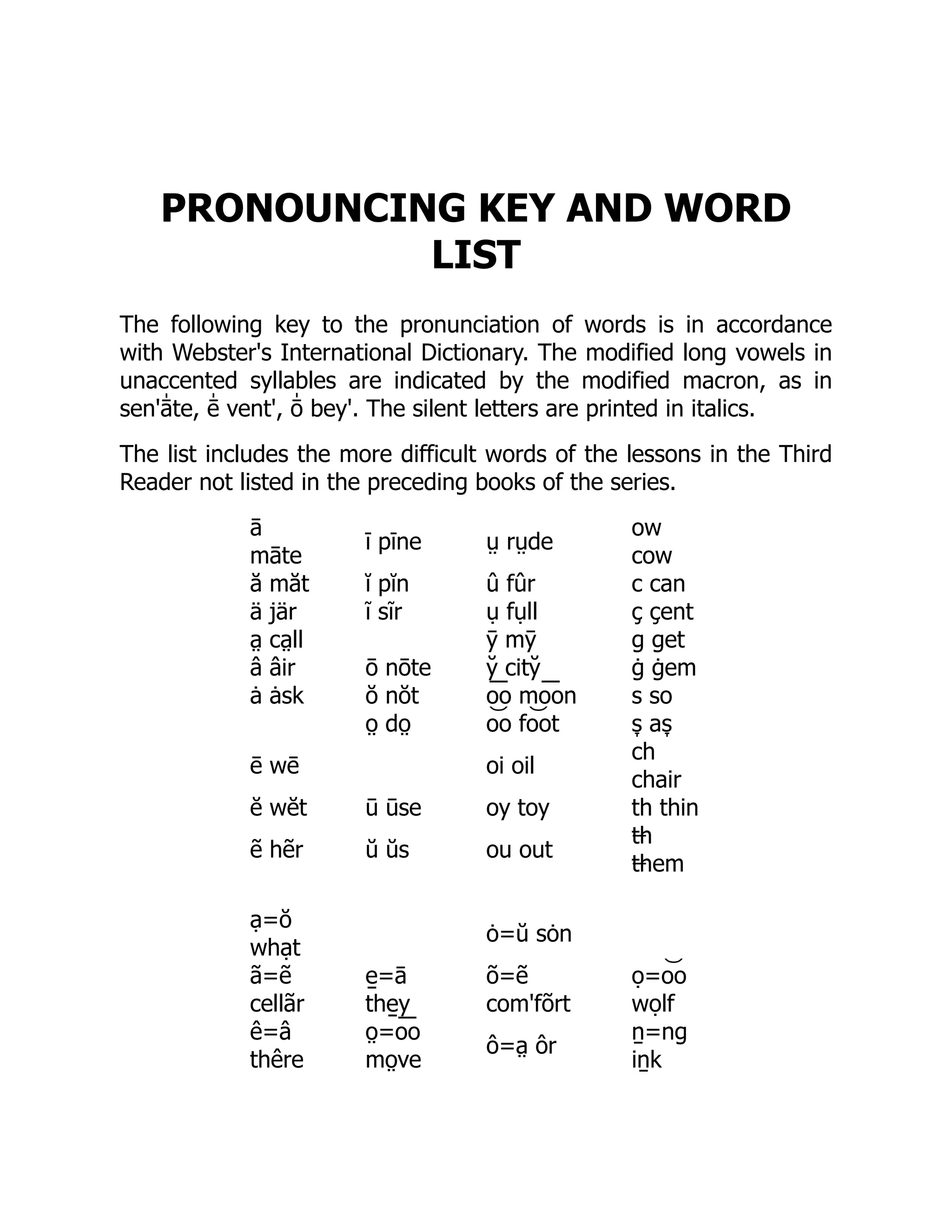
PRONOUNCING KEY AND WORD
LIST
The following key to the pronunciation of words is in accordance
with Webster's International Dictionary. The modified long vowels in
unaccented syllables are indicated by the modified macron, as in
sen'ā̍ te, ē̍ vent', ō̍ bey'. The silent letters are printed in italics.
The list includes the more difficult words of the lessons in the Third
Reader not listed in the preceding books of the series.
ā
māte
ī pīne ṳ rṳde
ow
cow
ă măt ĭ pĭn û fûr c can
ä jär ĩ sĩr ụ fụll ç çent
a̤ ca̤ ll ȳ mȳ g get
â âir ō nōte y̆ city̆ ġ ġem
ȧ ȧsk ŏ nŏt o͞ o mo͞ on s so
o̤ do̤ o͝ o fo͝ ot s̞ as̞
ē wē oi oil
ch
chair
ĕ wĕt ū ūse oy toy th thin
ẽ hẽr ŭ ŭs ou out
t̶h
t̶hem
ạ=ŏ
whạt
ȯ=ŭ sȯn
ã=ẽ
cellãr
e̱ =ā
the̱ y
õ=ẽ
com'fõrt
ọ=o͝ o
wọlf
ê=â
thêre
o̤ =o͞ o
mo̤ ve
ô=a̤ ôr
ṉ=ng
iṉk
Ab'nẽr
A'brȧ hăm
ăb'sençe
ăc count'
ā'cre
ăd vīçe'
ȧ greed'
ăl'cōve
ăl'dẽr
Ăl'ĭçe
ȧ līght'
Al lē'grȧ
ȧ lo͞ of'
ăl'phȧ bĕt
a̤ l rĕad'y̆
a̤ l'tẽred
A mĕr'ĭ cȧ
ȧ mūs̞ ed'
ān'ġel
ăṉ'gry̆
ănt'lẽr
ăn'vĭl
ā'prĭ cŏt
A'prĭl
ăr rīve'
ăr'rō̍ w
ăr'rō̍ w hĕad
ȧ shōre'
ăt'tĭc
a̤ u'bûrn
A̤ u'gŭst
ȧ wāit'
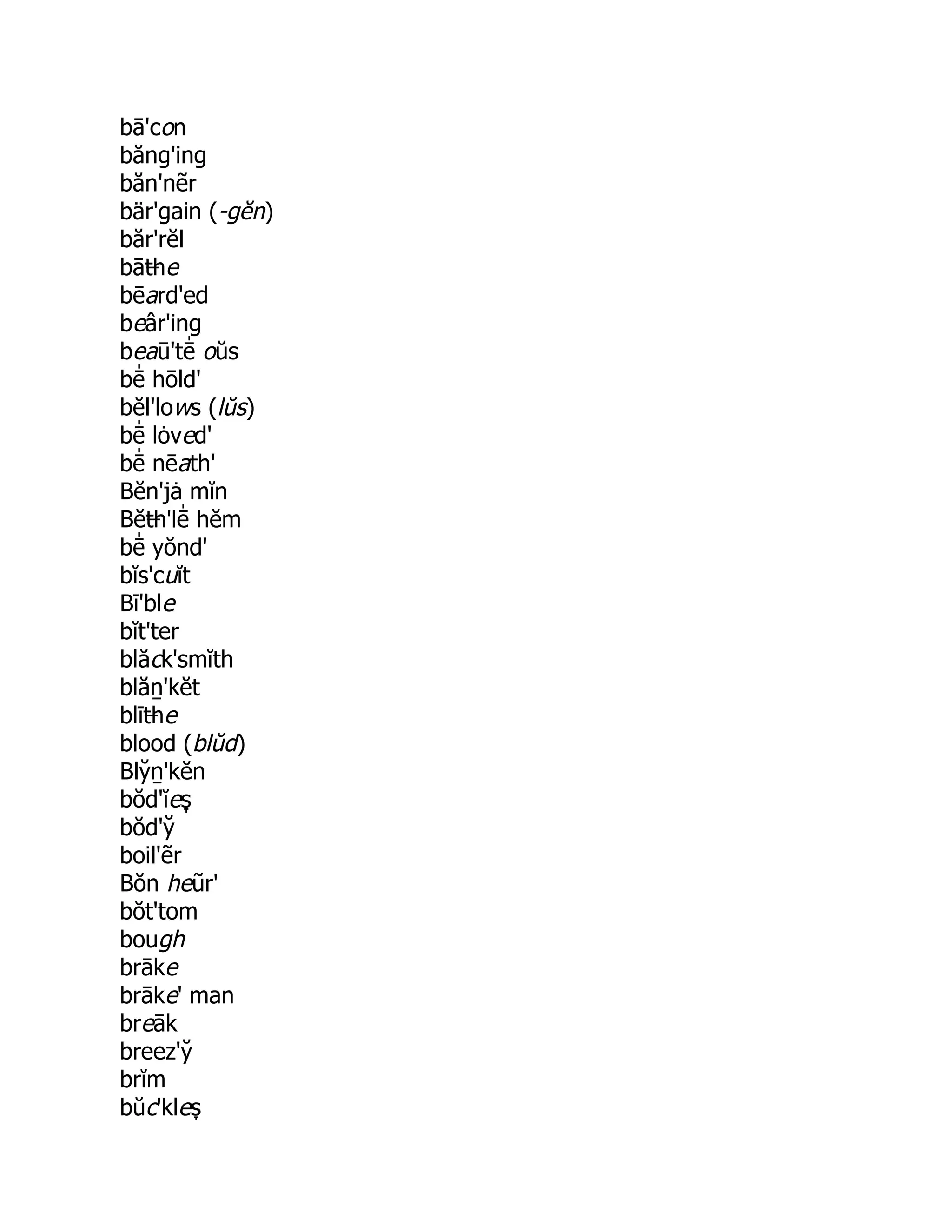
bā'con
băng'ing
băn'nẽr
bär'gain (-gĕn)
băr'rĕl
bāt̶he
bēard'ed
beâr'ing
beaū'tē̍ oŭs
bē̍ hōld'
bĕl'lows (lŭs)
bē̍ lȯved'
bē̍ nēath'
Bĕn'jȧ mĭn
Bĕt̶h'lē̍ hĕm
bē̍ yŏnd'
bĭs'cuĭt
Bī'ble
bĭt'ter
blăck'smĭth
blăṉ'kĕt
blīt̶he
blood (blŭd)
Bly̆ ṉ'kĕn
bŏd'ĭes̞
bŏd'y̆
boil'ẽr
Bŏn heũr'
bŏt'tom
bough
brāke
brāke' man
breāk
breez'y̆
brĭm
bŭc'kles̞
s̞
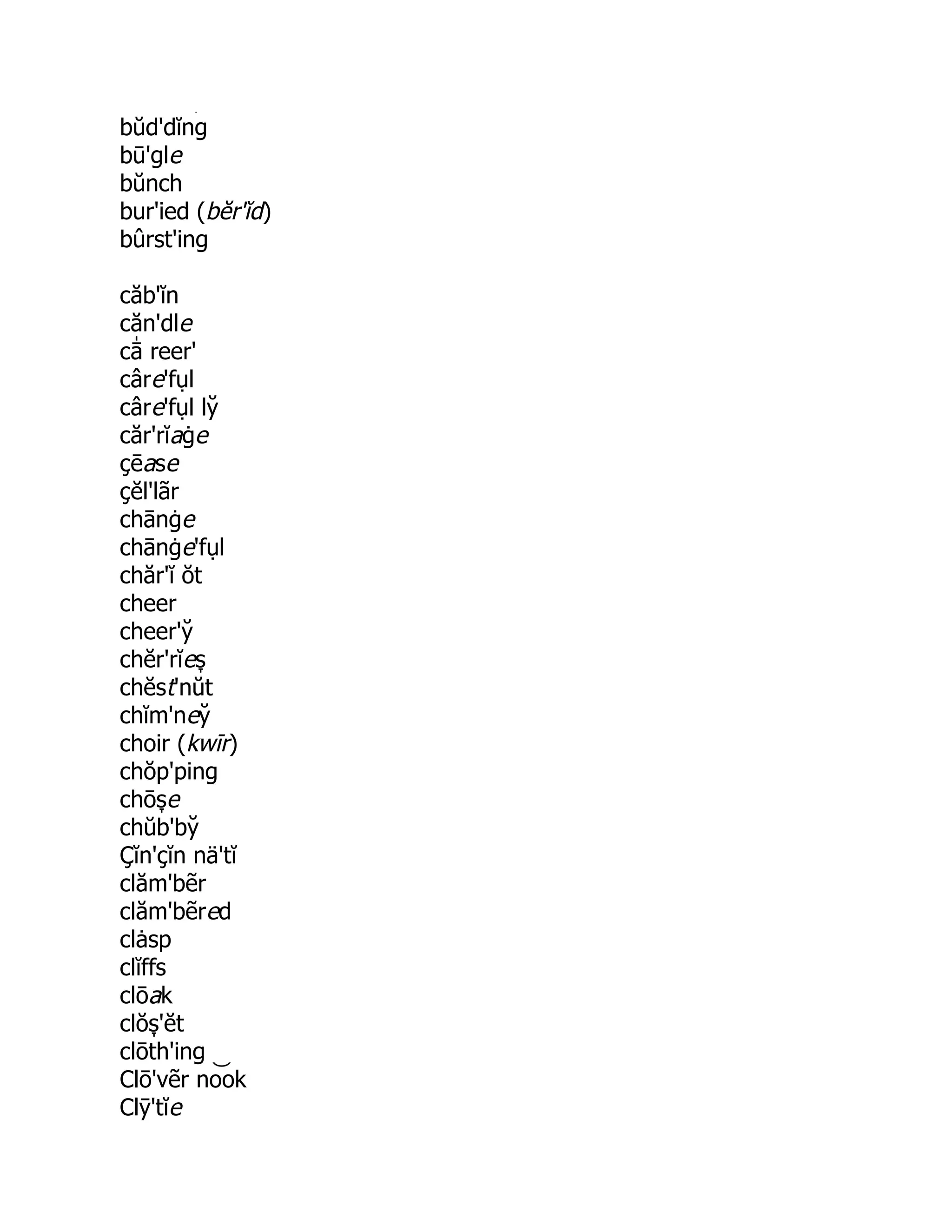
bŭd'dĭng
bū'gle
bŭnch
bur'ied (bĕr'ĭd)
bûrst'ing
căb'ĭn
căn'dle
cā̍ reer'
câre'fụl
câre'fụl ly̆
căr'rĭaġe
çēase
çĕl'lãr
chānġe
chānġe'fụl
chăr'ĭ ŏt
cheer
cheer'y̆
chĕr'rĭes̞
chĕst'nŭt
chĭm'ney̆
choir (kwīr)
chŏp'ping
chōs̞ e
chŭb'by̆
Çĭn'çĭn nä'tĭ
clăm'bẽr
clăm'bẽred
clȧsp
clĭffs
clōak
clŏs̞ 'ĕt
clōth'ing
Clō'vẽr no͝ ok
Clȳ'tĭe
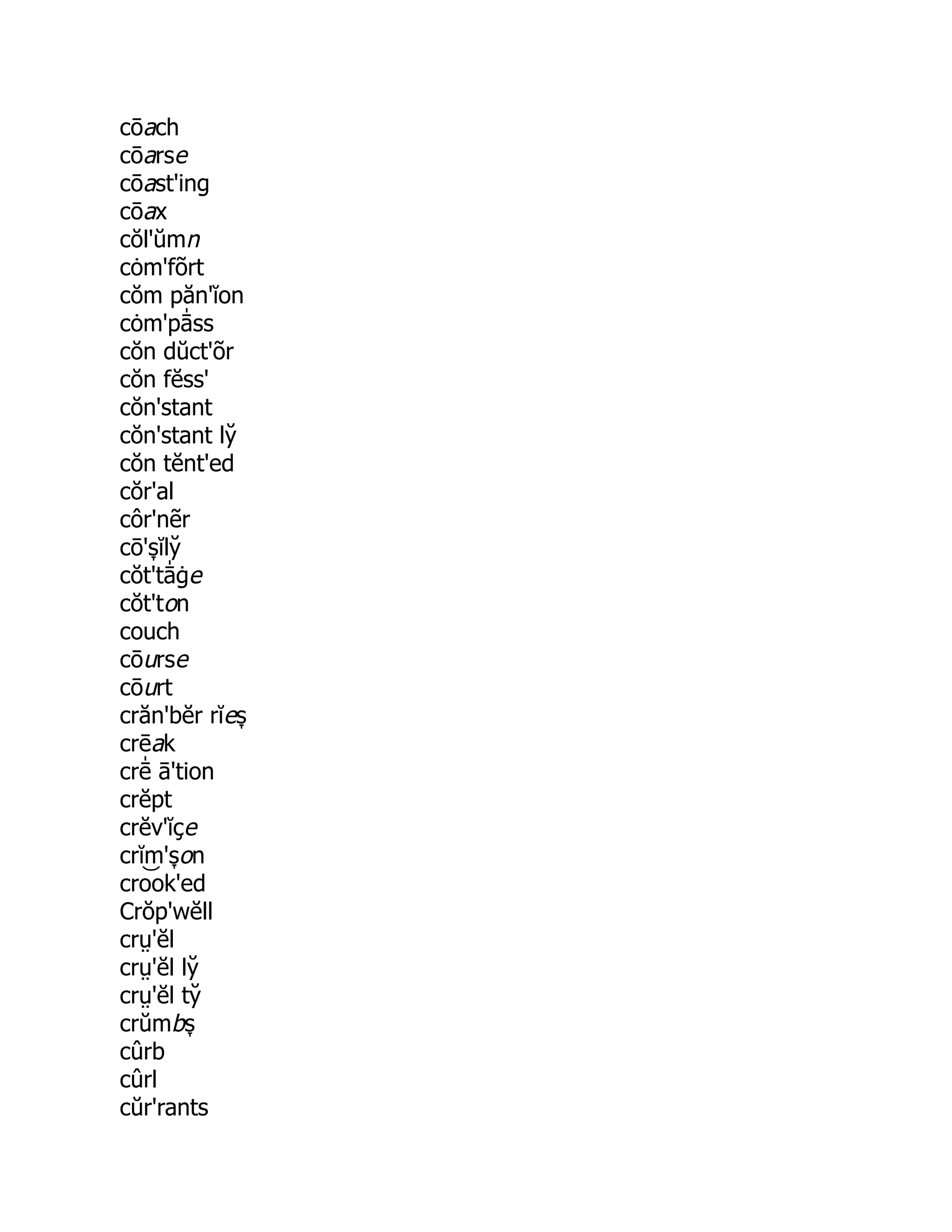
cōach
cōarse
cōast'ing
cōax
cŏl'ŭmn
cȯm'fõrt
cŏm păn'ĭon
cȯm'pā̍ ss
cŏn dŭct'õr
cŏn fĕss'
cŏn'stant
cŏn'stant ly̆
cŏn tĕnt'ed
cŏr'al
côr'nẽr
cō's̞ ĭly̆
cŏt'tā̍ ġe
cŏt'ton
couch
cōurse
cōurt
crăn'bĕr rĭes̞
crēak
crē̍ ā'tion
crĕpt
crĕv'ĭçe
crĭm's̞ on
cro͝ ok'ed
Crŏp'wĕll
crṳ'ĕl
crṳ'ĕl ly̆
crṳ'ĕl ty̆
crŭmbs̞
cûrb
cûrl
cŭr'rants
cŭr'rent
dāin'tīes̞
dăm'ask
dăn'dē̍ līon
dān'ġẽr
dăsh'ing
da̤ ugh'tẽr
dăz'zle
dĕath
Dĕb'ō̍ rȧh
Dē̍ çĕm'bẽr
dē̍ cīd'ed
dē̍ lāy'
dē̍ līght'
dē̍ līght'ed
dī'ȧ mȯnd
dĭm'ly̆
dĭp'pẽr
dĭ rĕct'ly̆
dĭs cȯv'ẽr
dĭs'tançe
dĭs tûrb'
dīve
dōor'wāy
dȯz'en
draught (drȧft)
drēar'y̆
drĭfts
drĭp'ping
drown
drowned
drown'ing
dŭnçe
dŭst'y̆
dȳ'ing
ēa'gle
ẽar'nĕst
ēar'rĭngs
Eas'tẽr
ēat'en
ĕch'ō̍
ĕd'ū cāt ed
ĕld'est
ĕlm
ĕlse'whêre
ĕm broi'dẽr
ĕmp'ty̆
ĕn cămped'
ĕn'ē̍ mĭes̞
ĕn'ē̍ my̆
ĕn ġĭ neer'
Eng'lĭsh (ĭṉ-')
Eng'lĭsh man
ē̍ nôr'moŭs
Ẽr'nĕst
ĕr'rand
ĕs cāpe'
Es'kĭ mō̍
ēve
ex ăct'ly̆ (egz-)
ĕx clāim'
ex'īle
ex trēme'
ex trēme'ly̆
Fâir'făx
fa̤ lse'ho͝ od
fā'moŭs
făn'çĭes̞
făn'çy̆
fâre wĕll'
fâsh'iȯned
făth'ȯm
fa̤ ult
fĕath'ẽr y̆
Fĕb'rụ ā̍ ry̆
feed'ing
fee'ble
Fẽr'dĭ nănd
fẽrn
fĕs'tĭ val
fī'ẽry̆
fĭfteenth
fĭṉ'gẽr
fĭn'ĭsh
fīre'līght
fīre'man
flăshed
fleeçe
fleeç'y̆
flour
flūte
flŭt'tẽr
fōam'ing
fo͝ ot'stĕp
fōrçe
fōrġe
fŏr ĕv´ẽr
fōrth
Frȧnçe
free´dȯm
freeze
friĕnd´ly̆
frīght´en
frŏl´ĭc
frŏst´ed
frown
fûr´nĭ tūre
fŭr´rō̍ ws̞
fûr´ry̆
fu̇ r´thẽr
găl´lẽr y̆
gāme
gär´ment
găth´er
ga̤ uz´y̆
ġĕn´ẽr al
ġĕn´tle man
ghōst
glăd´dens̞
glȧnçe
glee
glōbe
glōw´ing
gown
grā´çioŭs
grāin
grăm´mãr
grȧsp
greed
Greek
griēve
grīnd´ing
gro̤ up
growled
guĕst
gŭst
hăb´ĭt
hälf
hälves̞
s̞
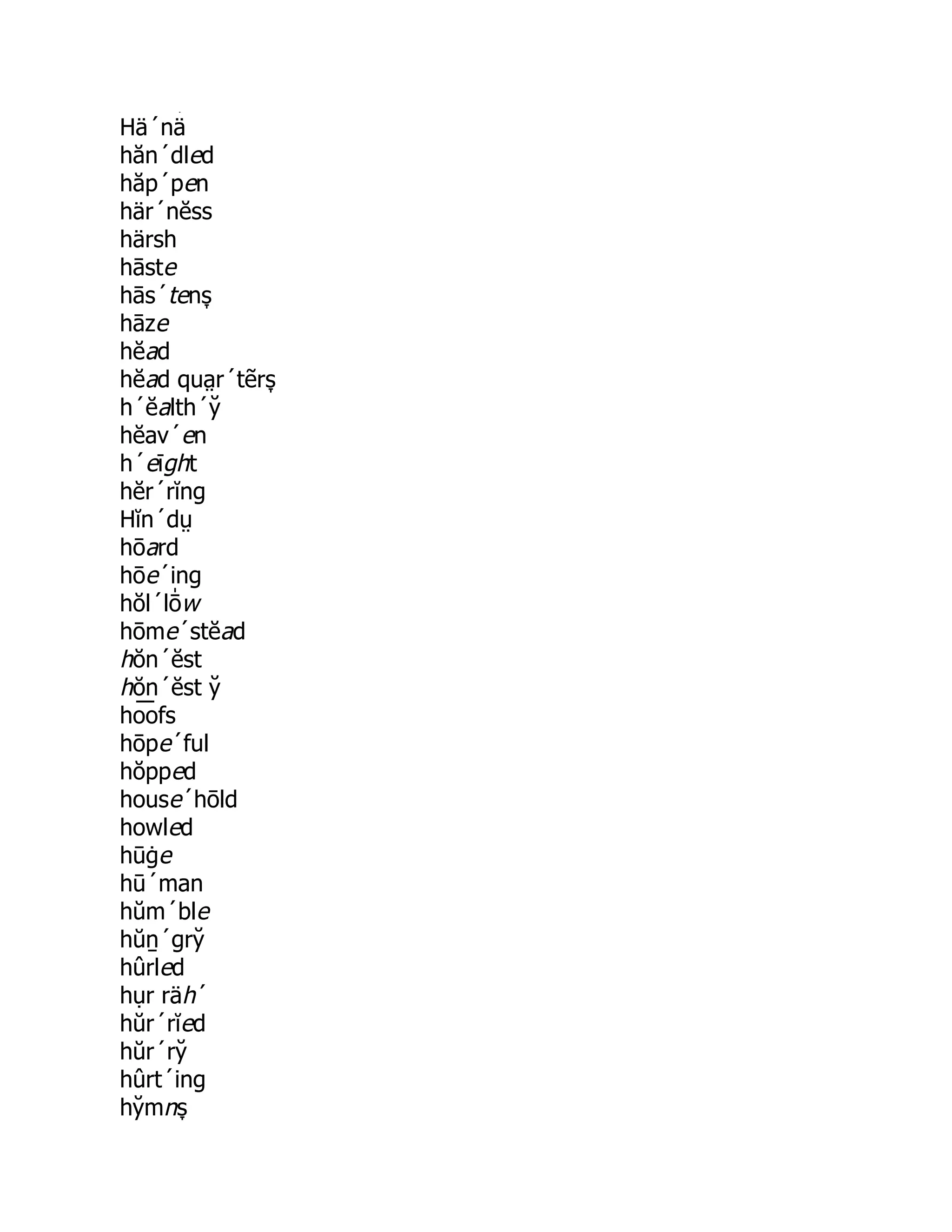
Hä´nä
hăn´dled
hăp´pen
här´nĕss
härsh
hāste
hās´tens̞
hāze
hĕad
hĕad qua̤ r´tẽrs̞
h´ĕalth´y̆
hĕav´en
h´eīght
hĕr´rĭng
Hĭn´dṳ
hōard
hōe´ing
hŏl´lō̍ w
hōme´stĕad
hŏn´ĕst
hŏn´ĕst y̆
ho͞ ofs
hōpe´ful
hŏpped
house´hōld
howled
hūġe
hū´man
hŭm´ble
hŭṉ´gry̆
hûrled
hụr räh´
hŭr´rĭed
hŭr´ry̆
hûrt´ing
hy̆ mns̞
s̞
içe´bẽrg
ī´çy̆
ī´dly̆
ĭm´ā̍ ġe
ĭm pā´tiençe
ĭn clōs̞ e´
In´dĭ ăn´ȧ
ĭn stĕad´
ĭn tĕnd´ing
ĭn´tẽr ĕst ing
ĭn vīte´
Is̞ ´ȧ bĕl´lȧ
īs´lands̞
īsles̞
ī´vy̆
Jā´cob
Jăn´ū̍ ā̍ ry̆
Jȧ păn´
Jăp ȧ nēs̞ e´
jäun´ty̆
join
joy´ous
jūiçe
Jūne
jŭṉ´gle
Kāte
Kĕn tŭck´y̆
kīnd´ly̆
kĭng´dȯm
knāve
knees̞
knĕlt
knŏwl´edġe
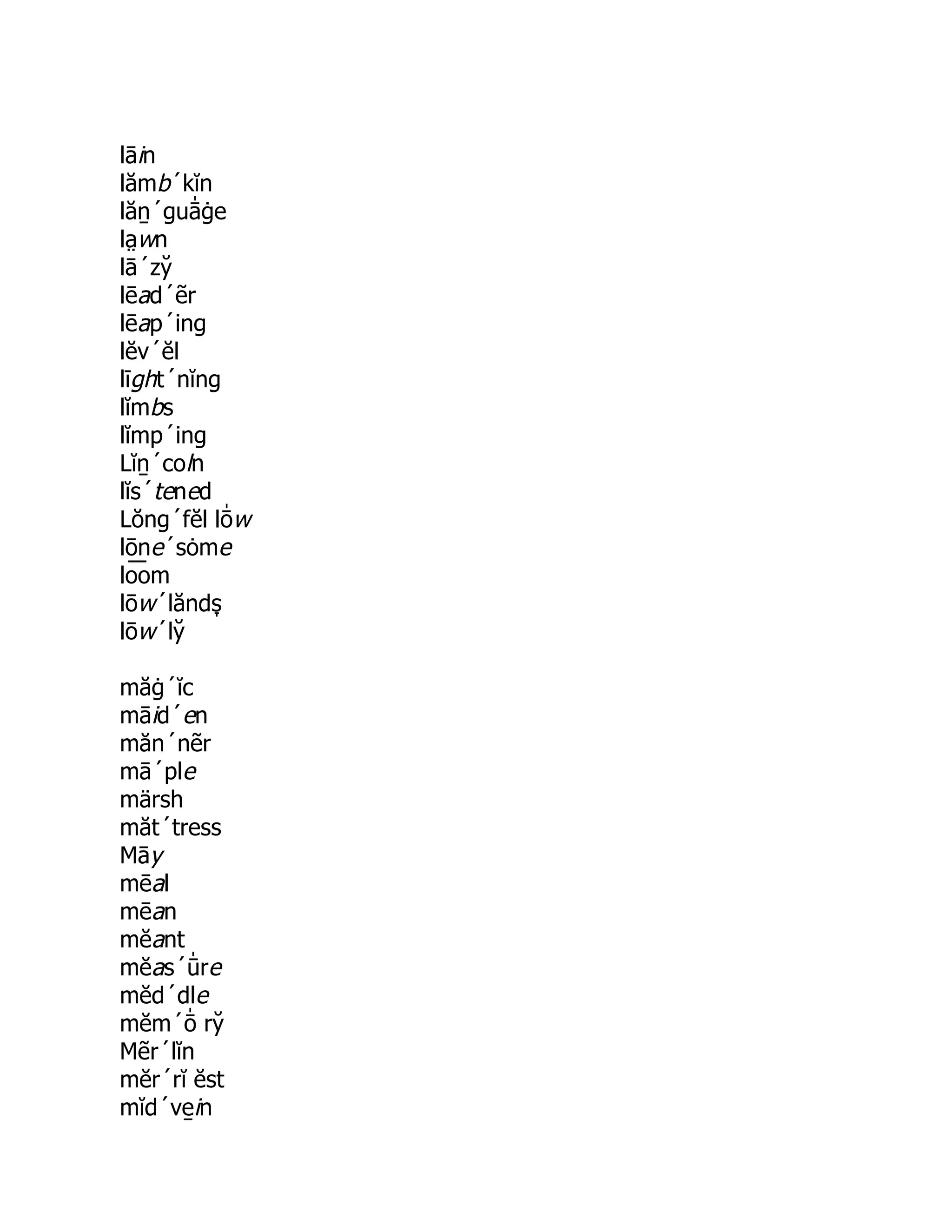
lāin
lămb´kĭn
lăṉ´guā̍ ġe
la̤ wn
lā´zy̆
lēad´ẽr
lēap´ing
lĕv´ĕl
līght´nĭng
lĭmbs
lĭmp´ing
Lĭṉ´coln
lĭs´tened
Lŏng´fĕl lō̍ w
lōne´sȯme
lo͞ om
lōw´lănds̞
lōw´ly̆
măġ´ĭc
māid´en
măn´nẽr
mā´ple
märsh
măt´tress
Māy
mēal
mēan
mĕant
mĕas´ū̍ re
mĕd´dle
mĕm´ō̍ ry̆
Mẽr´lĭn
mĕr´rĭ ĕst
mĭd´ve̱ in
e̱
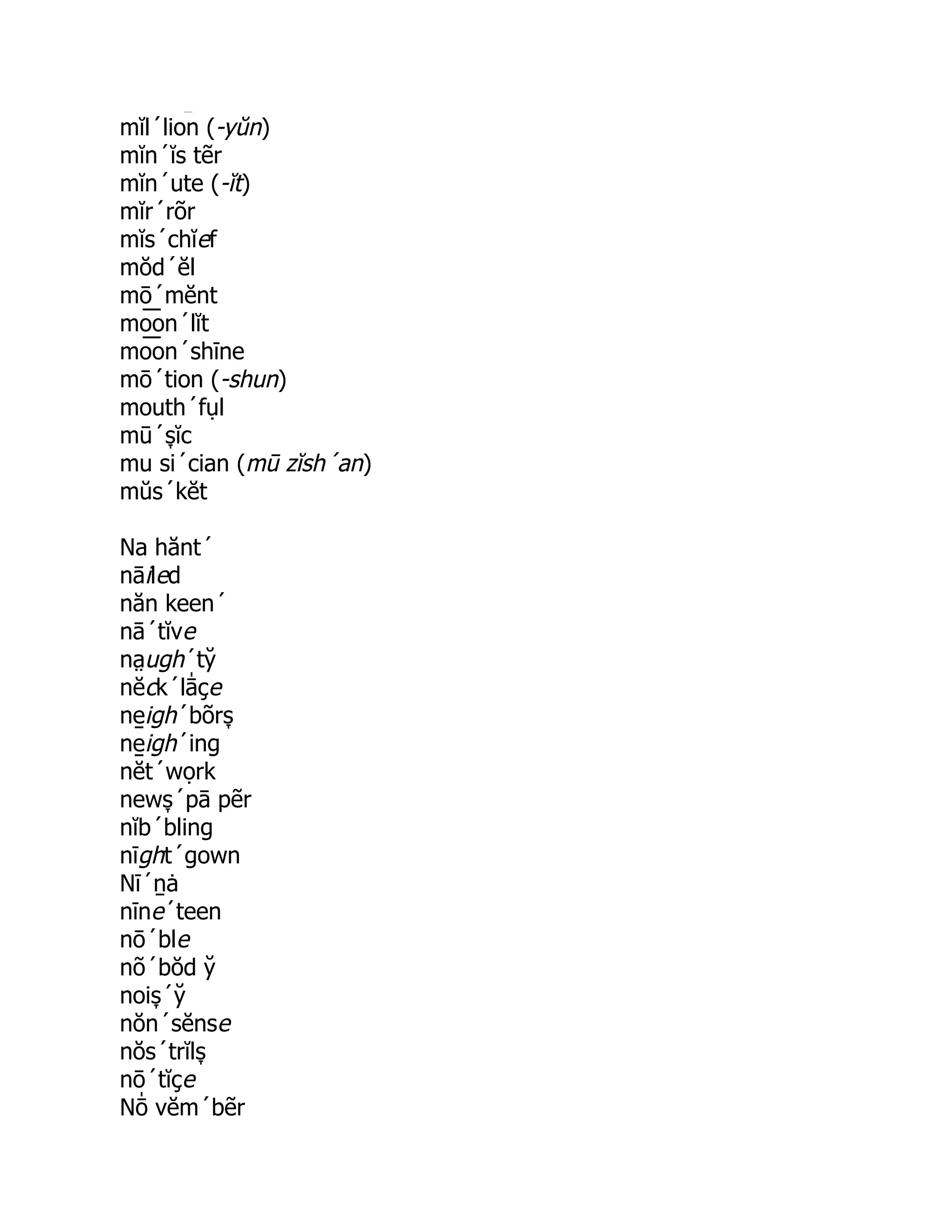
mĭl´lion (-yŭn)
mĭn´ĭs tẽr
mĭn´ute (-ĭt)
mĭr´rõr
mĭs´chĭef
mŏd´ĕl
mō´mĕnt
mo͞ on´lĭt
mo͞ on´shīne
mō´tion (-shun)
mouth´fụl
mū´s̞ ĭc
mu si´cian (mū zĭsh´an)
mŭs´kĕt
Na hănt´
nāiled
năn keen´
nā´tĭve
na̤ ugh´ty̆
nĕck´lā̍ çe
ne̱ igh´bõrs̞
ne̱ igh´ing
nĕt´wọrk
news̞ ´pā pẽr
nĭb´bling
nīght´gown
Nī´ṉȧ
nīne´teen
nō´ble
nõ´bŏd y̆
nois̞ ´y̆
nŏn´sĕnse
nŏs´trĭls̞
nō´tĭçe
Nō̍ vĕm´bẽr
nûrs´ẽr y̆
ō̍ blīġed´
ŏb s̞ ẽrve´
Oc tō´bẽr
ŏf´fẽr
ŏf´fĭçe
ŏf´fĭ çẽrs̞
once (wŭns)
ō´pen ing
ŏp´pō̍ s̞ ĭte
ôr´chãrd
ō´rĭ ōle
ôr´nȧ ment
ō´vẽr lo͝ ok´
owl´ĕt
ōwn´ẽr
ŏx´en
păck´ā̍ ġe
păcked
păd´dle
pâir
pāne
Păr´ȧ dīse
pär´don
Păr´ĭs
pär´lõr
păr´rȯt
pär´tĭes̞
păs´sā̍ ġe
pȧss´ẽrs̞
pȧs´tū̍ re
pā´tient (-shent)
păt´tẽr ing
pa̤ us̞ e
s̞
peâr
peeped
pĕl´ĭ can
pĕn´çĭl
pẽrch
pĕr´ĭsh
Phā´ē̍ thŏn
Phœ´be (fē´bē)
pĭ ăz´zȧ
pĭc´kles̞
piēçe
pĭ´ġeȯn
pĭl´lō̍ ws̞
Pĭn´tȧ
pīpes
plāin´ly̆
plăn´ĕt
plăṉk
plănned
plăt´fôrm
plāy´fĕl lō̍ w
plow´ing
plūm´y̆
plŭnġed
pŏck´ĕts
pōked
pō̍ līte´
pŏp´côrn
pōrch
pŏs´sĭ ble
pōst
pōst´ā̍ ġe
pounçed
pōured
prāis̞ e
prăṉk
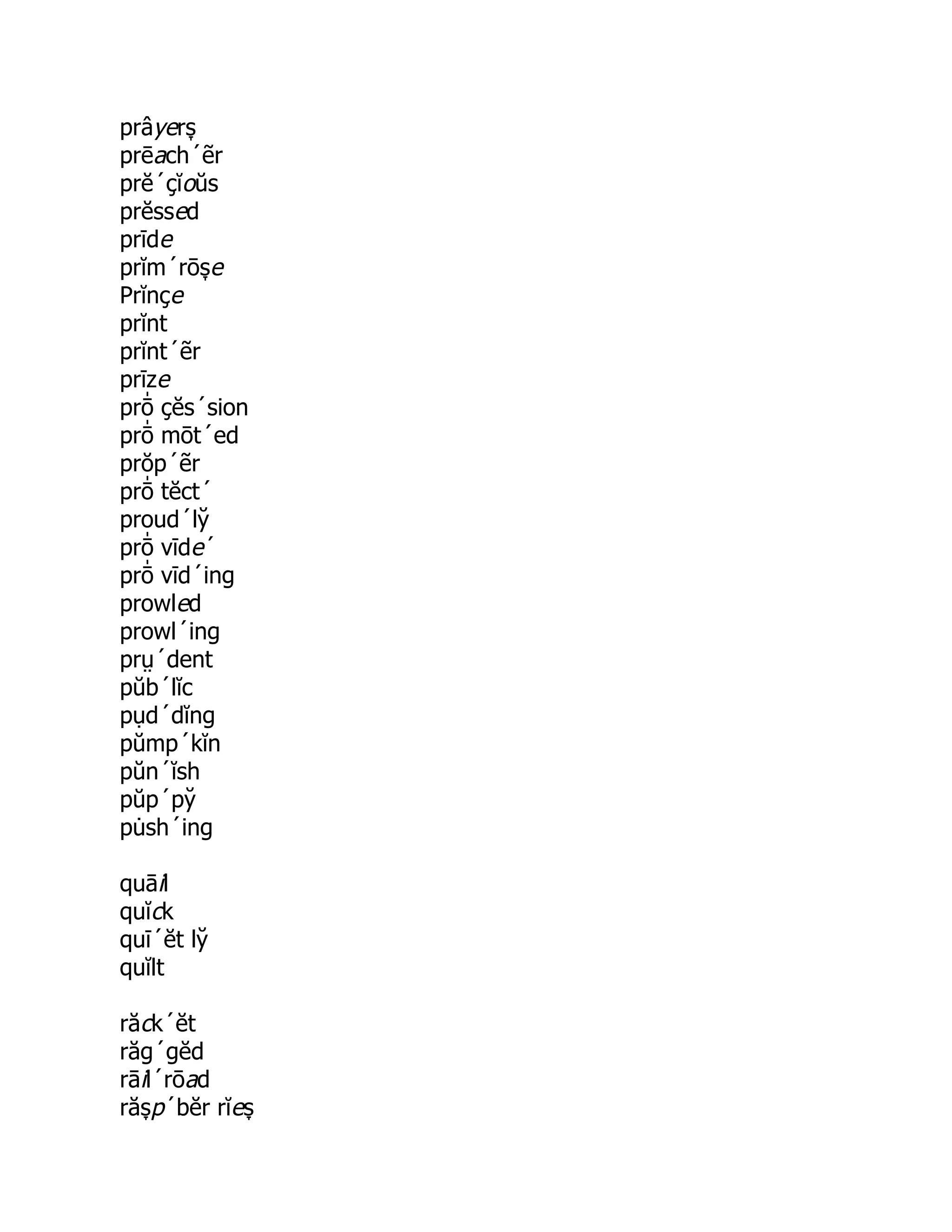
prâyers̞
prēach´ẽr
prĕ´çĭoŭs
prĕssed
prīde
prĭm´rōs̞ e
Prĭnçe
prĭnt
prĭnt´ẽr
prīze
prō̍ çĕs´sion
prō̍ mōt´ed
prŏp´ẽr
prō̍ tĕct´
proud´ly̆
prō̍ vīde´
prō̍ vīd´ing
prowled
prowl´ing
prṳ´dent
pŭb´lĭc
pụd´dĭng
pŭmp´kĭn
pŭn´ĭsh
pŭp´py̆
pu̇ sh´ing
quāil
quĭck
quī´ĕt ly̆
quĭlt
răck´ĕt
răg´gĕd
rāil´rōad
răs̞ p´bĕr rĭes̞
s̞ s̞
răt´tlĭng
rēared
rēa´s̞ on
rē̍ çēive´
rē̍ frĕsh´ing
rē̍ joiçe´
rĕl´ȧ tĭves̞
rē̍ māin´
rē̍ pēat´
rē̍ pōs̞ e´
rī´fle
rī´pen ing
rĭs̞ ´en
rōam
rōast
rŏck´y̆
rōll´ing
Rŏl´lō
Rō´s̞ ȧ
rough (rūf)
Rṳ´dy̆
rŭf´fle
rŭs´tle
rŭs´tling
rŭst´y̆
săd´dest
săd´nĕss
Săn´tȧ Mȧ rī´ȧ
săsh´es̞
săt´ĭn
sa̤ u´çẽr
scăm´pẽr
schŏl´ãr
scōld
scout
scrăm´ble
scrătched
scrēam
screen
sēal
sēa´pōrt
sẽarch
sĕc´ȯnd
sē̍ lĕct´ed
Sĕp tĕm´bẽr
sẽr´mȯn
sĕv´ẽr al
sĕx´tȯn
shăg´gy̆
shāme
sha̤ wl
shĕl´tẽr
shĕp´hẽrd
shôrt
shōul´dẽr
shŭt´tle
sīgn
Sī´las
sī´lençe
sī´lent ly̆
sĭn´ew y̆
sīze
skĕtch
slĕdġe
sleet
slēigh
slĭpped
slōp´ing
slŭg´gãrd
slȳ
smīl´ing
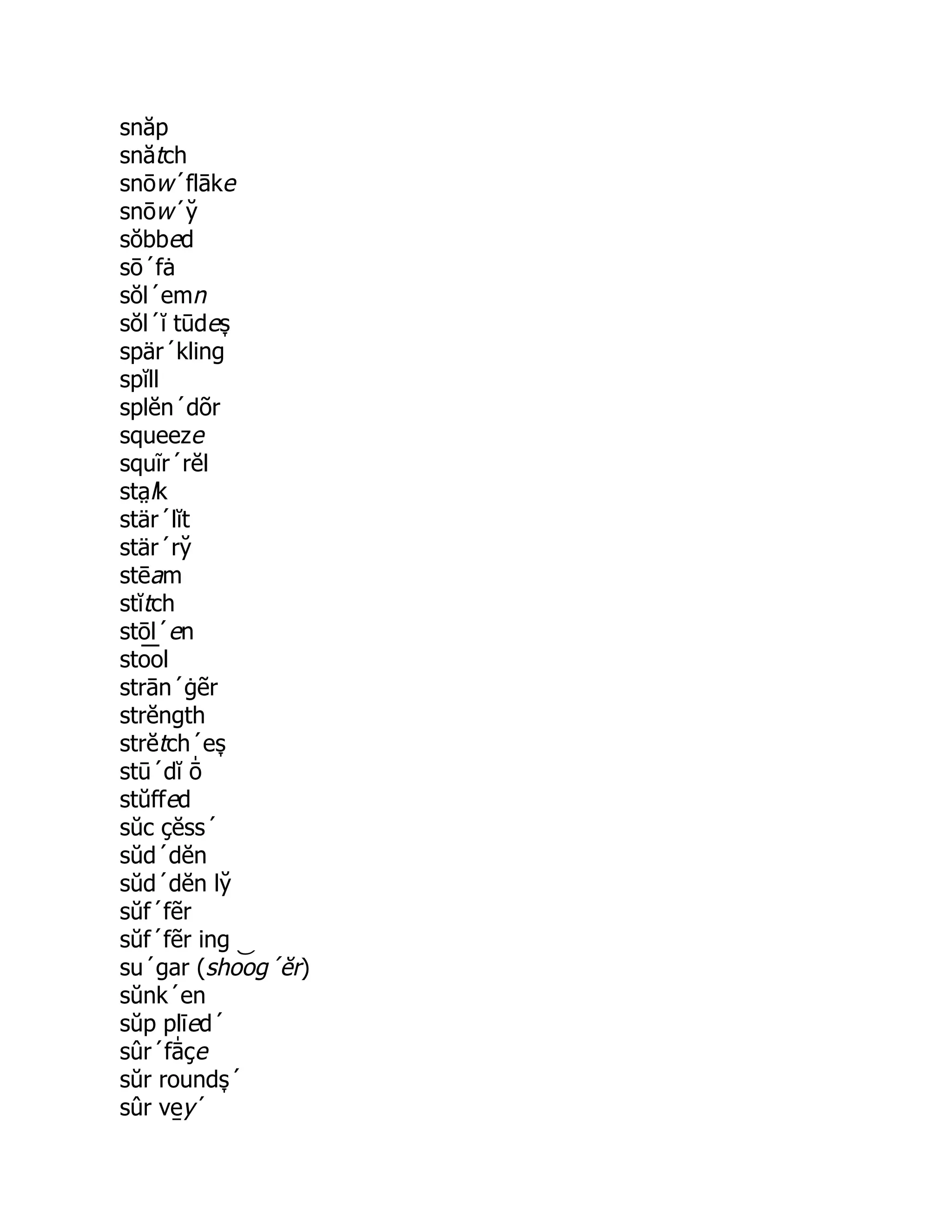
snăp
snătch
snōw´flāke
snōw´y̆
sŏbbed
sō´fȧ
sŏl´emn
sŏl´ĭ tūdes̞
spär´kling
spĭll
splĕn´dõr
squeeze
squĩr´rĕl
sta̤ lk
stär´lĭt
stär´ry̆
stēam
stĭtch
stōl´en
sto͞ ol
strān´ġẽr
strĕngth
strĕtch´es̞
stū´dĭ ō̍
stŭffed
sŭc çĕss´
sŭd´dĕn
sŭd´dĕn ly̆
sŭf´fẽr
sŭf´fẽr ing
su´gar (sho͝ og´ĕr)
sŭnk´en
sŭp plīed´
sûr´fā̍ çe
sŭr rounds̞ ´
sûr ve̱ y´
e̱
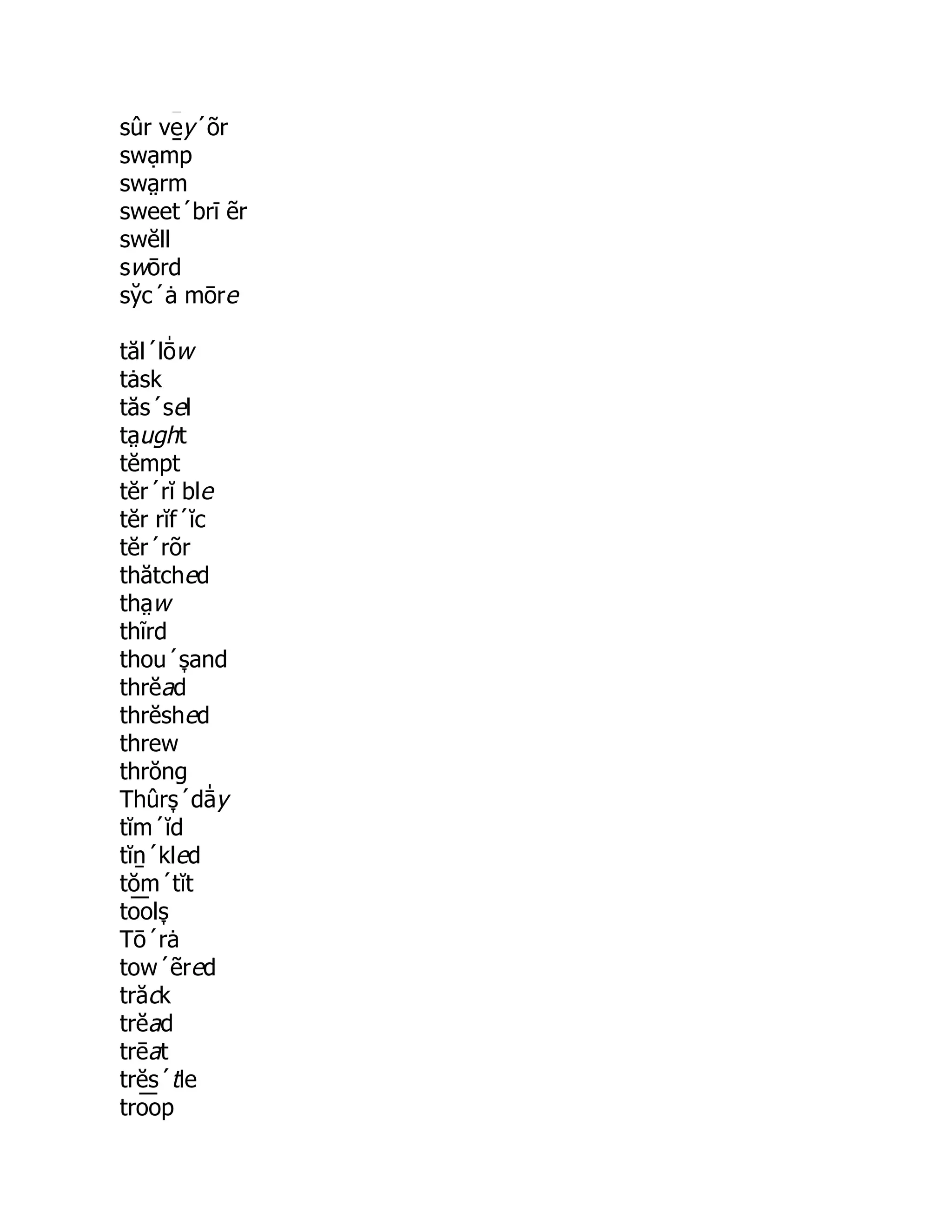
sûr ve̱ y´õr
swạmp
swa̤ rm
sweet´brī ẽr
swĕll
swōrd
sy̆ c´ȧ mōre
tăl´lō̍ w
tȧsk
tăs´sel
ta̤ ught
tĕmpt
tĕr´rĭ ble
tĕr rĭf´ĭc
tĕr´rõr
thătched
tha̤ w
thĩrd
thou´s̞ and
thrĕad
thrĕshed
threw
thrŏng
Thûrs̞ ´dā̍ y
tĭm´ĭd
tĭṉ´kled
tŏm´tĭt
to͞ ols̞
Tō´rȧ
tow´ẽred
trăck
trĕad
trēat
trĕs´tle
tro͞ op
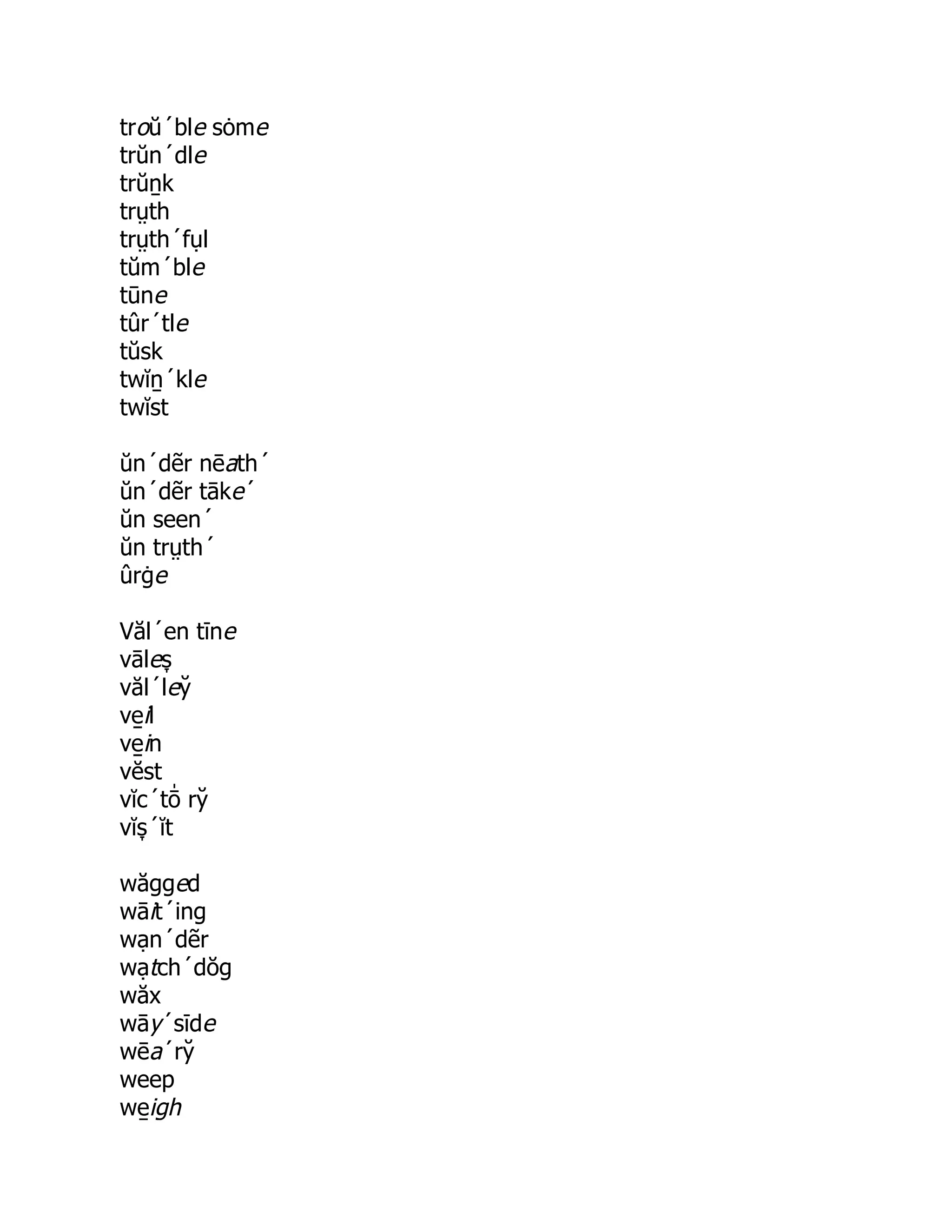
troŭ´ble sȯme
trŭn´dle
trŭṉk
trṳth
trṳth´fụl
tŭm´ble
tūne
tûr´tle
tŭsk
twĭṉ´kle
twĭst
ŭn´dẽr nēath´
ŭn´dẽr tāke´
ŭn seen´
ŭn trṳth´
ûrġe
Văl´en tīne
vāles̞
văl´ley̆
ve̱ il
ve̱ in
vĕst
vĭc´tō̍ ry̆
vĭs̞ ´ĭt
wăgged
wāit´ing
wạn´dẽr
wạtch´dŏg
wăx
wāy´sīde
wēa´ry̆
weep
we̱ igh
e̱
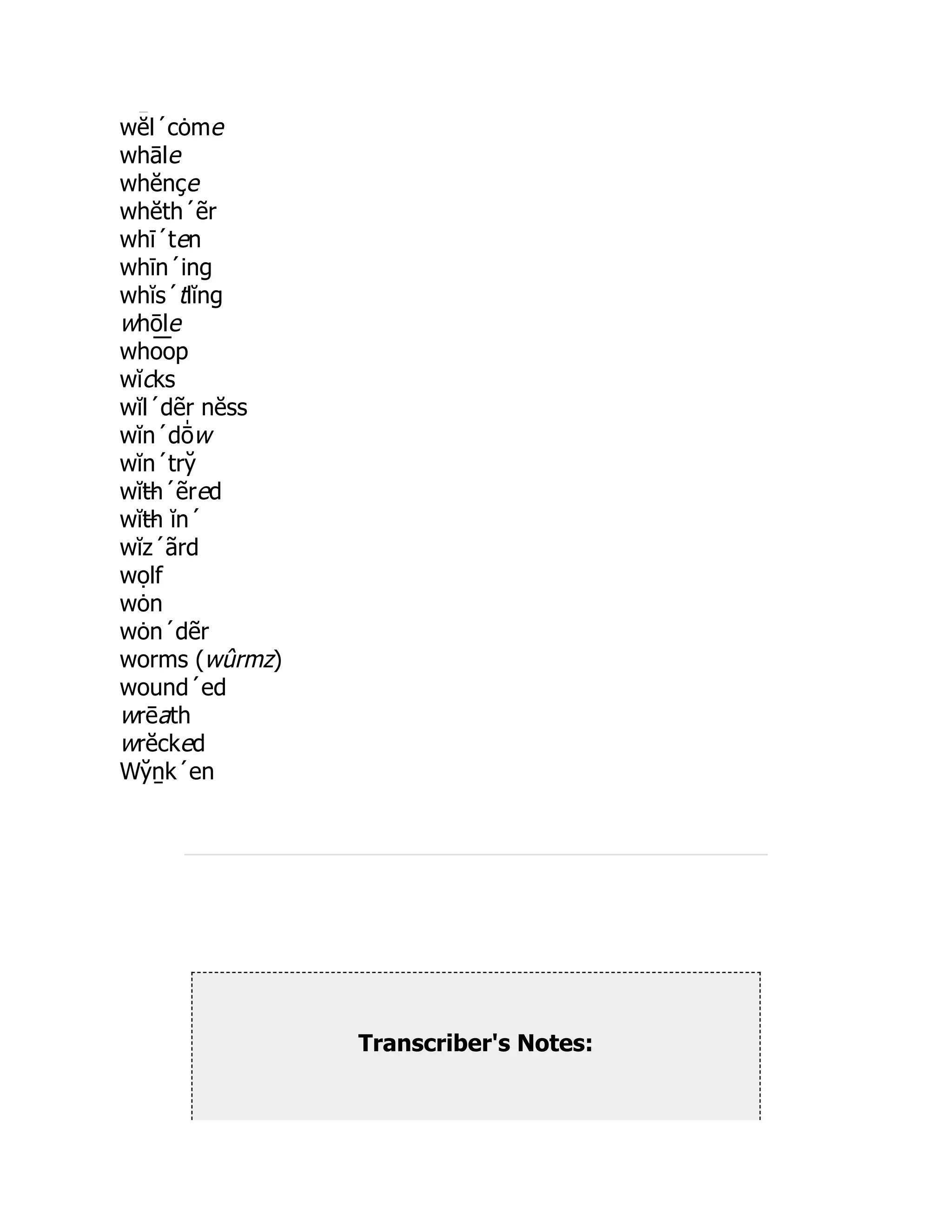
wĕl´cȯme
whāle
whĕnçe
whĕth´ẽr
whī´ten
whīn´ing
whĭs´tlĭng
whōle
who͞ op
wĭcks
wĭl´dẽr nĕss
wĭn´dō̍ w
wĭn´try̆
wĭt̶h´ẽred
wĭt̶h ĭn´
wĭz´ãrd
wọlf
wȯn
wȯn´dẽr
worms (wûrmz)
wound´ed
wrēath
wrĕcked
Wy̆ ṉk´en
Transcriber's Notes:
Obvious punctuation and spelling errors have
been fixed throughout.
Inconsistent hyphenation is as in the original.
The [th], th ligature, in the pronunciation key
and list has been replaced with t̶h as there is
no character for the th ligature.
Dora Reed Goodale and Dora Read Goodale
left as in the original.
*** END OF THE PROJECT GUTENBERG EBOOK BROOKS'S
READERS, THIRD YEAR ***
Updated editions will replace the previous one—the old editions
will be renamed.
Creating the works from print editions not protected by U.S.
copyright law means that no one owns a United States
copyright in these works, so the Foundation (and you!) can copy
and distribute it in the United States without permission and
without paying copyright royalties. Special rules, set forth in the
General Terms of Use part of this license, apply to copying and
distributing Project Gutenberg™ electronic works to protect the
PROJECT GUTENBERG™ concept and trademark. Project
Gutenberg is a registered trademark, and may not be used if
you charge for an eBook, except by following the terms of the
trademark license, including paying royalties for use of the
Project Gutenberg trademark. If you do not charge anything for
copies of this eBook, complying with the trademark license is
very easy. You may use this eBook for nearly any purpose such
as creation of derivative works, reports, performances and
research. Project Gutenberg eBooks may be modified and
printed and given away—you may do practically ANYTHING in
the United States with eBooks not protected by U.S. copyright
law. Redistribution is subject to the trademark license, especially
commercial redistribution.
START: FULL LICENSE
THE FULL PROJECT GUTENBERG LICENSE
PLEASE READ THIS BEFORE YOU DISTRIBUTE OR USE THIS WORK
To protect the Project Gutenberg™ mission of promoting the
free distribution of electronic works, by using or distributing this
work (or any other work associated in any way with the phrase
“Project Gutenberg”), you agree to comply with all the terms of
the Full Project Gutenberg™ License available with this file or
online at www.gutenberg.org/license.
Section 1. General Terms of Use and
Redistributing Project Gutenberg™
electronic works
1.A. By reading or using any part of this Project Gutenberg™
electronic work, you indicate that you have read, understand,
agree to and accept all the terms of this license and intellectual
property (trademark/copyright) agreement. If you do not agree
to abide by all the terms of this agreement, you must cease
using and return or destroy all copies of Project Gutenberg™
electronic works in your possession. If you paid a fee for
obtaining a copy of or access to a Project Gutenberg™
electronic work and you do not agree to be bound by the terms
of this agreement, you may obtain a refund from the person or
entity to whom you paid the fee as set forth in paragraph 1.E.8.
1.B. “Project Gutenberg” is a registered trademark. It may only
be used on or associated in any way with an electronic work by
people who agree to be bound by the terms of this agreement.
There are a few things that you can do with most Project
Gutenberg™ electronic works even without complying with the
full terms of this agreement. See paragraph 1.C below. There
are a lot of things you can do with Project Gutenberg™
electronic works if you follow the terms of this agreement and
help preserve free future access to Project Gutenberg™
electronic works. See paragraph 1.E below.
Welcome to our website – the ideal destination for book lovers and
knowledge seekers. With a mission to inspire endlessly, we offer a
vast collection of books, ranging from classic literary works to
specialized publications, self-development books, and children's
literature. Each book is a new journey of discovery, expanding
knowledge and enriching the soul of the reade
Our website is not just a platform for buying books, but a bridge
connecting readers to the timeless values of culture and wisdom. With
an elegant, user-friendly interface and an intelligent search system,
we are committed to providing a quick and convenient shopping
experience. Additionally, our special promotions and home delivery
services ensure that you save time and fully enjoy the joy of reading.
Let us accompany you on the journey of exploring knowledge and
personal growth!
testbankdeal.com
Retailing Management 9th Edition Michael Levy Solutions Manual

  • 1.
    Visit https://testbankdeal.com todownload the full version and explore more testbank or solutions manual Retailing Management 9th Edition Michael Levy Solutions Manual _____ Click the link below to download _____ https://testbankdeal.com/product/retailing-management-9th- edition-michael-levy-solutions-manual/ Explore and download more testbank or solutions manual at testbankdeal.com
  • 2.
    Here are somerecommended products that we believe you will be interested in. You can click the link to download. Retailing Management 9th Edition Michael Levy Test Bank https://testbankdeal.com/product/retailing-management-9th-edition- michael-levy-test-bank/ Retailing Management Canadian 5th Edition Levy Solutions Manual https://testbankdeal.com/product/retailing-management-canadian-5th- edition-levy-solutions-manual/ Retailing Management Canadian 5th Edition Levy Test Bank https://testbankdeal.com/product/retailing-management-canadian-5th- edition-levy-test-bank/ Microbiology A Human Perspective 7th Edition Nester Solutions Manual https://testbankdeal.com/product/microbiology-a-human-perspective-7th- edition-nester-solutions-manual/
  • 3.
    Engineering Fundamentals AnIntroduction to Engineering SI Edition 5th Edition Moaveni Solutions Manual https://testbankdeal.com/product/engineering-fundamentals-an- introduction-to-engineering-si-edition-5th-edition-moaveni-solutions- manual/ Trigonometry 11th Edition Lial Test Bank https://testbankdeal.com/product/trigonometry-11th-edition-lial-test- bank/ Practical Research Planning and Design 12th Edition Leedy Test Bank https://testbankdeal.com/product/practical-research-planning-and- design-12th-edition-leedy-test-bank/ Retailing 8th Edition Dunne Solutions Manual https://testbankdeal.com/product/retailing-8th-edition-dunne- solutions-manual/ Financial Accounting 3rd Edition Weygandt Solutions Manual https://testbankdeal.com/product/financial-accounting-3rd-edition- weygandt-solutions-manual/
  • 4.
    Fluid Mechanics 8thEdition White Solutions Manual https://testbankdeal.com/product/fluid-mechanics-8th-edition-white- solutions-manual/
  • 5.
    Chapter 07 -Retail Locations 7-1 Copyright © 2014 McGraw-Hill Education. All rights reserved. No reproduction or distribution without the prior written consent of McGraw-Hill Education. CHAPTER 7 RETAIL LOCATIONS ANNOTATED OUTLINE INSTRUCTOR NOTES I. Types of Locations • Store location is often the most important decision made by a retailer. • Location is typically the prime consideration in a customer's store choice. • Location decisions have strategic importance because they can be used to develop a sustainable competitive advantage. • Location decisions are generally risky. They are hard to change because retailers frequently have to either make substantial investments to buy and develop real estate or commit to long-term leases with developers. • Many types of locations are available for retail stores – each with their own strengths and weaknesses. Choosing a particular location type involves evaluating a series of trade-offs. • These trade-offs generally concern the cost of the location versus its value to customers. • Trade area is the geographic area encompassing most of the customers who would patronize a specific site. See PPT 7-5 Discuss the importance of store location based on students' shopping preferences. For the following types of products, how far would they travel to reach a store: 1. Eggs and milk 2. Socks 3. Running shoes 4. Home theater system Ask students to evaluate the best location in the area around the university. What are the characteristics of the location that make it so attractive? See PPT 7-8 and 7-9 II. Unplanned Retail Locations • Some retailers put their stores in unplanned locations. In an unplanned location, there is no centralized management to determine where specific stores are and how they are operated. A. Freestanding Sites • A freestanding site is a retail location that's not connected to other retailers, although many are located adjacent to malls. See PPT 7-11
  • 6.
    Chapter 07 -Retail Locations 7-2 Copyright © 2014 McGraw-Hill Education. All rights reserved. No reproduction or distribution without the prior written consent of McGraw-Hill Education. • Retailers with large space requirements, such as warehouse clubs and hypermarkets, are often freestanding. • Outparcels, which are stores that are not connected to other stores in a shopping center but are located on the premises, typically in a parking area, are freestanding locations that are popular for fast food restaurants or banks. • These locations enable retailers to have a drive-through window, dedicated parking, and clear visibility from the street. • Advantages of freestanding locations are greater visibility, lower rents, ample parking, no direct competition, greater convenience for customers, fewer restrictions on signs, hours, or merchandise, and ease of expansion. • The most serious disadvantage is the lack of synergy with other stores. A retailer in a freestanding location must be a primary destination point for customers. It must offer customers something special in terms of merchandise, price, promotion, or services to get them into the store. Have the students visited a retailer in a freestanding site? What made them travel to such a retailer? What retailers are best suited for a freestanding site? B. City or Town Locations • Some retailers are finding urban locations attractive, particularly in cities that are redeveloping their downtowns and surrounding urban areas. • In general, urban areas have low occupancy costs, and locations in the central business districts often have high pedestrian traffic. • Many urban areas are going through a process of gentrification – the renewal and rebuilding of offices, housing, and retailers in deteriorating areas – coupled with an influx of more affluent people that displaces the former poorer residents. • Redevelopment opportunities for retailers are also emerging in so-called brownfields – former industrial locations with a history of See PPT 7-12
  • 7.
    Chapter 07 -Retail Locations 7-3 Copyright © 2014 McGraw-Hill Education. All rights reserved. No reproduction or distribution without the prior written consent of McGraw-Hill Education. chemical pollutants, as developers and investors give these areas serious consideration for clean-up. 1. Central Business Districts • The central business district (CBD) is the traditional downtown business area in a city or town. • Although CBD locations in the United States declined in popularity among retailers and their customers for years, many are experiencing revival as they become gentrified, drawing in new residents and retailers. • Because shoplifting can be common and parking is often limited, CBDs generally require the retailers to hire security. • Shopping flow in the CBD may be slow on evenings and weekends when area businesses are closed as parking problems and driving time discourage customers from driving in from the suburbs. See PPT 7-13 Ask students whether they shop in the CBD of the town/city in which they live. Ask them in which city(s) they love to shop in the CBD. Why? If they were going to open a shop, would they consider a CBD location? Why or why not? We would expect cities like San Francisco, New York, London, Paris to be mentioned as great “shopping cities.” 2. Main Street Locations • Main Street is the traditional shopping area in smaller towns, or a secondary business district in a suburb or within a larger city. Their occupancy costs are lower than those of the primary CBD. They do not draw as many people and offer smaller overall selection through fewer stores. Main Streets typically don't off the entertainment and recreational activities available in the more successful primary CBDs. Ask students if national retailers have started to invade the “Main Street” in their neighborhoods. See PPT 7-14 for a comparison of CBDs and Main Street locations. 3. Inner-City Locations • The inner city in the United States refers to high density urban areas that have higher unemployment and lower median incomes than the surrounding metropolitan area. Some retailers have avoided opening stores in the inner city because they believe it is riskier and achieves lower returns than other areas. As a result, inner city consumers often have to travel to the suburbs to shop, even What are the various ethical issues in retailers charging higher margins in inner cities? What are the reasons retailers remain successful even though their prices may be higher in inner cities? See PPT 7-15
  • 8.
    Chapter 07 -Retail Locations 7-4 Copyright © 2014 McGraw-Hill Education. All rights reserved. No reproduction or distribution without the prior written consent of McGraw-Hill Education. for food items. • That said, retailing can play an important role in inner city redevelopment activities by bringing needed services and jobs to inner city residents, as well as property taxes to support redevelopment efforts. III. Shopping Centers • A shopping center is a group of retail and other commercial establishments that is planned, developed, owned, and managed as a single property. • By combining many stores at one location, the developer attracts more consumers to the shopping center than if the stores were at separate locations. • Shopping center management maintains common facilities (common area maintenance, or CAM) such as the parking area and restrooms, and is responsible for security, outdoor signage and advertising for the center. • Most shopping centers have at least one or two major retailers, referred to as anchors. • In strip shopping centers, supermarkets are typically the anchors, whereas department stores traditionally anchor enclosed shopping malls. Lifestyle centers may not have anchors, while power centers are often made of “anchors” exclusively. See PPT 7-16 A. Neighborhood and Community Shopping Centers (Strip Centers) • Strip centers are attached rows of stores managed as units, with onsite parking usually located at the front of the stores. • The primary advantages of these centers are that they offer customers convenient locations and easy parking. They also offer relatively low rents for retailers. • The primary disadvantages are that there is no protection from the weather. Strip centers also offer less assortment and See PPT 7-18 Ask students for examples of neighborhood and community shopping centers in the campus area and discuss. What are the pros and cons of these locations?
  • 9.
    Chapter 07 -Retail Locations 7-5 Copyright © 2014 McGraw-Hill Education. All rights reserved. No reproduction or distribution without the prior written consent of McGraw-Hill Education. entertainment options for customers than malls. B. Power centers • A power center is a shopping center that is dominated by several large anchors, including discount stores, off-price stores, warehouse clubs, or category specialists. • Unlike traditional strip centers, power centers often include several freestanding (unconnected) anchors and only a minimum number of specialty tenants. • Now many power centers are larger than regional malls and have trade areas as large as regional malls. • Power centers offer low occupancy costs and modest levels of consumer convenience and vehicular and pedestrian traffic. See PPT 7-19 Why would a smaller retailer locate in a power center anchored by discount stores and off-price stores? What types of merchandise would likely be carried by the smaller retailer? C. Shopping Malls • Shopping malls are enclosed, climate controlled, lighted shopping centers with retail stores on one or both sides of an enclosed walkway. • Shopping malls are classified as either regional malls (less than 1 million square feet) or super regional malls (more than 1 million square feet). • Shopping malls have several advantages over alternative locations. • First, because of the many different types of stores, the merchandise assortments available within those stores, and the opportunity to combine shopping with entertainment, shopping malls attract many shoppers and have a large trade area. • Second, retailers and their customers don’t have to worry about the weather. • Third, malls offer retailers a strong level of homogeneous operations with the other stores, such as uniform hours of operation. See PPT 7-20, 7-21 Ask students if they spend more/less time in shopping malls than they did 5 years ago. [ It will probably be less. Ask them why.] Do students notice some significant differences between one shopping mall and another? If so, what are these? [Prompt students on differences in types of stores, overall ambience and environment of the shopping mall, general levels of service through the various stores in the shopping mall, etc.]
  • 10.
    Chapter 07 -Retail Locations 7-6 Copyright © 2014 McGraw-Hill Education. All rights reserved. No reproduction or distribution without the prior written consent of McGraw-Hill Education. • Although shopping centers are an excellent site option for many retailers, they have some disadvantages. • First, mall rents are higher than those of strip centers, freestanding sites, and most central business districts. • Second, some tenants may not like mall management’s control of their operations. Managers can, for instance, dictate store hours and window displays. • Third, competition within shopping centers can be intense. • Shopping malls are facing several challenges, leading to declining mall traffic and sales. • First, many people simply do not have time to stroll through a mall. Strip centers, freestanding locations, and power centers are more convenient as they offer convenient parking and easy access. • Second, most retailers in shopping malls sell fashionable apparel, a merchandise category that has seen limited growth due to more casual lifestyles. • Third, many malls are getting old and have not been subject to any significant remodeling, making them somewhat rundown and less appealing to customers than they once were. • Fourth, the consolidation in retailing, particularly in the department store segment, has decreased the number of potential anchor tenants, leaving some malls with diminished drawing power. D. Lifestyle Centers • Lifestyle centers, the fastest growing type of retail development, are shopping centers with an open-air configuration of specialty stores, entertainment and restaurants with design ambience and amenities such as fountains and street furniture. See PPTs 7-23
  • 11.
    Chapter 07 -Retail Locations 7-7 Copyright © 2014 McGraw-Hill Education. All rights reserved. No reproduction or distribution without the prior written consent of McGraw-Hill Education. • Lifestyle centers resemble the main streets in small towns, where people stroll from store to store, have lunch, sit for a while on a park bench talking to friends. Thus, they cater to the “lifestyles” of consumers in their trade areas. • Due to the ease of parking, lifestyle centers are very convenient for shoppers. But they typically have less retail space than enclosed malls and thus smaller trade areas, attracting fewer customers than enclosed malls. Many are located near higher income areas so the higher purchases per visit compensate for the fewer number of shoppers. E. Mixed-Use Developments • Mixed-use developments (MXDs) combine several different uses in one complex, including shopping centers, office towers, hotels, residential complexes, civic centers, and convention centers. See PPT 7- 24 F. Outlet Centers • Outlet centers are shopping centers that consist mostly of manufacturers’ outlets. • Outlet centers have progressed from no-frills warehouses to well-designed buildings with landscaping, gardens, and food courts that make them hard to distinguish from more traditional shopping and lifestyle centers. • Outlet centers are larger in size today than they were a decade ago, with some outlets having more the one million square feet. • In the U.S. only two or three new outlet centers open each year, yet outlet centers are becoming very popular outside the U.S. • Tourism is an important factor in generating traffic for many outlet centers. Thus, many are located in with convenient interstate access and close to popular tourist attractions. See PPT 7-25 Ask students if they have been to an outlet center. What types of products have they purchased from such centers? Was the visit an everyday shopping trip or part of a vacation? G. Theme / Festival Centers See PPT 7-26
  • 12.
    Chapter 07 -Retail Locations 7-8 Copyright © 2014 McGraw-Hill Education. All rights reserved. No reproduction or distribution without the prior written consent of McGraw-Hill Education. • Theme/festival centers are shopping centers that typically employ a unifying theme that is carried out by the individual shops in their architectural design, and to an extent, in their merchandise. The biggest appeal of these centers is to tourists. • These centers typically contain tenants similar to specialty centers, except there usually are no large specialty stores or department stores. H. Larger, Multiformat Developments - Omnicenters • New shopping center developments are combining enclosed malls, lifestyle centers, and power centers. Although centers of this type do not have an official name, they may be referred to as omnicenters. • Omnicenters represent a response to several trends in retailing, including the desire of tenants to lower common area maintenance charges by spreading the costs among more tenants and function inside larger developments that generate more pedestrian traffic and longer shopping trips. • In addition these centers reflect the growing tendency of consumers to cross-shop, as well as the desire for time-scarce consumers to participate in one-stop shopping. See PPT 7-27 IV. Other Location Opportunities • Airports, resorts, stores within a store, and temporary stores are interesting location alternatives for many retailers. See PPT 7-28 A. Temporary Stores • Retailers and manufacturers sometimes open temporary or pop-up stores to a focus on a new product or a limited group of products. These temporary stores introduce and remind consumers of a brand or store, but they are not designed primarily to sell the product. See PPT 7-29 B. Store within a Store See PPT 7-30
  • 13.
    Chapter 07 -Retail Locations 7-9 Copyright © 2014 McGraw-Hill Education. All rights reserved. No reproduction or distribution without the prior written consent of McGraw-Hill Education. • Another nontraditional location for retailers is within other, larger stores. Retailers, particularly department stores, have traditionally leased space to other retailers such as sellers of fine jewelry or furs. • Grocery stores have been experimenting with the store-within-a-store concept for years with service providers like banks, film processors, and video outlets. C. Merchandise Kiosks • Merchandise kiosks are small, temporary selling spaces typically located in the walkways of enclosed malls, airports, train stations, or office building lobbies. • They usually have short-term leases and are often operated seasonally. • Some are staffed and represent a miniature store or cart that could be easily moved. Others are twenty-first century versions of a vending machine. • For mall operators, kiosks are an opportunity to generate rental income in otherwise vacant space and to offer a broad assortment of merchandise for visitors. They also can generate excitement leading to additional sales for the entire mall. See PPT 7-31 Ask students which categories of merchandise are best suited for sale in merchandise kiosks. Discuss some of the merchandise kiosks that students most frequently see in the mall. D. Airports • One important high-pedestrian area that has become popular with national retail chains is airports. • Sales per square foot at airport malls are often three to four times as high as at regular mall stores. However, rents are higher too. Also, costs can be higher – hours are longer, and since the location is often inconvenient for workers, businesses have to pay higher wages. • The best airport locations tend to be ones where there are many layovers and international flights. See PPT 7-32 Are airports good places to buy products? Why or why not? Which products have students purchased from an airport retailer?
  • 14.
    Chapter 07 -Retail Locations 7-10 Copyright © 2014 McGraw-Hill Education. All rights reserved. No reproduction or distribution without the prior written consent of McGraw-Hill Education. V. Location and Retail Strategy • Location type decisions need to be consistent with the shopping behavior and size of the retailer’s target market and its positioning. PPT 7-33 illustrates the need to match the retailer’s strategy with its location type. A. Shopping Behavior of Consumers in Retailer’s Target Market • A critical factor affecting the location consumers select to visit is the shopping situation in which they are involved. • Three shopping situations are: (1) convenience shopping, (2) comparison shopping, and (3) specialty shopping. See PPT 7-34 Ask students how the nature of the consumer’s shopping behavior will affect their preferred store location. 1. Convenience Shopping • When consumers are engaged in convenience shopping situations, they are primarily concerned with minimizing their effort to get the product or service they want. • Stores selling primarily convenience goods usually locate their stores close to where their customers are and make it easy for them to park, find what they want, and go about their other business. See PPT 7-35 Ask students where they are most likely to purchase convenience items such as soda, gum and milk. Why do they select those particular locations? 2. Comparison Shopping • Consumers involved in comparison shopping situations have a general idea about the type of product or service they want, but they do not have a strong preference for a brand, model or specific retailer to patronize. • Enclosed malls or shopping districts devoted to one type of merchandise attract consumers by facilitating their comparison shopping activities. • Category specialists offer the same benefit of comparison shopping as a collection of co-located specialty stores because consumers can see almost all of the brands See PPT 7-36 Ask students to discuss product categories they often comparison shop for. Where do they go to compare? Describe the types of retailers they patronize for comparison shopping situations.
  • 15.
    Chapter 07 -Retail Locations 7-11 Copyright © 2014 McGraw-Hill Education. All rights reserved. No reproduction or distribution without the prior written consent of McGraw-Hill Education. and models in a particular product category. • This comparison shopping makes category killers destination stores, places where consumers will go even if it is inconvenient. 3. Specialty Shopping • When consumers go specialty shopping, they know what they want and will not accept a substitute. • The retailer becomes a destination store. Thus, consumers are willing to travel to an inconvenient location. Discuss specialty stores students have been to. Would those stores improve their business by being more conveniently located? Why or why not? See PPT 7-37 VI. Legal Considerations • The legal issues that affect site decision include environmental issues, zoning, building codes, signs, and licensing requirements. A. Environmental Issues • Two environmental issues have received particular attention in recent years. First is “above-ground risks” such as asbestos- containing materials or lead pipes used in construction. The second issue is hazardous materials that have been stored in the ground. This issue may be of particular importance to a dry cleaner or an auto repair shop. • Retailers may protect themselves against environmental hazards with protective lease clauses in their leases, and/or by purchasing environmental protection insurance policies. See PPT 7-38 for a review of these issues. B. Zoning and Building Codes • Zoning determines how a particular site can be used. Building codes are similar legal restrictions that can determine the type of building, signs, size and type of parking lot, etc. that can be used at a particular location. See PPT 7-39 for a review of other legal issues retailers must consider. C. Signs • Restrictions on the use of signs can impact a particular site's desirability. Size and style
  • 16.
    Chapter 07 -Retail Locations 7-12 Copyright © 2014 McGraw-Hill Education. All rights reserved. No reproduction or distribution without the prior written consent of McGraw-Hill Education. may be restricted by building codes, zoning ordinances, or even the shopping center management. D. Licensing Requirements • Licensing requirements may vary in different parts of a region. For instance, some Dallas neighborhoods are "dry," meaning no alcoholic beverages can be sold; and in other areas, only wine and beer can be sold. VI Summary • Location decisions are particularly important because of their high-cost, long-term commitment and impact on customer patronage. • Choosing a particular location type involves evaluating a series of trade-offs including the occupancy costs of the location, the pedestrian and vehicle traffic associated with the location, the restrictions placed on store operations by the property management, and the convenience of the location for customers.
  • 17.
    Chapter 07 -Retail Locations 7-13 Copyright © 2014 McGraw-Hill Education. All rights reserved. No reproduction or distribution without the prior written consent of McGraw-Hill Education. ANSWERS TO “GET OUT AND DO ITS” 2. INTERNET EXERCISE Go to the web page for Faneuil Hall Marketplace at: www.faneuilhallmarketplace.com and the online site for CocoWalk at: http://www.cocowalk.net. What kinds of centers are these? List their similarities and differences. Who is the target market for each of these retail locations? Faneuil Hall Marketplace – “It's the seat of American history and the site of one of America's most famous shopping and dining experiences, Faneuil Hall Marketplace. For over 250 years, the marketplace has played an integral role in the life of Boston's residents.” Restaurants, shopping, history (close to the Freedom Trail) events and entertainment. This urban market place is located in Boston, Massachusetts and it attracts both locals and tourist of all ages. CocoWalk – “Miami’s ultimate destination for shopping, dining & entertainment. As the first lifestyle center in Florida, CocoWalks’ unique grounds and buildings were carefully designed to blend seamlessly into the surroundings of Coconut Grove, a bayside boating village known for being eclectic, sometimes eccentric and always exciting”. Shops, boutiques, a movie theater, restaurants, cafes, bars and live entertainment. This center caters to Miami residents and international visitors with upscale shops and sophisticated restaurants. 3. GO SHOPPING Go to your favorite shopping center, and analyze the tenant mx. Do the tenants appear to complement one another? What changes would you make in the tenant mix to increase the overall performance of the center? Students’ answers will vary. Typically, in most shopping centers, the tenant mix is complementary. Many retailers want to open locations close to their competitors, especially for comparison shopping purposes. Ask students if there is a retailer that they would like to see in their favorite shopping center that isn’t currently there now. What stores would they remove from the shopping center to improve the overall quality of the shopping experience at the shopping center? 4. GO SHOPPING Visit a lifestyle center. What tenants are found in this location? Describe the population characteristics around this center? How far would people drive to shop at this lifestyle center? What other types of retail locations does this lifestyle center compete with? Students’ answers will vary. In most lifestyle centers, the tenants are going to be a mix of higher-end specialty stores with a few smaller format department stores. Stores like Williams- Sonoma and Pottery Barn tend to locate in lifestyle centers. When describing the population surrounding the center, it will likely be in a more affluent part of town versus other shopping centers. Lifestyle centers typically compete with other lifestyle centers or regional shopping malls, and in some instances, power centers. 5. INTERNET EXERCISE Go to the home page for Simon Property Group, www.simon.com/about_simon/our_business/default.aspx, and read about the business that Simon is in. What is the difference between their businesses?
  • 18.
    Chapter 07 -Retail Locations 7-14 Copyright © 2014 McGraw-Hill Education. All rights reserved. No reproduction or distribution without the prior written consent of McGraw-Hill Education. Simon Malls is a property management group specializing in three different types of properties: malls, premium outlets, and The Mills. The malls of Simon are “premier malls that provide an unparalleled retail and dining experience for guests.” While, the premium outlets provide guests with outlet shopping experiences for designer and name brands like Coach, Gap, Nike, and Polo Ralph Lauren. The Mills are totally unique to Simon. Simon operates 15 of The Mills facilities. The Mills offers outlet shopping, value retail, dining, and entertainment in 12 states. 6. INTERNET EXERCISE Go to the homepage of your favorite enclosed mall and describe it in terms of the following characteristics: number of anchor stores, number and categories of specialty stores, number of sit-down and quick service restaurants, and types of entertainment offered. What are the strengths and weaknesses of this assortment of retailers? What are the unique features of this particular mall? Student answers will vary depending on the mall selected. Students should be able to categorize the different retailers (anchor stores versus specialty stores, etc.). How much entertainment does the mall provide? Does that appeal to students? Do students visit the malls because of the stores or because of the supplementary services like dining and entertainment? 7. GO SHOPPING Visit a power center that contains a Target, Staples, Sports Authority, Home Depot, or other category specialists. What other retailers are in the same location? How is this mix of stores beneficial to both shoppers and retailers? Other retailers in this type of shopping center may include a food store, clothing stores such as Old Navy, a book store, craft store, and possibly some quick service and family restaurants. Students should consider how the retailers prefer low occupancy costs, high traffic levels and are trying to reach the same target customers. Shoppers enjoy the convenience of easy parking and many retailers located together. 8. INTERNET EXERCISE Go to www.pbs.org/itvs/storewars/ . This site contains information about the Ashland’s town council’s decision to allow Walmart to open a store in Ashland, Virginia. Summarize the pros and cons of allowing Walmart to open a store in town. Were you surprised by the town council’s decision? Why or why not? The people of Ashland that were in favor of the new Walmart said that they liked it because of the convenience of one-stop shopping, the creation of new jobs, improvement in the roads and infrastructure of the town, and a larger selection of products at better prices. The residents that were against the new Walmart said that it would increase traffic, decrease city revenue, and destroy the unique character of downtown Ashland. Eventually, the town council approved the building of Walmart. Students should discuss if they were surprised or not by this decision.
  • 19.
    Chapter 07 -Retail Locations 7-15 Copyright © 2014 McGraw-Hill Education. All rights reserved. No reproduction or distribution without the prior written consent of McGraw-Hill Education. ANSWERS TO DISCUSSION QUESTIONS AND PROBLEMS 1. Why is store location such an important decision for retailers? Location decisions are particularly important because of their high-cost, long-term commitment and impact on customer patronage. Location is typically one of the most influential considerations in a consumer’s store choice decision. Further, location decisions have strategic importance because they can be used to develop a sustainable competitive advantage. 2. Pick your favorite store. Describe the advantages and disadvantages of its current location, given its target market. Students store choices will likely vary considerably. The store’s target market must be clearly defined. And then the location should give the store a competitive advantage with the target market they have defined. Store: Urban Outfitters The target market for this store can be defined as young men and women from ages 16 to 25 that live in the city or want the urban look. The best location for this store would be in a central business district. This is a traditional downtown business area in a city or a town. The store will draw from the business activity of the downtown area. There is an inflow of people from public transportation and a high level of pedestrian traffic. Store: The GAP The primary target market segments for this store are men and women ranging from as young as 15 to 40 years old looking for value in basic clothing. The best location for this store would be in a shopping center, particularly a mall. A shopping center consists of a group of retail and other commercial establishments that is planned, developed, owned, and managed as a single property. A mall focuses on pedestrians and gains its advantage because it can have a set of stores that carry similar merchandise assortments. The target market looking for basics, can shop at the GAP and also shop at complementary stores nearby. This allows the target market to have a one stop shopping experience. Store: Verizon The target market segments of Verizon are men and women ages 18 and up looking for a cellular phone for convenience and safety. A great location for Verizon would be a kiosk. A kiosk is located in mall common areas, is stationary, and has many conveniences of a store such as telephones, electricity, and moveable shelves. Advantages of these selling spaces are the prime mall locations, the relative inexpensiveness, and the short-term leases available, which reduce owner’s risk. This is a perfect location for a Verizon store because the items are very small and require little shelf space. A customer looking to get a phone, does not need a lot of frills, but instead wants the information and the phone at a convenience. Also this location will appeal to their target market. As they walk down the mall they may be induced to purchase without previous planning.
  • 20.
    Chapter 07 -Retail Locations 7-16 Copyright © 2014 McGraw-Hill Education. All rights reserved. No reproduction or distribution without the prior written consent of McGraw-Hill Education. 3. Home Depot typically locates in either a power center or a freestanding site. What are the strengths of each location for this home improvement retailer? The tenant mix of a power center lends itself to attracting customers who would want to shop at Home Depot. Home Depot will also benefit from this location due to increased traffic flow of customers who will shop at a power center. Home Depot will benefit from a free-standing location due to probable lower rent, abundant parking, lack of direct competition, and the ability to design and operate the store with few or no restrictions. 4. As a consultant to 7-Eleven convenience stores, American Eagle Outfitters, and Porsche of America, what would you say is the single most important factor in choosing a site for these three very different types of stores? The most important criterion that is common to all types of stores is a location that attracts the right segment of consumers. However, since the segments targeted are different and the merchandise/services offered are also different, these differences would also affect the location decision for each of the retailers. For 7-Eleven, consumers who are shopping for convenience products – food as well as non food items – are the primary target. Since these consumers do not wish to travel far and are willing to pay a slightly higher price as compared to grocery stores, the best locations for 7-Eleven stores are smaller, neighborhood strip centers. For American Eagle Outfitters, the CBDs, Main Street or regional and super regional shopping centers may attract their target consumers, while for Porsche of America, upscale commercial neighborhoods – typically a commercial avenue further away from downtown – will likely appeal to their target customers. 5. Retailers are locating in shopping centers and free-standing locations in central business districts that have suffered decay. As a result, these areas are rejuvenating, a process known as gentrification. Some people have questioned the ethical and social ramifications of this process. Discuss the benefits and detriments of gentrification. The benefits of gentrification include the redevelopment of urban areas that are in a state of decay. Usually, these areas would continue to decay if it weren’t for the interested retailers. Some retail developers argue that gentrification projects have positive effects on fighting crime and drugs. Gentrification also allows retailers to develop buildings that would be financially impossible to duplicate in today’s market. These structures often have significant historical value. Finally, retail gentrification promotes the development of projects such as housing and offices. This allows whole neighborhoods to make a comeback. Gentrification may negatively impact the historical and/or cultural makeup of an area. In addition, gentrification may be so successful that neighboring properties may increase in value to the point that existing tenants may not be able to afford the higher rents and/or taxes. This is especially controversial in terms of displacement of lower income individuals and families. Gentrification projects are often highly speculative due to the expensive financing and high risks usually associated with projects of this kind. When financing is a problem, a project may have to be temporarily stopped or abandoned before completion, which results in
  • 21.
    Chapter 07 -Retail Locations 7-17 Copyright © 2014 McGraw-Hill Education. All rights reserved. No reproduction or distribution without the prior written consent of McGraw-Hill Education. further accelerating decay of empty buildings and an uncertain future for existing businesses and people. 6. Staples, OfficeMax and Office Depot all have strong multichannel strategies. How do competition and the Internet affect their strategies for locating stores? Since all three stores sell mostly standardized and easily specified office supplies, the products stocked by them can be conveniently and easily sold through the Internet. The primary target markets for this type of retail outlets are small office/home office businesses. The Internet enables these firms to target medium and large firms as well. At the same time, the Internet is also an opportunity to target customers far removed from their primary concentration areas (Southeast for Office Depot and Northeast for Staples) without incurring the additional costs of each store location in markets where consumers may be sparse. While it does cost a tremendous amount of capital to set up and successfully operate an Internet site, the costs of the site are spread to a wider target market and trading area as compared to the costs of setting up individual stores in multiple locations. So the Internet enables these firms to optimize on marketing efforts to various target markets as well as the costs of setting up new stores in locations that may not generate sufficient traffic. Since these three competitors offer similar merchandise it is import to offer some type of rewards program to build store loyalty. Another way to differentiate in this industry is to offer unique customer services such as delivery, printing and computer support. 7. In many malls, quick service food retailers are located together in an area known as a food court. What are the advantages and disadvantages of this location for the food retailers? What is the new trend for food retailers in the shopping environment? Mall food courts allow customers to find the fast-food retailers in the center of the shopping mall. Since food courts usually have public seating in one area within the food court, each fast-food retailer does not have to provide separate seating room for customers. The common area charges associated with these kinds of arrangements are significantly less than if each fast-food retailer provided a separate seating area. This arrangement enables the fast-food retailers to lease a smaller amount of expensive space. Finally, food courts provide a variety of alternatives therefore creating a synergy that attracts a larger group of potential customers. Groups of potential customers, such as families, can patronize a variety of fast-food retailers at one time. In terms of disadvantages, food courts require the fast-food retailers to be located next to each other, thus making the immediate environment extremely competitive. In addition, since malls with food courts usually insist that the fast-food retailers locate within the food court, there is no opportunity to try to locate to a better position within the mall. Also, food courts tend to have limited space, therefore creating less flexibility in store design and expansion.
  • 22.
    Chapter 07 -Retail Locations 7-18 Copyright © 2014 McGraw-Hill Education. All rights reserved. No reproduction or distribution without the prior written consent of McGraw-Hill Education. The new trend for food retail in malls is providing a more upscale, sit-down dining experience in sit down restaurants. Mall developers have learned that good food options can be a powerful attractor of customer traffic. 8. Why would a Payless ShoeSource store locate in a neighborhood shopping center instead of a regional shopping mall? A Payless Shoe Source might locate in a strip shopping center because these centers offer customers convenient locations and easy parking, and offer retailers relatively lower rents than regional shopping centers. This may enable Payless to offer lower prices than a store offering comparable merchandise at the mall, and may also serve to offset the opportunity cost of being located in a lower traffic location. 9. How does the mall near you home or university combine the shopping and entertainment experience? Answers here will vary widely. Students may describe efforts at traditional shopping centers, such as special promotions, food courts, holiday events or music/video offerings. Others may respond with entertainment features typically found at lifestyle centers, including concerts and events, more restaurants and clubs, and recreation centers. 10. Consider a big city that has invested in an urban renaissance. What components of the gentrification project attract both local residents and visiting tourists to spend time shopping, eating and sightseeing in this location? Local residents will likely be attracted to the convenience of retailers located in or nearby their neighborhoods, along with the needed services, jobs, enhanced safety, visibility and choices among retailers that would accompany the gentrification project. Visiting tourists may be more attracted to the historical significance and unique entertainment elements built into the project.
  • 23.
    Another Random ScribdDocument with Unrelated Content
  • 24.
    JUNE Roses by thegarden wall, Poppies red and lilies tall, Bobolinks and robins,—all Tell that June is here.
  • 25.
    JULY The clover meadowscall the bees, The squirrels chatter on the trees, And robins sing their merry lays: Hurrah for glad vacation days!
  • 26.
    AUGUST Sing a songof harvest time, When the golden grain is high, When the blossoms blow, And the sun in a glow Sweeps over a cloudless sky.
  • 27.
    THE SEASONS Sing asong of seasons, Something bright in all, Flowers in the summer, Fires in the fall. —Robert Louis Stevenson.
  • 28.
    THE MONTHS In Januaryfalls the snow, In February cold winds blow. In March peep out the early flowers, In April fall the sunny showers. In May the tulips bloom so gay, In June the farmer mows his hay. In July harvest is begun, In August hotly shines the sun. September turns the green leaves brown, October winds then shake them down. November fields are brown and sere, December comes and ends the year.
  • 29.
    FOR THE GIRLS Myfairest child, I have no song to give you, No lark could pipe to skies so dull and gray. Yet, ere we part, one lesson I can leave you For every day:— Be good, sweet maid, And let who will be clever; Do noble things, not dream them, all day long; And so make life, death, and that vast forever, One grand, sweet song. —Charles Kingsley.
  • 30.
    FOR THE BOYS Dareto be right! Dare to be true! You have a work that no other can do; Do it so bravely, so kindly, so well, Angels will hasten the story to tell. Dare to be right! Dare to be true! The failings of others can never save you. Stand by your conscience, your honor, your faith; Stand like a hero and battle till death.
  • 31.
    WHAT WOULD IDO? If I were a bird I would warble a song, The sweetest and finest that ever was heard, And build me a nest in the old elm tree; Oh, that's what I'd do if I were a bird! If I were a flower I'd hasten to bloom, And make myself beautiful all the day through, With drinking the sunshine, the wind, and the rain; Oh, if I were a flower, that's what I'd do! If I were a brook I would sparkle and dance Among the green fields where sheep and lambs stray, And call, "Little lambkins, come hither and drink;" Oh, if I were a brook, that is what I would say! If I were a star I would shine wide and bright To guide the lone sailor on ocean afar, And travelers, lost in the desert and woods; Oh, that's what I'd do if I were a star! But I know that for me other tasks have been set, For I am a child and can nothing else be; I must sit at my lessons, and, day after day, Learn to read and to spell, and to add one, two, and three. Yet perhaps if I try I shall sometime find out How the birds sing so sweetly, how the roses grow red,
  • 32.
    What the merrybrook says to the moss-covered stones, And what makes the stars stay so high overhead.
  • 33.
    PRONOUNCING KEY ANDWORD LIST The following key to the pronunciation of words is in accordance with Webster's International Dictionary. The modified long vowels in unaccented syllables are indicated by the modified macron, as in sen'ā̍ te, ē̍ vent', ō̍ bey'. The silent letters are printed in italics. The list includes the more difficult words of the lessons in the Third Reader not listed in the preceding books of the series. ā māte ī pīne ṳ rṳde ow cow ă măt ĭ pĭn û fûr c can ä jär ĩ sĩr ụ fụll ç çent a̤ ca̤ ll ȳ mȳ g get â âir ō nōte y̆ city̆ ġ ġem ȧ ȧsk ŏ nŏt o͞ o mo͞ on s so o̤ do̤ o͝ o fo͝ ot s̞ as̞ ē wē oi oil ch chair ĕ wĕt ū ūse oy toy th thin ẽ hẽr ŭ ŭs ou out t̶h t̶hem ạ=ŏ whạt ȯ=ŭ sȯn ã=ẽ cellãr e̱ =ā the̱ y õ=ẽ com'fõrt ọ=o͝ o wọlf ê=â thêre o̤ =o͞ o mo̤ ve ô=a̤ ôr ṉ=ng iṉk
  • 34.
    Ab'nẽr A'brȧ hăm ăb'sençe ăc count' ā'cre ădvīçe' ȧ greed' ăl'cōve ăl'dẽr Ăl'ĭçe ȧ līght' Al lē'grȧ ȧ lo͞ of' ăl'phȧ bĕt a̤ l rĕad'y̆ a̤ l'tẽred A mĕr'ĭ cȧ ȧ mūs̞ ed' ān'ġel ăṉ'gry̆ ănt'lẽr ăn'vĭl ā'prĭ cŏt A'prĭl ăr rīve' ăr'rō̍ w ăr'rō̍ w hĕad ȧ shōre' ăt'tĭc a̤ u'bûrn A̤ u'gŭst ȧ wāit'
  • 35.
    bā'con băng'ing băn'nẽr bär'gain (-gĕn) băr'rĕl bāt̶he bēard'ed beâr'ing beaū'tē̍ oŭs bē̍hōld' bĕl'lows (lŭs) bē̍ lȯved' bē̍ nēath' Bĕn'jȧ mĭn Bĕt̶h'lē̍ hĕm bē̍ yŏnd' bĭs'cuĭt Bī'ble bĭt'ter blăck'smĭth blăṉ'kĕt blīt̶he blood (blŭd) Bly̆ ṉ'kĕn bŏd'ĭes̞ bŏd'y̆ boil'ẽr Bŏn heũr' bŏt'tom bough brāke brāke' man breāk breez'y̆ brĭm bŭc'kles̞
  • 36.
    s̞ bŭd'dĭng bū'gle bŭnch bur'ied (bĕr'ĭd) bûrst'ing căb'ĭn căn'dle cā̍ reer' câre'fụl câre'fụlly̆ căr'rĭaġe çēase çĕl'lãr chānġe chānġe'fụl chăr'ĭ ŏt cheer cheer'y̆ chĕr'rĭes̞ chĕst'nŭt chĭm'ney̆ choir (kwīr) chŏp'ping chōs̞ e chŭb'by̆ Çĭn'çĭn nä'tĭ clăm'bẽr clăm'bẽred clȧsp clĭffs clōak clŏs̞ 'ĕt clōth'ing Clō'vẽr no͝ ok Clȳ'tĭe
  • 37.
    cōach cōarse cōast'ing cōax cŏl'ŭmn cȯm'fõrt cŏm păn'ĭon cȯm'pā̍ ss cŏndŭct'õr cŏn fĕss' cŏn'stant cŏn'stant ly̆ cŏn tĕnt'ed cŏr'al côr'nẽr cō's̞ ĭly̆ cŏt'tā̍ ġe cŏt'ton couch cōurse cōurt crăn'bĕr rĭes̞ crēak crē̍ ā'tion crĕpt crĕv'ĭçe crĭm's̞ on cro͝ ok'ed Crŏp'wĕll crṳ'ĕl crṳ'ĕl ly̆ crṳ'ĕl ty̆ crŭmbs̞ cûrb cûrl cŭr'rants
  • 38.
    cŭr'rent dāin'tīes̞ dăm'ask dăn'dē̍ līon dān'ġẽr dăsh'ing da̤ ugh'tẽr dăz'zle dĕath Dĕb'ō̍rȧh Dē̍ çĕm'bẽr dē̍ cīd'ed dē̍ lāy' dē̍ līght' dē̍ līght'ed dī'ȧ mȯnd dĭm'ly̆ dĭp'pẽr dĭ rĕct'ly̆ dĭs cȯv'ẽr dĭs'tançe dĭs tûrb' dīve dōor'wāy dȯz'en draught (drȧft) drēar'y̆ drĭfts drĭp'ping drown drowned drown'ing dŭnçe dŭst'y̆ dȳ'ing
  • 39.
    ēa'gle ẽar'nĕst ēar'rĭngs Eas'tẽr ēat'en ĕch'ō̍ ĕd'ū cāt ed ĕld'est ĕlm ĕlse'whêre ĕmbroi'dẽr ĕmp'ty̆ ĕn cămped' ĕn'ē̍ mĭes̞ ĕn'ē̍ my̆ ĕn ġĭ neer' Eng'lĭsh (ĭṉ-') Eng'lĭsh man ē̍ nôr'moŭs Ẽr'nĕst ĕr'rand ĕs cāpe' Es'kĭ mō̍ ēve ex ăct'ly̆ (egz-) ĕx clāim' ex'īle ex trēme' ex trēme'ly̆ Fâir'făx fa̤ lse'ho͝ od fā'moŭs făn'çĭes̞ făn'çy̆
  • 40.
    fâre wĕll' fâsh'iȯned făth'ȯm fa̤ ult fĕath'ẽry̆ Fĕb'rụ ā̍ ry̆ feed'ing fee'ble Fẽr'dĭ nănd fẽrn fĕs'tĭ val fī'ẽry̆ fĭfteenth fĭṉ'gẽr fĭn'ĭsh fīre'līght fīre'man flăshed fleeçe fleeç'y̆ flour flūte flŭt'tẽr fōam'ing fo͝ ot'stĕp fōrçe fōrġe fŏr ĕv´ẽr fōrth Frȧnçe free´dȯm freeze friĕnd´ly̆ frīght´en frŏl´ĭc frŏst´ed
  • 41.
    frown fûr´nĭ tūre fŭr´rō̍ ws̞ fûr´ry̆ fu̇r´thẽr găl´lẽr y̆ gāme gär´ment găth´er ga̤ uz´y̆ ġĕn´ẽr al ġĕn´tle man ghōst glăd´dens̞ glȧnçe glee glōbe glōw´ing gown grā´çioŭs grāin grăm´mãr grȧsp greed Greek griēve grīnd´ing gro̤ up growled guĕst gŭst hăb´ĭt hälf hälves̞
  • 42.
    s̞ Hä´nä hăn´dled hăp´pen här´nĕss härsh hāste hās´tens̞ hāze hĕad hĕad qua̤ r´tẽrs̞ h´ĕalth´y̆ hĕav´en h´eīght hĕr´rĭng Hĭn´dṳ hōard hōe´ing hŏl´lō̍w hōme´stĕad hŏn´ĕst hŏn´ĕst y̆ ho͞ ofs hōpe´ful hŏpped house´hōld howled hūġe hū´man hŭm´ble hŭṉ´gry̆ hûrled hụr räh´ hŭr´rĭed hŭr´ry̆ hûrt´ing hy̆ mns̞
  • 43.
    s̞ içe´bẽrg ī´çy̆ ī´dly̆ ĭm´ā̍ ġe ĭm pā´tiençe ĭnclōs̞ e´ In´dĭ ăn´ȧ ĭn stĕad´ ĭn tĕnd´ing ĭn´tẽr ĕst ing ĭn vīte´ Is̞ ´ȧ bĕl´lȧ īs´lands̞ īsles̞ ī´vy̆ Jā´cob Jăn´ū̍ ā̍ ry̆ Jȧ păn´ Jăp ȧ nēs̞ e´ jäun´ty̆ join joy´ous jūiçe Jūne jŭṉ´gle Kāte Kĕn tŭck´y̆ kīnd´ly̆ kĭng´dȯm knāve knees̞ knĕlt knŏwl´edġe
  • 44.
    lāin lămb´kĭn lăṉ´guā̍ ġe la̤ wn lā´zy̆ lēad´ẽr lēap´ing lĕv´ĕl līght´nĭng lĭmbs lĭmp´ing Lĭṉ´coln lĭs´tened Lŏng´fĕllō̍ w lōne´sȯme lo͞ om lōw´lănds̞ lōw´ly̆ măġ´ĭc māid´en măn´nẽr mā´ple märsh măt´tress Māy mēal mēan mĕant mĕas´ū̍ re mĕd´dle mĕm´ō̍ ry̆ Mẽr´lĭn mĕr´rĭ ĕst mĭd´ve̱ in
  • 45.
    e̱ mĭl´lion (-yŭn) mĭn´ĭs tẽr mĭn´ute(-ĭt) mĭr´rõr mĭs´chĭef mŏd´ĕl mō´mĕnt mo͞ on´lĭt mo͞ on´shīne mō´tion (-shun) mouth´fụl mū´s̞ ĭc mu si´cian (mū zĭsh´an) mŭs´kĕt Na hănt´ nāiled năn keen´ nā´tĭve na̤ ugh´ty̆ nĕck´lā̍ çe ne̱ igh´bõrs̞ ne̱ igh´ing nĕt´wọrk news̞ ´pā pẽr nĭb´bling nīght´gown Nī´ṉȧ nīne´teen nō´ble nõ´bŏd y̆ nois̞ ´y̆ nŏn´sĕnse nŏs´trĭls̞ nō´tĭçe Nō̍ vĕm´bẽr
  • 46.
    nûrs´ẽr y̆ ō̍ blīġed´ ŏbs̞ ẽrve´ Oc tō´bẽr ŏf´fẽr ŏf´fĭçe ŏf´fĭ çẽrs̞ once (wŭns) ō´pen ing ŏp´pō̍ s̞ ĭte ôr´chãrd ō´rĭ ōle ôr´nȧ ment ō´vẽr lo͝ ok´ owl´ĕt ōwn´ẽr ŏx´en păck´ā̍ ġe păcked păd´dle pâir pāne Păr´ȧ dīse pär´don Păr´ĭs pär´lõr păr´rȯt pär´tĭes̞ păs´sā̍ ġe pȧss´ẽrs̞ pȧs´tū̍ re pā´tient (-shent) păt´tẽr ing pa̤ us̞ e
  • 47.
    s̞ peâr peeped pĕl´ĭ can pĕn´çĭl pẽrch pĕr´ĭsh Phā´ē̍ thŏn Phœ´be(fē´bē) pĭ ăz´zȧ pĭc´kles̞ piēçe pĭ´ġeȯn pĭl´lō̍ ws̞ Pĭn´tȧ pīpes plāin´ly̆ plăn´ĕt plăṉk plănned plăt´fôrm plāy´fĕl lō̍ w plow´ing plūm´y̆ plŭnġed pŏck´ĕts pōked pō̍ līte´ pŏp´côrn pōrch pŏs´sĭ ble pōst pōst´ā̍ ġe pounçed pōured prāis̞ e prăṉk
  • 48.
    prâyers̞ prēach´ẽr prĕ´çĭoŭs prĕssed prīde prĭm´rōs̞ e Prĭnçe prĭnt prĭnt´ẽr prīze prō̍ çĕs´sion prō̍mōt´ed prŏp´ẽr prō̍ tĕct´ proud´ly̆ prō̍ vīde´ prō̍ vīd´ing prowled prowl´ing prṳ´dent pŭb´lĭc pụd´dĭng pŭmp´kĭn pŭn´ĭsh pŭp´py̆ pu̇ sh´ing quāil quĭck quī´ĕt ly̆ quĭlt răck´ĕt răg´gĕd rāil´rōad răs̞ p´bĕr rĭes̞
  • 49.
    s̞ s̞ răt´tlĭng rēared rēa´s̞ on rē̍çēive´ rē̍ frĕsh´ing rē̍ joiçe´ rĕl´ȧ tĭves̞ rē̍ māin´ rē̍ pēat´ rē̍ pōs̞ e´ rī´fle rī´pen ing rĭs̞ ´en rōam rōast rŏck´y̆ rōll´ing Rŏl´lō Rō´s̞ ȧ rough (rūf) Rṳ´dy̆ rŭf´fle rŭs´tle rŭs´tling rŭst´y̆ săd´dest săd´nĕss Săn´tȧ Mȧ rī´ȧ săsh´es̞ săt´ĭn sa̤ u´çẽr scăm´pẽr schŏl´ãr scōld scout
  • 50.
    scrăm´ble scrătched scrēam screen sēal sēa´pōrt sẽarch sĕc´ȯnd sē̍ lĕct´ed Sĕp tĕm´bẽr sẽr´mȯn sĕv´ẽral sĕx´tȯn shăg´gy̆ shāme sha̤ wl shĕl´tẽr shĕp´hẽrd shôrt shōul´dẽr shŭt´tle sīgn Sī´las sī´lençe sī´lent ly̆ sĭn´ew y̆ sīze skĕtch slĕdġe sleet slēigh slĭpped slōp´ing slŭg´gãrd slȳ smīl´ing
  • 51.
    snăp snătch snōw´flāke snōw´y̆ sŏbbed sō´fȧ sŏl´emn sŏl´ĭ tūdes̞ spär´kling spĭll splĕn´dõr squeeze squĩr´rĕl sta̤ lk stär´lĭt stär´ry̆ stēam stĭtch stōl´en sto͞ol strān´ġẽr strĕngth strĕtch´es̞ stū´dĭ ō̍ stŭffed sŭc çĕss´ sŭd´dĕn sŭd´dĕn ly̆ sŭf´fẽr sŭf´fẽr ing su´gar (sho͝ og´ĕr) sŭnk´en sŭp plīed´ sûr´fā̍ çe sŭr rounds̞ ´ sûr ve̱ y´
  • 52.
    e̱ sûr ve̱ y´õr swạmp swa̤rm sweet´brī ẽr swĕll swōrd sy̆ c´ȧ mōre tăl´lō̍ w tȧsk tăs´sel ta̤ ught tĕmpt tĕr´rĭ ble tĕr rĭf´ĭc tĕr´rõr thătched tha̤ w thĩrd thou´s̞ and thrĕad thrĕshed threw thrŏng Thûrs̞ ´dā̍ y tĭm´ĭd tĭṉ´kled tŏm´tĭt to͞ ols̞ Tō´rȧ tow´ẽred trăck trĕad trēat trĕs´tle tro͞ op
  • 53.
    troŭ´ble sȯme trŭn´dle trŭṉk trṳth trṳth´fụl tŭm´ble tūne tûr´tle tŭsk twĭṉ´kle twĭst ŭn´dẽr nēath´ ŭn´dẽrtāke´ ŭn seen´ ŭn trṳth´ ûrġe Văl´en tīne vāles̞ văl´ley̆ ve̱ il ve̱ in vĕst vĭc´tō̍ ry̆ vĭs̞ ´ĭt wăgged wāit´ing wạn´dẽr wạtch´dŏg wăx wāy´sīde wēa´ry̆ weep we̱ igh
  • 54.
    e̱ wĕl´cȯme whāle whĕnçe whĕth´ẽr whī´ten whīn´ing whĭs´tlĭng whōle who͞ op wĭcks wĭl´dẽr nĕss wĭn´dō̍w wĭn´try̆ wĭt̶h´ẽred wĭt̶h ĭn´ wĭz´ãrd wọlf wȯn wȯn´dẽr worms (wûrmz) wound´ed wrēath wrĕcked Wy̆ ṉk´en Transcriber's Notes:
  • 55.
    Obvious punctuation andspelling errors have been fixed throughout. Inconsistent hyphenation is as in the original. The [th], th ligature, in the pronunciation key and list has been replaced with t̶h as there is no character for the th ligature. Dora Reed Goodale and Dora Read Goodale left as in the original.
  • 56.
    *** END OFTHE PROJECT GUTENBERG EBOOK BROOKS'S READERS, THIRD YEAR *** Updated editions will replace the previous one—the old editions will be renamed. Creating the works from print editions not protected by U.S. copyright law means that no one owns a United States copyright in these works, so the Foundation (and you!) can copy and distribute it in the United States without permission and without paying copyright royalties. Special rules, set forth in the General Terms of Use part of this license, apply to copying and distributing Project Gutenberg™ electronic works to protect the PROJECT GUTENBERG™ concept and trademark. Project Gutenberg is a registered trademark, and may not be used if you charge for an eBook, except by following the terms of the trademark license, including paying royalties for use of the Project Gutenberg trademark. If you do not charge anything for copies of this eBook, complying with the trademark license is very easy. You may use this eBook for nearly any purpose such as creation of derivative works, reports, performances and research. Project Gutenberg eBooks may be modified and printed and given away—you may do practically ANYTHING in the United States with eBooks not protected by U.S. copyright law. Redistribution is subject to the trademark license, especially commercial redistribution. START: FULL LICENSE
  • 57.
    THE FULL PROJECTGUTENBERG LICENSE
  • 58.
    PLEASE READ THISBEFORE YOU DISTRIBUTE OR USE THIS WORK To protect the Project Gutenberg™ mission of promoting the free distribution of electronic works, by using or distributing this work (or any other work associated in any way with the phrase “Project Gutenberg”), you agree to comply with all the terms of the Full Project Gutenberg™ License available with this file or online at www.gutenberg.org/license. Section 1. General Terms of Use and Redistributing Project Gutenberg™ electronic works 1.A. By reading or using any part of this Project Gutenberg™ electronic work, you indicate that you have read, understand, agree to and accept all the terms of this license and intellectual property (trademark/copyright) agreement. If you do not agree to abide by all the terms of this agreement, you must cease using and return or destroy all copies of Project Gutenberg™ electronic works in your possession. If you paid a fee for obtaining a copy of or access to a Project Gutenberg™ electronic work and you do not agree to be bound by the terms of this agreement, you may obtain a refund from the person or entity to whom you paid the fee as set forth in paragraph 1.E.8. 1.B. “Project Gutenberg” is a registered trademark. It may only be used on or associated in any way with an electronic work by people who agree to be bound by the terms of this agreement. There are a few things that you can do with most Project Gutenberg™ electronic works even without complying with the full terms of this agreement. See paragraph 1.C below. There are a lot of things you can do with Project Gutenberg™ electronic works if you follow the terms of this agreement and help preserve free future access to Project Gutenberg™ electronic works. See paragraph 1.E below.
  • 59.
    Welcome to ourwebsite – the ideal destination for book lovers and knowledge seekers. With a mission to inspire endlessly, we offer a vast collection of books, ranging from classic literary works to specialized publications, self-development books, and children's literature. Each book is a new journey of discovery, expanding knowledge and enriching the soul of the reade Our website is not just a platform for buying books, but a bridge connecting readers to the timeless values of culture and wisdom. With an elegant, user-friendly interface and an intelligent search system, we are committed to providing a quick and convenient shopping experience. Additionally, our special promotions and home delivery services ensure that you save time and fully enjoy the joy of reading. Let us accompany you on the journey of exploring knowledge and personal growth! testbankdeal.com