
GROWTH OF RETAIL SECTOR in INDIA – Review 2012
Presentation by : Prof. Vijay Karmarkar, SIRT, BHOPAL


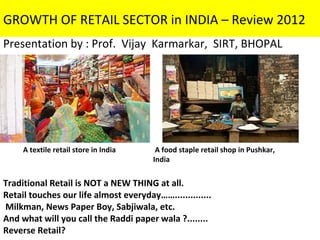
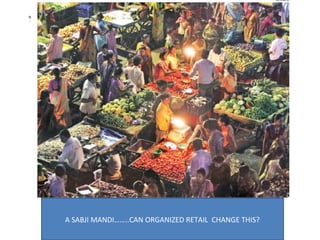
     A textile retail store in India    A food staple retail shop in Pushkar,
                                       India


Traditional Retail is NOT a NEW THING at all.
Retail touches our life almost everyday……..............
Milkman, News Paper Boy, Sabjiwala, etc.
And what will you call the Raddi paper wala ?........
Reverse Retail?
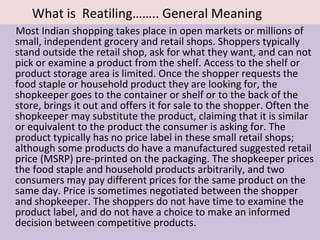
A SABJI MANDI……..CAN ORGANIZED RETAIL CHANGE THIS?
What is Reatiling…….. General Meaning
Most Indian shopping takes place in open markets or millions of
small, independent grocery and retail shops. Shoppers typically
stand outside the retail shop, ask for what they want, and can not
pick or examine a product from the shelf. Access to the shelf or
product storage area is limited. Once the shopper requests the
food staple or household product they are looking for, the
shopkeeper goes to the container or shelf or to the back of the
store, brings it out and offers it for sale to the shopper. Often the
shopkeeper may substitute the product, claiming that it is similar
or equivalent to the product the consumer is asking for. The
product typically has no price label in these small retail shops;
although some products do have a manufactured suggested retail
price (MSRP) pre-printed on the packaging. The shopkeeper prices
the food staple and household products arbitrarily, and two
consumers may pay different prices for the same product on the
same day. Price is sometimes negotiated between the shopper
and shopkeeper. The shoppers do not have time to examine the
product label, and do not have a choice to make an informed
decision between competitive products.
India’s Retail Scenario

India's retail and logistics industry, organized and unorganized in
combination, employs about 40 million Indians (3.3% of Indian
population). The typical Indian retail shops are very small. Over 14
million outlets operate in the country and only 4% of them being
larger than 500 sq ft (46 m2) in size. India has about 11 shop
outlets for every 1000 people. Vast majority of the unorganized
retail shops in India employ family members, do not have the scale
to procure or transport products at high volume wholesale level,
have limited to no quality control or fake-versus-authentic product
screening technology and have no training on safe and hygienic
storage, packaging or logistics. The unorganized retail shops
source their products from a chain of middlemen who mark up the
product as it moves from farmer or producer to the consumer.
The unorganized retail shops typically offer no after-sales support
or service. Finally, most transactions at unorganized retail shops
are done with cash, with all sales being final.
Growth over 1997-2010
• Retailing in India is one of the pillars of its economy and accounts
  for about 15% of its GDP. The Indian retail market is estimated to be
  US$450 billion and one of the top five retail markets in the world by
  economic value. India is one of the fastest growing retail market in the
  world, with 1.2 billion people.
• India's retailing industry is essentially owner manned small shops. In
  2010, larger format convenience stores and supermarkets accounted
  for about 4 percent of the industry, and these were present only in
  large urban centers. India's retail and logistics industry employs about
  40 million Indians (3.3% of Indian population).
• Until 2011, Indian central government denied foreign direct
  investment (FDI) in multi-brand retail, forbidding foreign groups from
  any ownership in supermarkets, convenience stores or any retail
  outlets. Even single-brand retail was limited to 51% ownership and a
  bureaucratic process.
In November 2011, India's central government announced retail reforms
for both multi-brand stores and single-brand stores. These market
reforms paved the way for retail innovation and competition with multi-
brand retailers such as Walmart , Carrefour and Tesco, as well single
brand majors such as IKEA, Nike, and Apple. The announcement
sparked intense activism, both in opposition and in support of the
reforms. In December 2011, under pressure from the opposition, Indian
government placed the retail reforms on hold till it reaches a consensus.


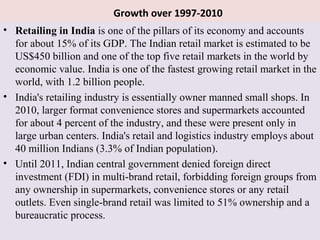
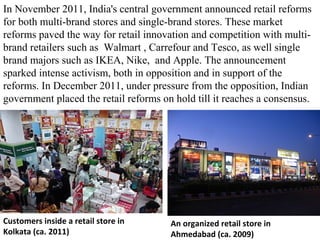
Customers inside a retail store in     An organized retail store in
Kolkata (ca. 2011)                     Ahmedabad (ca. 2009)
In January 2012, India approved reforms for single-brand
stores welcoming anyone in the world to innovate in Indian
retail market with 100% ownership, but imposed the
requirement that the single brand retailer source 30 percent of
its goods from India. Indian government continues the hold on
retail reforms for multi-brand stores. IKEA announced in
January that it is putting on hold its plan to open stores in
India because of the 30 percent requirement. It is believed that
the 30 percent requirement is likely to significantly delay if
not prevent most single brand majors from Europe, USA and
Japan from opening stores and creating associated jobs in
India.


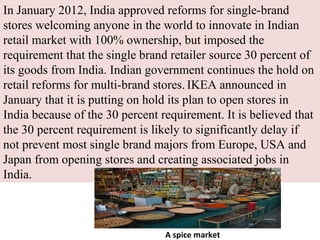
                                 A spice market
• The world's largest retailer by sales, Wal-Mart Stores Inc and
  Sunil Mittal's Bharti Enterprises have entered into a joint
  venture agreement and they are planning to open 10 to 15
  cash-and-carry facilities over seven years. The first of the
  stores, which will sell groceries, consumer appliances and
  fruits and vegetables to retailers and small businesses, is
  slated to open in north India by the end of 2008.
• Carrefour, the world’s second largest retailer by sales, is
  planning to set up two business entities in the country one for
  its cash-and-carry business and the other a master franchisee
  which will lend its banner, technical services and know how
  to an Indian company for direct-to-consumer retail.
• The world’s fifth largest retailer by sales, Costco Wholesale
  Corp (Costco) known for its warehouse club model is also
  interested in coming to India and waiting for the right
  opportunity.
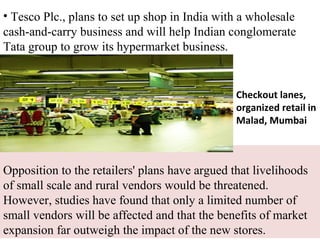
• Tesco Plc., plans to set up shop in India with a wholesale
cash-and-carry business and will help Indian conglomerate
Tata group to grow its hypermarket business.


                                                Checkout lanes,
                                                organized retail in
                                                Malad, Mumbai


Opposition to the retailers' plans have argued that livelihoods
of small scale and rural vendors would be threatened.
However, studies have found that only a limited number of
small vendors will be affected and that the benefits of market
expansion far outweigh the impact of the new stores.
• The low-intensity entry of the diversified Mahindra Group into retail
  is unique because it plans to focus on lifestyle products. The
  Mahindra Group is the fourth largest Indian business group to enter
  the business of retail after Reliance Industries Ltd, the Aditya Birla
  Group, and Bharti Enterprises Ltd. The other three groups are
  focusing either on perishables and groceries, or a range of products, or
  both.
• REI AGRO LTD Retail: 6TEN and 6TEN kirana stores
• Future Groups-Formats: Big Bazaar, Food Bazaar, Pantaloons,
  Central, Fashion Station, Brand Factory, Depot, all, E-Zone etc.
• Raymond Ltd.: Textiles, The Raymond Shop, Park Avenue, Park
  Avenue Woman, Parx, Colourplus, Neck Ties & More, Shirts & More
  etc.
• Fabindia: Textiles, Home furnishings, handloom apparel, jewellery
• RP-Sanjiv Goenka Group Retail-Formats:
  Spencer’s Hyper, Spencer's Daily, Music World,
  Au Bon Pain (International bakery cafeteria),
  Beverly Hills Polo Club
• The Tata Group-Formats: Westside, Star India Bazaar,
  Steel junction, Landmark, Titan Industries with World of
Titans showrooms, Tanishq outlets, Croma.
• Reliance Retail-Formats: Reliance MART,
    Reliance SUPER, Reliance FRESH, Reliance Footprint,
    Reliance Living, Reliance Digital, Reliance Jewellery,
    Reliance Trends, Reliance AutoZone, iStore
• Next retail India Ltd (ConsumerElectronics)
• Vivek Limited Retail Formats: Viveks, Jainsons,
   Viveks Service Centre, Viveks Safe Deposit Lockers
• PGC Retail -T-Mart India , Switcher, Respect India,
   Grand India Bazaar,etc.,
• Subhiksha-Formats: Subhiksha supermarket pharmacy and
  telecom discount chain.
• Trinethra- Formats: Fabmall supermarket chain and Fabcity
  hypermarket chain
• Vishal Retail Group-Formats: Vishal Mega Mart
• BPCL-Formats: In & Out
• German Metro Cash & Carry
• Shoprite Holdings-Formats: Shoprite Hyper
   Paritala stores bazar: honey shine stores
• Aditya Birla Group - "More" Outlets
    Kapas- Cotton garment outlets
• Nmart Retails with 71 operating Stores till now and total
   153 Stores in India and 1 to open in Dubai Shortly.
   (Expected to be 150 by the end of Aug-2012)
• Reliance ADAG Retail-Format: Reliance WorldMart
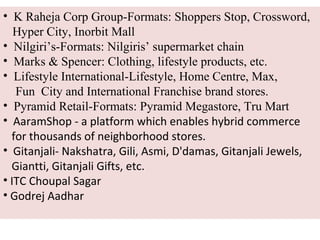
• K Raheja Corp Group-Formats: Shoppers Stop, Crossword,
   Hyper City, Inorbit Mall
• Nilgiri’s-Formats: Nilgiris’ supermarket chain
• Marks & Spencer: Clothing, lifestyle products, etc.
• Lifestyle International-Lifestyle, Home Centre, Max,
   Fun City and International Franchise brand stores.
• Pyramid Retail-Formats: Pyramid Megastore, Tru Mart
• AaramShop - a platform which enables hybrid commerce
  for thousands of neighborhood stores.
• Gitanjali- Nakshatra, Gili, Asmi, D'damas, Gitanjali Jewels,
  Giantti, Gitanjali Gifts, etc.
• ITC Choupal Sagar
• Godrej Aadhar
Challenges for retailing In India

     The organised retail sector in India has been witnessing various
    issues and challenges which are proving to be a hurdle for its fast-
    paced growth. Even though the organised retail sector is in a very
    nascent stage in India, it provides ample opportunities for retailers,
    and mitigation of a few challenges will help the sector attain higher
    economies of scale and growth. Elucidated below are the
    challenges and risks that the sector faces:
•   Global economic slowdown
•   Competition from the unorganized sector
•   Retail sector has no recognition as an industry
•   High real-estate costs
•   Lack of basic infrastructure
•   Supply-chain inefficiencies
•   Challenges with respect to human resources
•   Margin Pressure
To become a truly flourishing industry, retailing in India needs
to cross the following hurdles:
• Automatic approval is not allowed for foreign investment in
retail.
• Regulations restricting real estate purchases, and
 cumbersome local laws.
• Taxation, which favours small retail businesses.
• Absence of developed supply chain and integrated IT
management.
• Lack of trained work force.
• Low skill level for retailing management.
• Lack of Retailing Courses and study options.
• Intrinsic complexity of retailing – rapid price changes,
constant threat of product obsolescence and low margins.
Organised retailers face immense competition from the unorganised
  retailers or kirana stores (mom-and-pop stores) that generally cater to
  the customers within their neighbourhood. The unorganised retail
  sector constitutes over 94% of India’s total retail sector and thus,
  poses a serious hurdle for organised retailers. If put numerically, the
  organised retailers are facing stiff competition from over 13 million
  kirana stores that offer personalized services such as direct credit to
  customers, free home delivery services, apart from the loyalty
  benefits. During the current economic slowdown, the traditional
  kirana stores adopted various measures to retain their customers,
  which directly affected organised retailers. Generally, it has been
  observed that customers shop impulsively and end up spending more
  than what they need at organised retail outlets; however, in kirana
  stores, they stick to their needs because of the limited variety. During
  a downturn, many customers may not like to spend more as is evident
  from the past few months’ trend that shoppers are increasingly
  switching from organised retail stores to kiranas.
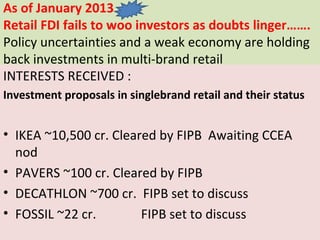
As of January 2013
Retail FDI fails to woo investors as doubts linger…….
Policy uncertainties and a weak economy are holding
back investments in multi-brand retail
INTERESTS RECEIVED :
Investment proposals in singlebrand retail and their status


• IKEA ~10,500 cr. Cleared by FIPB Awaiting CCEA
  nod
• PAVERS ~100 cr. Cleared by FIPB
• DECATHLON ~700 cr. FIPB set to discuss
• FOSSIL ~22 cr.        FIPB set to discuss
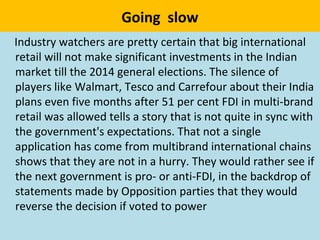
Going slow
Industry watchers are pretty certain that big international
retail will not make significant investments in the Indian
market till the 2014 general elections. The silence of
players like Walmart, Tesco and Carrefour about their India
plans even five months after 51 per cent FDI in multi-brand
retail was allowed tells a story that is not quite in sync with
the government's expectations. That not a single
application has come from multibrand international chains
shows that they are not in a hurry. They would rather see if
the next government is pro- or anti-FDI, in the backdrop of
statements made by Opposition parties that they would
reverse the decision if voted to power
Retail present vk 2012

Retail present vk 2012

  • 1.
    GROWTH OF RETAILSECTOR in INDIA – Review 2012 Presentation by : Prof. Vijay Karmarkar, SIRT, BHOPAL A textile retail store in India A food staple retail shop in Pushkar, India Traditional Retail is NOT a NEW THING at all. Retail touches our life almost everyday…….............. Milkman, News Paper Boy, Sabjiwala, etc. And what will you call the Raddi paper wala ?........ Reverse Retail?
  • 2.
    A SABJI MANDI……..CANORGANIZED RETAIL CHANGE THIS?
  • 3.
    What is Reatiling……..General Meaning Most Indian shopping takes place in open markets or millions of small, independent grocery and retail shops. Shoppers typically stand outside the retail shop, ask for what they want, and can not pick or examine a product from the shelf. Access to the shelf or product storage area is limited. Once the shopper requests the food staple or household product they are looking for, the shopkeeper goes to the container or shelf or to the back of the store, brings it out and offers it for sale to the shopper. Often the shopkeeper may substitute the product, claiming that it is similar or equivalent to the product the consumer is asking for. The product typically has no price label in these small retail shops; although some products do have a manufactured suggested retail price (MSRP) pre-printed on the packaging. The shopkeeper prices the food staple and household products arbitrarily, and two consumers may pay different prices for the same product on the same day. Price is sometimes negotiated between the shopper and shopkeeper. The shoppers do not have time to examine the product label, and do not have a choice to make an informed decision between competitive products.
  • 4.
    India’s Retail Scenario India'sretail and logistics industry, organized and unorganized in combination, employs about 40 million Indians (3.3% of Indian population). The typical Indian retail shops are very small. Over 14 million outlets operate in the country and only 4% of them being larger than 500 sq ft (46 m2) in size. India has about 11 shop outlets for every 1000 people. Vast majority of the unorganized retail shops in India employ family members, do not have the scale to procure or transport products at high volume wholesale level, have limited to no quality control or fake-versus-authentic product screening technology and have no training on safe and hygienic storage, packaging or logistics. The unorganized retail shops source their products from a chain of middlemen who mark up the product as it moves from farmer or producer to the consumer. The unorganized retail shops typically offer no after-sales support or service. Finally, most transactions at unorganized retail shops are done with cash, with all sales being final.
  • 5.
    Growth over 1997-2010 •Retailing in India is one of the pillars of its economy and accounts for about 15% of its GDP. The Indian retail market is estimated to be US$450 billion and one of the top five retail markets in the world by economic value. India is one of the fastest growing retail market in the world, with 1.2 billion people. • India's retailing industry is essentially owner manned small shops. In 2010, larger format convenience stores and supermarkets accounted for about 4 percent of the industry, and these were present only in large urban centers. India's retail and logistics industry employs about 40 million Indians (3.3% of Indian population). • Until 2011, Indian central government denied foreign direct investment (FDI) in multi-brand retail, forbidding foreign groups from any ownership in supermarkets, convenience stores or any retail outlets. Even single-brand retail was limited to 51% ownership and a bureaucratic process.
  • 6.
    In November 2011,India's central government announced retail reforms for both multi-brand stores and single-brand stores. These market reforms paved the way for retail innovation and competition with multi- brand retailers such as Walmart , Carrefour and Tesco, as well single brand majors such as IKEA, Nike, and Apple. The announcement sparked intense activism, both in opposition and in support of the reforms. In December 2011, under pressure from the opposition, Indian government placed the retail reforms on hold till it reaches a consensus. Customers inside a retail store in An organized retail store in Kolkata (ca. 2011) Ahmedabad (ca. 2009)
  • 7.
    In January 2012,India approved reforms for single-brand stores welcoming anyone in the world to innovate in Indian retail market with 100% ownership, but imposed the requirement that the single brand retailer source 30 percent of its goods from India. Indian government continues the hold on retail reforms for multi-brand stores. IKEA announced in January that it is putting on hold its plan to open stores in India because of the 30 percent requirement. It is believed that the 30 percent requirement is likely to significantly delay if not prevent most single brand majors from Europe, USA and Japan from opening stores and creating associated jobs in India. A spice market
  • 8.
    • The world'slargest retailer by sales, Wal-Mart Stores Inc and Sunil Mittal's Bharti Enterprises have entered into a joint venture agreement and they are planning to open 10 to 15 cash-and-carry facilities over seven years. The first of the stores, which will sell groceries, consumer appliances and fruits and vegetables to retailers and small businesses, is slated to open in north India by the end of 2008. • Carrefour, the world’s second largest retailer by sales, is planning to set up two business entities in the country one for its cash-and-carry business and the other a master franchisee which will lend its banner, technical services and know how to an Indian company for direct-to-consumer retail. • The world’s fifth largest retailer by sales, Costco Wholesale Corp (Costco) known for its warehouse club model is also interested in coming to India and waiting for the right opportunity.
  • 9.
    • Tesco Plc.,plans to set up shop in India with a wholesale cash-and-carry business and will help Indian conglomerate Tata group to grow its hypermarket business. Checkout lanes, organized retail in Malad, Mumbai Opposition to the retailers' plans have argued that livelihoods of small scale and rural vendors would be threatened. However, studies have found that only a limited number of small vendors will be affected and that the benefits of market expansion far outweigh the impact of the new stores.
  • 10.
    • The low-intensityentry of the diversified Mahindra Group into retail is unique because it plans to focus on lifestyle products. The Mahindra Group is the fourth largest Indian business group to enter the business of retail after Reliance Industries Ltd, the Aditya Birla Group, and Bharti Enterprises Ltd. The other three groups are focusing either on perishables and groceries, or a range of products, or both. • REI AGRO LTD Retail: 6TEN and 6TEN kirana stores • Future Groups-Formats: Big Bazaar, Food Bazaar, Pantaloons, Central, Fashion Station, Brand Factory, Depot, all, E-Zone etc. • Raymond Ltd.: Textiles, The Raymond Shop, Park Avenue, Park Avenue Woman, Parx, Colourplus, Neck Ties & More, Shirts & More etc. • Fabindia: Textiles, Home furnishings, handloom apparel, jewellery
  • 11.
    • RP-Sanjiv GoenkaGroup Retail-Formats: Spencer’s Hyper, Spencer's Daily, Music World, Au Bon Pain (International bakery cafeteria), Beverly Hills Polo Club • The Tata Group-Formats: Westside, Star India Bazaar, Steel junction, Landmark, Titan Industries with World of Titans showrooms, Tanishq outlets, Croma. • Reliance Retail-Formats: Reliance MART, Reliance SUPER, Reliance FRESH, Reliance Footprint, Reliance Living, Reliance Digital, Reliance Jewellery, Reliance Trends, Reliance AutoZone, iStore • Next retail India Ltd (ConsumerElectronics) • Vivek Limited Retail Formats: Viveks, Jainsons, Viveks Service Centre, Viveks Safe Deposit Lockers • PGC Retail -T-Mart India , Switcher, Respect India, Grand India Bazaar,etc.,
  • 12.
    • Subhiksha-Formats: Subhikshasupermarket pharmacy and telecom discount chain. • Trinethra- Formats: Fabmall supermarket chain and Fabcity hypermarket chain • Vishal Retail Group-Formats: Vishal Mega Mart • BPCL-Formats: In & Out • German Metro Cash & Carry • Shoprite Holdings-Formats: Shoprite Hyper Paritala stores bazar: honey shine stores • Aditya Birla Group - "More" Outlets Kapas- Cotton garment outlets • Nmart Retails with 71 operating Stores till now and total 153 Stores in India and 1 to open in Dubai Shortly. (Expected to be 150 by the end of Aug-2012) • Reliance ADAG Retail-Format: Reliance WorldMart
  • 13.
    • K RahejaCorp Group-Formats: Shoppers Stop, Crossword, Hyper City, Inorbit Mall • Nilgiri’s-Formats: Nilgiris’ supermarket chain • Marks & Spencer: Clothing, lifestyle products, etc. • Lifestyle International-Lifestyle, Home Centre, Max, Fun City and International Franchise brand stores. • Pyramid Retail-Formats: Pyramid Megastore, Tru Mart • AaramShop - a platform which enables hybrid commerce for thousands of neighborhood stores. • Gitanjali- Nakshatra, Gili, Asmi, D'damas, Gitanjali Jewels, Giantti, Gitanjali Gifts, etc. • ITC Choupal Sagar • Godrej Aadhar
  • 14.
    Challenges for retailingIn India The organised retail sector in India has been witnessing various issues and challenges which are proving to be a hurdle for its fast- paced growth. Even though the organised retail sector is in a very nascent stage in India, it provides ample opportunities for retailers, and mitigation of a few challenges will help the sector attain higher economies of scale and growth. Elucidated below are the challenges and risks that the sector faces: • Global economic slowdown • Competition from the unorganized sector • Retail sector has no recognition as an industry • High real-estate costs • Lack of basic infrastructure • Supply-chain inefficiencies • Challenges with respect to human resources • Margin Pressure
  • 15.
    To become atruly flourishing industry, retailing in India needs to cross the following hurdles: • Automatic approval is not allowed for foreign investment in retail. • Regulations restricting real estate purchases, and cumbersome local laws. • Taxation, which favours small retail businesses. • Absence of developed supply chain and integrated IT management. • Lack of trained work force. • Low skill level for retailing management. • Lack of Retailing Courses and study options. • Intrinsic complexity of retailing – rapid price changes, constant threat of product obsolescence and low margins.
  • 16.
    Organised retailers faceimmense competition from the unorganised retailers or kirana stores (mom-and-pop stores) that generally cater to the customers within their neighbourhood. The unorganised retail sector constitutes over 94% of India’s total retail sector and thus, poses a serious hurdle for organised retailers. If put numerically, the organised retailers are facing stiff competition from over 13 million kirana stores that offer personalized services such as direct credit to customers, free home delivery services, apart from the loyalty benefits. During the current economic slowdown, the traditional kirana stores adopted various measures to retain their customers, which directly affected organised retailers. Generally, it has been observed that customers shop impulsively and end up spending more than what they need at organised retail outlets; however, in kirana stores, they stick to their needs because of the limited variety. During a downturn, many customers may not like to spend more as is evident from the past few months’ trend that shoppers are increasingly switching from organised retail stores to kiranas.
  • 17.
    As of January2013 Retail FDI fails to woo investors as doubts linger……. Policy uncertainties and a weak economy are holding back investments in multi-brand retail INTERESTS RECEIVED : Investment proposals in singlebrand retail and their status • IKEA ~10,500 cr. Cleared by FIPB Awaiting CCEA nod • PAVERS ~100 cr. Cleared by FIPB • DECATHLON ~700 cr. FIPB set to discuss • FOSSIL ~22 cr. FIPB set to discuss
  • 18.
    Going slow Industry watchersare pretty certain that big international retail will not make significant investments in the Indian market till the 2014 general elections. The silence of players like Walmart, Tesco and Carrefour about their India plans even five months after 51 per cent FDI in multi-brand retail was allowed tells a story that is not quite in sync with the government's expectations. That not a single application has come from multibrand international chains shows that they are not in a hurry. They would rather see if the next government is pro- or anti-FDI, in the backdrop of statements made by Opposition parties that they would reverse the decision if voted to power