RETAILING
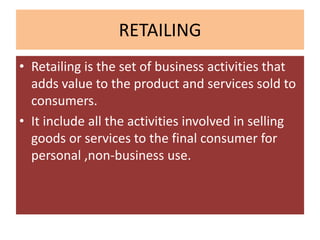
• Retailing is the set of business activities that
  adds value to the product and services sold to
  consumers.
• It include all the activities involved in selling
  goods or services to the final consumer for
  personal ,non-business use.
Concepts
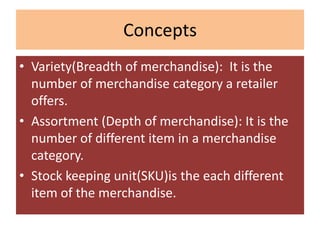
• Variety(Breadth of merchandise): It is the
  number of merchandise category a retailer
  offers.
• Assortment (Depth of merchandise): It is the
  number of different item in a merchandise
  category.
• Stock keeping unit(SKU)is the each different
  item of the merchandise.
Functions
• Providing an assortment of product and
  services.
• Breaking Bulk
• Holding Inventory
• Providing Services
• Convenient location
Economic significance of retailing
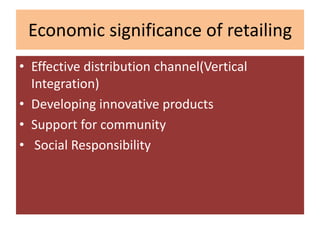
• Effective distribution channel(Vertical
  Integration)
• Developing innovative products
• Support for community
• Social Responsibility
The retail management decision
                   process
•   The world of Retailing :
   Introduction
   Types of retailers
   Multichannel Retailing
   Customer buying behavior
•   Retailing Strategy:
   Retail marketing strategy
   Financial strategy
   Retail location
   Site location
   Organization structure and HRM
   Information system and supply chain management
The retail management decision
                process
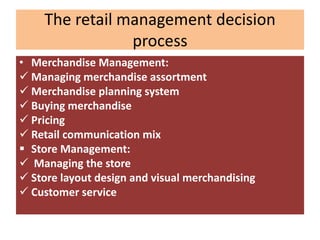
• Merchandise Management:
 Managing merchandise assortment
 Merchandise planning system
 Buying merchandise
 Pricing
 Retail communication mix
 Store Management:
 Managing the store
 Store layout design and visual merchandising
 Customer service
Evolution of retails
• Traditional Formats:
• Haats
• Mandis
• Established Formats:
•   Kirana shops:
•   Convenience stores
•   Department stores
•   Company showrooms
•   Cooperative stores
•   Pan/ beedi shops
Evolution of retails in India
•   Emerging Formats:
•   Exclusive retail outlets
•   Hypermarket
•   Speciality malls
•   Multiplexes
•   Fast food outlets
•   Service galleries
Classification of retail format
            (Types of retails )
• Store based retailing:
• Non-store based retailing
• Service retailing
Classification of Retail formats
•   Store based Retailing:
•   1)Form of ownership:
•   Independent retailer
•   Chain retailer
•   Franchise
•   Leased Department
•   Consumer cooperatives
Store Based Retailing
• 2)Merchandise offered:
•   Convenience store
•   Supermarkets
•   Hypermarkets
•   Speciality Stores
•   Departmental stores
•   Off price retailers
•   Factory Outlets
•   Catalogue showrooms
•   Category killers
•   Warehouse clubs
Convenience store
• The product range covers the basic
  requirements in food and grocery.
• The store size ranges from3000-8000 sq.ft.
Super markets
• Large , low cost, low margin ,high volume, self
  service operations designed to meet the need
  for food groceries and other non food items.
• It ranges from400 sqm to 2500 sqm ,selling at
  least 70% of food items.
Hyper market
• It is the combination of supermarket and a
  department store selling wide range of food
  and non food items.
• Sales area between 5,000 and 15,000 sq m .
• Discounted price.
• A destination offer.
• At least 35% of selling space devoted to non
  grocery product is termed as a hyper market.
Specialty Store
• A store specializing in a particular type of
  merchandise.
• It would operate in an area under 8,000 sq feet .
• Narrow product line , with deep assortments in
  the product line.
• Clearly defined target market.

• Eg:Chamosa,Viveks
Department store
• It varies from20,000 to 40,000 sq ft and stock
  anywhere between 50,000 to 1,00,000 SKU’s
• They have separate departments on several
  floors.
• They depend on food ,clothing and home
  related items for at least 10% but less than
  70% of their sales.
Non-store retailing
•   Direct selling
•   Mail order
•   Telemarketing
•   E-tailing
•   Information kiosks
•   Automated vending
•   The cash and carry
Service retailing
•   Banks
•   Car Rentals
•   Video Rentals
•   Airlines
•   Education
•   Health care
Features of service retailing
•   Intangibility
•   Simultaneous production and consumption
•   Perishability
•   Inconsistency
Drivers of retail change in India
•   Socio economic factor
•   Changing Income profiles
•   The age factor
•   The changing role of women
•   The changing consumption basket
•   Increase credit friendliness
•   Geographical dispersion of market potential
FDI policy
• 51 per cent foreign investment in single brand
Retail with prior Government permission.

• Single-brand retailers such as Nike, Damro,
  Louis Vuitton, can operate now on their own.
FDI is allowed through any of the
            following methods:
• Hi-Tech items
• Social sector items
• Medical and diagnostic items
• Item sourced from Indian small sector with
  technology provided by foreign collaborator
• Two-year Test marketing
FDI
• 100% FDI is allowed on specific approval basis
In case of trading companies in India for carrying
  out any of the following:
1)Export Trading
2)Bulk imports
3)Cash and carry
4)Sales substantially to group companies.
FDI
•   Franchising
•   Joint Ventures
•   Manufacturing facility
•   Distribution offices
•   Wholesale trading
FDI
• Franchise agreements • Most widely used
  entry route by multinational retailers
• Cash and Carry wholesale trading
• • 100% FDI is allowed in wholesale trading
  which involves building of a large distribution
  infrastructure to assist local Manufacturers
• • Metro AG of Germany
FDI
• Strategic licensing agreements
• • Foreign company enters into a licensing
  agreement with a domestic retailer
Porters five forces with respect to
            Indian retail sector
•   Threats of new entrants
•   Threats of substitutes
•   Bargaining power of suppliers
•   Bargaining power of buyers
•   Intensity of rivalry
Indian retail market
•   Highly fragmented
•   Low entry barriers
•   Absence of economies of scale
•   High transportation cost
•   Diverse market need
•   High cost of real estate
•   Lack of adequate infrastructure

Retailing

  • 1.
    RETAILING • Retailing isthe set of business activities that adds value to the product and services sold to consumers. • It include all the activities involved in selling goods or services to the final consumer for personal ,non-business use.
  • 2.
    Concepts • Variety(Breadth ofmerchandise): It is the number of merchandise category a retailer offers. • Assortment (Depth of merchandise): It is the number of different item in a merchandise category. • Stock keeping unit(SKU)is the each different item of the merchandise.
  • 3.
    Functions • Providing anassortment of product and services. • Breaking Bulk • Holding Inventory • Providing Services • Convenient location
  • 4.
    Economic significance ofretailing • Effective distribution channel(Vertical Integration) • Developing innovative products • Support for community • Social Responsibility
  • 5.
    The retail managementdecision process • The world of Retailing :  Introduction  Types of retailers  Multichannel Retailing  Customer buying behavior • Retailing Strategy:  Retail marketing strategy  Financial strategy  Retail location  Site location  Organization structure and HRM  Information system and supply chain management
  • 6.
    The retail managementdecision process • Merchandise Management:  Managing merchandise assortment  Merchandise planning system  Buying merchandise  Pricing  Retail communication mix  Store Management:  Managing the store  Store layout design and visual merchandising  Customer service
  • 7.
    Evolution of retails •Traditional Formats: • Haats • Mandis • Established Formats: • Kirana shops: • Convenience stores • Department stores • Company showrooms • Cooperative stores • Pan/ beedi shops
  • 8.
    Evolution of retailsin India • Emerging Formats: • Exclusive retail outlets • Hypermarket • Speciality malls • Multiplexes • Fast food outlets • Service galleries
  • 9.
    Classification of retailformat (Types of retails ) • Store based retailing: • Non-store based retailing • Service retailing
  • 10.
    Classification of Retailformats • Store based Retailing: • 1)Form of ownership: • Independent retailer • Chain retailer • Franchise • Leased Department • Consumer cooperatives
  • 11.
    Store Based Retailing •2)Merchandise offered: • Convenience store • Supermarkets • Hypermarkets • Speciality Stores • Departmental stores • Off price retailers • Factory Outlets • Catalogue showrooms • Category killers • Warehouse clubs
  • 12.
    Convenience store • Theproduct range covers the basic requirements in food and grocery. • The store size ranges from3000-8000 sq.ft.
  • 13.
    Super markets • Large, low cost, low margin ,high volume, self service operations designed to meet the need for food groceries and other non food items. • It ranges from400 sqm to 2500 sqm ,selling at least 70% of food items.
  • 14.
    Hyper market • Itis the combination of supermarket and a department store selling wide range of food and non food items. • Sales area between 5,000 and 15,000 sq m . • Discounted price. • A destination offer. • At least 35% of selling space devoted to non grocery product is termed as a hyper market.
  • 15.
    Specialty Store • Astore specializing in a particular type of merchandise. • It would operate in an area under 8,000 sq feet . • Narrow product line , with deep assortments in the product line. • Clearly defined target market. • Eg:Chamosa,Viveks
  • 16.
    Department store • Itvaries from20,000 to 40,000 sq ft and stock anywhere between 50,000 to 1,00,000 SKU’s • They have separate departments on several floors. • They depend on food ,clothing and home related items for at least 10% but less than 70% of their sales.
  • 17.
    Non-store retailing • Direct selling • Mail order • Telemarketing • E-tailing • Information kiosks • Automated vending • The cash and carry
  • 18.
    Service retailing • Banks • Car Rentals • Video Rentals • Airlines • Education • Health care
  • 19.
    Features of serviceretailing • Intangibility • Simultaneous production and consumption • Perishability • Inconsistency
  • 20.
    Drivers of retailchange in India • Socio economic factor • Changing Income profiles • The age factor • The changing role of women • The changing consumption basket • Increase credit friendliness • Geographical dispersion of market potential
  • 21.
    FDI policy • 51per cent foreign investment in single brand Retail with prior Government permission. • Single-brand retailers such as Nike, Damro, Louis Vuitton, can operate now on their own.
  • 22.
    FDI is allowedthrough any of the following methods: • Hi-Tech items • Social sector items • Medical and diagnostic items • Item sourced from Indian small sector with technology provided by foreign collaborator • Two-year Test marketing
  • 23.
    FDI • 100% FDIis allowed on specific approval basis In case of trading companies in India for carrying out any of the following: 1)Export Trading 2)Bulk imports 3)Cash and carry 4)Sales substantially to group companies.
  • 24.
    FDI • Franchising • Joint Ventures • Manufacturing facility • Distribution offices • Wholesale trading
  • 25.
    FDI • Franchise agreements• Most widely used entry route by multinational retailers • Cash and Carry wholesale trading • • 100% FDI is allowed in wholesale trading which involves building of a large distribution infrastructure to assist local Manufacturers • • Metro AG of Germany
  • 26.
    FDI • Strategic licensingagreements • • Foreign company enters into a licensing agreement with a domestic retailer
  • 27.
    Porters five forceswith respect to Indian retail sector • Threats of new entrants • Threats of substitutes • Bargaining power of suppliers • Bargaining power of buyers • Intensity of rivalry
  • 28.
    Indian retail market • Highly fragmented • Low entry barriers • Absence of economies of scale • High transportation cost • Diverse market need • High cost of real estate • Lack of adequate infrastructure