Module-1
Basics of Retailing
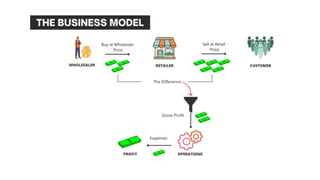
• Retail is a business deal in which the seller sells small quantities of
goods to the customers as per their needs.
• A retail store is a retail business enterprise which primarily deals with
sales volume in retailing.
• In easy terms, the function of retailing is to sell products to final
consumers by an individual or a firm.
• The word retailing has its origins in the French verb „retailer‟, which
means “to cut up”, and refers to one of the fundamental retailing
activities which is to buy in larger quantities and sell in smaller
quantities.
WHAT DOES THE RETAILING INDUSTRY
INCLUDE?
• Department Stores – Modern Bazaar, Reliance Smart Bazaar, Vishal
Mega mart
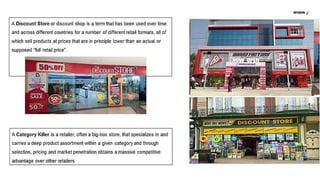
• Discount Stores – Brand Factory, D-mart
• Clothing Stores- Pantaloon, Fab India, Van Heusen
• Specialty retailers- Kalyan Jewellers, Sketchers, Archies
• Convenience Stores- 24/7, Reliance Fresh
• Home furnishing retailers- Home Centre, Pepper fry, Urbanladdar
• Auto Retailers- Maruti Suzuki, Tata Motors
Functions of a Retailer
Breaking bulk into smaller quantities
Providing customer services
Providing feedback to producers about
customer needs
Product Assortment, storing products,
marking prices
Providing product and service information to customers
Indian Retail : Some Facts and figures
• The Indian retail industry
has emerged as one of the
most dynamic and fast-paced
industries due to the entry
of several new players.
• India is the world’s fifth-
largest global destination
in the retail space.
• As per Kearney
Research, India’s
retail industry is
projected to grow at
9% over 2019-2030,
from US$ 779 billion
in 2019 to US$ 1,407
billion by 2026 and
more than US$ 1.8
trillion by 2030.
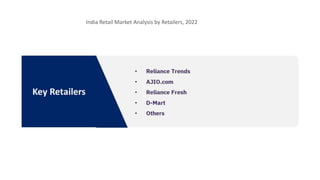
India Retail Market Analysis by Retailers, 2022
Evolution of Retail in India
The history of retailing in India is a journey marked by significant shifts and
transformations, shaped by both economic factors and government initiatives.
• Pre-1991: Traditional Retail Landscape Before the economic reforms of 1991,
India's retail sector was primarily characterized by traditional markets, local kirana
(mom-and-pop) stores, and unorganized retail. The government held tight control
of the economy, limiting the entry of multinational retailers.
• 1991 Onwards: Liberalization and Entry of Multinationals The economic
liberalization in 1991 opened up the Indian market to foreign direct investment
(FDI), leading to the entry of multinational retailers. This period witnessed the
beginning of the organized retail sector, with modern retail chains and shopping
malls making their presence felt in urban centres.
Early 2000s: Rise of Organized Retail
• The early 2000s saw rapid growth in organized retail, with the emergence of well-known
retail chains and the establishment of large shopping malls. This period witnessed a shift
in consumer preferences towards a more organized and branded shopping experience.
• The 2000s witnessed the entry of global retail giants into the Indian market. Companies
such as Walmart, Carrefour, and Metro began establishing their presence, bringing in
international retail practices and expertise.
• Domestic players also made significant strides during this period. Companies like
Reliance Retail, Big Bazaar (part of the Future Group), and Spencer's Retail expanded
their footprint, introducing large-format stores that offered a diverse range of products
under one roof.
• The mid-2000s marked a significant turning point with the advent of e-commerce. Online
retail platforms gained momentum, offering consumers a convenient way to shop from the
comfort of their homes. This period witnessed the rise of several e-commerce giants,
transforming the retail landscape.
• The 2000s also witnessed the integration of technology in the retail sector. Point-of-sale
systems, inventory management software, and customer relationship management tools
became crucial for efficient operations and enhanced customer experiences.
• Government Initiatives: FDI Policies and GST Implementation The Indian
government has played a crucial role in shaping the retail sector through various
initiatives. Changes in foreign direct investment (FDI) policies, allowing higher
FDI limits in multi-brand retail, have influenced the entry of global players.
Additionally, the implementation of the Goods and Services Tax (GST) in 2017
aimed to streamline the taxation system, reducing complexities for retailers and
fostering a unified market
• 2020: Impact of COVID-19 and Digital Acceleration The COVID-19 pandemic
in 2020 brought unforeseen challenges to the retail sector, with lockdowns
affecting physical retail operations. However, it also accelerated the adoption of
digital technologies, pushing retailers to enhance their online presence and adopt
innovative strategies to cater to changing consumer behaviors.
• Future Outlook: Technology and Sustainability Looking ahead, the future of
retail in India appears to be increasingly intertwined with technology. The
integration of artificial intelligence, data analytics, and digital payment systems is
expected to redefine the retail experience. Government initiatives promoting
sustainability and ease of doing business are likely to further shape the evolving
landscape of retailing in India.
Organized Retailing in India
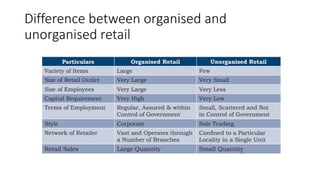
• Retailing in India can be further divided into organised and unorganised
sectors.
• Organized Retailing: Organized retailing is selling products or merchandise
at a specific place such as a department store, hypermarket, supermarket,
or even convenience store.
• The government keeps a proper record of organised retailing, and retailers
must pay the tax to the government.
• The Indian retail market has embraced modern retailing. Higher expansion
in the Indian economy has resulted in greater spending power among the
Indian populace, resulting in the growth of the organised retail sector.
• The following are some characteristics of the organised retail sector:
1. Retail establishments are owned by corporations.
2. The organization employs a small number of full-time employees,
while others work on a contract basis.
3. Employees are bound by minimum wage legislation.
Unorganized sector
• Unorganized retail refers to retail establishments, kirana stores, and convenience
stores that operate without paying taxes or being recognised by the government.
• The unorganised sector in India continues to dominate due to its numerous
advantages.
• The main benefit is that it has a low operational cost and requires less
investment because it has a direct impact on product pricing.
• Unorganized merchants are providing modern retailers with excellent
opportunities to open stores in remote locations.
• Problems of unorganized retail in india –
1. Lack of adequate infrastructure
2. Lack of modern technology
3. Lack of skilled manpower
Difference between organised and
unorganised retail
KEY ELEMENTS OF RETAIL
Design, Strategy &
Planning
Logistics & Supply
Chain Management
Operations
Merchandising
Customer Experience &
Management
Growth drivers for retail in India
Key Drivers for growth in retail
1. Favourable Demographics
India has witnessed a change in the age and income pattern over the last decade,
which is likely to continue in the years to come. India is believed to have a more
young population as compared to the US and China. Two-thirds of the Indian
population is under 35, with a median age of 23 years, as opposed to the world
median age of 33.
The large proportion of the working-age population translates to a lucrative
consumer base vis-a-vis other economies of the world, placing India on the radar as
one of the most promising retail destinations of the world.
2. Rise in Income and Purchasing power
With the growth of income levels and more than one earning member household,
the Indian average disposable income is growing fast resulting in enhanced demand
for goods and services. Energized by ranking as the third largest economy in terms of
Purchasing Power Parity (PPP), next only to the United States and China. The
purchasing power of Indian urban consumers towards Apparel, Cosmetics, Shoes,
Food, Watches, Jewellery, and Beverages is increasing.
3. Change in consumer Mindset
With the emergence of consumerism, the retailer faces a more knowledgeable and
demanding consumer. As the business exist to satisfy consumer needs, the growing
consumer expectation has forced the retail organizations to change their format of
retail trade. Consumer demand, convenience, comfort, time, location etc. are the
important factors for the growth of organised retailing in India.
4. Brand consciousness
Brand consciousness is a key driver of growth in the retail sector. It plays a crucial
role in all three parameters of the retail sector: consumer behaviour, advertising
management, and retail growth. The Indian retail industry has evolved manifold,
traversing the ‘mom and pop’ store era to reach today’s sophisticated large domestic
and international brand-dominated scenario.
One of the key drivers for global brands to enter India has been the measures taken
by the government to liberalize the Indian retail sector for foreign investment.
Many single-brand retailers like Louis Vuitton and Tommy Hilfiger were the first to
take advantage of this opportunity.
The cash-and-carry format has been adopted by global multichannel retailing giants
like Metro and Walmart to enter the fray. Recent brands to join the Indian market
include Zara (2009), H&M (2015), Gap (2016), and IKEA (set to open its first store in
Hyderabad in 2017).
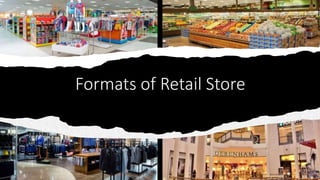
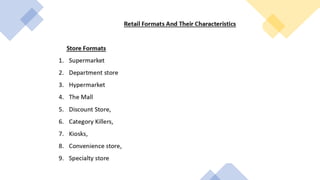
Formats of Retail Store
SUPERMARKETS
• Supermarkets are large retail stores that offer a wide variety of food and
household products, organized into aisles for convenient shopping. They
typically operate on a self-service model, allowing customers to select and
purchase items directly from the shelves.
• The supermarket typically has places for fresh meat, fresh produce, dairy,
baked goods, and similar foodstuffs. Shelf space is also reserved for
canned and packaged goods and for various non-food items such
as kitchenware, household cleaners, pharmacy products and pet supplies.
• Some supermarkets also sell other household products that are consumed
regularly, medicine, and toiletries, and some sell a much wider range of
non-food products: basic sporting equipment, board games, and seasonal
items.
• Example- Reliance Fresh, Modern bazaar
HYPERMARKETS
• Hypermarkets are self service retail formats that provide a vastly wide
variety of merchandise for the consumers to choose from.
• A Hypermarket is a large establishment combining the characteristics
of a supermarket and a department store.
• These establishments are generally larger in size more floor space in a
retail outlet.
• Their business model focuses on high volume and low margin sales.
• Example- Spencer's Retail, Dmart, Carrefour, Metro
Departmental stores
• “A departmental store is a large retailing business unit which handles a wide variety of
shopping and specialty goods and is organized into the separate department for
purposes of promotion, service, and control.”
• Department stores are typically organized into different departments, each selling a
different type of product. Many department stores also have restaurants, cafes, and
other amenities.
• A department store is a place where women, men, or kids can find all the products they
need under one roof.
• It is a one-stop shop for everything from clothes, jewelry, cosmetics, discount, sale, etc.
• Department stores usually have several floors, each one selling a different type of
product. Companies create department stores in order to make it easier for customers to
find everything they need in one place.
• Example- Big Bazaar, Shoppers Stop, Lifestyle
• When it comes to departmental stores, they are large retail
establishments that sell a variety of things from numerous
departments. On the other hand, a supermarket is a large self-
service retail market that sells food and household goods.
• Supermarkets are typically smaller than department stores, despite
their size. As a result, department stores are the largest of all.
Department shops are usually multi-story buildings. In most
supermarkets, there is only one floor.
• Hypermarkets differ from supermarkets because they provide a
greater variety of FMCG products. A supermarket, for example,
provides a pleasant and friendly atmosphere that encourages
customers to shop. For most people seeking daily necessities, it is a
go-to location. On the other hand, a hypermarket resembles a
warehouse and lacks glamor.
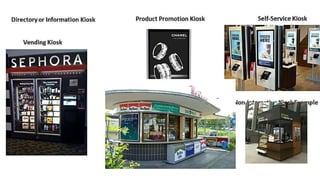
kiosk
• A kiosk is a self-service interactive system designed to perform specific functions
or provide information to users. Here are some common characteristics of kiosks:
1.User Interface:
1. Touchscreen: Most kiosks feature a touchscreen interface, allowing users to
interact with the system by tapping or swiping.
2. Input Devices: Some kiosks may include additional input devices such as
keyboards, card readers, barcode scanners, or biometric scanners,
depending on their purpose.
2.Functionality:
1. Specific Purpose: Kiosks are designed for specific functions, such as
information display, ticket purchasing, product ordering, or check-in services.
2. Self-Service: Users can independently navigate through the kiosk interface
without assistance from staff.
specialty store
• A specialty store is a type of retail establishment that focuses on selling a
specific category or niche of products. Unlike general or department
stores, specialty stores concentrate on a particular type of merchandise,
often catering to a specific target audience with unique interests or needs.
• A specialty store is a retail store that sells a specialized line of
merchandise, related to a specific category of products. They are the
opposite of general stores, which sell general lines of merchandise,
such as department stores.
• Furniture stores, florists, electronics and appliance stores, office
supplies stores, pharmacies and book stores are all considered
specialty stores.
Convenience Store
• A convenience store can be defined as a retail business designed by keeping the
convenience of its customers in the center. Therefore, these stores are located at
convenient locations where people can quickly purchase a vast number of
products such as grocery items, food, and gasoline, etc.
• It stocks all the essential goods such as groceries items like eggs, bread, butter,
and milk, over-the-counter medicines, coffee, snacks, tobacco products, and soft
drinks, etc. The convenience stores are referred to with various names such as
corner shops, corner stores, or C-store.
• Convenience stores not only provide all the convenient stuff but also offer service
to their customers for long hours. Many convenience stores remain open for 24
hours. That means a person can buy any goods at any time of the day.
Non-store retailing
• Non-store retailing is a form of retailing in which a firm sells its products without a physical retail
store/space. The firm sells its products via online platforms and delivers the product to customer’s doorstep.
• Non store retailing occurs when a firm uses a strategy mix that is not store based, to reach customers and
complete transactions. A non store retailer does not utilize conventional store facilities.
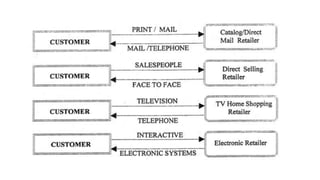
• The major types of non store retail formats are:
(a) e-tailing or Electronic retailing or Internet retailing
(b) Catalog and Direct Mail retailing
(c) Direct selling
(d) TV Home shopping
Electronic retailing
• Electronic retailing (e-tailing), also known as e-
retailing, refers to the process of selling goods and
services through digital channels such as websites
and apps.
• E-tailing encompasses both business-to-business
(B2B) and business-to-consumer (B2C) sales of
products and services via the internet.
• This involves building out distribution channels,
including warehouses, webpages, and product
shipping centers.
1.Revenue Sources:
1. Product Sales: E-tailers earn revenue by
selling their products to consumers or
businesses.
2. Subscription Models: Both B2C and B2B
companies can generate revenue through
subscription-based models (e.g., Netflix).
3. Online Advertising: Revenue can also come
from online advertising (e.g., Meta, formerly
Facebook Inc.).
1.Critical Factors:
1. Engaging Website: Successful e-tailing requires an engaging website that is easily navigable and
regularly updated to meet consumers’ changing demands.
2. Branding: Strong branding is essential. Products and services must stand out from competitors and
add value to consumers’ lives.
3. Competitive Pricing: Offerings should be competitively priced to avoid losing customers solely
based on price.
4. Efficient Distribution: Prompt and efficient distribution networks are crucial. Consumers expect
timely delivery of products or services.
5. Transparency: Trust is built through transparent business practices.
CATALOG RETAILING
• Also known as mail-order retailing, is a type of non store format where the product or service is
communicated to a prospective customer through a catalog. A variation of this format is Direct
Mail retailing where the offering is communicated by means of letters and brochures.
• The factor that most attracts customers to catalog retailing is convenience. Shopping at home,
particularly at such harried times as Diwali or New Year, provides an undeniable attraction.
Catalog retailers also offer the facility of gift wrapping orders and dispatching them directly to the
persons for whom they are meant.
• Example: L.L.Bean
1. Printed Catalogs: L.L.Bean publishes seasonal catalogs that showcase its extensive product range, including clothing,
outerwear, footwear, outdoor gear, and home goods. These catalogs are distributed to customers through direct mail and are
also available for viewing online.
2. Iconic Products: L.L.Bean is known for its iconic products such as the Bean Boot, the Norwegian Fisherman's Sweater, and the
L.L.Bean Boat and Tote Bag. These products have become staples in the outdoor community and are featured prominently in
L.L.Bean catalogs.
3. Quality and Durability: L.L.Bean is committed to providing high-quality, durable products that are designed to withstand the
rigors of outdoor use
DIRECT SELLING
• Referred to as door-to-door retailing, where a
salesperson, quite often an independent businessperson,
contacts a customer directly in a convenient location,
either at the customer's home or at work, or at home
sales parties, and demonstrates the product's benefits,
takes an order and delivers the merchandise to the
customer.
• Some of the products sold directly include: cosmetics,
personal care products, kitchen ware, carpets and some
other household effects.
• Two methods of selling are commonly used: (a) Personal
selling and (b) Telephone selling or Teleselling
• Example: Avon Products, Inc.
• Independent Sales Representatives: Avon operates through a network
of independent sales representatives who are responsible for marketing
and selling Avon products to customers.
• Product Catalogs
Personal selling
• Face-to-face selling, also known as in-person selling or direct selling, involves direct
interaction between a salesperson and a potential customer in a physical setting, such as
a store, office, or outdoor location. This form of selling allows for personalized
communication, relationship building, and immediate feedback, making it a powerful tool
for closing sales and building customer loyalty.
• These master distributors either buy the merchandise from the firm and resell it to their
distributors or receive a commission on the merchandise sold by their distributors. In addition to
selling the merchandise, the master distributors are involved in recruiting and training other
distributors.
• face-to-face selling enables the salesperson to establish rapport, understand the
customer's needs, and provide tailored solutions in real-time. The direct interaction fosters
trust and confidence, leading to a successful sale and a positive customer relationship.
Tele Selling
• Teleselling is another traditional mode of non-store retailing and was very
common in the late 1990s and early 2020s. It involves selling a product via
telephone. However, this non-store retailing channel has almost diminished
over time.
• Teleselling is still a common practice in stockbrokers; they often approach
their potential clients through telephones, etc. Moreover, bankers often sell
their promotional offers, credit/debit cards, etc., via telemarketing.
Television home shopping
• Television home shopping, also known as teleshopping or direct response
television (DRTV), is a form of retail where products are demonstrated,
promoted, and sold on television channels. In India, television home
shopping has gained popularity over the years, with several companies
operating dedicated channels for this purpose.
• "Naaptol," which operates as both an e-commerce platform and a
television home shopping channel in India. Naaptol showcases products
through infomercials and live demonstrations on its dedicated TV channel.
Customers can place orders via phone or online, and the products are
delivered to their doorstep.
• There are three ways in which a company can communicate to the target
audience through television
• i) Through an infomercial (informative commercial), where, between scheduled
TV programmes, advertisements for products are aired and orders solicited from
viewers.
• ii) Through a 30- or 60-minute capsule, covering various products, with in depth
demonstrations.
• iii) Through dedicated channels, which carry-programmes on television shopping,
advertising products offered by a company, along with demonstrations and
prices.
Advantages of Non-Store Retailing
Non-store retailing offers several distinct advantages for both businesses and consumers.
• For businesses, the absence of physical storefronts reduces overhead costs associated with
maintaining and operating traditional retail spaces. This cost savings can be redirected towards
marketing, product development, and enhancing the overall customer experience.
• Additionally, non-store retailing allows businesses to reach a broader audience, transcending
geographical boundaries and time constraints, thereby expanding their market potential.
• From a consumer perspective, non-store retailing provides unparalleled convenience, enabling
individuals to browse, research, and make purchases at any time and from any location with an
internet connection.
• The ability to compare products, read reviews, and access a vast array of options empowers
consumers to make informed purchasing decisions, thereby enhancing their overall shopping
experience.
Study Materials and References
1. Bajaj, Tuli & Srivastava , Retail Management- Oxford University Publications
2. Swapna Pradhan ,Retailing Management ,Tata –Mcgraw hill Publications
3. https://www.bing.com/videos/riverview/relatedvideo?&q=retail+introduction+tutorial&&mid=F85F210DA
B9005653360F85F210DAB9005653360&&FORM=VRDGAR

Retailing-An Introduction Module 1 .pptx

  • 1.
  • 2.
    Basics of Retailing •Retail is a business deal in which the seller sells small quantities of goods to the customers as per their needs. • A retail store is a retail business enterprise which primarily deals with sales volume in retailing. • In easy terms, the function of retailing is to sell products to final consumers by an individual or a firm. • The word retailing has its origins in the French verb „retailer‟, which means “to cut up”, and refers to one of the fundamental retailing activities which is to buy in larger quantities and sell in smaller quantities.
  • 3.
    WHAT DOES THERETAILING INDUSTRY INCLUDE? • Department Stores – Modern Bazaar, Reliance Smart Bazaar, Vishal Mega mart • Discount Stores – Brand Factory, D-mart • Clothing Stores- Pantaloon, Fab India, Van Heusen • Specialty retailers- Kalyan Jewellers, Sketchers, Archies • Convenience Stores- 24/7, Reliance Fresh • Home furnishing retailers- Home Centre, Pepper fry, Urbanladdar • Auto Retailers- Maruti Suzuki, Tata Motors
  • 5.
    Functions of aRetailer Breaking bulk into smaller quantities Providing customer services Providing feedback to producers about customer needs Product Assortment, storing products, marking prices Providing product and service information to customers
  • 8.
    Indian Retail :Some Facts and figures • The Indian retail industry has emerged as one of the most dynamic and fast-paced industries due to the entry of several new players. • India is the world’s fifth- largest global destination in the retail space.
  • 9.
    • As perKearney Research, India’s retail industry is projected to grow at 9% over 2019-2030, from US$ 779 billion in 2019 to US$ 1,407 billion by 2026 and more than US$ 1.8 trillion by 2030.
  • 11.
    India Retail MarketAnalysis by Retailers, 2022
  • 12.
  • 13.
    The history ofretailing in India is a journey marked by significant shifts and transformations, shaped by both economic factors and government initiatives. • Pre-1991: Traditional Retail Landscape Before the economic reforms of 1991, India's retail sector was primarily characterized by traditional markets, local kirana (mom-and-pop) stores, and unorganized retail. The government held tight control of the economy, limiting the entry of multinational retailers. • 1991 Onwards: Liberalization and Entry of Multinationals The economic liberalization in 1991 opened up the Indian market to foreign direct investment (FDI), leading to the entry of multinational retailers. This period witnessed the beginning of the organized retail sector, with modern retail chains and shopping malls making their presence felt in urban centres.
  • 14.
    Early 2000s: Riseof Organized Retail • The early 2000s saw rapid growth in organized retail, with the emergence of well-known retail chains and the establishment of large shopping malls. This period witnessed a shift in consumer preferences towards a more organized and branded shopping experience. • The 2000s witnessed the entry of global retail giants into the Indian market. Companies such as Walmart, Carrefour, and Metro began establishing their presence, bringing in international retail practices and expertise. • Domestic players also made significant strides during this period. Companies like Reliance Retail, Big Bazaar (part of the Future Group), and Spencer's Retail expanded their footprint, introducing large-format stores that offered a diverse range of products under one roof. • The mid-2000s marked a significant turning point with the advent of e-commerce. Online retail platforms gained momentum, offering consumers a convenient way to shop from the comfort of their homes. This period witnessed the rise of several e-commerce giants, transforming the retail landscape. • The 2000s also witnessed the integration of technology in the retail sector. Point-of-sale systems, inventory management software, and customer relationship management tools became crucial for efficient operations and enhanced customer experiences.
  • 15.
    • Government Initiatives:FDI Policies and GST Implementation The Indian government has played a crucial role in shaping the retail sector through various initiatives. Changes in foreign direct investment (FDI) policies, allowing higher FDI limits in multi-brand retail, have influenced the entry of global players. Additionally, the implementation of the Goods and Services Tax (GST) in 2017 aimed to streamline the taxation system, reducing complexities for retailers and fostering a unified market • 2020: Impact of COVID-19 and Digital Acceleration The COVID-19 pandemic in 2020 brought unforeseen challenges to the retail sector, with lockdowns affecting physical retail operations. However, it also accelerated the adoption of digital technologies, pushing retailers to enhance their online presence and adopt innovative strategies to cater to changing consumer behaviors. • Future Outlook: Technology and Sustainability Looking ahead, the future of retail in India appears to be increasingly intertwined with technology. The integration of artificial intelligence, data analytics, and digital payment systems is expected to redefine the retail experience. Government initiatives promoting sustainability and ease of doing business are likely to further shape the evolving landscape of retailing in India.
  • 17.
    Organized Retailing inIndia • Retailing in India can be further divided into organised and unorganised sectors. • Organized Retailing: Organized retailing is selling products or merchandise at a specific place such as a department store, hypermarket, supermarket, or even convenience store. • The government keeps a proper record of organised retailing, and retailers must pay the tax to the government. • The Indian retail market has embraced modern retailing. Higher expansion in the Indian economy has resulted in greater spending power among the Indian populace, resulting in the growth of the organised retail sector. • The following are some characteristics of the organised retail sector: 1. Retail establishments are owned by corporations. 2. The organization employs a small number of full-time employees, while others work on a contract basis. 3. Employees are bound by minimum wage legislation.
  • 18.
    Unorganized sector • Unorganizedretail refers to retail establishments, kirana stores, and convenience stores that operate without paying taxes or being recognised by the government. • The unorganised sector in India continues to dominate due to its numerous advantages. • The main benefit is that it has a low operational cost and requires less investment because it has a direct impact on product pricing. • Unorganized merchants are providing modern retailers with excellent opportunities to open stores in remote locations. • Problems of unorganized retail in india – 1. Lack of adequate infrastructure 2. Lack of modern technology 3. Lack of skilled manpower
  • 19.
    Difference between organisedand unorganised retail
  • 20.
    KEY ELEMENTS OFRETAIL Design, Strategy & Planning Logistics & Supply Chain Management Operations Merchandising Customer Experience & Management
  • 22.
    Growth drivers forretail in India
  • 23.
    Key Drivers forgrowth in retail 1. Favourable Demographics India has witnessed a change in the age and income pattern over the last decade, which is likely to continue in the years to come. India is believed to have a more young population as compared to the US and China. Two-thirds of the Indian population is under 35, with a median age of 23 years, as opposed to the world median age of 33. The large proportion of the working-age population translates to a lucrative consumer base vis-a-vis other economies of the world, placing India on the radar as one of the most promising retail destinations of the world.
  • 24.
    2. Rise inIncome and Purchasing power With the growth of income levels and more than one earning member household, the Indian average disposable income is growing fast resulting in enhanced demand for goods and services. Energized by ranking as the third largest economy in terms of Purchasing Power Parity (PPP), next only to the United States and China. The purchasing power of Indian urban consumers towards Apparel, Cosmetics, Shoes, Food, Watches, Jewellery, and Beverages is increasing. 3. Change in consumer Mindset With the emergence of consumerism, the retailer faces a more knowledgeable and demanding consumer. As the business exist to satisfy consumer needs, the growing consumer expectation has forced the retail organizations to change their format of retail trade. Consumer demand, convenience, comfort, time, location etc. are the important factors for the growth of organised retailing in India.
  • 25.
    4. Brand consciousness Brandconsciousness is a key driver of growth in the retail sector. It plays a crucial role in all three parameters of the retail sector: consumer behaviour, advertising management, and retail growth. The Indian retail industry has evolved manifold, traversing the ‘mom and pop’ store era to reach today’s sophisticated large domestic and international brand-dominated scenario. One of the key drivers for global brands to enter India has been the measures taken by the government to liberalize the Indian retail sector for foreign investment. Many single-brand retailers like Louis Vuitton and Tommy Hilfiger were the first to take advantage of this opportunity. The cash-and-carry format has been adopted by global multichannel retailing giants like Metro and Walmart to enter the fray. Recent brands to join the Indian market include Zara (2009), H&M (2015), Gap (2016), and IKEA (set to open its first store in Hyderabad in 2017).
  • 26.
  • 28.
    SUPERMARKETS • Supermarkets arelarge retail stores that offer a wide variety of food and household products, organized into aisles for convenient shopping. They typically operate on a self-service model, allowing customers to select and purchase items directly from the shelves. • The supermarket typically has places for fresh meat, fresh produce, dairy, baked goods, and similar foodstuffs. Shelf space is also reserved for canned and packaged goods and for various non-food items such as kitchenware, household cleaners, pharmacy products and pet supplies. • Some supermarkets also sell other household products that are consumed regularly, medicine, and toiletries, and some sell a much wider range of non-food products: basic sporting equipment, board games, and seasonal items. • Example- Reliance Fresh, Modern bazaar
  • 29.
    HYPERMARKETS • Hypermarkets areself service retail formats that provide a vastly wide variety of merchandise for the consumers to choose from. • A Hypermarket is a large establishment combining the characteristics of a supermarket and a department store. • These establishments are generally larger in size more floor space in a retail outlet. • Their business model focuses on high volume and low margin sales. • Example- Spencer's Retail, Dmart, Carrefour, Metro
  • 32.
    Departmental stores • “Adepartmental store is a large retailing business unit which handles a wide variety of shopping and specialty goods and is organized into the separate department for purposes of promotion, service, and control.” • Department stores are typically organized into different departments, each selling a different type of product. Many department stores also have restaurants, cafes, and other amenities. • A department store is a place where women, men, or kids can find all the products they need under one roof. • It is a one-stop shop for everything from clothes, jewelry, cosmetics, discount, sale, etc. • Department stores usually have several floors, each one selling a different type of product. Companies create department stores in order to make it easier for customers to find everything they need in one place. • Example- Big Bazaar, Shoppers Stop, Lifestyle
  • 34.
    • When itcomes to departmental stores, they are large retail establishments that sell a variety of things from numerous departments. On the other hand, a supermarket is a large self- service retail market that sells food and household goods. • Supermarkets are typically smaller than department stores, despite their size. As a result, department stores are the largest of all. Department shops are usually multi-story buildings. In most supermarkets, there is only one floor. • Hypermarkets differ from supermarkets because they provide a greater variety of FMCG products. A supermarket, for example, provides a pleasant and friendly atmosphere that encourages customers to shop. For most people seeking daily necessities, it is a go-to location. On the other hand, a hypermarket resembles a warehouse and lacks glamor.
  • 36.
    kiosk • A kioskis a self-service interactive system designed to perform specific functions or provide information to users. Here are some common characteristics of kiosks: 1.User Interface: 1. Touchscreen: Most kiosks feature a touchscreen interface, allowing users to interact with the system by tapping or swiping. 2. Input Devices: Some kiosks may include additional input devices such as keyboards, card readers, barcode scanners, or biometric scanners, depending on their purpose. 2.Functionality: 1. Specific Purpose: Kiosks are designed for specific functions, such as information display, ticket purchasing, product ordering, or check-in services. 2. Self-Service: Users can independently navigate through the kiosk interface without assistance from staff.
  • 38.
    specialty store • Aspecialty store is a type of retail establishment that focuses on selling a specific category or niche of products. Unlike general or department stores, specialty stores concentrate on a particular type of merchandise, often catering to a specific target audience with unique interests or needs. • A specialty store is a retail store that sells a specialized line of merchandise, related to a specific category of products. They are the opposite of general stores, which sell general lines of merchandise, such as department stores. • Furniture stores, florists, electronics and appliance stores, office supplies stores, pharmacies and book stores are all considered specialty stores.
  • 39.
    Convenience Store • Aconvenience store can be defined as a retail business designed by keeping the convenience of its customers in the center. Therefore, these stores are located at convenient locations where people can quickly purchase a vast number of products such as grocery items, food, and gasoline, etc. • It stocks all the essential goods such as groceries items like eggs, bread, butter, and milk, over-the-counter medicines, coffee, snacks, tobacco products, and soft drinks, etc. The convenience stores are referred to with various names such as corner shops, corner stores, or C-store. • Convenience stores not only provide all the convenient stuff but also offer service to their customers for long hours. Many convenience stores remain open for 24 hours. That means a person can buy any goods at any time of the day.
  • 41.
    Non-store retailing • Non-storeretailing is a form of retailing in which a firm sells its products without a physical retail store/space. The firm sells its products via online platforms and delivers the product to customer’s doorstep. • Non store retailing occurs when a firm uses a strategy mix that is not store based, to reach customers and complete transactions. A non store retailer does not utilize conventional store facilities. • The major types of non store retail formats are: (a) e-tailing or Electronic retailing or Internet retailing (b) Catalog and Direct Mail retailing (c) Direct selling (d) TV Home shopping
  • 43.
    Electronic retailing • Electronicretailing (e-tailing), also known as e- retailing, refers to the process of selling goods and services through digital channels such as websites and apps. • E-tailing encompasses both business-to-business (B2B) and business-to-consumer (B2C) sales of products and services via the internet. • This involves building out distribution channels, including warehouses, webpages, and product shipping centers. 1.Revenue Sources: 1. Product Sales: E-tailers earn revenue by selling their products to consumers or businesses. 2. Subscription Models: Both B2C and B2B companies can generate revenue through subscription-based models (e.g., Netflix). 3. Online Advertising: Revenue can also come from online advertising (e.g., Meta, formerly Facebook Inc.).
  • 44.
    1.Critical Factors: 1. EngagingWebsite: Successful e-tailing requires an engaging website that is easily navigable and regularly updated to meet consumers’ changing demands. 2. Branding: Strong branding is essential. Products and services must stand out from competitors and add value to consumers’ lives. 3. Competitive Pricing: Offerings should be competitively priced to avoid losing customers solely based on price. 4. Efficient Distribution: Prompt and efficient distribution networks are crucial. Consumers expect timely delivery of products or services. 5. Transparency: Trust is built through transparent business practices.
  • 45.
    CATALOG RETAILING • Alsoknown as mail-order retailing, is a type of non store format where the product or service is communicated to a prospective customer through a catalog. A variation of this format is Direct Mail retailing where the offering is communicated by means of letters and brochures. • The factor that most attracts customers to catalog retailing is convenience. Shopping at home, particularly at such harried times as Diwali or New Year, provides an undeniable attraction. Catalog retailers also offer the facility of gift wrapping orders and dispatching them directly to the persons for whom they are meant. • Example: L.L.Bean 1. Printed Catalogs: L.L.Bean publishes seasonal catalogs that showcase its extensive product range, including clothing, outerwear, footwear, outdoor gear, and home goods. These catalogs are distributed to customers through direct mail and are also available for viewing online. 2. Iconic Products: L.L.Bean is known for its iconic products such as the Bean Boot, the Norwegian Fisherman's Sweater, and the L.L.Bean Boat and Tote Bag. These products have become staples in the outdoor community and are featured prominently in L.L.Bean catalogs. 3. Quality and Durability: L.L.Bean is committed to providing high-quality, durable products that are designed to withstand the rigors of outdoor use
  • 46.
    DIRECT SELLING • Referredto as door-to-door retailing, where a salesperson, quite often an independent businessperson, contacts a customer directly in a convenient location, either at the customer's home or at work, or at home sales parties, and demonstrates the product's benefits, takes an order and delivers the merchandise to the customer. • Some of the products sold directly include: cosmetics, personal care products, kitchen ware, carpets and some other household effects. • Two methods of selling are commonly used: (a) Personal selling and (b) Telephone selling or Teleselling • Example: Avon Products, Inc. • Independent Sales Representatives: Avon operates through a network of independent sales representatives who are responsible for marketing and selling Avon products to customers. • Product Catalogs
  • 47.
    Personal selling • Face-to-faceselling, also known as in-person selling or direct selling, involves direct interaction between a salesperson and a potential customer in a physical setting, such as a store, office, or outdoor location. This form of selling allows for personalized communication, relationship building, and immediate feedback, making it a powerful tool for closing sales and building customer loyalty. • These master distributors either buy the merchandise from the firm and resell it to their distributors or receive a commission on the merchandise sold by their distributors. In addition to selling the merchandise, the master distributors are involved in recruiting and training other distributors. • face-to-face selling enables the salesperson to establish rapport, understand the customer's needs, and provide tailored solutions in real-time. The direct interaction fosters trust and confidence, leading to a successful sale and a positive customer relationship.
  • 48.
    Tele Selling • Telesellingis another traditional mode of non-store retailing and was very common in the late 1990s and early 2020s. It involves selling a product via telephone. However, this non-store retailing channel has almost diminished over time. • Teleselling is still a common practice in stockbrokers; they often approach their potential clients through telephones, etc. Moreover, bankers often sell their promotional offers, credit/debit cards, etc., via telemarketing.
  • 49.
    Television home shopping •Television home shopping, also known as teleshopping or direct response television (DRTV), is a form of retail where products are demonstrated, promoted, and sold on television channels. In India, television home shopping has gained popularity over the years, with several companies operating dedicated channels for this purpose. • "Naaptol," which operates as both an e-commerce platform and a television home shopping channel in India. Naaptol showcases products through infomercials and live demonstrations on its dedicated TV channel. Customers can place orders via phone or online, and the products are delivered to their doorstep.
  • 50.
    • There arethree ways in which a company can communicate to the target audience through television • i) Through an infomercial (informative commercial), where, between scheduled TV programmes, advertisements for products are aired and orders solicited from viewers. • ii) Through a 30- or 60-minute capsule, covering various products, with in depth demonstrations. • iii) Through dedicated channels, which carry-programmes on television shopping, advertising products offered by a company, along with demonstrations and prices.
  • 52.
    Advantages of Non-StoreRetailing Non-store retailing offers several distinct advantages for both businesses and consumers. • For businesses, the absence of physical storefronts reduces overhead costs associated with maintaining and operating traditional retail spaces. This cost savings can be redirected towards marketing, product development, and enhancing the overall customer experience. • Additionally, non-store retailing allows businesses to reach a broader audience, transcending geographical boundaries and time constraints, thereby expanding their market potential. • From a consumer perspective, non-store retailing provides unparalleled convenience, enabling individuals to browse, research, and make purchases at any time and from any location with an internet connection. • The ability to compare products, read reviews, and access a vast array of options empowers consumers to make informed purchasing decisions, thereby enhancing their overall shopping experience.
  • 53.
    Study Materials andReferences 1. Bajaj, Tuli & Srivastava , Retail Management- Oxford University Publications 2. Swapna Pradhan ,Retailing Management ,Tata –Mcgraw hill Publications 3. https://www.bing.com/videos/riverview/relatedvideo?&q=retail+introduction+tutorial&&mid=F85F210DA B9005653360F85F210DAB9005653360&&FORM=VRDGAR