Marketing case study- D-Mart.
Prasad Kulkarni
Please purchase the full case study from IVEY publishing.
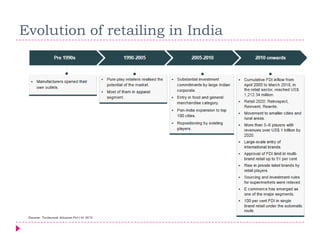
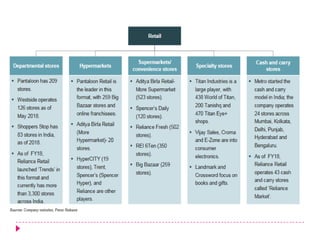
Evolution of retailing in India
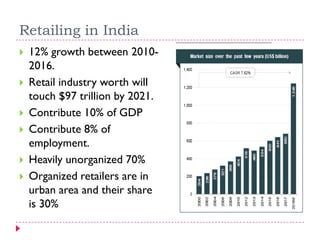
Retailing in India
 12% growth between 2010-
2016.
 Retail industry worth will
touch $97 trillion by 2021.
 Contribute 10% of GDP
 Contribute 8% of
employment.
 Heavily unorganized 70%
 Organized retailers are in
urban area and their share
is 30%
Factors influencing the retailing
 Rising middle class.
 Increasing per capita income
 Changing lifestyles
 Urbanization.
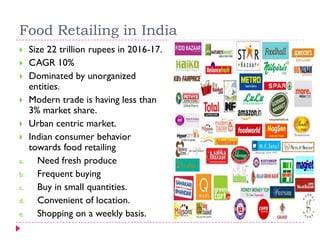
Food Retailing in India
 Size 22 trillion rupees in 2016-17.
 CAGR 10%
 Dominated by unorganized
entities.
 Modern trade is having less than
3% market share.
 Urban centric market.
 Indian consumer behavior
towards food retailing
a. Need fresh produce
b. Frequent buying
c. Buy in small quantities.
d. Convenient of location.
e. Shopping on a weekly basis.
 Customer food habits vary
from region to region.
 Urban consumer wants to
shop all products under
one roof.
 Organized retailers are
procuring directly from
farmers.
 Emergence of private labels
and margin to the retailer.
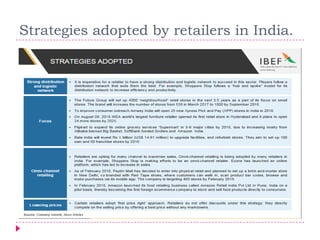
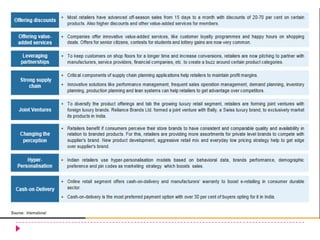
Strategies adopted by retailers in India.
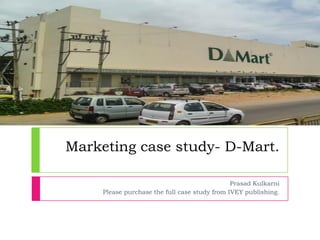
D-Mart
 Owned by Avenue supermarkets limited.
 Started in 2002.
 Started first store in Powai Mumbai.
 Philosophy “ give them what they want”
 D-Mart observations
1. Middle class didn’t have enough money to
shop in the air-conditioned shopping
malls
2. Affluent class also wanted to save the
money.
3. It had conviction that if customer saved
more he will buy more.
4. Savings will brings word of mouth and
need less advertising.
 Product strategies
1. Low cost
2. Daily needs
3. Sell them less than MRP
4. No private labels in the
Major categories.
5. Limited assortment ( Less
variety)
6. Quicker inventory turnover
is the motto of all products.
7. Sell products 6-12% less
than MRP.
 Supplier strategies
1. Pay quicker
2. Develop relationship
3. Negotiate directly from
manufacturers.
4. Source from China.
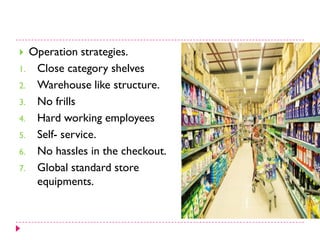
 Operation strategies.
1. Close category shelves
2. Warehouse like structure.
3. No frills
4. Hard working employees
5. Self- service.
6. No hassles in the checkout.
7. Global standard store
equipments.
 D- Mart believes in Hyper market structure
 No retail outlets in Shopping malls.
 Restricted them shelves to western India and south India.
 Most of the new stores opened where already they have
75% of the stores.
 D-mart is highly specific on locations . It helped them to
save cost of real-estate.
 The company owned the land or taken on lease for 30
years.
 They are in the suburban areas to keep the cost low.
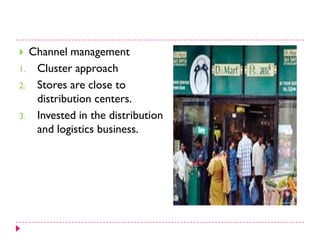
 Channel management
1. Cluster approach
2. Stores are close to
distribution centers.
3. Invested in the distribution
and logistics business.
Competitors
 Future bazaar
expansion by acquiring
nilgiris’ and Heritage.
 More expansion
 Amazon groceries
 Bigbasket.com
 Grofers.
 Trent.
Possible issues
 Shareholders will pressure
to expand.
 Changing regional to
national needs different
procurement strategies.
 Regional and local player
competition.
 Facing large online players.

Marketing case study d-mart

  • 1.
    Marketing case study-D-Mart. Prasad Kulkarni Please purchase the full case study from IVEY publishing.
  • 2.
  • 3.
    Retailing in India 12% growth between 2010- 2016.  Retail industry worth will touch $97 trillion by 2021.  Contribute 10% of GDP  Contribute 8% of employment.  Heavily unorganized 70%  Organized retailers are in urban area and their share is 30%
  • 4.
    Factors influencing theretailing  Rising middle class.  Increasing per capita income  Changing lifestyles  Urbanization.
  • 5.
    Food Retailing inIndia  Size 22 trillion rupees in 2016-17.  CAGR 10%  Dominated by unorganized entities.  Modern trade is having less than 3% market share.  Urban centric market.  Indian consumer behavior towards food retailing a. Need fresh produce b. Frequent buying c. Buy in small quantities. d. Convenient of location. e. Shopping on a weekly basis.
  • 6.
     Customer foodhabits vary from region to region.  Urban consumer wants to shop all products under one roof.  Organized retailers are procuring directly from farmers.  Emergence of private labels and margin to the retailer.
  • 7.
    Strategies adopted byretailers in India.
  • 9.
    D-Mart  Owned byAvenue supermarkets limited.  Started in 2002.  Started first store in Powai Mumbai.  Philosophy “ give them what they want”  D-Mart observations 1. Middle class didn’t have enough money to shop in the air-conditioned shopping malls 2. Affluent class also wanted to save the money. 3. It had conviction that if customer saved more he will buy more. 4. Savings will brings word of mouth and need less advertising.
  • 10.
     Product strategies 1.Low cost 2. Daily needs 3. Sell them less than MRP 4. No private labels in the Major categories. 5. Limited assortment ( Less variety) 6. Quicker inventory turnover is the motto of all products. 7. Sell products 6-12% less than MRP.
  • 11.
     Supplier strategies 1.Pay quicker 2. Develop relationship 3. Negotiate directly from manufacturers. 4. Source from China.
  • 12.
     Operation strategies. 1.Close category shelves 2. Warehouse like structure. 3. No frills 4. Hard working employees 5. Self- service. 6. No hassles in the checkout. 7. Global standard store equipments.
  • 13.
     D- Martbelieves in Hyper market structure  No retail outlets in Shopping malls.  Restricted them shelves to western India and south India.  Most of the new stores opened where already they have 75% of the stores.  D-mart is highly specific on locations . It helped them to save cost of real-estate.  The company owned the land or taken on lease for 30 years.  They are in the suburban areas to keep the cost low.
  • 14.
     Channel management 1.Cluster approach 2. Stores are close to distribution centers. 3. Invested in the distribution and logistics business.
  • 15.
    Competitors  Future bazaar expansionby acquiring nilgiris’ and Heritage.  More expansion  Amazon groceries  Bigbasket.com  Grofers.  Trent.
  • 17.
    Possible issues  Shareholderswill pressure to expand.  Changing regional to national needs different procurement strategies.  Regional and local player competition.  Facing large online players.