1
RESPIRATORY SYSTEM
Dr. ANIKET A. SHILWANT
Associate Professor
Dept. of Sharir Kriya
Noble Ayurved College & Research Institute
Junagadh, Gujarat
Dr.Aniket A Shilwant 2
 Hypoxia
 Asphyxia
 Lung Function Tests
 Regulation of Respiration
Table of Content
Dr.Aniket A Shilwant 3
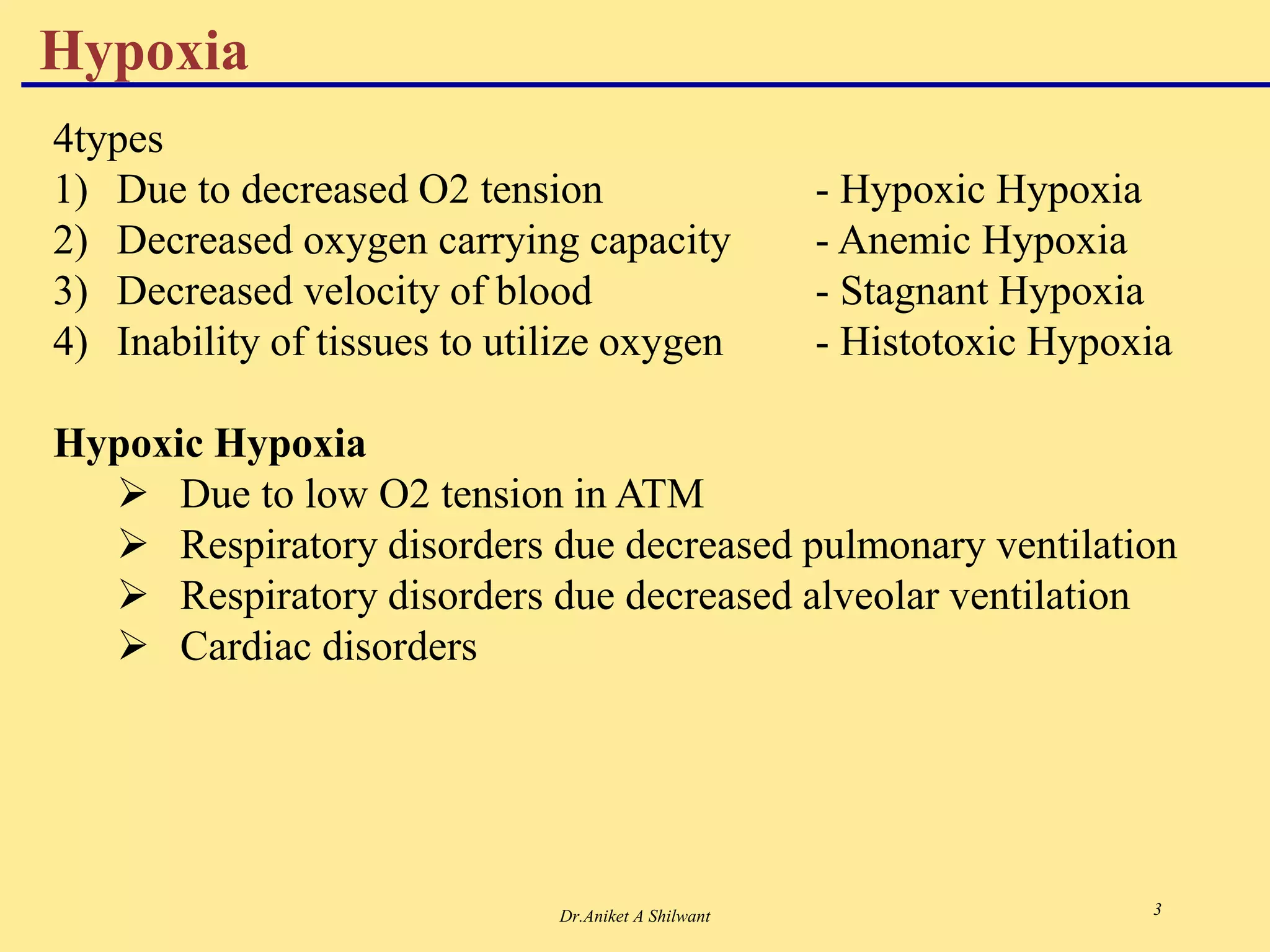
4types
1) Due to decreased O2 tension - Hypoxic Hypoxia
2) Decreased oxygen carrying capacity - Anemic Hypoxia
3) Decreased velocity of blood - Stagnant Hypoxia
4) Inability of tissues to utilize oxygen - Histotoxic Hypoxia
Hypoxic Hypoxia
 Due to low O2 tension in ATM
 Respiratory disorders due decreased pulmonary ventilation
 Respiratory disorders due decreased alveolar ventilation
 Cardiac disorders
Hypoxia
Dr.Aniket A Shilwant 4
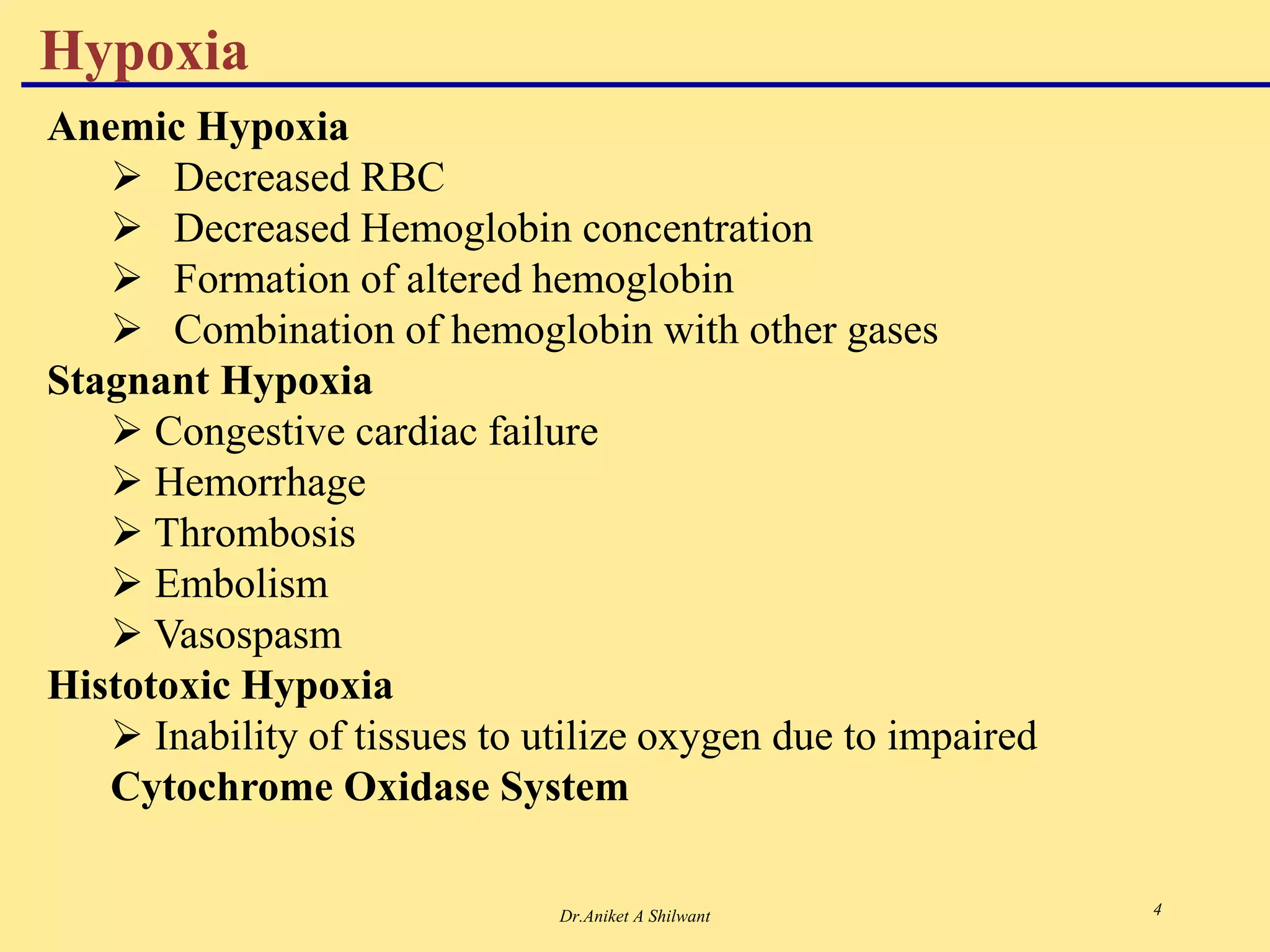
Anemic Hypoxia
 Decreased RBC
 Decreased Hemoglobin concentration
 Formation of altered hemoglobin
 Combination of hemoglobin with other gases
Stagnant Hypoxia
 Congestive cardiac failure
 Hemorrhage
 Thrombosis
 Embolism
 Vasospasm
Histotoxic Hypoxia
 Inability of tissues to utilize oxygen due to impaired
Cytochrome Oxidase System
Hypoxia
Dr.Aniket A Shilwant 5
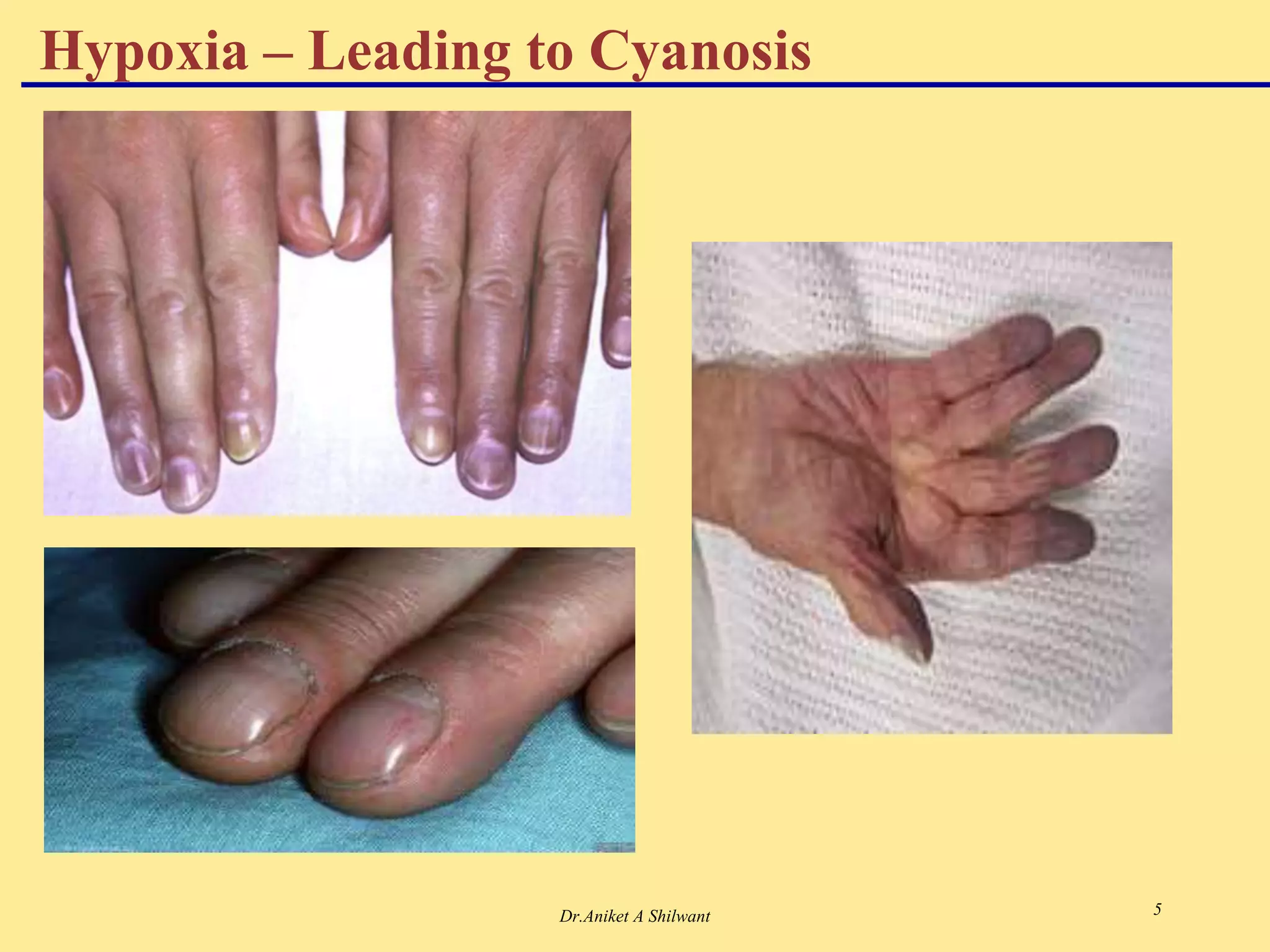
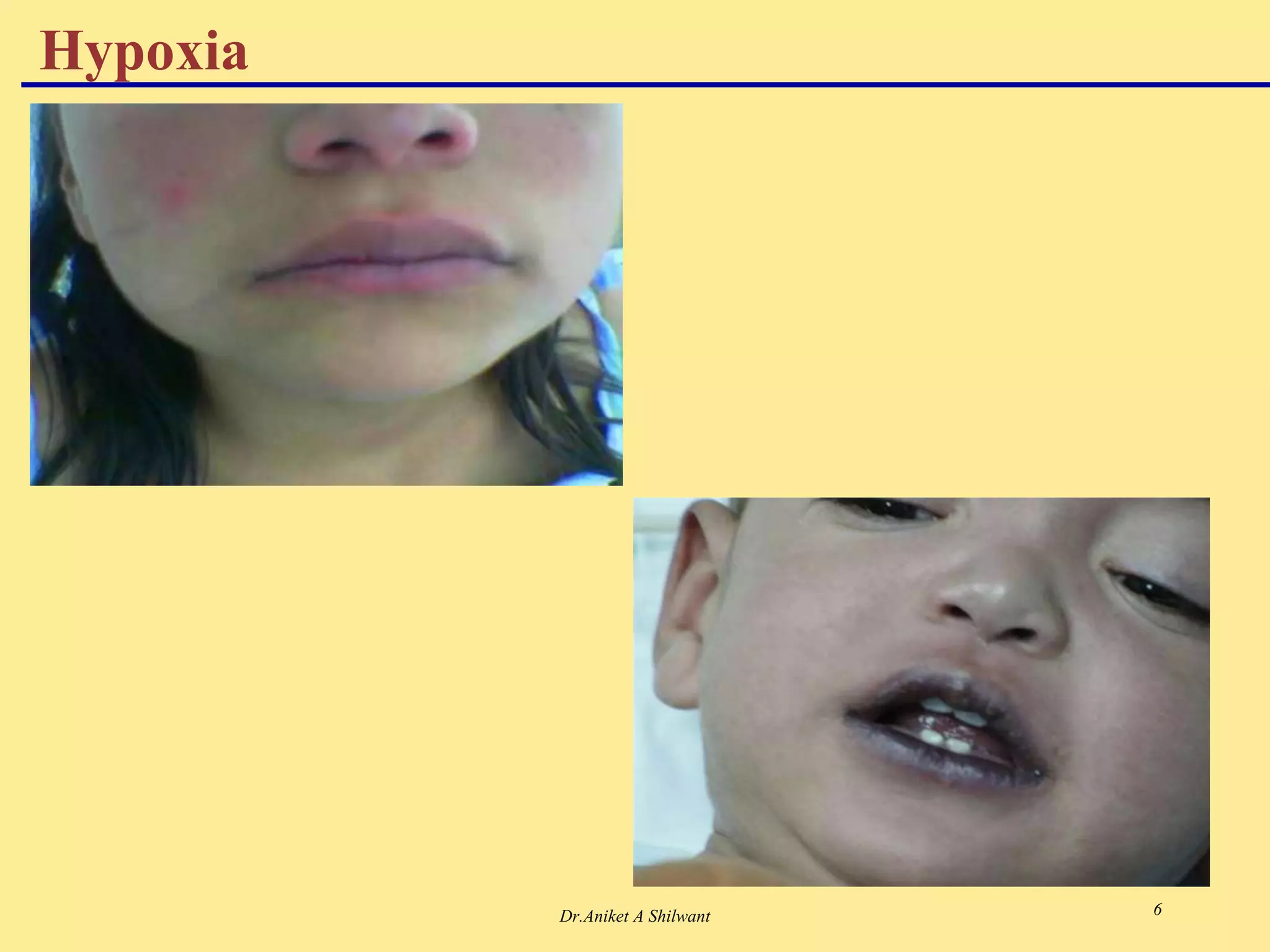
Hypoxia – Leading to Cyanosis
Dr.Aniket A Shilwant 6
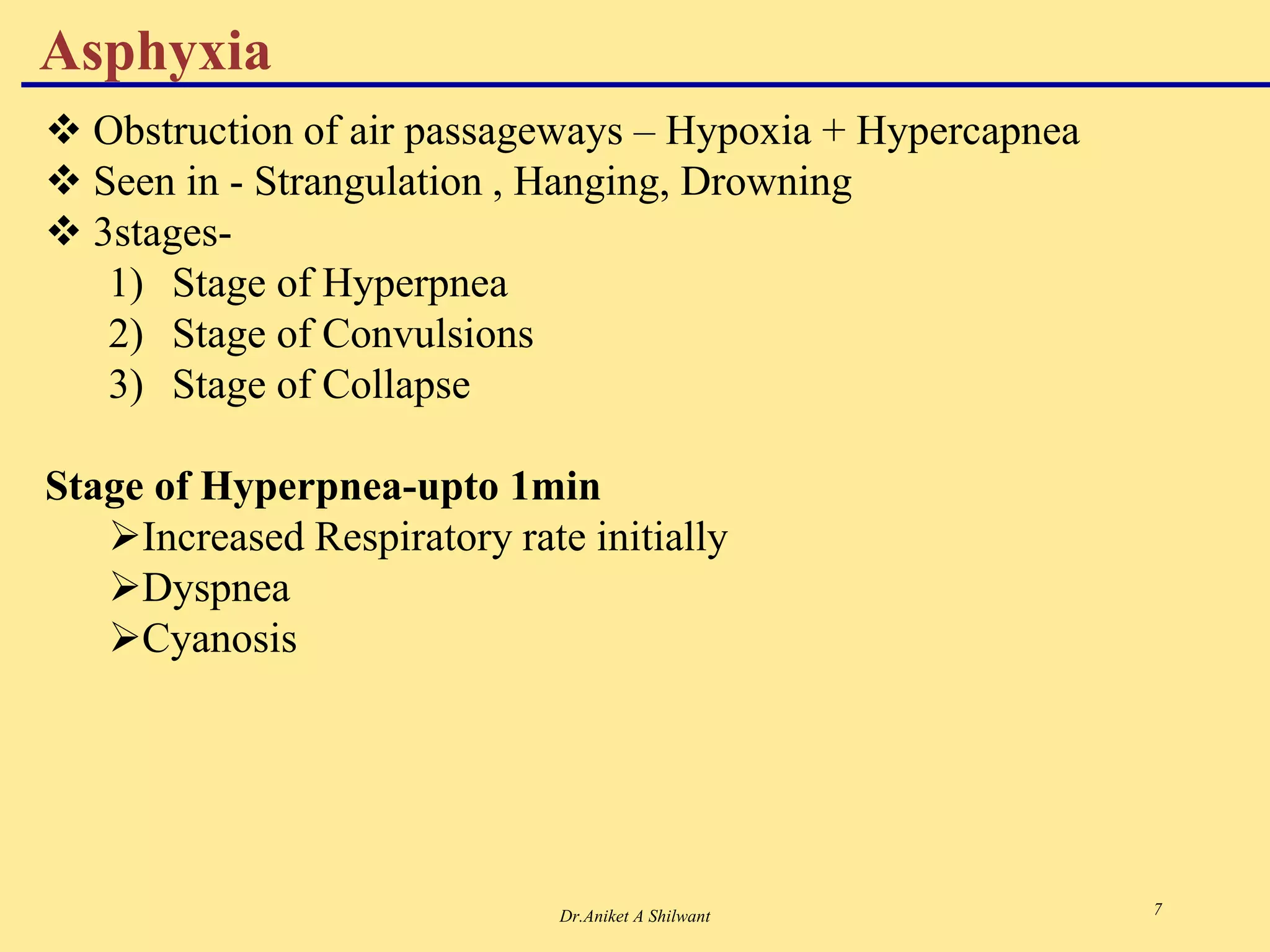
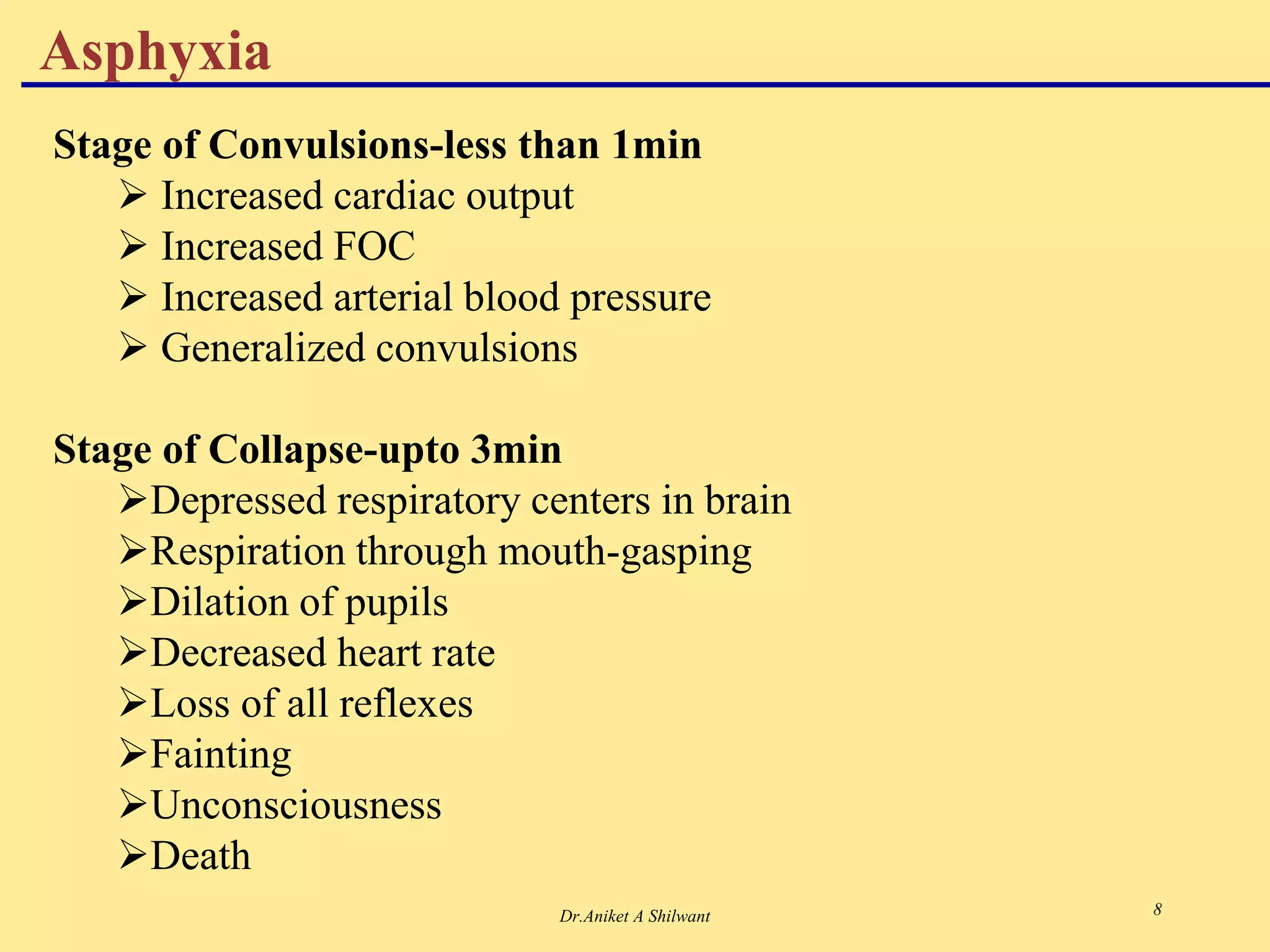
Hypoxia
Dr.Aniket A Shilwant 7
 Obstruction of air passageways – Hypoxia + Hypercapnea
 Seen in - Strangulation , Hanging, Drowning
 3stages-
1) Stage of Hyperpnea
2) Stage of Convulsions
3) Stage of Collapse
Stage of Hyperpnea-upto 1min
Increased Respiratory rate initially
Dyspnea
Cyanosis
Asphyxia
Dr.Aniket A Shilwant 8
Stage of Convulsions-less than 1min
 Increased cardiac output
 Increased FOC
 Increased arterial blood pressure
 Generalized convulsions
Stage of Collapse-upto 3min
Depressed respiratory centers in brain
Respiration through mouth-gasping
Dilation of pupils
Decreased heart rate
Loss of all reflexes
Fainting
Unconsciousness
Death
Asphyxia
Dr.Aniket A Shilwant 9
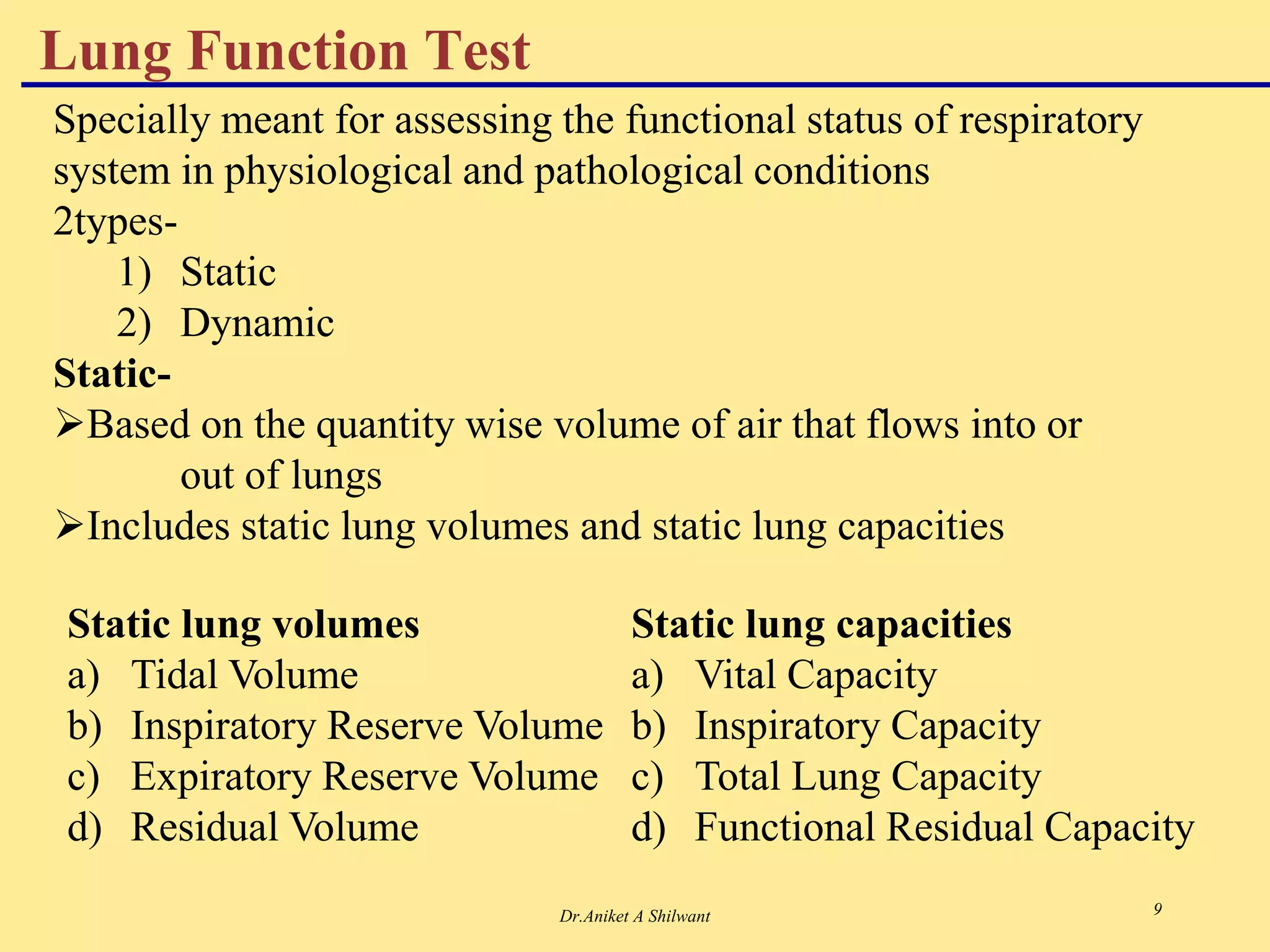
Lung Function Test
Specially meant for assessing the functional status of respiratory
system in physiological and pathological conditions
2types-
1) Static
2) Dynamic
Static-
Based on the quantity wise volume of air that flows into or
out of lungs
Includes static lung volumes and static lung capacities
Static lung volumes
a) Tidal Volume
b) Inspiratory Reserve Volume
c) Expiratory Reserve Volume
d) Residual Volume
Static lung capacities
a) Vital Capacity
b) Inspiratory Capacity
c) Total Lung Capacity
d) Functional Residual Capacity
Dr.Aniket A Shilwant 10
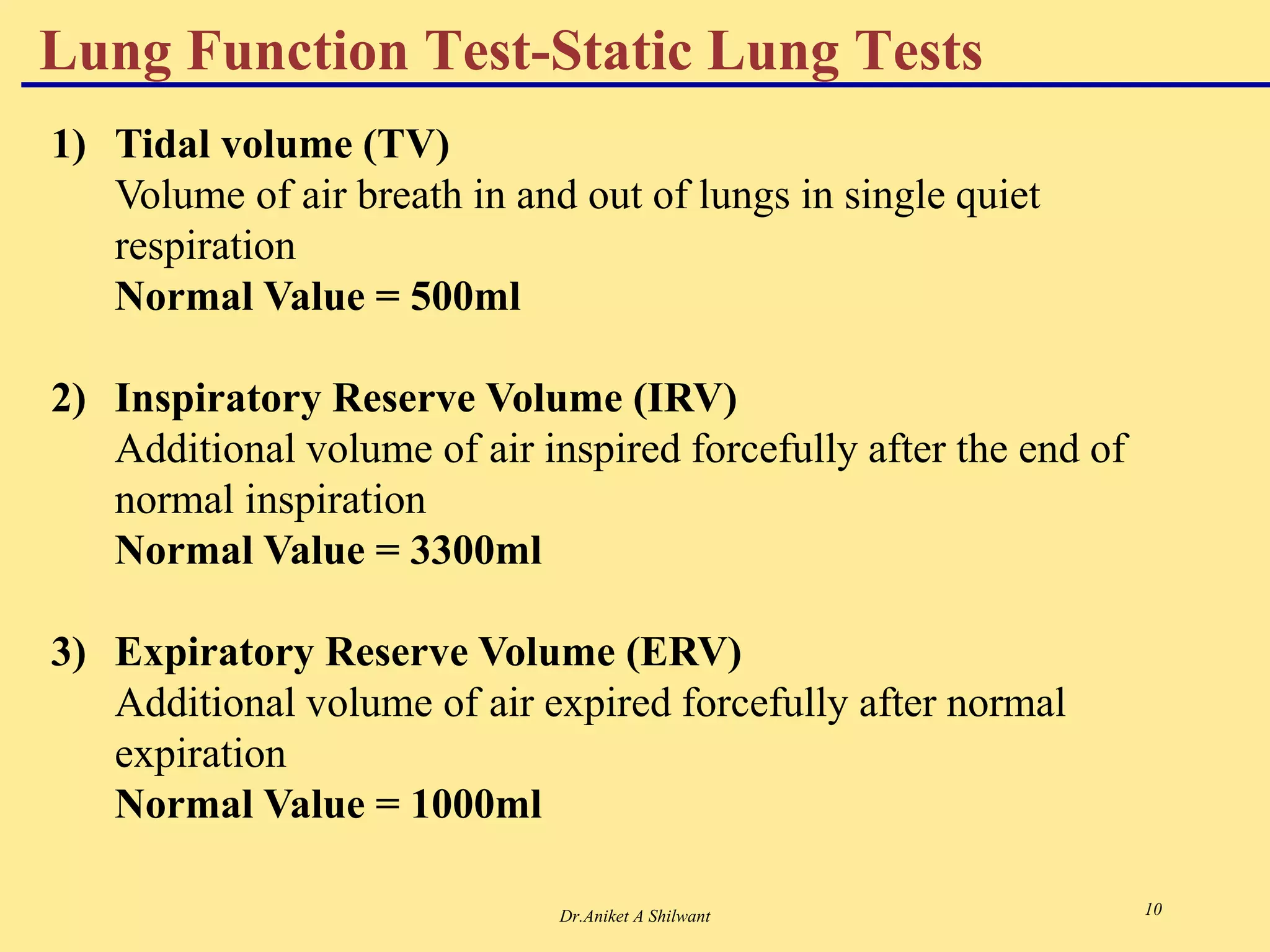
1) Tidal volume (TV)
Volume of air breath in and out of lungs in single quiet
respiration
Normal Value = 500ml
2) Inspiratory Reserve Volume (IRV)
Additional volume of air inspired forcefully after the end of
normal inspiration
Normal Value = 3300ml
3) Expiratory Reserve Volume (ERV)
Additional volume of air expired forcefully after normal
expiration
Normal Value = 1000ml
Lung Function Test-Static Lung Tests
Dr.Aniket A Shilwant 11
Lung Function Test-Static Lung Tests
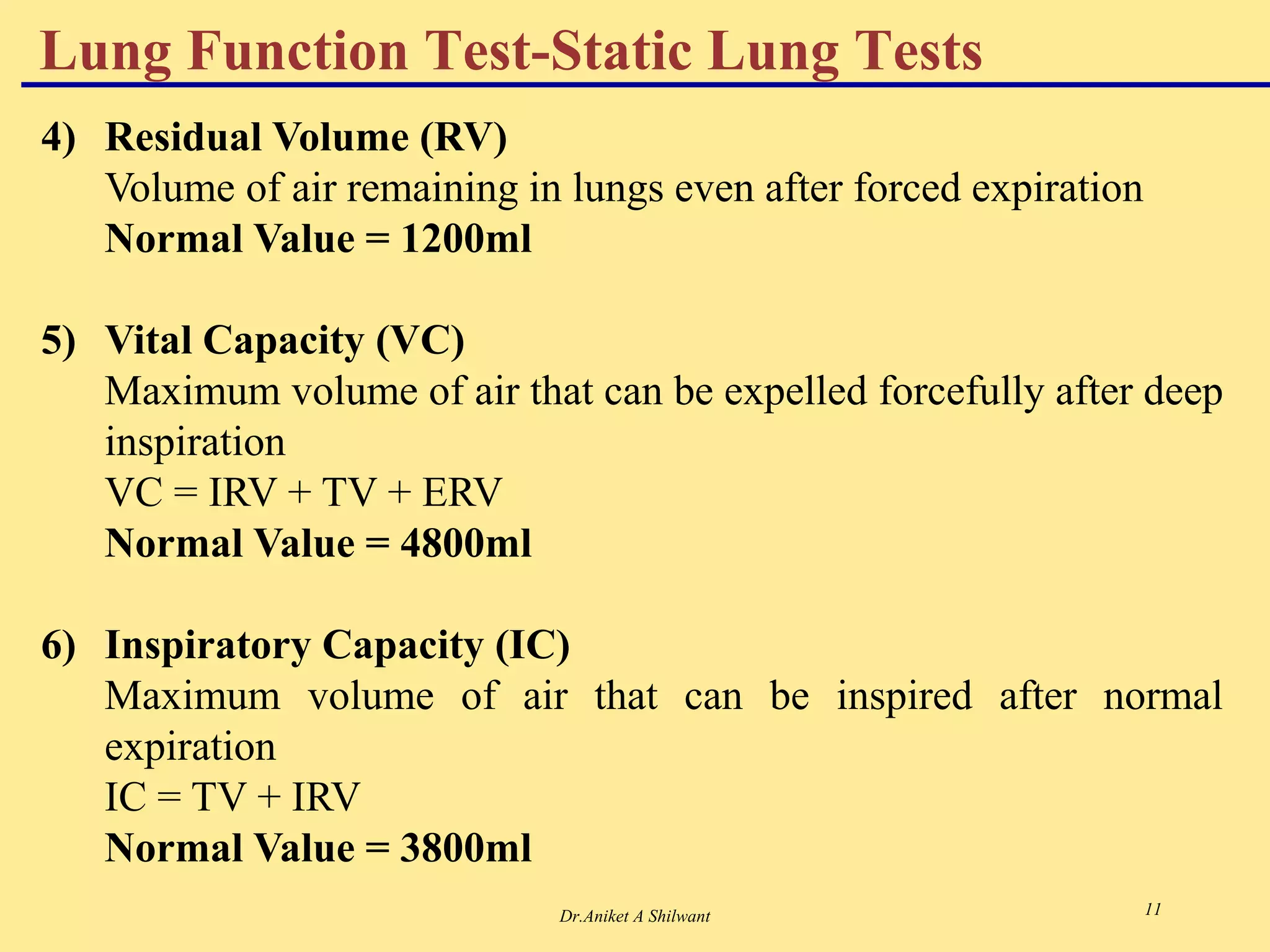
4) Residual Volume (RV)
Volume of air remaining in lungs even after forced expiration
Normal Value = 1200ml
5) Vital Capacity (VC)
Maximum volume of air that can be expelled forcefully after deep
inspiration
VC = IRV + TV + ERV
Normal Value = 4800ml
6) Inspiratory Capacity (IC)
Maximum volume of air that can be inspired after normal
expiration
IC = TV + IRV
Normal Value = 3800ml
Dr.Aniket A Shilwant 12
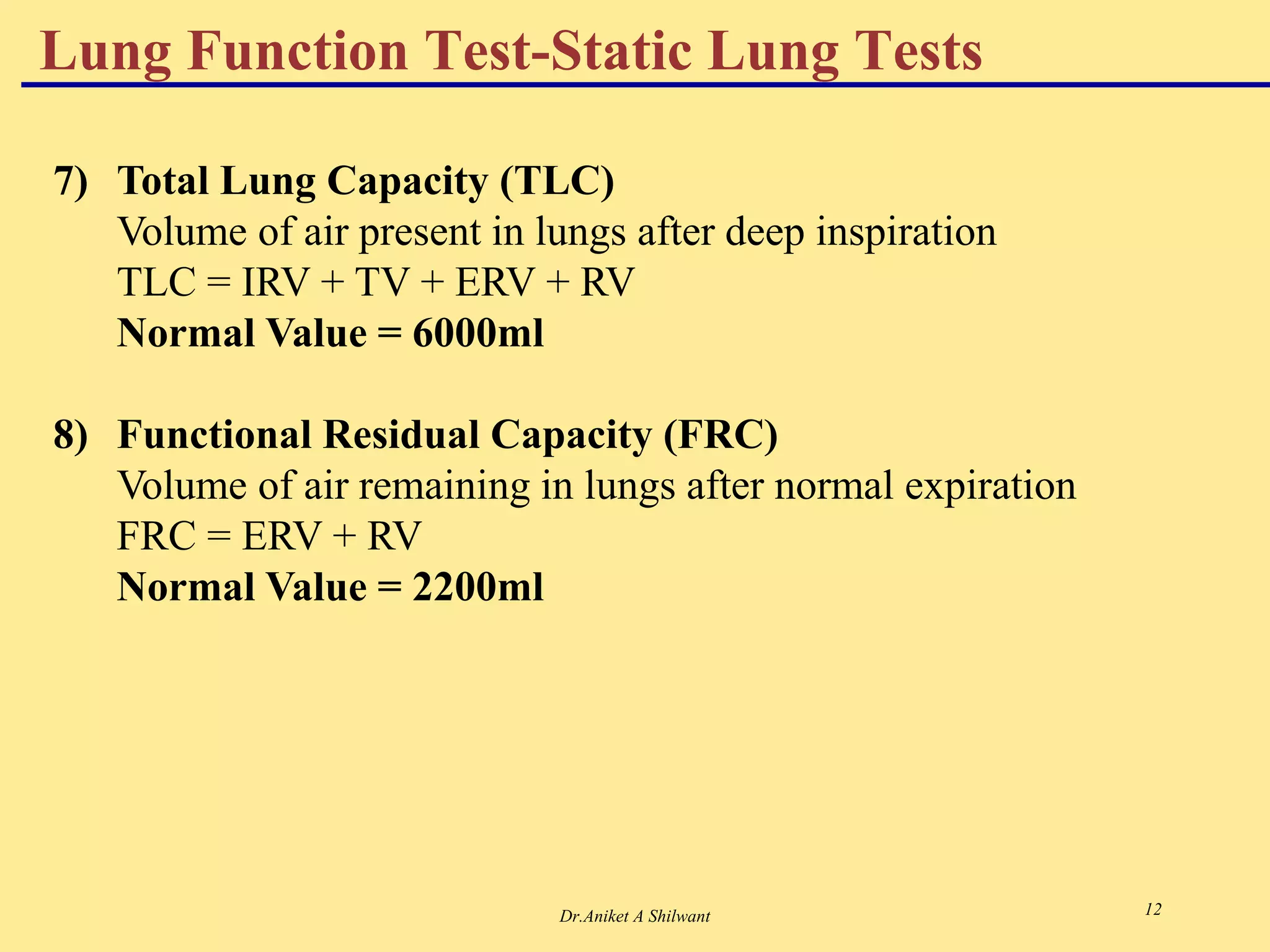
7) Total Lung Capacity (TLC)
Volume of air present in lungs after deep inspiration
TLC = IRV + TV + ERV + RV
Normal Value = 6000ml
8) Functional Residual Capacity (FRC)
Volume of air remaining in lungs after normal expiration
FRC = ERV + RV
Normal Value = 2200ml
Lung Function Test-Static Lung Tests
Dr.Aniket A Shilwant 13
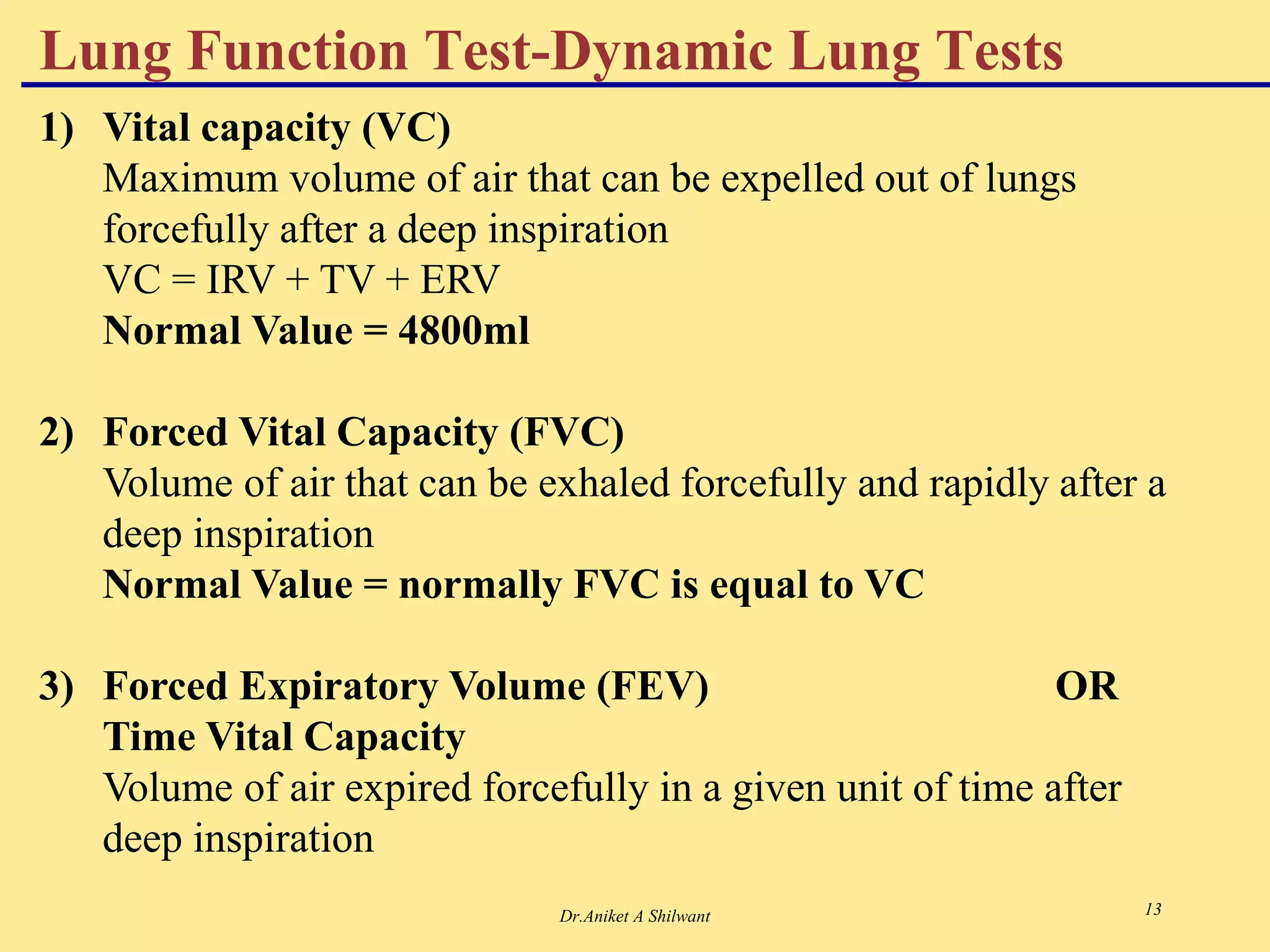
1) Vital capacity (VC)
Maximum volume of air that can be expelled out of lungs
forcefully after a deep inspiration
VC = IRV + TV + ERV
Normal Value = 4800ml
2) Forced Vital Capacity (FVC)
Volume of air that can be exhaled forcefully and rapidly after a
deep inspiration
Normal Value = normally FVC is equal to VC
3) Forced Expiratory Volume (FEV) OR
Time Vital Capacity
Volume of air expired forcefully in a given unit of time after
deep inspiration
Lung Function Test-Dynamic Lung Tests
Dr.Aniket A Shilwant 14
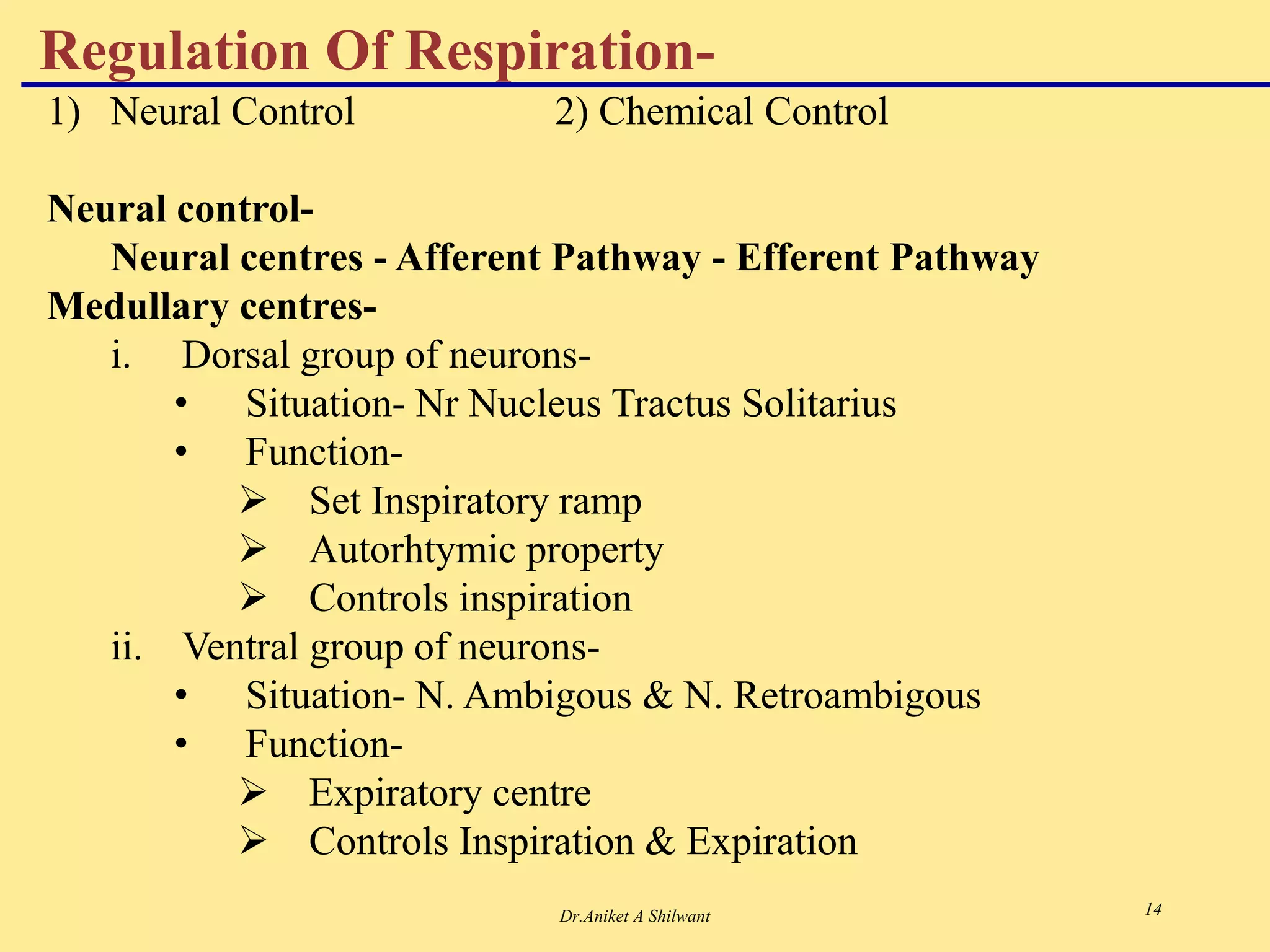
1) Neural Control 2) Chemical Control
Neural control-
Neural centres - Afferent Pathway - Efferent Pathway
Medullary centres-
i. Dorsal group of neurons-
• Situation- Nr Nucleus Tractus Solitarius
• Function-
 Set Inspiratory ramp
 Autorhtymic property
 Controls inspiration
ii. Ventral group of neurons-
• Situation- N. Ambigous & N. Retroambigous
• Function-
 Expiratory centre
 Controls Inspiration & Expiration
Regulation Of Respiration-
Dr.Aniket A Shilwant 15
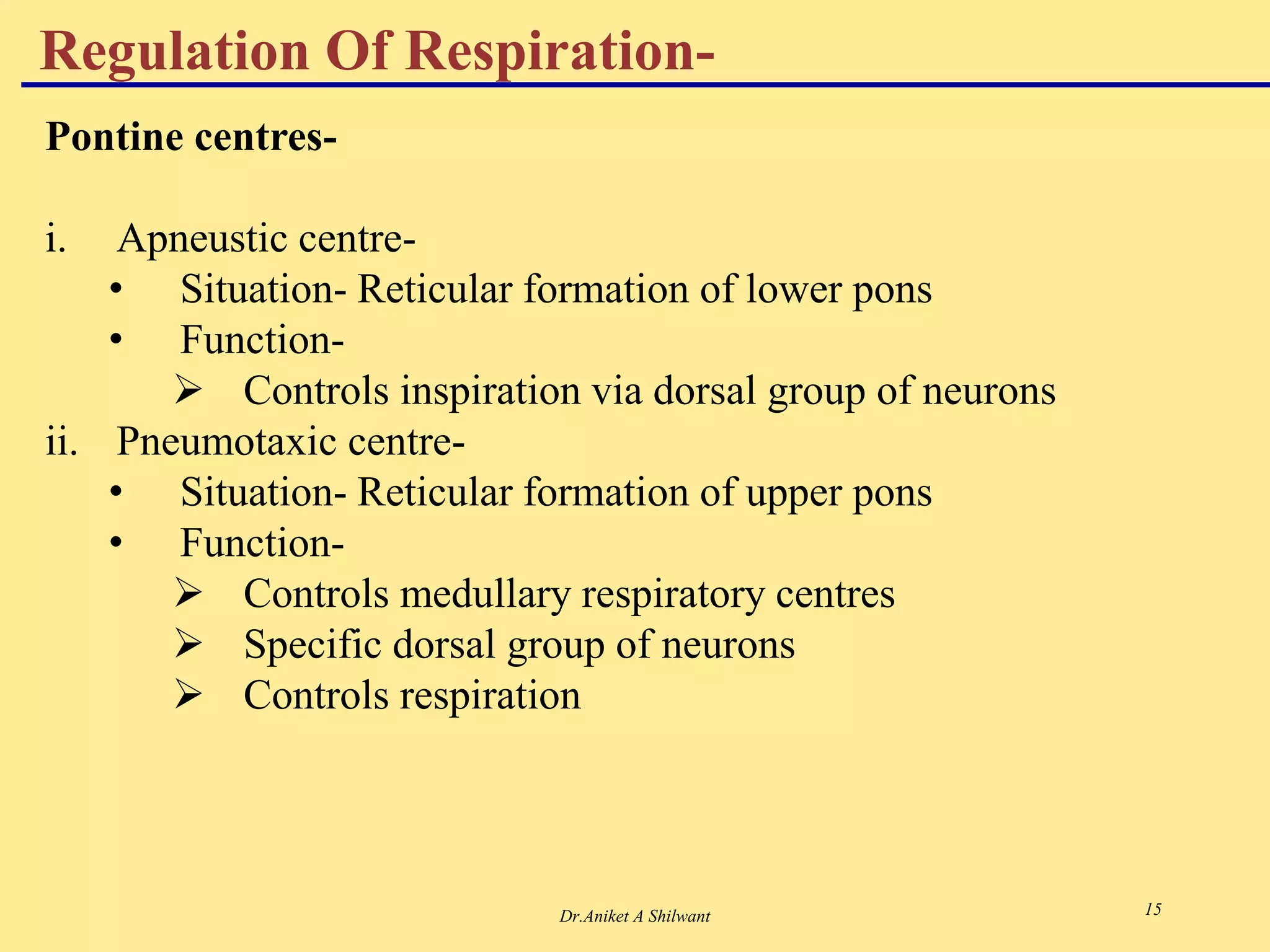
Pontine centres-
i. Apneustic centre-
• Situation- Reticular formation of lower pons
• Function-
 Controls inspiration via dorsal group of neurons
ii. Pneumotaxic centre-
• Situation- Reticular formation of upper pons
• Function-
 Controls medullary respiratory centres
 Specific dorsal group of neurons
 Controls respiration
Regulation Of Respiration-
Dr.Aniket A Shilwant 16
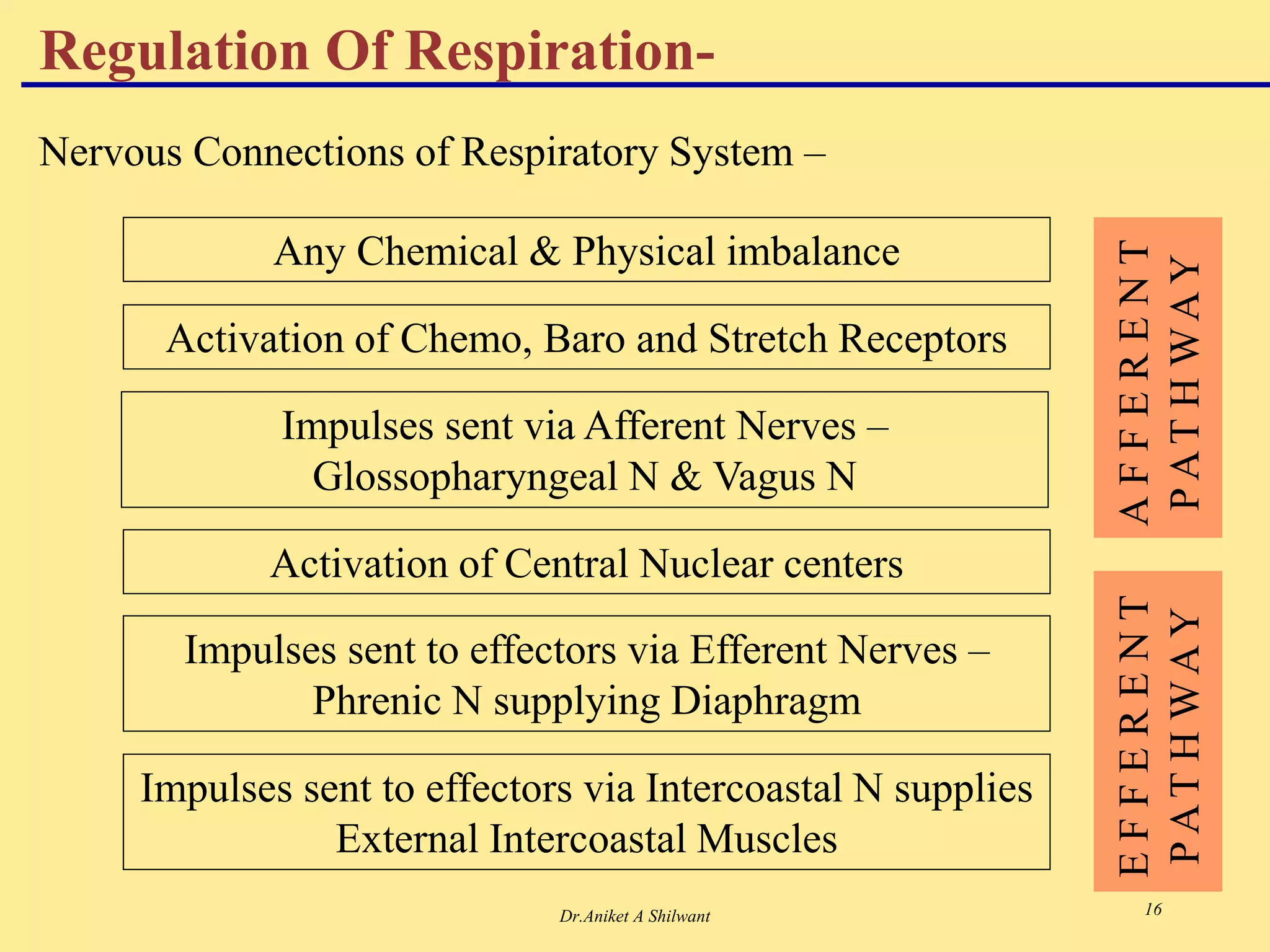
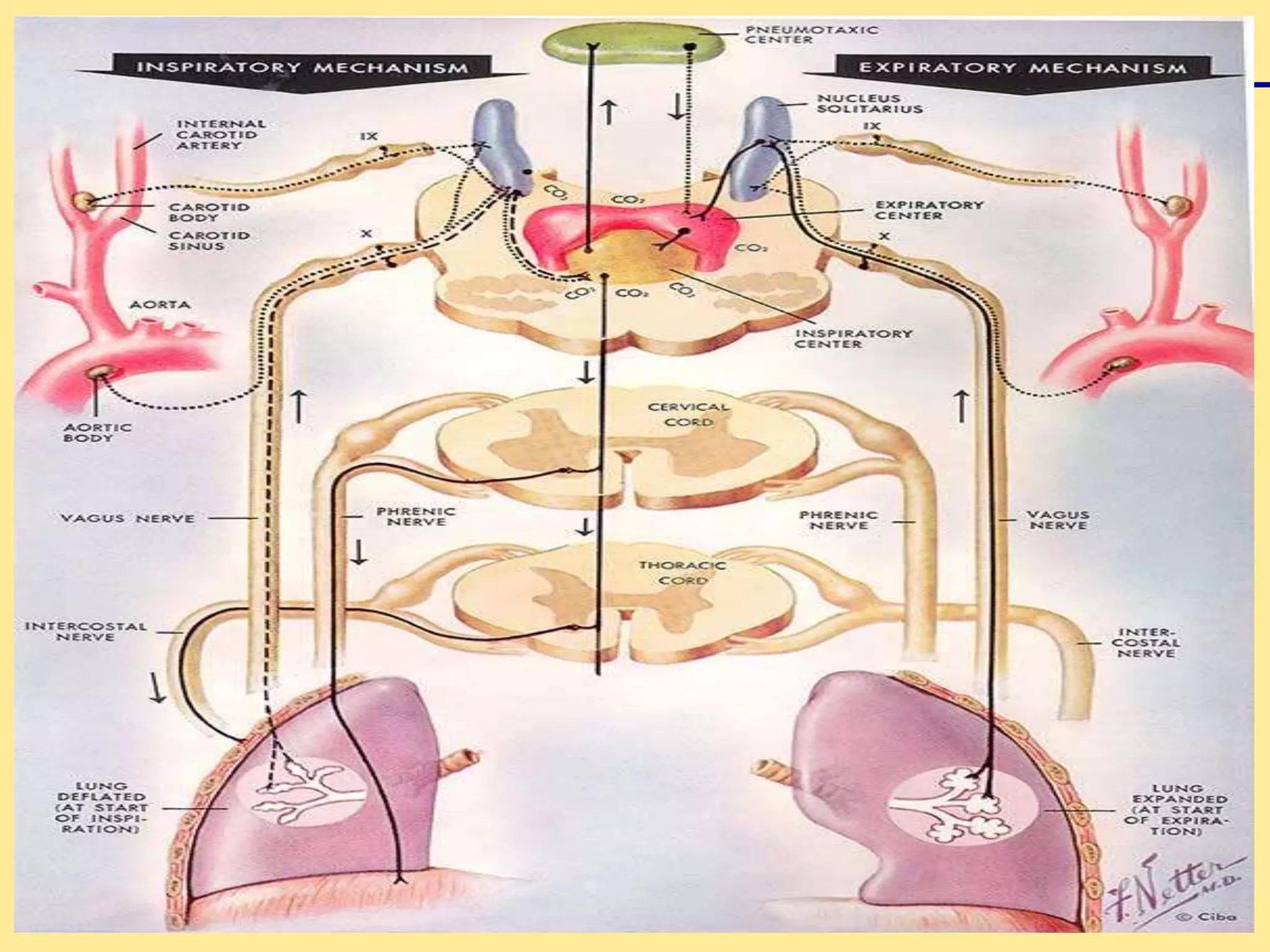
Regulation Of Respiration-
Any Chemical & Physical imbalance
Activation of Chemo, Baro and Stretch Receptors
Impulses sent via Afferent Nerves –
Glossopharyngeal N & Vagus N
Activation of Central Nuclear centers
Impulses sent to effectors via Efferent Nerves –
Phrenic N supplying Diaphragm
Impulses sent to effectors via Intercoastal N supplies
External Intercoastal Muscles
A
F
F
E
R
E
N
T
P
A
T
H
W
A
Y
E
F
F
E
R
E
N
T
P
A
T
H
W
A
Y
Nervous Connections of Respiratory System –
Dr.Aniket A Shilwant 17
Regulation Of Respiration-
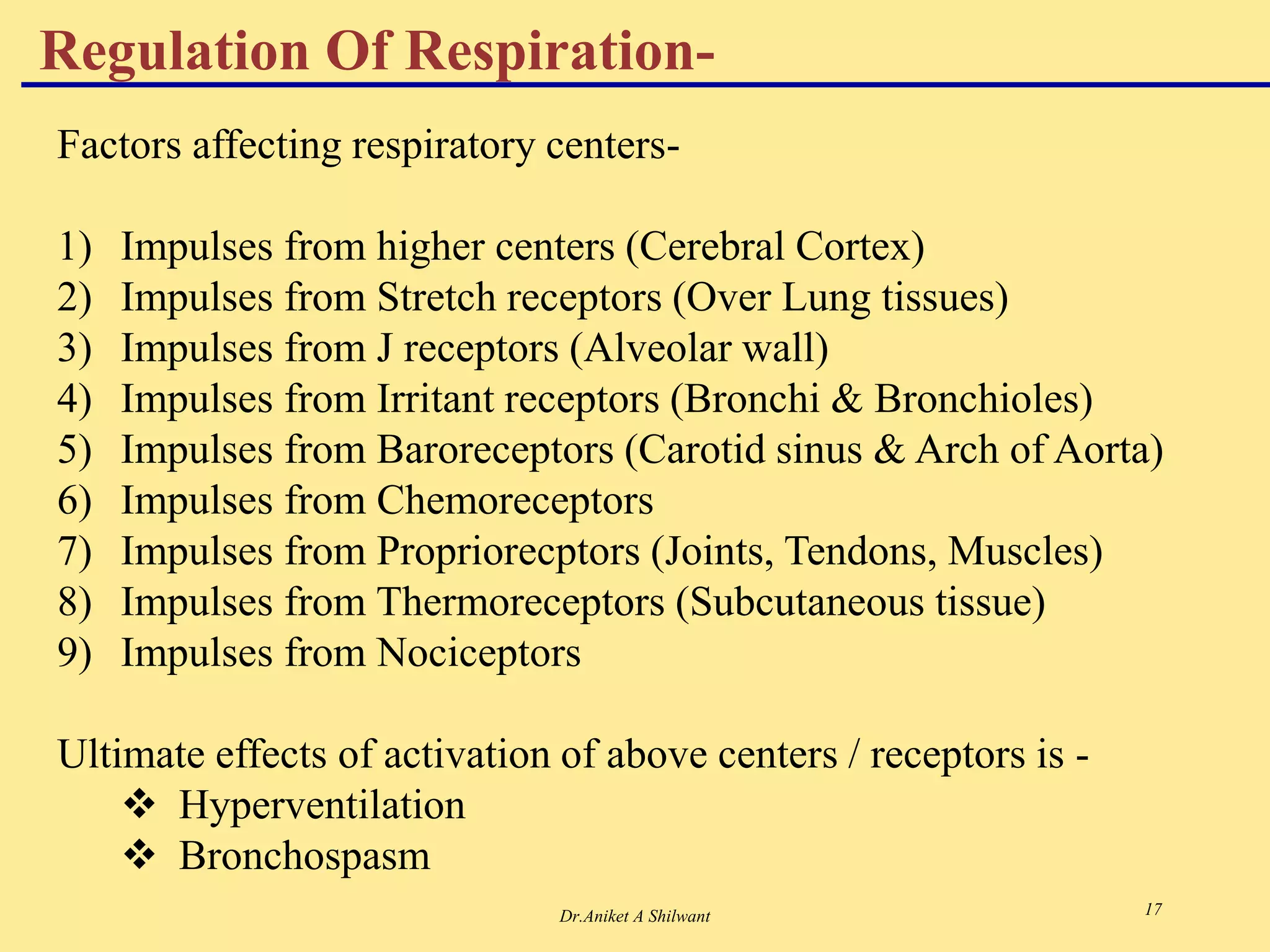
Factors affecting respiratory centers-
1) Impulses from higher centers (Cerebral Cortex)
2) Impulses from Stretch receptors (Over Lung tissues)
3) Impulses from J receptors (Alveolar wall)
4) Impulses from Irritant receptors (Bronchi & Bronchioles)
5) Impulses from Baroreceptors (Carotid sinus & Arch of Aorta)
6) Impulses from Chemoreceptors
7) Impulses from Propriorecptors (Joints, Tendons, Muscles)
8) Impulses from Thermoreceptors (Subcutaneous tissue)
9) Impulses from Nociceptors
Ultimate effects of activation of above centers / receptors is -
 Hyperventilation
 Bronchospasm
Dr.Aniket A Shilwant 18
Regulation Of Respiration-
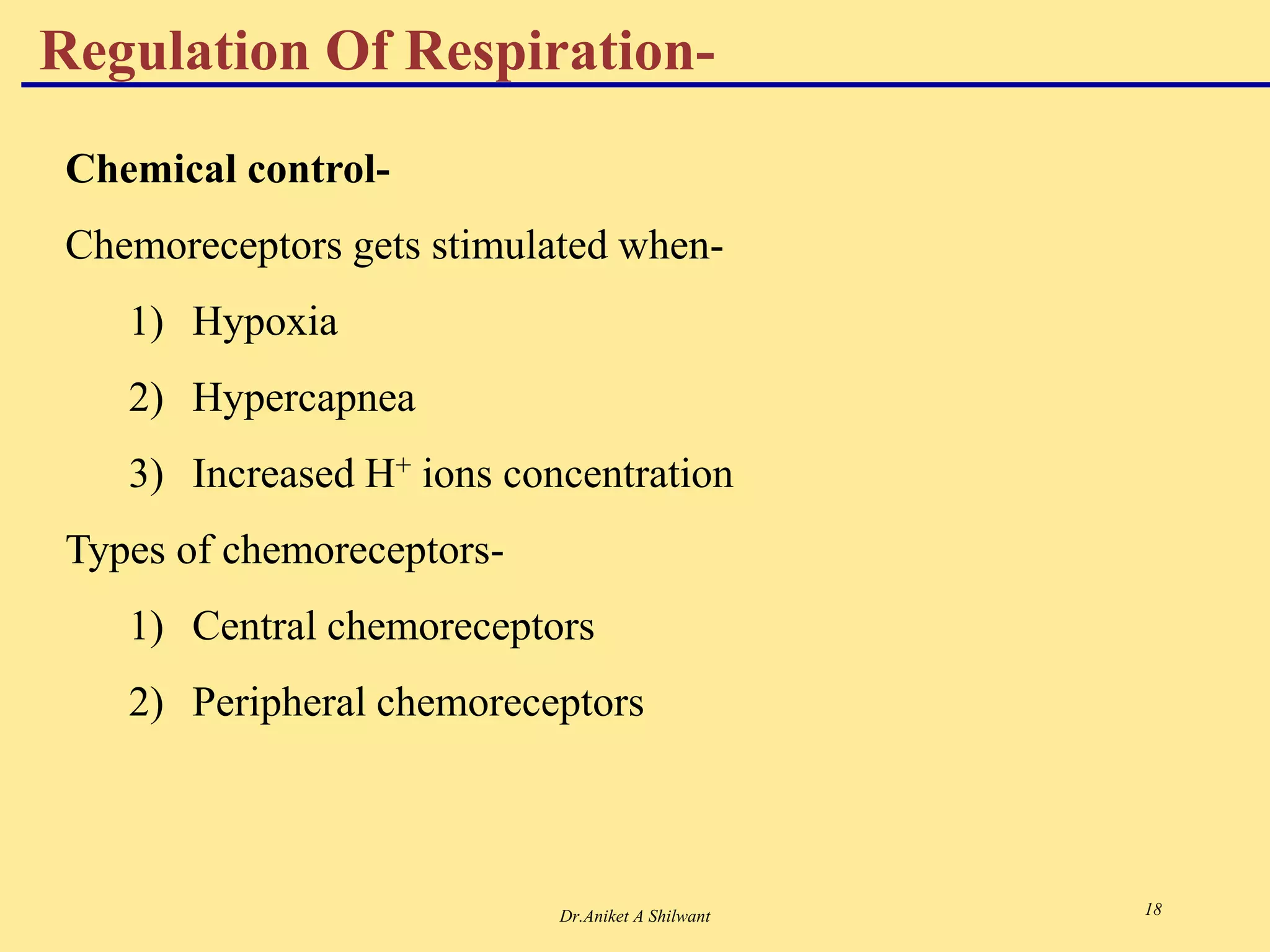
Chemical control-
Chemoreceptors gets stimulated when-
1) Hypoxia
2) Hypercapnea
3) Increased H+ ions concentration
Types of chemoreceptors-
1) Central chemoreceptors
2) Peripheral chemoreceptors
Dr.Aniket A Shilwant 19
Dr.Aniket A Shilwant 20
Dr. ANIKET A. SHILWANT
Associate Professor
Dept. of Sharir Kriya
Noble Ayurved College & Research Institute
Junagadh, Gujarat
ayuraniket18@gmail.com
aniket.shilwant@ngivbt.edu.in
THANK YOU !!!

RESPIRATORY SYSTEM-3.ppt

  • 1.
    1 RESPIRATORY SYSTEM Dr. ANIKETA. SHILWANT Associate Professor Dept. of Sharir Kriya Noble Ayurved College & Research Institute Junagadh, Gujarat
  • 2.
    Dr.Aniket A Shilwant2  Hypoxia  Asphyxia  Lung Function Tests  Regulation of Respiration Table of Content
  • 3.
    Dr.Aniket A Shilwant3 4types 1) Due to decreased O2 tension - Hypoxic Hypoxia 2) Decreased oxygen carrying capacity - Anemic Hypoxia 3) Decreased velocity of blood - Stagnant Hypoxia 4) Inability of tissues to utilize oxygen - Histotoxic Hypoxia Hypoxic Hypoxia  Due to low O2 tension in ATM  Respiratory disorders due decreased pulmonary ventilation  Respiratory disorders due decreased alveolar ventilation  Cardiac disorders Hypoxia
  • 4.
    Dr.Aniket A Shilwant4 Anemic Hypoxia  Decreased RBC  Decreased Hemoglobin concentration  Formation of altered hemoglobin  Combination of hemoglobin with other gases Stagnant Hypoxia  Congestive cardiac failure  Hemorrhage  Thrombosis  Embolism  Vasospasm Histotoxic Hypoxia  Inability of tissues to utilize oxygen due to impaired Cytochrome Oxidase System Hypoxia
  • 5.
    Dr.Aniket A Shilwant5 Hypoxia – Leading to Cyanosis
  • 6.
  • 7.
    Dr.Aniket A Shilwant7  Obstruction of air passageways – Hypoxia + Hypercapnea  Seen in - Strangulation , Hanging, Drowning  3stages- 1) Stage of Hyperpnea 2) Stage of Convulsions 3) Stage of Collapse Stage of Hyperpnea-upto 1min Increased Respiratory rate initially Dyspnea Cyanosis Asphyxia
  • 8.
    Dr.Aniket A Shilwant8 Stage of Convulsions-less than 1min  Increased cardiac output  Increased FOC  Increased arterial blood pressure  Generalized convulsions Stage of Collapse-upto 3min Depressed respiratory centers in brain Respiration through mouth-gasping Dilation of pupils Decreased heart rate Loss of all reflexes Fainting Unconsciousness Death Asphyxia
  • 9.
    Dr.Aniket A Shilwant9 Lung Function Test Specially meant for assessing the functional status of respiratory system in physiological and pathological conditions 2types- 1) Static 2) Dynamic Static- Based on the quantity wise volume of air that flows into or out of lungs Includes static lung volumes and static lung capacities Static lung volumes a) Tidal Volume b) Inspiratory Reserve Volume c) Expiratory Reserve Volume d) Residual Volume Static lung capacities a) Vital Capacity b) Inspiratory Capacity c) Total Lung Capacity d) Functional Residual Capacity
  • 10.
    Dr.Aniket A Shilwant10 1) Tidal volume (TV) Volume of air breath in and out of lungs in single quiet respiration Normal Value = 500ml 2) Inspiratory Reserve Volume (IRV) Additional volume of air inspired forcefully after the end of normal inspiration Normal Value = 3300ml 3) Expiratory Reserve Volume (ERV) Additional volume of air expired forcefully after normal expiration Normal Value = 1000ml Lung Function Test-Static Lung Tests
  • 11.
    Dr.Aniket A Shilwant11 Lung Function Test-Static Lung Tests 4) Residual Volume (RV) Volume of air remaining in lungs even after forced expiration Normal Value = 1200ml 5) Vital Capacity (VC) Maximum volume of air that can be expelled forcefully after deep inspiration VC = IRV + TV + ERV Normal Value = 4800ml 6) Inspiratory Capacity (IC) Maximum volume of air that can be inspired after normal expiration IC = TV + IRV Normal Value = 3800ml
  • 12.
    Dr.Aniket A Shilwant12 7) Total Lung Capacity (TLC) Volume of air present in lungs after deep inspiration TLC = IRV + TV + ERV + RV Normal Value = 6000ml 8) Functional Residual Capacity (FRC) Volume of air remaining in lungs after normal expiration FRC = ERV + RV Normal Value = 2200ml Lung Function Test-Static Lung Tests
  • 13.
    Dr.Aniket A Shilwant13 1) Vital capacity (VC) Maximum volume of air that can be expelled out of lungs forcefully after a deep inspiration VC = IRV + TV + ERV Normal Value = 4800ml 2) Forced Vital Capacity (FVC) Volume of air that can be exhaled forcefully and rapidly after a deep inspiration Normal Value = normally FVC is equal to VC 3) Forced Expiratory Volume (FEV) OR Time Vital Capacity Volume of air expired forcefully in a given unit of time after deep inspiration Lung Function Test-Dynamic Lung Tests
  • 14.
    Dr.Aniket A Shilwant14 1) Neural Control 2) Chemical Control Neural control- Neural centres - Afferent Pathway - Efferent Pathway Medullary centres- i. Dorsal group of neurons- • Situation- Nr Nucleus Tractus Solitarius • Function-  Set Inspiratory ramp  Autorhtymic property  Controls inspiration ii. Ventral group of neurons- • Situation- N. Ambigous & N. Retroambigous • Function-  Expiratory centre  Controls Inspiration & Expiration Regulation Of Respiration-
  • 15.
    Dr.Aniket A Shilwant15 Pontine centres- i. Apneustic centre- • Situation- Reticular formation of lower pons • Function-  Controls inspiration via dorsal group of neurons ii. Pneumotaxic centre- • Situation- Reticular formation of upper pons • Function-  Controls medullary respiratory centres  Specific dorsal group of neurons  Controls respiration Regulation Of Respiration-
  • 16.
    Dr.Aniket A Shilwant16 Regulation Of Respiration- Any Chemical & Physical imbalance Activation of Chemo, Baro and Stretch Receptors Impulses sent via Afferent Nerves – Glossopharyngeal N & Vagus N Activation of Central Nuclear centers Impulses sent to effectors via Efferent Nerves – Phrenic N supplying Diaphragm Impulses sent to effectors via Intercoastal N supplies External Intercoastal Muscles A F F E R E N T P A T H W A Y E F F E R E N T P A T H W A Y Nervous Connections of Respiratory System –
  • 17.
    Dr.Aniket A Shilwant17 Regulation Of Respiration- Factors affecting respiratory centers- 1) Impulses from higher centers (Cerebral Cortex) 2) Impulses from Stretch receptors (Over Lung tissues) 3) Impulses from J receptors (Alveolar wall) 4) Impulses from Irritant receptors (Bronchi & Bronchioles) 5) Impulses from Baroreceptors (Carotid sinus & Arch of Aorta) 6) Impulses from Chemoreceptors 7) Impulses from Propriorecptors (Joints, Tendons, Muscles) 8) Impulses from Thermoreceptors (Subcutaneous tissue) 9) Impulses from Nociceptors Ultimate effects of activation of above centers / receptors is -  Hyperventilation  Bronchospasm
  • 18.
    Dr.Aniket A Shilwant18 Regulation Of Respiration- Chemical control- Chemoreceptors gets stimulated when- 1) Hypoxia 2) Hypercapnea 3) Increased H+ ions concentration Types of chemoreceptors- 1) Central chemoreceptors 2) Peripheral chemoreceptors
  • 19.
  • 20.
    Dr.Aniket A Shilwant20 Dr. ANIKET A. SHILWANT Associate Professor Dept. of Sharir Kriya Noble Ayurved College & Research Institute Junagadh, Gujarat ayuraniket18@gmail.com aniket.shilwant@ngivbt.edu.in THANK YOU !!!

Editor's Notes