
KAPHA DOSHA BHEDA
D r. A n i k e t A n i l S h i l w a n t
BAMS, MD (Ayurveda Physiology)
ayuraniket18@gmail.com
TABLE OF CONTENTS
1 . AVA L A M B A K A K A P H A
2 . K L E D A K A K A P H A
3 . B O D H A K K A P H A
4 . TA R PA K A K A P H A
5 . S H L E S H A K K A P H A
AVALAMBAKA KAPHA
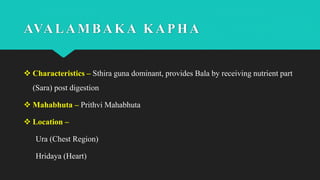
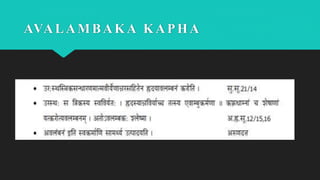
 Characteristics – Sthira guna dominant, provides Bala by receiving nutrient part
(Sara) post digestion
 Mahabhuta – Prithvi Mahabhuta
 Location –
Ura (Chest Region)
Hridaya (Heart)
AVALAMBAKA KAPHA
FUNCTIONS
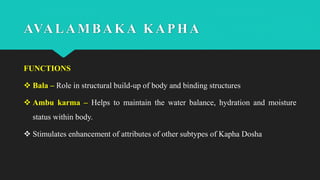
 Bala – Role in structural build-up of body and binding structures
 Ambu karma – Helps to maintain the water balance, hydration and moisture
status within body.
 Stimulates enhancement of attributes of other subtypes of Kapha Dosha
AVALAMBAKA KAPHA
M O D E R N P H Y S I O L O G I C A L U N D E R S T A N D I N G O F
F U N C T I O N S
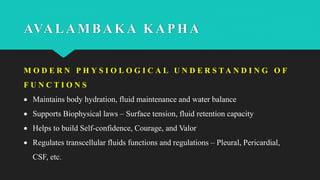
 Maintains body hydration, fluid maintenance and water balance
 Supports Biophysical laws – Surface tension, fluid retention capacity
 Helps to build Self-confidence, Courage, and Valor
 Regulates transcellular fluids functions and regulations – Pleural, Pericardial,
CSF, etc.
AVALAMBAKA KAPHA
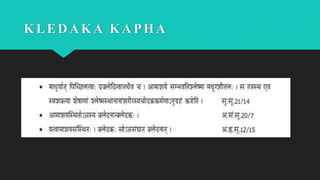
 Characteristics – Madhur Rasa Pradhan, Snigdha guna dominant
 Mahabhuta – Jala Mahabhuta
 Location – Amashaya – Upper part of Stomach including fundus and body with all
mucous and gastric glands along with secretions
 Functions –
 Anna Kledana – Helps to make the food bolus moist
 Supports to circulate the digestive enzymes and juices over the ingested food bolus.
KLEDAKA KAPHA
KLEDAKA KAPHA
M O D E R N P H Y S I O L O G I C A L U N D E R S T A N D I N G O F
F U N C T I O N S
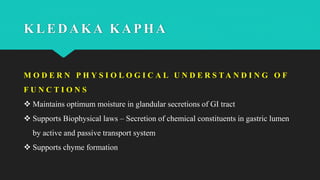
 Maintains optimum moisture in glandular secretions of GI tract
 Supports Biophysical laws – Secretion of chemical constituents in gastric lumen
by active and passive transport system
 Supports chyme formation
KLEDAKA KAPHA
BODHAKA KAPHA
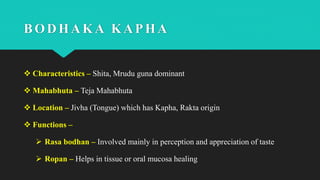
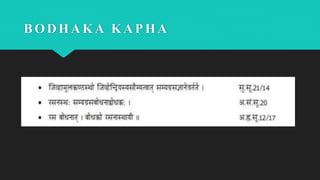
 Characteristics – Shita, Mrudu guna dominant
 Mahabhuta – Teja Mahabhuta
 Location – Jivha (Tongue) which has Kapha, Rakta origin
 Functions –
 Rasa bodhan – Involved mainly in perception and appreciation of taste
 Ropan – Helps in tissue or oral mucosa healing
BODHAKA KAPHA
BODHAKA KAPHA
M O D E R N P H Y S I O L O G I C A L U N D E R S T A N D I N G O F
F U N C T I O N S
 Maintain optimum glandular secretions of oral cavity
 Facilitates making bolus of ingested food
 Facilitates digestion of carbohydrates
 Other functions attributed to salivary amylase (Ptylin)
 Oral hygiene maintenance
 Prevents conditions like Ageusia, Dry mouth syndrome, etc.
TARPAKA KAPHA
 Characteristics – Snigdha and Guru guna, Indriya related subtype of Kapha
Dosha
 Mahabhuta – Vayu Mahabhuta
 Location – Shira Sansthan (Head along with Nervous system)
 Functions –
 Indriya Tarpan – Smoothness in sensory and motor nuclear centers
functioning
 Pooran – Helps to fill the porous bony cavities
TARPAKA KAPHA
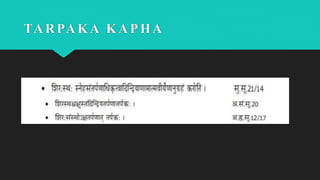
TARPAKA KAPHA
M O D E R N P H Y S I O L O G I C A L U N D E R S T A N D I N G O F
F U N C T I O N S
 Facilitates excitability property of Nervous tissue
 Eases Nerve impulse synaptic transmission process
 Provides optimum nutrition and hydration of Nervous structures
 Prevents Neuro-muscular incoordination symptoms, UMN and LMN disorders,
etc.
SHLESHAKA KAPHA
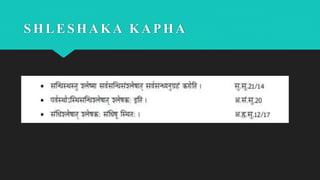
 Characteristics – Shlakshna guna dominant
 Mahabhuta – Akasha Mahabhuta
 Location – Bone Joints
 Functions –
Sandhi Shleshan – Lubrication of bony joints
SHLESHAKA KAPHA
SHLESHAKA KAPHA
M O D E R N P H Y S I O L O G I C A L U N D E R S T A N D I N G O F
F U N C T I O N S
 Provides lubrication and Oleation of bony joints
 Ease of Locomotion
 Free access for range of movements
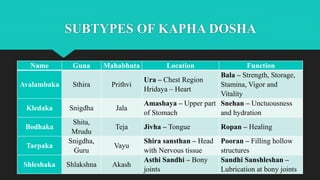
SUBTYPES OF KAPHA DOSHA
Name Guna Mahabhuta Location Function
Avalambaka Sthira Prithvi
Ura – Chest Region
Hridaya – Heart
Bala – Strength, Storage,
Stamina, Vigor and
Vitality
Kledaka Snigdha Jala
Amashaya – Upper part
of Stomach
Snehan – Unctuousness
and hydration
Bodhaka
Shita,
Mrudu
Teja Jivha – Tongue Ropan – Healing
Tarpaka
Snigdha,
Guru
Vayu
Shira sansthan – Head
with Nervous tissue
Pooran – Filling hollow
structures
Shleshaka Shlakshna Akash
Asthi Sandhi – Bony
joints
Sandhi Sanshleshan –
Lubrication at bony joints
Tha nk Yo u !!!
Dr. Aniket A. Shilwant
BAMS, MD (Ayurveda Physiology)
ayuraniket18@gmail.com

KAPHA DOSHA BHEDA.pptx

  • 1.
    KAPHA DOSHA BHEDA Dr. A n i k e t A n i l S h i l w a n t BAMS, MD (Ayurveda Physiology) ayuraniket18@gmail.com
  • 2.
    TABLE OF CONTENTS 1. AVA L A M B A K A K A P H A 2 . K L E D A K A K A P H A 3 . B O D H A K K A P H A 4 . TA R PA K A K A P H A 5 . S H L E S H A K K A P H A
  • 3.
    AVALAMBAKA KAPHA  Characteristics– Sthira guna dominant, provides Bala by receiving nutrient part (Sara) post digestion  Mahabhuta – Prithvi Mahabhuta  Location – Ura (Chest Region) Hridaya (Heart)
  • 4.
  • 5.
    FUNCTIONS  Bala –Role in structural build-up of body and binding structures  Ambu karma – Helps to maintain the water balance, hydration and moisture status within body.  Stimulates enhancement of attributes of other subtypes of Kapha Dosha AVALAMBAKA KAPHA
  • 6.
    M O DE R N P H Y S I O L O G I C A L U N D E R S T A N D I N G O F F U N C T I O N S  Maintains body hydration, fluid maintenance and water balance  Supports Biophysical laws – Surface tension, fluid retention capacity  Helps to build Self-confidence, Courage, and Valor  Regulates transcellular fluids functions and regulations – Pleural, Pericardial, CSF, etc. AVALAMBAKA KAPHA
  • 7.
     Characteristics –Madhur Rasa Pradhan, Snigdha guna dominant  Mahabhuta – Jala Mahabhuta  Location – Amashaya – Upper part of Stomach including fundus and body with all mucous and gastric glands along with secretions  Functions –  Anna Kledana – Helps to make the food bolus moist  Supports to circulate the digestive enzymes and juices over the ingested food bolus. KLEDAKA KAPHA
  • 8.
  • 9.
    M O DE R N P H Y S I O L O G I C A L U N D E R S T A N D I N G O F F U N C T I O N S  Maintains optimum moisture in glandular secretions of GI tract  Supports Biophysical laws – Secretion of chemical constituents in gastric lumen by active and passive transport system  Supports chyme formation KLEDAKA KAPHA
  • 10.
    BODHAKA KAPHA  Characteristics– Shita, Mrudu guna dominant  Mahabhuta – Teja Mahabhuta  Location – Jivha (Tongue) which has Kapha, Rakta origin  Functions –  Rasa bodhan – Involved mainly in perception and appreciation of taste  Ropan – Helps in tissue or oral mucosa healing
  • 11.
  • 12.
    BODHAKA KAPHA M OD E R N P H Y S I O L O G I C A L U N D E R S T A N D I N G O F F U N C T I O N S  Maintain optimum glandular secretions of oral cavity  Facilitates making bolus of ingested food  Facilitates digestion of carbohydrates  Other functions attributed to salivary amylase (Ptylin)  Oral hygiene maintenance  Prevents conditions like Ageusia, Dry mouth syndrome, etc.
  • 13.
    TARPAKA KAPHA  Characteristics– Snigdha and Guru guna, Indriya related subtype of Kapha Dosha  Mahabhuta – Vayu Mahabhuta  Location – Shira Sansthan (Head along with Nervous system)  Functions –  Indriya Tarpan – Smoothness in sensory and motor nuclear centers functioning  Pooran – Helps to fill the porous bony cavities
  • 14.
  • 15.
    TARPAKA KAPHA M OD E R N P H Y S I O L O G I C A L U N D E R S T A N D I N G O F F U N C T I O N S  Facilitates excitability property of Nervous tissue  Eases Nerve impulse synaptic transmission process  Provides optimum nutrition and hydration of Nervous structures  Prevents Neuro-muscular incoordination symptoms, UMN and LMN disorders, etc.
  • 16.
    SHLESHAKA KAPHA  Characteristics– Shlakshna guna dominant  Mahabhuta – Akasha Mahabhuta  Location – Bone Joints  Functions – Sandhi Shleshan – Lubrication of bony joints
  • 17.
  • 18.
    SHLESHAKA KAPHA M OD E R N P H Y S I O L O G I C A L U N D E R S T A N D I N G O F F U N C T I O N S  Provides lubrication and Oleation of bony joints  Ease of Locomotion  Free access for range of movements
  • 19.
    SUBTYPES OF KAPHADOSHA Name Guna Mahabhuta Location Function Avalambaka Sthira Prithvi Ura – Chest Region Hridaya – Heart Bala – Strength, Storage, Stamina, Vigor and Vitality Kledaka Snigdha Jala Amashaya – Upper part of Stomach Snehan – Unctuousness and hydration Bodhaka Shita, Mrudu Teja Jivha – Tongue Ropan – Healing Tarpaka Snigdha, Guru Vayu Shira sansthan – Head with Nervous tissue Pooran – Filling hollow structures Shleshaka Shlakshna Akash Asthi Sandhi – Bony joints Sandhi Sanshleshan – Lubrication at bony joints
  • 20.
    Tha nk You !!! Dr. Aniket A. Shilwant BAMS, MD (Ayurveda Physiology) ayuraniket18@gmail.com