1
RESPIRATORY SYSTEM
Dr. ANIKET A. SHILWANT
Associate Professor
Dept. of Sharir Kriya
Noble Ayurved College & Research Institute
Junagadh, Gujarat
Dr.Aniket A Shilwant 2
Table of Contents
 Mechanics of Respiration
 Exchange of Gases
 Transport of Gases
Dr.Aniket A Shilwant 3
Mechanics of Respiration
Respiration process is assisted by muscles
Muscles involved-2types
1) Primary
2) Accessory
1) Primary muscles- Which actually involve in change of shape
of thoracic cage
2) Accessory muscles-Which assist or support the primary
muscles in their function
Muscles involved -2types
a) Inspiratory
b) Expiratory
i. Inspiratory Primary M
ii. Inspiratory Accessory M
iii. Expiratory Primary M
iv. Expiratory Accessory M
Dr.Aniket A Shilwant 4
Lungs expands with expansion of thoracic cage.
This is supported by –
1) Thoracic lid
2) Upper coastal series
3) Lower coastal series
4) Diaphragm
Thoracic cage expands in –
1) Anteroposterior diameter
2) Transverse diameter
3) Vertical diameter
Mechanics of Respiration
Dr.Aniket A Shilwant 5
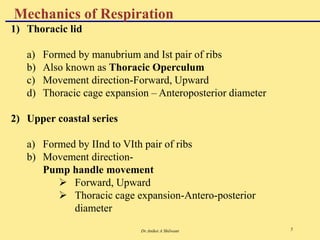
1) Thoracic lid
a) Formed by manubrium and Ist pair of ribs
b) Also known as Thoracic Operculum
c) Movement direction-Forward, Upward
d) Thoracic cage expansion – Anteroposterior diameter
2) Upper coastal series
a) Formed by IInd to VIth pair of ribs
b) Movement direction-
Pump handle movement
 Forward, Upward
 Thoracic cage expansion-Antero-posterior
diameter
Mechanics of Respiration
Dr.Aniket A Shilwant 6
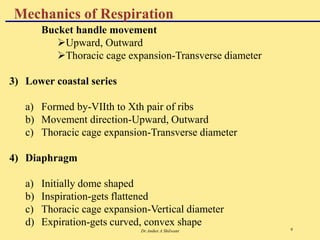
Bucket handle movement
Upward, Outward
Thoracic cage expansion-Transverse diameter
3) Lower coastal series
a) Formed by-VIIth to Xth pair of ribs
b) Movement direction-Upward, Outward
c) Thoracic cage expansion-Transverse diameter
4) Diaphragm
a) Initially dome shaped
b) Inspiration-gets flattened
c) Thoracic cage expansion-Vertical diameter
d) Expiration-gets curved, convex shape
Mechanics of Respiration
Dr.Aniket A Shilwant 7
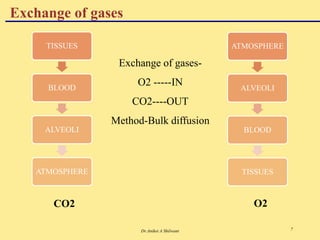
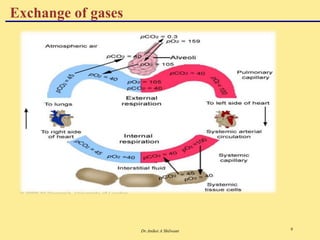
Exchange of gases
Exchange of gases-
O2 -----IN
CO2----OUT
Method-Bulk diffusion
ATMOSPHERE
ALVEOLI
BLOOD
TISSUES
TISSUES
BLOOD
ALVEOLI
ATMOSPHERE
CO2 O2
Dr.Aniket A Shilwant 8
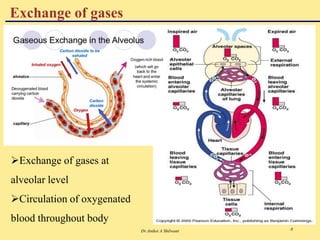
Exchange of gases at
alveolar level
Circulation of oxygenated
blood throughout body
Exchange of gases
Dr.Aniket A Shilwant 9
Exchange of gases
Dr.Aniket A Shilwant 10
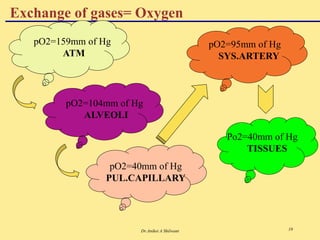
Exchange of gases= Oxygen
pO2=159mm of Hg
ATM
pO2=104mm of Hg
ALVEOLI
pO2=95mm of Hg
SYS.ARTERY
Po2=40mm of Hg
TISSUES
pO2=40mm of Hg
PUL.CAPILLARY
Dr.Aniket A Shilwant 11
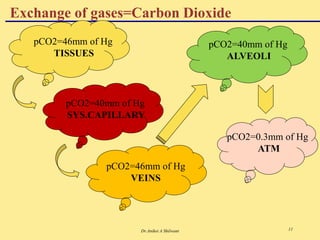
Exchange of gases=Carbon Dioxide
pCO2=46mm of Hg
TISSUES
pCO2=40mm of Hg
SYS.CAPILLARY
pCO2=40mm of Hg
ALVEOLI
pCO2=0.3mm of Hg
ATM
pCO2=46mm of Hg
VEINS
Dr.Aniket A Shilwant 12
Transport of gases
Oxygen
1) Simple physical form
2) Oxyhemoglobin
Simple physical form
Freely suspended in blood
Travels through plasma
Very minimal amount
0.3ml/100ml accounts to only 3% of total oxygen
Dr.Aniket A Shilwant 13
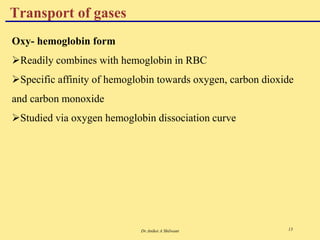
Oxy- hemoglobin form
Readily combines with hemoglobin in RBC
Specific affinity of hemoglobin towards oxygen, carbon dioxide
and carbon monoxide
Studied via oxygen hemoglobin dissociation curve
Transport of gases
Dr.Aniket A Shilwant 14
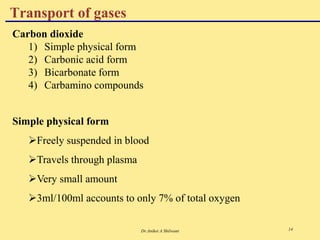
Carbon dioxide
1) Simple physical form
2) Carbonic acid form
3) Bicarbonate form
4) Carbamino compounds
Simple physical form
Freely suspended in blood
Travels through plasma
Very small amount
3ml/100ml accounts to only 7% of total oxygen
Transport of gases
Dr.Aniket A Shilwant 15
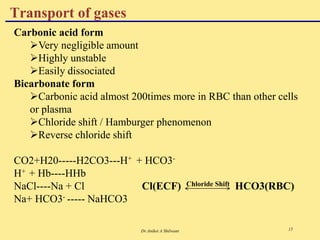
Carbonic acid form
Very negligible amount
Highly unstable
Easily dissociated
Bicarbonate form
Carbonic acid almost 200times more in RBC than other cells
or plasma
Chloride shift / Hamburger phenomenon
Reverse chloride shift
CO2+H20-----H2CO3---H+ + HCO3-
H+ + Hb----HHb
NaCl----Na + Cl Cl(ECF) Chloride Shift HCO3(RBC)
Na+ HCO3- ----- NaHCO3
Transport of gases
Dr.Aniket A Shilwant 16
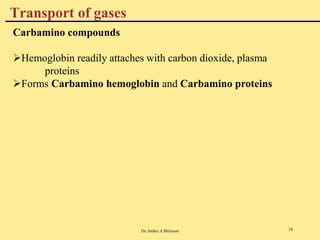
Carbamino compounds
Hemoglobin readily attaches with carbon dioxide, plasma
proteins
Forms Carbamino hemoglobin and Carbamino proteins
Transport of gases
Dr.Aniket A Shilwant 17
Dr. ANIKET A. SHILWANT
Associate Professor
Dept. of Sharir Kriya
Noble Ayurved College & Research Institute
Junagadh, Gujarat
ayuraniket18@gmail.com
aniket.shilwant@ngivbt.edu.in
THANK YOU !!!

RESPIRATORY SYSTEM-2.ppt

  • 1.
    1 RESPIRATORY SYSTEM Dr. ANIKETA. SHILWANT Associate Professor Dept. of Sharir Kriya Noble Ayurved College & Research Institute Junagadh, Gujarat
  • 2.
    Dr.Aniket A Shilwant2 Table of Contents  Mechanics of Respiration  Exchange of Gases  Transport of Gases
  • 3.
    Dr.Aniket A Shilwant3 Mechanics of Respiration Respiration process is assisted by muscles Muscles involved-2types 1) Primary 2) Accessory 1) Primary muscles- Which actually involve in change of shape of thoracic cage 2) Accessory muscles-Which assist or support the primary muscles in their function Muscles involved -2types a) Inspiratory b) Expiratory i. Inspiratory Primary M ii. Inspiratory Accessory M iii. Expiratory Primary M iv. Expiratory Accessory M
  • 4.
    Dr.Aniket A Shilwant4 Lungs expands with expansion of thoracic cage. This is supported by – 1) Thoracic lid 2) Upper coastal series 3) Lower coastal series 4) Diaphragm Thoracic cage expands in – 1) Anteroposterior diameter 2) Transverse diameter 3) Vertical diameter Mechanics of Respiration
  • 5.
    Dr.Aniket A Shilwant5 1) Thoracic lid a) Formed by manubrium and Ist pair of ribs b) Also known as Thoracic Operculum c) Movement direction-Forward, Upward d) Thoracic cage expansion – Anteroposterior diameter 2) Upper coastal series a) Formed by IInd to VIth pair of ribs b) Movement direction- Pump handle movement  Forward, Upward  Thoracic cage expansion-Antero-posterior diameter Mechanics of Respiration
  • 6.
    Dr.Aniket A Shilwant6 Bucket handle movement Upward, Outward Thoracic cage expansion-Transverse diameter 3) Lower coastal series a) Formed by-VIIth to Xth pair of ribs b) Movement direction-Upward, Outward c) Thoracic cage expansion-Transverse diameter 4) Diaphragm a) Initially dome shaped b) Inspiration-gets flattened c) Thoracic cage expansion-Vertical diameter d) Expiration-gets curved, convex shape Mechanics of Respiration
  • 7.
    Dr.Aniket A Shilwant7 Exchange of gases Exchange of gases- O2 -----IN CO2----OUT Method-Bulk diffusion ATMOSPHERE ALVEOLI BLOOD TISSUES TISSUES BLOOD ALVEOLI ATMOSPHERE CO2 O2
  • 8.
    Dr.Aniket A Shilwant8 Exchange of gases at alveolar level Circulation of oxygenated blood throughout body Exchange of gases
  • 9.
    Dr.Aniket A Shilwant9 Exchange of gases
  • 10.
    Dr.Aniket A Shilwant10 Exchange of gases= Oxygen pO2=159mm of Hg ATM pO2=104mm of Hg ALVEOLI pO2=95mm of Hg SYS.ARTERY Po2=40mm of Hg TISSUES pO2=40mm of Hg PUL.CAPILLARY
  • 11.
    Dr.Aniket A Shilwant11 Exchange of gases=Carbon Dioxide pCO2=46mm of Hg TISSUES pCO2=40mm of Hg SYS.CAPILLARY pCO2=40mm of Hg ALVEOLI pCO2=0.3mm of Hg ATM pCO2=46mm of Hg VEINS
  • 12.
    Dr.Aniket A Shilwant12 Transport of gases Oxygen 1) Simple physical form 2) Oxyhemoglobin Simple physical form Freely suspended in blood Travels through plasma Very minimal amount 0.3ml/100ml accounts to only 3% of total oxygen
  • 13.
    Dr.Aniket A Shilwant13 Oxy- hemoglobin form Readily combines with hemoglobin in RBC Specific affinity of hemoglobin towards oxygen, carbon dioxide and carbon monoxide Studied via oxygen hemoglobin dissociation curve Transport of gases
  • 14.
    Dr.Aniket A Shilwant14 Carbon dioxide 1) Simple physical form 2) Carbonic acid form 3) Bicarbonate form 4) Carbamino compounds Simple physical form Freely suspended in blood Travels through plasma Very small amount 3ml/100ml accounts to only 7% of total oxygen Transport of gases
  • 15.
    Dr.Aniket A Shilwant15 Carbonic acid form Very negligible amount Highly unstable Easily dissociated Bicarbonate form Carbonic acid almost 200times more in RBC than other cells or plasma Chloride shift / Hamburger phenomenon Reverse chloride shift CO2+H20-----H2CO3---H+ + HCO3- H+ + Hb----HHb NaCl----Na + Cl Cl(ECF) Chloride Shift HCO3(RBC) Na+ HCO3- ----- NaHCO3 Transport of gases
  • 16.
    Dr.Aniket A Shilwant16 Carbamino compounds Hemoglobin readily attaches with carbon dioxide, plasma proteins Forms Carbamino hemoglobin and Carbamino proteins Transport of gases
  • 17.
    Dr.Aniket A Shilwant17 Dr. ANIKET A. SHILWANT Associate Professor Dept. of Sharir Kriya Noble Ayurved College & Research Institute Junagadh, Gujarat ayuraniket18@gmail.com aniket.shilwant@ngivbt.edu.in THANK YOU !!!

Editor's Notes