
APPLIED ASPECT
OF STROTASA
Dr. ANIKET A. SHILWANT
Assistant Professor
GJP-IASR
TABLE OF CONTENTS
 Nirukti
 Synonyms
 Number of Strotasa
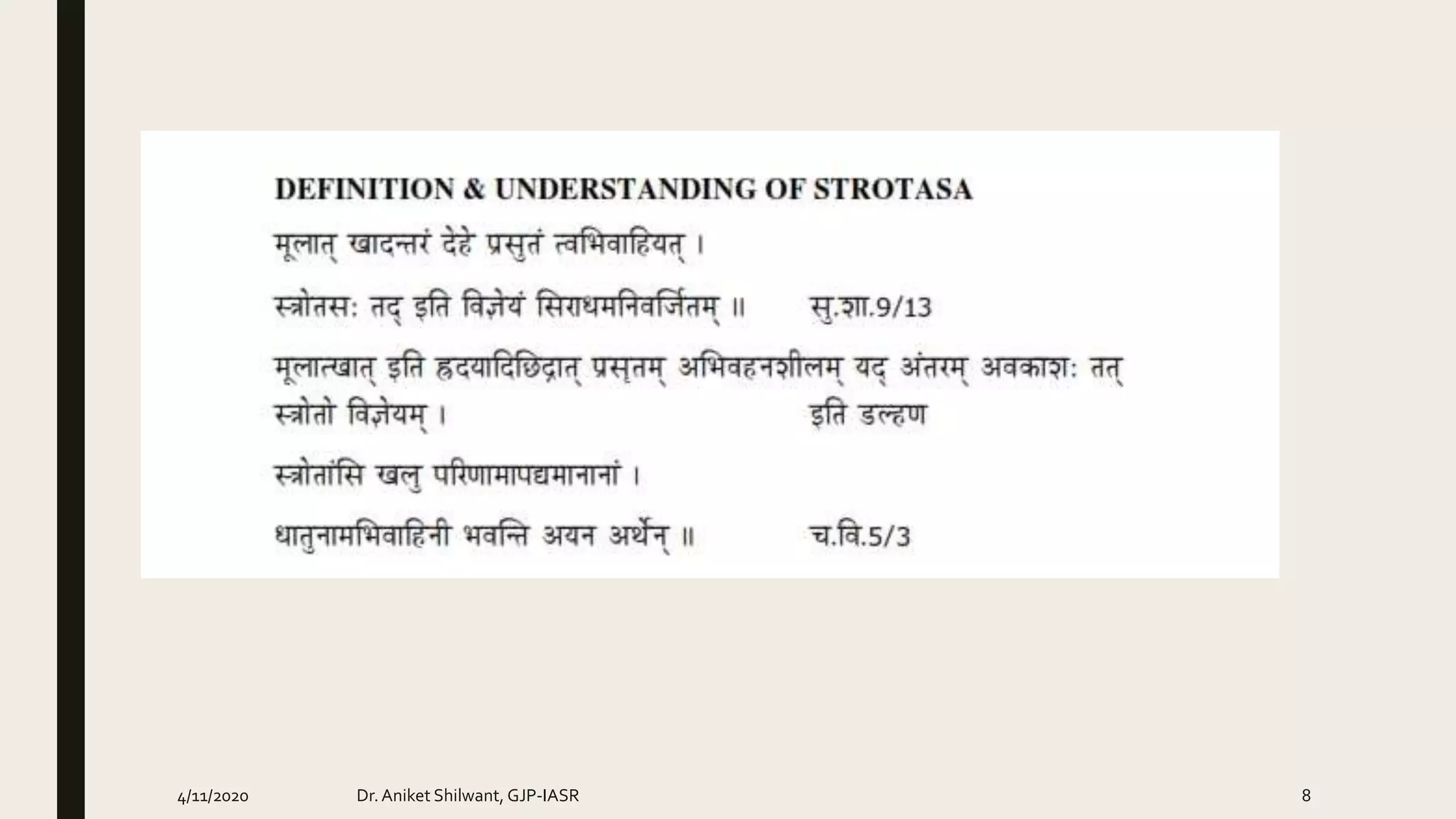
 Definition & Understanding of Strotasa
 General Dushti hetu
 General Dushti lakshana
 General Moola sthana
 Applied Clinical Aspect of Strotasa
4/11/2020 Dr.Aniket Shilwant, GJP-IASR 2
4/11/2020 Dr.Aniket Shilwant, GJP-IASR 3
4/11/2020 Dr.Aniket Shilwant, GJP-IASR 4
Strotasa is a term related with Expression of Bhava padartha
Expression of Strotasa may be as per specific time period, for specific function,
continuously and so on.
Ex.
1. Strotasa expressing Bhava padartha at specific time period –
 Artava vaha Strotasa
 Stanya vaha Strotasa
 Shabda vaha Strotasa
2. Strotasa expressing Bhava padartha for specific function –
 Anna vaha Strotasa
 Shukra vaha Strotasa
3. Strotasa expressing and working Bhava padartha continuously –
 Prana vaha Strotasa
 Rasa vaha Strotasa
4/11/2020 Dr.Aniket Shilwant, GJP-IASR 5
NUMBER OF STROTASA
 As per production of Bhava padartha – Innumerous
 As per function – Limited and countable
 As per expression of Bhava padarth through an opening – Two
Antarmukha (Internal orifices) Bahirmukha (External orifices)
 Antarmukha (Internal orifices) –
 Charak – 13
 Sushruta – 11 pairs (total 22)
 Bahirmukha (External orifices)
 Male – 09 (2Eyes, 2Ears, 2Nostrils, 1Oral cavity, Urinary & Anal opening 1 each)
 Females – 12 (Extras - 2 Breast openings and 1 Vaginal opening)
4/11/2020 Dr.Aniket Shilwant, GJP-IASR 6
Miscellaneous –
 Dosha vaha
 Oja vaha
 Mano vaha
 Svar vaha
 Shabda vaha
 Budhi vaha
4/11/2020 Dr.Aniket Shilwant, GJP-IASR 7
4/11/2020 Dr.Aniket Shilwant, GJP-IASR 8
4/11/2020 Dr.Aniket Shilwant, GJP-IASR 9
4/11/2020 Dr.Aniket Shilwant, GJP-IASR 10
4/11/2020 Dr.Aniket Shilwant, GJP-IASR 11
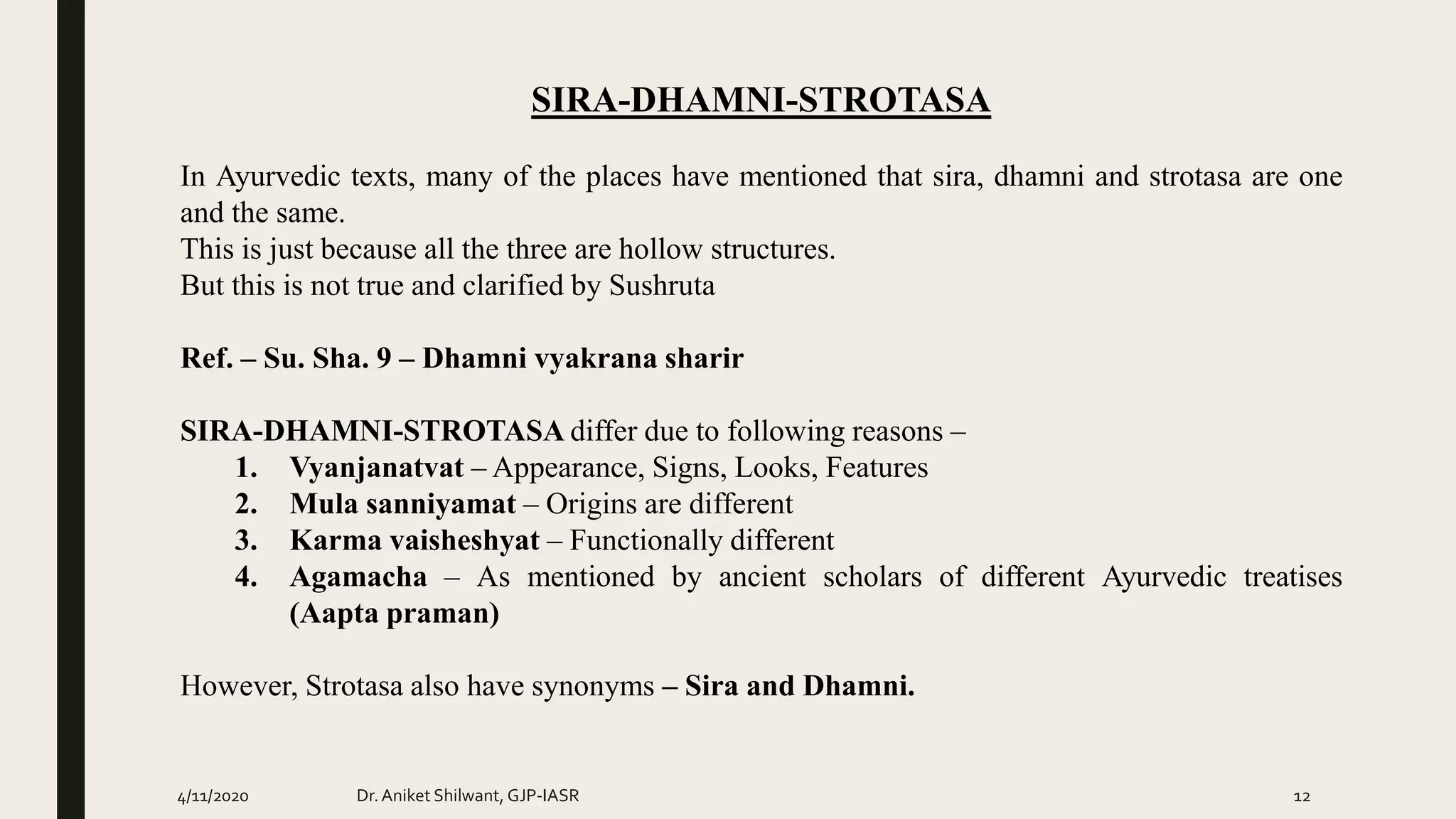
SIRA-DHAMNI-STROTASA
In Ayurvedic texts, many of the places have mentioned that sira, dhamni and strotasa are one
and the same.
This is just because all the three are hollow structures.
But this is not true and clarified by Sushruta
Ref. – Su. Sha. 9 – Dhamni vyakrana sharir
SIRA-DHAMNI-STROTASA differ due to following reasons –
1. Vyanjanatvat – Appearance, Signs, Looks, Features
2. Mula sanniyamat – Origins are different
3. Karma vaisheshyat – Functionally different
4. Agamacha – As mentioned by ancient scholars of different Ayurvedic treatises
(Aapta praman)
However, Strotasa also have synonyms – Sira and Dhamni.
4/11/2020 Dr.Aniket Shilwant, GJP-IASR 12
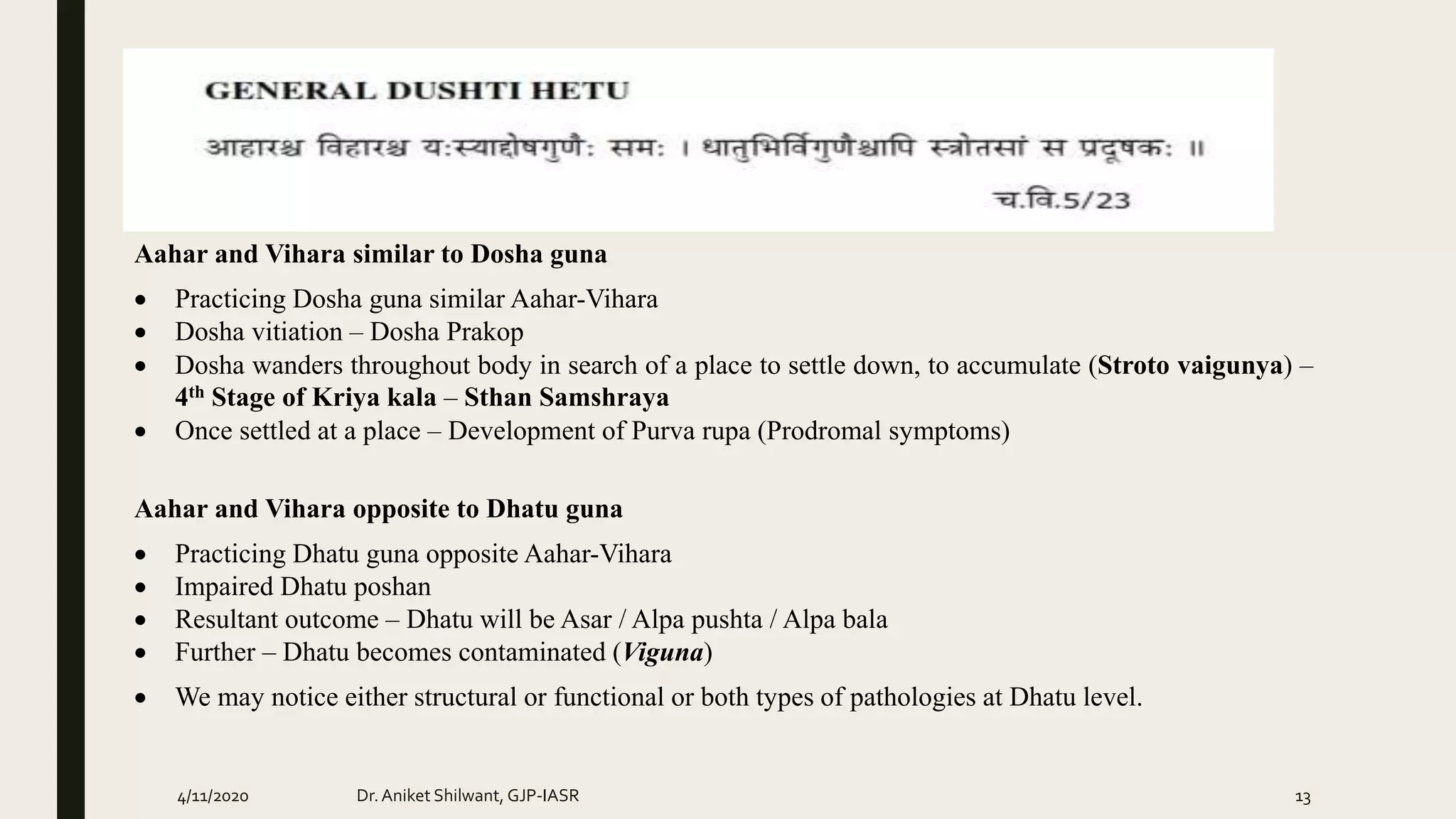
Aahar and Vihara similar to Dosha guna
 Practicing Dosha guna similar Aahar-Vihara
 Dosha vitiation – Dosha Prakop
 Dosha wanders throughout body in search of a place to settle down, to accumulate (Stroto vaigunya) –
4th Stage of Kriya kala – Sthan Samshraya
 Once settled at a place – Development of Purva rupa (Prodromal symptoms)
Aahar and Vihara opposite to Dhatu guna
 Practicing Dhatu guna opposite Aahar-Vihara
 Impaired Dhatu poshan
 Resultant outcome – Dhatu will be Asar / Alpa pushta / Alpa bala
 Further – Dhatu becomes contaminated (Viguna)
 We may notice either structural or functional or both types of pathologies at Dhatu level.
4/11/2020 Dr.Aniket Shilwant, GJP-IASR 13
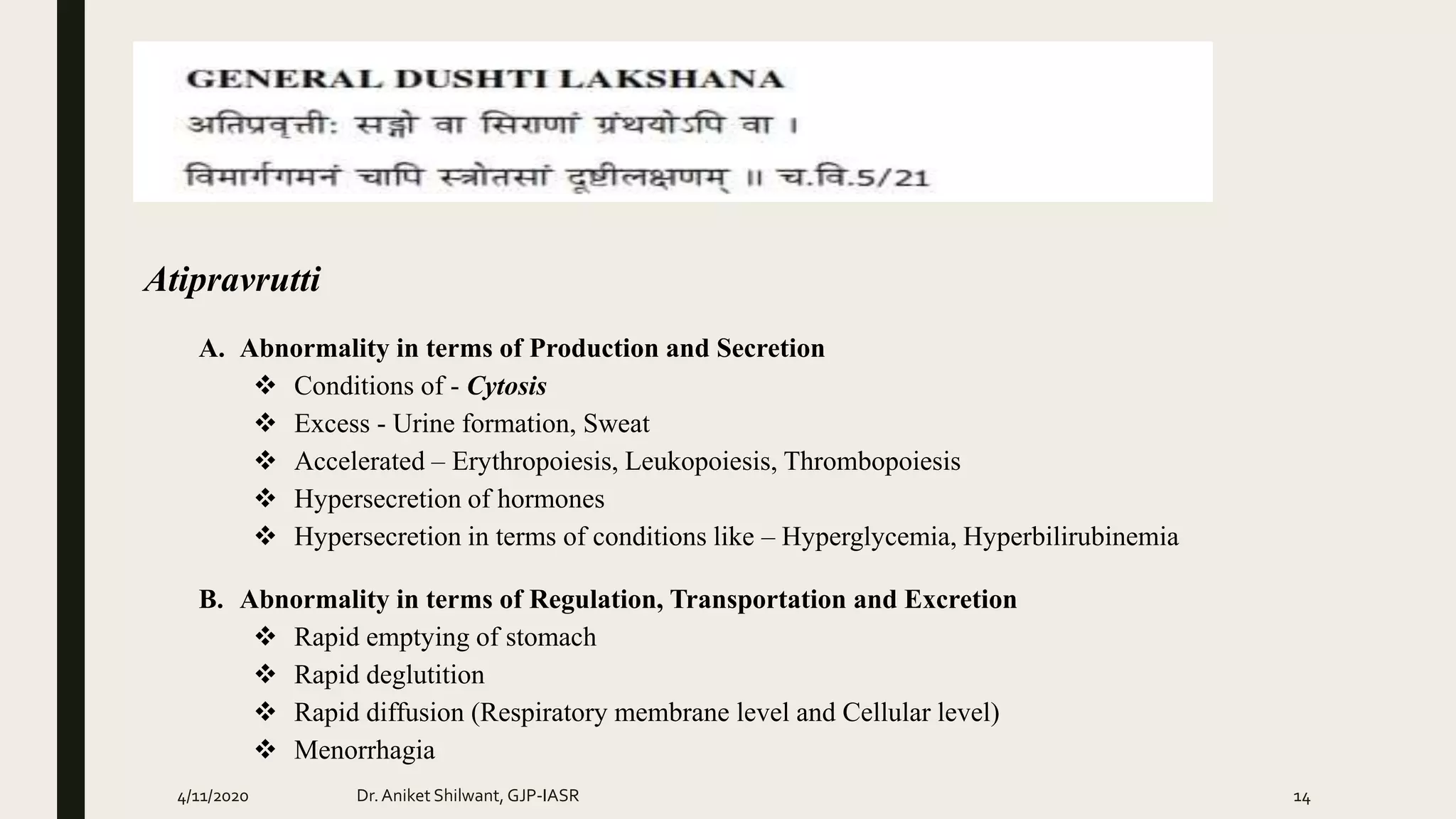
Atipravrutti
A. Abnormality in terms of Production and Secretion
 Conditions of - Cytosis
 Excess - Urine formation, Sweat
 Accelerated – Erythropoiesis, Leukopoiesis, Thrombopoiesis
 Hypersecretion of hormones
 Hypersecretion in terms of conditions like – Hyperglycemia, Hyperbilirubinemia
B. Abnormality in terms of Regulation, Transportation and Excretion
 Rapid emptying of stomach
 Rapid deglutition
 Rapid diffusion (Respiratory membrane level and Cellular level)
 Menorrhagia
4/11/2020 Dr.Aniket Shilwant, GJP-IASR 14
Sanga
 Obstruction
 Atrophy of structure / organ / cell / tissue
 Hindrance or obstruction in normal processes like – constriction-relaxation; secretion-absorption and
many more.
 Shrinkage of gland – Glandular atrophy – Atrophy of Pituitary or Thyroid gland
 Muscle atrophy – Muscle wasting – PEM, Marasmus, Malnutrition, Ascites
 Obstruction – Obstructive jaundice (Gallstones), Hydro nephrosis (Renal calculi in
ureter/bladder/urethra), Asthma (Foreign body or Calcification of mucus secretions in bronchial tree)
4/11/2020 Dr.Aniket Shilwant, GJP-IASR 15
Sira granthi
 Only noticed in physically present channels
 Abnormal growth – Cysts, Tumorous growth, Aneurysms
 Engorgement of vessels – Piles (Veins engorged), Varicosities, DVT
Vimarga gaman
 Diversion of normal route of Vata dosha
 Dosha gati – Shakha to Koshta and vice versa
 Pyrexia
 Obstructive jaundice
 Raktapitta (Vimarga gaman of Rasa-Rakta-Pitta)
4/11/2020 Dr.Aniket Shilwant, GJP-IASR 16
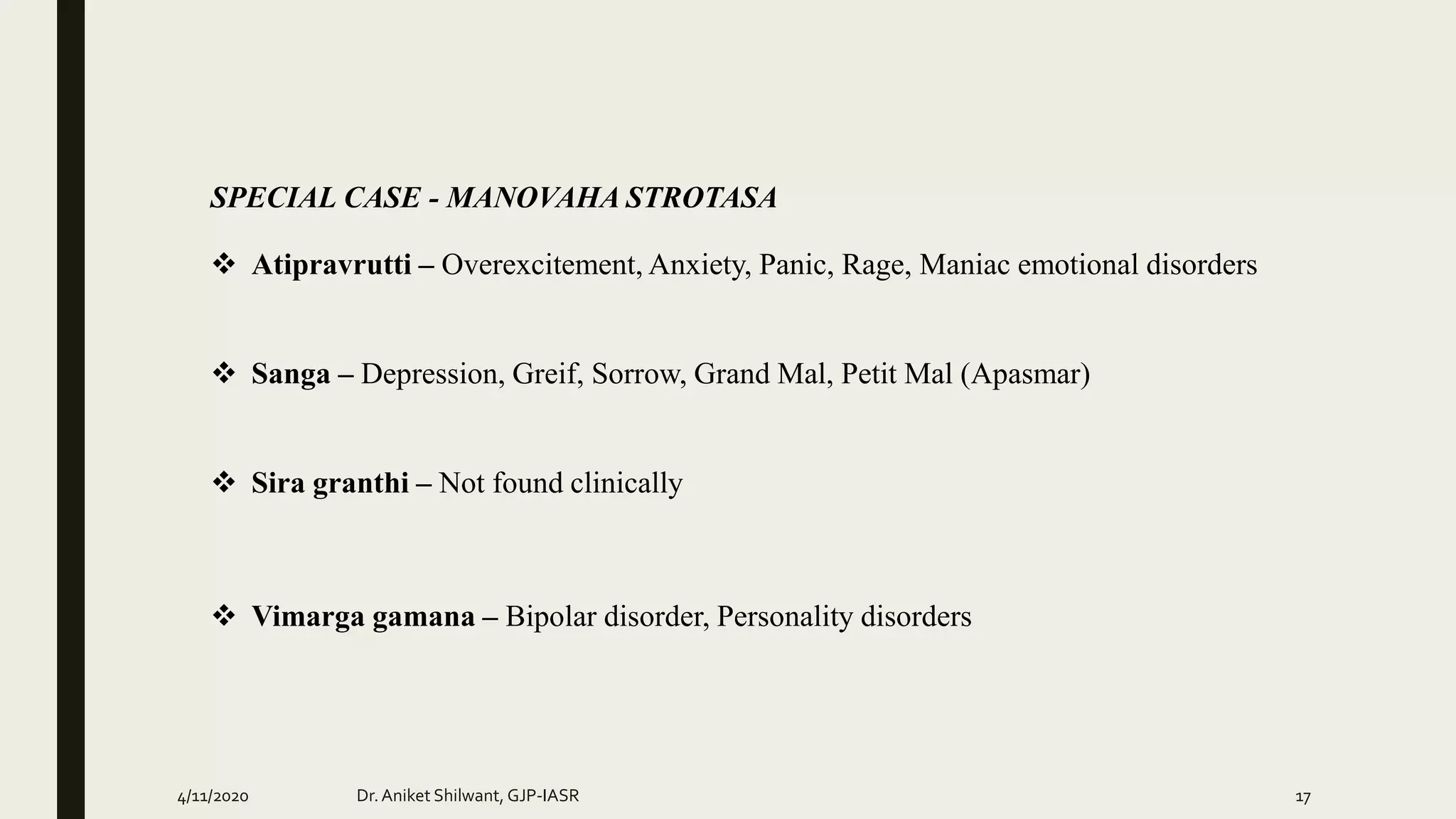
SPECIAL CASE - MANOVAHA STROTASA
 Atipravrutti – Overexcitement, Anxiety, Panic, Rage, Maniac emotional disorders
 Sanga – Depression, Greif, Sorrow, Grand Mal, Petit Mal (Apasmar)
 Sira granthi – Not found clinically
 Vimarga gamana – Bipolar disorder, Personality disorders
4/11/2020 Dr.Aniket Shilwant, GJP-IASR 17
Sr.
No
Strotasa
Mula sthan as
per Charak Samhita
Mula sthan as
per Sushruta Samhita
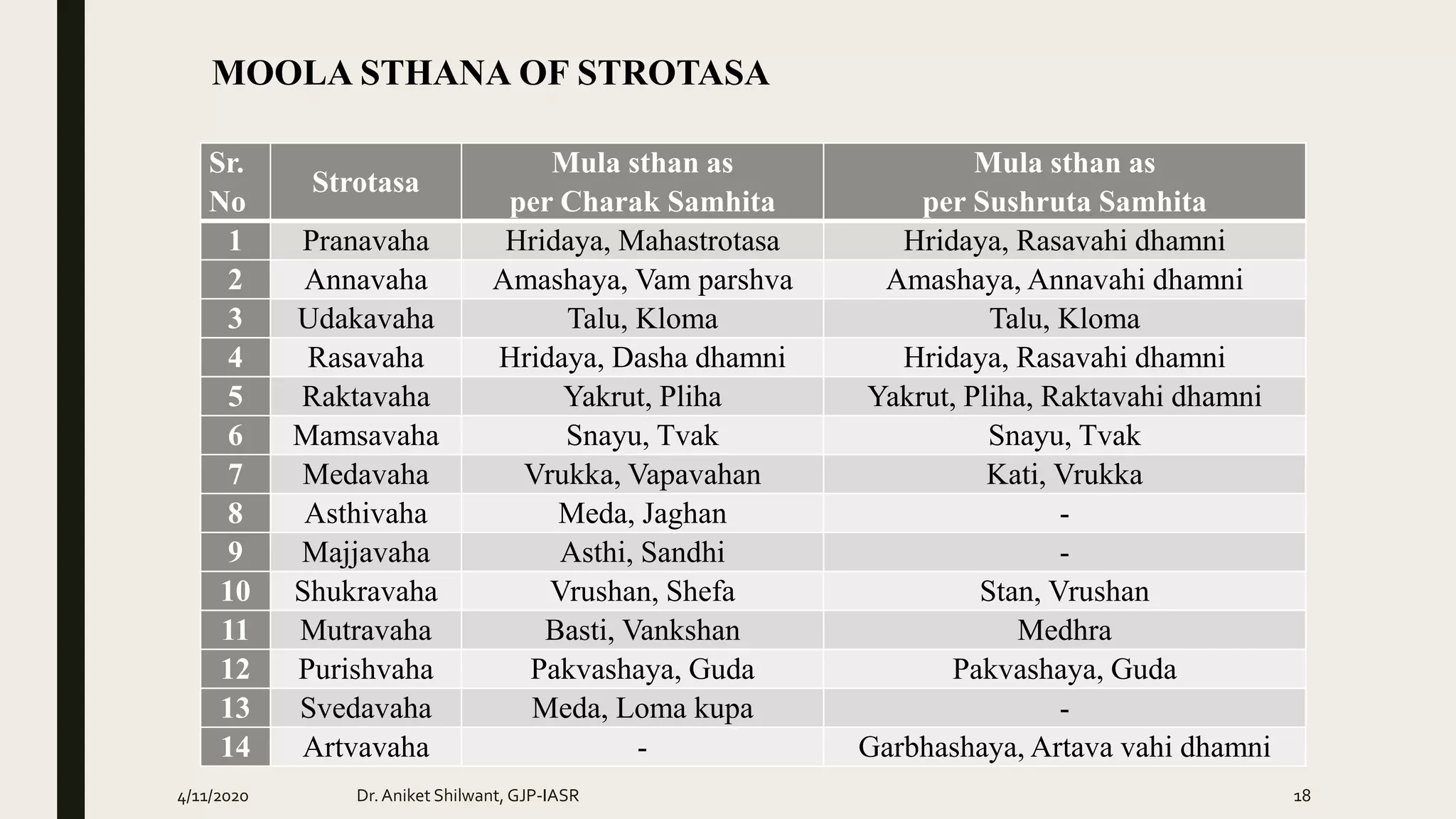
1 Pranavaha Hridaya, Mahastrotasa Hridaya, Rasavahi dhamni
2 Annavaha Amashaya, Vam parshva Amashaya, Annavahi dhamni
3 Udakavaha Talu, Kloma Talu, Kloma
4 Rasavaha Hridaya, Dasha dhamni Hridaya, Rasavahi dhamni
5 Raktavaha Yakrut, Pliha Yakrut, Pliha, Raktavahi dhamni
6 Mamsavaha Snayu, Tvak Snayu, Tvak
7 Medavaha Vrukka, Vapavahan Kati, Vrukka
8 Asthivaha Meda, Jaghan -
9 Majjavaha Asthi, Sandhi -
10 Shukravaha Vrushan, Shefa Stan, Vrushan
11 Mutravaha Basti, Vankshan Medhra
12 Purishvaha Pakvashaya, Guda Pakvashaya, Guda
13 Svedavaha Meda, Loma kupa -
14 Artvavaha - Garbhashaya, Artava vahi dhamni
MOOLA STHANA OF STROTASA
4/11/2020 Dr.Aniket Shilwant, GJP-IASR 18
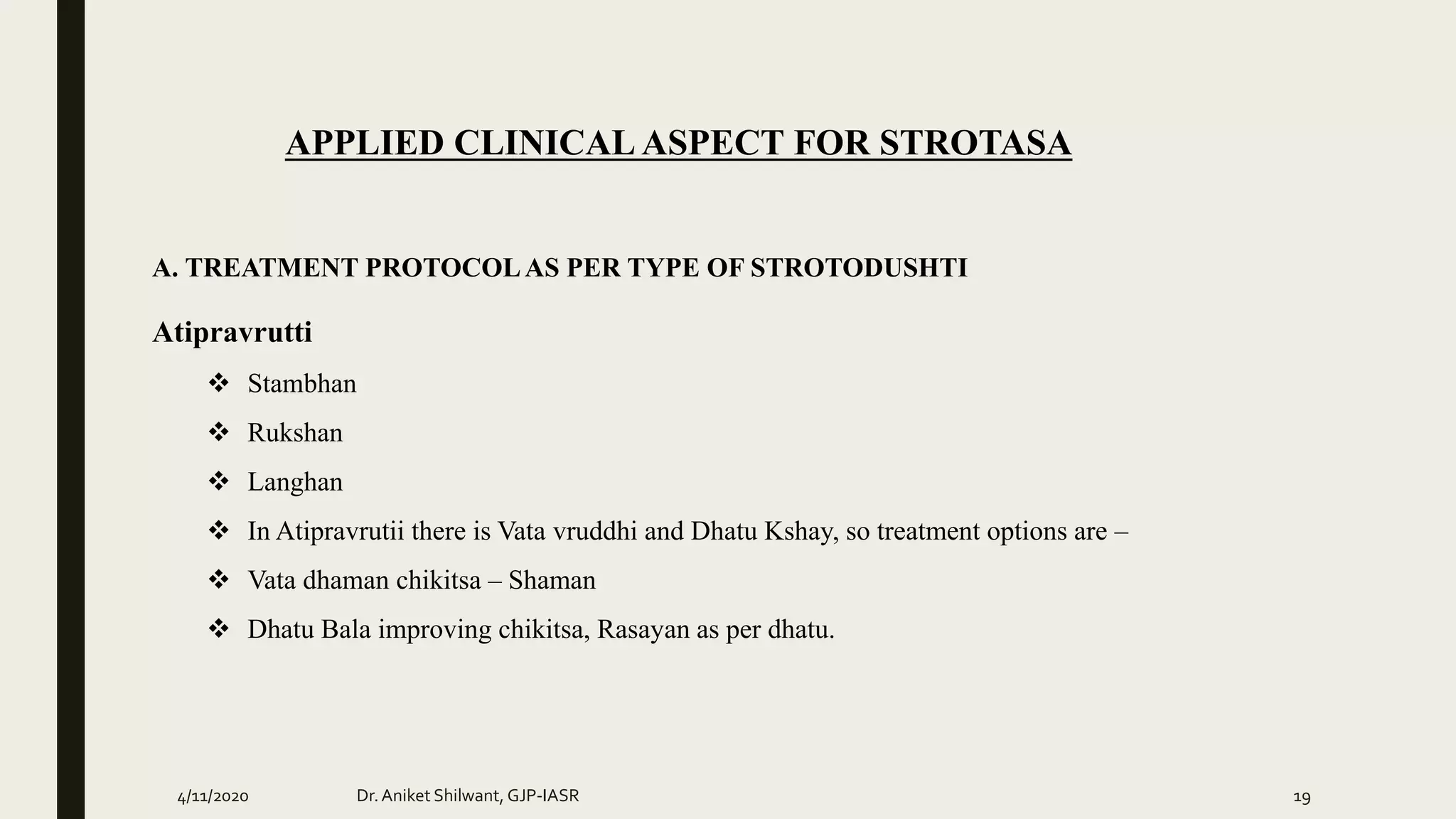
APPLIED CLINICAL ASPECT FOR STROTASA
A. TREATMENT PROTOCOLAS PER TYPE OF STROTODUSHTI
Atipravrutti
 Stambhan
 Rukshan
 Langhan
 In Atipravrutii there is Vata vruddhi and Dhatu Kshay, so treatment options are –
 Vata dhaman chikitsa – Shaman
 Dhatu Bala improving chikitsa, Rasayan as per dhatu.
4/11/2020 Dr.Aniket Shilwant, GJP-IASR 19
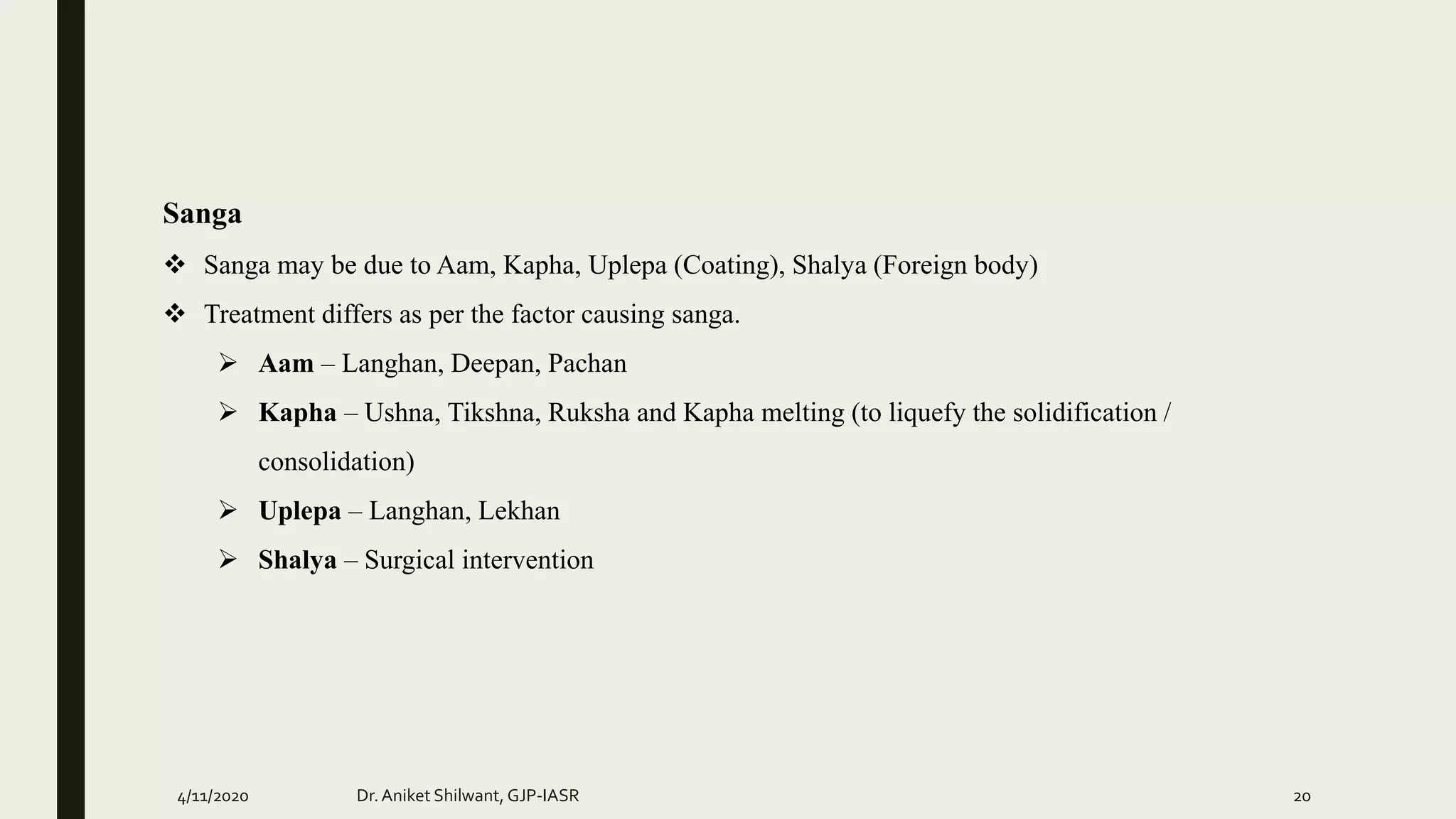
Sanga
 Sanga may be due to Aam, Kapha, Uplepa (Coating), Shalya (Foreign body)
 Treatment differs as per the factor causing sanga.
 Aam – Langhan, Deepan, Pachan
 Kapha – Ushna, Tikshna, Ruksha and Kapha melting (to liquefy the solidification /
consolidation)
 Uplepa – Langhan, Lekhan
 Shalya – Surgical intervention
4/11/2020 Dr.Aniket Shilwant, GJP-IASR 20
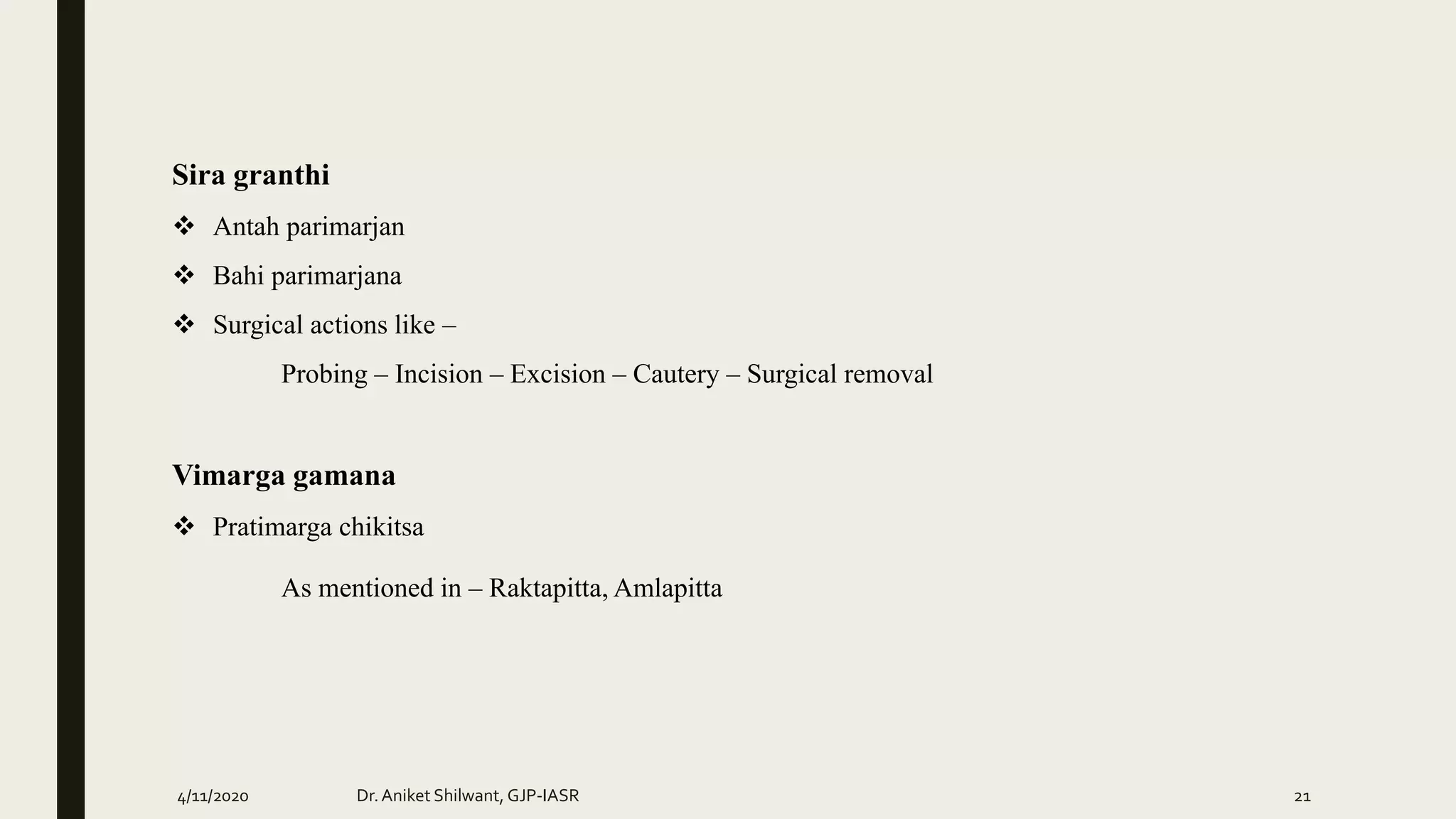
Sira granthi
 Antah parimarjan
 Bahi parimarjana
 Surgical actions like –
Probing – Incision – Excision – Cautery – Surgical removal
Vimarga gamana
 Pratimarga chikitsa
As mentioned in – Raktapitta, Amlapitta
4/11/2020 Dr.Aniket Shilwant, GJP-IASR 21
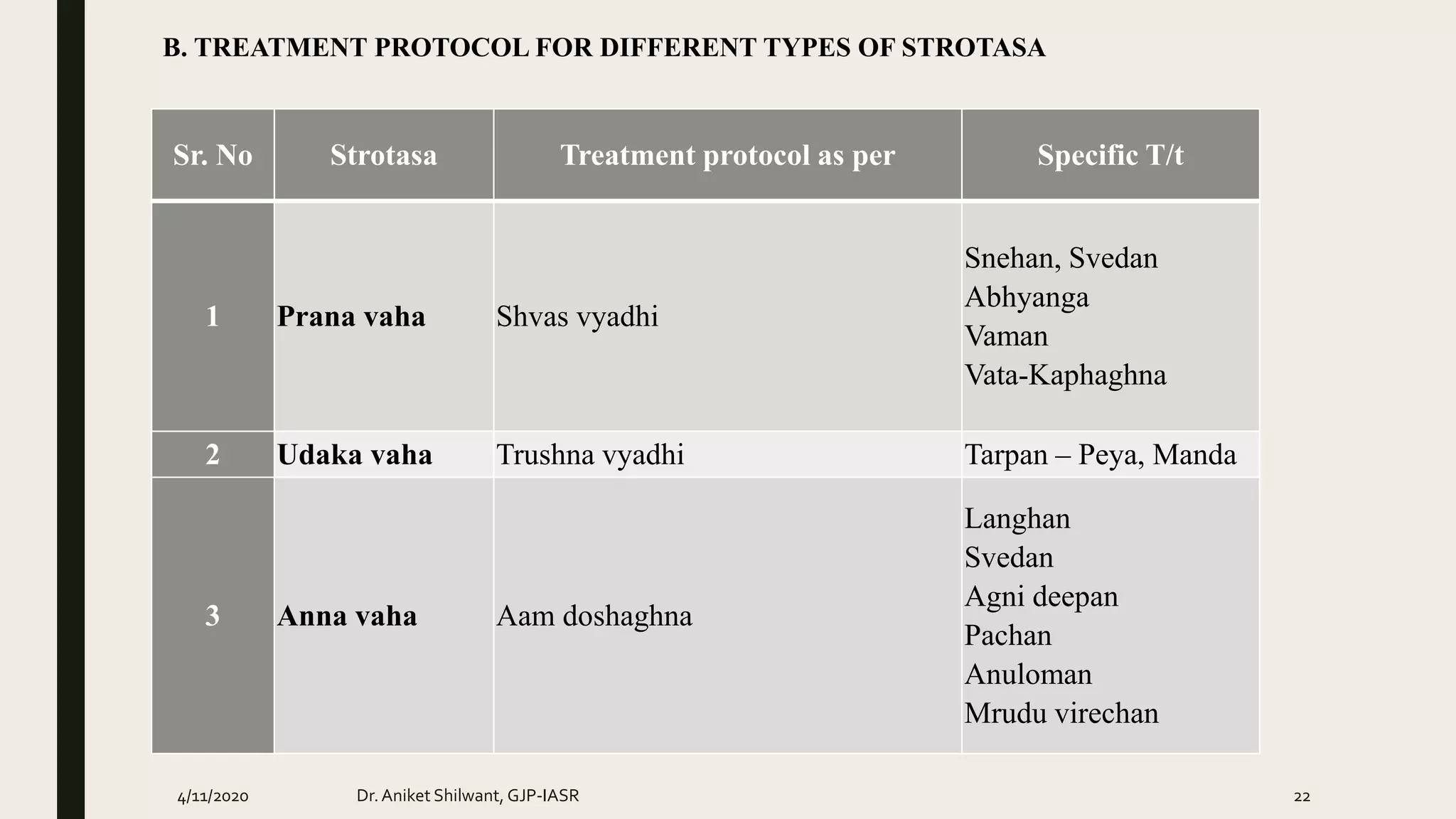
Sr. No Strotasa Treatment protocol as per Specific T/t
1 Prana vaha Shvas vyadhi
Snehan, Svedan
Abhyanga
Vaman
Vata-Kaphaghna
2 Udaka vaha Trushna vyadhi Tarpan – Peya, Manda
3 Anna vaha Aam doshaghna
Langhan
Svedan
Agni deepan
Pachan
Anuloman
Mrudu virechan
B. TREATMENT PROTOCOL FOR DIFFERENT TYPES OF STROTASA
4/11/2020 Dr.Aniket Shilwant, GJP-IASR 22
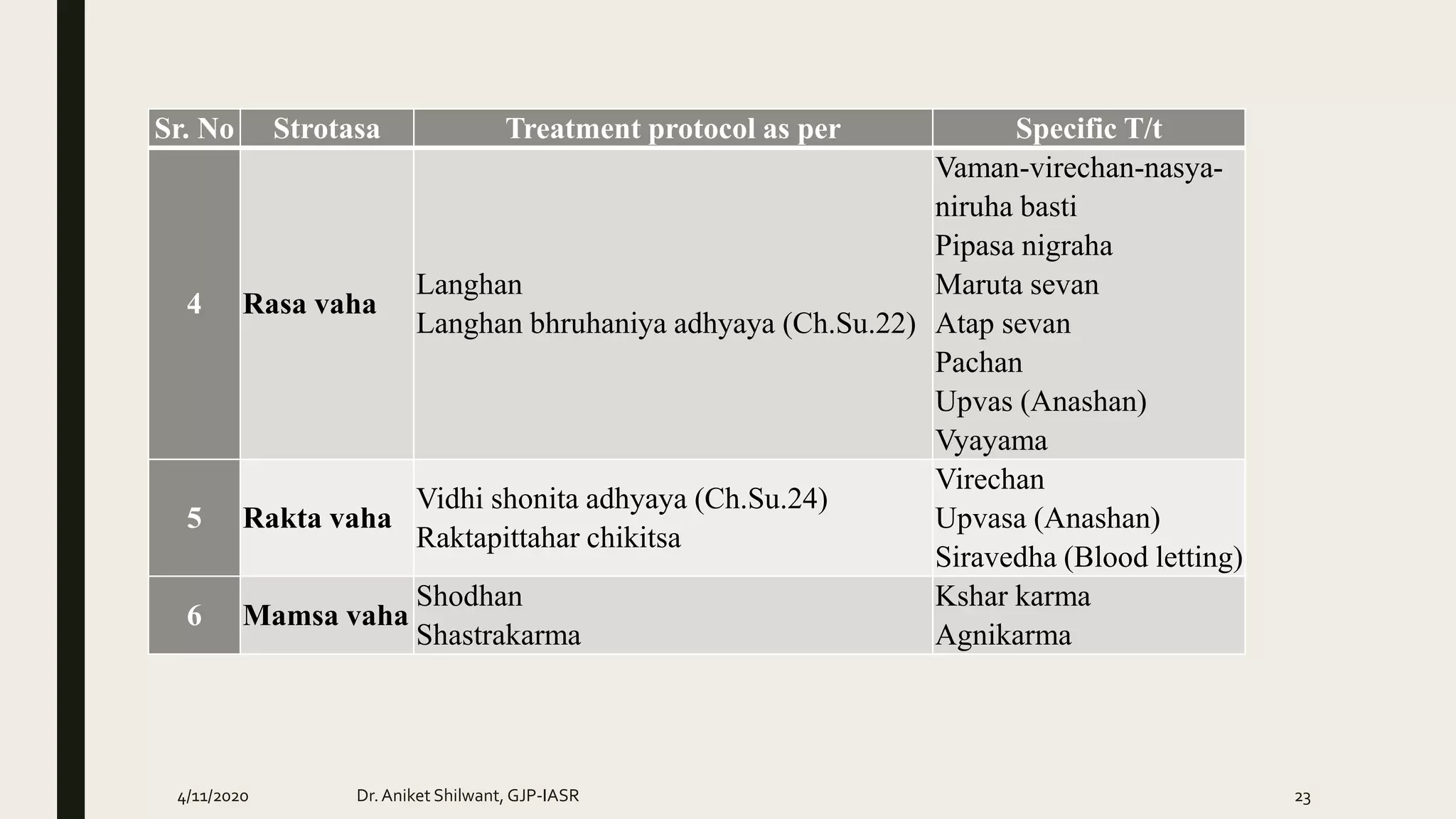
Sr. No Strotasa Treatment protocol as per Specific T/t
4 Rasa vaha
Langhan
Langhan bhruhaniya adhyaya (Ch.Su.22)
Vaman-virechan-nasya-
niruha basti
Pipasa nigraha
Maruta sevan
Atap sevan
Pachan
Upvas (Anashan)
Vyayama
5 Rakta vaha
Vidhi shonita adhyaya (Ch.Su.24)
Raktapittahar chikitsa
Virechan
Upvasa (Anashan)
Siravedha (Blood letting)
6 Mamsa vaha
Shodhan
Shastrakarma
Kshar karma
Agnikarma
4/11/2020 Dr.Aniket Shilwant, GJP-IASR 23
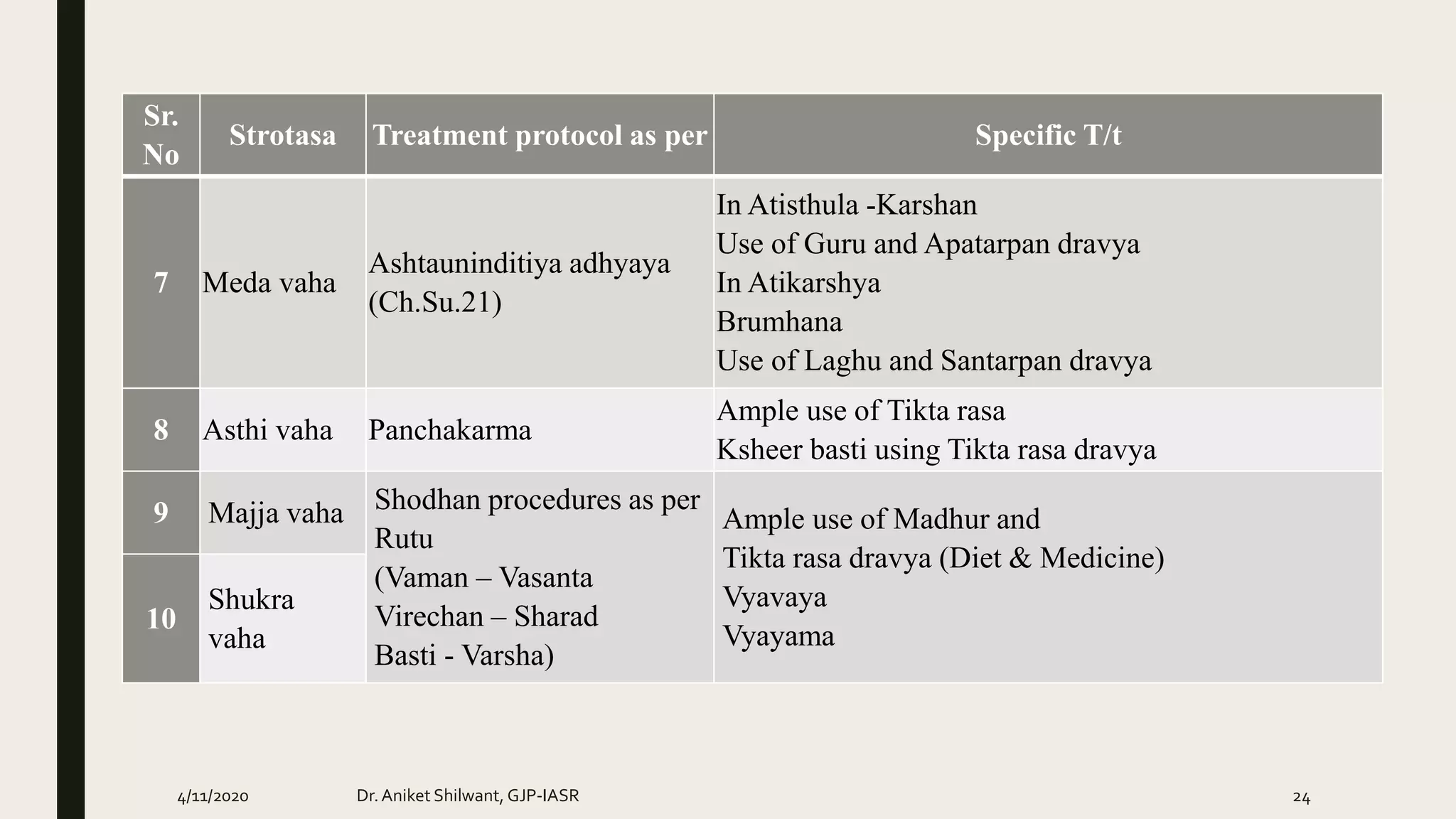
Sr.
No
Strotasa Treatment protocol as per Specific T/t
7 Meda vaha
Ashtauninditiya adhyaya
(Ch.Su.21)
In Atisthula -Karshan
Use of Guru and Apatarpan dravya
In Atikarshya
Brumhana
Use of Laghu and Santarpan dravya
8 Asthi vaha Panchakarma
Ample use of Tikta rasa
Ksheer basti using Tikta rasa dravya
9 Majja vaha Shodhan procedures as per
Rutu
(Vaman – Vasanta
Virechan – Sharad
Basti - Varsha)
Ample use of Madhur and
Tikta rasa dravya (Diet & Medicine)
Vyavaya
Vyayama
10
Shukra
vaha
4/11/2020 Dr.Aniket Shilwant, GJP-IASR 24
Sr. No Strotasa Treatment protocol as per Specific T/t
11 Mutra vaha Mutrakrucha
Svedan, Avagaha
Abhyanga
Avapidaka ghruta
Trividha basti (Asthapan, Anuvasan & Uttar
basti)
12 Purisha vaha Atisara vyadhi
Svedan, Avagaha
Abhyanga
Varti (Suppository)
Basti
Use of Pramathi dravya
Anuloman, Stransan, Virechan
Ama avastha – Pachan & Grahi
Niram avastha – Stambhan
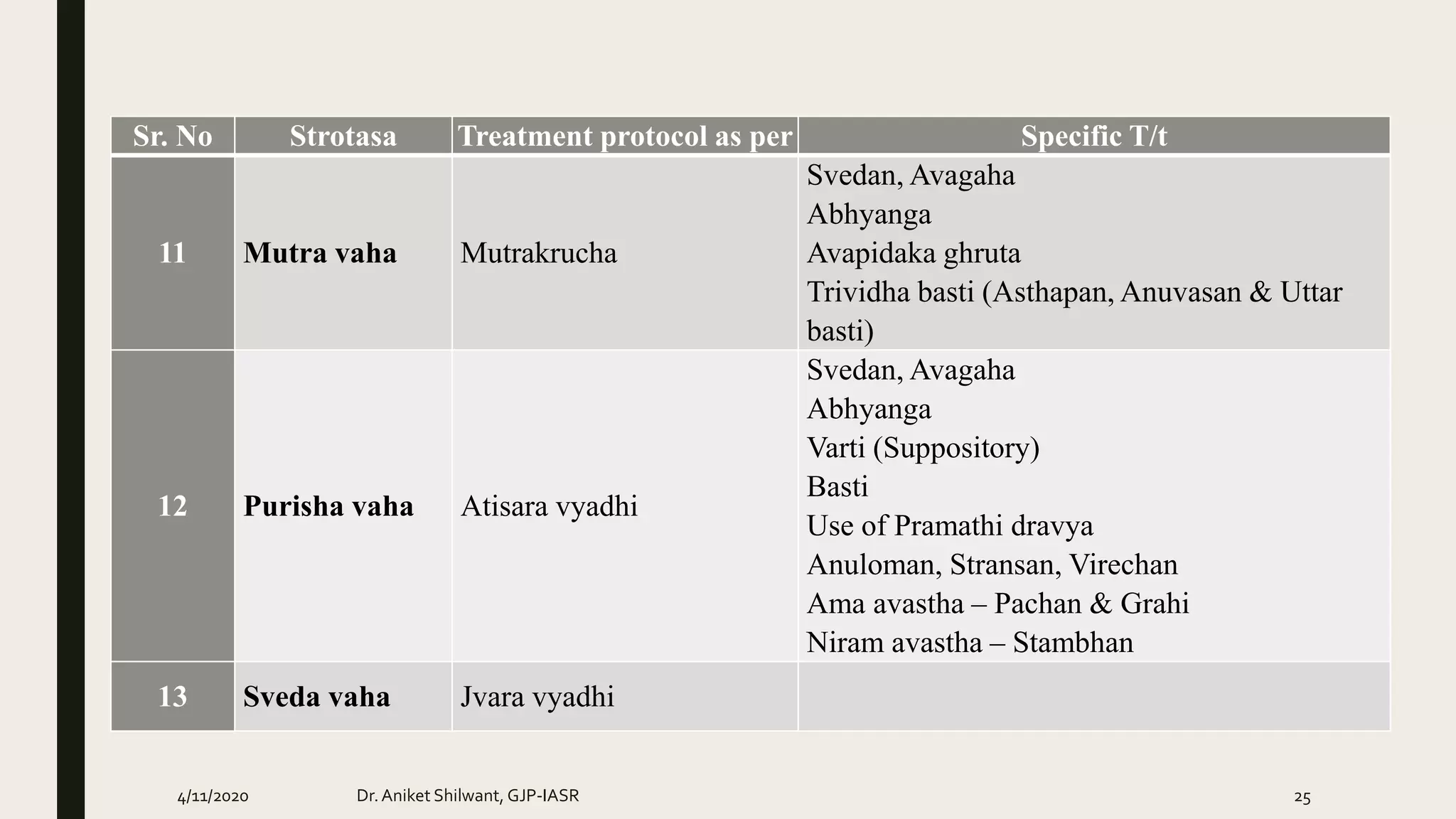
13 Sveda vaha Jvara vyadhi
4/11/2020 Dr.Aniket Shilwant, GJP-IASR 25
Thank You All !!!
4/11/2020 Dr.Aniket Shilwant, GJP-IASR 26

APPLIED ASPECT OF STROTASA

  • 1.
    APPLIED ASPECT OF STROTASA Dr.ANIKET A. SHILWANT Assistant Professor GJP-IASR
  • 2.
    TABLE OF CONTENTS Nirukti  Synonyms  Number of Strotasa  Definition & Understanding of Strotasa  General Dushti hetu  General Dushti lakshana  General Moola sthana  Applied Clinical Aspect of Strotasa 4/11/2020 Dr.Aniket Shilwant, GJP-IASR 2
  • 3.
  • 4.
  • 5.
    Strotasa is aterm related with Expression of Bhava padartha Expression of Strotasa may be as per specific time period, for specific function, continuously and so on. Ex. 1. Strotasa expressing Bhava padartha at specific time period –  Artava vaha Strotasa  Stanya vaha Strotasa  Shabda vaha Strotasa 2. Strotasa expressing Bhava padartha for specific function –  Anna vaha Strotasa  Shukra vaha Strotasa 3. Strotasa expressing and working Bhava padartha continuously –  Prana vaha Strotasa  Rasa vaha Strotasa 4/11/2020 Dr.Aniket Shilwant, GJP-IASR 5
  • 6.
    NUMBER OF STROTASA As per production of Bhava padartha – Innumerous  As per function – Limited and countable  As per expression of Bhava padarth through an opening – Two Antarmukha (Internal orifices) Bahirmukha (External orifices)  Antarmukha (Internal orifices) –  Charak – 13  Sushruta – 11 pairs (total 22)  Bahirmukha (External orifices)  Male – 09 (2Eyes, 2Ears, 2Nostrils, 1Oral cavity, Urinary & Anal opening 1 each)  Females – 12 (Extras - 2 Breast openings and 1 Vaginal opening) 4/11/2020 Dr.Aniket Shilwant, GJP-IASR 6
  • 7.
    Miscellaneous –  Doshavaha  Oja vaha  Mano vaha  Svar vaha  Shabda vaha  Budhi vaha 4/11/2020 Dr.Aniket Shilwant, GJP-IASR 7
  • 8.
  • 9.
  • 10.
  • 11.
  • 12.
    SIRA-DHAMNI-STROTASA In Ayurvedic texts,many of the places have mentioned that sira, dhamni and strotasa are one and the same. This is just because all the three are hollow structures. But this is not true and clarified by Sushruta Ref. – Su. Sha. 9 – Dhamni vyakrana sharir SIRA-DHAMNI-STROTASA differ due to following reasons – 1. Vyanjanatvat – Appearance, Signs, Looks, Features 2. Mula sanniyamat – Origins are different 3. Karma vaisheshyat – Functionally different 4. Agamacha – As mentioned by ancient scholars of different Ayurvedic treatises (Aapta praman) However, Strotasa also have synonyms – Sira and Dhamni. 4/11/2020 Dr.Aniket Shilwant, GJP-IASR 12
  • 13.
    Aahar and Viharasimilar to Dosha guna  Practicing Dosha guna similar Aahar-Vihara  Dosha vitiation – Dosha Prakop  Dosha wanders throughout body in search of a place to settle down, to accumulate (Stroto vaigunya) – 4th Stage of Kriya kala – Sthan Samshraya  Once settled at a place – Development of Purva rupa (Prodromal symptoms) Aahar and Vihara opposite to Dhatu guna  Practicing Dhatu guna opposite Aahar-Vihara  Impaired Dhatu poshan  Resultant outcome – Dhatu will be Asar / Alpa pushta / Alpa bala  Further – Dhatu becomes contaminated (Viguna)  We may notice either structural or functional or both types of pathologies at Dhatu level. 4/11/2020 Dr.Aniket Shilwant, GJP-IASR 13
  • 14.
    Atipravrutti A. Abnormality interms of Production and Secretion  Conditions of - Cytosis  Excess - Urine formation, Sweat  Accelerated – Erythropoiesis, Leukopoiesis, Thrombopoiesis  Hypersecretion of hormones  Hypersecretion in terms of conditions like – Hyperglycemia, Hyperbilirubinemia B. Abnormality in terms of Regulation, Transportation and Excretion  Rapid emptying of stomach  Rapid deglutition  Rapid diffusion (Respiratory membrane level and Cellular level)  Menorrhagia 4/11/2020 Dr.Aniket Shilwant, GJP-IASR 14
  • 15.
    Sanga  Obstruction  Atrophyof structure / organ / cell / tissue  Hindrance or obstruction in normal processes like – constriction-relaxation; secretion-absorption and many more.  Shrinkage of gland – Glandular atrophy – Atrophy of Pituitary or Thyroid gland  Muscle atrophy – Muscle wasting – PEM, Marasmus, Malnutrition, Ascites  Obstruction – Obstructive jaundice (Gallstones), Hydro nephrosis (Renal calculi in ureter/bladder/urethra), Asthma (Foreign body or Calcification of mucus secretions in bronchial tree) 4/11/2020 Dr.Aniket Shilwant, GJP-IASR 15
  • 16.
    Sira granthi  Onlynoticed in physically present channels  Abnormal growth – Cysts, Tumorous growth, Aneurysms  Engorgement of vessels – Piles (Veins engorged), Varicosities, DVT Vimarga gaman  Diversion of normal route of Vata dosha  Dosha gati – Shakha to Koshta and vice versa  Pyrexia  Obstructive jaundice  Raktapitta (Vimarga gaman of Rasa-Rakta-Pitta) 4/11/2020 Dr.Aniket Shilwant, GJP-IASR 16
  • 17.
    SPECIAL CASE -MANOVAHA STROTASA  Atipravrutti – Overexcitement, Anxiety, Panic, Rage, Maniac emotional disorders  Sanga – Depression, Greif, Sorrow, Grand Mal, Petit Mal (Apasmar)  Sira granthi – Not found clinically  Vimarga gamana – Bipolar disorder, Personality disorders 4/11/2020 Dr.Aniket Shilwant, GJP-IASR 17
  • 18.
    Sr. No Strotasa Mula sthan as perCharak Samhita Mula sthan as per Sushruta Samhita 1 Pranavaha Hridaya, Mahastrotasa Hridaya, Rasavahi dhamni 2 Annavaha Amashaya, Vam parshva Amashaya, Annavahi dhamni 3 Udakavaha Talu, Kloma Talu, Kloma 4 Rasavaha Hridaya, Dasha dhamni Hridaya, Rasavahi dhamni 5 Raktavaha Yakrut, Pliha Yakrut, Pliha, Raktavahi dhamni 6 Mamsavaha Snayu, Tvak Snayu, Tvak 7 Medavaha Vrukka, Vapavahan Kati, Vrukka 8 Asthivaha Meda, Jaghan - 9 Majjavaha Asthi, Sandhi - 10 Shukravaha Vrushan, Shefa Stan, Vrushan 11 Mutravaha Basti, Vankshan Medhra 12 Purishvaha Pakvashaya, Guda Pakvashaya, Guda 13 Svedavaha Meda, Loma kupa - 14 Artvavaha - Garbhashaya, Artava vahi dhamni MOOLA STHANA OF STROTASA 4/11/2020 Dr.Aniket Shilwant, GJP-IASR 18
  • 19.
    APPLIED CLINICAL ASPECTFOR STROTASA A. TREATMENT PROTOCOLAS PER TYPE OF STROTODUSHTI Atipravrutti  Stambhan  Rukshan  Langhan  In Atipravrutii there is Vata vruddhi and Dhatu Kshay, so treatment options are –  Vata dhaman chikitsa – Shaman  Dhatu Bala improving chikitsa, Rasayan as per dhatu. 4/11/2020 Dr.Aniket Shilwant, GJP-IASR 19
  • 20.
    Sanga  Sanga maybe due to Aam, Kapha, Uplepa (Coating), Shalya (Foreign body)  Treatment differs as per the factor causing sanga.  Aam – Langhan, Deepan, Pachan  Kapha – Ushna, Tikshna, Ruksha and Kapha melting (to liquefy the solidification / consolidation)  Uplepa – Langhan, Lekhan  Shalya – Surgical intervention 4/11/2020 Dr.Aniket Shilwant, GJP-IASR 20
  • 21.
    Sira granthi  Antahparimarjan  Bahi parimarjana  Surgical actions like – Probing – Incision – Excision – Cautery – Surgical removal Vimarga gamana  Pratimarga chikitsa As mentioned in – Raktapitta, Amlapitta 4/11/2020 Dr.Aniket Shilwant, GJP-IASR 21
  • 22.
    Sr. No StrotasaTreatment protocol as per Specific T/t 1 Prana vaha Shvas vyadhi Snehan, Svedan Abhyanga Vaman Vata-Kaphaghna 2 Udaka vaha Trushna vyadhi Tarpan – Peya, Manda 3 Anna vaha Aam doshaghna Langhan Svedan Agni deepan Pachan Anuloman Mrudu virechan B. TREATMENT PROTOCOL FOR DIFFERENT TYPES OF STROTASA 4/11/2020 Dr.Aniket Shilwant, GJP-IASR 22
  • 23.
    Sr. No StrotasaTreatment protocol as per Specific T/t 4 Rasa vaha Langhan Langhan bhruhaniya adhyaya (Ch.Su.22) Vaman-virechan-nasya- niruha basti Pipasa nigraha Maruta sevan Atap sevan Pachan Upvas (Anashan) Vyayama 5 Rakta vaha Vidhi shonita adhyaya (Ch.Su.24) Raktapittahar chikitsa Virechan Upvasa (Anashan) Siravedha (Blood letting) 6 Mamsa vaha Shodhan Shastrakarma Kshar karma Agnikarma 4/11/2020 Dr.Aniket Shilwant, GJP-IASR 23
  • 24.
    Sr. No Strotasa Treatment protocolas per Specific T/t 7 Meda vaha Ashtauninditiya adhyaya (Ch.Su.21) In Atisthula -Karshan Use of Guru and Apatarpan dravya In Atikarshya Brumhana Use of Laghu and Santarpan dravya 8 Asthi vaha Panchakarma Ample use of Tikta rasa Ksheer basti using Tikta rasa dravya 9 Majja vaha Shodhan procedures as per Rutu (Vaman – Vasanta Virechan – Sharad Basti - Varsha) Ample use of Madhur and Tikta rasa dravya (Diet & Medicine) Vyavaya Vyayama 10 Shukra vaha 4/11/2020 Dr.Aniket Shilwant, GJP-IASR 24
  • 25.
    Sr. No StrotasaTreatment protocol as per Specific T/t 11 Mutra vaha Mutrakrucha Svedan, Avagaha Abhyanga Avapidaka ghruta Trividha basti (Asthapan, Anuvasan & Uttar basti) 12 Purisha vaha Atisara vyadhi Svedan, Avagaha Abhyanga Varti (Suppository) Basti Use of Pramathi dravya Anuloman, Stransan, Virechan Ama avastha – Pachan & Grahi Niram avastha – Stambhan 13 Sveda vaha Jvara vyadhi 4/11/2020 Dr.Aniket Shilwant, GJP-IASR 25
  • 26.
    Thank You All!!! 4/11/2020 Dr.Aniket Shilwant, GJP-IASR 26