Presented by:
Henry Clarke Kisembo
What is Policy
  A course of action that will create a desired objective
 in the interest of the masses or the people in a given
 country.
Types of Policies
 Substantive and Administration policy
 The first is concerned with the legislation, programs
 and practices that govern the substantive aspects of
 community work. This dimension of policy includes, for
 example, income security, employment initiatives,
 child care services and social exclusion.
Types of Policies
 The second type of policy focuses largely upon
  administrative procedures. These involve, for instance,
  the collection of statistical information on
  neighbourhoods and the evaluation of complex
  community programs.
Types of Policies
 Vertical and Horizontal Policy
 Horizontal policy-making is developed by two or more
 organizations, each of which has the ability or
 mandate to deal with only one dimension of a given
 situation. Horizontal or integrated policy is created
 between parts of an organization or among
 organizational components that are similar in
 hierarchical position [Smith 2003: 11-12].
Types of Policies
  Governments increasingly are focusing their efforts
 upon horizontal policy-making in recognition of the
 fact that many of the objectives they seek to achieve
 are complex and relate to the mandates of two or more
 departments, jurisdictions or non-governmental
 organizations. Areas of common interest include, for
 example, climate change, Youth employment and the
 range of concerns rooted in cities and communities.
Types of Policies
 Vertical Policy
   Vertical policy is what we think of as the normal or
  traditional way in which policy decisions are made. It
  is developed within a single organizational structure
  and generally starts with broad overarching policy,
  sometimes called “corporate” or “framework” policy.
  Such decisions are made at head office and guide
  subsequent decisions throughout the organization.
Types of Policies
 Reactive and Proactive Policy
  Reactive policy emerges in response to a concern or
 crisis that must be addressed – health emergencies
 and environmental disasters are two examples.
 Proactive policies, by contrast, are introduced and
 pursued through deliberate choice. Increasingly have
 been recognized as vital keys that unlock the doors to
 both economic wealth and social well-being.
Types of Policies
 Current and Future Policy
 Those that are currently on the public agenda and
 those that are not. Issues already on the public policy
 agenda (e.g., health care) often have high profile. A
 formal process to amend or improve the existing
 arrangement generally is in place.
Types of Policies
  If an issue is not currently or never has been ‘alive’ on
 the public agenda, then there is work to be done in
 making the case for its importance and raising
 awareness about the implications of non-response.
 Making the case usually involves gathering evidence
 that supports the policy. Relevant evidence includes,
 for example, research findings, evaluation data and
 results from focus groups.
Purpose of Public Policy
 Public policy has a clear and unique purpose which is;
  seeking to achieve a desired goal that is considered to
  be in the best interest of all members of society.
  Examples include clean air, clean water, good health,
  increased employment, an innovative economy, active
  trade, high educational attainment, decent and
  affordable housing, minimal levels of poverty,
  improved literacy, low crime and a socially cohesive
  society, to name a few.
Policy development as a decision
making process
 A public policy is a deliberate and (usually) careful
  decision that provides guidance for addressing
  selected public concerns. Policy development can be
  seen, then, as a decision making process that helps
  address identified goals, problems or concerns. At its
  core, policy development entails the selection of a
  destination or desired objective.
Policy development as a decision
making process
 The actual formulation of policy involves the
  identification and analysis of a range of actions that
  respond to these concerns. Each possible solution is
  assessed against a number of factors such as probable
  effectiveness, potential cost, resources required for
  implementation, political context and community
  support.
Policy development as a decision
making process
 In short, any given policy represents the end result of a
  decision as to how best to achieve a specific objective.
  Most people actually apply a similar process in the
  decisions they make in their everyday lives – even
  around fairly inconsequential choices.
Public Policy and Poverty reduction
 Poverty reduction involves multiple pathways
  Like many public policy concerns, poverty is a
 complex issue whose roots can be traced to many
 different factors. These include low levels of literacy
 and education; poor health or severe disability;
 economic shocks such as recession or labour market
 restructuring that typically throw substantial numbers
 out of work; and sudden change in life circumstances,
 such as separation, divorce or death of a spouse.
Public Policy and Poverty reduction
 While it has not been established that any one or all of
 these factors actually cause poverty, research evidence
 finds that they tend to be correlated with high levels of
 poverty. A correlation means that these factors are
 generally found to co-exist. The presence of multiple
 correlates of poverty means that a range of solutions is
 required to address this multidimensional problem.
Policy formulation processes
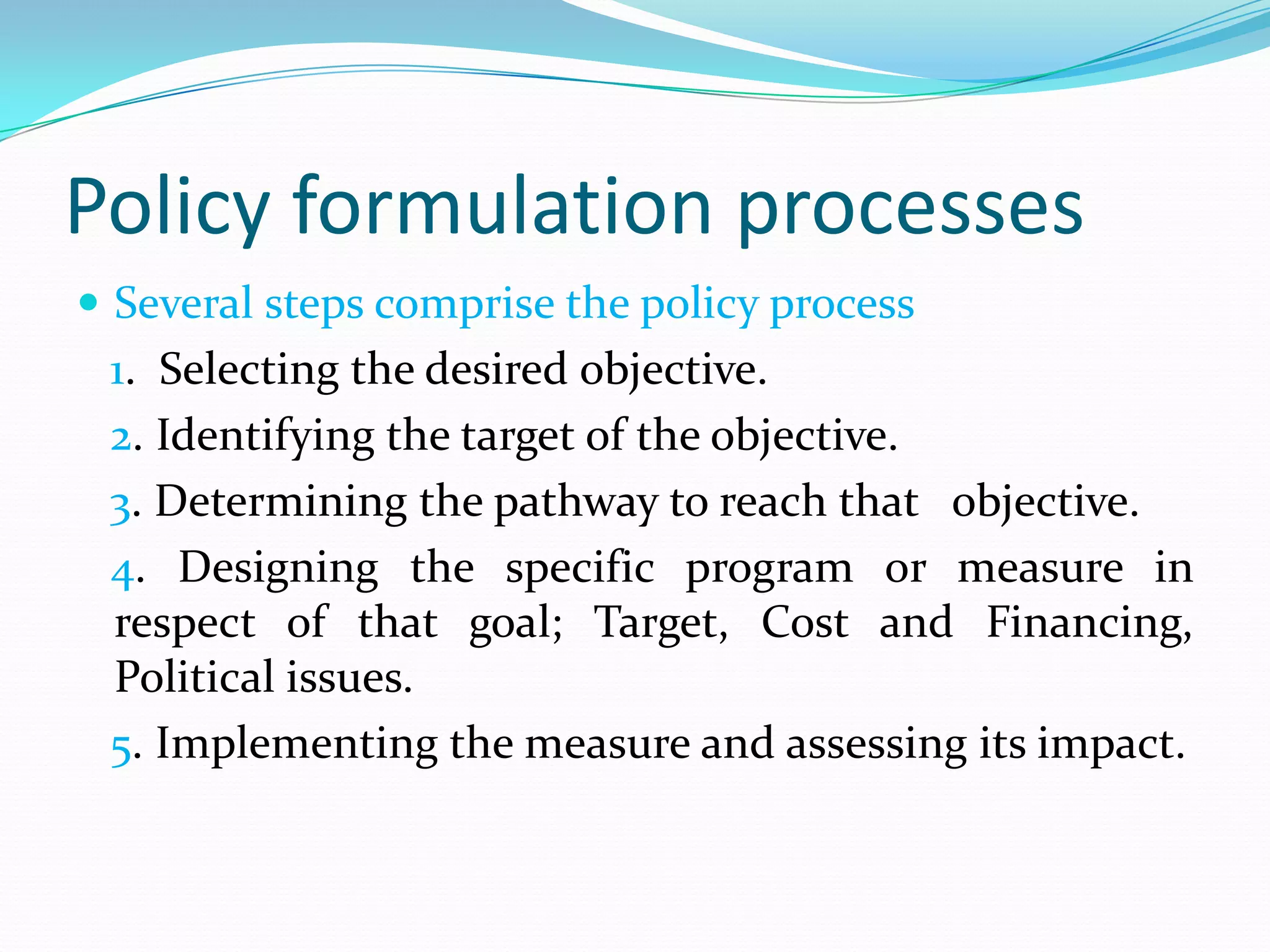
 Several steps comprise the policy process
 1. Selecting the desired objective.
 2. Identifying the target of the objective.
 3. Determining the pathway to reach that objective.
 4. Designing the specific program or measure in
 respect of that goal; Target, Cost and Financing,
 Political issues.
 5. Implementing the measure and assessing its impact.
Conclusion
 Public policy represents a decision, made by a publicly
  elected or designated body, which is deemed to be in
  the public interest.
 Policy development involves the selection of choices
  about the most appropriate means to a desired end. A
  policy decision is the result of a method, which in
  theory at least, considers a range of options and the
  potential impact of each. The weighing of options
  takes into account various factors, including:
Conclusion
 who benefits (the more the better).
 who might be negatively affected (the fewer the
  better).
 time required to implement the solution.
 associated cost and financing.
 political complexities of a federate government
  structure.
Conclusion
 At the end of the day, the formulation of public policy
  involves a process of making good decisions – for the
  public good.

Policy formulation and processes

  • 1.
  • 2.
    What is Policy A course of action that will create a desired objective in the interest of the masses or the people in a given country.
  • 3.
    Types of Policies Substantive and Administration policy The first is concerned with the legislation, programs and practices that govern the substantive aspects of community work. This dimension of policy includes, for example, income security, employment initiatives, child care services and social exclusion.
  • 4.
    Types of Policies The second type of policy focuses largely upon administrative procedures. These involve, for instance, the collection of statistical information on neighbourhoods and the evaluation of complex community programs.
  • 5.
    Types of Policies Vertical and Horizontal Policy Horizontal policy-making is developed by two or more organizations, each of which has the ability or mandate to deal with only one dimension of a given situation. Horizontal or integrated policy is created between parts of an organization or among organizational components that are similar in hierarchical position [Smith 2003: 11-12].
  • 6.
    Types of Policies Governments increasingly are focusing their efforts upon horizontal policy-making in recognition of the fact that many of the objectives they seek to achieve are complex and relate to the mandates of two or more departments, jurisdictions or non-governmental organizations. Areas of common interest include, for example, climate change, Youth employment and the range of concerns rooted in cities and communities.
  • 7.
    Types of Policies Vertical Policy Vertical policy is what we think of as the normal or traditional way in which policy decisions are made. It is developed within a single organizational structure and generally starts with broad overarching policy, sometimes called “corporate” or “framework” policy. Such decisions are made at head office and guide subsequent decisions throughout the organization.
  • 8.
    Types of Policies Reactive and Proactive Policy Reactive policy emerges in response to a concern or crisis that must be addressed – health emergencies and environmental disasters are two examples. Proactive policies, by contrast, are introduced and pursued through deliberate choice. Increasingly have been recognized as vital keys that unlock the doors to both economic wealth and social well-being.
  • 9.
    Types of Policies Current and Future Policy Those that are currently on the public agenda and those that are not. Issues already on the public policy agenda (e.g., health care) often have high profile. A formal process to amend or improve the existing arrangement generally is in place.
  • 10.
    Types of Policies If an issue is not currently or never has been ‘alive’ on the public agenda, then there is work to be done in making the case for its importance and raising awareness about the implications of non-response. Making the case usually involves gathering evidence that supports the policy. Relevant evidence includes, for example, research findings, evaluation data and results from focus groups.
  • 11.
    Purpose of PublicPolicy  Public policy has a clear and unique purpose which is; seeking to achieve a desired goal that is considered to be in the best interest of all members of society. Examples include clean air, clean water, good health, increased employment, an innovative economy, active trade, high educational attainment, decent and affordable housing, minimal levels of poverty, improved literacy, low crime and a socially cohesive society, to name a few.
  • 12.
    Policy development asa decision making process  A public policy is a deliberate and (usually) careful decision that provides guidance for addressing selected public concerns. Policy development can be seen, then, as a decision making process that helps address identified goals, problems or concerns. At its core, policy development entails the selection of a destination or desired objective.
  • 13.
    Policy development asa decision making process  The actual formulation of policy involves the identification and analysis of a range of actions that respond to these concerns. Each possible solution is assessed against a number of factors such as probable effectiveness, potential cost, resources required for implementation, political context and community support.
  • 14.
    Policy development asa decision making process  In short, any given policy represents the end result of a decision as to how best to achieve a specific objective. Most people actually apply a similar process in the decisions they make in their everyday lives – even around fairly inconsequential choices.
  • 15.
    Public Policy andPoverty reduction  Poverty reduction involves multiple pathways Like many public policy concerns, poverty is a complex issue whose roots can be traced to many different factors. These include low levels of literacy and education; poor health or severe disability; economic shocks such as recession or labour market restructuring that typically throw substantial numbers out of work; and sudden change in life circumstances, such as separation, divorce or death of a spouse.
  • 16.
    Public Policy andPoverty reduction While it has not been established that any one or all of these factors actually cause poverty, research evidence finds that they tend to be correlated with high levels of poverty. A correlation means that these factors are generally found to co-exist. The presence of multiple correlates of poverty means that a range of solutions is required to address this multidimensional problem.
  • 17.
    Policy formulation processes Several steps comprise the policy process 1. Selecting the desired objective. 2. Identifying the target of the objective. 3. Determining the pathway to reach that objective. 4. Designing the specific program or measure in respect of that goal; Target, Cost and Financing, Political issues. 5. Implementing the measure and assessing its impact.
  • 18.
    Conclusion  Public policyrepresents a decision, made by a publicly elected or designated body, which is deemed to be in the public interest.  Policy development involves the selection of choices about the most appropriate means to a desired end. A policy decision is the result of a method, which in theory at least, considers a range of options and the potential impact of each. The weighing of options takes into account various factors, including:
  • 19.
    Conclusion  who benefits(the more the better).  who might be negatively affected (the fewer the better).  time required to implement the solution.  associated cost and financing.  political complexities of a federate government structure.
  • 20.
    Conclusion  At theend of the day, the formulation of public policy involves a process of making good decisions – for the public good.