9/6/07 | pag. 1
A framework for public policy analysis
and policy evaluation
M. Theo Jans
IES research colloqium – 4 September 2007
Policy analysis
• Public policy focuses on ‘the public and its
problems’ (Dewey, 1927)
• The study of ‘how, why and to what effect
governments pursue particular courses of
action and inaction’ (Heidenheimer, 1990)
• ‘What governments do, why they do it, and
what difference does it make’ (Dye, 1976)
• ‘The study of the nature, causes, and
effects of public policies’ (Nagel, 1990)
Policy analysis
• Public policy concerned with:
– How are problems and issues defined and
constructed?
– How are they placed on political and policy agenda?
– How policy options emerge?
– How and why governments act or do not act
– What are the effects of government policy?
– …
• No single discipline, integrates what seems
useful for understanding
Policy analysis
• Multi-method (quantitative, qualitative)
• Multi-disciplinary (social sciences)
• Problem-focused
• Mapping the context
• Options and effects
• Analysis:
– Of policy => theories (determination, content,
evaluation)
– For policy => prescriptive, applied (techniques)
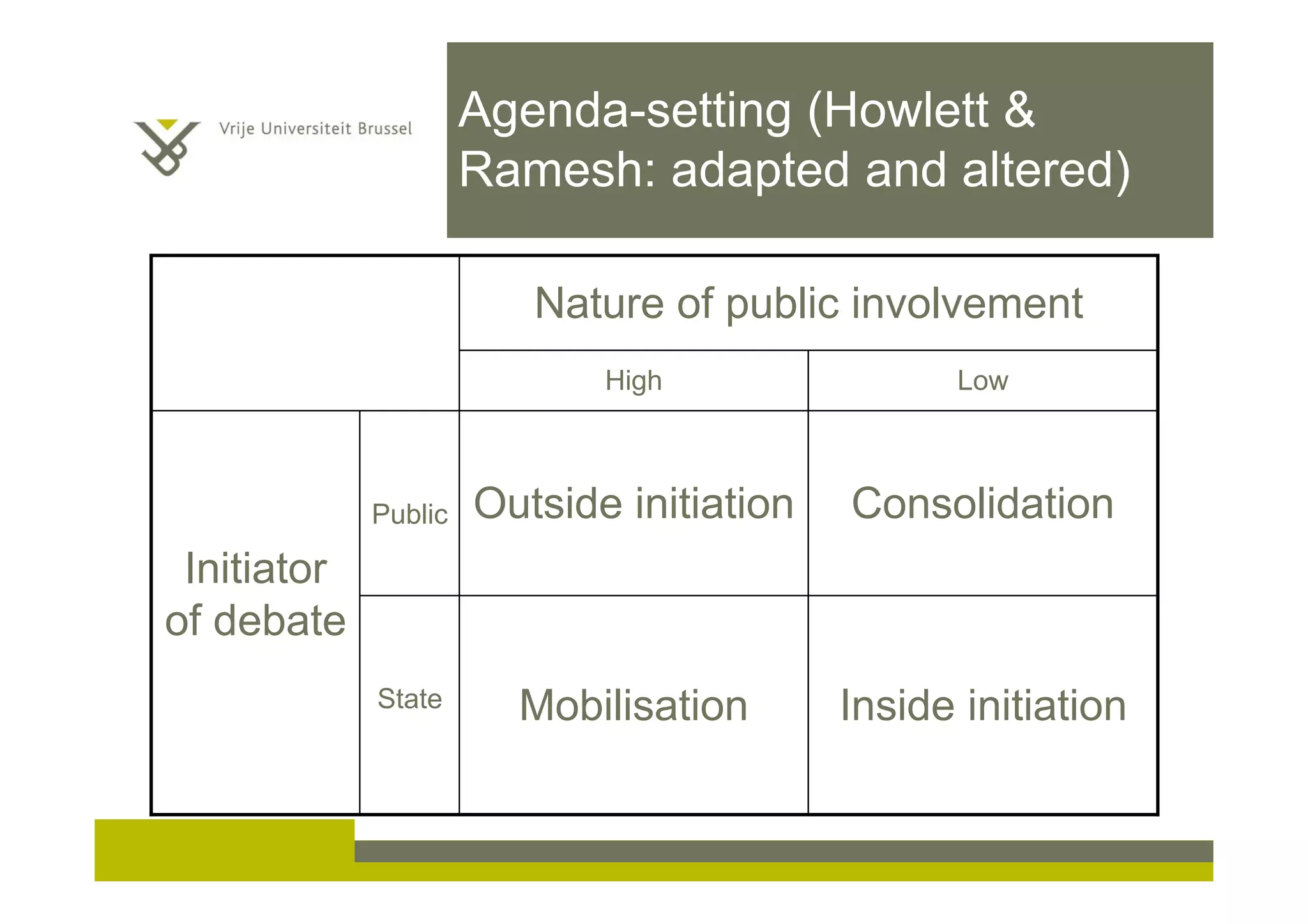
Agenda-setting (Howlett &
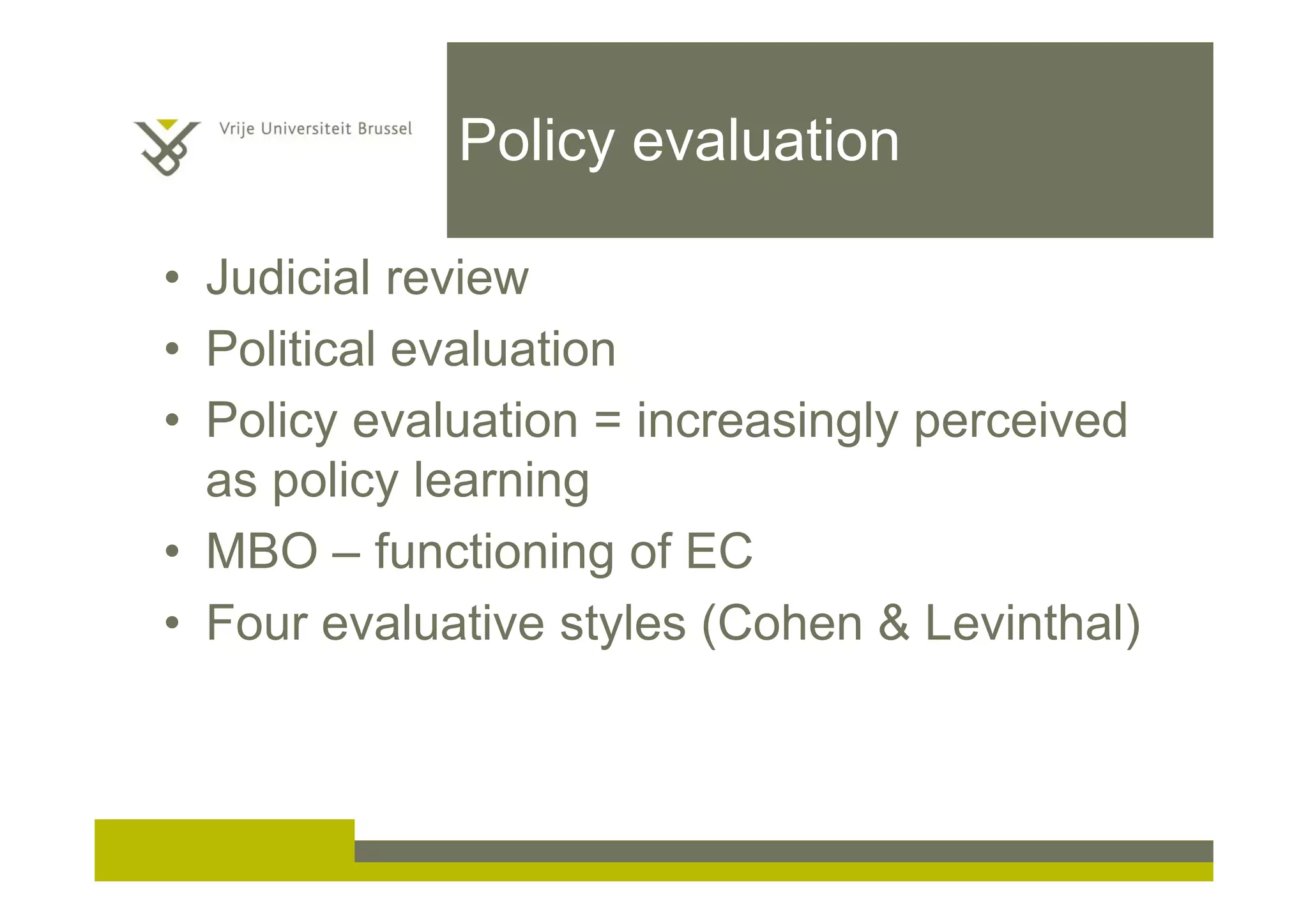
Ramesh: adapted and altered)
Inside initiationMobilisationState
ConsolidationOutside initiationPublic
Initiator
of debate
LowHigh
Nature of public involvement
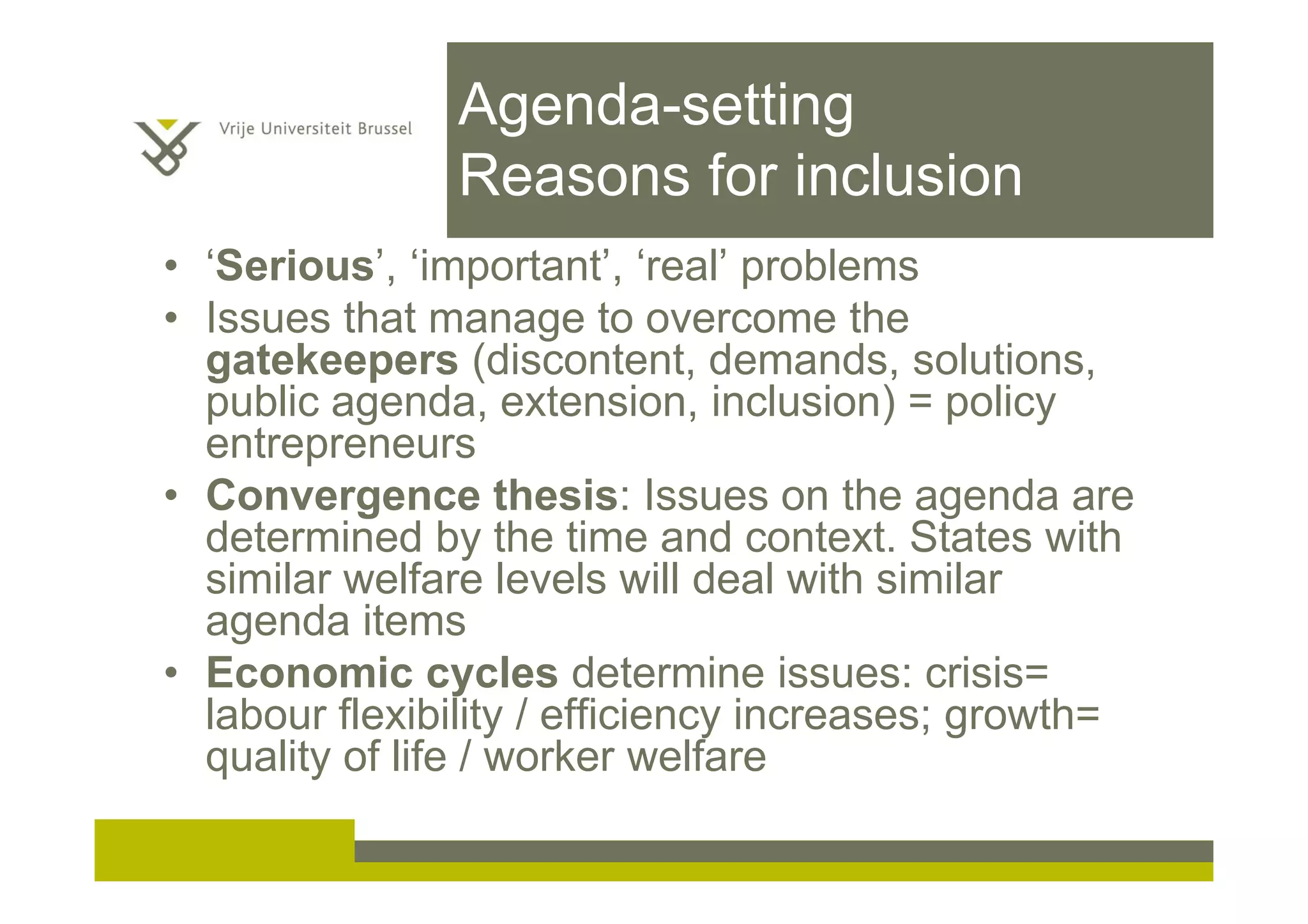
Agenda-setting
Reasons for inclusion
• ‘Serious’, ‘important’, ‘real’ problems
• Issues that manage to overcome the
gatekeepers (discontent, demands, solutions,
public agenda, extension, inclusion) = policy
entrepreneurs
• Convergence thesis: Issues on the agenda are
determined by the time and context. States with
similar welfare levels will deal with similar
agenda items
• Economic cycles determine issues: crisis=
labour flexibility / efficiency increases; growth=
quality of life / worker welfare
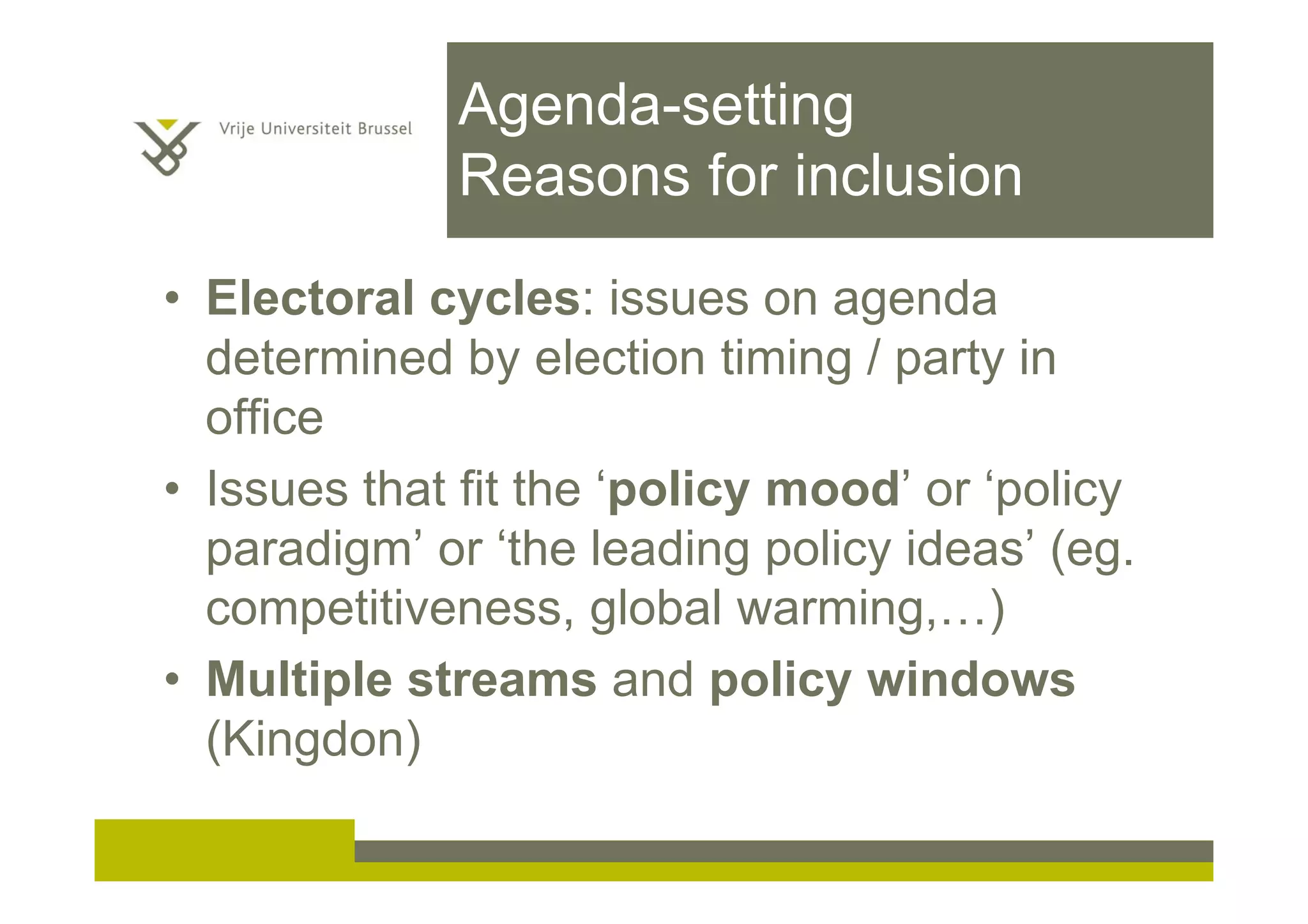
Agenda-setting
Reasons for inclusion
• Electoral cycles: issues on agenda
determined by election timing / party in
office
• Issues that fit the ‘policy mood’ or ‘policy
paradigm’ or ‘the leading policy ideas’ (eg.
competitiveness, global warming,…)
• Multiple streams and policy windows
(Kingdon)
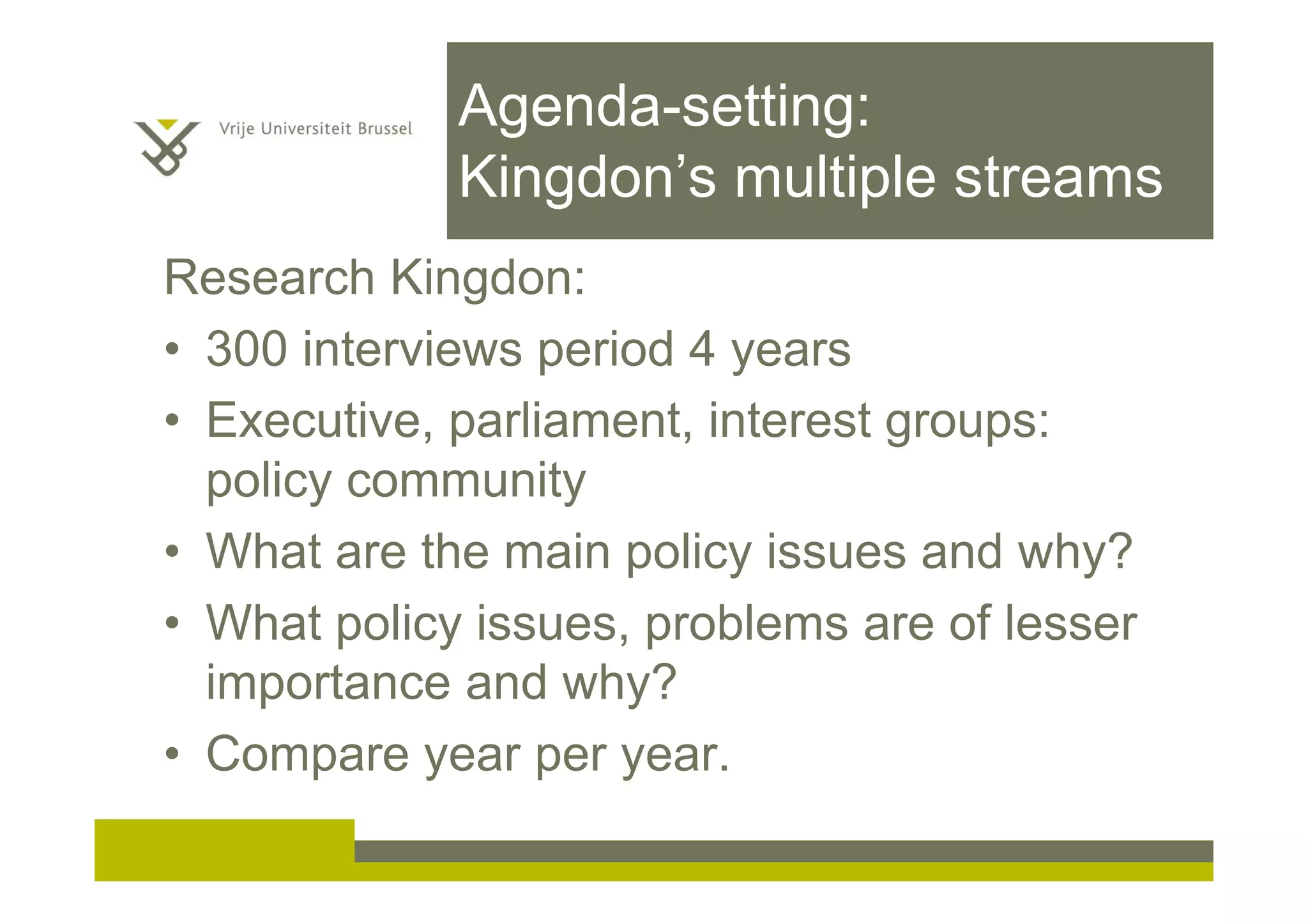
Agenda-setting:
Kingdon’s multiple streams
Research Kingdon:
• 300 interviews period 4 years
• Executive, parliament, interest groups:
policy community
• What are the main policy issues and why?
• What policy issues, problems are of lesser
importance and why?
• Compare year per year.
Agenda-setting:
Kingdon’s multiple streams
• Origin is necessary but unclear, follow-up is
much more important for inclusion
• “I can trace the paths of ideas. But my personal
theory is that people plant seeds every day.
There are a lot of ideas around, and there is no
lacking of ideas. The real question is, which of
these ideas will catch hold ? When you plant a
seed you need rain, soil, and luck.” (Kingdon,
81)
• Streams of recognised problems, of policy
solutions, stream of political events.
Agenda-setting:
Stream of recognised problems
• Stream problem recognition by actors in- and outside government
– Indicators: volume, change (IM scoreboard, week-end traffic
accidents)
– Focus events: 9/11
– Policy feedback: evaluation, complaints (speeding fines, small
arms legislation)
• Conditions become problems
– Clash with norms, values, principles
– Unfavourable comparisons with other countries/situations
• Problems can go back to being social conditions again
– Something was done, time and effort was spent on the issue
(BHV)
– Indicators decrease, crisis dissolves
– Acceptance and getting used to problem (high unemployment
levels, racism)
– Other problems take priority and absorb the attention
Agenda-setting:
Stream of policy solutions
• Stream Policy Community
– Administration, academics, policy advisors, think
thanks, interest groups: formulate policy proposals
• Primeval policy soup: multitude of ideas are
debated, combined, tested, exchanged, and
evaluated
• Selection mechanism: ‘survival of the fittest’
– Technical and administrative feasibility
– Congruence with dominant values
– Anticipation of probable resistance (budget, public
opinion, political receptiveness)
Agenda-setting:
Stream of politics
• Events (ex. dioxine in poultry, prison
escape Dutroux, coalition negotiations)
• Elections
• Governmental majorities
• Activities of interest groups
• The political climate
• ...
Agenda-setting:
When streams meet
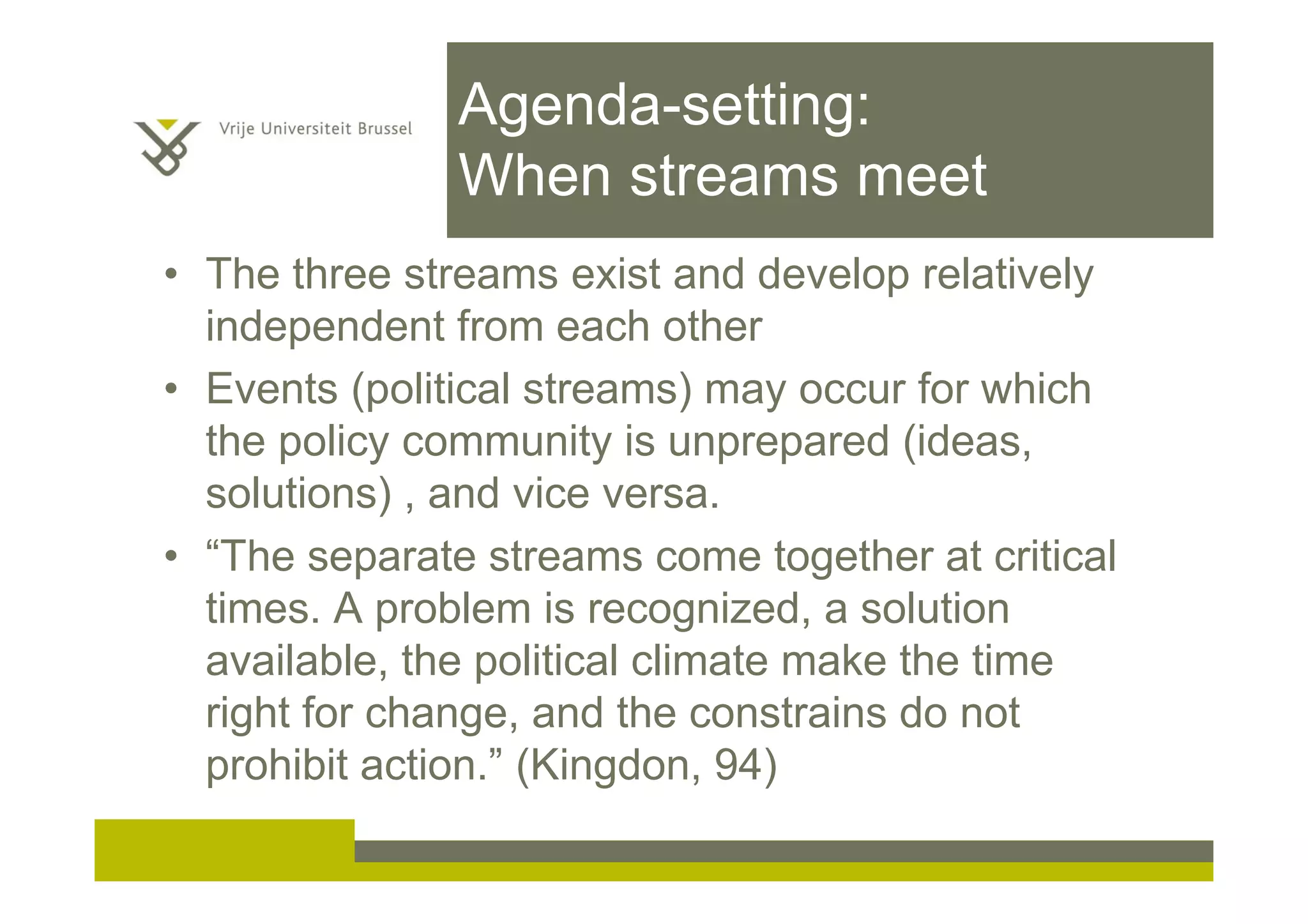
• The three streams exist and develop relatively
independent from each other
• Events (political streams) may occur for which
the policy community is unprepared (ideas,
solutions) , and vice versa.
• “The separate streams come together at critical
times. A problem is recognized, a solution
available, the political climate make the time
right for change, and the constrains do not
prohibit action.” (Kingdon, 94)
Agenda-setting:
Policy window
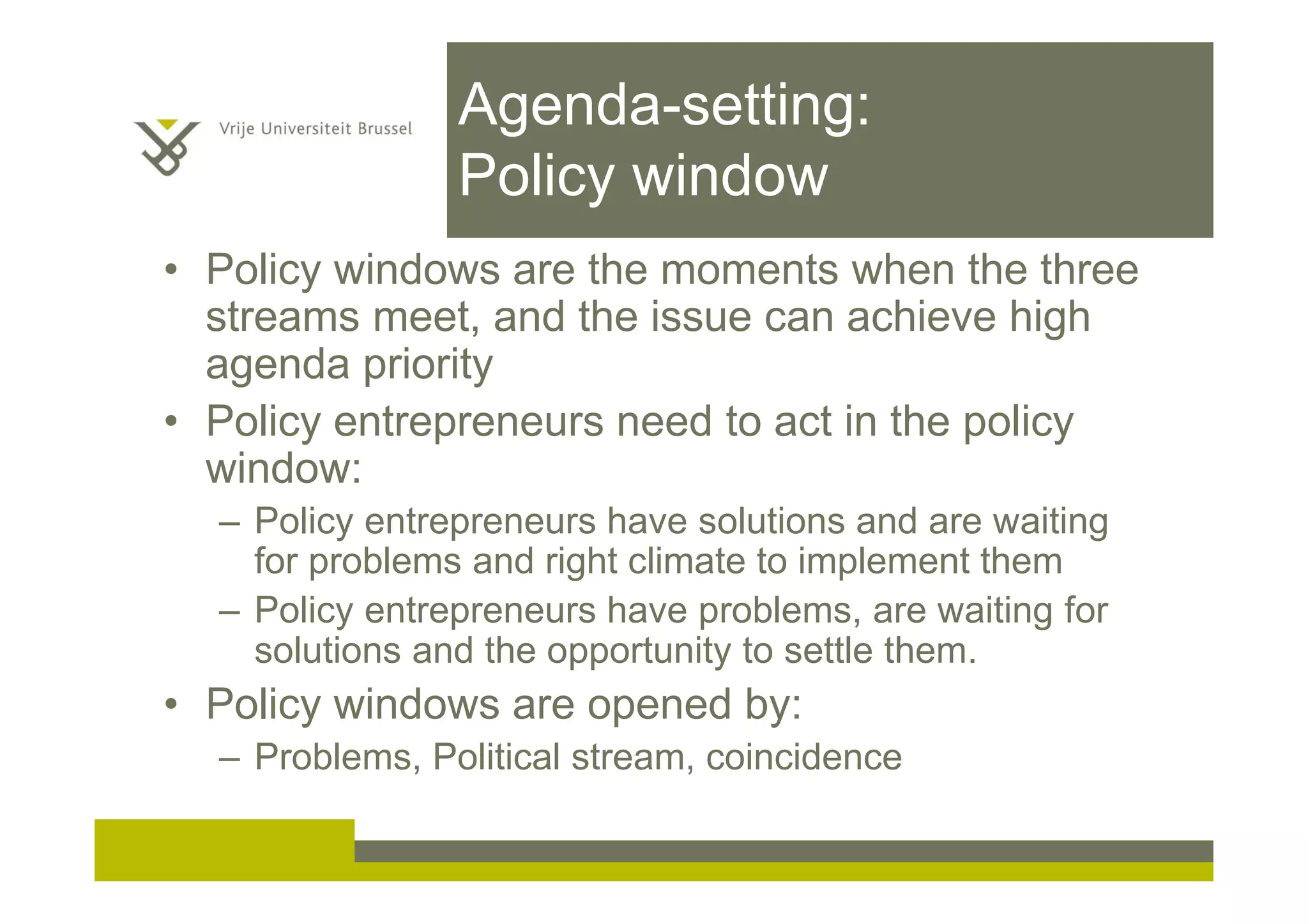
• Policy windows are the moments when the three
streams meet, and the issue can achieve high
agenda priority
• Policy entrepreneurs need to act in the policy
window:
– Policy entrepreneurs have solutions and are waiting
for problems and right climate to implement them
– Policy entrepreneurs have problems, are waiting for
solutions and the opportunity to settle them.
• Policy windows are opened by:
– Problems, Political stream, coincidence
Agenda-setting:
Policy window
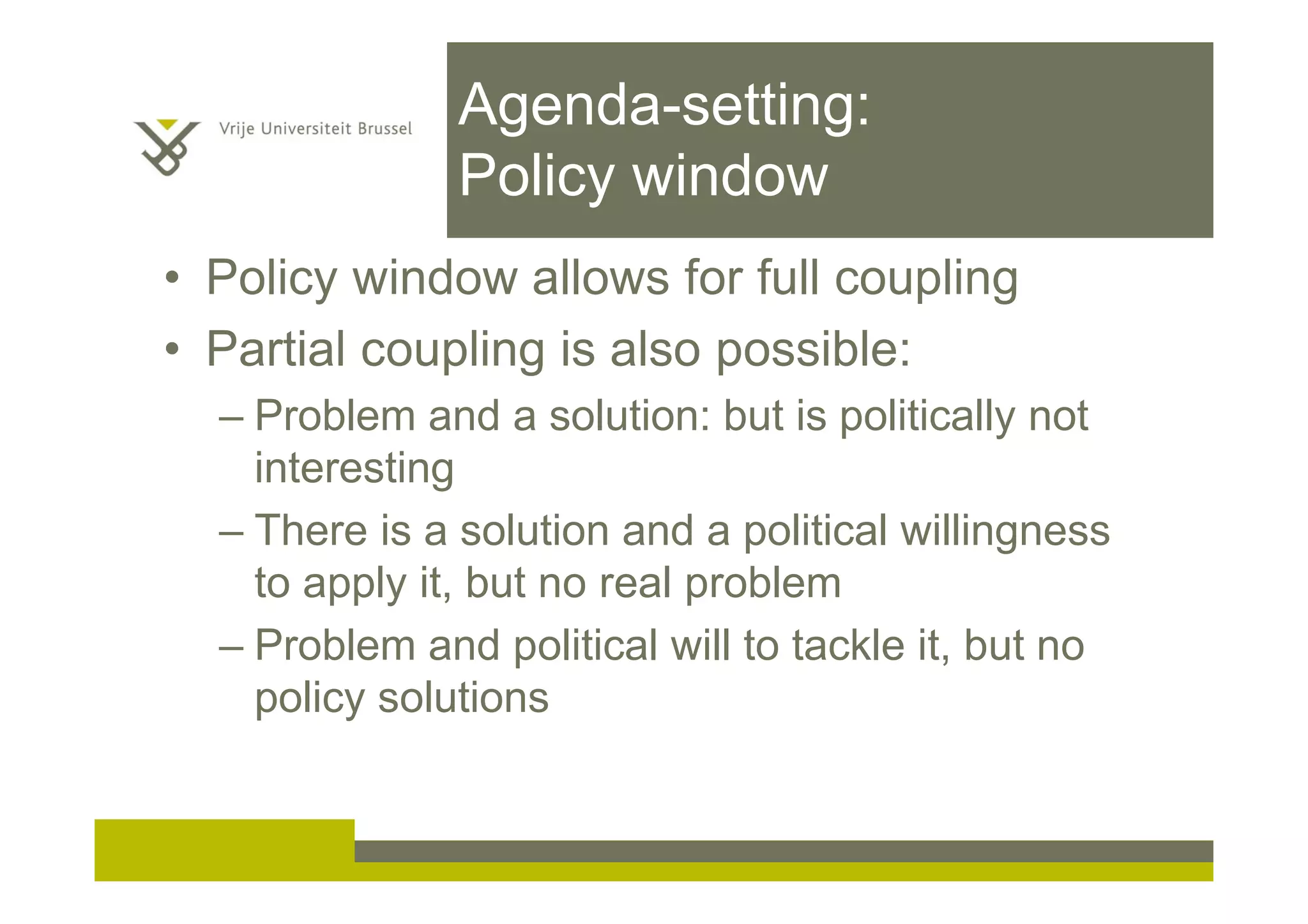
• Policy window allows for full coupling
• Partial coupling is also possible:
– Problem and a solution: but is politically not
interesting
– There is a solution and a political willingness
to apply it, but no real problem
– Problem and political will to tackle it, but no
policy solutions
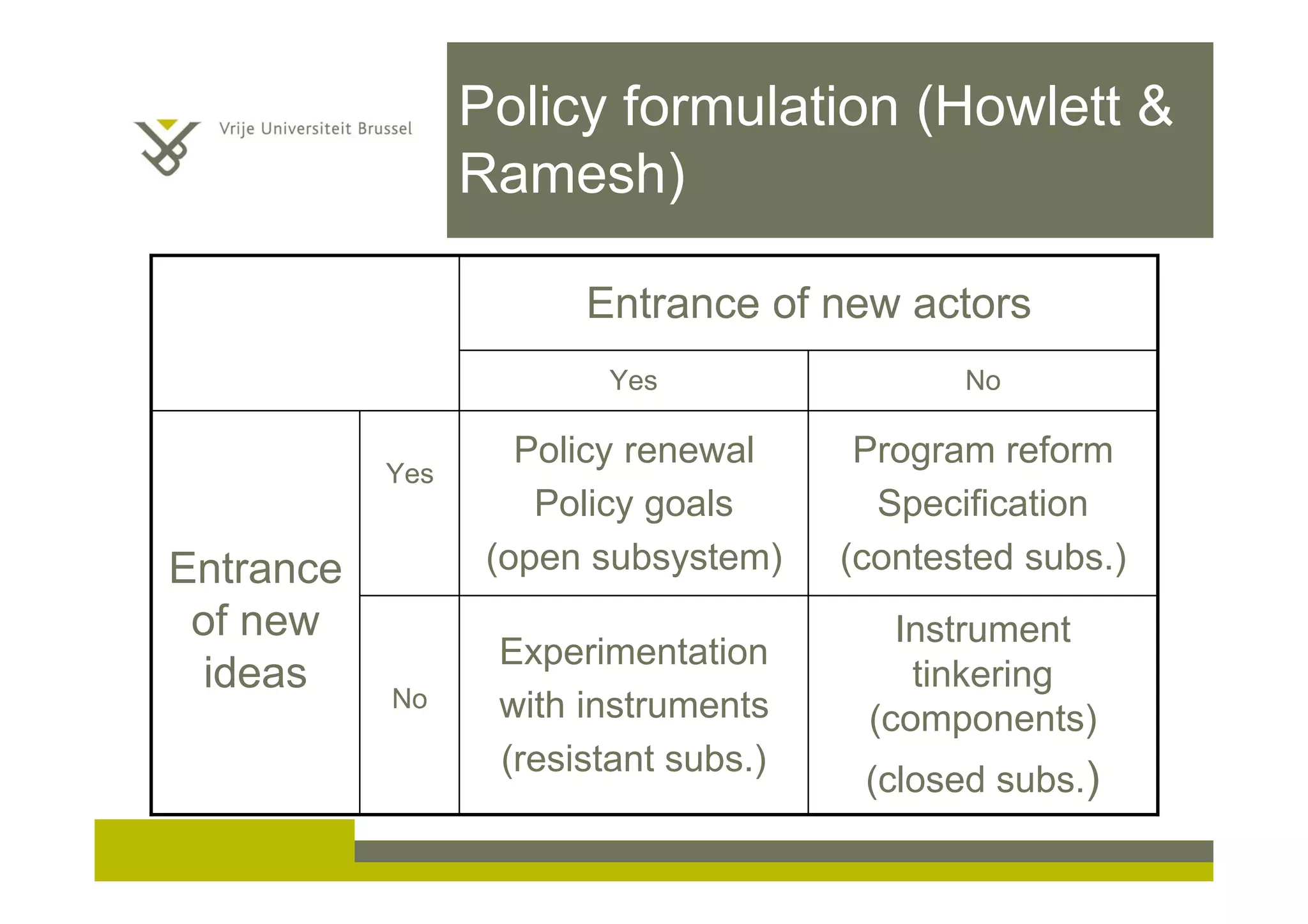
Policy formulation
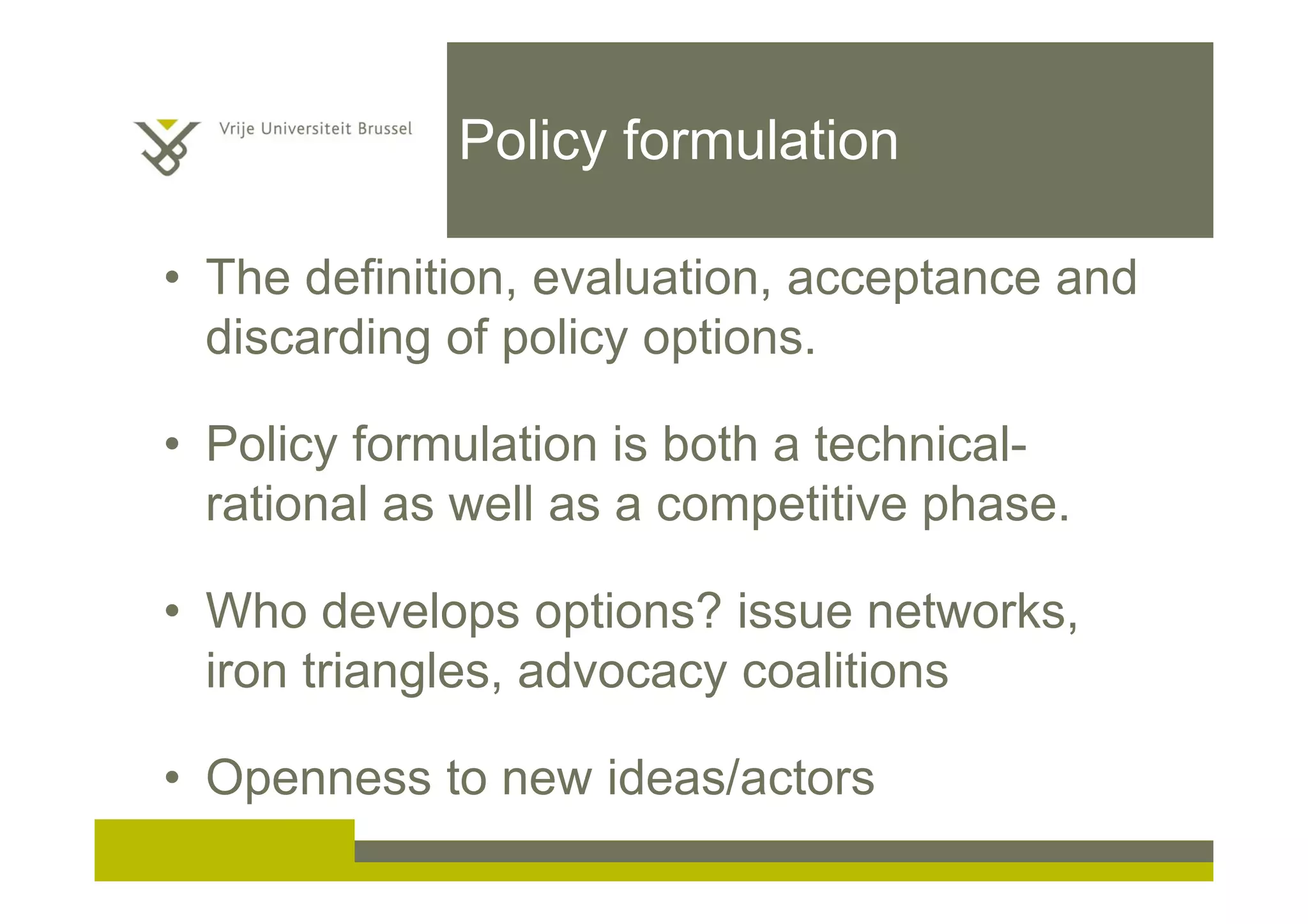
• The definition, evaluation, acceptance and
discarding of policy options.
• Policy formulation is both a technical-
rational as well as a competitive phase.
• Who develops options? issue networks,
iron triangles, advocacy coalitions
• Openness to new ideas/actors
Policy formulation (Howlett &
Ramesh)
Instrument
tinkering
(components)
(closed subs.)
Experimentation
with instruments
(resistant subs.)
No
Program reform
Specification
(contested subs.)
Policy renewal
Policy goals
(open subsystem)
Yes
Entrance
of new
ideas
NoYes
Entrance of new actors
Decision-making
Three models
• The rational model
• The incremental model
• The irrational model
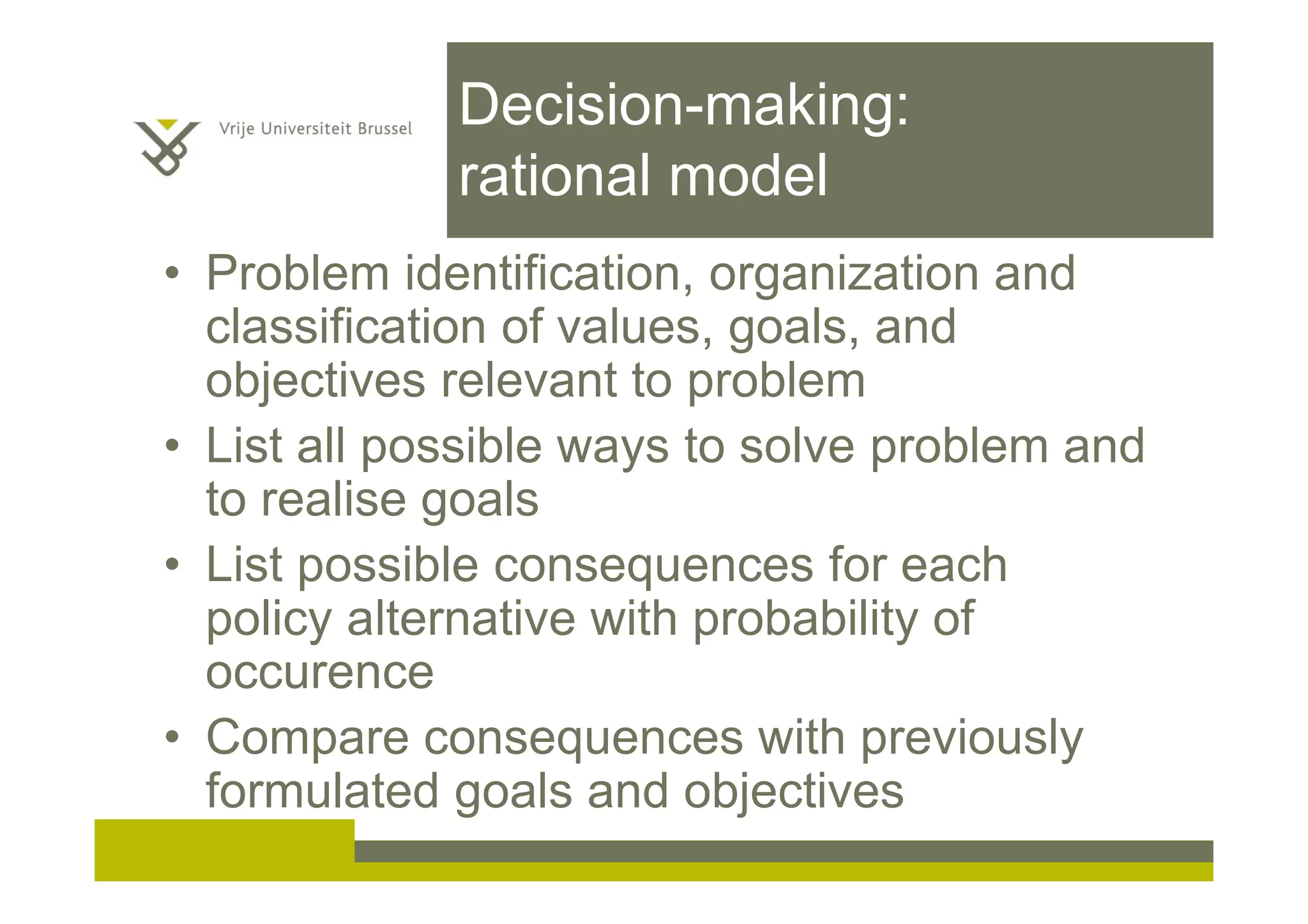
Decision-making:
rational model
• Problem identification, organization and
classification of values, goals, and
objectives relevant to problem
• List all possible ways to solve problem and
to realise goals
• List possible consequences for each
policy alternative with probability of
occurence
• Compare consequences with previously
formulated goals and objectives
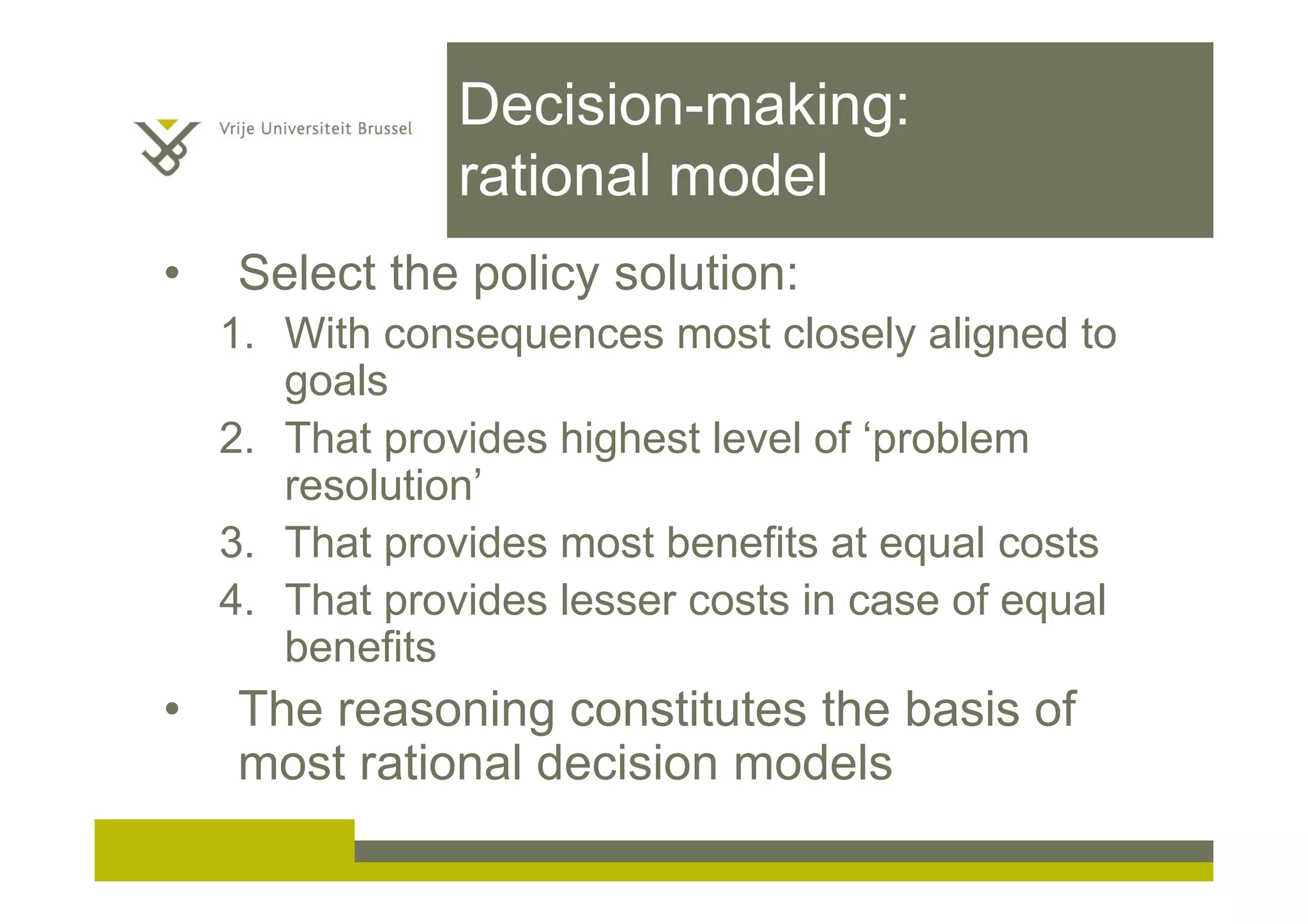
Decision-making:
rational model
• Select the policy solution:
1. With consequences most closely aligned to
goals
2. That provides highest level of ‘problem
resolution’
3. That provides most benefits at equal costs
4. That provides lesser costs in case of equal
benefits
• The reasoning constitutes the basis of
most rational decision models
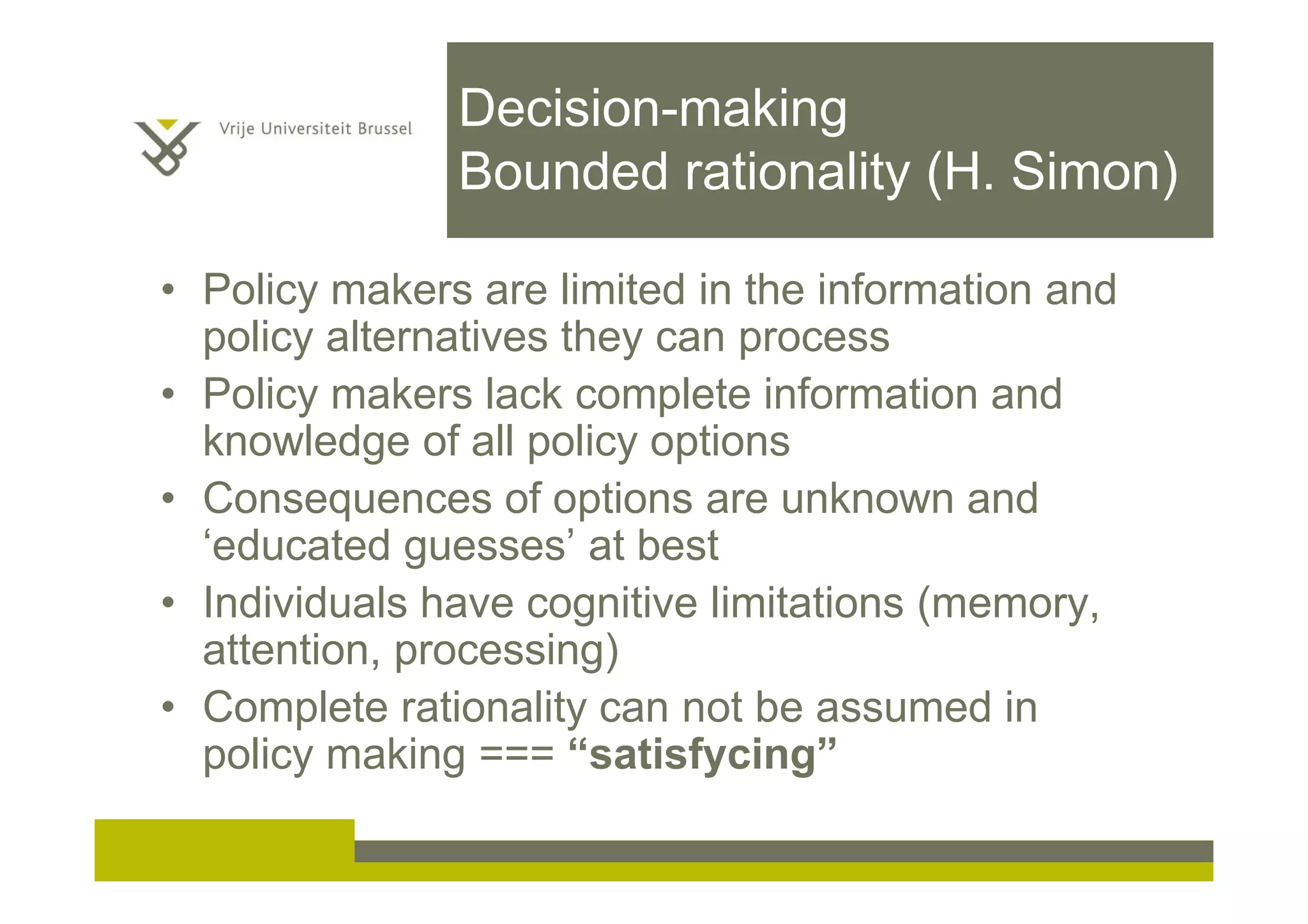
Decision-making
Bounded rationality (H. Simon)
• Policy makers are limited in the information and
policy alternatives they can process
• Policy makers lack complete information and
knowledge of all policy options
• Consequences of options are unknown and
‘educated guesses’ at best
• Individuals have cognitive limitations (memory,
attention, processing)
• Complete rationality can not be assumed in
policy making === “satisfycing”
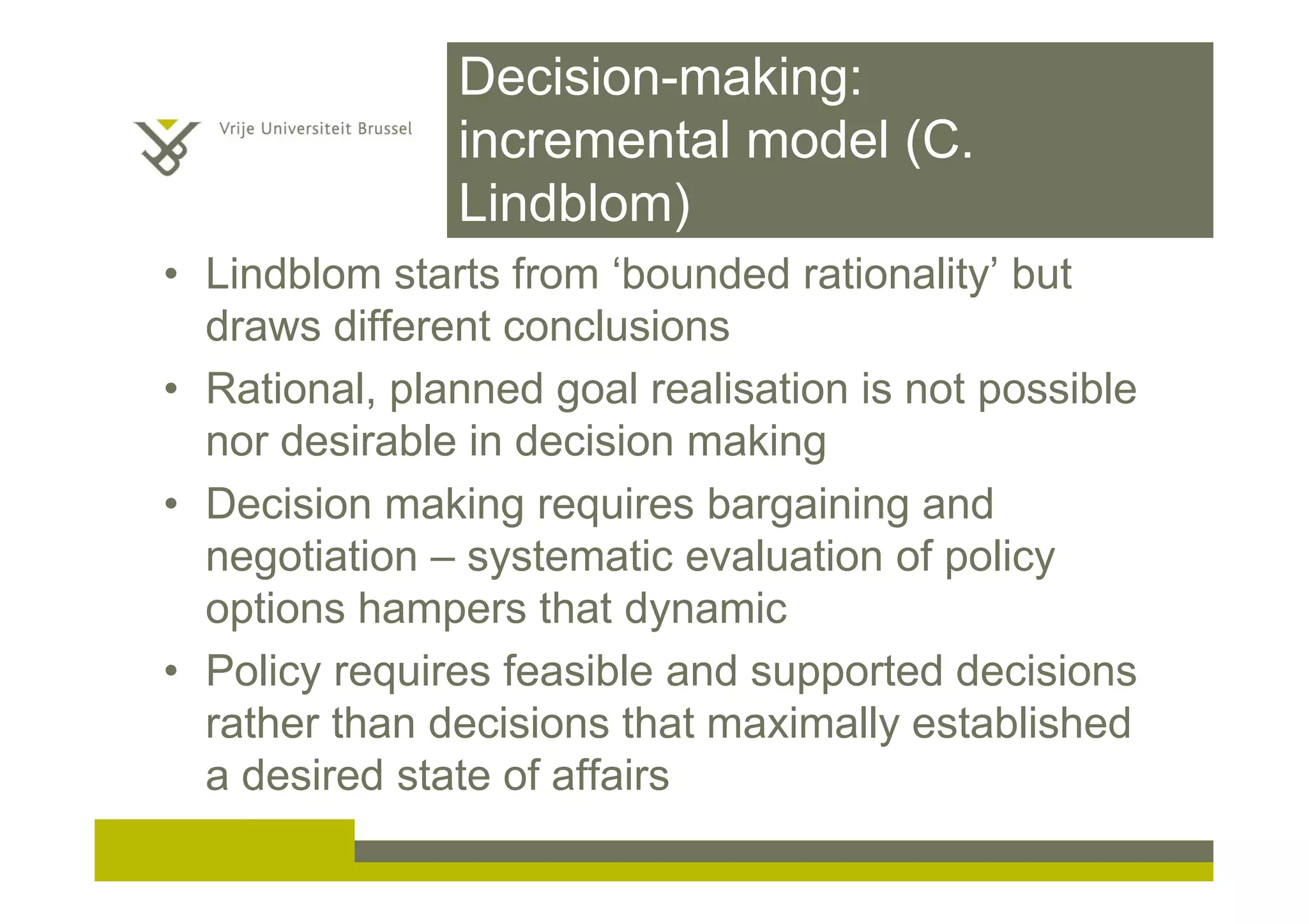
Decision-making:
incremental model (C.
Lindblom)
• Lindblom starts from ‘bounded rationality’ but
draws different conclusions
• Rational, planned goal realisation is not possible
nor desirable in decision making
• Decision making requires bargaining and
negotiation – systematic evaluation of policy
options hampers that dynamic
• Policy requires feasible and supported decisions
rather than decisions that maximally established
a desired state of affairs
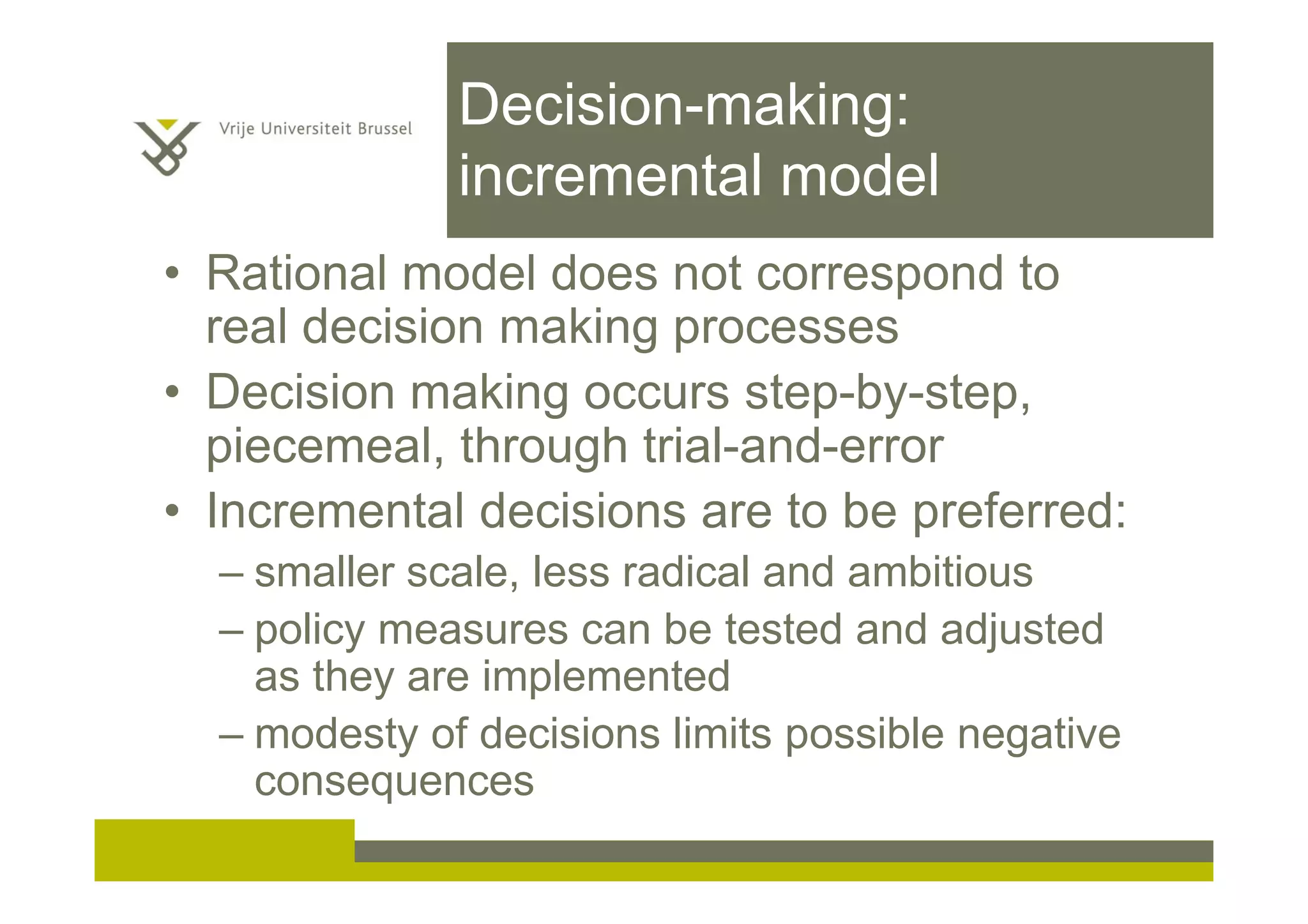
Decision-making:
incremental model
• Rational model does not correspond to
real decision making processes
• Decision making occurs step-by-step,
piecemeal, through trial-and-error
• Incremental decisions are to be preferred:
– smaller scale, less radical and ambitious
– policy measures can be tested and adjusted
as they are implemented
– modesty of decisions limits possible negative
consequences
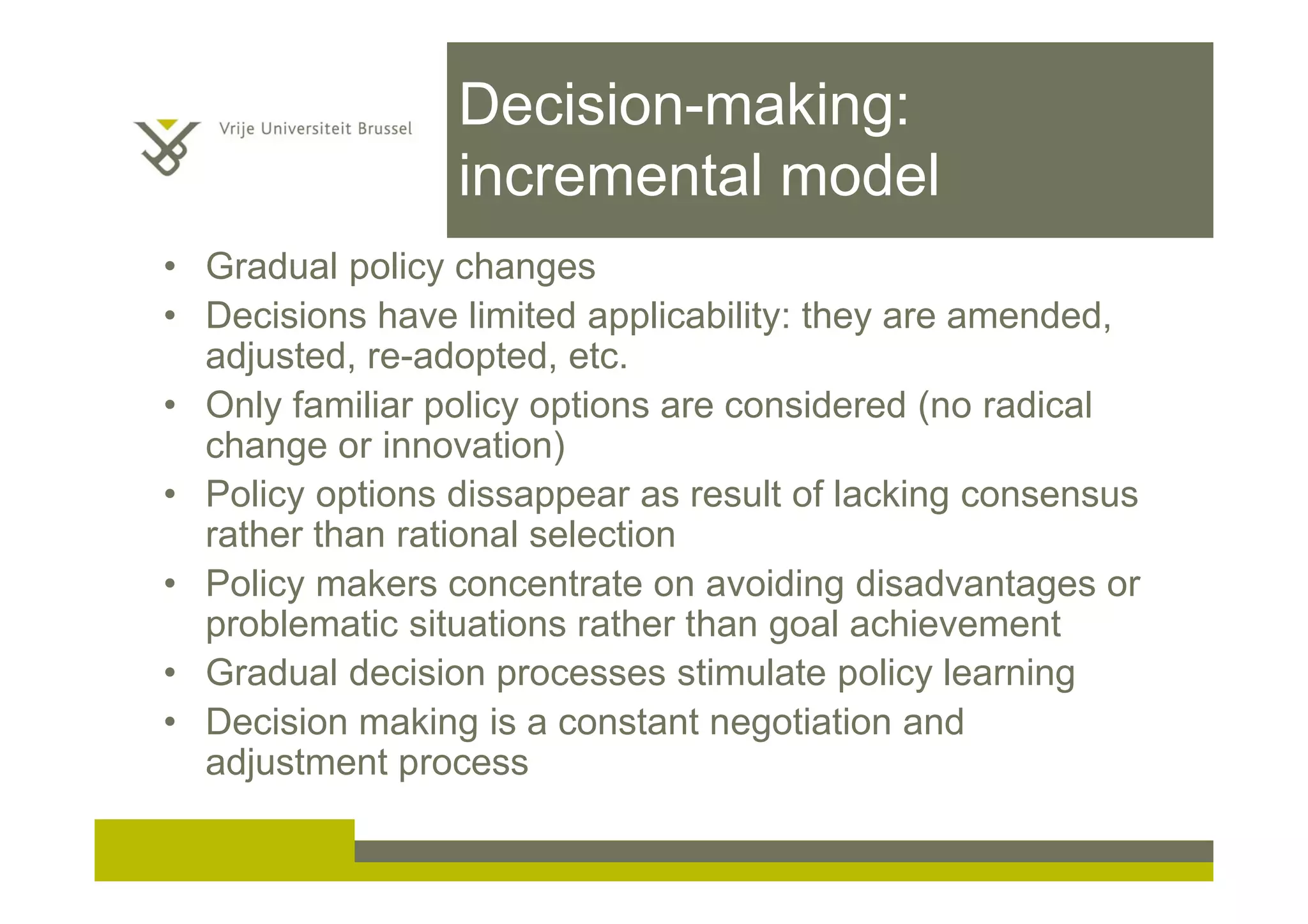
Decision-making:
incremental model
• Gradual policy changes
• Decisions have limited applicability: they are amended,
adjusted, re-adopted, etc.
• Only familiar policy options are considered (no radical
change or innovation)
• Policy options dissappear as result of lacking consensus
rather than rational selection
• Policy makers concentrate on avoiding disadvantages or
problematic situations rather than goal achievement
• Gradual decision processes stimulate policy learning
• Decision making is a constant negotiation and
adjustment process
Decision-making:
irrational model
• March, Cohen, Olsen: analysis of decision
making in universities
• Non-rational, nor incremental decision-
making
• Rather coincidental congruence between
problems, solutions and choice
opportunities
• Problems, solutions and choice moments
are ‘dumped’ in garbage cans
Decision-making:
organised anarchies
• Unclear preferences and goals: organisation is a
loose collection of ideas with few clear goals
(multiple goals)
– No clear preferences: would lead to conflict
– Preferences and strategy are developed through
action, rather than that action is guided by
preferences or strategies
– Often organisations have multiple goals (quality
research, education, many students, income, smooth
running administration, happy alumni)
Decision-making:
organised anarchies
• Incomplete knowledge of technology and
organisation: own role is known, partial
understanding of other roles and of
procedures within organisation
– Knowledge of how institution is acquired
through ‘trial-and-error’ or is deduced from
experiences and responses in crisis situations
• Varying participation: participation and
time investment varies considerably
among participants: impact on outcome
Implementation
• Pressman & Wildawsky: “Implementation”
• “how great expectations in Washington are
dashed in Oackland; or why it is amazing
that Federal programs work at all, this
being a saga of the economic
development administration as told by two
sympathetic observers who seek to build
morals on a foundation of ruined hopes”
(1973 federal program for unemployed inhabitants of
Oackland)
Pressman - Wildavsky
Top-down implementation
• Frustration felt with the failures of ‘the war
on poverty’ and ‘great society’
programmes (in late sixties)
• Sentiment that rationalized decision
making (Simon, McNamara) was not
leading to desired policy outcomes
• Not because bad decisions were taken but
rather because good decisions were badly
implemented
Pressman - Wildavsky
Top-down implementation
• Multiple intermediary actors (govs., agencies) for
implementation require perfect co-operation
(Wildavsky)
• Less than perfect co-operation leads to an
accumulation of small mishaps which trigger
policy large failures
• Careful implementation design is the key to
succes = top-down approach
• Monitoring and control of implementation
(Military chain of command)
Michael Lipsky
The bottom-up perspective
• Implementation: analysis of front-line staff
in policy delivery agencies or ‘street-level’
bureaucrats
• Policy is made as it is being administered
• “The decisions of street-level bureaucrats,
the routines they establish, and the
devices they invent to cope with
uncertainties and work pressures,
effectively become the public policies they
carry out”
Michael Lipsky
The bottom-up perspective
• Street-level bureaucrats start with high
service ambitions but ‘large classes’ or
‘huge caseloads’, inadequate resources,
uncertainties of method, unpredictability of
of clients defeat their initial aspirations
• To cope with pressures, implementers
develop methods of processing people in
a routine and stereotyped way =
techniques to salvage service and
decision making values
Implementation and ambiguity:
R. Matland.
Symbolic
implementation
(local coalitions)
Political
implementation
(power and
feedback)
High
Experimental
implementation
(context, variation,
learning)
Administrative
implementation
(planning and
resources)
Low
Level
conflict
HighLow
Policy ambiguity
Policy evaluation
• The stage of the policy process at which it
is determined how a public policy has
actually fared in action (Howlett &
Ramesh) = evaluation of means being
employed and objectives being served
• Problem no universal and fixed criteria
– Spectacular failures
– Substantive failures
– Procedural failures
Policy evaluation
• Evaluate output in function of
expectations/goals BUT failure or succes
is a judgement of events (not inherent to
the event)
• Goals often vague, multiple, no ranking,
shifting throughout policy stages.
• Evaluation inherent, build-in biases
Policy evaluation
• Administrative:
– Effort evaluation: screen and monetarise inputs -
“what does it cost”
– Performance: screen outputs (graduates,
publications) - “what is it doing”
– Effectiveness: “is it doing what it is supposed to be
doing” – goals vs. outputs
– Efficiency: input evaluation / output evaluation and
seek to reduce input (lower cost)
– Process evaluation: organization methods used and
possibilities for process re-engineering
Policy evaluation
• Judicial review
• Political evaluation
• Policy evaluation = increasingly perceived
as policy learning
• MBO – functioning of EC
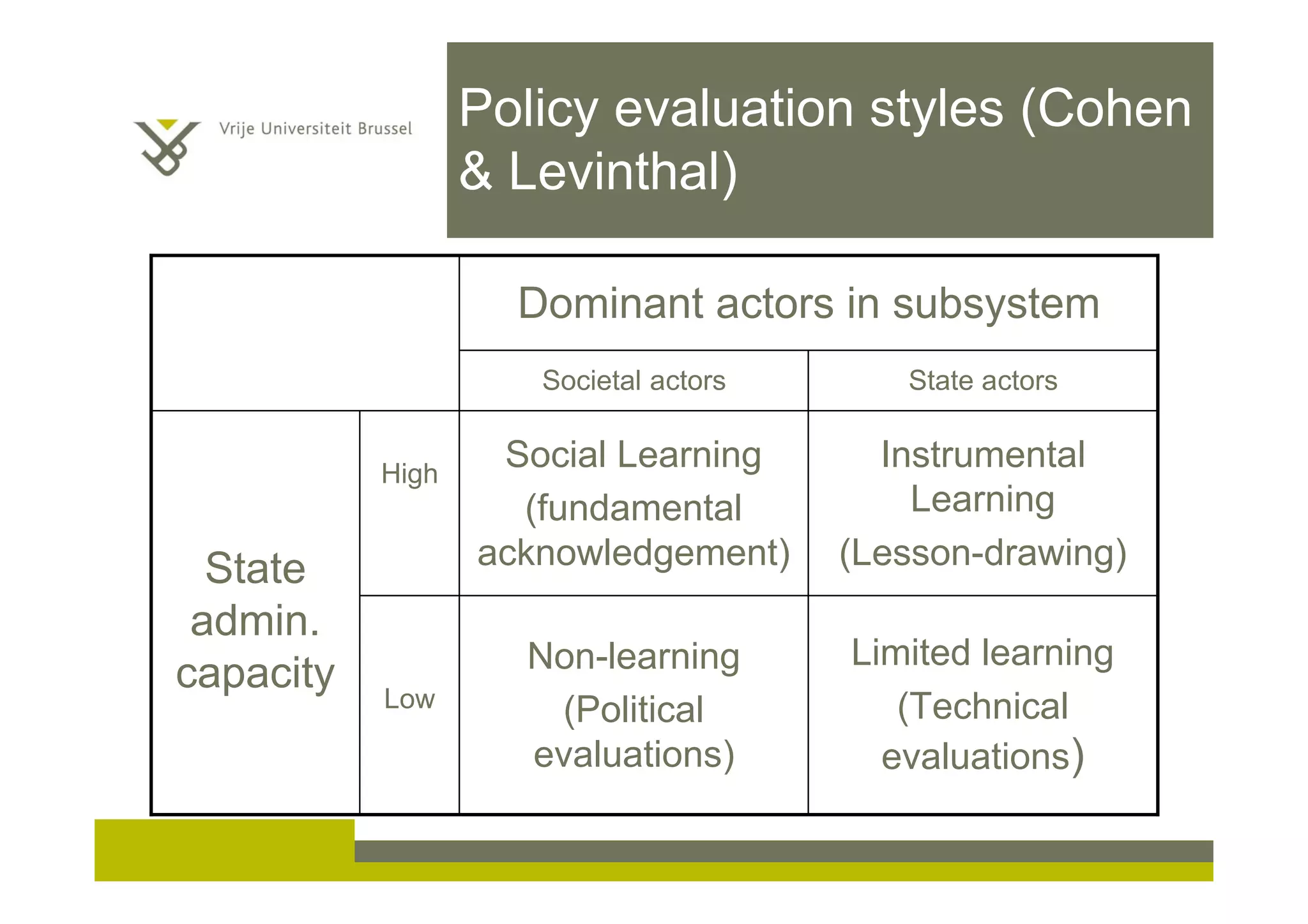
• Four evaluative styles (Cohen & Levinthal)
Policy evaluation styles (Cohen
& Levinthal)
Limited learning
(Technical
evaluations)
Non-learning
(Political
evaluations)
Low
Instrumental
Learning
(Lesson-drawing)
Social Learning
(fundamental
acknowledgement)
High
State
admin.
capacity
State actorsSocietal actors
Dominant actors in subsystem
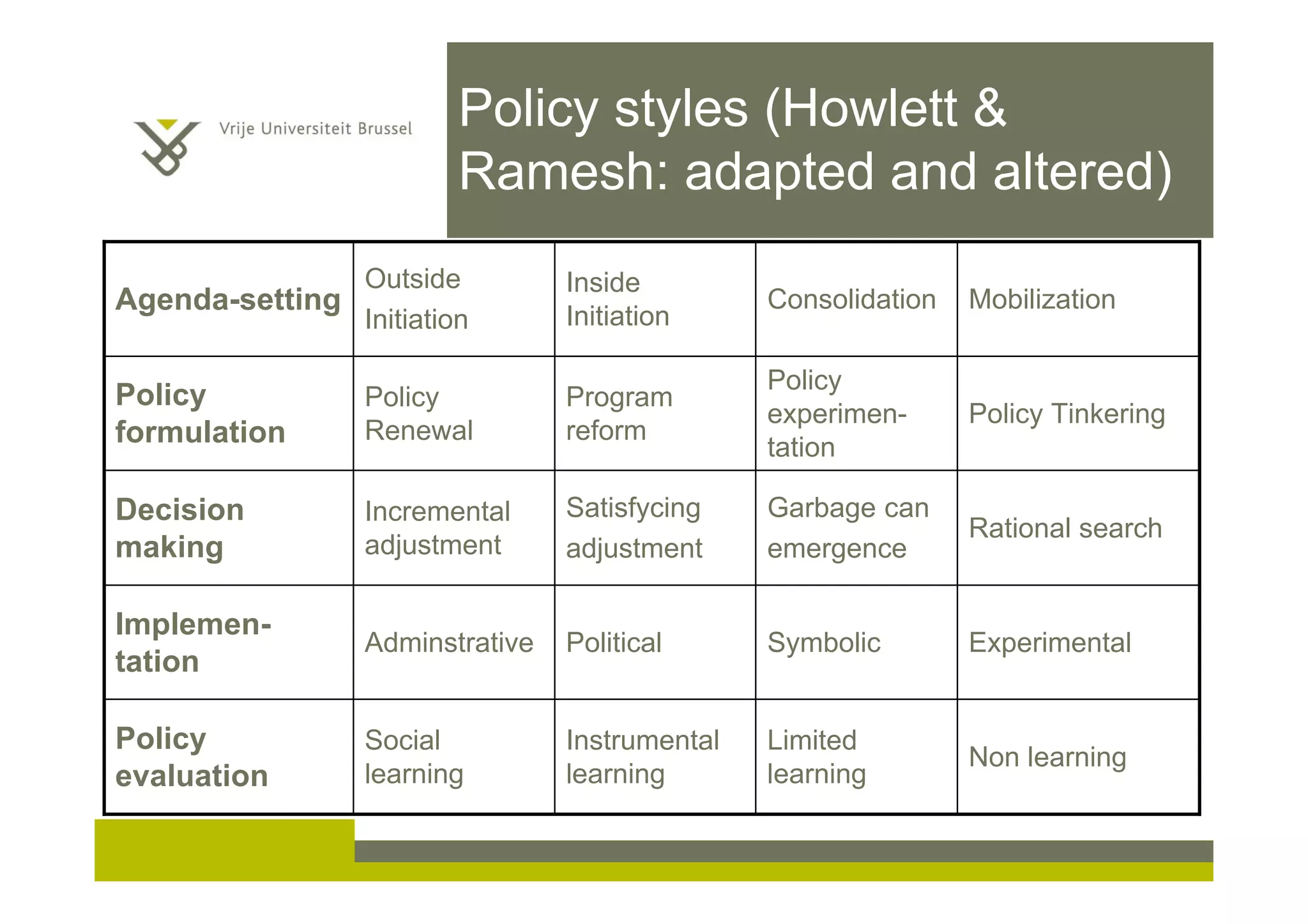
Policy styles (Howlett &
Ramesh: adapted and altered)
Non learning
Limited
learning
Instrumental
learning
Social
learning
Policy
evaluation
ExperimentalSymbolicPoliticalAdminstrative
Implemen-
tation
Rational search
Garbage can
emergence
Satisfycing
adjustment
Incremental
adjustment
Decision
making
Policy Tinkering
Policy
experimen-
tation
Program
reform
Policy
Renewal
Policy
formulation
MobilizationConsolidation
Inside
Initiation
Outside
Initiation
Agenda-setting
Bibliography
• M. Howlett, M. Ramesh (2003) Studying public policy. Policy cycles and policy
subsystems. OUP, Canada.
• M.D. Cohen, J.G March, J.P. Olsen (1972) A garbage can model of organizational
choice. Administrative Science Quarterly, 17, 1: 1-25.
• W.M. Cohen, D.A. Levinthal (1990) Absorptive capacity: a new perspective on
learning and innovation. Administrative Science Quarterly, 35: 128-52.
• B.W. Hogwood, L.A. Gunn (1984) Policy analysis for the real world. New York: Oxford
University Press.
• J.W. Kingdon (1984) Agendas, alternatives and public policies. Boston, Little, Brown.
• C.E. Lindblom (1979) Still muddling through. Public Administration Review, 39, 6:
517-25.
• J.L. Pressman, A.B. Wildavsky (1984) Implementation: how great expectations in
Washington are dashed in Oakland. 3rd edn. Berkeley, University of California Press.
• M. Lipsky (1980) Street-level bureaucracy: dilemmas of the individual in public
services. New York: Russell Sage Foundation.
• R.E. Matland (1995) Synthesizing the implementation literature: the ambiguity-conflict
model of policy implementation. Journal of Public Administration Research and
Theory, 5, 2.
• P.A. Sabatier (1999) The need for better theories. in P.A. Sabatier (1999) ed.
Theories of the policy process. Boulder Colorado: Westview Press.
• H.A. Simon (1957) Models of man: social and rational. John Wiley: New York.

Policy analysis

  • 1.
    9/6/07 | pag.1 A framework for public policy analysis and policy evaluation M. Theo Jans IES research colloqium – 4 September 2007
  • 2.
    Policy analysis • Publicpolicy focuses on ‘the public and its problems’ (Dewey, 1927) • The study of ‘how, why and to what effect governments pursue particular courses of action and inaction’ (Heidenheimer, 1990) • ‘What governments do, why they do it, and what difference does it make’ (Dye, 1976) • ‘The study of the nature, causes, and effects of public policies’ (Nagel, 1990)
  • 3.
    Policy analysis • Publicpolicy concerned with: – How are problems and issues defined and constructed? – How are they placed on political and policy agenda? – How policy options emerge? – How and why governments act or do not act – What are the effects of government policy? – … • No single discipline, integrates what seems useful for understanding
  • 4.
    Policy analysis • Multi-method(quantitative, qualitative) • Multi-disciplinary (social sciences) • Problem-focused • Mapping the context • Options and effects • Analysis: – Of policy => theories (determination, content, evaluation) – For policy => prescriptive, applied (techniques)
  • 5.
    Agenda-setting (Howlett & Ramesh:adapted and altered) Inside initiationMobilisationState ConsolidationOutside initiationPublic Initiator of debate LowHigh Nature of public involvement
  • 6.
    Agenda-setting Reasons for inclusion •‘Serious’, ‘important’, ‘real’ problems • Issues that manage to overcome the gatekeepers (discontent, demands, solutions, public agenda, extension, inclusion) = policy entrepreneurs • Convergence thesis: Issues on the agenda are determined by the time and context. States with similar welfare levels will deal with similar agenda items • Economic cycles determine issues: crisis= labour flexibility / efficiency increases; growth= quality of life / worker welfare
  • 7.
    Agenda-setting Reasons for inclusion •Electoral cycles: issues on agenda determined by election timing / party in office • Issues that fit the ‘policy mood’ or ‘policy paradigm’ or ‘the leading policy ideas’ (eg. competitiveness, global warming,…) • Multiple streams and policy windows (Kingdon)
  • 8.
    Agenda-setting: Kingdon’s multiple streams ResearchKingdon: • 300 interviews period 4 years • Executive, parliament, interest groups: policy community • What are the main policy issues and why? • What policy issues, problems are of lesser importance and why? • Compare year per year.
  • 9.
    Agenda-setting: Kingdon’s multiple streams •Origin is necessary but unclear, follow-up is much more important for inclusion • “I can trace the paths of ideas. But my personal theory is that people plant seeds every day. There are a lot of ideas around, and there is no lacking of ideas. The real question is, which of these ideas will catch hold ? When you plant a seed you need rain, soil, and luck.” (Kingdon, 81) • Streams of recognised problems, of policy solutions, stream of political events.
  • 10.
    Agenda-setting: Stream of recognisedproblems • Stream problem recognition by actors in- and outside government – Indicators: volume, change (IM scoreboard, week-end traffic accidents) – Focus events: 9/11 – Policy feedback: evaluation, complaints (speeding fines, small arms legislation) • Conditions become problems – Clash with norms, values, principles – Unfavourable comparisons with other countries/situations • Problems can go back to being social conditions again – Something was done, time and effort was spent on the issue (BHV) – Indicators decrease, crisis dissolves – Acceptance and getting used to problem (high unemployment levels, racism) – Other problems take priority and absorb the attention
  • 11.
    Agenda-setting: Stream of policysolutions • Stream Policy Community – Administration, academics, policy advisors, think thanks, interest groups: formulate policy proposals • Primeval policy soup: multitude of ideas are debated, combined, tested, exchanged, and evaluated • Selection mechanism: ‘survival of the fittest’ – Technical and administrative feasibility – Congruence with dominant values – Anticipation of probable resistance (budget, public opinion, political receptiveness)
  • 12.
    Agenda-setting: Stream of politics •Events (ex. dioxine in poultry, prison escape Dutroux, coalition negotiations) • Elections • Governmental majorities • Activities of interest groups • The political climate • ...
  • 13.
    Agenda-setting: When streams meet •The three streams exist and develop relatively independent from each other • Events (political streams) may occur for which the policy community is unprepared (ideas, solutions) , and vice versa. • “The separate streams come together at critical times. A problem is recognized, a solution available, the political climate make the time right for change, and the constrains do not prohibit action.” (Kingdon, 94)
  • 14.
    Agenda-setting: Policy window • Policywindows are the moments when the three streams meet, and the issue can achieve high agenda priority • Policy entrepreneurs need to act in the policy window: – Policy entrepreneurs have solutions and are waiting for problems and right climate to implement them – Policy entrepreneurs have problems, are waiting for solutions and the opportunity to settle them. • Policy windows are opened by: – Problems, Political stream, coincidence
  • 15.
    Agenda-setting: Policy window • Policywindow allows for full coupling • Partial coupling is also possible: – Problem and a solution: but is politically not interesting – There is a solution and a political willingness to apply it, but no real problem – Problem and political will to tackle it, but no policy solutions
  • 16.
    Policy formulation • Thedefinition, evaluation, acceptance and discarding of policy options. • Policy formulation is both a technical- rational as well as a competitive phase. • Who develops options? issue networks, iron triangles, advocacy coalitions • Openness to new ideas/actors
  • 17.
    Policy formulation (Howlett& Ramesh) Instrument tinkering (components) (closed subs.) Experimentation with instruments (resistant subs.) No Program reform Specification (contested subs.) Policy renewal Policy goals (open subsystem) Yes Entrance of new ideas NoYes Entrance of new actors
  • 18.
    Decision-making Three models • Therational model • The incremental model • The irrational model
  • 19.
    Decision-making: rational model • Problemidentification, organization and classification of values, goals, and objectives relevant to problem • List all possible ways to solve problem and to realise goals • List possible consequences for each policy alternative with probability of occurence • Compare consequences with previously formulated goals and objectives
  • 20.
    Decision-making: rational model • Selectthe policy solution: 1. With consequences most closely aligned to goals 2. That provides highest level of ‘problem resolution’ 3. That provides most benefits at equal costs 4. That provides lesser costs in case of equal benefits • The reasoning constitutes the basis of most rational decision models
  • 21.
    Decision-making Bounded rationality (H.Simon) • Policy makers are limited in the information and policy alternatives they can process • Policy makers lack complete information and knowledge of all policy options • Consequences of options are unknown and ‘educated guesses’ at best • Individuals have cognitive limitations (memory, attention, processing) • Complete rationality can not be assumed in policy making === “satisfycing”
  • 22.
    Decision-making: incremental model (C. Lindblom) •Lindblom starts from ‘bounded rationality’ but draws different conclusions • Rational, planned goal realisation is not possible nor desirable in decision making • Decision making requires bargaining and negotiation – systematic evaluation of policy options hampers that dynamic • Policy requires feasible and supported decisions rather than decisions that maximally established a desired state of affairs
  • 23.
    Decision-making: incremental model • Rationalmodel does not correspond to real decision making processes • Decision making occurs step-by-step, piecemeal, through trial-and-error • Incremental decisions are to be preferred: – smaller scale, less radical and ambitious – policy measures can be tested and adjusted as they are implemented – modesty of decisions limits possible negative consequences
  • 24.
    Decision-making: incremental model • Gradualpolicy changes • Decisions have limited applicability: they are amended, adjusted, re-adopted, etc. • Only familiar policy options are considered (no radical change or innovation) • Policy options dissappear as result of lacking consensus rather than rational selection • Policy makers concentrate on avoiding disadvantages or problematic situations rather than goal achievement • Gradual decision processes stimulate policy learning • Decision making is a constant negotiation and adjustment process
  • 25.
    Decision-making: irrational model • March,Cohen, Olsen: analysis of decision making in universities • Non-rational, nor incremental decision- making • Rather coincidental congruence between problems, solutions and choice opportunities • Problems, solutions and choice moments are ‘dumped’ in garbage cans
  • 26.
    Decision-making: organised anarchies • Unclearpreferences and goals: organisation is a loose collection of ideas with few clear goals (multiple goals) – No clear preferences: would lead to conflict – Preferences and strategy are developed through action, rather than that action is guided by preferences or strategies – Often organisations have multiple goals (quality research, education, many students, income, smooth running administration, happy alumni)
  • 27.
    Decision-making: organised anarchies • Incompleteknowledge of technology and organisation: own role is known, partial understanding of other roles and of procedures within organisation – Knowledge of how institution is acquired through ‘trial-and-error’ or is deduced from experiences and responses in crisis situations • Varying participation: participation and time investment varies considerably among participants: impact on outcome
  • 28.
    Implementation • Pressman &Wildawsky: “Implementation” • “how great expectations in Washington are dashed in Oackland; or why it is amazing that Federal programs work at all, this being a saga of the economic development administration as told by two sympathetic observers who seek to build morals on a foundation of ruined hopes” (1973 federal program for unemployed inhabitants of Oackland)
  • 29.
    Pressman - Wildavsky Top-downimplementation • Frustration felt with the failures of ‘the war on poverty’ and ‘great society’ programmes (in late sixties) • Sentiment that rationalized decision making (Simon, McNamara) was not leading to desired policy outcomes • Not because bad decisions were taken but rather because good decisions were badly implemented
  • 30.
    Pressman - Wildavsky Top-downimplementation • Multiple intermediary actors (govs., agencies) for implementation require perfect co-operation (Wildavsky) • Less than perfect co-operation leads to an accumulation of small mishaps which trigger policy large failures • Careful implementation design is the key to succes = top-down approach • Monitoring and control of implementation (Military chain of command)
  • 31.
    Michael Lipsky The bottom-upperspective • Implementation: analysis of front-line staff in policy delivery agencies or ‘street-level’ bureaucrats • Policy is made as it is being administered • “The decisions of street-level bureaucrats, the routines they establish, and the devices they invent to cope with uncertainties and work pressures, effectively become the public policies they carry out”
  • 32.
    Michael Lipsky The bottom-upperspective • Street-level bureaucrats start with high service ambitions but ‘large classes’ or ‘huge caseloads’, inadequate resources, uncertainties of method, unpredictability of of clients defeat their initial aspirations • To cope with pressures, implementers develop methods of processing people in a routine and stereotyped way = techniques to salvage service and decision making values
  • 33.
    Implementation and ambiguity: R.Matland. Symbolic implementation (local coalitions) Political implementation (power and feedback) High Experimental implementation (context, variation, learning) Administrative implementation (planning and resources) Low Level conflict HighLow Policy ambiguity
  • 34.
    Policy evaluation • Thestage of the policy process at which it is determined how a public policy has actually fared in action (Howlett & Ramesh) = evaluation of means being employed and objectives being served • Problem no universal and fixed criteria – Spectacular failures – Substantive failures – Procedural failures
  • 35.
    Policy evaluation • Evaluateoutput in function of expectations/goals BUT failure or succes is a judgement of events (not inherent to the event) • Goals often vague, multiple, no ranking, shifting throughout policy stages. • Evaluation inherent, build-in biases
  • 36.
    Policy evaluation • Administrative: –Effort evaluation: screen and monetarise inputs - “what does it cost” – Performance: screen outputs (graduates, publications) - “what is it doing” – Effectiveness: “is it doing what it is supposed to be doing” – goals vs. outputs – Efficiency: input evaluation / output evaluation and seek to reduce input (lower cost) – Process evaluation: organization methods used and possibilities for process re-engineering
  • 37.
    Policy evaluation • Judicialreview • Political evaluation • Policy evaluation = increasingly perceived as policy learning • MBO – functioning of EC • Four evaluative styles (Cohen & Levinthal)
  • 38.
    Policy evaluation styles(Cohen & Levinthal) Limited learning (Technical evaluations) Non-learning (Political evaluations) Low Instrumental Learning (Lesson-drawing) Social Learning (fundamental acknowledgement) High State admin. capacity State actorsSocietal actors Dominant actors in subsystem
  • 39.
    Policy styles (Howlett& Ramesh: adapted and altered) Non learning Limited learning Instrumental learning Social learning Policy evaluation ExperimentalSymbolicPoliticalAdminstrative Implemen- tation Rational search Garbage can emergence Satisfycing adjustment Incremental adjustment Decision making Policy Tinkering Policy experimen- tation Program reform Policy Renewal Policy formulation MobilizationConsolidation Inside Initiation Outside Initiation Agenda-setting
  • 40.
    Bibliography • M. Howlett,M. Ramesh (2003) Studying public policy. Policy cycles and policy subsystems. OUP, Canada. • M.D. Cohen, J.G March, J.P. Olsen (1972) A garbage can model of organizational choice. Administrative Science Quarterly, 17, 1: 1-25. • W.M. Cohen, D.A. Levinthal (1990) Absorptive capacity: a new perspective on learning and innovation. Administrative Science Quarterly, 35: 128-52. • B.W. Hogwood, L.A. Gunn (1984) Policy analysis for the real world. New York: Oxford University Press. • J.W. Kingdon (1984) Agendas, alternatives and public policies. Boston, Little, Brown. • C.E. Lindblom (1979) Still muddling through. Public Administration Review, 39, 6: 517-25. • J.L. Pressman, A.B. Wildavsky (1984) Implementation: how great expectations in Washington are dashed in Oakland. 3rd edn. Berkeley, University of California Press. • M. Lipsky (1980) Street-level bureaucracy: dilemmas of the individual in public services. New York: Russell Sage Foundation. • R.E. Matland (1995) Synthesizing the implementation literature: the ambiguity-conflict model of policy implementation. Journal of Public Administration Research and Theory, 5, 2. • P.A. Sabatier (1999) The need for better theories. in P.A. Sabatier (1999) ed. Theories of the policy process. Boulder Colorado: Westview Press. • H.A. Simon (1957) Models of man: social and rational. John Wiley: New York.