
INDUCTIVE EFFECTS,
RESONANCE, & HYPER
CONJUGATION
Dr. Rajasekhar
Reddy A
K L COLLEGE OF PHARMACY,
KLEF DEEMED TO BE
UNIVERSITY
RESONANCE
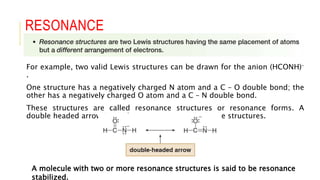
For example, two valid Lewis structures can be drawn for the anion (HCONH)–
.
One structure has a negatively charged N atom and a C – O double bond; the
other has a negatively charged O atom and a C – N double bond.
These structures are called resonance structures or resonance forms. A
double headed arrow is used to separate two resonance structures.
A molecule with two or more resonance structures is said to be resonance
stabilized.
RESONANCE THEORY
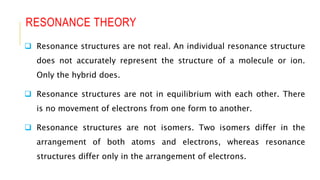
 Resonance structures are not real. An individual resonance structure
does not accurately represent the structure of a molecule or ion.
Only the hybrid does.
 Resonance structures are not in equilibrium with each other. There
is no movement of electrons from one form to another.
 Resonance structures are not isomers. Two isomers differ in the
arrangement of both atoms and electrons, whereas resonance
structures differ only in the arrangement of electrons.
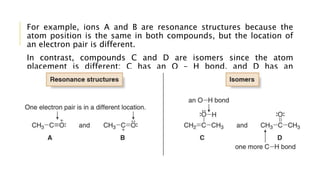
For example, ions A and B are resonance structures because the
atom position is the same in both compounds, but the location of
an electron pair is different.
In contrast, compounds C and D are isomers since the atom
placement is different; C has an O – H bond, and D has an
additional C – H bond.
DRAWING RESONANCE STRUCTURES
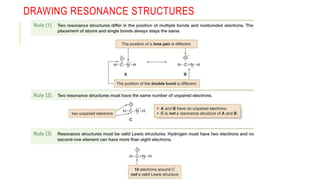
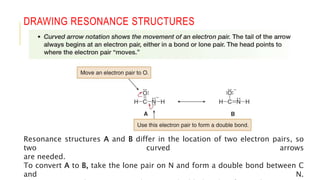
Resonance structures A and B differ in the location of two electron pairs, so
two curved arrows
are needed.
To convert A to B, take the lone pair on N and form a double bond between C
and N.
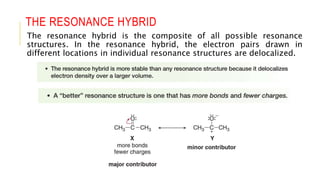
THE RESONANCE HYBRID
The resonance hybrid is the composite of all possible resonance
structures. In the resonance hybrid, the electron pairs drawn in
different locations in individual resonance structures are delocalized.
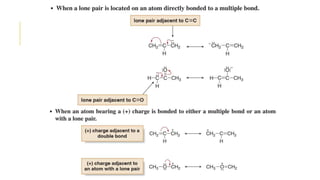
 Two differences commonly seen are the position of a multiple bond
and the site of a charge.
 The anion (HCONH)– illustrates two conventions for drawing
resonance hybrids.
INDUCTIVE EFFECT
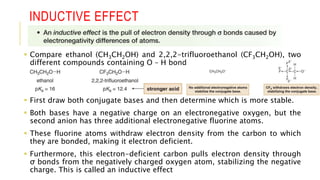
 Compare ethanol (CH3CH2OH) and 2,2,2-trifluoroethanol (CF3CH2OH), two
different compounds containing O – H bonds.
 First draw both conjugate bases and then determine which is more stable.
 Both bases have a negative charge on an electronegative oxygen, but the
second anion has three additional electronegative fluorine atoms.
 These fluorine atoms withdraw electron density from the carbon to which
they are bonded, making it electron deficient.
 Furthermore, this electron-deficient carbon pulls electron density through
σ bonds from the negatively charged oxygen atom, stabilizing the negative
charge. This is called an inductive effect
Inductive effects result because an electronegative atom stabilizes the negative charge of
the conjugate base. The more electronegative the atom and the closer it is to the site of
the negative charge, the greater the effect.
INDUCTIVE EFFECT
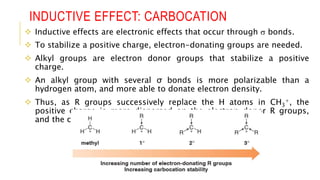
 Inductive effects are electronic effects that occur through s bonds.
 To stabilize a positive charge, electron-donating groups are needed.
 Alkyl groups are electron donor groups that stabilize a positive
charge.
 An alkyl group with several σ bonds is more polarizable than a
hydrogen atom, and more able to donate electron density.
 Thus, as R groups successively replace the H atoms in CH3
+, the
positive charge is more dispersed on the electron donor R groups,
and the carbocation is more stabilized.
INDUCTIVE EFFECT: CARBOCATION
HYPERCONJUGATION
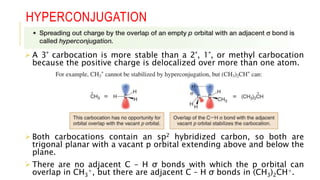
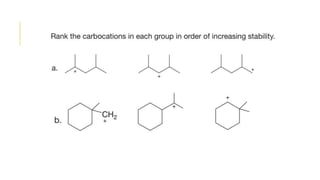
 A 3° carbocation is more stable than a 2°, 1°, or methyl carbocation
because the positive charge is delocalized over more than one atom.
 Both carbocations contain an sp2 hybridized carbon, so both are
trigonal planar with a vacant p orbital extending above and below the
plane.
 There are no adjacent C – H σ bonds with which the p orbital can
overlap in CH3
+, but there are adjacent C – H σ bonds in (CH3)2CH+.
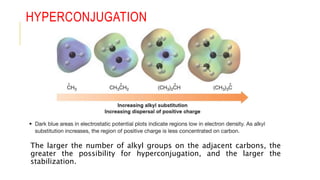
The larger the number of alkyl groups on the adjacent carbons, the
greater the possibility for hyperconjugation, and the larger the
stabilization.
HYPERCONJUGATION
Resonance, inductive effect and hyperconjugation

Resonance, inductive effect and hyperconjugation

  • 1.
    INDUCTIVE EFFECTS, RESONANCE, &HYPER CONJUGATION Dr. Rajasekhar Reddy A K L COLLEGE OF PHARMACY, KLEF DEEMED TO BE UNIVERSITY
  • 2.
    RESONANCE For example, twovalid Lewis structures can be drawn for the anion (HCONH)– . One structure has a negatively charged N atom and a C – O double bond; the other has a negatively charged O atom and a C – N double bond. These structures are called resonance structures or resonance forms. A double headed arrow is used to separate two resonance structures. A molecule with two or more resonance structures is said to be resonance stabilized.
  • 3.
    RESONANCE THEORY  Resonancestructures are not real. An individual resonance structure does not accurately represent the structure of a molecule or ion. Only the hybrid does.  Resonance structures are not in equilibrium with each other. There is no movement of electrons from one form to another.  Resonance structures are not isomers. Two isomers differ in the arrangement of both atoms and electrons, whereas resonance structures differ only in the arrangement of electrons.
  • 4.
    For example, ionsA and B are resonance structures because the atom position is the same in both compounds, but the location of an electron pair is different. In contrast, compounds C and D are isomers since the atom placement is different; C has an O – H bond, and D has an additional C – H bond.
  • 5.
  • 6.
    DRAWING RESONANCE STRUCTURES Resonancestructures A and B differ in the location of two electron pairs, so two curved arrows are needed. To convert A to B, take the lone pair on N and form a double bond between C and N.
  • 8.
    THE RESONANCE HYBRID Theresonance hybrid is the composite of all possible resonance structures. In the resonance hybrid, the electron pairs drawn in different locations in individual resonance structures are delocalized.
  • 9.
     Two differencescommonly seen are the position of a multiple bond and the site of a charge.  The anion (HCONH)– illustrates two conventions for drawing resonance hybrids.
  • 10.
    INDUCTIVE EFFECT  Compareethanol (CH3CH2OH) and 2,2,2-trifluoroethanol (CF3CH2OH), two different compounds containing O – H bonds.  First draw both conjugate bases and then determine which is more stable.  Both bases have a negative charge on an electronegative oxygen, but the second anion has three additional electronegative fluorine atoms.  These fluorine atoms withdraw electron density from the carbon to which they are bonded, making it electron deficient.  Furthermore, this electron-deficient carbon pulls electron density through σ bonds from the negatively charged oxygen atom, stabilizing the negative charge. This is called an inductive effect
  • 11.
    Inductive effects resultbecause an electronegative atom stabilizes the negative charge of the conjugate base. The more electronegative the atom and the closer it is to the site of the negative charge, the greater the effect. INDUCTIVE EFFECT
  • 12.
     Inductive effectsare electronic effects that occur through s bonds.  To stabilize a positive charge, electron-donating groups are needed.  Alkyl groups are electron donor groups that stabilize a positive charge.  An alkyl group with several σ bonds is more polarizable than a hydrogen atom, and more able to donate electron density.  Thus, as R groups successively replace the H atoms in CH3 +, the positive charge is more dispersed on the electron donor R groups, and the carbocation is more stabilized. INDUCTIVE EFFECT: CARBOCATION
  • 14.
    HYPERCONJUGATION  A 3°carbocation is more stable than a 2°, 1°, or methyl carbocation because the positive charge is delocalized over more than one atom.  Both carbocations contain an sp2 hybridized carbon, so both are trigonal planar with a vacant p orbital extending above and below the plane.  There are no adjacent C – H σ bonds with which the p orbital can overlap in CH3 +, but there are adjacent C – H σ bonds in (CH3)2CH+.
  • 15.
    The larger thenumber of alkyl groups on the adjacent carbons, the greater the possibility for hyperconjugation, and the larger the stabilization. HYPERCONJUGATION