Intra- & Intermolecular
forces
Dr. Rajasekhar Reddy A
K L COLLEGE OF PHARMACY,
KLEF DEEMED TO BE UNIVERSITY
Intermolecular Forces
• Intermolecular forces are the interactions that exist between
molecules.
• A functional group determines the type and strength of
these interactions.
• Intermolecular forces are also referred to as noncovalent
interactions or nonbonded interactions.
Intermolecular Forces in Ionic
Compounds
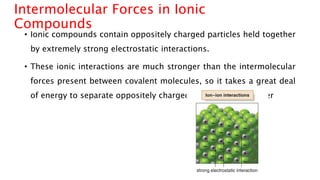
• Ionic compounds contain oppositely charged particles held together
by extremely strong electrostatic interactions.
• These ionic interactions are much stronger than the intermolecular
forces present between covalent molecules, so it takes a great deal
of energy to separate oppositely charged ions from each other
Intermolecular Forces in Covalent
Compounds
• Covalent compounds are composed of discrete molecules.
• The nature of the forces between the molecules depends on
the functional group present.
• There are three different types of interactions, presented here
in order of increasing strength:
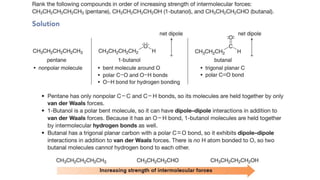
• van der Waals forces
• dipole–dipole interactions
• hydrogen bonding
van der Waals Forces
• van der Waals forces, also called London forces, are very weak
interactions caused by the momentary changes in electron density in a
molecule.
• van der Waals forces are the only attractive forces present in nonpolar
compounds.
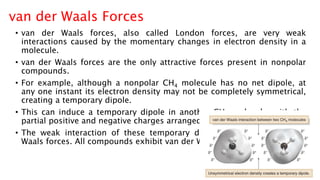
• For example, although a nonpolar CH4 molecule has no net dipole, at
any one instant its electron density may not be completely symmetrical,
creating a temporary dipole.
• This can induce a temporary dipole in another CH4 molecule, with the
partial positive and negative charges arranged close to each other.
• The weak interaction of these temporary dipoles constitutes van der
Waals forces. All compounds exhibit van der Waals forces.
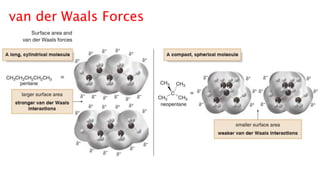
• The surface area of a molecule determines the strength of the van der
Waals interactions.
• The larger the surface area, the larger the attractive force between two
molecules, and the stronger the intermolecular forces.
• Long, sausage-shaped molecules such as CH3CH2CH2CH2CH3 (pentane)
have stronger van der Waals interactions than compact spherical ones
like C(CH3)4 (neopentane).
• Another factor affecting the strength of van der Waals forces is
polarizability.
van der Waals Forces
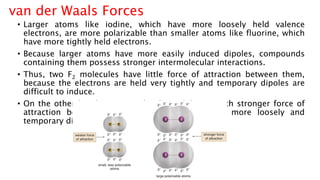
• Larger atoms like iodine, which have more loosely held valence
electrons, are more polarizable than smaller atoms like fluorine, which
have more tightly held electrons.
• Because larger atoms have more easily induced dipoles, compounds
containing them possess stronger intermolecular interactions.
• Thus, two F2 molecules have little force of attraction between them,
because the electrons are held very tightly and temporary dipoles are
difficult to induce.
• On the other hand, two I2 molecules exhibit a much stronger force of
attraction because the electrons are held much more loosely and
temporary dipoles are easily induced
van der Waals Forces
Dipole–Dipole Interactions
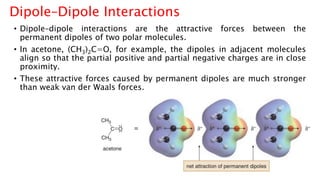
• Dipole–dipole interactions are the attractive forces between the
permanent dipoles of two polar molecules.
• In acetone, (CH3)2C=O, for example, the dipoles in adjacent molecules
align so that the partial positive and partial negative charges are in close
proximity.
• These attractive forces caused by permanent dipoles are much stronger
than weak van der Waals forces.
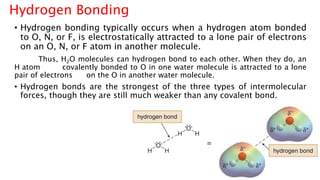
Hydrogen Bonding
• Hydrogen bonding typically occurs when a hydrogen atom bonded
to O, N, or F, is electrostatically attracted to a lone pair of electrons
on an O, N, or F atom in another molecule.
Thus, H2O molecules can hydrogen bond to each other. When they do, an
H atom covalently bonded to O in one water molecule is attracted to a lone
pair of electrons on the O in another water molecule.
• Hydrogen bonds are the strongest of the three types of intermolecular
forces, though they are still much weaker than any covalent bond.
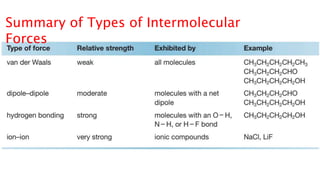
Summary of Types of Intermolecular
Forces
Intramolecular forces – Ionic Bond
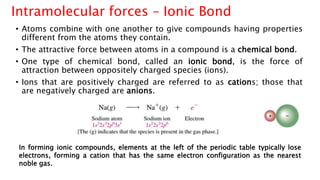
• Atoms combine with one another to give compounds having properties
different from the atoms they contain.
• The attractive force between atoms in a compound is a chemical bond.
• One type of chemical bond, called an ionic bond, is the force of
attraction between oppositely charged species (ions).
• Ions that are positively charged are referred to as cations; those that
are negatively charged are anions.
In forming ionic compounds, elements at the left of the periodic table typically lose
electrons, forming a cation that has the same electron configuration as the nearest
noble gas.
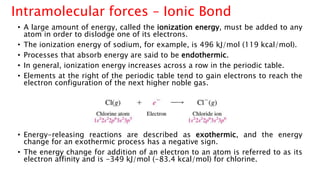
• A large amount of energy, called the ionization energy, must be added to any
atom in order to dislodge one of its electrons.
• The ionization energy of sodium, for example, is 496 kJ/mol (119 kcal/mol).
• Processes that absorb energy are said to be endothermic.
• In general, ionization energy increases across a row in the periodic table.
• Elements at the right of the periodic table tend to gain electrons to reach the
electron configuration of the next higher noble gas.
• Energy-releasing reactions are described as exothermic, and the energy
change for an exothermic process has a negative sign.
• The energy change for addition of an electron to an atom is referred to as its
electron affinity and is -349 kJ/mol (-83.4 kcal/mol) for chlorine.
Intramolecular forces – Ionic Bond
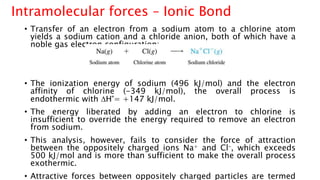
• Transfer of an electron from a sodium atom to a chlorine atom
yields a sodium cation and a chloride anion, both of which have a
noble gas electron configuration:
• The ionization energy of sodium (496 kJ/mol) and the electron
affinity of chlorine (-349 kJ/mol), the overall process is
endothermic with DH°= +147 kJ/mol.
• The energy liberated by adding an electron to chlorine is
insufficient to override the energy required to remove an electron
from sodium.
• This analysis, however, fails to consider the force of attraction
between the oppositely charged ions Na+ and Cl–, which exceeds
500 kJ/mol and is more than sufficient to make the overall process
exothermic.
• Attractive forces between oppositely charged particles are termed
Intramolecular forces – Ionic Bond
COVALENT BONDS
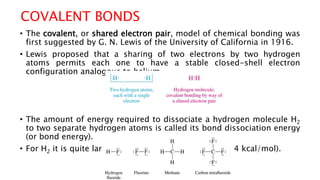
• The covalent, or shared electron pair, model of chemical bonding was
first suggested by G. N. Lewis of the University of California in 1916.
• Lewis proposed that a sharing of two electrons by two hydrogen
atoms permits each one to have a stable closed-shell electron
configuration analogous to helium.
• The amount of energy required to dissociate a hydrogen molecule H2
to two separate hydrogen atoms is called its bond dissociation energy
(or bond energy).
• For H2 it is quite large, being equal to 435 kJ/mol (104 kcal/mol).
DOUBLE BONDS AND TRIPLE BONDS
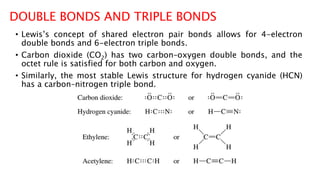
• Lewis’s concept of shared electron pair bonds allows for 4-electron
double bonds and 6-electron triple bonds.
• Carbon dioxide (CO2) has two carbon–oxygen double bonds, and the
octet rule is satisfied for both carbon and oxygen.
• Similarly, the most stable Lewis structure for hydrogen cyanide (HCN)
has a carbon–nitrogen triple bond.
Hydrogen Bonding - Intramolecular
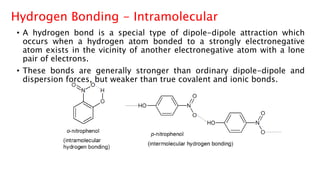
• A hydrogen bond is a special type of dipole-dipole attraction which
occurs when a hydrogen atom bonded to a strongly electronegative
atom exists in the vicinity of another electronegative atom with a lone
pair of electrons.
• These bonds are generally stronger than ordinary dipole-dipole and
dispersion forces, but weaker than true covalent and ionic bonds.
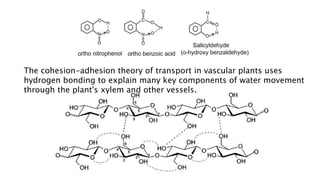
The cohesion-adhesion theory of transport in vascular plants uses
hydrogen bonding to explain many key components of water movement
through the plant's xylem and other vessels.
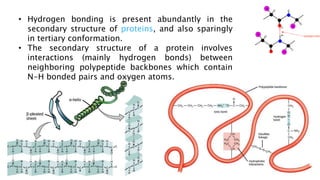
• Hydrogen bonding is present abundantly in the
secondary structure of proteins, and also sparingly
in tertiary conformation.
• The secondary structure of a protein involves
interactions (mainly hydrogen bonds) between
neighboring polypeptide backbones which contain
N-H bonded pairs and oxygen atoms.
Inductive effects, Resonance, and Hyper
conjugation

Intermolecular forces- Organic Chemistry

  • 1.
    Intra- & Intermolecular forces Dr.Rajasekhar Reddy A K L COLLEGE OF PHARMACY, KLEF DEEMED TO BE UNIVERSITY
  • 2.
    Intermolecular Forces • Intermolecularforces are the interactions that exist between molecules. • A functional group determines the type and strength of these interactions. • Intermolecular forces are also referred to as noncovalent interactions or nonbonded interactions.
  • 3.
    Intermolecular Forces inIonic Compounds • Ionic compounds contain oppositely charged particles held together by extremely strong electrostatic interactions. • These ionic interactions are much stronger than the intermolecular forces present between covalent molecules, so it takes a great deal of energy to separate oppositely charged ions from each other
  • 4.
    Intermolecular Forces inCovalent Compounds • Covalent compounds are composed of discrete molecules. • The nature of the forces between the molecules depends on the functional group present. • There are three different types of interactions, presented here in order of increasing strength: • van der Waals forces • dipole–dipole interactions • hydrogen bonding
  • 5.
    van der WaalsForces • van der Waals forces, also called London forces, are very weak interactions caused by the momentary changes in electron density in a molecule. • van der Waals forces are the only attractive forces present in nonpolar compounds. • For example, although a nonpolar CH4 molecule has no net dipole, at any one instant its electron density may not be completely symmetrical, creating a temporary dipole. • This can induce a temporary dipole in another CH4 molecule, with the partial positive and negative charges arranged close to each other. • The weak interaction of these temporary dipoles constitutes van der Waals forces. All compounds exhibit van der Waals forces.
  • 6.
    • The surfacearea of a molecule determines the strength of the van der Waals interactions. • The larger the surface area, the larger the attractive force between two molecules, and the stronger the intermolecular forces. • Long, sausage-shaped molecules such as CH3CH2CH2CH2CH3 (pentane) have stronger van der Waals interactions than compact spherical ones like C(CH3)4 (neopentane). • Another factor affecting the strength of van der Waals forces is polarizability. van der Waals Forces
  • 7.
  • 8.
    • Larger atomslike iodine, which have more loosely held valence electrons, are more polarizable than smaller atoms like fluorine, which have more tightly held electrons. • Because larger atoms have more easily induced dipoles, compounds containing them possess stronger intermolecular interactions. • Thus, two F2 molecules have little force of attraction between them, because the electrons are held very tightly and temporary dipoles are difficult to induce. • On the other hand, two I2 molecules exhibit a much stronger force of attraction because the electrons are held much more loosely and temporary dipoles are easily induced van der Waals Forces
  • 9.
    Dipole–Dipole Interactions • Dipole–dipoleinteractions are the attractive forces between the permanent dipoles of two polar molecules. • In acetone, (CH3)2C=O, for example, the dipoles in adjacent molecules align so that the partial positive and partial negative charges are in close proximity. • These attractive forces caused by permanent dipoles are much stronger than weak van der Waals forces.
  • 10.
    Hydrogen Bonding • Hydrogenbonding typically occurs when a hydrogen atom bonded to O, N, or F, is electrostatically attracted to a lone pair of electrons on an O, N, or F atom in another molecule. Thus, H2O molecules can hydrogen bond to each other. When they do, an H atom covalently bonded to O in one water molecule is attracted to a lone pair of electrons on the O in another water molecule. • Hydrogen bonds are the strongest of the three types of intermolecular forces, though they are still much weaker than any covalent bond.
  • 11.
    Summary of Typesof Intermolecular Forces
  • 14.
    Intramolecular forces –Ionic Bond • Atoms combine with one another to give compounds having properties different from the atoms they contain. • The attractive force between atoms in a compound is a chemical bond. • One type of chemical bond, called an ionic bond, is the force of attraction between oppositely charged species (ions). • Ions that are positively charged are referred to as cations; those that are negatively charged are anions. In forming ionic compounds, elements at the left of the periodic table typically lose electrons, forming a cation that has the same electron configuration as the nearest noble gas.
  • 15.
    • A largeamount of energy, called the ionization energy, must be added to any atom in order to dislodge one of its electrons. • The ionization energy of sodium, for example, is 496 kJ/mol (119 kcal/mol). • Processes that absorb energy are said to be endothermic. • In general, ionization energy increases across a row in the periodic table. • Elements at the right of the periodic table tend to gain electrons to reach the electron configuration of the next higher noble gas. • Energy-releasing reactions are described as exothermic, and the energy change for an exothermic process has a negative sign. • The energy change for addition of an electron to an atom is referred to as its electron affinity and is -349 kJ/mol (-83.4 kcal/mol) for chlorine. Intramolecular forces – Ionic Bond
  • 16.
    • Transfer ofan electron from a sodium atom to a chlorine atom yields a sodium cation and a chloride anion, both of which have a noble gas electron configuration: • The ionization energy of sodium (496 kJ/mol) and the electron affinity of chlorine (-349 kJ/mol), the overall process is endothermic with DH°= +147 kJ/mol. • The energy liberated by adding an electron to chlorine is insufficient to override the energy required to remove an electron from sodium. • This analysis, however, fails to consider the force of attraction between the oppositely charged ions Na+ and Cl–, which exceeds 500 kJ/mol and is more than sufficient to make the overall process exothermic. • Attractive forces between oppositely charged particles are termed Intramolecular forces – Ionic Bond
  • 17.
    COVALENT BONDS • Thecovalent, or shared electron pair, model of chemical bonding was first suggested by G. N. Lewis of the University of California in 1916. • Lewis proposed that a sharing of two electrons by two hydrogen atoms permits each one to have a stable closed-shell electron configuration analogous to helium. • The amount of energy required to dissociate a hydrogen molecule H2 to two separate hydrogen atoms is called its bond dissociation energy (or bond energy). • For H2 it is quite large, being equal to 435 kJ/mol (104 kcal/mol).
  • 18.
    DOUBLE BONDS ANDTRIPLE BONDS • Lewis’s concept of shared electron pair bonds allows for 4-electron double bonds and 6-electron triple bonds. • Carbon dioxide (CO2) has two carbon–oxygen double bonds, and the octet rule is satisfied for both carbon and oxygen. • Similarly, the most stable Lewis structure for hydrogen cyanide (HCN) has a carbon–nitrogen triple bond.
  • 19.
    Hydrogen Bonding -Intramolecular • A hydrogen bond is a special type of dipole-dipole attraction which occurs when a hydrogen atom bonded to a strongly electronegative atom exists in the vicinity of another electronegative atom with a lone pair of electrons. • These bonds are generally stronger than ordinary dipole-dipole and dispersion forces, but weaker than true covalent and ionic bonds.
  • 20.
    The cohesion-adhesion theoryof transport in vascular plants uses hydrogen bonding to explain many key components of water movement through the plant's xylem and other vessels.
  • 21.
    • Hydrogen bondingis present abundantly in the secondary structure of proteins, and also sparingly in tertiary conformation. • The secondary structure of a protein involves interactions (mainly hydrogen bonds) between neighboring polypeptide backbones which contain N-H bonded pairs and oxygen atoms.
  • 22.
    Inductive effects, Resonance,and Hyper conjugation