
ANTITUBERCULAR
AGENTS
Rajasekhar Reddy A
M.Pharm., (Ph.D.)
Assistant Professor
College of Pharmacy
K L E F deemed to be University
Medicinal Chemistry
Tuberculosis:
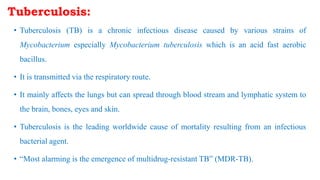
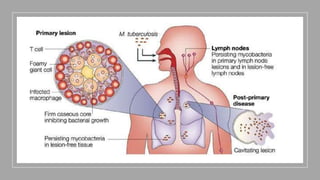
• Tuberculosis (TB) is a chronic infectious disease caused by various strains of
Mycobacterium especially Mycobacterium tuberculosis which is an acid fast aerobic
bacillus.
• It is transmitted via the respiratory route.
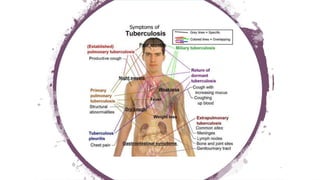
• It mainly affects the lungs but can spread through blood stream and lymphatic system to
the brain, bones, eyes and skin.
• Tuberculosis is the leading worldwide cause of mortality resulting from an infectious
bacterial agent.
• “Most alarming is the emergence of multidrug-resistant TB” (MDR-TB).
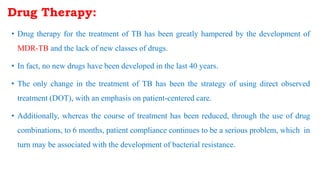
• Drug therapy for the treatment of TB has been greatly hampered by the development of
MDR-TB and the lack of new classes of drugs.
• In fact, no new drugs have been developed in the last 40 years.
• The only change in the treatment of TB has been the strategy of using direct observed
treatment (DOT), with an emphasis on patient-centered care.
• Additionally, whereas the course of treatment has been reduced, through the use of drug
combinations, to 6 months, patient compliance continues to be a serious problem, which in
turn may be associated with the development of bacterial resistance.
Drug Therapy:
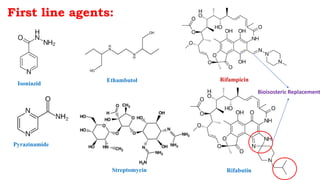
• First line agents.
An effective bacterial agent, with an acceptable degree of toxicity.
ex. Isoniazid, Ethambutol, Rifampicin, Streptomycin, Pyrazinamide, Rifabutin.
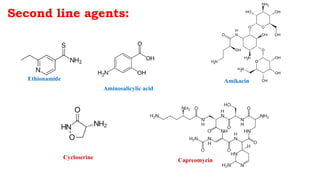
• Second line agents.
For microbial resistance or patient related factors.
ex. Ethionamide, Aminosalicylic acid, Cycloserine, Amikacin, Capreomycin.
Classification:
First line agents:
Isoniazid
Ethambutol Rifampicin
Pyrazinamide
RifabutinStreptomycin
Bioisosteric Replacement
Second line agents:
Ethionamide
Aminosalicylic acid
Cycloserine
Amikacin
Capreomycin
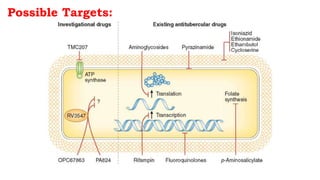
Possible Targets:
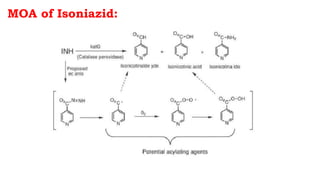
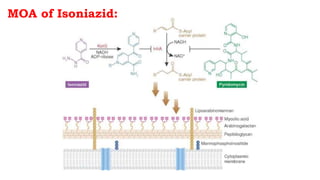
MOA of Isoniazid:
MOA of Isoniazid:
• It generally is recognized that INH is a pro-drug that is activated through an oxidation reaction catalyzed by
an endogenous enzyme.
• This enzyme, katG, which exhibits catalase-peroxidase activity, converts INH to a reactive species capable
of acylation of an enzyme system found exclusively in M . tuberculosis.
• Reaction of INH with catalase-peroxidase results in formation of isonicotinaldehyde, isonicotinic acid, and
isonicotinamide, which can be accounted for through the reactive intermediate isonicotinoyl radical or
isonicotinic peroxide.
• The mycolic acids are important constituents of the mycobacterial cell wall in that they provide a
permeability barrier to hydrophilic solutes.
• The enzyme inhA, produced under the control of the inhA gene, is an NADH-dependent, enoyl reductase
protein thought to be involved in double-bond reduction during fatty acid elongation.
MOA of Isoniazid:
• Isoniazid specifically inhibits long-chain fatty acid synthesis (>26 carbon atoms).
• It should be noted that the mycolic acids are α-branched lipids having a “short” arm of 20 to 24
carbons and a “long” arm of 50 to 60 carbons.
• It has been proposed that INH is activated to an electrophilic species that acylates the four
position of the NADH.
• The acylated NADH is no longer capable of catalyzing the reduction of unsaturated fatty acids,
which are essential for the synthesis of the mycolic acids.
MOA of Isoniazid:
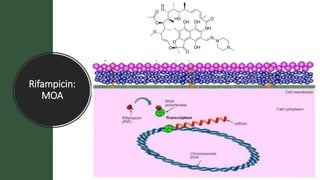
Rifampicin:
MOA
• The rifamycins inhibit bacterial DNA-dependent RNA polymerase (DDRP) by binding to the β-
subunit of the enzyme and are highly active against rapidly dividing intracellular and extracellular
bacilli.
• Rifampin is active against DDRP from both Gram-positive and Gram-negative bacteria, but
because of poor penetration of the cell wall of Gram-negative organisms by RIF, the drug has less
value in infections caused by such organisms.
• Inhibition of DDRP leads to blocking the initiation of chain formation in RNA synthesis.
• It has been suggested that the naphthalene ring of the rifamycins π-π bonds to an aromatic amino
acid ring in the DDRP protein.
• The DDRP is a metalloenzyme that contains two zinc atoms.
MOA of Rifampicins:
• It is further postulated that the oxygens at C-1 and C-8 of a rifamycin can chelate to a zinc atom,
which increases the binding to DDRP, and finally, the oxygens at C-21 and C-23 form strong
hydrogen bonds to the DDRP.
• The binding of the rifamycins to DDRP results in the inhibition of the RNA synthesis.
• Specifically, RIF has been shown to inhibit the elongation of full-length transcripts, but it has no
effect on transcription initiation.
• Resistance develops when a mutation occurs in the gene responsible for the β-subunit of the RNA
polymerase (rpoB gene), resulting in an inability of the antibiotic to readily bind to the RNA
polymerase
MOA of Rifampicins:
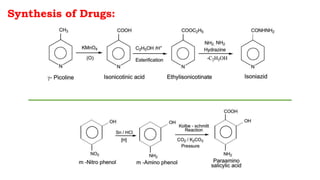
Synthesis of Drugs:
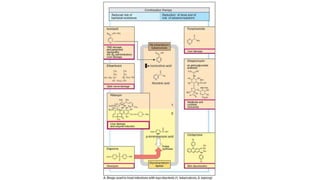
Anti tuberculosis Agents

Anti tuberculosis Agents

  • 1.
    ANTITUBERCULAR AGENTS Rajasekhar Reddy A M.Pharm.,(Ph.D.) Assistant Professor College of Pharmacy K L E F deemed to be University Medicinal Chemistry
  • 2.
    Tuberculosis: • Tuberculosis (TB)is a chronic infectious disease caused by various strains of Mycobacterium especially Mycobacterium tuberculosis which is an acid fast aerobic bacillus. • It is transmitted via the respiratory route. • It mainly affects the lungs but can spread through blood stream and lymphatic system to the brain, bones, eyes and skin. • Tuberculosis is the leading worldwide cause of mortality resulting from an infectious bacterial agent. • “Most alarming is the emergence of multidrug-resistant TB” (MDR-TB).
  • 5.
    • Drug therapyfor the treatment of TB has been greatly hampered by the development of MDR-TB and the lack of new classes of drugs. • In fact, no new drugs have been developed in the last 40 years. • The only change in the treatment of TB has been the strategy of using direct observed treatment (DOT), with an emphasis on patient-centered care. • Additionally, whereas the course of treatment has been reduced, through the use of drug combinations, to 6 months, patient compliance continues to be a serious problem, which in turn may be associated with the development of bacterial resistance. Drug Therapy:
  • 6.
    • First lineagents. An effective bacterial agent, with an acceptable degree of toxicity. ex. Isoniazid, Ethambutol, Rifampicin, Streptomycin, Pyrazinamide, Rifabutin. • Second line agents. For microbial resistance or patient related factors. ex. Ethionamide, Aminosalicylic acid, Cycloserine, Amikacin, Capreomycin. Classification:
  • 7.
    First line agents: Isoniazid EthambutolRifampicin Pyrazinamide RifabutinStreptomycin Bioisosteric Replacement
  • 8.
    Second line agents: Ethionamide Aminosalicylicacid Cycloserine Amikacin Capreomycin
  • 9.
  • 10.
  • 11.
  • 12.
    • It generallyis recognized that INH is a pro-drug that is activated through an oxidation reaction catalyzed by an endogenous enzyme. • This enzyme, katG, which exhibits catalase-peroxidase activity, converts INH to a reactive species capable of acylation of an enzyme system found exclusively in M . tuberculosis. • Reaction of INH with catalase-peroxidase results in formation of isonicotinaldehyde, isonicotinic acid, and isonicotinamide, which can be accounted for through the reactive intermediate isonicotinoyl radical or isonicotinic peroxide. • The mycolic acids are important constituents of the mycobacterial cell wall in that they provide a permeability barrier to hydrophilic solutes. • The enzyme inhA, produced under the control of the inhA gene, is an NADH-dependent, enoyl reductase protein thought to be involved in double-bond reduction during fatty acid elongation. MOA of Isoniazid:
  • 13.
    • Isoniazid specificallyinhibits long-chain fatty acid synthesis (>26 carbon atoms). • It should be noted that the mycolic acids are α-branched lipids having a “short” arm of 20 to 24 carbons and a “long” arm of 50 to 60 carbons. • It has been proposed that INH is activated to an electrophilic species that acylates the four position of the NADH. • The acylated NADH is no longer capable of catalyzing the reduction of unsaturated fatty acids, which are essential for the synthesis of the mycolic acids. MOA of Isoniazid:
  • 14.
  • 15.
    • The rifamycinsinhibit bacterial DNA-dependent RNA polymerase (DDRP) by binding to the β- subunit of the enzyme and are highly active against rapidly dividing intracellular and extracellular bacilli. • Rifampin is active against DDRP from both Gram-positive and Gram-negative bacteria, but because of poor penetration of the cell wall of Gram-negative organisms by RIF, the drug has less value in infections caused by such organisms. • Inhibition of DDRP leads to blocking the initiation of chain formation in RNA synthesis. • It has been suggested that the naphthalene ring of the rifamycins π-π bonds to an aromatic amino acid ring in the DDRP protein. • The DDRP is a metalloenzyme that contains two zinc atoms. MOA of Rifampicins:
  • 16.
    • It isfurther postulated that the oxygens at C-1 and C-8 of a rifamycin can chelate to a zinc atom, which increases the binding to DDRP, and finally, the oxygens at C-21 and C-23 form strong hydrogen bonds to the DDRP. • The binding of the rifamycins to DDRP results in the inhibition of the RNA synthesis. • Specifically, RIF has been shown to inhibit the elongation of full-length transcripts, but it has no effect on transcription initiation. • Resistance develops when a mutation occurs in the gene responsible for the β-subunit of the RNA polymerase (rpoB gene), resulting in an inability of the antibiotic to readily bind to the RNA polymerase MOA of Rifampicins:
  • 17.