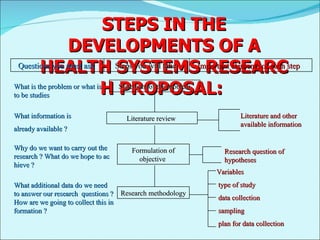
STEPS IN THEDEVELOPMENTS OF A HEALTH SYSTEMS RESEARCH PROPOSAL: Questions you must ask Steps you will take Important elements of each step What is the problem or what is to be studies Statement of the problem What information is already available ? Why do we want to carry out the research ? What do we hope to achieve ? What additional data do we need to answer our research questions ? How are we going to collect this information ? Literature review Formulation of objective Research methodology Literature and other available information Research question of hypotheses Variables type of study data collection sampling plan for data collection
3.
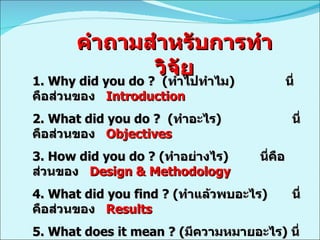
คำถามสำหรับการทำวิจัย 1. Why did you do ? ( ทำไปทำไม ) นี่คือส่วนของ Introduction 2. What did you do ? ( ทำอะไร ) นี่คือส่วนของ Objectives 3. How did you do ? ( ทำอย่างไร ) นี่คือส่วนของ Design & Methodology 4. What did you find ? ( ทำแล้วพบอะไร ) นี่คือส่วนของ Results 5. What does it mean ? ( มีความหมายอะไร ) นี่คือส่วนของ Discussion 6. What’s new ? ( ก่อให้เกิดความรู้อะไร ) นี่คือส่วนของ Conclusion
4.
โครงร่างการวิจัย โครงร่างการวิจัยมี 3 องค์ประกอบ 1. WHY ( ทำไปทำไม ) - Introduction - Background - Background & Significance of the Problem - Rationale - Background & Rationale - The Problem - Problem & Its Significance
5.
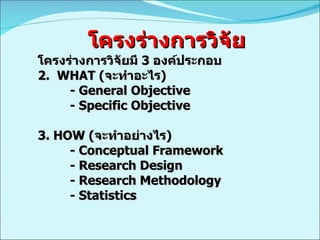
โครงร่างการวิจัย โครงร่างการวิจัยมี 3 องค์ประกอบ 2. WHAT ( จะทำอะไร ) - General Objective - Specific Objective 3. HOW ( จะทำอย่างไร ) - Conceptual Framework - Research Design - Research Methodology - Statistics
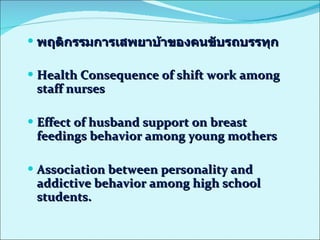
พฤติกรรมการเสพยาบ้าของคนขับรถบรรทุก Health Consequenceof shift work among staff nurses Effect of husband support on breast feedings behavior among young mothers Association between personality and addictive behavior among high school students.
16.
Readiness for emergencyplan of health facilities along the Thai-Cambodian borders K.A.P. of health personnel toward consumer protection program Effectiveness of hospital care versus domiciliation care on disease states of CHD patients
รูปแบบการวิจัยวิเคราะห์แบบตัดขวาง (Cross-sectional analyticDesign) D S I D I D I D I D วัดตัวแปรอิสระ และตัวแปรตาม พร้อมๆ กัน ณ ช่วงเวลาหนึ่ง ประชากร / ตัวอย่างที่ศึกษา ไม่ได้เลือกจากตัวแปรอิสระ หรือตัวแปรตาม บอกอัตราชุกของปรากฎการณ์ได้ แต่บอกอัตราเสี่ยงไม่ได้
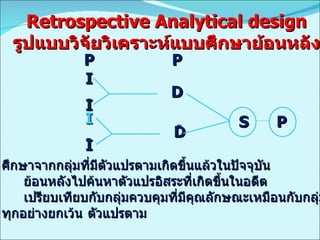
Retrospective Analytical designรูปแบบวิจัยวิเคราะห์แบบศึกษาย้อนหลัง P P I I I I D D S P ศึกษาจากกลุ่มที่มีตัวแปรตามเกิดขึ้นแล้วในปัจจุบัน ย้อนหลังไปค้นหาตัวแปรอิสระที่เกิดขึ้นในอดีต เปรียบเทียบกับกลุ่มควบคุมที่มีคุณลักษณะเหมือนกับกลุ่มศึกษา ทุกอย่างยกเว้น ตัวแปรตาม

























![Week 1 intro[1]](https://cdn.slidesharecdn.com/ss_thumbnails/week1intro1-100921040241-phpapp01-thumbnail.jpg?width=640&height=640&fit=bounds)


![วิทยากรวิจัยชั้นเรียนสถาบันวิจัย[1].สุธาสินี](https://cdn.slidesharecdn.com/ss_thumbnails/1-100506064729-phpapp01-thumbnail.jpg?width=640&height=640&fit=bounds)


