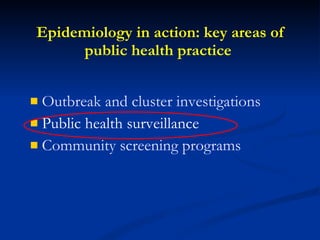
Epidemiology in action:key areas of public health practice Outbreak and cluster investigations Public health surveillance Community screening programs
3.
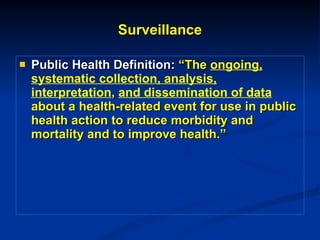
Surveillance Public HealthDefinition: “The ongoing, systematic collection, analysis, interpretation , and dissemination of data about a health-related event for use in public health action to reduce morbidity and mortality and to improve health.”
4.
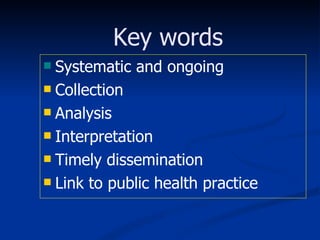
Key words Systematicand ongoing Collection Analysis Interpretation Timely dissemination Link to public health practice
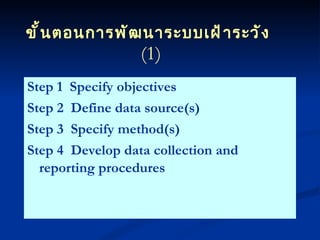
Step 1 Specify objectives Step 2 Define data source(s) Step 3 Specify method(s) Step 4 Develop data collection and reporting procedures ขั้นตอนการพัฒนาระบบเฝ้าระวัง (1)
13.
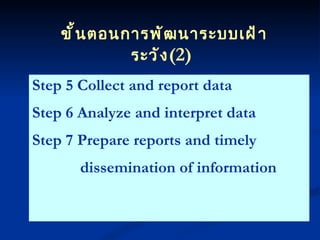
Step 5 Collectand report data Step 6 Analyze and interpret data Step 7 Prepare reports and timely dissemination of information ขั้นตอนการพัฒนาระบบเฝ้าระวัง (2)
14.
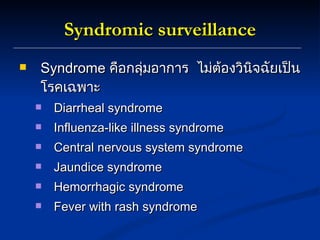
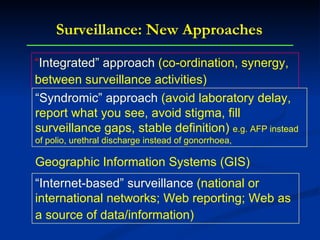
Surveillance: New Approaches “ Integrated” approach (co-ordination, synergy, between surveillance activities) “ Syndromic” approach (avoid laboratory delay, report what you see, avoid stigma, fill surveillance gaps, stable definition) e.g. AFP instead of polio, urethral discharge instead of gonorrhoea, “ Internet-based” surveillance (national or international networks; Web reporting; Web as a source of data/information) Geographic Information Systems (GIS)
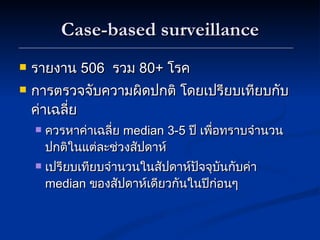
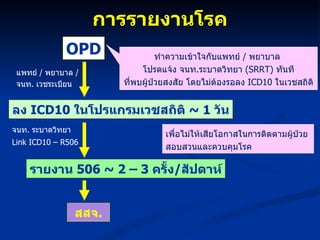
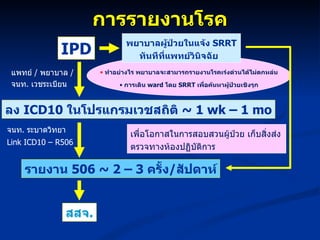
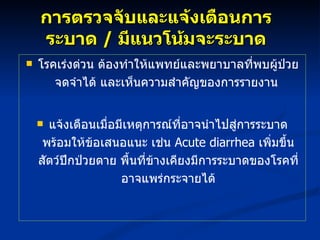
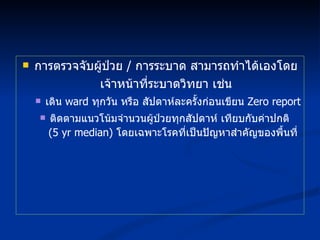
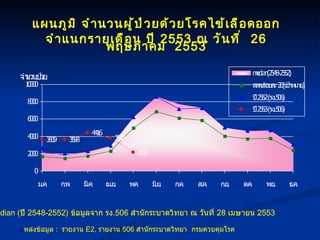
การตรวจจับผู้ป่วย / การระบาด สามารถทำได้เองโดยเจ้าหน้าที่ระบาดวิทยา เช่น เดิน ward ทุกวัน หรือ สัปดาห์ละครั้งก่อนเขียน Zero report ติดตามแนวโน้มจำนวนผู้ป่วยทุกสัปดาห์ เทียบกับค่าปกติ (5 yr median) โดยเฉพาะโรคที่เป็นปัญหาสำคัญของพื้นที่
19.
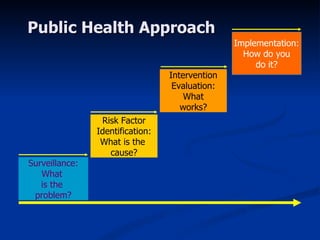
Public Health ApproachProblem Response Intervention Evaluation: What works? Implementation: How do you do it? Surveillance: What is the problem? Risk Factor Identification: What is the cause?
20.
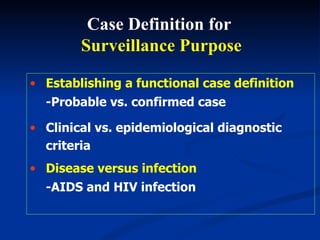
Establishing a functionalcase definition -Probable vs. confirmed case Clinical vs. epidemiological diagnostic criteria Disease versus infection -AIDS and HIV infection Case Definition for Surveillance Purpose
21.
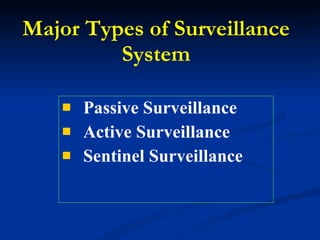
Major Types ofSurveillance System Passive Surveillance Active Surveillance Sentinel Surveillance
22.
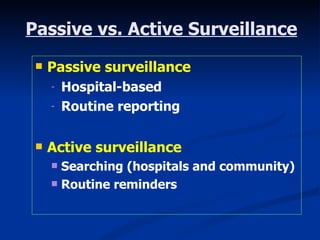
Passive vs. ActiveSurveillance Passive surveillance Hospital-based Routine reporting Active surveillance Searching (hospitals and community) Routine reminders
23.
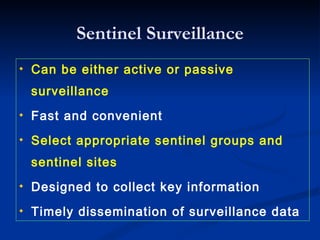
Sentinel Surveillance Canbe either active or passive surveillance Fast and convenient Select appropriate sentinel groups and sentinel sites Designed to collect key information Timely dissemination of surveillance data
24.
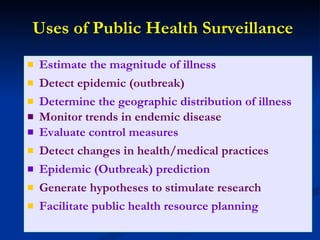
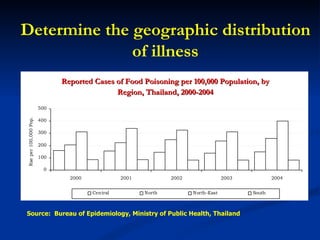
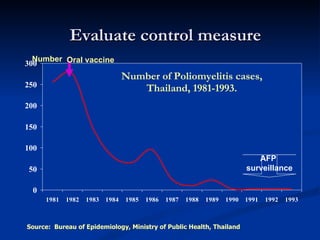
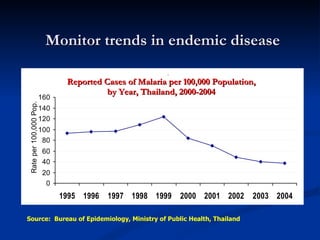
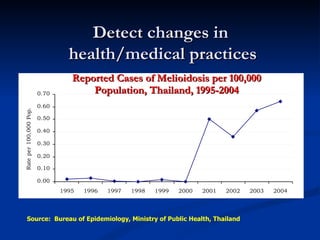
Uses of PublicHealth Surveillance Estimate the magnitude of illness Detect epidemic (outbreak) Determine the geographic distribution of illness Monitor trends in endemic disease Evaluate control measures Detect changes in health/medical practices Epidemic (Outbreak) prediction Generate hypotheses to stimulate research Facilitate public health resource planning
25.
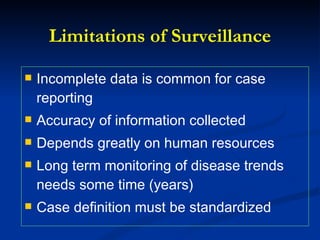
Limitations of SurveillanceIncomplete data is common for case reporting Accuracy of information collected Depends greatly on human resources Long term monitoring of disease trends needs some time (years) Case definition must be standardized
26.
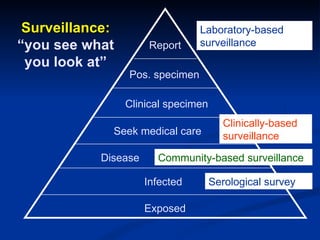
Exposed Clinical specimenDisease Pos. specimen Infected Seek medical care Report Surveillance: “ you see what you look at” Laboratory-based surveillance Clinically-based surveillance Community-based surveillance Serological survey
27.
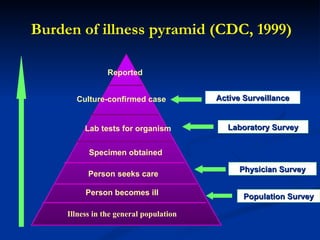
Burden of illnesspyramid (CDC, 1999) Illness in the general population Culture-confirmed case Lab tests for organism Specimen obtained Person seeks care Person becomes ill Reported Active Surveillance Physician Survey Laboratory Survey Population Survey
28.
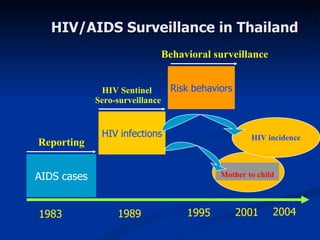
HIV/AIDS Surveillance inThailand Behavioral surveillance 1983 AIDS cases HIV infections Risk behaviors 1995 1989 Mother to child HIV incidence 2001 2004 Reporting HIV Sentinel Sero-surveillance
29.
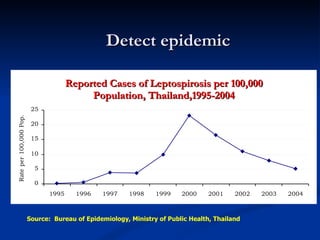
Reported Cases ofLeptospirosis per 100,000 Population, Thailand,1995-2004 Detect epidemic Source: Bureau of Epidemiology, Ministry of Public Health, Thailand
30.
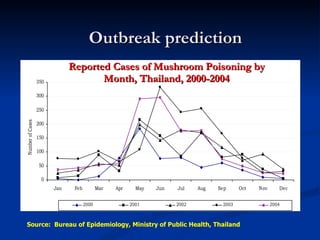
Reported Cases ofMushroom Poisoning by Month, Thailand, 2000-2004 Outbreak prediction Source: Bureau of Epidemiology, Ministry of Public Health, Thailand
31.
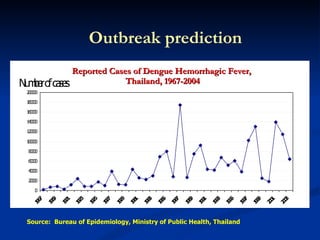
Reported Cases ofDengue Hemorrhagic Fever, Thailand, 1967-2004 Outbreak prediction Source: Bureau of Epidemiology, Ministry of Public Health, Thailand
32.
Reported Cases ofFood Poisoning per 100,000 Population, by Region, Thailand, 2000-2004 Determine the geographic distribution of illness Source: Bureau of Epidemiology, Ministry of Public Health, Thailand
33.
Number of Poliomyelitiscases, Thailand, 1981-1993. Number AFP surveillance Oral vaccine Evaluate control measure Source: Bureau of Epidemiology, Ministry of Public Health, Thailand
34.
Reported Cases ofMalaria per 100,000 Population, by Year, Thailand, 2000-2004 Monitor trends in endemic disease Source: Bureau of Epidemiology, Ministry of Public Health, Thailand
35.
Reported Cases ofMelioidosis per 100,000 Population, Thailand, 1995-2004 Detect changes in health/medical practices Source: Bureau of Epidemiology, Ministry of Public Health, Thailand
36.
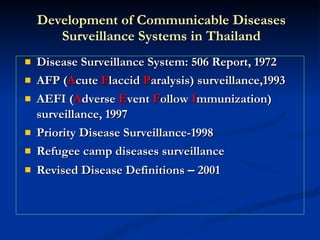
Development of CommunicableDiseases Surveillance Systems in Thailand Disease Surveillance System : 506 Report, 1972 AFP ( A cute F laccid P aralysis) surveillance,1993 AEFI ( A dverse E vent F ollow I mmunization) surveillance, 1997 Priority Disease Surveillance-1998 Refugee camp diseases surveillance Revised Disease Definitions – 2001
37.
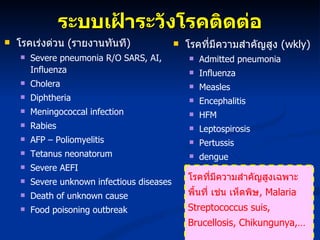
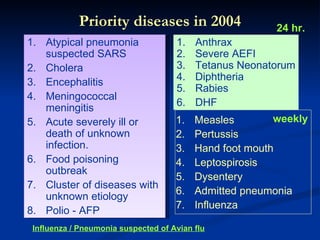
Priority diseases in2004 Atypical pneumonia suspected SARS Cholera Encephalitis Meningococcal meningitis Acute severely ill or death of unknown infection . Food poisoning outbreak Cluster of diseases with unknown etiology Polio - AFP Anthrax Severe AEFI Tetanus Neonatorum Diphtheria Rabies DHF weekly Influenza / Pneumonia suspected of Avian flu Measles Pertussis Hand foot mouth Leptospirosis Dysentery Admitted pneumonia Influenza 24 hr.
38.
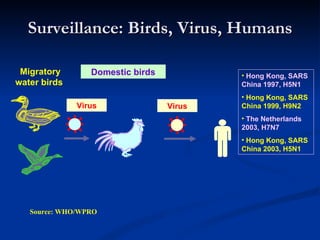
Surveillance: Birds, Virus,Humans Migratory water birds Source: WHO/WPRO Hong Kong, SARS China 1997, H5N1 Hong Kong, SARS China 1999, H9N2 The Netherlands 2003, H7N7 Hong Kong, SARS China 2003, H5N1 Virus Virus Domestic birds
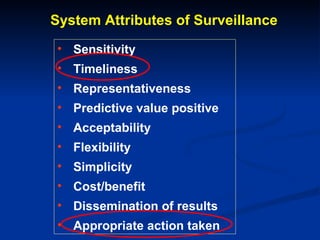
Sensitivity Timeliness RepresentativenessPredictive value positive Acceptability Flexibility Simplicity Cost/benefit Dissemination of results Appropriate action taken System Attributes of Surveillance
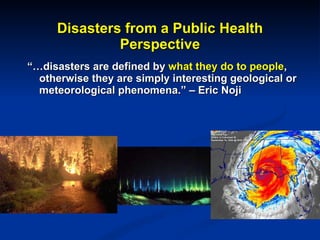
“… disasters aredefined by what they do to people , otherwise they are simply interesting geological or meteorological phenomena.” – Eric Noji Disasters from a Public Health Perspective
49.
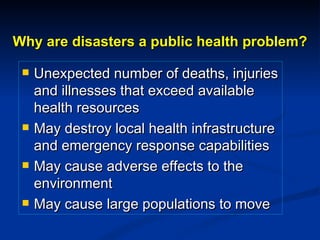
Why are disastersa public health problem? Unexpected number of deaths, injuries and illnesses that exceed available health resources May destroy local health infrastructure and emergency response capabilities May cause adverse effects to the environment May cause large populations to move
50.
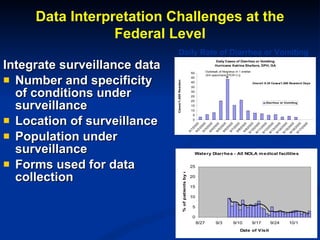
Integrate surveillance data Number and specificity of conditions under surveillance Location of surveillance Population under surveillance Forms used for data collection Data Interpretation Challenges at the Federal Level Daily Rate of Diarrhea or Vomiting % Cases of Watery Diarrhea
51.
Lessons Learned Surveillanceprovided valuable information - No significant outbreaks detected - Defused rumors - Measured burden of chronic conditions However No “standardized” forms available No “standardized” denominator
52.
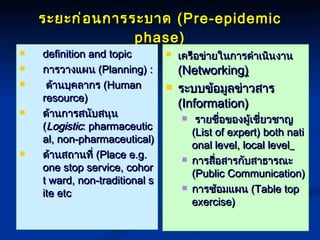
ระยะก่อนการระบาด (Pre-epidemicphase) definition and topic การวางแผน (Planning) : ด้านบุคลากร (Human resource) ด้านการสนับสนุน ( Logistic : pharmaceutical, non-pharmaceutical) ด้านสถานที่ (Place e.g. one stop service, cohort ward, non-traditional site etc เครือข่ายในการดำเนินงาน (Networking ) ระบบข้อมูลข่าวสาร (Information) รายชื่อของผู้เชี่ยวชาญ (List of expert) both national level, local level การสื่อสารกับสาธารณะ (Public Communication) การซ้อมแผน (Table top exercise)
53.
54.
References Teutsch SM,Churchill RE, eds. Principles and practice of public health surveillance , 2nd ed. New York: Oxford University Press, 2000. University of Pittsburgh Supercourse “Overview Of Public Health Surveillance” CDC. Updated guidelines for evaluating public health surveillance systems. MMWR 2001; 50 (RR-13): 1-35
55.
Surveillance Public HealthDefinition: “The ongoing, systematic collection, analysis, interpretation , and dissemination of data about a health-related event for use in public health action to reduce morbidity and mortality and to improve health.”
#3 Dr. Narumol Sawanpanyalert Applied epidemiology synthesizes and applies the results of etiologic studies to set priorities for intervention; it evaluates public health interventions and policies; it measures the quality and outcome of medical care; and it effectively communicates epidemiologic findings to health professionals and the public. Outbreak and cluster investigations, public health surveillance and community screening programs represent key areas of public health practice in which systematic application of epidemiologic methods have a large and positive impact.


![[email_address] 081-842-4148](https://image.slidesharecdn.com/rawang-110704204153-phpapp02/85/Surveillance-Systems-56-320.jpg)


