The Statement of the Problem: Staging Your Thesis
Why Writing a Statement of the Problem: To present the  global  and  local  issues surrounding the topic you will study To  present evidence  of those issues To  argue  for the importance of your study
To build good arguments: Make statements and present evidence to support the statement. Evidence could be put together from: A summary of views from other research A summary of views from public opinion Statistics showing results on area of interest
A Challenge for You With a partner, find the  statements  and the  supporting evidence  in the following excerpts from the  Statement of the Problem  of the following research studies:
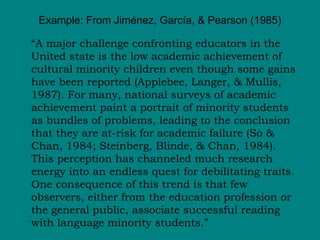
Example: From Jiménez, García, & Pearson (1985) “ A major challenge confronting educators in the United state is the low academic achievement of cultural minority children even though some gains have been reported (Applebee, Langer, & Mullis, 1987). For many, national surveys of academic achievement paint a portrait of minority students as bundles of problems, leading to the conclusion that they are at-risk for academic failure (So & Chan, 1984; Steinberg, Blinde, & Chan, 1984). This perception has channeled much research energy into an endless quest for debilitating traits. One consequence of this trend is that few observers, either from the education profession or the general public, associate successful reading with language minority students.”
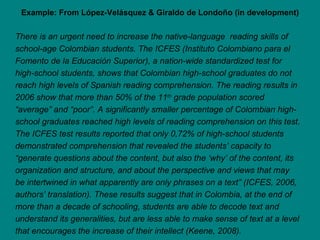
Example: From López-Velásquez & Giraldo de Londoño (in development) There is an urgent need to increase the native-language  reading skills of school-age Colombian students. The ICFES (Instituto Colombiano para el Fomento de la Educación Superior), a nation-wide standardized test for high-school students, shows that Colombian high-school graduates do not reach high levels of Spanish reading comprehension. The reading results in 2006 show that more than 50% of the 11 th  grade population scored “average” and “poor”. A significantly smaller percentage of Colombian high-school graduates reached high levels of reading comprehension on this test. The ICFES test results reported that only 0,72% of high-school students demonstrated comprehension that revealed the students’ capacity to “generate questions about the content, but also the ‘why’ of the content, its organization and structure, and about the perspective and views that may be intertwined in what apparently are only phrases on a text” (ICFES, 2006, authors’ translation). These results suggest that in Colombia, at the end of more than a decade of schooling, students are able to decode text and understand its generalities, but are less able to make sense of text at a level that encourages the increase of their intellect (Keene, 2008).
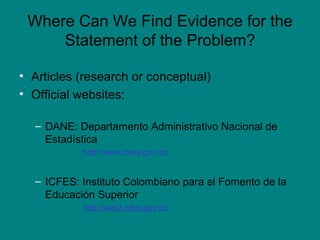
Where Can We Find Evidence for the Statement of the Problem? Articles (research or conceptual) Official websites: DANE: Departamento Administrativo Nacional de Estadística  http://www.dane.gov.co/ ICFES: Instituto Colombiano para el Fomento de la Educación Superior  http://web2.icfes.gov.co/
More Places to Search for Evidence 2 MEN: Ministerio de Educación Nacional http://www.mineducacion.gov.co/1621/channel.html National Newspapers: eltiempo.com elespectador.com elcolombiano.com latarde.com
More Places to Search for Evidence 3 Colombian Professional Associations: www.asocopi.org www.britichcouncil.org/colombia Other Official (reliable) local sources: Transcript reports (grades) Program documents School PEI MEN Standards UTP records
IMPORTANT!!!! Write down the information of your sources. You’ll need it to build your reference list!!! Author Name/last name Title of newspaper Name of institution Title of publication Title of journal Year of publication Website URL Date of retrieval
For Next Class Collect  3 pieces of evidence  relevant to your research idea from several sources to start building your Statement of the Problem.

The statement of the problem

  • 1.
    The Statement ofthe Problem: Staging Your Thesis
  • 2.
    Why Writing aStatement of the Problem: To present the global and local issues surrounding the topic you will study To present evidence of those issues To argue for the importance of your study
  • 3.
    To build goodarguments: Make statements and present evidence to support the statement. Evidence could be put together from: A summary of views from other research A summary of views from public opinion Statistics showing results on area of interest
  • 4.
    A Challenge forYou With a partner, find the statements and the supporting evidence in the following excerpts from the Statement of the Problem of the following research studies:
  • 5.
    Example: From Jiménez,García, & Pearson (1985) “ A major challenge confronting educators in the United state is the low academic achievement of cultural minority children even though some gains have been reported (Applebee, Langer, & Mullis, 1987). For many, national surveys of academic achievement paint a portrait of minority students as bundles of problems, leading to the conclusion that they are at-risk for academic failure (So & Chan, 1984; Steinberg, Blinde, & Chan, 1984). This perception has channeled much research energy into an endless quest for debilitating traits. One consequence of this trend is that few observers, either from the education profession or the general public, associate successful reading with language minority students.”
  • 6.
    Example: From López-Velásquez& Giraldo de Londoño (in development) There is an urgent need to increase the native-language reading skills of school-age Colombian students. The ICFES (Instituto Colombiano para el Fomento de la Educación Superior), a nation-wide standardized test for high-school students, shows that Colombian high-school graduates do not reach high levels of Spanish reading comprehension. The reading results in 2006 show that more than 50% of the 11 th grade population scored “average” and “poor”. A significantly smaller percentage of Colombian high-school graduates reached high levels of reading comprehension on this test. The ICFES test results reported that only 0,72% of high-school students demonstrated comprehension that revealed the students’ capacity to “generate questions about the content, but also the ‘why’ of the content, its organization and structure, and about the perspective and views that may be intertwined in what apparently are only phrases on a text” (ICFES, 2006, authors’ translation). These results suggest that in Colombia, at the end of more than a decade of schooling, students are able to decode text and understand its generalities, but are less able to make sense of text at a level that encourages the increase of their intellect (Keene, 2008).
  • 7.
    Where Can WeFind Evidence for the Statement of the Problem? Articles (research or conceptual) Official websites: DANE: Departamento Administrativo Nacional de Estadística http://www.dane.gov.co/ ICFES: Instituto Colombiano para el Fomento de la Educación Superior http://web2.icfes.gov.co/
  • 8.
    More Places toSearch for Evidence 2 MEN: Ministerio de Educación Nacional http://www.mineducacion.gov.co/1621/channel.html National Newspapers: eltiempo.com elespectador.com elcolombiano.com latarde.com
  • 9.
    More Places toSearch for Evidence 3 Colombian Professional Associations: www.asocopi.org www.britichcouncil.org/colombia Other Official (reliable) local sources: Transcript reports (grades) Program documents School PEI MEN Standards UTP records
  • 10.
    IMPORTANT!!!! Write downthe information of your sources. You’ll need it to build your reference list!!! Author Name/last name Title of newspaper Name of institution Title of publication Title of journal Year of publication Website URL Date of retrieval
  • 11.
    For Next ClassCollect 3 pieces of evidence relevant to your research idea from several sources to start building your Statement of the Problem.