1 
Final Year Project 
The FYP is as it sounds; a year-long project that evolves 
through three written phases: 
the Proposal 
the Progress Report 
the Final Report 
At the end of the cycle, you are also required to give a 
presentation of your work and to construct a poster. 
The proposal should be typed using Times New Roman 
font (size 12) with double spacing on one side of A4 sized 
paper. Allow 1.5in (38mm) margin on the left and 1.0in 
margin elsewhere.
• For the three written phases of the project, it is important 
to realize that each is derived from the phase before it. 
Thus, there is a lot of thinking, planning, and writing 
involved in putting together the Proposal. 
• The Progress Report evolves from the Proposal -- it 
should not be a completely new document. Far too many 
students spend an exorbitant amount of time reinventing 
the wheel, drafting completely new introductions for their 
Progress Report and their FYP. 
• Work smart -- put time and effort into thinking and 
reading about your topic at the Proposal phase. Then, 
when coming to the Progress Report and the FYP, break 
the information down into three subgroups: 
2
• information that is > 50% new 
• information that is < 50% new 
• information that can be recycled 
• This will provide a logical plan regarding how your 
3 
team should prioritize writing time
4 
Proposal 
• Structure 
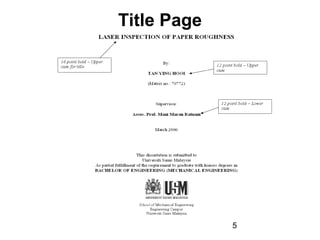
– Title Page 
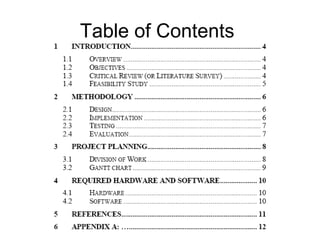
– Table of Contents 
– Introduction 
– Methodology 
– Project Planning 
– Hardware and Software Requirements 
– References 
– Appendices
5 
Title Page
Table of Contents 
6
7 
Introduction 
• gives the project a context 
• explains why the project is important 
• states what the FYP aims to accomplish and how 
• provides objectives 
• identifies possible problems or complications 
• is written for a non-specialist
• Example: 
• Gaming, as both a cultural phenomenon and a lucrative global business [why the 
project is important], has enjoyed enormous success over the past five years. With 
this increase in popularityhas come a demand for more sophisticated 3D modeling. 
[context] The push in the industry is for smoother, seamless graphics. [problem] For 
this project, we will design a software program intended to greatly enhance the 
capabilities of 3D Studio Max to produce more realistic graphics. [state what the 
proposal aims to accomplish and how] 
• Think of your objectives as what you want to accomplish and what 
you need to learn [software packages, algorithms] 
8 
– What is your project objective? 
– Describe the scope of your project 
– Describe how you are going to achieve your objective 
• What are the problems that you will address and why? 
• What are your goals? What can you deliver? 
• What are the technical challenges and how do you plan to overcome 
these?
• Example: 
• For all its strengths, GPS has two related weaknesses: 
signal reception and the accuracy of local information. 
Overcoming these weaknesses would greatly enhance 
its performance, thereby stimulating a new generation in 
GPS technology and design [1]. We will create an 
algorithm that addresses the problem of local positioning 
[1] while... 
• In this project, we will achieve the following goals: X, Y 
and Z [2].To achieve the first goal, we will review the 
literature on algorithm design and....[3] The technical 
challenges involved in reaching this first goal are...[3] 
9
10 
Methodology 
• Begin your methodology with a clear description of what 
you were doing during the summer: literature survey/ 
feasibility study and/or a critical review. You do not 
need to address all the questions below, just the ones 
that are relevant to your project. 
• What is the history of your project topic? 
• What are experts in the field discussing that relates to 
your topic? 
• What are the trade-offs? 
• What is the latest research? 
• What is the state-of-the-art in your project area?
11 
Example 
• Design - Figure out what the sub-problems are and what approach to take or what 
theory to investigate. 
• theory based 
• conceptual 
• Implementation - Build it 
• tools? 
• technical skills based 
• Testing - How are you going to ensure that it [the program/ game/ etc.] works 
correctly? [black box/ white box/ regression testing] 
• look at the project from a micro level 
• include experiments 
• look at system results 
• test each part of the system 
• make sure that design and implementation work 
• Evaluation - Evaluate your results relative to your stated objective: 
• look at the project from a macro level 
• measure performance 
• compare your system/model with one or more (a) baseline systems/models, and/or 
(b) similar competing systems/models
12 
Project Planning 
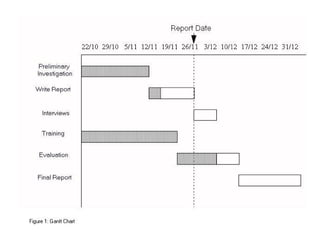
• All projects require planning including an outline 
of who in the team is doing what and when; thus, 
you will need to include a Gantt chart. 
• A Gantt chart is constructed with a horizontal axis representing the total time span of the 
project, broken down into increments (for example, days, weeks, or months) and a vertical 
axis representing the tasks that make up the project (for example, if the project is 
outfitting your computer with new software, the major tasks involved might be: conduct 
research, choose software, install software). Horizontal bars of varying lengths represent 
the sequences, timing, and time span for each task. Using the same example, you would 
put "conduct research" at the top of the verticle axis and draw a bar on the graph that 
represents the amount of time you expect to spend on the research, and then enter the 
other tasks below the first one and representative bars at the points in time when you 
expect to undertake them. The bar spans may overlap, as, for example, you may conduct 
research and choose software during the same time span. As the project progresses, 
secondary bars, arrowheads, or darkened bars may be added to indicate completed tasks, 
or the portions of tasks that have been completed. A vertical line is used to represent the 
report date.
13
Citations and References 
• Throughout the paper, you must provide citations 
whenever you paraphrase and/or summarize someone 
else's ideas and when you use a direct quote. The 
citation style preferred by the COMP department is the 
number system. 
• Not providing citations hurts your team and your work in 
several ways. First, it makes your team look like a bunch 
of amateurs. Second, it discredits your work. Third, 
providing no citations equals plagiarism-the academic 
equivalent to robbery. Examples of what constitutes 
plagiarism. 
14
15 
References 
• Under the Harvard System, references are made by 
giving the author's surname together with the year of 
publication. In the text, the year of publication appears 
within parentheses after the author's surname if the latter 
forms part of a sentence; for examples, Ch'ng (1986) or 
Saleh and Zainuddin (1987) or, where there are more 
than two authors, Nagendran et.al (1990). 
• In contrast, both the author's surname and the year of 
publication appear within parentheses if the author's 
surname does not form aprt of a sentence; for example: 
(Omar & Tan, 1989).
• At the end of the thesis, all the references cited are listed 
in alphabetical order. 
• There is no necessity to number the references. 
References to periodicals should be listed as follows: 
• aauthors' surnames and initials (instead of first author 
et.al), year of publication in parentheses, exact title of 
paper, contracted title of periodical in italics (or 
underlined), volume number in Arabic figures double 
underline (or in bold print), initial and final page numbers 
of article. For example: 
• Kalotas, T.M. & Lee, A.R. (1990). A simple device to 
illustrate angular momentum conservation and instability. 
Am. J. Phys. 58(1), 80-81. 
16
• In the Harvard System, the titles of books are in italics 
followed by the town and publisher. For example: 
• Conn, E.E., Stumpf, P.K., Bruening, G. & Doi, R.H. 
(1987). Outlines ofBiochemistry, 3th edn.New York: John 
Wiley & Sons. 
• Reference from an edited book may be written thus: 
• Hocking, A.D. (1988). Moulds and yeasts associated 
with foods of reduced water activity: ecological 
interactions. In Food Preservation by Moisture 
Control (Seow, C.C., ed.), p. 57-72. London: Elsevier 
Applied Sci. Publ. 
17

Fyp proposal writing

  • 1.
    1 Final YearProject The FYP is as it sounds; a year-long project that evolves through three written phases: the Proposal the Progress Report the Final Report At the end of the cycle, you are also required to give a presentation of your work and to construct a poster. The proposal should be typed using Times New Roman font (size 12) with double spacing on one side of A4 sized paper. Allow 1.5in (38mm) margin on the left and 1.0in margin elsewhere.
  • 2.
    • For thethree written phases of the project, it is important to realize that each is derived from the phase before it. Thus, there is a lot of thinking, planning, and writing involved in putting together the Proposal. • The Progress Report evolves from the Proposal -- it should not be a completely new document. Far too many students spend an exorbitant amount of time reinventing the wheel, drafting completely new introductions for their Progress Report and their FYP. • Work smart -- put time and effort into thinking and reading about your topic at the Proposal phase. Then, when coming to the Progress Report and the FYP, break the information down into three subgroups: 2
  • 3.
    • information thatis > 50% new • information that is < 50% new • information that can be recycled • This will provide a logical plan regarding how your 3 team should prioritize writing time
  • 4.
    4 Proposal •Structure – Title Page – Table of Contents – Introduction – Methodology – Project Planning – Hardware and Software Requirements – References – Appendices
  • 5.
  • 6.
  • 7.
    7 Introduction •gives the project a context • explains why the project is important • states what the FYP aims to accomplish and how • provides objectives • identifies possible problems or complications • is written for a non-specialist
  • 8.
    • Example: •Gaming, as both a cultural phenomenon and a lucrative global business [why the project is important], has enjoyed enormous success over the past five years. With this increase in popularityhas come a demand for more sophisticated 3D modeling. [context] The push in the industry is for smoother, seamless graphics. [problem] For this project, we will design a software program intended to greatly enhance the capabilities of 3D Studio Max to produce more realistic graphics. [state what the proposal aims to accomplish and how] • Think of your objectives as what you want to accomplish and what you need to learn [software packages, algorithms] 8 – What is your project objective? – Describe the scope of your project – Describe how you are going to achieve your objective • What are the problems that you will address and why? • What are your goals? What can you deliver? • What are the technical challenges and how do you plan to overcome these?
  • 9.
    • Example: •For all its strengths, GPS has two related weaknesses: signal reception and the accuracy of local information. Overcoming these weaknesses would greatly enhance its performance, thereby stimulating a new generation in GPS technology and design [1]. We will create an algorithm that addresses the problem of local positioning [1] while... • In this project, we will achieve the following goals: X, Y and Z [2].To achieve the first goal, we will review the literature on algorithm design and....[3] The technical challenges involved in reaching this first goal are...[3] 9
  • 10.
    10 Methodology •Begin your methodology with a clear description of what you were doing during the summer: literature survey/ feasibility study and/or a critical review. You do not need to address all the questions below, just the ones that are relevant to your project. • What is the history of your project topic? • What are experts in the field discussing that relates to your topic? • What are the trade-offs? • What is the latest research? • What is the state-of-the-art in your project area?
  • 11.
    11 Example •Design - Figure out what the sub-problems are and what approach to take or what theory to investigate. • theory based • conceptual • Implementation - Build it • tools? • technical skills based • Testing - How are you going to ensure that it [the program/ game/ etc.] works correctly? [black box/ white box/ regression testing] • look at the project from a micro level • include experiments • look at system results • test each part of the system • make sure that design and implementation work • Evaluation - Evaluate your results relative to your stated objective: • look at the project from a macro level • measure performance • compare your system/model with one or more (a) baseline systems/models, and/or (b) similar competing systems/models
  • 12.
    12 Project Planning • All projects require planning including an outline of who in the team is doing what and when; thus, you will need to include a Gantt chart. • A Gantt chart is constructed with a horizontal axis representing the total time span of the project, broken down into increments (for example, days, weeks, or months) and a vertical axis representing the tasks that make up the project (for example, if the project is outfitting your computer with new software, the major tasks involved might be: conduct research, choose software, install software). Horizontal bars of varying lengths represent the sequences, timing, and time span for each task. Using the same example, you would put "conduct research" at the top of the verticle axis and draw a bar on the graph that represents the amount of time you expect to spend on the research, and then enter the other tasks below the first one and representative bars at the points in time when you expect to undertake them. The bar spans may overlap, as, for example, you may conduct research and choose software during the same time span. As the project progresses, secondary bars, arrowheads, or darkened bars may be added to indicate completed tasks, or the portions of tasks that have been completed. A vertical line is used to represent the report date.
  • 13.
  • 14.
    Citations and References • Throughout the paper, you must provide citations whenever you paraphrase and/or summarize someone else's ideas and when you use a direct quote. The citation style preferred by the COMP department is the number system. • Not providing citations hurts your team and your work in several ways. First, it makes your team look like a bunch of amateurs. Second, it discredits your work. Third, providing no citations equals plagiarism-the academic equivalent to robbery. Examples of what constitutes plagiarism. 14
  • 15.
    15 References •Under the Harvard System, references are made by giving the author's surname together with the year of publication. In the text, the year of publication appears within parentheses after the author's surname if the latter forms part of a sentence; for examples, Ch'ng (1986) or Saleh and Zainuddin (1987) or, where there are more than two authors, Nagendran et.al (1990). • In contrast, both the author's surname and the year of publication appear within parentheses if the author's surname does not form aprt of a sentence; for example: (Omar & Tan, 1989).
  • 16.
    • At theend of the thesis, all the references cited are listed in alphabetical order. • There is no necessity to number the references. References to periodicals should be listed as follows: • aauthors' surnames and initials (instead of first author et.al), year of publication in parentheses, exact title of paper, contracted title of periodical in italics (or underlined), volume number in Arabic figures double underline (or in bold print), initial and final page numbers of article. For example: • Kalotas, T.M. & Lee, A.R. (1990). A simple device to illustrate angular momentum conservation and instability. Am. J. Phys. 58(1), 80-81. 16
  • 17.
    • In theHarvard System, the titles of books are in italics followed by the town and publisher. For example: • Conn, E.E., Stumpf, P.K., Bruening, G. & Doi, R.H. (1987). Outlines ofBiochemistry, 3th edn.New York: John Wiley & Sons. • Reference from an edited book may be written thus: • Hocking, A.D. (1988). Moulds and yeasts associated with foods of reduced water activity: ecological interactions. In Food Preservation by Moisture Control (Seow, C.C., ed.), p. 57-72. London: Elsevier Applied Sci. Publ. 17