Research Methodology
Topic: Research by Purpose &
Research by Method
•Presented By: Musaddaq Ishtiaq Cheema
•Phd English (Semester 1st
)
What is Research:
Research is a systematic and organized process of investigating
a particular question, problem, or topic to discover new
information, validate existing knowledge, or develop new
theories. It involves collecting, analyzing, and interpreting data
to answer a research question or solve a problem. Research is
grounded in methodology, which ensures the accuracy,
reliability, and validity of the findings.
Key characteristics of Research:
1.Systematic Process: Research follows a structured method, involving
clearly defined steps to gather and analyze data.
2.Objective: It aims to uncover facts or develop theories that are unbiased
and based on evidence.
3.Methodological: Research employs specific methodologies—qualitative,
quantitative, or a combination of both—to ensure accuracy and reliability.
4.Analytical: It involves critically examining data and information to draw
conclusions.
5.Replicable: Good research can be replicated by others, reinforcing its
validity and reliability.
Research by Purpose
•Research by Purpose refers to categorizing research based on
its overall objective or goal. The purpose of research dictates
why it is conducted, which helps in understanding the nature and
expected outcomes of the study. Research by purpose is
typically divided into the following types
Basic Research
•
•Basic research, also known as pure or fundamental research, is a type of scientific inquiry aimed
at improving our understanding of fundamental principles, concepts, and theories. Unlike applied
research, which focuses on solving practical problems, basic research is more about gaining
knowledge for its own sake without a direct, immediate application. It often serves as the
foundation for applied research in various fields, as it helps build the theoretical and empirical
frameworks that applied scientists use to develop new technologies, methods, and innovations.
•Key Characteristics:
1.Objective: To explore new theories and understand phenomena without immediate concern for
practical outcomes.
2.Method: Often involves experiments, observation, and theoretical analysis.
3.Output: New knowledge, theories, and models that explain how the world works.
4.Fields: Common in natural sciences (like physics and biology), social sciences, and humanities.
Action Research
•Action research is a participatory and practical approach to research aimed at solving specific problems or
improving practices within a particular setting, often in real-time. It involves a cyclical process of planning,
acting, observing, and reflecting. The researcher works closely with participants (such as a community,
organization, or classroom) to implement changes, assess their effects, and continuously refine the strategies
based on feedback and data gathered during the process.
•Key Characteristics:
1. Problem-focused: Targets specific issues or challenges in a local context (e.g., educational, organizational, or
social settings).
2. Participatory: Involves collaboration between researchers and participants, with participants playing an
active role in identifying issues and developing solutions.
3. Iterative: Follows a cycle of planning, action, observation, and reflection, with each cycle informing the next.
4. Practical: Aims to bring about immediate improvements in practice, rather than just generating theoretical
knowledge.
Development Research
•Development research, also known as design-based research or developmental research, is a systematic study
that focuses on the creation and improvement of products, processes, or educational interventions. It often involves
the design, development, and evaluation of innovative solutions in complex, real-world contexts. The primary aim
of development research is to generate knowledge that not only enhances the designed product or process but also
advances theoretical understanding.
•Key Characteristics:
1. Practical Focus: Targets the development and improvement of specific products, programs, or interventions.
2. Iterative Process: Involves repeated cycles of design, testing, and refinement based on feedback and data.
3. Collaboration: Typically involves close collaboration between researchers, designers, and practitioners to
ensure the relevance and effectiveness of the developed solutions.
4. Theory and Practice Integration: Generates both practical solutions and theoretical insights, contributing to
academic knowledge while solving real-world problems.
Exploratory Research
• Objective: To explore and investigate a relatively unknown or unclear topic, problem, or
phenomenon. It is often used when there is little prior knowledge or existing research
available on the subject.
• Purpose: To gather preliminary information that helps to define problems, develop
hypotheses, or gain insights for future research.
• Example: Investigating the potential social impacts of a new technology where no prior
studies exist.
• Methods: Qualitative techniques like interviews, literature reviews, focus groups, or case
studies.
• Characteristics:
• It is flexible and open-ended.
• Does not aim to provide conclusive evidence but seeks to understand the "what" and "how"
of the problem.
Descriptive Research
•Objective: To describe the characteristics of a population, phenomenon, or
situation. It focuses on providing an accurate and detailed depiction of a subject.
•Purpose: To document and present factual information about what is
happening, without necessarily explaining why it is happening.
•Example: A survey describing consumer buying behavior in a particular market
or demographic.
•Methods: Surveys, observational studies, and case studies.
Characteristics:
•It answers questions like "who," "what," "where," "when," and "how many."
•It does not seek to explain the causes or effects of the phenomenon.
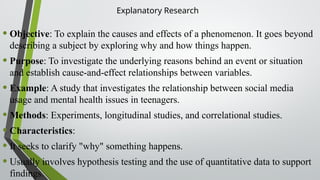
Explanatory Research
• Objective: To explain the causes and effects of a phenomenon. It goes beyond
describing a subject by exploring why and how things happen.
• Purpose: To investigate the underlying reasons behind an event or situation
and establish cause-and-effect relationships between variables.
• Example: A study that investigates the relationship between social media
usage and mental health issues in teenagers.
• Methods: Experiments, longitudinal studies, and correlational studies.
• Characteristics:
• It seeks to clarify "why" something happens.
• Usually involves hypothesis testing and the use of quantitative data to support
findings.
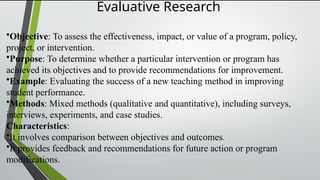
Evaluative Research
•Objective: To assess the effectiveness, impact, or value of a program, policy,
project, or intervention.
•Purpose: To determine whether a particular intervention or program has
achieved its objectives and to provide recommendations for improvement.
•Example: Evaluating the success of a new teaching method in improving
student performance.
•Methods: Mixed methods (qualitative and quantitative), including surveys,
interviews, experiments, and case studies.
Characteristics:
•It involves comparison between objectives and outcomes.
•It provides feedback and recommendations for future action or program
modifications.
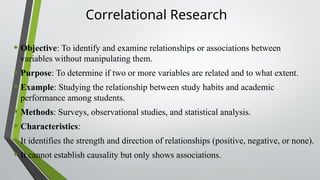
Correlational Research
• Objective: To identify and examine relationships or associations between
variables without manipulating them.
• Purpose: To determine if two or more variables are related and to what extent.
• Example: Studying the relationship between study habits and academic
performance among students.
• Methods: Surveys, observational studies, and statistical analysis.
• Characteristics:
• It identifies the strength and direction of relationships (positive, negative, or none).
• It cannot establish causality but only shows associations.
Research by Method
• "Research by method" generally refers to the systematic approach used to
gather, analyze, and interpret data within a study. This includes various
methodologies that researchers choose based on their research questions,
objectives, and the nature of the data they are investigating. Here are some
key categories
Qualitative Research
• Purpose: To explore and understand complex phenomena, behaviors, and experiences in
depth.
• Characteristics: Focuses on gathering non-numerical data, emphasizing meanings,
interpretations, and contextual understanding.
• Methods:
• Interviews: Engaging participants in conversations to gather detailed insights.
• Focus Groups: Facilitating discussions among a group of people to explore opinions
and experiences.
• Observations: Watching and recording behaviors in natural settings to understand
context.
• Case Studies: In-depth analysis of a single case or a small number of cases to provide
comprehensive insights.
Quantitative Research
• Purpose: To quantify relationships, test hypotheses, and analyze statistical data.
• Characteristics: Involves structured data collection methods and statistical
analysis to derive conclusions.
• Methods:
• Surveys: Using questionnaires to collect numerical data from a large sample.
• Experiments: Manipulating variables to observe effects in controlled
conditions.
• Observational Studies: Gathering numerical data through systematic
observation.
• Secondary Data Analysis: Analyzing existing datasets for new insights.
Mixed Method Research
• Purpose: To combine qualitative and quantitative approaches to provide a
comprehensive view of a research problem.
• Characteristics: Allows researchers to triangulate data, enhancing validity
and depth.
• Methods:
• Sequential Designs: Collecting qualitative data followed by quantitative
data (or vice versa) to explore findings in depth.
• Concurrent Designs: Collecting both qualitative and quantitative data
simultaneously to gain a broader perspective.
Conclusion
•Understanding the distinctions between research by purpose and by
method is crucial for selecting the appropriate approach for a study.
While the purpose guides the direction and goals of the research, the
chosen method dictates the techniques and data analysis strategies
employed. A well-designed research project effectively integrates
both aspects, ensuring that the research question is addressed
appropriately and that the findings are reliable and relevant.

Research by pupose and method presentation.pptx

  • 1.
    Research Methodology Topic: Researchby Purpose & Research by Method •Presented By: Musaddaq Ishtiaq Cheema •Phd English (Semester 1st )
  • 2.
    What is Research: Researchis a systematic and organized process of investigating a particular question, problem, or topic to discover new information, validate existing knowledge, or develop new theories. It involves collecting, analyzing, and interpreting data to answer a research question or solve a problem. Research is grounded in methodology, which ensures the accuracy, reliability, and validity of the findings.
  • 3.
    Key characteristics ofResearch: 1.Systematic Process: Research follows a structured method, involving clearly defined steps to gather and analyze data. 2.Objective: It aims to uncover facts or develop theories that are unbiased and based on evidence. 3.Methodological: Research employs specific methodologies—qualitative, quantitative, or a combination of both—to ensure accuracy and reliability. 4.Analytical: It involves critically examining data and information to draw conclusions. 5.Replicable: Good research can be replicated by others, reinforcing its validity and reliability.
  • 4.
    Research by Purpose •Researchby Purpose refers to categorizing research based on its overall objective or goal. The purpose of research dictates why it is conducted, which helps in understanding the nature and expected outcomes of the study. Research by purpose is typically divided into the following types
  • 5.
    Basic Research • •Basic research,also known as pure or fundamental research, is a type of scientific inquiry aimed at improving our understanding of fundamental principles, concepts, and theories. Unlike applied research, which focuses on solving practical problems, basic research is more about gaining knowledge for its own sake without a direct, immediate application. It often serves as the foundation for applied research in various fields, as it helps build the theoretical and empirical frameworks that applied scientists use to develop new technologies, methods, and innovations. •Key Characteristics: 1.Objective: To explore new theories and understand phenomena without immediate concern for practical outcomes. 2.Method: Often involves experiments, observation, and theoretical analysis. 3.Output: New knowledge, theories, and models that explain how the world works. 4.Fields: Common in natural sciences (like physics and biology), social sciences, and humanities.
  • 6.
    Action Research •Action researchis a participatory and practical approach to research aimed at solving specific problems or improving practices within a particular setting, often in real-time. It involves a cyclical process of planning, acting, observing, and reflecting. The researcher works closely with participants (such as a community, organization, or classroom) to implement changes, assess their effects, and continuously refine the strategies based on feedback and data gathered during the process. •Key Characteristics: 1. Problem-focused: Targets specific issues or challenges in a local context (e.g., educational, organizational, or social settings). 2. Participatory: Involves collaboration between researchers and participants, with participants playing an active role in identifying issues and developing solutions. 3. Iterative: Follows a cycle of planning, action, observation, and reflection, with each cycle informing the next. 4. Practical: Aims to bring about immediate improvements in practice, rather than just generating theoretical knowledge.
  • 7.
    Development Research •Development research,also known as design-based research or developmental research, is a systematic study that focuses on the creation and improvement of products, processes, or educational interventions. It often involves the design, development, and evaluation of innovative solutions in complex, real-world contexts. The primary aim of development research is to generate knowledge that not only enhances the designed product or process but also advances theoretical understanding. •Key Characteristics: 1. Practical Focus: Targets the development and improvement of specific products, programs, or interventions. 2. Iterative Process: Involves repeated cycles of design, testing, and refinement based on feedback and data. 3. Collaboration: Typically involves close collaboration between researchers, designers, and practitioners to ensure the relevance and effectiveness of the developed solutions. 4. Theory and Practice Integration: Generates both practical solutions and theoretical insights, contributing to academic knowledge while solving real-world problems.
  • 8.
    Exploratory Research • Objective:To explore and investigate a relatively unknown or unclear topic, problem, or phenomenon. It is often used when there is little prior knowledge or existing research available on the subject. • Purpose: To gather preliminary information that helps to define problems, develop hypotheses, or gain insights for future research. • Example: Investigating the potential social impacts of a new technology where no prior studies exist. • Methods: Qualitative techniques like interviews, literature reviews, focus groups, or case studies. • Characteristics: • It is flexible and open-ended. • Does not aim to provide conclusive evidence but seeks to understand the "what" and "how" of the problem.
  • 9.
    Descriptive Research •Objective: Todescribe the characteristics of a population, phenomenon, or situation. It focuses on providing an accurate and detailed depiction of a subject. •Purpose: To document and present factual information about what is happening, without necessarily explaining why it is happening. •Example: A survey describing consumer buying behavior in a particular market or demographic. •Methods: Surveys, observational studies, and case studies. Characteristics: •It answers questions like "who," "what," "where," "when," and "how many." •It does not seek to explain the causes or effects of the phenomenon.
  • 10.
    Explanatory Research • Objective:To explain the causes and effects of a phenomenon. It goes beyond describing a subject by exploring why and how things happen. • Purpose: To investigate the underlying reasons behind an event or situation and establish cause-and-effect relationships between variables. • Example: A study that investigates the relationship between social media usage and mental health issues in teenagers. • Methods: Experiments, longitudinal studies, and correlational studies. • Characteristics: • It seeks to clarify "why" something happens. • Usually involves hypothesis testing and the use of quantitative data to support findings.
  • 11.
    Evaluative Research •Objective: Toassess the effectiveness, impact, or value of a program, policy, project, or intervention. •Purpose: To determine whether a particular intervention or program has achieved its objectives and to provide recommendations for improvement. •Example: Evaluating the success of a new teaching method in improving student performance. •Methods: Mixed methods (qualitative and quantitative), including surveys, interviews, experiments, and case studies. Characteristics: •It involves comparison between objectives and outcomes. •It provides feedback and recommendations for future action or program modifications.
  • 12.
    Correlational Research • Objective:To identify and examine relationships or associations between variables without manipulating them. • Purpose: To determine if two or more variables are related and to what extent. • Example: Studying the relationship between study habits and academic performance among students. • Methods: Surveys, observational studies, and statistical analysis. • Characteristics: • It identifies the strength and direction of relationships (positive, negative, or none). • It cannot establish causality but only shows associations.
  • 13.
    Research by Method •"Research by method" generally refers to the systematic approach used to gather, analyze, and interpret data within a study. This includes various methodologies that researchers choose based on their research questions, objectives, and the nature of the data they are investigating. Here are some key categories
  • 14.
    Qualitative Research • Purpose:To explore and understand complex phenomena, behaviors, and experiences in depth. • Characteristics: Focuses on gathering non-numerical data, emphasizing meanings, interpretations, and contextual understanding. • Methods: • Interviews: Engaging participants in conversations to gather detailed insights. • Focus Groups: Facilitating discussions among a group of people to explore opinions and experiences. • Observations: Watching and recording behaviors in natural settings to understand context. • Case Studies: In-depth analysis of a single case or a small number of cases to provide comprehensive insights.
  • 15.
    Quantitative Research • Purpose:To quantify relationships, test hypotheses, and analyze statistical data. • Characteristics: Involves structured data collection methods and statistical analysis to derive conclusions. • Methods: • Surveys: Using questionnaires to collect numerical data from a large sample. • Experiments: Manipulating variables to observe effects in controlled conditions. • Observational Studies: Gathering numerical data through systematic observation. • Secondary Data Analysis: Analyzing existing datasets for new insights.
  • 16.
    Mixed Method Research •Purpose: To combine qualitative and quantitative approaches to provide a comprehensive view of a research problem. • Characteristics: Allows researchers to triangulate data, enhancing validity and depth. • Methods: • Sequential Designs: Collecting qualitative data followed by quantitative data (or vice versa) to explore findings in depth. • Concurrent Designs: Collecting both qualitative and quantitative data simultaneously to gain a broader perspective.
  • 17.
    Conclusion •Understanding the distinctionsbetween research by purpose and by method is crucial for selecting the appropriate approach for a study. While the purpose guides the direction and goals of the research, the chosen method dictates the techniques and data analysis strategies employed. A well-designed research project effectively integrates both aspects, ensuring that the research question is addressed appropriately and that the findings are reliable and relevant.