Technical Writing &
Communication Skills
PGS-502
Submitted To: Submitted By:
Dr. Vandana Kaushik M. Sc. Students:
Prof. FRM Deptt. FRM Deptt.
THESIS
A thesis is a document submitted in support of
candidature for an academic degree or professional
qualification presenting the author’s research and
findings.
CHAPTERS IN THESIS
SUMMARY
“Summary of findings is the last part of the thesis
or dissertation. It is where the findings or the
result of the thesis study is written”
CHARACTERISTICS
1. Summary of findings should be a short statement such
as the main purpose of the study, the population or
respondents, period of the study, method of research
used, research instrument and sampling design.
CHARACTERISTICS
2. Findings should be written in textual generalization,
that is, a summary of the important data consisting
of text and numbers.
CHARACTERISTICS
3. Only important findings should be included in the
summary
CHARACTERISTICS
4. No new information or data should be included in
the summary of findings.
CHARACTERISTICS
5. Findings should be stated concisely, not explained
or elaborated anymore.
Steps for writing
Summary
Keep all the important point and
evidences in front of your eyes
cluster the main idea of the whole
piece and the main evidence for each
idea.
REMEMBER
• Do not rewrite the original piece.
• Keep your summary short.
• Use your own wording.
• Refer to the central and main ideas of the original
piece.
• Read with who, what, when, where, why and how
questions in mind.
• Do not put in your opinion of the issue or topic
discussed in the original piece.
CONCLUSION
“conclusion is typically created at the end of the
writing process. The conclusion of a research
thesis reaffirms the thesis statement, discusses
the issues, and reaches a final judgment. The
conclusion is not a summary; it is a belief based
on your reasoning and on the evidence you have
accumulated. This is the place to share with
readers the conclusions you have reached because
of your research.”
Purpose of Conclusion
1. Tie together, integrate and synthesize the various
issues raised in the discussion sections, whilst
reflecting the introductory thesis statement (s) or
objectives.
2. To provide answers to the thesis research questions.
3. Identify the theoretical and policy implications of
the study with respect to the overall study area.
4. Highlights the study limitations
5. Provide direction and areas for future research
CHARACTERISTICS
1. It doesn’t contain numerals.
2. It focus on the meaning/ essence of the
study.
3. It is explicit and definite, leaving merely
giving implied giving the researcher a bit of
doubt (qualifiers such as probably, may be,
perhaps should be avoided).
It includes
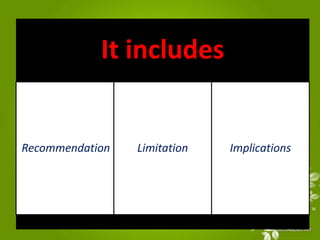
Recommendation Limitation Implications
RECOMMENDATION
Research often exposes further problems and
introduces more questions. As a student, there is a
time limit to your research project, so it is unlikely
that your work would have solved all the problems
associated with the area of study
Characteristics of The
Recommendations
• based upon the findings and conclusions.
• feasible, practical, and attainable.
• action-oriented (recommend action to remedy or
unfavorable condition discovered)
• limited only to the subject of the study but
recommend further research on the same subject.
LIMITATION
In the case of an empirical research it is important to
identify the various limitations which were
encountered during the sampling, lab work, data
collection and analysis stages of the research or
project. However, the limitation should end on a
positive note to show how they worked together to
provide focus and strengthen the empirical results.
IMPLICATIONS
An author should also focus in the future
implications of the study. How the work can be
beneficial for upcoming researchers.
THANK YOU

summary and conclusion

  • 1.
    Technical Writing & CommunicationSkills PGS-502 Submitted To: Submitted By: Dr. Vandana Kaushik M. Sc. Students: Prof. FRM Deptt. FRM Deptt.
  • 2.
    THESIS A thesis isa document submitted in support of candidature for an academic degree or professional qualification presenting the author’s research and findings.
  • 3.
  • 4.
    SUMMARY “Summary of findingsis the last part of the thesis or dissertation. It is where the findings or the result of the thesis study is written”
  • 5.
    CHARACTERISTICS 1. Summary offindings should be a short statement such as the main purpose of the study, the population or respondents, period of the study, method of research used, research instrument and sampling design.
  • 6.
    CHARACTERISTICS 2. Findings shouldbe written in textual generalization, that is, a summary of the important data consisting of text and numbers.
  • 7.
    CHARACTERISTICS 3. Only importantfindings should be included in the summary
  • 8.
    CHARACTERISTICS 4. No newinformation or data should be included in the summary of findings.
  • 9.
    CHARACTERISTICS 5. Findings shouldbe stated concisely, not explained or elaborated anymore.
  • 10.
    Steps for writing Summary Keepall the important point and evidences in front of your eyes cluster the main idea of the whole piece and the main evidence for each idea.
  • 11.
    REMEMBER • Do notrewrite the original piece. • Keep your summary short. • Use your own wording. • Refer to the central and main ideas of the original piece. • Read with who, what, when, where, why and how questions in mind. • Do not put in your opinion of the issue or topic discussed in the original piece.
  • 12.
    CONCLUSION “conclusion is typicallycreated at the end of the writing process. The conclusion of a research thesis reaffirms the thesis statement, discusses the issues, and reaches a final judgment. The conclusion is not a summary; it is a belief based on your reasoning and on the evidence you have accumulated. This is the place to share with readers the conclusions you have reached because of your research.”
  • 13.
    Purpose of Conclusion 1.Tie together, integrate and synthesize the various issues raised in the discussion sections, whilst reflecting the introductory thesis statement (s) or objectives. 2. To provide answers to the thesis research questions. 3. Identify the theoretical and policy implications of the study with respect to the overall study area. 4. Highlights the study limitations 5. Provide direction and areas for future research
  • 14.
    CHARACTERISTICS 1. It doesn’tcontain numerals. 2. It focus on the meaning/ essence of the study. 3. It is explicit and definite, leaving merely giving implied giving the researcher a bit of doubt (qualifiers such as probably, may be, perhaps should be avoided).
  • 15.
  • 16.
    RECOMMENDATION Research often exposesfurther problems and introduces more questions. As a student, there is a time limit to your research project, so it is unlikely that your work would have solved all the problems associated with the area of study
  • 17.
    Characteristics of The Recommendations •based upon the findings and conclusions. • feasible, practical, and attainable. • action-oriented (recommend action to remedy or unfavorable condition discovered) • limited only to the subject of the study but recommend further research on the same subject.
  • 18.
    LIMITATION In the caseof an empirical research it is important to identify the various limitations which were encountered during the sampling, lab work, data collection and analysis stages of the research or project. However, the limitation should end on a positive note to show how they worked together to provide focus and strengthen the empirical results.
  • 19.
    IMPLICATIONS An author shouldalso focus in the future implications of the study. How the work can be beneficial for upcoming researchers.
  • 20.