TYPES OF RESEARCH
▶ - a human activity based on intellectual
application in the investigation matter.
▶ Is a systematic and organized way to find answers
to questions.
▶ Its primary aim is discovering, interpreting, and
development of methods and systems for the
advancement of human knowledge on a wide
variety of scientific matters of our world and the
universe.
What is Research?
▶ Applied Research
▶ Pure Research
▶ Action and Developmental Research
3 Basic Types of Research
▶ Refers to scientific study and research that seeks to
solve practical problems rather than to acquire
knowledge for knowledge’s sake.
▶ Is original work undertaken primarily to acquire new
knowledge with a specific application in view.
▶ It is used to find solutions to everyday problems, cure
illness, and develop innovative technologies.
▶ It is for the sake of technological advancements.
▶ Its goal is to improve the human condition.
Applied Research
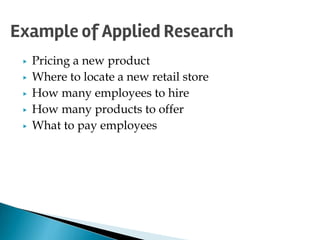
▶ Pricing a new product
▶ Where to locate a new retail store
▶ How many employees to hire
▶ How many products to offer
▶ What to pay employees
Example of Applied Research
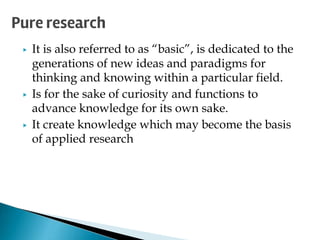
▶ It is also referred to as “basic”, is dedicated to the
generations of new ideas and paradigms for
thinking and knowing within a particular field.
▶ Is for the sake of curiosity and functions to
advance knowledge for its own sake.
▶ It create knowledge which may become the basis
of applied research
Pure research
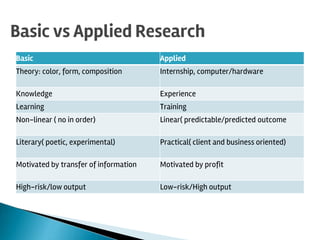
Basic Applied
Theory: color, form, composition Internship, computer/hardware
Knowledge Experience
Learning Training
Non-linear ( no in order) Linear( predictable/predicted outcome
Literary( poetic, experimental) Practical( client and business oriented)
Motivated by transfer of information Motivated by profit
High-risk/low output Low-risk/High output
Basic vs Applied Research
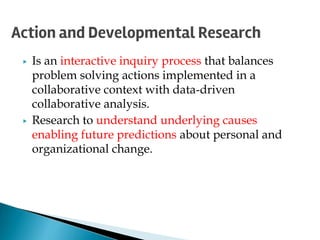
▶ Is an interactive inquiry process that balances
problem solving actions implemented in a
collaborative context with data-driven
collaborative analysis.
▶ Research to understand underlying causes
enabling future predictions about personal and
organizational change.
Action and Developmental Research
▶ Is a procedure supplementary to observation in
which the researcher seeks to test the authenticity
of the reports or observations made by others.
▶ Employed by researchers who are interested in
reporting events and/or conditions that occurred
in the past.
▶ An attempt is made to establish facts in order to
arrive at conclusions concerning past events or
predict future events.
Historical Research
▶ 1. Recognition of a historical problem or the
identification of a need for certain historical
knowledge.
▶ 2. Gathering of as much relevant information about
the problem or topic.
▶ 3. The selection, organization, and analysis of the most
pertinent collected evidence
▶ 4. Recording of conclusions.
▶ 5. Forming of hypothesis that tentatively explain
relationship between historical factors
▶ 6. The rigorous collection and organization signs in a
meaningful narrative
Steps in conducting historical research
▶ Primary sources- first hand accounts of
information. It involves logic, intuition,
persistence, and common sense. E.g. personal
diaries, eyewitness accounts of evens.
▶ Secondary sources- are records or accounts
prepared by someone other than the person, or
persons who participated in or observed event.
(E.g. newspapers, textbooks, review of research
and other references)
Sources of Data
SPECIFIC RESEARCH METHODOLOGY
▶ Historical Research
▶ Descriptive Research
▶ Experimental Research
▶ Causal Comparative Research
HISTORICAL RESEARCH
▶ Historical Research is a procedure supplementary
to observation in which the researcher seeks to
test the authenticity of the reports or observations
made by others.
▶ The process of learning and understanding the
background and growth of a chosen field of study
or profession can offer insight into organizational
culture, current trends, and future possibilities.
The historical method of research applies to all
fields of study because it encompasses their:
origins, growth, theories, personalities, crisis, etc.
DESCRIPTIVE RESEARCH
▶ Tells "what is." No manipulations of variables are
attempted, only descriptions of variables and their
relationships as they naturally occur.
▶ It is used to obtain information concerning the
current status of the phenomena to describe "what
exists" with respect to variables or conditions in a
situation.
EXPERIMENTAL RESEARCH
▶ An attempt by the researcher to maintain control
over all factors that may affect the result of an
experiment. In doing this, the researcher attempts
to determine or predict what may occur.
▶ The purpose, therefore, of experimental designs is
to eliminate alternative hypotheses.
CAUSAL COMPARATIVE RESEARCH
▶ It is used when you cannot test a hypothesis by
manipulating a variable. This type of research allows you
to investigate relationships in which variables like
intelligence, creativity, socioeconomic status, and
instructor personality cannot be manipulated.
▶ Causal-comparative research is also referred to as "ex post
facto" research, which means after the fact or from a thing
done afterwards. This simply implies that the researcher is
studying the cause-effect relationship that already exists,
without attempting any control or change in either the
cause or the effect.

MELJUN CORTES research lectures_types_of_research

  • 1.
  • 2.
    ▶ - ahuman activity based on intellectual application in the investigation matter. ▶ Is a systematic and organized way to find answers to questions. ▶ Its primary aim is discovering, interpreting, and development of methods and systems for the advancement of human knowledge on a wide variety of scientific matters of our world and the universe. What is Research?
  • 3.
    ▶ Applied Research ▶Pure Research ▶ Action and Developmental Research 3 Basic Types of Research
  • 4.
    ▶ Refers toscientific study and research that seeks to solve practical problems rather than to acquire knowledge for knowledge’s sake. ▶ Is original work undertaken primarily to acquire new knowledge with a specific application in view. ▶ It is used to find solutions to everyday problems, cure illness, and develop innovative technologies. ▶ It is for the sake of technological advancements. ▶ Its goal is to improve the human condition. Applied Research
  • 5.
    ▶ Pricing anew product ▶ Where to locate a new retail store ▶ How many employees to hire ▶ How many products to offer ▶ What to pay employees Example of Applied Research
  • 6.
    ▶ It isalso referred to as “basic”, is dedicated to the generations of new ideas and paradigms for thinking and knowing within a particular field. ▶ Is for the sake of curiosity and functions to advance knowledge for its own sake. ▶ It create knowledge which may become the basis of applied research Pure research
  • 7.
    Basic Applied Theory: color,form, composition Internship, computer/hardware Knowledge Experience Learning Training Non-linear ( no in order) Linear( predictable/predicted outcome Literary( poetic, experimental) Practical( client and business oriented) Motivated by transfer of information Motivated by profit High-risk/low output Low-risk/High output Basic vs Applied Research
  • 8.
    ▶ Is aninteractive inquiry process that balances problem solving actions implemented in a collaborative context with data-driven collaborative analysis. ▶ Research to understand underlying causes enabling future predictions about personal and organizational change. Action and Developmental Research
  • 9.
    ▶ Is aprocedure supplementary to observation in which the researcher seeks to test the authenticity of the reports or observations made by others. ▶ Employed by researchers who are interested in reporting events and/or conditions that occurred in the past. ▶ An attempt is made to establish facts in order to arrive at conclusions concerning past events or predict future events. Historical Research
  • 10.
    ▶ 1. Recognitionof a historical problem or the identification of a need for certain historical knowledge. ▶ 2. Gathering of as much relevant information about the problem or topic. ▶ 3. The selection, organization, and analysis of the most pertinent collected evidence ▶ 4. Recording of conclusions. ▶ 5. Forming of hypothesis that tentatively explain relationship between historical factors ▶ 6. The rigorous collection and organization signs in a meaningful narrative Steps in conducting historical research
  • 11.
    ▶ Primary sources-first hand accounts of information. It involves logic, intuition, persistence, and common sense. E.g. personal diaries, eyewitness accounts of evens. ▶ Secondary sources- are records or accounts prepared by someone other than the person, or persons who participated in or observed event. (E.g. newspapers, textbooks, review of research and other references) Sources of Data
  • 12.
    SPECIFIC RESEARCH METHODOLOGY ▶Historical Research ▶ Descriptive Research ▶ Experimental Research ▶ Causal Comparative Research
  • 13.
    HISTORICAL RESEARCH ▶ HistoricalResearch is a procedure supplementary to observation in which the researcher seeks to test the authenticity of the reports or observations made by others. ▶ The process of learning and understanding the background and growth of a chosen field of study or profession can offer insight into organizational culture, current trends, and future possibilities. The historical method of research applies to all fields of study because it encompasses their: origins, growth, theories, personalities, crisis, etc.
  • 14.
    DESCRIPTIVE RESEARCH ▶ Tells"what is." No manipulations of variables are attempted, only descriptions of variables and their relationships as they naturally occur. ▶ It is used to obtain information concerning the current status of the phenomena to describe "what exists" with respect to variables or conditions in a situation.
  • 15.
    EXPERIMENTAL RESEARCH ▶ Anattempt by the researcher to maintain control over all factors that may affect the result of an experiment. In doing this, the researcher attempts to determine or predict what may occur. ▶ The purpose, therefore, of experimental designs is to eliminate alternative hypotheses.
  • 16.
    CAUSAL COMPARATIVE RESEARCH ▶It is used when you cannot test a hypothesis by manipulating a variable. This type of research allows you to investigate relationships in which variables like intelligence, creativity, socioeconomic status, and instructor personality cannot be manipulated. ▶ Causal-comparative research is also referred to as "ex post facto" research, which means after the fact or from a thing done afterwards. This simply implies that the researcher is studying the cause-effect relationship that already exists, without attempting any control or change in either the cause or the effect.