OBSERVATIONOBSERVATION
Mukut HazarikaMukut Hazarika
ProfessorProfessor
Department of EducationDepartment of Education
Dibrugarh UniversityDibrugarh University
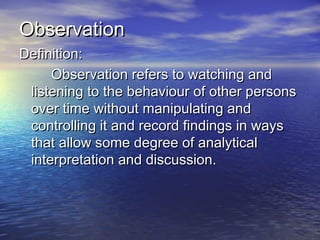
ObservationObservation
Definition:Definition:
Observation refers to watching andObservation refers to watching and
listening to the behaviour of other personslistening to the behaviour of other persons
over time without manipulating andover time without manipulating and
controlling it and record findings in wayscontrolling it and record findings in ways
that allow some degree of analyticalthat allow some degree of analytical
interpretation and discussion.interpretation and discussion.
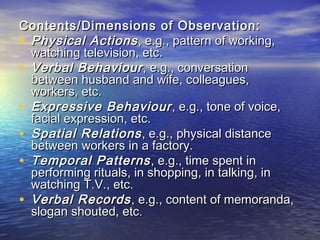
Contents/Dimensions of Observation:Contents/Dimensions of Observation:
• Physical ActionsPhysical Actions , e.g., pattern of working,, e.g., pattern of working,
watching television, etc.watching television, etc.
• Verbal BehaviourVerbal Behaviour , e.g., conversation, e.g., conversation
between husband and wife, colleagues,between husband and wife, colleagues,
workers, etc.workers, etc.
• Expressive BehaviourExpressive Behaviour , e.g., tone of voice,, e.g., tone of voice,
facial expression, etc.facial expression, etc.
• Spatial RelationsSpatial Relations, e.g., physical distance, e.g., physical distance
between workers in a factory.between workers in a factory.
• Temporal PatternsTemporal Patterns, e.g., time spent in, e.g., time spent in
performing rituals, in shopping, in talking, inperforming rituals, in shopping, in talking, in
watching T.V., etc.watching T.V., etc.
• Verbal RecordsVerbal Records, e.g., content of memoranda,, e.g., content of memoranda,
slogan shouted, etc.slogan shouted, etc.
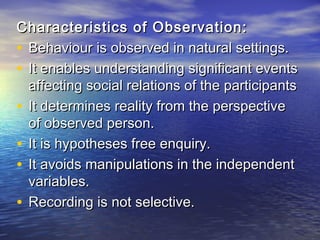
Characteristics of Observation:Characteristics of Observation:
• Behaviour is observed in natural settings.Behaviour is observed in natural settings.
• It enables understanding significant eventsIt enables understanding significant events
affecting social relations of the participantsaffecting social relations of the participants
• It determines reality from the perspectiveIt determines reality from the perspective
of observed person.of observed person.
• It is hypotheses free enquiry.It is hypotheses free enquiry.
• It avoids manipulations in the independentIt avoids manipulations in the independent
variables.variables.
• Recording is not selective.Recording is not selective.
Process of Observation:Process of Observation:
• Selecting a topicSelecting a topic
• Choosing a research siteChoosing a research site
• Gaining access in settingGaining access in setting
• Taking rolesTaking roles
• Jotting down field notesJotting down field notes
• Formulating analysisFormulating analysis
• Writing ReportsWriting Reports
Advantages of Observation:Advantages of Observation:
• It provides a direct procedure for studyingIt provides a direct procedure for studying
various aspects of human behaviour, which mayvarious aspects of human behaviour, which may
be the only effective way to gather data in abe the only effective way to gather data in a
particular situation.particular situation.
• It is effective especially for studying socialIt is effective especially for studying social
processes in depth over time.processes in depth over time.
• It is a flexible technique in which researchIt is a flexible technique in which research
design can be modified at any time.design can be modified at any time.
• It is less complicated.It is less complicated.
• It offers data when respondents are unable orIt offers data when respondents are unable or
unwilling to cooperate for giving information.unwilling to cooperate for giving information.
• It approaches reality in its natural setting andIt approaches reality in its natural setting and
studies events as they evolve.studies events as they evolve.
• It allows collection of wide range of information.It allows collection of wide range of information.
Limitations of Observation:Limitations of Observation:
• It cannot be employed when largeIt cannot be employed when large
groups are to be studied.groups are to be studied.
• A subject may intentionally attempt toA subject may intentionally attempt to
exhibit an artificial behaviour whenexhibit an artificial behaviour when
he/she knows that he is beinghe/she knows that he is being
observed.observed.
• Observation method is timeObservation method is time
consuming and sometimes too costly.consuming and sometimes too costly.
Types of ObservationTypes of Observation
• On the basis of the ability of observational dataOn the basis of the ability of observational data
to generate useful and researchable in formationto generate useful and researchable in formation
Reiss (1971) divides observation into theReiss (1971) divides observation into the
following two types:following two types:
(a) Systematic Observation(a) Systematic Observation
(b) Unsystematic Observation(b) Unsystematic Observation
• On the basis of role played by the investigator, itOn the basis of role played by the investigator, it
is divided into the following two types:is divided into the following two types:
(a) Participant Observation(a) Participant Observation
(b) Non-participant Observation(b) Non-participant Observation
• Systematic ObservationSystematic Observation : Systematic: Systematic
observation refers to those observation inobservation refers to those observation in
which observation is done according towhich observation is done according to
some explicit procedures as well as insome explicit procedures as well as in
accordance with logic of scientificaccordance with logic of scientific
inference.inference.
• Unsystematic Observation:Unsystematic Observation:
Unsystematic observation is a type ofUnsystematic observation is a type of
causal observation made by investigatorcausal observation made by investigator
without specifying any explicit andwithout specifying any explicit and
objective inference.objective inference.
• Participant ObservationParticipant Observation : In participant: In participant
observation the investigator actively participatesobservation the investigator actively participates
in the activities of the group to be observed.in the activities of the group to be observed.
Usually, the identity of the observer is not knownUsually, the identity of the observer is not known
to other members of the group (to other members of the group (disguiseddisguised
participant observation). Therefore, the otherparticipant observation). Therefore, the other
members of the group take him as an ordinarymembers of the group take him as an ordinary
member and interact with him in a natural way.member and interact with him in a natural way.
But sometimes the members who are beingBut sometimes the members who are being
observed know that the observer is present forobserved know that the observer is present for
collecting information about them (collecting information about them (undisguisedundisguised
participant observation). The procedure ofparticipant observation). The procedure of
observation in participant observation isobservation in participant observation is
unstructured and the observer has someunstructured and the observer has some
flexibility in deciding what to observe, how toflexibility in deciding what to observe, how to
record it, etc.record it, etc.
Advantages:Advantages:
• In participant observation since theIn participant observation since the
observation is done in a natural setting,observation is done in a natural setting,
the investigator is able to record thethe investigator is able to record the
natural behaviour.natural behaviour.
• Usually the complete observation by theUsually the complete observation by the
method of participant observation takesmethod of participant observation takes
several months or years. As aseveral months or years. As a
consequence whatever information isconsequence whatever information is
collected is very broad and meaningful forcollected is very broad and meaningful for
understanding human behaviour.understanding human behaviour.
Disadvantages:Disadvantages:
• Since participant observation is usuallySince participant observation is usually
unstructured, it fails to be precise about theunstructured, it fails to be precise about the
procedure of data collection.procedure of data collection.
• Participant observation is time consuming deviceParticipant observation is time consuming device
and therefore, not all observers become ready toand therefore, not all observers become ready to
proceed by the procedure of participantproceed by the procedure of participant
observation.observation.
• Since the observer participates in the activities ofSince the observer participates in the activities of
the group, the observer sometimes startsthe group, the observer sometimes starts
showing human weaknesses like love, sympathy,showing human weaknesses like love, sympathy,
hatred, etc. towards the members and theirhatred, etc. towards the members and their
behaviour.behaviour.
• Non-participant ObservationNon-participant Observation : Non-: Non-
participant observation is the observationparticipant observation is the observation
in which the investigator observes thein which the investigator observes the
behaviour of other persons in a naturalbehaviour of other persons in a natural
setting but does not participate in thesetting but does not participate in the
activities of the group to be observed. Non-activities of the group to be observed. Non-
participant observation is usuallyparticipant observation is usually
structured and therefore, the observerstructured and therefore, the observer
preplans the likely nature of natural setting,preplans the likely nature of natural setting,
problems associated with the presence ofproblems associated with the presence of
the investigator, etc.the investigator, etc.
Advantages:Advantages:
• Since non-participant observation isSince non-participant observation is
usually structured, the obtained data areusually structured, the obtained data are
more reliable and representative.more reliable and representative.
• In non-participant observation theIn non-participant observation the
observer is able to concentrate upon anyobserver is able to concentrate upon any
specific aspects of social behaviour in aspecific aspects of social behaviour in a
better way and therefore, gets a betterbetter way and therefore, gets a better
opportunity to find out the solution of theopportunity to find out the solution of the
problem.problem.
Disadvantages:Disadvantages:
• In non–participant observation, theIn non–participant observation, the
persons being observed developpersons being observed develop
consciousness that their behaviour areconsciousness that their behaviour are
being observed. This consciousnessbeing observed. This consciousness
slightly distorts the natural flow of theirslightly distorts the natural flow of their
behaviour.behaviour.
• Since the settings are structured, it alsoSince the settings are structured, it also
affects the person being observed.affects the person being observed.
Observation Schedule:Observation Schedule:
• Observation schedule is a device used byObservation schedule is a device used by
field researchers to systematically recordfield researchers to systematically record
observations. It employs observationobservations. It employs observation
instead of verbal questions. Questions ininstead of verbal questions. Questions in
the observation schedule are answeredthe observation schedule are answered
not by talking but by observations.not by talking but by observations.
Reliability of Observation basedReliability of Observation based
data:data:
• Internal Consistency ReliabilityInternal Consistency Reliability ::
Internal consistency refers to whether theInternal consistency refers to whether the
data are plausible given all that is knowndata are plausible given all that is known
about a person or event, eliminatingabout a person or event, eliminating
common forms of human deception. Incommon forms of human deception. In
other words, do the pieces fit together intoother words, do the pieces fit together into
a coherent picture? For example, are aa coherent picture? For example, are a
member’s actions consistent over timemember’s actions consistent over time
and in different social contexts?and in different social contexts?
• External Consistency ReliabilityExternal Consistency Reliability ::
External consistency is achieved byExternal consistency is achieved by
verifying or cross-checking observationsverifying or cross-checking observations
with other, divergent sources of data. Inwith other, divergent sources of data. In
other words, does it all fit into the over allother words, does it all fit into the over all
context ? For example, can others verifycontext ? For example, can others verify
what a researcher observed about awhat a researcher observed about a
person ? Does other evidence confirm theperson ? Does other evidence confirm the
researcher’s observation ? (Interobserverresearcher’s observation ? (Interobserver
Consistency)Consistency)
• Another kind of external consistency canAnother kind of external consistency can
be achieved by asking an observer to viewbe achieved by asking an observer to view
and rate or code at different times exactlyand rate or code at different times exactly
the same behaviour (Double observationthe same behaviour (Double observation
by the same observer).by the same observer).
Validity of Observation based data:Validity of Observation based data:
• An observational measurement can beAn observational measurement can be
valid only to the extent that recordedvalid only to the extent that recorded
differences in score represent actualdifferences in score represent actual
differences in behaviour rather thandifferences in behaviour rather than
differences in the impressions made ondifferences in the impressions made on
different observer.different observer.
There are four kinds of validity:There are four kinds of validity:
• Ecological ValidityEcological Validity : It is the degree to: It is the degree to
which the social world described by awhich the social world described by a
researcher matches the world ofresearcher matches the world of
members. It asks: Is the natural settingmembers. It asks: Is the natural setting
described relatively undisturbed by thedescribed relatively undisturbed by the
researcher’s presence or procedure ? Aresearcher’s presence or procedure ? A
study has ecological validity if eventsstudy has ecological validity if events
would have occurred without awould have occurred without a
researcher’s presence.researcher’s presence.
• Validity in terms of Natural HistoryValidity in terms of Natural History ::
Natural history is a detailed description ofNatural history is a detailed description of
how the project was conducted. It is fullhow the project was conducted. It is full
and candid disclosure of a researcher’sand candid disclosure of a researcher’s
actions, assumptions, and procedures foractions, assumptions, and procedures for
others to evaluate. A study is valid inothers to evaluate. A study is valid in
terms of natural history if outsiders seeterms of natural history if outsiders see
and accept the field site and researcher’sand accept the field site and researcher’s
actions.actions.
• Member ValidationMember Validation : Member validation occurs when a: Member validation occurs when a
researcher takes field results back to members, whoresearcher takes field results back to members, who
judge their adequacy. A study is member valid ifjudge their adequacy. A study is member valid if
members recognize and understand the researcher’smembers recognize and understand the researcher’s
description as reflecting their intimate social world.description as reflecting their intimate social world.
• Limitations:Limitations:
(a) Member validation has limitations because conflicting(a) Member validation has limitations because conflicting
perspectives in a setting produce disagreement withperspectives in a setting produce disagreement with
researcher’s observations and members may objectresearcher’s observations and members may object
when results do not portray their group in a favourablewhen results do not portray their group in a favourable
way.way.
(b) In addition, members may not recognize the(b) In addition, members may not recognize the
description because it is not from their perspective ordescription because it is not from their perspective or
does not fit with their purposes.does not fit with their purposes.
• Validity in terms of Competent InsiderValidity in terms of Competent Insider
Performance: Competent insider performance isPerformance: Competent insider performance is
the ability of a nonmember to interact effectivelythe ability of a nonmember to interact effectively
as a member or pass as one. This includes theas a member or pass as one. This includes the
ability to tell and understand insider jokes. Aability to tell and understand insider jokes. A
valid study gives enough of a flavour of thevalid study gives enough of a flavour of the
social life in the field and sufficient detail so thatsocial life in the field and sufficient detail so that
an outsider can act as a member.an outsider can act as a member.
• Limitations:Limitations:
(a) Its limitation is that it is not possible to know(a) Its limitation is that it is not possible to know
the social rules for every situation.the social rules for every situation.
(b) Also, an outsider might be able to pass(b) Also, an outsider might be able to pass
simply because members are being polite andsimply because members are being polite and
do not want to point out social mistakes.do not want to point out social mistakes.
Reliability and Validity of observationalReliability and Validity of observational
measurement are improved whenmeasurement are improved when
observations are made at frequentobservations are made at frequent
intervals by the same observer, or whenintervals by the same observer, or when
several observers record theirseveral observers record their
observations independently (Best, 1977).observations independently (Best, 1977).
Standardization of ObservationStandardization of Observation
Schedule:Schedule:
1.1. Reliability:Reliability:
• Inter-observer agreement in recording of the sameInter-observer agreement in recording of the same
behaviour.behaviour.
• Consistency of a single observer from one time toConsistency of a single observer from one time to
another.another.
• Estimate the variability of the trait itself. There areEstimate the variability of the trait itself. There are
significant variations in human behaviour from onesignificant variations in human behaviour from one
time to the next, one situation to another.time to the next, one situation to another.
2.2. Validity:Validity:
• The extent to which the recoded differences in scoreThe extent to which the recoded differences in score
represent actual differences in behaviour.represent actual differences in behaviour.
Strengths of Observation Schedule:Strengths of Observation Schedule:
• It allows the researcher to identify theIt allows the researcher to identify the
frequencies or order of events and encouragesfrequencies or order of events and encourages
the comparisons over time.the comparisons over time.
• When used in monitoring/appraisal, the strengthWhen used in monitoring/appraisal, the strength
of observation schedule is that the observer andof observation schedule is that the observer and
teacher can agree in advance what is beingteacher can agree in advance what is being
studied, and the observer can make anstudied, and the observer can make an
accurate record for future comparison.accurate record for future comparison.
Limitations of ObservationLimitations of Observation
Schedule:Schedule:
• It does not record the contextual data,It does not record the contextual data,
qualitative impression such as ‘was thequalitative impression such as ‘was the
lesson interesting’.lesson interesting’.
• In monitoring or appraisal, it isIn monitoring or appraisal, it is
demonstrably necessary to recognize thedemonstrably necessary to recognize the
danger of over-simple classifications.danger of over-simple classifications.
How to quantify observation basedHow to quantify observation based
data ?data ?
• How frequently school students quarrel ?How frequently school students quarrel ?
• Who quarrels more, boys or girls ?Who quarrels more, boys or girls ?
• What is the duration of conflict ?What is the duration of conflict ?
• Are there any change with age ?Are there any change with age ?
• Who controls/stops their quarrel ?Who controls/stops their quarrel ?
Rating ScaleRating Scale
• Rating scale refers to a scale with a set of pointsRating scale refers to a scale with a set of points
which describe varying degrees of thewhich describe varying degrees of the
dimension of an attribute being observed (Koul,dimension of an attribute being observed (Koul,
1997).1997).
• A rating scale is defined as a technique throughA rating scale is defined as a technique through
which the observer or rater categorizes thewhich the observer or rater categorizes the
objects, events or persons on a continuumobjects, events or persons on a continuum
represented by a series of continuous numeralsrepresented by a series of continuous numerals
(Singh,1997).(Singh,1997).
Types of Rating ScalesTypes of Rating Scales
• Numerical ScalesNumerical Scales
• Graphical ScalesGraphical Scales
• Percentage RatingPercentage Rating
• Standard ScalesStandard Scales
• Scales of cumulated pointsScales of cumulated points
• Forced choice scalesForced choice scales
Numerical ScalesNumerical Scales
• Numerical scale consists of a sequence ofNumerical scale consists of a sequence of
defined numbers which is supplied to thedefined numbers which is supplied to the
rater or the observer. The rater or therater or the observer. The rater or the
observer assigns to each stimulus, to beobserver assigns to each stimulus, to be
rated, an appropriate number as definedrated, an appropriate number as defined
or describes.or describes.
Graphic ScalesGraphic Scales
• The scales are presented graphically inThe scales are presented graphically in
which descriptive cues corresponding towhich descriptive cues corresponding to
the different scale steps are given. In thisthe different scale steps are given. In this
scale, a straight line is drawn vertically orscale, a straight line is drawn vertically or
horizontally with various cues to help thehorizontally with various cues to help the
rater. The line may be segmented in unitsrater. The line may be segmented in units
or continuous.or continuous.
Percentage RatingPercentage Rating
• This technique involves placing objects,This technique involves placing objects,
persons, etc among different specifiedpersons, etc among different specified
percentage groups or into differentpercentage groups or into different
percentiles or quartiles. For example: inpercentiles or quartiles. For example: in
the highest 5 per cent of the group, in thethe highest 5 per cent of the group, in the
middle 25 percent of the group, in themiddle 25 percent of the group, in the
lowest 10 percent, etc.lowest 10 percent, etc.
Standard ScaleStandard Scale
• A standard scale is one in which the raterA standard scale is one in which the rater
is presented with some standards withis presented with some standards with
pre-established scale values. Thesepre-established scale values. These
standards usually consist of objects ofstandards usually consist of objects of
same kind. For example: Handwriting-same kind. For example: Handwriting-
standards, Portrait-matching, man-to-manstandards, Portrait-matching, man-to-man
scale, etc.scale, etc.
Portrait Matching ScalePortrait Matching Scale
• In this technique a set of standards or verbalIn this technique a set of standards or verbal
sketches or portraits for any given trait on whichsketches or portraits for any given trait on which
rating is to be done, is prepared.rating is to be done, is prepared.
• For constructing the verbal portrait a largeFor constructing the verbal portrait a large
number of verbal statements describing that traitnumber of verbal statements describing that trait
are collected and each is written in a separateare collected and each is written in a separate
card.card.
• They are then rank-ordered by a group ofThey are then rank-ordered by a group of
experts.experts.
• Then a desired number of sketches areThen a desired number of sketches are
prepared which have the same averageprepared which have the same average
rank.rank.
• The portraits are given to another group ofThe portraits are given to another group of
judges for ranking them and mean rankjudges for ranking them and mean rank
becomes the scale value.becomes the scale value.
• Then the rater is given all the verbalThen the rater is given all the verbal
portraits to read and he names theportraits to read and he names the
persons who belong to the portraits.persons who belong to the portraits.
• A person’s final rating is the average of allA person’s final rating is the average of all
the portraits values.the portraits values.
Scales of cumulated PointsScales of cumulated Points
• The rating score of a person, in theseThe rating score of a person, in these
scales, is the sum of the individual ratingsscales, is the sum of the individual ratings
or points assigned to all the items of theor points assigned to all the items of the
scale.scale.
Forced-Choice RatingsForced-Choice Ratings
• In forced choice rating scale the rater is given aIn forced choice rating scale the rater is given a
set of attributes in terms of verbal statements forset of attributes in terms of verbal statements for
a single item and he decides which one or ones,a single item and he decides which one or ones,
represent the individual being rated mostrepresent the individual being rated most
appropriately and accurately. The items ofappropriately and accurately. The items of
forced-choice scale may have severalforced-choice scale may have several
alternatives. The four alternatives are morealternatives. The four alternatives are more
common in forced-choice scale. In this form, thecommon in forced-choice scale. In this form, the
rater may be asked to select any two statementsrater may be asked to select any two statements
which are most descriptive and representative ofwhich are most descriptive and representative of
the persons being rated.the persons being rated.
Example of Forced-ChoiceExample of Forced-Choice
ScaleScale
• Is well informed in science.Is well informed in science.
• Can apply scientific fact and theory toCan apply scientific fact and theory to
practical situations.practical situations.
• Create confidence in those with whom heCreate confidence in those with whom he
deals.deals.
• Explains the reasons for hisExplains the reasons for his
recommendations.recommendations.
Distinction between Forced-ChoiceDistinction between Forced-Choice
Rating Scale and other types ofRating Scale and other types of
Rating ScaleRating Scale
• All other types of rating techniquesAll other types of rating techniques
consider one attribute at a time and placeconsider one attribute at a time and place
the ratee in any one of a set of categories.the ratee in any one of a set of categories.
Steps followed in Construction andSteps followed in Construction and
Standardization of Rating Scale:Standardization of Rating Scale:
• Definition of traitsDefinition of traits : Each trait should: Each trait should
be clearly defined so that traits may bebe clearly defined so that traits may be
clearly and uniformly understood by allclearly and uniformly understood by all
judges.judges.
• Degree of traitDegree of trait: The degree of trait: The degree of trait
should be defined.should be defined.
• Reliability:Reliability:
• Validity:Validity:
Reliability of Rating Scale:Reliability of Rating Scale:
• Reliability of rating scale depends upon extentReliability of rating scale depends upon extent
variation of judges’ ratings. Judges rating anvariation of judges’ ratings. Judges rating an
individual on a specified trait will not alwaysindividual on a specified trait will not always
agree as to his score or rank. The mean or theagree as to his score or rank. The mean or the
median of all the judgments represent themedian of all the judgments represent the
nearest approximation to the true rating.nearest approximation to the true rating.
However, the averaging to be meaningful, theHowever, the averaging to be meaningful, the
variation of the judges’ rating should be small.variation of the judges’ rating should be small.
• Reliability of rating scales are determinedReliability of rating scales are determined
by repeating judgments after a timeby repeating judgments after a time
interval and then determining correlationinterval and then determining correlation
coefficient between ratings of two or morecoefficient between ratings of two or more
judges; and by determining relationshipjudges; and by determining relationship
between judges’ ratings and self-ratings.between judges’ ratings and self-ratings.
• Overt traits are more reliably rated thanOvert traits are more reliably rated than
covert traits.covert traits.
• Reliability of trait estimates is affected byReliability of trait estimates is affected by
desirability or undesirability of the trait.desirability or undesirability of the trait.
• Some persons are more accurately ratedSome persons are more accurately rated
than others. Extroverted individuals arethan others. Extroverted individuals are
more reliably judged than introverted.more reliably judged than introverted.
• Degree of certainty of ratings should beDegree of certainty of ratings should be
stated.stated.
Validity of Rating Scale:Validity of Rating Scale:
• The validity of a rating scale is the extentThe validity of a rating scale is the extent
to which the judges’ understand theto which the judges’ understand the
meaning of the traits being evaluated andmeaning of the traits being evaluated and
the extent of accuracy in rating them.the extent of accuracy in rating them.
• The principal indication of the validity ofThe principal indication of the validity of
some rating scale is the extent to whichsome rating scale is the extent to which
the person using them find them useful.the person using them find them useful.

Research tool.observation

  • 1.
    OBSERVATIONOBSERVATION Mukut HazarikaMukut Hazarika ProfessorProfessor Departmentof EducationDepartment of Education Dibrugarh UniversityDibrugarh University
  • 2.
    ObservationObservation Definition:Definition: Observation refers towatching andObservation refers to watching and listening to the behaviour of other personslistening to the behaviour of other persons over time without manipulating andover time without manipulating and controlling it and record findings in wayscontrolling it and record findings in ways that allow some degree of analyticalthat allow some degree of analytical interpretation and discussion.interpretation and discussion.
  • 3.
    Contents/Dimensions of Observation:Contents/Dimensionsof Observation: • Physical ActionsPhysical Actions , e.g., pattern of working,, e.g., pattern of working, watching television, etc.watching television, etc. • Verbal BehaviourVerbal Behaviour , e.g., conversation, e.g., conversation between husband and wife, colleagues,between husband and wife, colleagues, workers, etc.workers, etc. • Expressive BehaviourExpressive Behaviour , e.g., tone of voice,, e.g., tone of voice, facial expression, etc.facial expression, etc. • Spatial RelationsSpatial Relations, e.g., physical distance, e.g., physical distance between workers in a factory.between workers in a factory. • Temporal PatternsTemporal Patterns, e.g., time spent in, e.g., time spent in performing rituals, in shopping, in talking, inperforming rituals, in shopping, in talking, in watching T.V., etc.watching T.V., etc. • Verbal RecordsVerbal Records, e.g., content of memoranda,, e.g., content of memoranda, slogan shouted, etc.slogan shouted, etc.
  • 4.
    Characteristics of Observation:Characteristicsof Observation: • Behaviour is observed in natural settings.Behaviour is observed in natural settings. • It enables understanding significant eventsIt enables understanding significant events affecting social relations of the participantsaffecting social relations of the participants • It determines reality from the perspectiveIt determines reality from the perspective of observed person.of observed person. • It is hypotheses free enquiry.It is hypotheses free enquiry. • It avoids manipulations in the independentIt avoids manipulations in the independent variables.variables. • Recording is not selective.Recording is not selective.
  • 5.
    Process of Observation:Processof Observation: • Selecting a topicSelecting a topic • Choosing a research siteChoosing a research site • Gaining access in settingGaining access in setting • Taking rolesTaking roles • Jotting down field notesJotting down field notes • Formulating analysisFormulating analysis • Writing ReportsWriting Reports
  • 6.
    Advantages of Observation:Advantagesof Observation: • It provides a direct procedure for studyingIt provides a direct procedure for studying various aspects of human behaviour, which mayvarious aspects of human behaviour, which may be the only effective way to gather data in abe the only effective way to gather data in a particular situation.particular situation. • It is effective especially for studying socialIt is effective especially for studying social processes in depth over time.processes in depth over time. • It is a flexible technique in which researchIt is a flexible technique in which research design can be modified at any time.design can be modified at any time. • It is less complicated.It is less complicated. • It offers data when respondents are unable orIt offers data when respondents are unable or unwilling to cooperate for giving information.unwilling to cooperate for giving information. • It approaches reality in its natural setting andIt approaches reality in its natural setting and studies events as they evolve.studies events as they evolve. • It allows collection of wide range of information.It allows collection of wide range of information.
  • 7.
    Limitations of Observation:Limitationsof Observation: • It cannot be employed when largeIt cannot be employed when large groups are to be studied.groups are to be studied. • A subject may intentionally attempt toA subject may intentionally attempt to exhibit an artificial behaviour whenexhibit an artificial behaviour when he/she knows that he is beinghe/she knows that he is being observed.observed. • Observation method is timeObservation method is time consuming and sometimes too costly.consuming and sometimes too costly.
  • 8.
    Types of ObservationTypesof Observation • On the basis of the ability of observational dataOn the basis of the ability of observational data to generate useful and researchable in formationto generate useful and researchable in formation Reiss (1971) divides observation into theReiss (1971) divides observation into the following two types:following two types: (a) Systematic Observation(a) Systematic Observation (b) Unsystematic Observation(b) Unsystematic Observation • On the basis of role played by the investigator, itOn the basis of role played by the investigator, it is divided into the following two types:is divided into the following two types: (a) Participant Observation(a) Participant Observation (b) Non-participant Observation(b) Non-participant Observation
  • 9.
    • Systematic ObservationSystematicObservation : Systematic: Systematic observation refers to those observation inobservation refers to those observation in which observation is done according towhich observation is done according to some explicit procedures as well as insome explicit procedures as well as in accordance with logic of scientificaccordance with logic of scientific inference.inference. • Unsystematic Observation:Unsystematic Observation: Unsystematic observation is a type ofUnsystematic observation is a type of causal observation made by investigatorcausal observation made by investigator without specifying any explicit andwithout specifying any explicit and objective inference.objective inference.
  • 10.
    • Participant ObservationParticipantObservation : In participant: In participant observation the investigator actively participatesobservation the investigator actively participates in the activities of the group to be observed.in the activities of the group to be observed. Usually, the identity of the observer is not knownUsually, the identity of the observer is not known to other members of the group (to other members of the group (disguiseddisguised participant observation). Therefore, the otherparticipant observation). Therefore, the other members of the group take him as an ordinarymembers of the group take him as an ordinary member and interact with him in a natural way.member and interact with him in a natural way. But sometimes the members who are beingBut sometimes the members who are being observed know that the observer is present forobserved know that the observer is present for collecting information about them (collecting information about them (undisguisedundisguised participant observation). The procedure ofparticipant observation). The procedure of observation in participant observation isobservation in participant observation is unstructured and the observer has someunstructured and the observer has some flexibility in deciding what to observe, how toflexibility in deciding what to observe, how to record it, etc.record it, etc.
  • 11.
    Advantages:Advantages: • In participantobservation since theIn participant observation since the observation is done in a natural setting,observation is done in a natural setting, the investigator is able to record thethe investigator is able to record the natural behaviour.natural behaviour. • Usually the complete observation by theUsually the complete observation by the method of participant observation takesmethod of participant observation takes several months or years. As aseveral months or years. As a consequence whatever information isconsequence whatever information is collected is very broad and meaningful forcollected is very broad and meaningful for understanding human behaviour.understanding human behaviour.
  • 12.
    Disadvantages:Disadvantages: • Since participantobservation is usuallySince participant observation is usually unstructured, it fails to be precise about theunstructured, it fails to be precise about the procedure of data collection.procedure of data collection. • Participant observation is time consuming deviceParticipant observation is time consuming device and therefore, not all observers become ready toand therefore, not all observers become ready to proceed by the procedure of participantproceed by the procedure of participant observation.observation. • Since the observer participates in the activities ofSince the observer participates in the activities of the group, the observer sometimes startsthe group, the observer sometimes starts showing human weaknesses like love, sympathy,showing human weaknesses like love, sympathy, hatred, etc. towards the members and theirhatred, etc. towards the members and their behaviour.behaviour.
  • 13.
    • Non-participant ObservationNon-participantObservation : Non-: Non- participant observation is the observationparticipant observation is the observation in which the investigator observes thein which the investigator observes the behaviour of other persons in a naturalbehaviour of other persons in a natural setting but does not participate in thesetting but does not participate in the activities of the group to be observed. Non-activities of the group to be observed. Non- participant observation is usuallyparticipant observation is usually structured and therefore, the observerstructured and therefore, the observer preplans the likely nature of natural setting,preplans the likely nature of natural setting, problems associated with the presence ofproblems associated with the presence of the investigator, etc.the investigator, etc.
  • 14.
    Advantages:Advantages: • Since non-participantobservation isSince non-participant observation is usually structured, the obtained data areusually structured, the obtained data are more reliable and representative.more reliable and representative. • In non-participant observation theIn non-participant observation the observer is able to concentrate upon anyobserver is able to concentrate upon any specific aspects of social behaviour in aspecific aspects of social behaviour in a better way and therefore, gets a betterbetter way and therefore, gets a better opportunity to find out the solution of theopportunity to find out the solution of the problem.problem.
  • 15.
    Disadvantages:Disadvantages: • In non–participantobservation, theIn non–participant observation, the persons being observed developpersons being observed develop consciousness that their behaviour areconsciousness that their behaviour are being observed. This consciousnessbeing observed. This consciousness slightly distorts the natural flow of theirslightly distorts the natural flow of their behaviour.behaviour. • Since the settings are structured, it alsoSince the settings are structured, it also affects the person being observed.affects the person being observed.
  • 16.
    Observation Schedule:Observation Schedule: •Observation schedule is a device used byObservation schedule is a device used by field researchers to systematically recordfield researchers to systematically record observations. It employs observationobservations. It employs observation instead of verbal questions. Questions ininstead of verbal questions. Questions in the observation schedule are answeredthe observation schedule are answered not by talking but by observations.not by talking but by observations.
  • 17.
    Reliability of ObservationbasedReliability of Observation based data:data: • Internal Consistency ReliabilityInternal Consistency Reliability :: Internal consistency refers to whether theInternal consistency refers to whether the data are plausible given all that is knowndata are plausible given all that is known about a person or event, eliminatingabout a person or event, eliminating common forms of human deception. Incommon forms of human deception. In other words, do the pieces fit together intoother words, do the pieces fit together into a coherent picture? For example, are aa coherent picture? For example, are a member’s actions consistent over timemember’s actions consistent over time and in different social contexts?and in different social contexts?
  • 18.
    • External ConsistencyReliabilityExternal Consistency Reliability :: External consistency is achieved byExternal consistency is achieved by verifying or cross-checking observationsverifying or cross-checking observations with other, divergent sources of data. Inwith other, divergent sources of data. In other words, does it all fit into the over allother words, does it all fit into the over all context ? For example, can others verifycontext ? For example, can others verify what a researcher observed about awhat a researcher observed about a person ? Does other evidence confirm theperson ? Does other evidence confirm the researcher’s observation ? (Interobserverresearcher’s observation ? (Interobserver Consistency)Consistency)
  • 19.
    • Another kindof external consistency canAnother kind of external consistency can be achieved by asking an observer to viewbe achieved by asking an observer to view and rate or code at different times exactlyand rate or code at different times exactly the same behaviour (Double observationthe same behaviour (Double observation by the same observer).by the same observer).
  • 20.
    Validity of Observationbased data:Validity of Observation based data: • An observational measurement can beAn observational measurement can be valid only to the extent that recordedvalid only to the extent that recorded differences in score represent actualdifferences in score represent actual differences in behaviour rather thandifferences in behaviour rather than differences in the impressions made ondifferences in the impressions made on different observer.different observer.
  • 21.
    There are fourkinds of validity:There are four kinds of validity: • Ecological ValidityEcological Validity : It is the degree to: It is the degree to which the social world described by awhich the social world described by a researcher matches the world ofresearcher matches the world of members. It asks: Is the natural settingmembers. It asks: Is the natural setting described relatively undisturbed by thedescribed relatively undisturbed by the researcher’s presence or procedure ? Aresearcher’s presence or procedure ? A study has ecological validity if eventsstudy has ecological validity if events would have occurred without awould have occurred without a researcher’s presence.researcher’s presence.
  • 22.
    • Validity interms of Natural HistoryValidity in terms of Natural History :: Natural history is a detailed description ofNatural history is a detailed description of how the project was conducted. It is fullhow the project was conducted. It is full and candid disclosure of a researcher’sand candid disclosure of a researcher’s actions, assumptions, and procedures foractions, assumptions, and procedures for others to evaluate. A study is valid inothers to evaluate. A study is valid in terms of natural history if outsiders seeterms of natural history if outsiders see and accept the field site and researcher’sand accept the field site and researcher’s actions.actions.
  • 23.
    • Member ValidationMemberValidation : Member validation occurs when a: Member validation occurs when a researcher takes field results back to members, whoresearcher takes field results back to members, who judge their adequacy. A study is member valid ifjudge their adequacy. A study is member valid if members recognize and understand the researcher’smembers recognize and understand the researcher’s description as reflecting their intimate social world.description as reflecting their intimate social world. • Limitations:Limitations: (a) Member validation has limitations because conflicting(a) Member validation has limitations because conflicting perspectives in a setting produce disagreement withperspectives in a setting produce disagreement with researcher’s observations and members may objectresearcher’s observations and members may object when results do not portray their group in a favourablewhen results do not portray their group in a favourable way.way. (b) In addition, members may not recognize the(b) In addition, members may not recognize the description because it is not from their perspective ordescription because it is not from their perspective or does not fit with their purposes.does not fit with their purposes.
  • 24.
    • Validity interms of Competent InsiderValidity in terms of Competent Insider Performance: Competent insider performance isPerformance: Competent insider performance is the ability of a nonmember to interact effectivelythe ability of a nonmember to interact effectively as a member or pass as one. This includes theas a member or pass as one. This includes the ability to tell and understand insider jokes. Aability to tell and understand insider jokes. A valid study gives enough of a flavour of thevalid study gives enough of a flavour of the social life in the field and sufficient detail so thatsocial life in the field and sufficient detail so that an outsider can act as a member.an outsider can act as a member. • Limitations:Limitations: (a) Its limitation is that it is not possible to know(a) Its limitation is that it is not possible to know the social rules for every situation.the social rules for every situation. (b) Also, an outsider might be able to pass(b) Also, an outsider might be able to pass simply because members are being polite andsimply because members are being polite and do not want to point out social mistakes.do not want to point out social mistakes.
  • 25.
    Reliability and Validityof observationalReliability and Validity of observational measurement are improved whenmeasurement are improved when observations are made at frequentobservations are made at frequent intervals by the same observer, or whenintervals by the same observer, or when several observers record theirseveral observers record their observations independently (Best, 1977).observations independently (Best, 1977).
  • 26.
    Standardization of ObservationStandardizationof Observation Schedule:Schedule: 1.1. Reliability:Reliability: • Inter-observer agreement in recording of the sameInter-observer agreement in recording of the same behaviour.behaviour. • Consistency of a single observer from one time toConsistency of a single observer from one time to another.another. • Estimate the variability of the trait itself. There areEstimate the variability of the trait itself. There are significant variations in human behaviour from onesignificant variations in human behaviour from one time to the next, one situation to another.time to the next, one situation to another. 2.2. Validity:Validity: • The extent to which the recoded differences in scoreThe extent to which the recoded differences in score represent actual differences in behaviour.represent actual differences in behaviour.
  • 27.
    Strengths of ObservationSchedule:Strengths of Observation Schedule: • It allows the researcher to identify theIt allows the researcher to identify the frequencies or order of events and encouragesfrequencies or order of events and encourages the comparisons over time.the comparisons over time. • When used in monitoring/appraisal, the strengthWhen used in monitoring/appraisal, the strength of observation schedule is that the observer andof observation schedule is that the observer and teacher can agree in advance what is beingteacher can agree in advance what is being studied, and the observer can make anstudied, and the observer can make an accurate record for future comparison.accurate record for future comparison.
  • 28.
    Limitations of ObservationLimitationsof Observation Schedule:Schedule: • It does not record the contextual data,It does not record the contextual data, qualitative impression such as ‘was thequalitative impression such as ‘was the lesson interesting’.lesson interesting’. • In monitoring or appraisal, it isIn monitoring or appraisal, it is demonstrably necessary to recognize thedemonstrably necessary to recognize the danger of over-simple classifications.danger of over-simple classifications.
  • 29.
    How to quantifyobservation basedHow to quantify observation based data ?data ? • How frequently school students quarrel ?How frequently school students quarrel ? • Who quarrels more, boys or girls ?Who quarrels more, boys or girls ? • What is the duration of conflict ?What is the duration of conflict ? • Are there any change with age ?Are there any change with age ? • Who controls/stops their quarrel ?Who controls/stops their quarrel ?
  • 30.
    Rating ScaleRating Scale •Rating scale refers to a scale with a set of pointsRating scale refers to a scale with a set of points which describe varying degrees of thewhich describe varying degrees of the dimension of an attribute being observed (Koul,dimension of an attribute being observed (Koul, 1997).1997). • A rating scale is defined as a technique throughA rating scale is defined as a technique through which the observer or rater categorizes thewhich the observer or rater categorizes the objects, events or persons on a continuumobjects, events or persons on a continuum represented by a series of continuous numeralsrepresented by a series of continuous numerals (Singh,1997).(Singh,1997).
  • 31.
    Types of RatingScalesTypes of Rating Scales • Numerical ScalesNumerical Scales • Graphical ScalesGraphical Scales • Percentage RatingPercentage Rating • Standard ScalesStandard Scales • Scales of cumulated pointsScales of cumulated points • Forced choice scalesForced choice scales
  • 32.
    Numerical ScalesNumerical Scales •Numerical scale consists of a sequence ofNumerical scale consists of a sequence of defined numbers which is supplied to thedefined numbers which is supplied to the rater or the observer. The rater or therater or the observer. The rater or the observer assigns to each stimulus, to beobserver assigns to each stimulus, to be rated, an appropriate number as definedrated, an appropriate number as defined or describes.or describes.
  • 33.
    Graphic ScalesGraphic Scales •The scales are presented graphically inThe scales are presented graphically in which descriptive cues corresponding towhich descriptive cues corresponding to the different scale steps are given. In thisthe different scale steps are given. In this scale, a straight line is drawn vertically orscale, a straight line is drawn vertically or horizontally with various cues to help thehorizontally with various cues to help the rater. The line may be segmented in unitsrater. The line may be segmented in units or continuous.or continuous.
  • 34.
    Percentage RatingPercentage Rating •This technique involves placing objects,This technique involves placing objects, persons, etc among different specifiedpersons, etc among different specified percentage groups or into differentpercentage groups or into different percentiles or quartiles. For example: inpercentiles or quartiles. For example: in the highest 5 per cent of the group, in thethe highest 5 per cent of the group, in the middle 25 percent of the group, in themiddle 25 percent of the group, in the lowest 10 percent, etc.lowest 10 percent, etc.
  • 35.
    Standard ScaleStandard Scale •A standard scale is one in which the raterA standard scale is one in which the rater is presented with some standards withis presented with some standards with pre-established scale values. Thesepre-established scale values. These standards usually consist of objects ofstandards usually consist of objects of same kind. For example: Handwriting-same kind. For example: Handwriting- standards, Portrait-matching, man-to-manstandards, Portrait-matching, man-to-man scale, etc.scale, etc.
  • 36.
    Portrait Matching ScalePortraitMatching Scale • In this technique a set of standards or verbalIn this technique a set of standards or verbal sketches or portraits for any given trait on whichsketches or portraits for any given trait on which rating is to be done, is prepared.rating is to be done, is prepared. • For constructing the verbal portrait a largeFor constructing the verbal portrait a large number of verbal statements describing that traitnumber of verbal statements describing that trait are collected and each is written in a separateare collected and each is written in a separate card.card. • They are then rank-ordered by a group ofThey are then rank-ordered by a group of experts.experts.
  • 37.
    • Then adesired number of sketches areThen a desired number of sketches are prepared which have the same averageprepared which have the same average rank.rank. • The portraits are given to another group ofThe portraits are given to another group of judges for ranking them and mean rankjudges for ranking them and mean rank becomes the scale value.becomes the scale value. • Then the rater is given all the verbalThen the rater is given all the verbal portraits to read and he names theportraits to read and he names the persons who belong to the portraits.persons who belong to the portraits. • A person’s final rating is the average of allA person’s final rating is the average of all the portraits values.the portraits values.
  • 38.
    Scales of cumulatedPointsScales of cumulated Points • The rating score of a person, in theseThe rating score of a person, in these scales, is the sum of the individual ratingsscales, is the sum of the individual ratings or points assigned to all the items of theor points assigned to all the items of the scale.scale.
  • 39.
    Forced-Choice RatingsForced-Choice Ratings •In forced choice rating scale the rater is given aIn forced choice rating scale the rater is given a set of attributes in terms of verbal statements forset of attributes in terms of verbal statements for a single item and he decides which one or ones,a single item and he decides which one or ones, represent the individual being rated mostrepresent the individual being rated most appropriately and accurately. The items ofappropriately and accurately. The items of forced-choice scale may have severalforced-choice scale may have several alternatives. The four alternatives are morealternatives. The four alternatives are more common in forced-choice scale. In this form, thecommon in forced-choice scale. In this form, the rater may be asked to select any two statementsrater may be asked to select any two statements which are most descriptive and representative ofwhich are most descriptive and representative of the persons being rated.the persons being rated.
  • 40.
    Example of Forced-ChoiceExampleof Forced-Choice ScaleScale • Is well informed in science.Is well informed in science. • Can apply scientific fact and theory toCan apply scientific fact and theory to practical situations.practical situations. • Create confidence in those with whom heCreate confidence in those with whom he deals.deals. • Explains the reasons for hisExplains the reasons for his recommendations.recommendations.
  • 41.
    Distinction between Forced-ChoiceDistinctionbetween Forced-Choice Rating Scale and other types ofRating Scale and other types of Rating ScaleRating Scale • All other types of rating techniquesAll other types of rating techniques consider one attribute at a time and placeconsider one attribute at a time and place the ratee in any one of a set of categories.the ratee in any one of a set of categories.
  • 42.
    Steps followed inConstruction andSteps followed in Construction and Standardization of Rating Scale:Standardization of Rating Scale: • Definition of traitsDefinition of traits : Each trait should: Each trait should be clearly defined so that traits may bebe clearly defined so that traits may be clearly and uniformly understood by allclearly and uniformly understood by all judges.judges. • Degree of traitDegree of trait: The degree of trait: The degree of trait should be defined.should be defined. • Reliability:Reliability: • Validity:Validity:
  • 43.
    Reliability of RatingScale:Reliability of Rating Scale: • Reliability of rating scale depends upon extentReliability of rating scale depends upon extent variation of judges’ ratings. Judges rating anvariation of judges’ ratings. Judges rating an individual on a specified trait will not alwaysindividual on a specified trait will not always agree as to his score or rank. The mean or theagree as to his score or rank. The mean or the median of all the judgments represent themedian of all the judgments represent the nearest approximation to the true rating.nearest approximation to the true rating. However, the averaging to be meaningful, theHowever, the averaging to be meaningful, the variation of the judges’ rating should be small.variation of the judges’ rating should be small.
  • 44.
    • Reliability ofrating scales are determinedReliability of rating scales are determined by repeating judgments after a timeby repeating judgments after a time interval and then determining correlationinterval and then determining correlation coefficient between ratings of two or morecoefficient between ratings of two or more judges; and by determining relationshipjudges; and by determining relationship between judges’ ratings and self-ratings.between judges’ ratings and self-ratings. • Overt traits are more reliably rated thanOvert traits are more reliably rated than covert traits.covert traits. • Reliability of trait estimates is affected byReliability of trait estimates is affected by desirability or undesirability of the trait.desirability or undesirability of the trait.
  • 45.
    • Some personsare more accurately ratedSome persons are more accurately rated than others. Extroverted individuals arethan others. Extroverted individuals are more reliably judged than introverted.more reliably judged than introverted. • Degree of certainty of ratings should beDegree of certainty of ratings should be stated.stated.
  • 46.
    Validity of RatingScale:Validity of Rating Scale: • The validity of a rating scale is the extentThe validity of a rating scale is the extent to which the judges’ understand theto which the judges’ understand the meaning of the traits being evaluated andmeaning of the traits being evaluated and the extent of accuracy in rating them.the extent of accuracy in rating them. • The principal indication of the validity ofThe principal indication of the validity of some rating scale is the extent to whichsome rating scale is the extent to which the person using them find them useful.the person using them find them useful.