
This document discusses naturalistic observation, a research method where behaviors are observed as they occur in natural settings without intervention. Some key points:
- Naturalistic observation is commonly used in psychology and social sciences to study behaviors in natural contexts rather than laboratories.
- It allows researchers to study things that can't be manipulated ethically in labs and supports external validity by observing findings in natural settings.
- Disadvantages include people may behave differently knowing they're observed and observers may interpret behaviors differently.
- Data collection methods include tallying behaviors, narrative notes, and audio/video recordings. Grounded theory and case studies are also discussed.
Overview of naturalistic method presented by Luis Carlos Romero Reyes, Robinson Montealegre, and Alejandro Franco in the context of Pedagogical Research at Amazonia University.
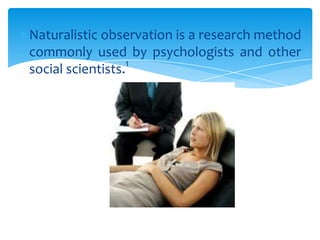
Naturalistic observation is a research method used by psychologists and social scientists to study behaviors outside of lab settings.
The method is often utilized in natural environments rather than controlled lab conditions.
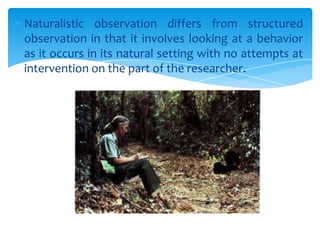
Differs from structured observation by allowing behaviors to be seen in their natural settings without researcher intervention.
Advantages include direct observation of subjects in natural settings and studying ethically sensitive topics that can't be manipulated.
Disadvantages include potential observer influence, conformity by subjects, and variability in observer interpretations.
Data is collected through tally counts, narratives, and audio/video recordings to analyze observed behaviors.
Naturalistic observation aids in formulating new hypotheses but requires control of bias from researcher preconceptions.
Sampling methods include time sampling and situation sampling to ensure a representative overview of behavior.
Grounded Theory focuses on data conceptualization, exploring processes as individuals interact within social contexts.
Researchers need to prepare for entry, define observation roles, interview strategies, and data recording.
Activity prompts for self-reflection on behavior under observation and discussion on suitable research strategies for memory impairment.
This type ofresearch is often utilized in situations
outside the lab.
4.
Naturalistic observation differsfrom structured
observation in that it involves looking at a behavior
as it occurs in its natural setting with no attempts at
intervention on the part of the researcher.
5.
ADVANTAGES OF NATURALISTIC
RESEARCH
3
Oneof the advantages of this type of
research is that it allows the researcher
to directly observe the subject in a
natural setting.
6.
It allows researchersto study things that
cannot be manipulated in a lab due to ethical
concerns.
It can help support the external validity of
research,
but
quite
another
to
actually observe those findings actually
occurring in a natural setting.
7.
DISADVANTAGES OF NATURALISTIC
3
METHOD
Peoplemay behave differently when they know
they are being watched.
People may try to behave in a certain way in order
to conform with what they think the researcher
expects to see.
Different observers may draw different
conclusions from the same witnessed behavior.
8.
3
DATA COLLECTION METHODS
Tallycounts: The observer writes down when
and how many times certain behaviors occurred.
Observer narratives: The observer may take
notes during the session and then go back later
to try to collect data and discern behavior
patterns from these notes.
Audio or video recordings: Depending upon the
type of behavior being observed, the researchers
might also decide to make actual audio or videotaped recordings of each observation session.
9.
HYPOTHESIS
2
In principle, onecan conduct naturalistic
observation nearly anywhere.
Humans also make good subjects for naturalistic
observation.
Naturalistic observation is probably the best
method around for the process of formulating new
hypotheses.
Researchers are always going to bring preconceived
ideas to a naturalistic-observation episode.
So, naturalistic observation is a good first step in
research; it is good for formulating hypotheses, but
care needs to be used to control for bias.
10.
COLLECTED DATA3
Researchers oftenuse sampling to gather information
through naturalistic observation. The goal is to make
sure that this sample of data is representative of the
subject's overall behavior.
Time sampling: Involves taking samples as different
intervals of time, which may be random or systematic.
Situation sampling: Involves observing a behavior in a
variety of different situations and settings.
11.
GROUNDED THEORY, CASEOF
5
STUDY
Grounded Theory method is a way of thinking
about and conceptualizing data.
The propose is to discover processes that occur as
individuals interact with other social context.
Human beings act toward things on the basis of the
meanings that the things have for us.
12.
CONCLUSSION
Naturalistic researchers mustidentify and
gain entry to the site they want to
study, determine the role they will
take, what and how they will observe, who
they will interview and what they will ask.
and how to record the information and
present it.
13.
References
1. Goodwin, C.J.(2004). Research in Psychology:
Methods and Design. Wiley.
2. http://peace.saumag.edu/faculty/kardas/courses/GPW
eiten/C1Intro/NatObserv.html
3. http://psychology.about.com/od/nindex/g/naturalistic.ht
m
4. http://http://mason.gmu.edu/~afinn/html/teaching/course
s/f03_comm250/fbk_chapters/10.pdf
5. http://mason.gmu.edu/~afinn/html/teaching/courses/f03_
comm250/fbk_chapters/10.pdf
14.
ACTIVITIES
Do you thinkyou’d act differently if you knew someone was
watching you?
Which of the following research strategies would be best for
determining whether alcohol impairs memory?
1. Experiment
2. Naturalistic Observation
3. Survey
4. Case Study
5. Correlational study