



Research question
Dr Tarek Tawfik Amin
Professor of Public Health
Cairo University
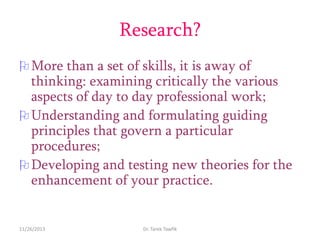
Research?
 More than a set of skills, it is away of

thinking: examining critically the various
aspects of day to day professional work;
 Understanding and formulating guiding
principles that govern a particular
procedures;
 Developing and testing new theories for the
enhancement of your practice.

11/26/2013

Dr. Tarek Tawfik
Working Definition
• It is the habit of questioning with
systematic examination of the observed
information to find answers which may
results in more effective professional
services. Kumar R 2005.
Definition:

Research is a structured inquiry that
utilizes acceptable scientific
methodology to solve problems and
creates new knowledge that is generally
applicable. Grinnell 1993

11/26/2013

Dr. Tarek Tawfik
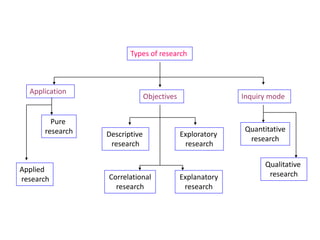
Types of research

Application

Pure
research

Applied
research

Objectives

Descriptive
research

Correlational
research

Inquiry mode

Exploratory
research

Explanatory
research

Quantitative
research
Qualitative
research
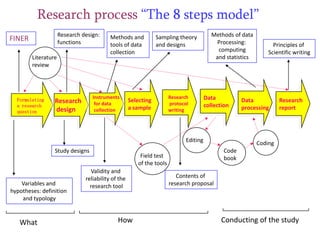
Research process “The 8 steps model”
Research design:
functions

FINER
Literature
review

Formulating
a research
question

Methods and
tools of data
collection

Instruments
for data
collection

Research
design

Sampling theory
and designs

Selecting
a sample

Research
protocol
writing

Methods of data
Processing:
computing
and statistics

Data
collection

Editing
Study designs

Variables and
hypotheses: definition
and typology

What

How

Data
processing

Research
report

Coding
Code
book

Field test
of the tools

Validity and
reliability of the
research tool

Principles of
Scientific writing

Contents of
research proposal

Conducting of the study
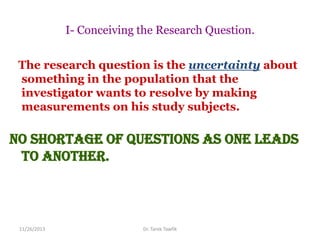
I- Conceiving the Research Question.
The research question is the uncertainty about
something in the population that the
investigator wants to resolve by making
measurements on his study subjects.

No shortage of questions as one leads
to another.

11/26/2013

Dr. Tarek Tawfik
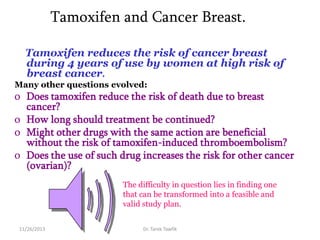
Tamoxifen and Cancer Breast.
Tamoxifen reduces the risk of cancer breast
during 4 years of use by women at high risk of
breast cancer.
Many other questions evolved:

o Does tamoxifen reduce the risk of death due to breast
cancer?
o How long should treatment be continued?
o Might other drugs with the same action are beneficial
without the risk of tamoxifen-induced thromboembolism?
o Does the use of such drug increases the risk for other cancer
(ovarian)?
The difficulty in question lies in finding one
that can be transformed into a feasible and
valid study plan.
11/26/2013

Dr. Tarek Tawfik
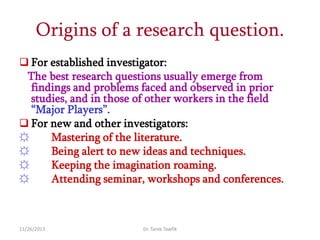
Origins of a research question.
 For established investigator:

The best research questions usually emerge from
findings and problems faced and observed in prior
studies, and in those of other workers in the field
“Major Players”.
 For new and other investigators:
☼
Mastering of the literature.
☼
Being alert to new ideas and techniques.
☼
Keeping the imagination roaming.
☼
Attending seminar, workshops and conferences.

11/26/2013

Dr. Tarek Tawfik
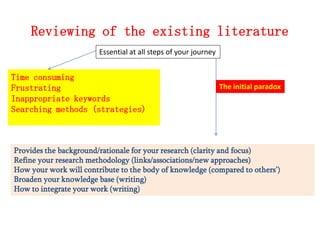
Reviewing of the existing literature
Essential at all steps of your journey

Time consuming
Frustrating
Inappropriate keywords
Searching methods (strategies)

The initial paradox

Provides the background/rationale for your research (clarity and focus)
Refine your research methodology (links/associations/new approaches)
How your work will contribute to the body of knowledge (compared to others’)
Broaden your knowledge base (writing)
How to integrate your work (writing)
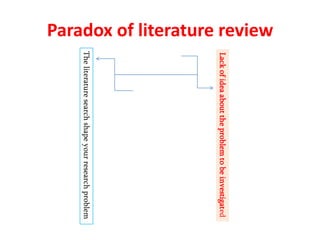
Paradox of literature review
Lack of idea about the problem to be investigated

The literature search shape your research problem
Formulating research problem
Potential research questions may occur to us
on a regular basis, but the process of
formulating them in a meaningful way is not
at all an easy task.
(Meenaghan & Twoomey 1985)
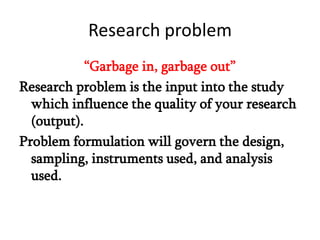
Research problem
“Garbage in, garbage out”
Research problem is the input into the study
which influence the quality of your research
(output).
Problem formulation will govern the design,
sampling, instruments used, and analysis
used.
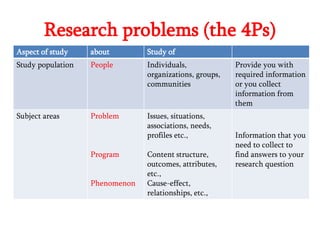
Research problems (the 4Ps)
Aspect of study

about

Study of

Study population

People

Individuals,
organizations, groups,
communities

Subject areas

Problem

Issues, situations,
associations, needs,
profiles etc.,

Program

Phenomenon

Content structure,
outcomes, attributes,
etc.,
Cause-effect,
relationships, etc.,

Provide you with
required information
or you collect
information from
them

Information that you
need to collect to
find answers to your
research question
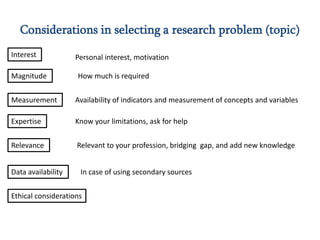
Considerations in selecting a research problem (topic)
Interest
Magnitude

Personal interest, motivation
How much is required

Measurement

Availability of indicators and measurement of concepts and variables

Expertise

Know your limitations, ask for help

Relevance

Relevant to your profession, bridging gap, and add new knowledge

Data availability

In case of using secondary sources

Ethical considerations
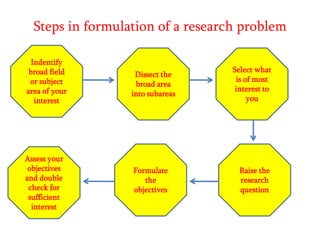
Steps in formulation of a research problem
Indentify
broad field
or subject
area of your
interest

Dissect the
broad area
into subareas

Assess your
objectives
and double
check for
sufficient
interest

Formulate
the
objectives

Select what
is of most
interest to
you

Raise the
research
question
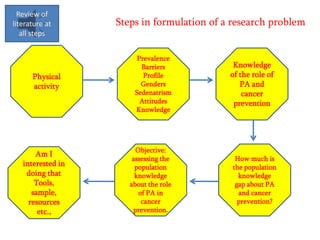
Review of
literature at
all steps

Physical
activity

Am I
interested in
doing that
Tools,
sample,
resources
etc.,

Steps in formulation of a research problem

Prevalence
Barriers
Profile
Genders
Sedenatrism
Attitudes
Knowledge

Objective:
assessing the
population
knowledge
about the role
of PA in
cancer
prevention.

Knowledge
of the role of
PA and
cancer
prevention

How much is
the population
knowledge
gap about PA
and cancer
prevention?
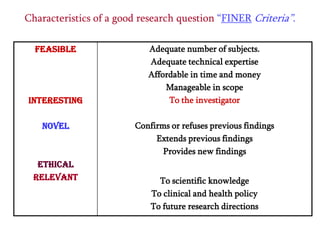
Characteristics of a good research question “FINER Criteria”.
Feasible

Interesting
Novel

Ethical
Relevant

Adequate number of subjects.
Adequate technical expertise
Affordable in time and money
Manageable in scope
To the investigator
Confirms or refuses previous findings
Extends previous findings
Provides new findings
To scientific knowledge
To clinical and health policy
To future research directions
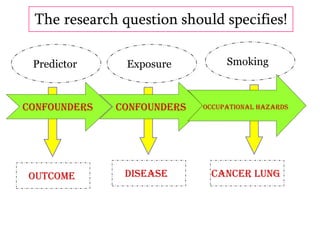
The research question should specifies!
Predictor

Exposure

Smoking

Confounders

Confounders

Occupational hazards

Outcome

Disease

Cancer lung
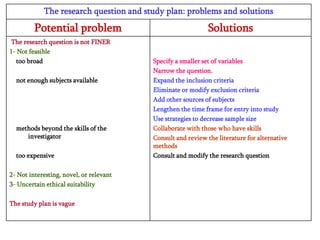
The research question and study plan: problems and solutions

Potential problem
The research question is not FINER
1- Not feasible
too broad
not enough subjects available

methods beyond the skills of the
investigator
too expensive
2- Not interesting, novel, or relevant
3- Uncertain ethical suitability
The study plan is vague

Solutions
Specify a smaller set of variables
Narrow the question.
Expand the inclusion criteria
Eliminate or modify exclusion criteria
Add other sources of subjects
Lengthen the time frame for entry into study
Use strategies to decrease sample size
Collaborate with those who have skills
Consult and review the literature for alternative
methods
Consult and modify the research question
The structure of a research project is set out in
its protocol, the written plan of the study.
The functions of the protocol are:
 Seeking grant funds.
 Helping the investigator to organize his research in a
logical, focused, and efficient way.

11/26/2013

Dr. Tarek Tawfik
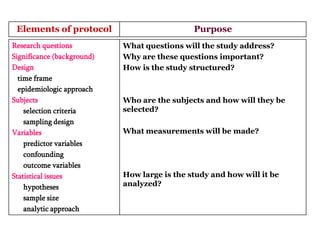
Elements of protocol
Research questions
Significance (background)
Design
time frame
epidemiologic approach
Subjects
selection criteria
sampling design
Variables
predictor variables
confounding
outcome variables
Statistical issues
hypotheses
sample size
analytic approach

Purpose
What questions will the study address?
Why are these questions important?
How is the study structured?

Who are the subjects and how will they be
selected?
What measurements will be made?

How large is the study and how will it be
analyzed?
Exercise:
Consider the following research questions.
First, write each question in a single
sentence that specifies a predictor, outcome,
and population.
Then discuss whether it meets the FINER
criteria.
Rewrite the question in a form that
overcomes any problems in meeting their
criteria.
11/26/2013

Dr. Tarek Tawfik
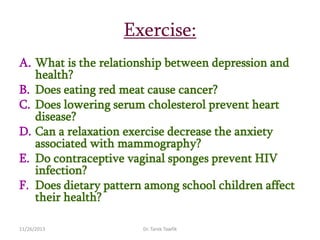
Exercise:
A. What is the relationship between depression and
health?
B. Does eating red meat cause cancer?
C. Does lowering serum cholesterol prevent heart
disease?
D. Can a relaxation exercise decrease the anxiety
associated with mammography?
E. Do contraceptive vaginal sponges prevent HIV
infection?
F. Does dietary pattern among school children affect
their health?
11/26/2013

Dr. Tarek Tawfik
Assignment:
Formulate a research questions regarding
health and health-related problems that may
be encountered in:
A. Rural community and the available health facilities.
B. Urban primary health care facility.
C. Primary schools.

11/26/2013

Dr. Tarek Tawfik

Research question

  • 1.
    Research question Dr TarekTawfik Amin Professor of Public Health Cairo University
  • 2.
    Research?  More thana set of skills, it is away of thinking: examining critically the various aspects of day to day professional work;  Understanding and formulating guiding principles that govern a particular procedures;  Developing and testing new theories for the enhancement of your practice. 11/26/2013 Dr. Tarek Tawfik
  • 3.
    Working Definition • Itis the habit of questioning with systematic examination of the observed information to find answers which may results in more effective professional services. Kumar R 2005.
  • 4.
    Definition: Research is astructured inquiry that utilizes acceptable scientific methodology to solve problems and creates new knowledge that is generally applicable. Grinnell 1993 11/26/2013 Dr. Tarek Tawfik
  • 5.
    Types of research Application Pure research Applied research Objectives Descriptive research Correlational research Inquirymode Exploratory research Explanatory research Quantitative research Qualitative research
  • 6.
    Research process “The8 steps model” Research design: functions FINER Literature review Formulating a research question Methods and tools of data collection Instruments for data collection Research design Sampling theory and designs Selecting a sample Research protocol writing Methods of data Processing: computing and statistics Data collection Editing Study designs Variables and hypotheses: definition and typology What How Data processing Research report Coding Code book Field test of the tools Validity and reliability of the research tool Principles of Scientific writing Contents of research proposal Conducting of the study
  • 7.
    I- Conceiving theResearch Question. The research question is the uncertainty about something in the population that the investigator wants to resolve by making measurements on his study subjects. No shortage of questions as one leads to another. 11/26/2013 Dr. Tarek Tawfik
  • 8.
    Tamoxifen and CancerBreast. Tamoxifen reduces the risk of cancer breast during 4 years of use by women at high risk of breast cancer. Many other questions evolved: o Does tamoxifen reduce the risk of death due to breast cancer? o How long should treatment be continued? o Might other drugs with the same action are beneficial without the risk of tamoxifen-induced thromboembolism? o Does the use of such drug increases the risk for other cancer (ovarian)? The difficulty in question lies in finding one that can be transformed into a feasible and valid study plan. 11/26/2013 Dr. Tarek Tawfik
  • 9.
    Origins of aresearch question.  For established investigator: The best research questions usually emerge from findings and problems faced and observed in prior studies, and in those of other workers in the field “Major Players”.  For new and other investigators: ☼ Mastering of the literature. ☼ Being alert to new ideas and techniques. ☼ Keeping the imagination roaming. ☼ Attending seminar, workshops and conferences. 11/26/2013 Dr. Tarek Tawfik
  • 10.
    Reviewing of theexisting literature Essential at all steps of your journey Time consuming Frustrating Inappropriate keywords Searching methods (strategies) The initial paradox Provides the background/rationale for your research (clarity and focus) Refine your research methodology (links/associations/new approaches) How your work will contribute to the body of knowledge (compared to others’) Broaden your knowledge base (writing) How to integrate your work (writing)
  • 11.
    Paradox of literaturereview Lack of idea about the problem to be investigated The literature search shape your research problem
  • 12.
    Formulating research problem Potentialresearch questions may occur to us on a regular basis, but the process of formulating them in a meaningful way is not at all an easy task. (Meenaghan & Twoomey 1985)
  • 13.
    Research problem “Garbage in,garbage out” Research problem is the input into the study which influence the quality of your research (output). Problem formulation will govern the design, sampling, instruments used, and analysis used.
  • 14.
    Research problems (the4Ps) Aspect of study about Study of Study population People Individuals, organizations, groups, communities Subject areas Problem Issues, situations, associations, needs, profiles etc., Program Phenomenon Content structure, outcomes, attributes, etc., Cause-effect, relationships, etc., Provide you with required information or you collect information from them Information that you need to collect to find answers to your research question
  • 15.
    Considerations in selectinga research problem (topic) Interest Magnitude Personal interest, motivation How much is required Measurement Availability of indicators and measurement of concepts and variables Expertise Know your limitations, ask for help Relevance Relevant to your profession, bridging gap, and add new knowledge Data availability In case of using secondary sources Ethical considerations
  • 16.
    Steps in formulationof a research problem Indentify broad field or subject area of your interest Dissect the broad area into subareas Assess your objectives and double check for sufficient interest Formulate the objectives Select what is of most interest to you Raise the research question
  • 17.
    Review of literature at allsteps Physical activity Am I interested in doing that Tools, sample, resources etc., Steps in formulation of a research problem Prevalence Barriers Profile Genders Sedenatrism Attitudes Knowledge Objective: assessing the population knowledge about the role of PA in cancer prevention. Knowledge of the role of PA and cancer prevention How much is the population knowledge gap about PA and cancer prevention?
  • 18.
    Characteristics of agood research question “FINER Criteria”. Feasible Interesting Novel Ethical Relevant Adequate number of subjects. Adequate technical expertise Affordable in time and money Manageable in scope To the investigator Confirms or refuses previous findings Extends previous findings Provides new findings To scientific knowledge To clinical and health policy To future research directions
  • 19.
    The research questionshould specifies! Predictor Exposure Smoking Confounders Confounders Occupational hazards Outcome Disease Cancer lung
  • 20.
    The research questionand study plan: problems and solutions Potential problem The research question is not FINER 1- Not feasible too broad not enough subjects available methods beyond the skills of the investigator too expensive 2- Not interesting, novel, or relevant 3- Uncertain ethical suitability The study plan is vague Solutions Specify a smaller set of variables Narrow the question. Expand the inclusion criteria Eliminate or modify exclusion criteria Add other sources of subjects Lengthen the time frame for entry into study Use strategies to decrease sample size Collaborate with those who have skills Consult and review the literature for alternative methods Consult and modify the research question
  • 21.
    The structure ofa research project is set out in its protocol, the written plan of the study. The functions of the protocol are:  Seeking grant funds.  Helping the investigator to organize his research in a logical, focused, and efficient way. 11/26/2013 Dr. Tarek Tawfik
  • 22.
    Elements of protocol Researchquestions Significance (background) Design time frame epidemiologic approach Subjects selection criteria sampling design Variables predictor variables confounding outcome variables Statistical issues hypotheses sample size analytic approach Purpose What questions will the study address? Why are these questions important? How is the study structured? Who are the subjects and how will they be selected? What measurements will be made? How large is the study and how will it be analyzed?
  • 23.
    Exercise: Consider the followingresearch questions. First, write each question in a single sentence that specifies a predictor, outcome, and population. Then discuss whether it meets the FINER criteria. Rewrite the question in a form that overcomes any problems in meeting their criteria. 11/26/2013 Dr. Tarek Tawfik
  • 24.
    Exercise: A. What isthe relationship between depression and health? B. Does eating red meat cause cancer? C. Does lowering serum cholesterol prevent heart disease? D. Can a relaxation exercise decrease the anxiety associated with mammography? E. Do contraceptive vaginal sponges prevent HIV infection? F. Does dietary pattern among school children affect their health? 11/26/2013 Dr. Tarek Tawfik
  • 25.
    Assignment: Formulate a researchquestions regarding health and health-related problems that may be encountered in: A. Rural community and the available health facilities. B. Urban primary health care facility. C. Primary schools. 11/26/2013 Dr. Tarek Tawfik