L-1
Introduction to Research
Methodology
Advance Research Methodology
Workshop
Vishal R. Naikare
Sinhgad College of Nursing,
Narhe, Pune: 411 041.
vishalrnaikare@gmail.com
9730470672
L-1: 45 Minutes.
Introduction to Research Methodology
1. What is Research.
2. Types of Research: (Basic vs Applied,
Quantitative vs Qualitative.)
3. Research Question: What is RQ, Characteristics
of Good RQ.
4. Hypothesis: Meaning, Types and Characteristics.
5. How do you select Research Topic.
6. Orientation to evaluation Criteria of Research.
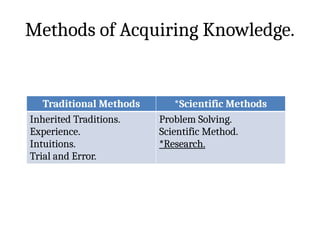
Methods of Acquiring Knowledge.
Traditional Methods *Scientific Methods
Inherited Traditions.
Experience.
Intuitions.
Trial and Error.
Problem Solving.
Scientific Method.
*Research.
What is Research.
‱ Prefix: Re: Once again, anew, afresh.
‱ Verb: Search: to look for something, examine
closely, carefully, to look for information, to
test and try, or to prove.
: Research: Close and careful examination of
facts and their relationship to discover new
knowledge.
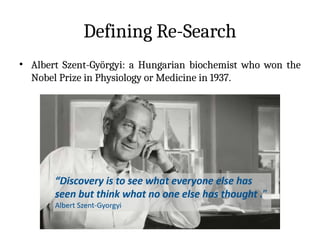
Defining Re-Search
‱ Albert Szent-Györgyi: a Hungarian biochemist who won the
Nobel Prize in Physiology or Medicine in 1937.
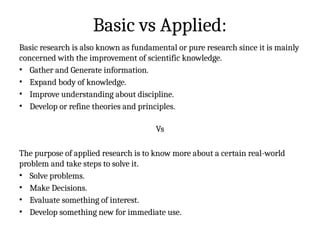
Basic vs Applied:
Basic research is also known as fundamental or pure research since it is mainly
concerned with the improvement of scientific knowledge.
‱ Gather and Generate information.
‱ Expand body of knowledge.
‱ Improve understanding about discipline.
‱ Develop or refine theories and principles.
Vs
The purpose of applied research is to know more about a certain real-world
problem and take steps to solve it.
‱ Solve problems.
‱ Make Decisions.
‱ Evaluate something of interest.
‱ Develop something new for immediate use.
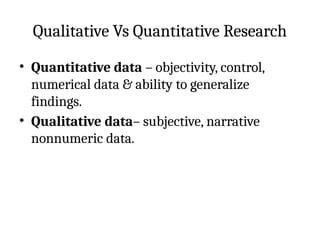
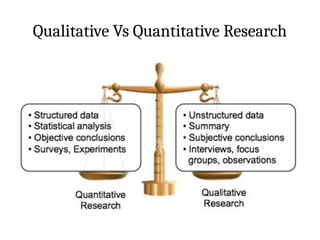
Qualitative Vs Quantitative Research
‱ Quantitative data – objectivity, control,
numerical data & ability to generalize
findings.
‱ Qualitative data– subjective, narrative
nonnumeric data.
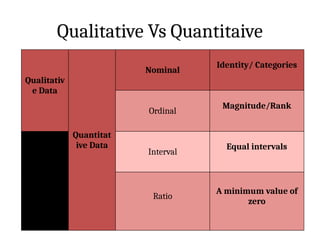
Qualitative Vs Quantitaive
Qualitativ
e Data
Quantitat
ive Data
Nominal
Identity/ Categories
Ordinal
Magnitude/Rank
Interval
Equal intervals
Ratio
A minimum value of
zero
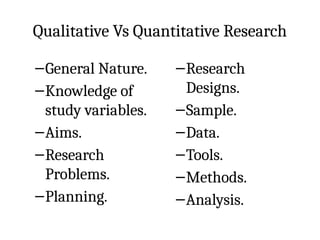
Qualitative Vs Quantitative Research
–General Nature.
–Knowledge of
study variables.
–Aims.
–Research
Problems.
–Planning.
–Research
Designs.
–Sample.
–Data.
–Tools.
–Methods.
–Analysis.
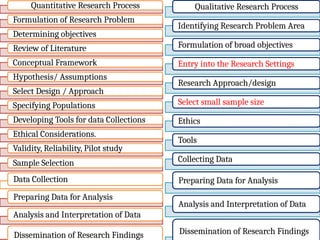
Qualitative Research Process
Identifying Research Problem Area
Formulation of broad objectives
Entry into the Research Settings
Research Approach/design
Select small sample size
Ethics
Tools
Collecting Data
Preparing Data for Analysis
Analysis and Interpretation of Data
Dissemination of Research Findings
Quantitative Research Process
Formulation of Research Problem
Determining objectives
Review of Literature
Conceptual Framework
Hypothesis/ Assumptions
Select Design / Approach
Specifying Populations
Developing Tools for data Collections
Ethical Considerations.
Validity, Reliability, Pilot study
Sample Selection
Data Collection
Preparing Data for Analysis
Analysis and Interpretation of Data
Dissemination of Research Findings
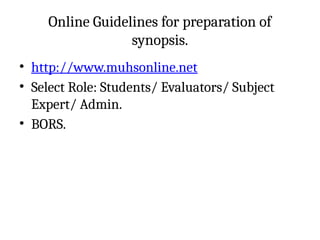
Online Guidelines for preparation of
synopsis.
‱ http://www.muhsonline.net
‱ Select Role: Students/ Evaluators/ Subject
Expert/ Admin.
‱ BORS.
Online Guidelines cont
..
‱ Title & Synopsis literature should not reflect
any type of student identity i.e. name of the
student/ guide/ College, mobile number,
contact details, etc.
‱ Student should attend the Research
Methodology workshop within the period of
one year / within first year from the batch
admitted in Academic Year 2017-18.
Guidelines cont..
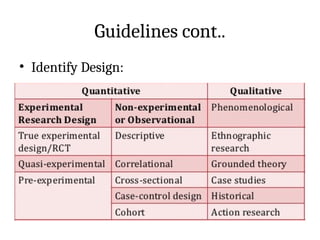
‱ Identify Design:
Guidelines cont..
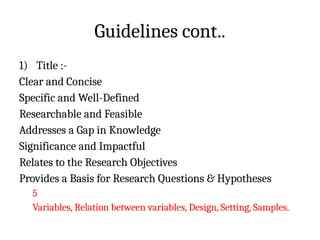
1) Title :-
Clear and Concise
Specific and Well-Defined
Researchable and Feasible
Addresses a Gap in Knowledge
Significance and Impactful
Relates to the Research Objectives
Provides a Basis for Research Questions & Hypotheses
5
Variables, Relation between variables, Design, Setting, Samples.
Guidelines cont..
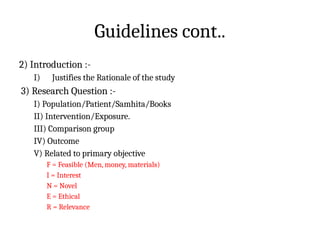
2) Introduction :-
I) Justifies the Rationale of the study
3) Research Question :-
I) Population/Patient/Samhita/Books
II) Intervention/Exposure.
III) Comparison group
IV) Outcome
V) Related to primary objective
F = Feasible (Men, money, materials)
I = Interest
N = Novel
E = Ethical
R = Relevance
Guidelines cont..
3) Hypothesis :-
I) Clearly stated
II) Reflects relation between two or more variables
III) Related to primary Research Question
4/5) Review of Literature :-
I) Clearly stated
II) Reflects relation between two or more variables
III) Related to primary Research Question.
The literature review is the mother of the
Research Question
Guidelines cont..
6) Objectives :-
I) Meets SMART criteria?
Specific – target a specific area for improvement.
Measurable – quantify or at least suggest an indicator of
progress.
Achievable – Whether the investigator can achieve with the
available resources.
Realistic – state what results can realistically be achieved,
given available resources.
Time-related – specify when the result(s) can be achieved.
Guidelines cont..
7) Methodology :-
I) Appropriate study design
II) Mentioned study setting
III) Mentioned Study population / Books.
IV) Sample size
a. Correctly calculated for the primary objective.
b. Adequate for primary objective .
c. If not adequate, acceptable justification provided.
V) Appropriate sampling technique
Guidelines cont..
VI) Method of selection of study subjects.
a. Appropriate Inclusion criteria
b. Appropriate Exclusion Criteria
c. Appropriate Subject withdrawal Criteria
VII) Operational definitions provided Coining of terms.
VIII) Appropriate Methods of measurements.
IX) Appropriate Study instrument / Data Collection tools
X) Methods of Data Collection relevant to objective
XI) Appropriate data Analysis plan and methods
Guidelines cont..
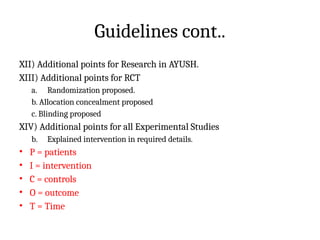
XII) Additional points for Research in AYUSH.
XIII) Additional points for RCT
a. Randomization proposed.
b. Allocation concealment proposed
c. Blinding proposed
XIV) Additional points for all Experimental Studies
b. Explained intervention in required details.
‱ P = patients
‱ I = intervention
‱ C = controls
‱ O = outcome
‱ T = Time
Guidelines cont..
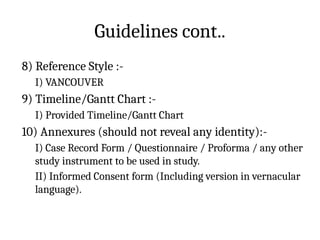
8) Reference Style :-
I) VANCOUVER
9) Timeline/Gantt Chart :-
I) Provided Timeline/Gantt Chart
10) Annexures (should not reveal any identity):-
I) Case Record Form / Questionnaire / Proforma / any other
study instrument to be used in study.
II) Informed Consent form (Including version in vernacular
language).
Guidelines cont..
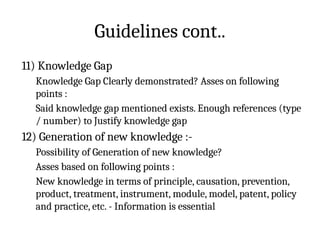
11) Knowledge Gap
Knowledge Gap Clearly demonstrated? Asses on following
points :
Said knowledge gap mentioned exists. Enough references (type
/ number) to Justify knowledge gap
12) Generation of new knowledge :-
Possibility of Generation of new knowledge?
Asses based on following points :
New knowledge in terms of principle, causation, prevention,
product, treatment, instrument, module, model, patent, policy
and practice, etc. - Information is essential
Thank you
‱ We have seen:
‱ L1: RMW.
1. What is Research.
2. Types of Research: (Basic vs Applied, Quantitative vs
Qualitative, Operational).
3. How do you select Research Topic.
4. Orientation to evaluation Criteria of Research.
Szent-Györgyi is not saying researchers do not help humanity—
rather, he believes they are driven by curiosity first, and their
discoveries incidentally benefit mankind.
It emphasizes the idea that groundbreaking discoveries often
come from those who are obsessed with understanding nature,
rather than those who start with the goal of helping people.
This perspective aligns with history—many great scientific
breakthroughs came from pure curiosity rather than a direct
intent to solve societal issues.
Introduction to research methodology and statistics

Introduction to research methodology and statistics

  • 1.
    L-1 Introduction to Research Methodology AdvanceResearch Methodology Workshop Vishal R. Naikare Sinhgad College of Nursing, Narhe, Pune: 411 041. vishalrnaikare@gmail.com 9730470672
  • 2.
    L-1: 45 Minutes. Introductionto Research Methodology 1. What is Research. 2. Types of Research: (Basic vs Applied, Quantitative vs Qualitative.) 3. Research Question: What is RQ, Characteristics of Good RQ. 4. Hypothesis: Meaning, Types and Characteristics. 5. How do you select Research Topic. 6. Orientation to evaluation Criteria of Research.
  • 3.
    Methods of AcquiringKnowledge. Traditional Methods *Scientific Methods Inherited Traditions. Experience. Intuitions. Trial and Error. Problem Solving. Scientific Method. *Research.
  • 4.
    What is Research. ‱Prefix: Re: Once again, anew, afresh. ‱ Verb: Search: to look for something, examine closely, carefully, to look for information, to test and try, or to prove. : Research: Close and careful examination of facts and their relationship to discover new knowledge.
  • 5.
    Defining Re-Search ‱ AlbertSzent-Györgyi: a Hungarian biochemist who won the Nobel Prize in Physiology or Medicine in 1937.
  • 6.
    Basic vs Applied: Basicresearch is also known as fundamental or pure research since it is mainly concerned with the improvement of scientific knowledge. ‱ Gather and Generate information. ‱ Expand body of knowledge. ‱ Improve understanding about discipline. ‱ Develop or refine theories and principles. Vs The purpose of applied research is to know more about a certain real-world problem and take steps to solve it. ‱ Solve problems. ‱ Make Decisions. ‱ Evaluate something of interest. ‱ Develop something new for immediate use.
  • 7.
    Qualitative Vs QuantitativeResearch ‱ Quantitative data – objectivity, control, numerical data & ability to generalize findings. ‱ Qualitative data– subjective, narrative nonnumeric data.
  • 8.
    Qualitative Vs Quantitaive Qualitativ eData Quantitat ive Data Nominal Identity/ Categories Ordinal Magnitude/Rank Interval Equal intervals Ratio A minimum value of zero
  • 9.
  • 10.
    Qualitative Vs QuantitativeResearch –General Nature. –Knowledge of study variables. –Aims. –Research Problems. –Planning. –Research Designs. –Sample. –Data. –Tools. –Methods. –Analysis.
  • 11.
    Qualitative Research Process IdentifyingResearch Problem Area Formulation of broad objectives Entry into the Research Settings Research Approach/design Select small sample size Ethics Tools Collecting Data Preparing Data for Analysis Analysis and Interpretation of Data Dissemination of Research Findings Quantitative Research Process Formulation of Research Problem Determining objectives Review of Literature Conceptual Framework Hypothesis/ Assumptions Select Design / Approach Specifying Populations Developing Tools for data Collections Ethical Considerations. Validity, Reliability, Pilot study Sample Selection Data Collection Preparing Data for Analysis Analysis and Interpretation of Data Dissemination of Research Findings
  • 12.
    Online Guidelines forpreparation of synopsis. ‱ http://www.muhsonline.net ‱ Select Role: Students/ Evaluators/ Subject Expert/ Admin. ‱ BORS.
  • 13.
    Online Guidelines cont
.. ‱Title & Synopsis literature should not reflect any type of student identity i.e. name of the student/ guide/ College, mobile number, contact details, etc. ‱ Student should attend the Research Methodology workshop within the period of one year / within first year from the batch admitted in Academic Year 2017-18.
  • 14.
  • 15.
    Guidelines cont.. 1) Title:- Clear and Concise Specific and Well-Defined Researchable and Feasible Addresses a Gap in Knowledge Significance and Impactful Relates to the Research Objectives Provides a Basis for Research Questions & Hypotheses 5 Variables, Relation between variables, Design, Setting, Samples.
  • 16.
    Guidelines cont.. 2) Introduction:- I) Justifies the Rationale of the study 3) Research Question :- I) Population/Patient/Samhita/Books II) Intervention/Exposure. III) Comparison group IV) Outcome V) Related to primary objective F = Feasible (Men, money, materials) I = Interest N = Novel E = Ethical R = Relevance
  • 17.
    Guidelines cont.. 3) Hypothesis:- I) Clearly stated II) Reflects relation between two or more variables III) Related to primary Research Question 4/5) Review of Literature :- I) Clearly stated II) Reflects relation between two or more variables III) Related to primary Research Question. The literature review is the mother of the Research Question
  • 18.
    Guidelines cont.. 6) Objectives:- I) Meets SMART criteria? Specific – target a specific area for improvement. Measurable – quantify or at least suggest an indicator of progress. Achievable – Whether the investigator can achieve with the available resources. Realistic – state what results can realistically be achieved, given available resources. Time-related – specify when the result(s) can be achieved.
  • 19.
    Guidelines cont.. 7) Methodology:- I) Appropriate study design II) Mentioned study setting III) Mentioned Study population / Books. IV) Sample size a. Correctly calculated for the primary objective. b. Adequate for primary objective . c. If not adequate, acceptable justification provided. V) Appropriate sampling technique
  • 20.
    Guidelines cont.. VI) Methodof selection of study subjects. a. Appropriate Inclusion criteria b. Appropriate Exclusion Criteria c. Appropriate Subject withdrawal Criteria VII) Operational definitions provided Coining of terms. VIII) Appropriate Methods of measurements. IX) Appropriate Study instrument / Data Collection tools X) Methods of Data Collection relevant to objective XI) Appropriate data Analysis plan and methods
  • 21.
    Guidelines cont.. XII) Additionalpoints for Research in AYUSH. XIII) Additional points for RCT a. Randomization proposed. b. Allocation concealment proposed c. Blinding proposed XIV) Additional points for all Experimental Studies b. Explained intervention in required details. ‱ P = patients ‱ I = intervention ‱ C = controls ‱ O = outcome ‱ T = Time
  • 22.
    Guidelines cont.. 8) ReferenceStyle :- I) VANCOUVER 9) Timeline/Gantt Chart :- I) Provided Timeline/Gantt Chart 10) Annexures (should not reveal any identity):- I) Case Record Form / Questionnaire / Proforma / any other study instrument to be used in study. II) Informed Consent form (Including version in vernacular language).
  • 23.
    Guidelines cont.. 11) KnowledgeGap Knowledge Gap Clearly demonstrated? Asses on following points : Said knowledge gap mentioned exists. Enough references (type / number) to Justify knowledge gap 12) Generation of new knowledge :- Possibility of Generation of new knowledge? Asses based on following points : New knowledge in terms of principle, causation, prevention, product, treatment, instrument, module, model, patent, policy and practice, etc. - Information is essential
  • 25.
    Thank you ‱ Wehave seen: ‱ L1: RMW. 1. What is Research. 2. Types of Research: (Basic vs Applied, Quantitative vs Qualitative, Operational). 3. How do you select Research Topic. 4. Orientation to evaluation Criteria of Research.
  • 26.
    Szent-Györgyi is notsaying researchers do not help humanity— rather, he believes they are driven by curiosity first, and their discoveries incidentally benefit mankind. It emphasizes the idea that groundbreaking discoveries often come from those who are obsessed with understanding nature, rather than those who start with the goal of helping people. This perspective aligns with history—many great scientific breakthroughs came from pure curiosity rather than a direct intent to solve societal issues.