
Visibility of research in
digital world
S G Deshmukh
ABV-Indian Institute of Information
Technology & Management , Gwalior
FDP on Multivariate and Advanced Data Analysis in
Marketing
27 Sep 2013
1
Objectives of FDP
 To raise the interest of faculty in integrating various
issues into their teaching
 To support them by offering opportunities to learn from
others experiences
 To give faculty quick access to existing knowledge
base of ABV-IIITM which participant would identify as
relevant
 To encourage the production of new knowledge
 To assist faculty to reach their career goals,
2
Acknowledgement
This presentation is based on extensive
information sharing sessions with
 Prof Abid Haleem (Jamia) ,Prof N K Sharma (IITK), Dr
Jitesh Thakkar (IITKh)
Thankful to numerous research scholars and
faculty members from various institutes
participating in our FDPs (more than 200) for
making us realize the importance of visibility of
research in current scenario
3
Prelude..
You may look at some of presentations
available at
http://www.slideshare.net/SanjeevDeshmukh/presentations
4
Speaking points..
 About research..
Why research
 Imperatives & Implications
1: Shelf life
2: Digitization of outcome
3: Sharing & Connectivity
4: Collaboration
5: Open Access
 Various tools for visibility
 Closing remarks..5
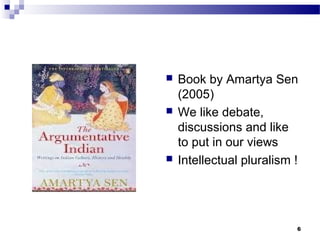
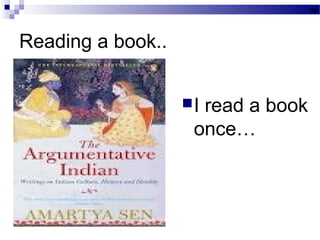
 Book by Amartya Sen
(2005)
 We like debate,
discussions and like
to put in our views
 Intellectual pluralism !
6
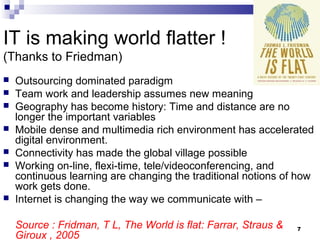
IT is making world flatter !
(Thanks to Friedman)
 Outsourcing dominated paradigm
 Team work and leadership assumes new meaning
 Geography has become history: Time and distance are no
longer the important variables
 Mobile dense and multimedia rich environment has accelerated
digital environment.
 Connectivity has made the global village possible
 Working on-line, flexi-time, tele/videoconferencing, and
continuous learning are changing the traditional notions of how
work gets done.
 Internet is changing the way we communicate with –
Source : Fridman, T L, The World is flat: Farrar, Straus &
Giroux , 2005
7
Observations..
 Transformation taking place
 The way we communicate has changed.
Research is no exception to this !
 Traditional ways of conducting research
and disseminating outcomes have also
changed.
8
What is happening today..
 An increasing focus on interdisciplinary/
multidisciplinary/transdisciplinary research;
 An increasing focus on problems, rather than
techniques;
 Greater emphasis on collaborative work and
communication;
 Greater emphasis on more diverse and informal
modes of communication
9
“Everyone wants one,
no one knows what it is,
and no one knows how to get one”
Philip Altbach, Boston College,
US on the “World Class University
10
What makes a world class
university ?
Key pillars:
 Teaching
 Knowledge Transfer
 Global outlook
 Research.
11
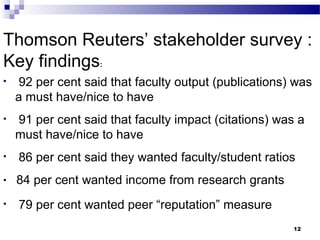
• 92 per cent said that faculty output (publications) was
a must have/nice to have
• 91 per cent said that faculty impact (citations) was a
must have/nice to have
• 86 per cent said they wanted faculty/student ratios
• 84 per cent wanted income from research grants
• 79 per cent wanted peer “reputation” measure
Thomson Reuters’ stakeholder survey :
Key findings:
12
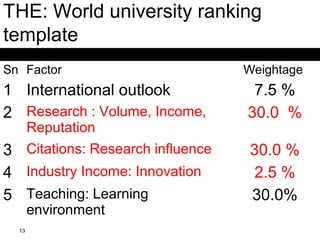
THE: World university ranking
template
www.timeshighereducation.co.uk/world-university-rankings/
Sn Factor Weightage
1 International outlook 7.5 %
2 Research : Volume, Income,
Reputation
30.0 %
3 Citations: Research influence 30.0 %
4 Industry Income: Innovation 2.5 %
5 Teaching: Learning
environment
30.0%
13
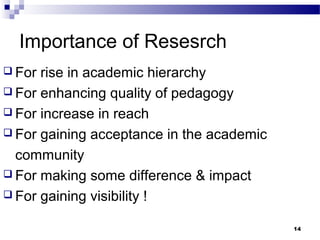
Importance of Resesrch
 For rise in academic hierarchy
 For enhancing quality of pedagogy
 For increase in reach
 For gaining acceptance in the academic
community
 For making some difference & impact
 For gaining visibility !
14
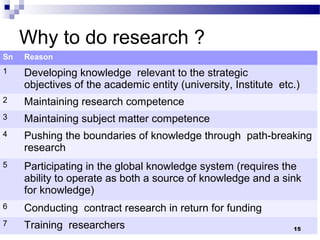
Why to do research ?
Sn Reason
1 Developing knowledge relevant to the strategic
objectives of the academic entity (university, Institute etc.)
2 Maintaining research competence
3 Maintaining subject matter competence
4 Pushing the boundaries of knowledge through path-breaking
research
5 Participating in the global knowledge system (requires the
ability to operate as both a source of knowledge and a sink
for knowledge)
6 Conducting contract research in return for funding
7 Training researchers 15
Criteria of Good Research
 Good research is systematic
 Good research is logical
 Good research is empirical
 Good research is replicable
 Good research is visible !
16
17
Criteria of good research
 Good research is systematic- structured with
specified steps taken in specified sequence in
accordance with well-defined rules
 Good research is logical: logical reasoning makes
research more meaningful in the context of decision
making
 Good research is empirical: dealing with concrete
data that provides the basis for external validity to
research results.
 Good research is replicable
 Good research is also visible : sharing with
community, peers and the society at large
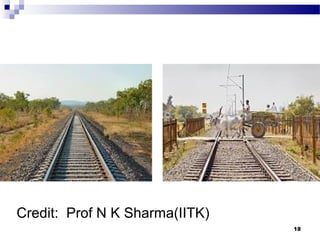
Credit: Prof N K Sharma(IITK)
18
Interesting developments
 World is flat
 Communication is anytime, anywhere, anyone !
 Sharing and collaboration
 Urge and desire for recognition !
19
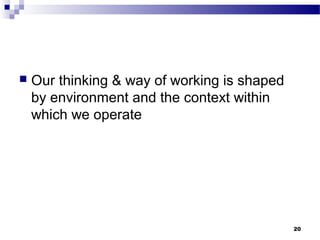
 Our thinking & way of working is shaped
by environment and the context within
which we operate
20
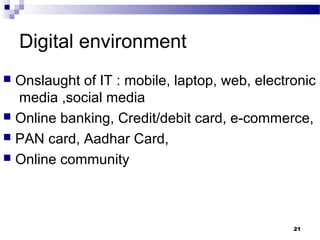
Digital environment
 Onslaught of IT : mobile, laptop, web, electronic
media ,social media
 Online banking, Credit/debit card, e-commerce,
 PAN card, Aadhar Card,
 Online community
21
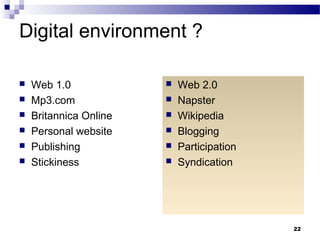
Digital environment ?
 Web 1.0
 Mp3.com
 Britannica Online
 Personal website
 Publishing
 Stickiness
 Web 2.0
 Napster
 Wikipedia
 Blogging
 Participation
 Syndication
22
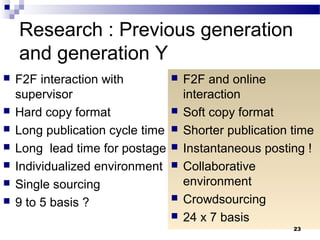
Research : Previous generation
and generation Y
 F2F interaction with
supervisor
 Hard copy format
 Long publication cycle time
 Long lead time for postage
 Individualized environment
 Single sourcing
 9 to 5 basis ?
 F2F and online
interaction
 Soft copy format
 Shorter publication time
 Instantaneous posting !
 Collaborative
environment
 Crowdsourcing
 24 x 7 basis
23
Today’s researcher
 IT savvy
 Spends more time online
 Responds positively to criticism
 Positively engaged with the topic
 Open to share and collaborate
 Has multiple-sources of guidance
 Comfortable in multi-tasking
 Has 24 x7 approach ?
24
Today’s research
 Literature review, Methodology, Analysis
enabled by IT and collaborative tools
 Turnaround time for Ph D has reduced
 Shelf life of an idea condensed
 Time-to-publish has drastically reduced
25
Today’s supervisor
 IT savvy
 Open to collaboration
 Open to experimentation
 Willing to network
 Need for visibilty
26
Observations..
 Developments at the global level are taking
place very rapidly , thanks to IT
 Unless there is serious research, it is difficult
to keep track of these developments and
translate these outcomes into classroom
 Global integration triggered integration of
academics
27
Observations..
 Role of the academic remains as one of
critiquing, challenging, and engaging in debate.
This role is as important as producing
practically useful research.
 What counts as knowledge will remain as
contested and needs to be debated and
negotiated between the profession, policy
makers, practitioners and academics, while
preserving the researcher’s role 28
Above quote from an article by G. Small in Nature, vol. 479, page 141
Summarizes how new technologies are changing the way in which the research
dialogues are being conducted:
 “In an era of budget cutting, early-career scientists will
have to be effective ambassadors for the profession.
This might manifest in conversations with family
members or with strangers sitting next to us on a
plane, or it might mean posting videos on YouTube or
blogging about our on going research.
 The days of scientists communicating only with each
other, in the languages of our individual disciplines, …
are rapidly coming to an end.”
29
Reading a book..
I read a book
once…
30
But journals are different…aren’t
they?
 As a researcher, you want citations,
readers, impact,…
 Can cite anything (relevant)
 blogs, tweets, presentations (SlideShare),
YouTube channels, video clips:
 But the original article itself has barely
changed
 Visibility ?
31
Remark..
 “…that if you are passionate about a topic and argue
your perspective in a compelling manner, you can
begin to generate a following…If people find your
opinions and perspective interesting, they will do a lot
of the work for you. By design, social media is a
conversation. When you post information, people like,
comment on, or forward your thoughts. This means
that not only can you put ideas out there but you can
learn a lot as well.”
 Boost your career with social media: tips for the uninitiated,
http://blogs.hbr.org/hmu/2011/12/boost-your-career-with-social.html
32
Visibility defined..
 vis·i·bil·i·ty (vz-bl-t)n. pl. vis·i·bil·i·ties
 1. The fact, state, or degree of being visible.
 2. The greatest distance under given weather
conditions to which it is possible to see without
instrumental assistance.
 3.a. The capability of being easily observed: an
executive with high visibility.
 b. The capability of providing a clear,
unobstructed view: a windshield with good
visibility. 33
Why visibility..
 it is crucial to make sure that your
research is visible on the internet.
 If your papers are available on the Web, it
is more likely that other researchers will
read your papers and cite you.
34
Visibility ..
 You can use it to enhance your personal
brand as a “Researcher”
 Establish your expertise, or
 Demonstrate your digital fluency
35
Imperative 1: Shelf life
 Web enabled world: Millions of ideas getting
generated, developed and disseminated
 Faster publishing cycle
 Web enabled submission, review and
publication process
 Shelf life of an idea has shortened considerably
36
Implications
 You have to update continuously and
must know the state-of-the-art
 You have to innovate continuously
 Literature review aided by IT tools: search
engines, indexing services !
 You have to be visible to the community
37
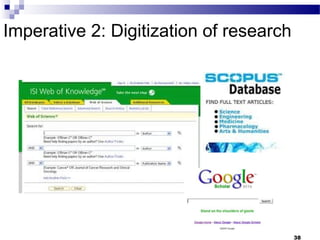
Imperative 2: Digitization of research
38
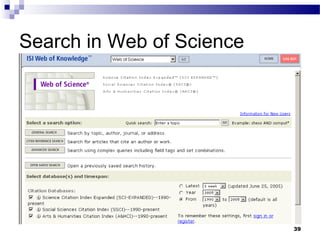
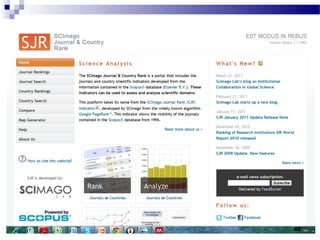
Search in Web of Science
39
40
Implications
 You can not afford to be invisible in the
digitized world
 Someone is going to measure you and make
you visible !
 You are constantly indexed, searched
 You are also under constant onslaught of new
and emerging ideas !
41
Imperative 3 : Sharing &
connectivity !
 Sharing of information
 Professional networks
 Social networks
42
Implications
 Sharing of information/Knowledge made easy
through IT
 You must share and connect
 Your collaborator may be anywhere in the
globe available 24 x 7 basis
 Power & influence of social media as a
binder!
43
Remark..
“New digital technologies are
predisposing scholars to an open
scholarship of content, knowledge
and learning” (Katz, 2010).
44
Visibility through social media
 Social media are tools for social interaction
using Web /mobile technologies (Wikipedia).
 These technologies, often referred to as Web
2.0 , provide services that support users in
generating and publishing their own content.
 Social interactions developed as a result of this
activity can support engagement with
communities of practice through networking
and other co-operative and collaborative 45
Researchgate
www.researchgate.net
 A network for researchers
 One can share and
disseminate
 Contributions in terms of
publications, downloads,
datasets etc.
46
Pegrum, M., "'I link therefore I am': network literacy as a core digital literacy", E-
learning and Digital Media 7(4), 346-354 2010 doi:10.2304/elea.2010.7.4.346
Measures of visibility
 Number of followers
 Number following
 Downloads
 Citations
 Number of questions asked/answered
47
Visible components of research
outcome : Visibility generated
 Individual Academic & Research Output
 Institutional Academic & Research Output
 Collaborations: How many people are we collaborating? the
collaboration index.
 Share in local, regional, National and Global knowledge
resources
 Patents, prototypes, new ventures
 Advisory and policy making role
 Conferences, seminars, Research papers, books and then
organized course material
Measuring this output through SCOPUS, h index, impact
factor SNIP, SJR, Google scholar, etc.
48
Visible individual research output
 Organized Course Materials, monographs
 Manuals/Edited Volume
 Proceedings of Invited Lectures, Seminar, Workshop,
etc.
 Proceedings of Conference; refereed & non-refereed
 Technical Reports
 Thesis
 Patents, prototypes
 Audio & Audio-Video Materials
49
Visible institutional research output
 Research papers in refereed journals
 Research papers in non-refereed journals
 Open access publications
 Institutional journal publications
 National / International Journals
 Research Books
 Seminar; National, International
 Workshops / Training programs
 Conferences; National, International
 Patents filed and received
 Industry projects undertaken
50
Imperative 4:Collaboration
 Institutional collaboration
 Focusing on core strengths
 No duplication of facilities
 Synergy of expertise
51
Implications
 Sharing of resources through collaboration
 Learning to work in a team based
approach
 Opportunity for joint visibility
 Comfortable in interdisciplinary work
 Project management approach
52
Interesting figures..
About 25,000 peer-reviewed journals are published
worldwide, in all disciplines and all languages
http://www.ulrichsweb.com/ulrichsweb/
They publish about 2.5 million articles per year
Most universities and research institutions can only
afford to subscribe to a fraction of those journals.
http://fisher.lib.virginia.edu/cgi-local/arlbin/arl.cgi?
task=setupstats
That means that all those articles are accessible to only
fraction of their potential users
which means that research is having only a fraction of its
potential usage and visibility !
53
Observation..
Research is achieving only a fraction of
its potential productivity and progress.
Research that is freely accessible on
the web has 25% - 250% greater
research impact
54
Imperative 5: Open access
 Open access improves educational experience
 Open access democratizes access to research
 Open access advances research
 Open access improves visibility and impact of
scholarship !
55
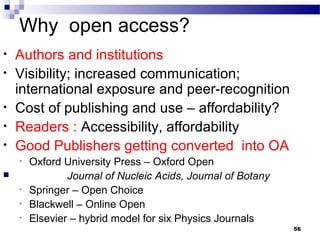
Why open access?
• Authors and institutions
• Visibility; increased communication;
international exposure and peer-recognition
• Cost of publishing and use – affordability?
• Readers : Accessibility, affordability
• Good Publishers getting converted into OA
• Oxford University Press – Oxford Open
 Journal of Nucleic Acids, Journal of Botany
• Springer – Open Choice
• Blackwell – Online Open
• Elsevier – hybrid model for six Physics Journals
56
Implications
 Pentabytes of data circulating the web
 Information needed fast
 Information flows freely
 Researchers “networked” socially
 New tools and new metrics of citations
 Directory of open access journals www.doaj.org
 Example: International J of Management &
Strategy
57
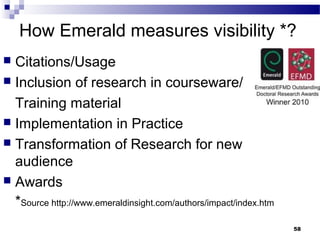
How Emerald measures visibility *?
 Citations/Usage
 Inclusion of research in courseware/
Training material
 Implementation in Practice
 Transformation of Research for new
audience
 Awards
*Source http://www.emeraldinsight.com/authors/impact/index.htm
58
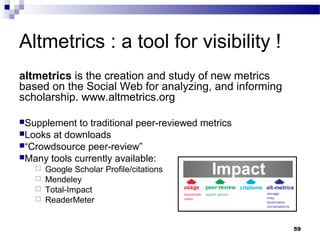
Altmetrics : a tool for visibility !
altmetrics is the creation and study of new metrics
based on the Social Web for analyzing, and informing
scholarship. www.altmetrics.org
Supplement to traditional peer-reviewed metrics
Looks at downloads
“Crowdsource peer-review”
Many tools currently available:
 Google Scholar Profile/citations
 Mendeley
 Total-Impact
 ReaderMeter
59
Visibility through..
 Crete a web site
 Post your papers thru social networking
sites such as academia.edu,
resesrchgate.com
 Use archiving services such as ArXiv or
Citeseer (according to the copyright
policy)
 Publish in open access journals
60
Tools for visibility..
 Formal dialogues : skype, Elluminate
 Informal interactions: google chats, facebook
 Documentation: Dropbox, google drive ,
Mendeley, Zetero
 Space for reflection: 750words.com, blogs
 Engaging with community: researchgate,
academia, LinkedIn
 Keeping informed about
conferences/developments : RSS feeds,
podcasts, webinar 61
Visibility..
 Visibility generated
Visibility generated by yourself through various
tools
 Visibility earned
Visibility earned by you from the external sources
62
Visibilty generated…
 Blog for researchers
 Communication and collaboration tools for
researchers
 Facebook for researchers
63
Visibilty generated..
 Google Scholar for researchers
 iTunesU for researchers
 LinkedIn for researchers
 Mendeley for researchers
 RSS feed for researchers
 Skype for researchers
 SlideShare for researchers
 YouTube for researchers 64
Visibility generated for
institution/university
 Research profile of institute/university
 Affiliation with other researchers of the
institute/university
 Established repository of knowledge and
systemic procedure embedded in the
institute
65
Visibilty generated through
scholarly resources
 E-journals
 Reviews
 Pre-prints and working papers
 Encyclopedias, dictionaries, and annotated content
 Data
 Blogs
 Discussion forums
http://www.arl.org/sc/models/models-pubs/search-form.shtml
66
Researcher and social media
 Researchers have always exchanged, shared
and disseminated information through various
media: brain storming sessions, conferences,
workshops, symposiums, doctoral consortia etc,
-Researchers have always built a network of
peers, friends, seniors
 Range of social media tools to facilitate and
support existing behaviours and practices –
 easy and free to use, user friendly !
67
Why use social media? ..1..
 Help to build your research profile – ‘showcase’
yourself and your work thus facilitating visibility
 Allows to build network, Help to explore and leverage research
opportunities ,Help to get early feedback
 Facilitate your online visibility
 Enhances research - according to CIBER
(2010)
 Disseminating findings, Identifying Research Opportunities
 Finding collaborators
 “Social media presents some opportunities for better,
faster research and dissemination” (CIBER 2010)
CIBER. 2010. Social media and research workflow? http://www.ucl.ac.uk/infostudies/research/ciber/Charleston-
2010.pdf
Brabazon, T. 2010. A community of scholars. http://www.timeshighereducation.co.uk/story.asp?
sectioncode=26&storycode=413384
68
Why use social media? ..2..
 The connection with:
Other researchers and Ph D students, both
internal and external
Research community
Experts
Industry
Society
 Growing need to communicate research
findings to public – these tools make it easier
69
Why use social media? ..3..
 May save time – use it to harvest the ‘wisdom of
crowds’ and find resources through your network
 It can help overcome the syndrome of “isolation of
doing research”
 Engages you with a community that cares about what
you care about and in turn share with them
“We don’t have a choice on whether we do social media,
the question is how well we do it”. –
Erik Qualman

70
How to do it:
Your digital identity
 Have an identity for ‘online presence’ or
‘digital footprint’. This is your Aadhar Card !
 Institutional – e.g. information on institute/university
webpages (www.iiitm.ac.in)
 Professional – e.g. LinkedIn profile, Academia
 ReserarchGate
 Social media - e.g. Facebook, Twitter
 Slideshare , Authorstream
71
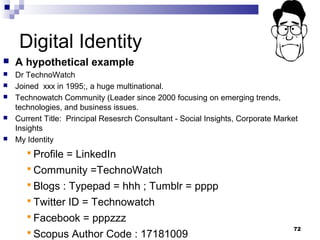
Digital Identity
 A hypothetical example
 Dr TechnoWatch
 Joined xxx in 1995;, a huge multinational.
 Technowatch Community (Leader since 2000 focusing on emerging trends,
technologies, and business issues.
 Current Title: Principal Resesrch Consultant - Social Insights, Corporate Market
Insights
 My Identity
 Profile = LinkedIn
 Community =TechnoWatch
 Blogs : Typepad = hhh ; Tumblr = pppp
 Twitter ID = Technowatch
 Facebook = pppzzz
 Scopus Author Code : 17181009
72
Example: Blogs
Blogs are a great way to share information
Test your ideas out with a wide
audience
Learn from others
Form new relationships
Build / manage your online personal
brand
Example : http://vogtsresearchmethods.blogspot.in/
73
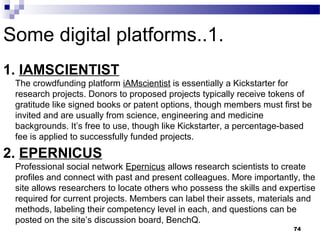
Some digital platforms..1.
1. IAMSCIENTIST 
The crowdfunding platform iAMscientist is essentially a Kickstarter for
research projects. Donors to proposed projects typically receive tokens of
gratitude like signed books or patent options, though members must first be
invited and are usually from science, engineering and medicine
backgrounds. It’s free to use, though like Kickstarter, a percentage-based
fee is applied to successfully funded projects.
2. EPERNICUS
Professional social network Epernicus allows research scientists to create
profiles and connect with past and present colleagues. More importantly, the
site allows researchers to locate others who possess the skills and expertise
required for current projects. Members can label their assets, materials and
methods, labeling their competency level in each, and questions can be
posted on the site’s discussion board, BenchQ.
74
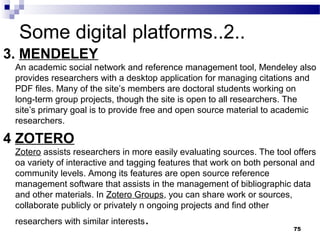
Some digital platforms..2..
3. MENDELEY
An academic social network and reference management tool, Mendeley also
provides researchers with a desktop application for managing citations and
PDF files. Many of the site’s members are doctoral students working on
long-term group projects, though the site is open to all researchers. The
site’s primary goal is to provide free and open source material to academic
researchers.
4 ZOTERO
Zotero assists researchers in more easily evaluating sources. The tool offers
oa variety of interactive and tagging features that work on both personal and
community levels. Among its features are open source reference
management software that assists in the management of bibliographic data
and other materials. In Zotero Groups, you can share work or sources,
collaborate publicly or privately n ongoing projects and find other
researchers with similar interests. 75
Google Scholar: friend
 Available free
 Can search in the same way as Google.
 Searches for scholarly information including journal
articles.
 Adequate coverage.
 Links to other articles that have cited that article.
Google Scholar: foe
 Results ranking unclear.
 No list of journals covered.
 Does not index all records from databases.
 Includes non-academic sources such as blogs.
 May not always get the full text.
Google Scholar
A searcher at the initial stages of research who is unwilling
to search multiple databases or do not have sophisticated
tools is likely to achieve better results by using Google
Scholar.
 Use Google Scholar in conjunction with other academic
search tools at your disposal
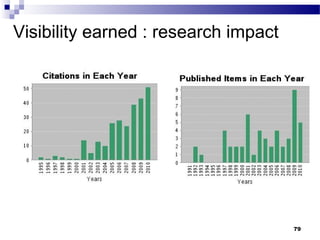
Visibility earned : research impact
79
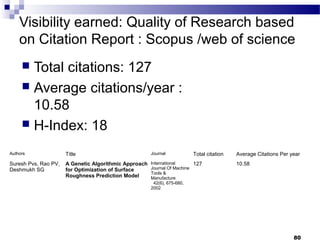
Visibility earned: Quality of Research based
on Citation Report : Scopus /web of science
 Total citations: 127
 Average citations/year :
10.58
 H-Index: 18
Authors Title Journal Total citation Average Citations Per year
Suresh Pvs, Rao PV,
Deshmukh SG
A Genetic Algorithmic Approach 
for Optimization of Surface 
Roughness Prediction Model
International
Journal Of Machine
Tools &
Manufacture
42(6), 675-680,
2002
127 10.58
80
Visibility earned..
 During first six months
 Over 420 full text article requests
 Over 320 full pages viewed by over 60 different visitors to the
website
 Visitors were from 12 different countries
 After three years
 500-600 visitors per month
 1500- 1700 downloads per month
 Visitors from 25 countries, with the US accounting for 20% of
traffic.
 Citations are up , Over 290 members on LinkedIn, 81
Visibility earned with industry
 Transfer of knowhow from you to industry
 Translating the needs of industry
 Establishing a dialogue with industry
 Sharing of research outcomes
 Building case studies
82
Visibility earned with society
 Relevance of your research to society
 Synchronization with the societal view ?
83
Impact of research
 Academic impact
 Economic and societal impact
 Conceptual
 Capacity building
Measures of visibility required 
84
Issues for considerations..
1. How research and its visibility are evaluated
today will not be the same in five years time.
2. What are good indicators of visibilty? What can
we measure? What should we be measuring?
3. How should we be measuring them? What do
they mean?
4. Measurements in future will allow for greater
granularity.
85
Closing remarks..
 There are various imperatives for making a
researcher visible
 To be an effective researcher, one must be
able make presence visible !
 In contemporary world, researcher must also
be comfortable in connecting and making
himself visible
 For this Social media offers an interesting
scope86
References
 Digital Researcher http://www.vitae.ac.uk/researchers/315321/Digital-
Researcher.html
 Cann, A., Dimitriou, K., Hooley, T., "Social Media : A guide for researchers",
(February), 2011
http://www.rin.ac.uk/our-work/communicating-and-disseminating-
research/social-media-guide-researchers
 Pegrum, M., "'I link therefore I am': network literacy as a core digital literacy",
E-learning and Digital Media 7(4), 346-354 2010
doi:10.2304/elea.2010.7.4.346
 Research Information Network, "If you build it, will they come? How
researchers perceive and use web 2.0", 2010
http://www.rin.ac.uk/our-work/communicating-and-disseminating-
research/use-and-relevance-web-20-researchers
 iGoogle http://www.google.com/ig
87
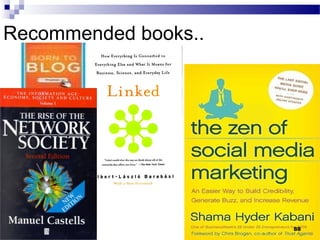
Recommended books..
88
Thank you &
stay in touch..
deshmukh.sg@gmail.com
http://www.slideshare.net/SanjeevDeshmukh
http://sgdeshmuk.blogspot.in/
89

Research visibilty-sgd

  • 1.
    Visibility of researchin digital world S G Deshmukh ABV-Indian Institute of Information Technology & Management , Gwalior FDP on Multivariate and Advanced Data Analysis in Marketing 27 Sep 2013 1
  • 2.
    Objectives of FDP To raise the interest of faculty in integrating various issues into their teaching  To support them by offering opportunities to learn from others experiences  To give faculty quick access to existing knowledge base of ABV-IIITM which participant would identify as relevant  To encourage the production of new knowledge  To assist faculty to reach their career goals, 2
  • 3.
    Acknowledgement This presentation isbased on extensive information sharing sessions with  Prof Abid Haleem (Jamia) ,Prof N K Sharma (IITK), Dr Jitesh Thakkar (IITKh) Thankful to numerous research scholars and faculty members from various institutes participating in our FDPs (more than 200) for making us realize the importance of visibility of research in current scenario 3
  • 4.
    Prelude.. You may lookat some of presentations available at http://www.slideshare.net/SanjeevDeshmukh/presentations 4
  • 5.
    Speaking points..  Aboutresearch.. Why research  Imperatives & Implications 1: Shelf life 2: Digitization of outcome 3: Sharing & Connectivity 4: Collaboration 5: Open Access  Various tools for visibility  Closing remarks..5
  • 6.
     Book byAmartya Sen (2005)  We like debate, discussions and like to put in our views  Intellectual pluralism ! 6
  • 7.
    IT is makingworld flatter ! (Thanks to Friedman)  Outsourcing dominated paradigm  Team work and leadership assumes new meaning  Geography has become history: Time and distance are no longer the important variables  Mobile dense and multimedia rich environment has accelerated digital environment.  Connectivity has made the global village possible  Working on-line, flexi-time, tele/videoconferencing, and continuous learning are changing the traditional notions of how work gets done.  Internet is changing the way we communicate with – Source : Fridman, T L, The World is flat: Farrar, Straus & Giroux , 2005 7
  • 8.
    Observations..  Transformation takingplace  The way we communicate has changed. Research is no exception to this !  Traditional ways of conducting research and disseminating outcomes have also changed. 8
  • 9.
    What is happeningtoday..  An increasing focus on interdisciplinary/ multidisciplinary/transdisciplinary research;  An increasing focus on problems, rather than techniques;  Greater emphasis on collaborative work and communication;  Greater emphasis on more diverse and informal modes of communication 9
  • 10.
    “Everyone wants one, noone knows what it is, and no one knows how to get one” Philip Altbach, Boston College, US on the “World Class University 10
  • 11.
    What makes aworld class university ? Key pillars:  Teaching  Knowledge Transfer  Global outlook  Research. 11
  • 12.
    • 92 percent said that faculty output (publications) was a must have/nice to have • 91 per cent said that faculty impact (citations) was a must have/nice to have • 86 per cent said they wanted faculty/student ratios • 84 per cent wanted income from research grants • 79 per cent wanted peer “reputation” measure Thomson Reuters’ stakeholder survey : Key findings: 12
  • 13.
    THE: World universityranking template www.timeshighereducation.co.uk/world-university-rankings/ Sn Factor Weightage 1 International outlook 7.5 % 2 Research : Volume, Income, Reputation 30.0 % 3 Citations: Research influence 30.0 % 4 Industry Income: Innovation 2.5 % 5 Teaching: Learning environment 30.0% 13
  • 14.
    Importance of Resesrch For rise in academic hierarchy  For enhancing quality of pedagogy  For increase in reach  For gaining acceptance in the academic community  For making some difference & impact  For gaining visibility ! 14
  • 15.
    Why to doresearch ? Sn Reason 1 Developing knowledge relevant to the strategic objectives of the academic entity (university, Institute etc.) 2 Maintaining research competence 3 Maintaining subject matter competence 4 Pushing the boundaries of knowledge through path-breaking research 5 Participating in the global knowledge system (requires the ability to operate as both a source of knowledge and a sink for knowledge) 6 Conducting contract research in return for funding 7 Training researchers 15
  • 16.
    Criteria of GoodResearch  Good research is systematic  Good research is logical  Good research is empirical  Good research is replicable  Good research is visible ! 16
  • 17.
    17 Criteria of goodresearch  Good research is systematic- structured with specified steps taken in specified sequence in accordance with well-defined rules  Good research is logical: logical reasoning makes research more meaningful in the context of decision making  Good research is empirical: dealing with concrete data that provides the basis for external validity to research results.  Good research is replicable  Good research is also visible : sharing with community, peers and the society at large
  • 18.
    Credit: Prof NK Sharma(IITK) 18
  • 19.
    Interesting developments  Worldis flat  Communication is anytime, anywhere, anyone !  Sharing and collaboration  Urge and desire for recognition ! 19
  • 20.
     Our thinking& way of working is shaped by environment and the context within which we operate 20
  • 21.
    Digital environment  Onslaughtof IT : mobile, laptop, web, electronic media ,social media  Online banking, Credit/debit card, e-commerce,  PAN card, Aadhar Card,  Online community 21
  • 22.
    Digital environment ? Web 1.0  Mp3.com  Britannica Online  Personal website  Publishing  Stickiness  Web 2.0  Napster  Wikipedia  Blogging  Participation  Syndication 22
  • 23.
    Research : Previousgeneration and generation Y  F2F interaction with supervisor  Hard copy format  Long publication cycle time  Long lead time for postage  Individualized environment  Single sourcing  9 to 5 basis ?  F2F and online interaction  Soft copy format  Shorter publication time  Instantaneous posting !  Collaborative environment  Crowdsourcing  24 x 7 basis 23
  • 24.
    Today’s researcher  ITsavvy  Spends more time online  Responds positively to criticism  Positively engaged with the topic  Open to share and collaborate  Has multiple-sources of guidance  Comfortable in multi-tasking  Has 24 x7 approach ? 24
  • 25.
    Today’s research  Literaturereview, Methodology, Analysis enabled by IT and collaborative tools  Turnaround time for Ph D has reduced  Shelf life of an idea condensed  Time-to-publish has drastically reduced 25
  • 26.
    Today’s supervisor  ITsavvy  Open to collaboration  Open to experimentation  Willing to network  Need for visibilty 26
  • 27.
    Observations..  Developments atthe global level are taking place very rapidly , thanks to IT  Unless there is serious research, it is difficult to keep track of these developments and translate these outcomes into classroom  Global integration triggered integration of academics 27
  • 28.
    Observations..  Role ofthe academic remains as one of critiquing, challenging, and engaging in debate. This role is as important as producing practically useful research.  What counts as knowledge will remain as contested and needs to be debated and negotiated between the profession, policy makers, practitioners and academics, while preserving the researcher’s role 28
  • 29.
    Above quote froman article by G. Small in Nature, vol. 479, page 141 Summarizes how new technologies are changing the way in which the research dialogues are being conducted:  “In an era of budget cutting, early-career scientists will have to be effective ambassadors for the profession. This might manifest in conversations with family members or with strangers sitting next to us on a plane, or it might mean posting videos on YouTube or blogging about our on going research.  The days of scientists communicating only with each other, in the languages of our individual disciplines, … are rapidly coming to an end.” 29
  • 30.
    Reading a book.. Iread a book once… 30
  • 31.
    But journals aredifferent…aren’t they?  As a researcher, you want citations, readers, impact,…  Can cite anything (relevant)  blogs, tweets, presentations (SlideShare), YouTube channels, video clips:  But the original article itself has barely changed  Visibility ? 31
  • 32.
    Remark..  “…that ifyou are passionate about a topic and argue your perspective in a compelling manner, you can begin to generate a following…If people find your opinions and perspective interesting, they will do a lot of the work for you. By design, social media is a conversation. When you post information, people like, comment on, or forward your thoughts. This means that not only can you put ideas out there but you can learn a lot as well.”  Boost your career with social media: tips for the uninitiated, http://blogs.hbr.org/hmu/2011/12/boost-your-career-with-social.html 32
  • 33.
    Visibility defined..  vis·i·bil·i·ty(vz-bl-t)n. pl. vis·i·bil·i·ties  1. The fact, state, or degree of being visible.  2. The greatest distance under given weather conditions to which it is possible to see without instrumental assistance.  3.a. The capability of being easily observed: an executive with high visibility.  b. The capability of providing a clear, unobstructed view: a windshield with good visibility. 33
  • 34.
    Why visibility..  itis crucial to make sure that your research is visible on the internet.  If your papers are available on the Web, it is more likely that other researchers will read your papers and cite you. 34
  • 35.
    Visibility ..  Youcan use it to enhance your personal brand as a “Researcher”  Establish your expertise, or  Demonstrate your digital fluency 35
  • 36.
    Imperative 1: Shelflife  Web enabled world: Millions of ideas getting generated, developed and disseminated  Faster publishing cycle  Web enabled submission, review and publication process  Shelf life of an idea has shortened considerably 36
  • 37.
    Implications  You haveto update continuously and must know the state-of-the-art  You have to innovate continuously  Literature review aided by IT tools: search engines, indexing services !  You have to be visible to the community 37
  • 38.
  • 39.
    Search in Webof Science 39
  • 40.
  • 41.
    Implications  You cannot afford to be invisible in the digitized world  Someone is going to measure you and make you visible !  You are constantly indexed, searched  You are also under constant onslaught of new and emerging ideas ! 41
  • 42.
    Imperative 3 :Sharing & connectivity !  Sharing of information  Professional networks  Social networks 42
  • 43.
    Implications  Sharing ofinformation/Knowledge made easy through IT  You must share and connect  Your collaborator may be anywhere in the globe available 24 x 7 basis  Power & influence of social media as a binder! 43
  • 44.
    Remark.. “New digital technologiesare predisposing scholars to an open scholarship of content, knowledge and learning” (Katz, 2010). 44
  • 45.
    Visibility through socialmedia  Social media are tools for social interaction using Web /mobile technologies (Wikipedia).  These technologies, often referred to as Web 2.0 , provide services that support users in generating and publishing their own content.  Social interactions developed as a result of this activity can support engagement with communities of practice through networking and other co-operative and collaborative 45
  • 46.
    Researchgate www.researchgate.net  A networkfor researchers  One can share and disseminate  Contributions in terms of publications, downloads, datasets etc. 46 Pegrum, M., "'I link therefore I am': network literacy as a core digital literacy", E- learning and Digital Media 7(4), 346-354 2010 doi:10.2304/elea.2010.7.4.346
  • 47.
    Measures of visibility Number of followers  Number following  Downloads  Citations  Number of questions asked/answered 47
  • 48.
    Visible components ofresearch outcome : Visibility generated  Individual Academic & Research Output  Institutional Academic & Research Output  Collaborations: How many people are we collaborating? the collaboration index.  Share in local, regional, National and Global knowledge resources  Patents, prototypes, new ventures  Advisory and policy making role  Conferences, seminars, Research papers, books and then organized course material Measuring this output through SCOPUS, h index, impact factor SNIP, SJR, Google scholar, etc. 48
  • 49.
    Visible individual researchoutput  Organized Course Materials, monographs  Manuals/Edited Volume  Proceedings of Invited Lectures, Seminar, Workshop, etc.  Proceedings of Conference; refereed & non-refereed  Technical Reports  Thesis  Patents, prototypes  Audio & Audio-Video Materials 49
  • 50.
    Visible institutional researchoutput  Research papers in refereed journals  Research papers in non-refereed journals  Open access publications  Institutional journal publications  National / International Journals  Research Books  Seminar; National, International  Workshops / Training programs  Conferences; National, International  Patents filed and received  Industry projects undertaken 50
  • 51.
    Imperative 4:Collaboration  Institutionalcollaboration  Focusing on core strengths  No duplication of facilities  Synergy of expertise 51
  • 52.
    Implications  Sharing ofresources through collaboration  Learning to work in a team based approach  Opportunity for joint visibility  Comfortable in interdisciplinary work  Project management approach 52
  • 53.
    Interesting figures.. About 25,000peer-reviewed journals are published worldwide, in all disciplines and all languages http://www.ulrichsweb.com/ulrichsweb/ They publish about 2.5 million articles per year Most universities and research institutions can only afford to subscribe to a fraction of those journals. http://fisher.lib.virginia.edu/cgi-local/arlbin/arl.cgi? task=setupstats That means that all those articles are accessible to only fraction of their potential users which means that research is having only a fraction of its potential usage and visibility ! 53
  • 54.
    Observation.. Research is achievingonly a fraction of its potential productivity and progress. Research that is freely accessible on the web has 25% - 250% greater research impact 54
  • 55.
    Imperative 5: Openaccess  Open access improves educational experience  Open access democratizes access to research  Open access advances research  Open access improves visibility and impact of scholarship ! 55
  • 56.
    Why open access? •Authors and institutions • Visibility; increased communication; international exposure and peer-recognition • Cost of publishing and use – affordability? • Readers : Accessibility, affordability • Good Publishers getting converted into OA • Oxford University Press – Oxford Open  Journal of Nucleic Acids, Journal of Botany • Springer – Open Choice • Blackwell – Online Open • Elsevier – hybrid model for six Physics Journals 56
  • 57.
    Implications  Pentabytes ofdata circulating the web  Information needed fast  Information flows freely  Researchers “networked” socially  New tools and new metrics of citations  Directory of open access journals www.doaj.org  Example: International J of Management & Strategy 57
  • 58.
    How Emerald measuresvisibility *?  Citations/Usage  Inclusion of research in courseware/ Training material  Implementation in Practice  Transformation of Research for new audience  Awards *Source http://www.emeraldinsight.com/authors/impact/index.htm 58
  • 59.
    Altmetrics : atool for visibility ! altmetrics is the creation and study of new metrics based on the Social Web for analyzing, and informing scholarship. www.altmetrics.org Supplement to traditional peer-reviewed metrics Looks at downloads “Crowdsource peer-review” Many tools currently available:  Google Scholar Profile/citations  Mendeley  Total-Impact  ReaderMeter 59
  • 60.
    Visibility through..  Cretea web site  Post your papers thru social networking sites such as academia.edu, resesrchgate.com  Use archiving services such as ArXiv or Citeseer (according to the copyright policy)  Publish in open access journals 60
  • 61.
    Tools for visibility.. Formal dialogues : skype, Elluminate  Informal interactions: google chats, facebook  Documentation: Dropbox, google drive , Mendeley, Zetero  Space for reflection: 750words.com, blogs  Engaging with community: researchgate, academia, LinkedIn  Keeping informed about conferences/developments : RSS feeds, podcasts, webinar 61
  • 62.
    Visibility..  Visibility generated Visibilitygenerated by yourself through various tools  Visibility earned Visibility earned by you from the external sources 62
  • 63.
    Visibilty generated…  Blogfor researchers  Communication and collaboration tools for researchers  Facebook for researchers 63
  • 64.
    Visibilty generated..  GoogleScholar for researchers  iTunesU for researchers  LinkedIn for researchers  Mendeley for researchers  RSS feed for researchers  Skype for researchers  SlideShare for researchers  YouTube for researchers 64
  • 65.
    Visibility generated for institution/university Research profile of institute/university  Affiliation with other researchers of the institute/university  Established repository of knowledge and systemic procedure embedded in the institute 65
  • 66.
    Visibilty generated through scholarlyresources  E-journals  Reviews  Pre-prints and working papers  Encyclopedias, dictionaries, and annotated content  Data  Blogs  Discussion forums http://www.arl.org/sc/models/models-pubs/search-form.shtml 66
  • 67.
    Researcher and socialmedia  Researchers have always exchanged, shared and disseminated information through various media: brain storming sessions, conferences, workshops, symposiums, doctoral consortia etc, -Researchers have always built a network of peers, friends, seniors  Range of social media tools to facilitate and support existing behaviours and practices –  easy and free to use, user friendly ! 67
  • 68.
    Why use socialmedia? ..1..  Help to build your research profile – ‘showcase’ yourself and your work thus facilitating visibility  Allows to build network, Help to explore and leverage research opportunities ,Help to get early feedback  Facilitate your online visibility  Enhances research - according to CIBER (2010)  Disseminating findings, Identifying Research Opportunities  Finding collaborators  “Social media presents some opportunities for better, faster research and dissemination” (CIBER 2010) CIBER. 2010. Social media and research workflow? http://www.ucl.ac.uk/infostudies/research/ciber/Charleston- 2010.pdf Brabazon, T. 2010. A community of scholars. http://www.timeshighereducation.co.uk/story.asp? sectioncode=26&storycode=413384 68
  • 69.
    Why use socialmedia? ..2..  The connection with: Other researchers and Ph D students, both internal and external Research community Experts Industry Society  Growing need to communicate research findings to public – these tools make it easier 69
  • 70.
    Why use socialmedia? ..3..  May save time – use it to harvest the ‘wisdom of crowds’ and find resources through your network  It can help overcome the syndrome of “isolation of doing research”  Engages you with a community that cares about what you care about and in turn share with them “We don’t have a choice on whether we do social media, the question is how well we do it”. – Erik Qualman  70
  • 71.
    How to doit: Your digital identity  Have an identity for ‘online presence’ or ‘digital footprint’. This is your Aadhar Card !  Institutional – e.g. information on institute/university webpages (www.iiitm.ac.in)  Professional – e.g. LinkedIn profile, Academia  ReserarchGate  Social media - e.g. Facebook, Twitter  Slideshare , Authorstream 71
  • 72.
    Digital Identity  A hypothetical example Dr TechnoWatch  Joined xxx in 1995;, a huge multinational.  Technowatch Community (Leader since 2000 focusing on emerging trends, technologies, and business issues.  Current Title: Principal Resesrch Consultant - Social Insights, Corporate Market Insights  My Identity  Profile = LinkedIn  Community =TechnoWatch  Blogs : Typepad = hhh ; Tumblr = pppp  Twitter ID = Technowatch  Facebook = pppzzz  Scopus Author Code : 17181009 72
  • 73.
    Example: Blogs Blogs area great way to share information Test your ideas out with a wide audience Learn from others Form new relationships Build / manage your online personal brand Example : http://vogtsresearchmethods.blogspot.in/ 73
  • 74.
    Some digital platforms..1. 1. IAMSCIENTIST  Thecrowdfunding platform iAMscientist is essentially a Kickstarter for research projects. Donors to proposed projects typically receive tokens of gratitude like signed books or patent options, though members must first be invited and are usually from science, engineering and medicine backgrounds. It’s free to use, though like Kickstarter, a percentage-based fee is applied to successfully funded projects. 2. EPERNICUS Professional social network Epernicus allows research scientists to create profiles and connect with past and present colleagues. More importantly, the site allows researchers to locate others who possess the skills and expertise required for current projects. Members can label their assets, materials and methods, labeling their competency level in each, and questions can be posted on the site’s discussion board, BenchQ. 74
  • 75.
    Some digital platforms..2.. 3. MENDELEY Anacademic social network and reference management tool, Mendeley also provides researchers with a desktop application for managing citations and PDF files. Many of the site’s members are doctoral students working on long-term group projects, though the site is open to all researchers. The site’s primary goal is to provide free and open source material to academic researchers. 4 ZOTERO Zotero assists researchers in more easily evaluating sources. The tool offers oa variety of interactive and tagging features that work on both personal and community levels. Among its features are open source reference management software that assists in the management of bibliographic data and other materials. In Zotero Groups, you can share work or sources, collaborate publicly or privately n ongoing projects and find other researchers with similar interests. 75
  • 76.
    Google Scholar: friend  Availablefree  Can search in the same way as Google.  Searches for scholarly information including journal articles.  Adequate coverage.  Links to other articles that have cited that article.
  • 77.
    Google Scholar: foe  Resultsranking unclear.  No list of journals covered.  Does not index all records from databases.  Includes non-academic sources such as blogs.  May not always get the full text.
  • 78.
    Google Scholar A searcherat the initial stages of research who is unwilling to search multiple databases or do not have sophisticated tools is likely to achieve better results by using Google Scholar.  Use Google Scholar in conjunction with other academic search tools at your disposal
  • 79.
    Visibility earned :research impact 79
  • 80.
    Visibility earned: Qualityof Research based on Citation Report : Scopus /web of science  Total citations: 127  Average citations/year : 10.58  H-Index: 18 Authors Title Journal Total citation Average Citations Per year Suresh Pvs, Rao PV, Deshmukh SG A Genetic Algorithmic Approach  for Optimization of Surface  Roughness Prediction Model International Journal Of Machine Tools & Manufacture 42(6), 675-680, 2002 127 10.58 80
  • 81.
    Visibility earned..  Duringfirst six months  Over 420 full text article requests  Over 320 full pages viewed by over 60 different visitors to the website  Visitors were from 12 different countries  After three years  500-600 visitors per month  1500- 1700 downloads per month  Visitors from 25 countries, with the US accounting for 20% of traffic.  Citations are up , Over 290 members on LinkedIn, 81
  • 82.
    Visibility earned withindustry  Transfer of knowhow from you to industry  Translating the needs of industry  Establishing a dialogue with industry  Sharing of research outcomes  Building case studies 82
  • 83.
    Visibility earned withsociety  Relevance of your research to society  Synchronization with the societal view ? 83
  • 84.
    Impact of research Academic impact  Economic and societal impact  Conceptual  Capacity building Measures of visibility required  84
  • 85.
    Issues for considerations.. 1.How research and its visibility are evaluated today will not be the same in five years time. 2. What are good indicators of visibilty? What can we measure? What should we be measuring? 3. How should we be measuring them? What do they mean? 4. Measurements in future will allow for greater granularity. 85
  • 86.
    Closing remarks..  Thereare various imperatives for making a researcher visible  To be an effective researcher, one must be able make presence visible !  In contemporary world, researcher must also be comfortable in connecting and making himself visible  For this Social media offers an interesting scope86
  • 87.
    References  Digital Researcherhttp://www.vitae.ac.uk/researchers/315321/Digital- Researcher.html  Cann, A., Dimitriou, K., Hooley, T., "Social Media : A guide for researchers", (February), 2011 http://www.rin.ac.uk/our-work/communicating-and-disseminating- research/social-media-guide-researchers  Pegrum, M., "'I link therefore I am': network literacy as a core digital literacy", E-learning and Digital Media 7(4), 346-354 2010 doi:10.2304/elea.2010.7.4.346  Research Information Network, "If you build it, will they come? How researchers perceive and use web 2.0", 2010 http://www.rin.ac.uk/our-work/communicating-and-disseminating- research/use-and-relevance-web-20-researchers  iGoogle http://www.google.com/ig 87
  • 88.
  • 89.
    Thank you & stayin touch.. deshmukh.sg@gmail.com http://www.slideshare.net/SanjeevDeshmukh http://sgdeshmuk.blogspot.in/ 89

Editor's Notes

  • #31 What was intriguing to me was how the author has researched through curated content – letters, notebooks, etc. – the social media of the day? There were many examples of quotes from soldiers fighting in various Empire Wars…from the Crimean, The Boer, and so on. I can’t imagine for one moment that a private in the infantry at Sebastopol believed for one moment that his letters home would be used in this way. But why wouldn’t academics want to refer to it. I was curious about who was curating all this material. Who will maintain and curate everything we know today as “social content”? The task is non-trivial and orders of magnitude greater than the journal article and peer-review processes that we have in place. In the books area this is different. You absolutely could create a book from blogs. It really amuses me how you can if you want to, throw the kitchen sink at the book in terms of the content that you’re going to use. And a good editor will help you craft this into something digestible, which ultimately is reviewed once it’s printed or digitised…either through advance copies for review and/or in the trade press. However, although this is without question academic output it’s not the same as a piece of primary scientific research, which must be reviewed by your peers in advance of publication.