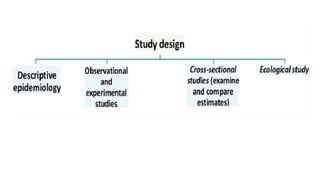

Types of study designs
--- Dr. Dipayan Banerjee
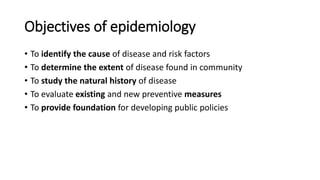
Objectives of epidemiology
• To identify the cause of disease and risk factors
• To determine the extent of disease found in community
• To study the natural history of disease
• To evaluate existing and new preventive measures
• To provide foundation for developing public policies
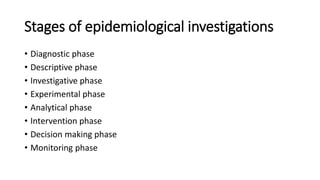
Stages of epidemiological investigations
• Diagnostic phase
• Descriptive phase
• Investigative phase
• Experimental phase
• Analytical phase
• Intervention phase
• Decision making phase
• Monitoring phase
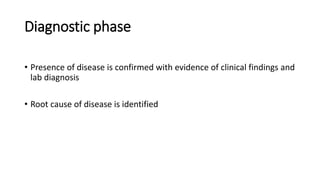
Diagnostic phase
• Presence of disease is confirmed with evidence of clinical findings and
lab diagnosis
• Root cause of disease is identified
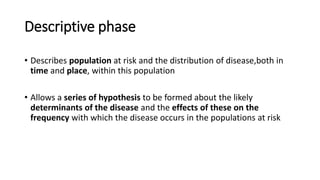
Descriptive phase
• Describes population at risk and the distribution of disease,both in
time and place, within this population
• Allows a series of hypothesis to be formed about the likely
determinants of the disease and the effects of these on the
frequency with which the disease occurs in the populations at risk
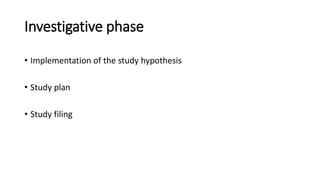
Investigative phase
• Implementation of the study hypothesis
• Study plan
• Study filing
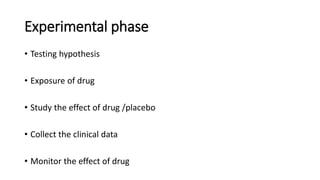
Experimental phase
• Testing hypothesis
• Exposure of drug
• Study the effect of drug /placebo
• Collect the clinical data
• Monitor the effect of drug
Analytical phase
• Arrangement of data
• Data mining
• Statistical analysis
• Data interpretation
Intervention phase
• Testing the hypothesis under controlled environment
• Appropriate methods for the control of the disease are examined
either under experimental conditions or in the field
• Interventions in the disease process are effected by manipulating
existing determinants or introducing new ones
Decision-making phase
• Knowledge of epidemiology of the disease is used to explore the
various options available for its control
• This often involves the modelling of the effects that these different
options are likely to have on the incidence of the disease
• These models can be combined with other models that examine the
costs of the various control measures and compare them with
benefits, in terms of increased productivity, that these measures are
likely to produce
• Optimum control strategy can be selected as a result of the expected
decrease in disease incidence in the populations of livestock at risk
Monitoring phase
• Which takes place during the implementation of the control measures
to ensure that these measures are being properly applied, are having
the desired effect on reducing disease incidence
• Success of control programme are detected
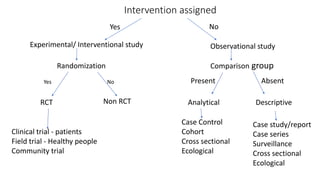
Intervention assigned
Comparison group
Experimental/ Interventional study Observational study
Analytical Descriptive
Randomization
Yes No
Present Absent
RCT Non RCT
Yes No
Case Control
Cohort
Cross sectional
Ecological
Case study/report
Case series
Surveillance
Cross sectional
Ecological
Clinical trial - patients
Field trial - Healthy people
Community trial
Descriptive studies
• Case study - report of a single patient
• Case series - Similar clinical findings of a group of patient
• Surveillance - Continuous scrutiny of all aspects of a disease pertinent
to its effective control
• Cross sectional - Study of a group of people at a single point of time
• Ecological - Studies of risk modifying factors on health or other
outcomes based on population defined either geographically or
temporally (may cause ecological fallacy)
Analytical studies
• Case control
• Cohort
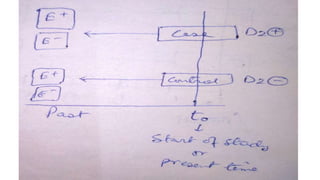
Case Control
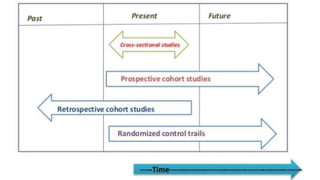
• Retrospective
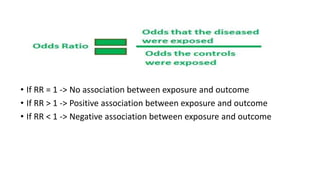
• ODDs ratio is calculated
• Suitable for rare disease
• Less time consuming
• No problem of loss of follow up/ dropout/ attrition
• Recall bias, selection bias present
• Multiple type of exposure leading to same disease can be calculated
• If RR = 1 -> No association between exposure and outcome
• If RR > 1 -> Positive association between exposure and outcome
• If RR < 1 -> Negative association between exposure and outcome
Cohort
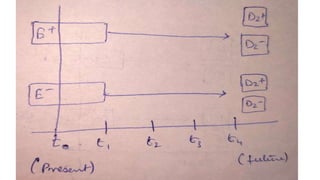
• Prospective
• Absolute risk, relative risk, attributable risk is calculated
• Suitable for rare exposure
• Much time consuming
• Temporality of association can be established
• Natural history of disease can be studied
• Hawthorne effect
• Single exposure leading to multiple disease can be studied
Variants of cohort
• Nested case control - Interim data analysis of an ongoing cohort study
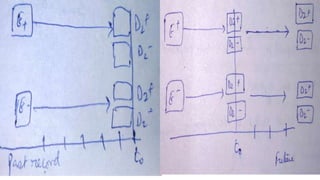
• Retrospective or historical cohort
• Mixed cohort - Ambidirectional
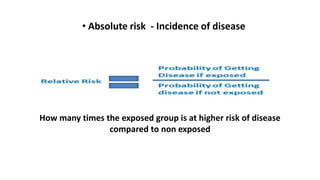
• Absolute risk - Incidence of disease
How many times the exposed group is at higher risk of disease
compared to non exposed
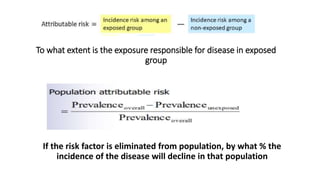
To what extent is the exposure responsible for disease in exposed
group
If the risk factor is eliminated from population, by what % the
incidence of the disease will decline in that population
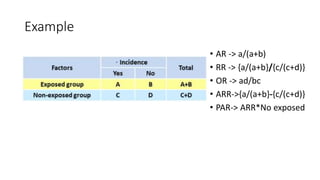
Example
• AR -> a/(a+b)
• RR -> {a/(a+b}/{c/(c+d)}
• OR -> ad/bc
• ARR->{a/(a+b}-{c/(c+d)}
• PAR-> ARR*No exposed
Randomized Control Trial
• Phase 0 : Animals
• Phase 1: Healthy individuals to know upper tolerable limit and
pharmacokinetics
• Phase 2: Patients to know the effect of drug
• Phase 3: Patient to compare effect of new drug with pre existing drug
• Phase 4: Patient for long term effect of drug
Meta analysis
• Here the data from similar small comparable studies and fresh
analysis of the data is done
• Effective sample size increase, error decrease, power of study
increase, level of confidence increase
• Best method to establish causal inference
ANY QUESTIONS?

Types of study design

  • 1.
    Types of studydesigns --- Dr. Dipayan Banerjee
  • 2.
    Objectives of epidemiology •To identify the cause of disease and risk factors • To determine the extent of disease found in community • To study the natural history of disease • To evaluate existing and new preventive measures • To provide foundation for developing public policies
  • 3.
    Stages of epidemiologicalinvestigations • Diagnostic phase • Descriptive phase • Investigative phase • Experimental phase • Analytical phase • Intervention phase • Decision making phase • Monitoring phase
  • 4.
    Diagnostic phase • Presenceof disease is confirmed with evidence of clinical findings and lab diagnosis • Root cause of disease is identified
  • 5.
    Descriptive phase • Describespopulation at risk and the distribution of disease,both in time and place, within this population • Allows a series of hypothesis to be formed about the likely determinants of the disease and the effects of these on the frequency with which the disease occurs in the populations at risk
  • 6.
    Investigative phase • Implementationof the study hypothesis • Study plan • Study filing
  • 7.
    Experimental phase • Testinghypothesis • Exposure of drug • Study the effect of drug /placebo • Collect the clinical data • Monitor the effect of drug
  • 8.
    Analytical phase • Arrangementof data • Data mining • Statistical analysis • Data interpretation
  • 9.
    Intervention phase • Testingthe hypothesis under controlled environment • Appropriate methods for the control of the disease are examined either under experimental conditions or in the field • Interventions in the disease process are effected by manipulating existing determinants or introducing new ones
  • 10.
    Decision-making phase • Knowledgeof epidemiology of the disease is used to explore the various options available for its control • This often involves the modelling of the effects that these different options are likely to have on the incidence of the disease • These models can be combined with other models that examine the costs of the various control measures and compare them with benefits, in terms of increased productivity, that these measures are likely to produce • Optimum control strategy can be selected as a result of the expected decrease in disease incidence in the populations of livestock at risk
  • 11.
    Monitoring phase • Whichtakes place during the implementation of the control measures to ensure that these measures are being properly applied, are having the desired effect on reducing disease incidence • Success of control programme are detected
  • 13.
    Intervention assigned Comparison group Experimental/Interventional study Observational study Analytical Descriptive Randomization Yes No Present Absent RCT Non RCT Yes No Case Control Cohort Cross sectional Ecological Case study/report Case series Surveillance Cross sectional Ecological Clinical trial - patients Field trial - Healthy people Community trial
  • 15.
    Descriptive studies • Casestudy - report of a single patient • Case series - Similar clinical findings of a group of patient • Surveillance - Continuous scrutiny of all aspects of a disease pertinent to its effective control • Cross sectional - Study of a group of people at a single point of time • Ecological - Studies of risk modifying factors on health or other outcomes based on population defined either geographically or temporally (may cause ecological fallacy)
  • 16.
    Analytical studies • Casecontrol • Cohort
  • 17.
    Case Control • Retrospective •ODDs ratio is calculated • Suitable for rare disease • Less time consuming • No problem of loss of follow up/ dropout/ attrition • Recall bias, selection bias present • Multiple type of exposure leading to same disease can be calculated
  • 19.
    • If RR= 1 -> No association between exposure and outcome • If RR > 1 -> Positive association between exposure and outcome • If RR < 1 -> Negative association between exposure and outcome
  • 20.
    Cohort • Prospective • Absoluterisk, relative risk, attributable risk is calculated • Suitable for rare exposure • Much time consuming • Temporality of association can be established • Natural history of disease can be studied • Hawthorne effect • Single exposure leading to multiple disease can be studied
  • 22.
    Variants of cohort •Nested case control - Interim data analysis of an ongoing cohort study • Retrospective or historical cohort • Mixed cohort - Ambidirectional
  • 24.
    • Absolute risk- Incidence of disease How many times the exposed group is at higher risk of disease compared to non exposed
  • 25.
    To what extentis the exposure responsible for disease in exposed group If the risk factor is eliminated from population, by what % the incidence of the disease will decline in that population
  • 26.
    Example • AR ->a/(a+b) • RR -> {a/(a+b}/{c/(c+d)} • OR -> ad/bc • ARR->{a/(a+b}-{c/(c+d)} • PAR-> ARR*No exposed
  • 27.
    Randomized Control Trial •Phase 0 : Animals • Phase 1: Healthy individuals to know upper tolerable limit and pharmacokinetics • Phase 2: Patients to know the effect of drug • Phase 3: Patient to compare effect of new drug with pre existing drug • Phase 4: Patient for long term effect of drug
  • 28.
    Meta analysis • Herethe data from similar small comparable studies and fresh analysis of the data is done • Effective sample size increase, error decrease, power of study increase, level of confidence increase • Best method to establish causal inference
  • 29.

Editor's Notes

  • #4 Confirmation of presence of the disease formation of hypothesis implementation of a series of field field studies to test hypothesis experiment under controlled conditions to test the hypothesis analysis of research data method for control of disease are examined either under experimental condition or field implementation of control measures