CHAPTER 2
A. Characteristics of a good problem statement
B. Research Objectives and Questions
C. Research Scope and Significance
DEFINING THE PROBLEM STATEMENT
a. Defining the problem statement to narrow down the broad problem so that it is well-
defined, focused and specific. A good literature review will lead to a good problem
statement.
i. It creates a sense of ownership for the researcher;
ii. Focuses the researcher on an accepted problem; and
iii. Describes the symptoms in measurable terms.
b. Determining the research direction; the solution to a problem depends very much on
how the problem is being viewed and framed.
c. When a problem has been successfully identified, a researcher must ensure that the
problem is defined and stated specifically enough that he/she can write about it.
PROBLEM STATEMENT
a. A succinct statement of the question or issue that is to be investigated with the goal
of finding an answer or solution.
b. Unambiguous, specific, and focused, and that the problem is addressed from a
specific academic perspective.
c. Three Elements:
i. The problem itself should be clearly stated with sufficient contextual detail to
justify its importance.
ii. The method of solving the problem, often stated as a claim or a working
thesis.
iii. The purpose, statement of objective and scope of the document the
researcher is preparing.
PROBLEM STATEMENT
• A succinct statement of the question or issue that is to be investigated with the goal of finding an
answer or solution.
• Unambiguous, specific, and focused, and that the problem is addressed from a specific academic
perspective.
• Three Elements:
1. The problem itself should be clearly stated with sufficient contextual detail to justify its
importance.
2. The method of solving the problem, often stated as a claim or a working thesis.
3. The purpose, statement of objective and scope of the document the researcher is preparing.
What Makes a Good Problem Statement?
1. Relevant - relevant to both managerial and academic perspectives.
 From a managerial perspective, research is relevant if it relates to (1) a
problem that currently exists in an organizational setting or (2) an area that
a manager believes needs to be improved in the organization.
 From an academic perspective, research is relevant if: (1) nothing is known
about a topic, (2) much is known about the topic, but the knowledge is scattered
and not integrated, (3) much research on the topic is available, but the results are
(partly) contradictory, or (4) established relationships do not hold in certain
situations. If you base your research report on the “nothing is known” argument,
you will have to prove that your claim is right.
What Makes a Good Problem Statement?
2. Feasible - feasible in terms of the capability of the researcher to complete it
given the restrictions that the researcher may have.
3. Interesting - must be an interesting one to him/her to keep the motivation
level high in ensuring completion of the task at hand.
Good problem statement …
• Understanding the antecedents–problem–consequences sequence and
gathering the relevant information to get a real grasp of the problem go a long
way towards pinpointing it.
• Correct problem definition is critical to ultimate problem solution.
• Allows managers to judge the relevance of the proposed study.
• Sets out the blueprint for the direction of the research.
Good problem statement …
• A good problem will have a good aim and a good aim will lead to good research
questions and research objectives.
• Helps build a solid theoretical framework which will in turn help set testable
hypotheses.
• Determines the type of data and its formats needed to answer each research question.
• Better clarity, control and implementation of data collection for the data analysis.
• Right data analysis – answers the research questions properly.
Content of Problem Statement
1. 2-3 pages
2. Should highlight:
I. Issues / problems faced in the study context (provide evidence – statistics, reports,
news, previous studies)
II. Gaps of the study – what are the limitations from previous studies
a. Knowledge – introduce new variables/theories, positioning of the variables, combination
of variables/theories in one model, etc.
b. Methods – analysis, research approach, etc.
c. Context – ex. limited studies conducted in Malaysian/Industry/Student/OKU/Elderly/
Children, etc. context
III. Explain how your current study will fill these gaps
IV. From this issues and limitations, you will raise your RQs & ROs
9
Example
 Previous research has addressed several aspects of [topic]: (1) _____ (cite two
or more relevant articles), (2) _______ (cite two or more relevant articles), and
(3) ________ (cite two or more relevant articles).
However, in addition, ..........encompasses several unexplored dimensions that
lately have attracted research attention in other disciplines (cite 2 or more
relevant articles). Some of these unexplored .......appear to be important and
worthy of investigation in the context of ...... An investigation of these issues is
important because ................ Furthermore, previous empirical research has
focused primarily on ......... Very little research has been done on.................
Exercise
Name Problem Statement
1. Afzal “Kes halusinasi, bocor paru-paru semakin meningkat dikalangan
orang muda akibat tabiat vape.”
Kes halusinasi akibat tabiat menghisap vape semakin meningkat
dikalangan remaja di kawasan Taman Cheras Awana.
2. Dini “Masalah sosial dan kualiti hidup di Malaysia”
Ketidak seimbangan ekonomi dan kualiti hidup golongan belia di
Bnadar Putra, Klang.
3. Farah “Permasalahan kewangan di Malaysia.”
Masalah kos pengajian yang semakin mahal di kalangan pelajar
universiti swasta di Bangi.
Research Objective & Research Questions
 A good problem statement includes both a statement of the research objective(s) and the
research question(s).
1. Research objective (RO):
a. why of the research
b. to solve a specific problem in a work setting;
c. to change something
d. Ex. To examine the effect of rewards on motivation
Example
Problem statement Research Objectives
“There is a significant lack of engagement
among students in online learning platforms,
leading to poor academic performance and
high dropout rates.”
To investigate the factors influencing student
engagement in online learning platforms and
develop strategies to enhance participation and
reduce dropout rates
Example
Problem statement Research Objectives
“"Small businesses in rural areas struggle with
accessing financial resources, which hinders
their growth and sustainability."
To assess the barriers to financial access for
small businesses in rural areas and propose
viable solutions to improve funding
opportunities and support business growth.
Example
Problem statement Research Objectives
“Chronic absenteeism in primary schools is a
growing concern, impacting students'
academic progress and overall school
performance.”
To identify the causes of chronic absenteeism in
primary schools and develop intervention
strategies to improve attendance and enhance
academic outcomes.
Research Objective & Research Questions
2. Research questions (RQ):
a. what of the research (what do you want to learn?)
b. translates problem into a specific need for information
c. are related to the objective
d. if objective is unclear we will not be able to formulate RQ
e. Ex. Is there any effect of rewards on motivation? @ Does rewards effect
motivation?
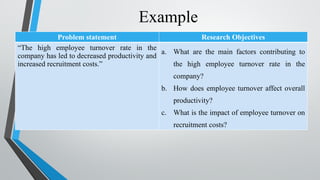
Example
Problem statement Research Objectives
“The high employee turnover rate in the
company has led to decreased productivity and
increased recruitment costs.”
a. What are the main factors contributing to
the high employee turnover rate in the
company?
b. How does employee turnover affect overall
productivity?
c. What is the impact of employee turnover on
recruitment costs?
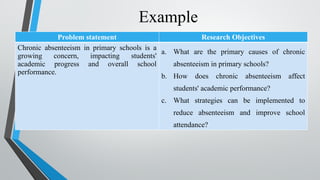
Example
Problem statement Research Objectives
Chronic absenteeism in primary schools is a
growing concern, impacting students'
academic progress and overall school
performance.
a. What are the primary causes of chronic
absenteeism in primary schools?
b. How does chronic absenteeism affect
students' academic performance?
c. What strategies can be implemented to
reduce absenteeism and improve school
attendance?
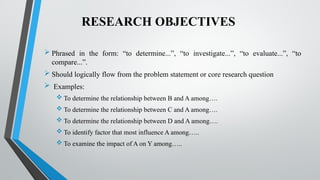
RESEARCH OBJECTIVES
 Phrased in the form: “to determine...”, “to investigate...”, “to evaluate...”, “to
compare...”.
 Should logically flow from the problem statement or core research question
 Examples:
 To determine the relationship between B and A among….
 To determine the relationship between C and A among….
 To determine the relationship between D and A among….
 To identify factor that most influence A among…..
 To examine the impact of A on Y among…..
RESEARCH QUESTIONS
 Based on the potential factors identified from previous studies which are
deemed important in the specific context of your study, you may also provide
specific research questions
 Examples:
 What is the relationship between B and A among….?
 What is the relationship between C and A among…..?
 What is the relationship between D and A among…..?
 What is the factor that most influence A among…..?
 What is the impact of A on Y among….?
 RQs help formulate research objectives
RESEARCH QUESTIONS IN
QUALITATIVE RESEARCH
• Usually focus on one concept or idea.
• Generally, don’t make comparisons among groups.
• Can be based on hunches or personal experience.
• Usually pertain to the actions or perceptions of participants.
• Qualitative research answers “how” and “why” questions or process.
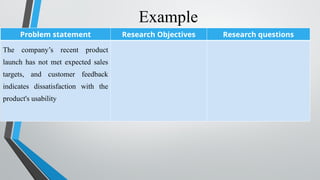
Example
Problem statement Research Objectives Research questions
The company’s recent product
launch has not met expected sales
targets, and customer feedback
indicates dissatisfaction with the
product's usability
Example
Problem statement Research Objectives Research questions
The company’s recent product
launch has not met expected sales
targets, and customer feedback
indicates dissatisfaction with the
product's usability
To investigate the reasons
behind the poor sales
performance and customer
dissatisfaction with the new
product, and to develop
recommendations for product
improvement and future
marketing strategies
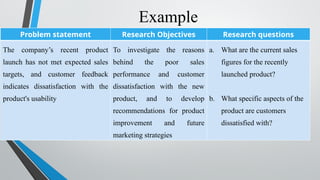
Example
Problem statement Research Objectives Research questions
The company’s recent product
launch has not met expected sales
targets, and customer feedback
indicates dissatisfaction with the
product's usability
To investigate the reasons
behind the poor sales
performance and customer
dissatisfaction with the new
product, and to develop
recommendations for product
improvement and future
marketing strategies
a. What are the current sales
figures for the recently
launched product?
b. What specific aspects of the
product are customers
dissatisfied with?
EXAMPLES OF QUALITATIVE
RESEARCH QUESTIONS
• How do Malaysian parents view teaching Math & Science in English?
• How do pupil in rural communities perceive their ability to obtain government
scholarships?
• How do Malaysian women view domestic violence?
• Why do youngsters join street demonstrations?
• Why do Generation Y prefer flexi working hour?
• How do board members/CEO's view CSR?
• How do employees’ perceptions of their superior's leadership quality and the
influence of organizational culture affect their orientation toward changing working
style?
• How do society perceive prostitution?
• How do men view extramarital affairs?
• Why do society tend to associate enforcement officers with bribery and corruption?
RESEARCH SCOPE
 The scope of the study refers to the boundaries within which your research
project will be performed.
 Define what the study is going to cover and what it is focusing on.
 Typically, the information that you need to include in the scope would cover
the following:
i. General purpose of the study
ii. The population or sample that you are studying
iii. The duration of the study
iv. The topics or theories that you will discuss
v. The geographical location covered in the study
• Covers what, why, where, when, who & how of the research
RESEARCH SIGNIFICANCE
• The significance of the study is a written statement that explains why your
research was needed. It's a justification of the importance of your work and
impact it has on your research field, it's contribution to new knowledge and
how others (ex. practitioners, institutions, industry, government, society, etc.)
will benefit from it.
RESEARCH SIGNIFICANCE
 How to Write Significance of the Study:
a. Use your research problem as a starting point.
b. State how your research will contribute to the existing literature in
the field.
c. Explain how your research will benefit society.
d. Mention the specific persons or institutions who will benefit from
your study.
e. Indicate how your study may help future studies in the field.
Example
• This study seeks to extend ............by addressing the gaps in ........
The study will investigate the impact of four ...........(1) .........,
(2).........., (3) ............., and (4) .......... In addition, interrelationships
among ............are examined. Findings from this study are hoped…..
(theoretical)…..(practical)…..

Chapter 2 - Problem statement, RO, and RQ.pptx

  • 1.
    CHAPTER 2 A. Characteristicsof a good problem statement B. Research Objectives and Questions C. Research Scope and Significance
  • 2.
    DEFINING THE PROBLEMSTATEMENT a. Defining the problem statement to narrow down the broad problem so that it is well- defined, focused and specific. A good literature review will lead to a good problem statement. i. It creates a sense of ownership for the researcher; ii. Focuses the researcher on an accepted problem; and iii. Describes the symptoms in measurable terms. b. Determining the research direction; the solution to a problem depends very much on how the problem is being viewed and framed. c. When a problem has been successfully identified, a researcher must ensure that the problem is defined and stated specifically enough that he/she can write about it.
  • 3.
    PROBLEM STATEMENT a. Asuccinct statement of the question or issue that is to be investigated with the goal of finding an answer or solution. b. Unambiguous, specific, and focused, and that the problem is addressed from a specific academic perspective. c. Three Elements: i. The problem itself should be clearly stated with sufficient contextual detail to justify its importance. ii. The method of solving the problem, often stated as a claim or a working thesis. iii. The purpose, statement of objective and scope of the document the researcher is preparing.
  • 4.
    PROBLEM STATEMENT • Asuccinct statement of the question or issue that is to be investigated with the goal of finding an answer or solution. • Unambiguous, specific, and focused, and that the problem is addressed from a specific academic perspective. • Three Elements: 1. The problem itself should be clearly stated with sufficient contextual detail to justify its importance. 2. The method of solving the problem, often stated as a claim or a working thesis. 3. The purpose, statement of objective and scope of the document the researcher is preparing.
  • 5.
    What Makes aGood Problem Statement? 1. Relevant - relevant to both managerial and academic perspectives.  From a managerial perspective, research is relevant if it relates to (1) a problem that currently exists in an organizational setting or (2) an area that a manager believes needs to be improved in the organization.  From an academic perspective, research is relevant if: (1) nothing is known about a topic, (2) much is known about the topic, but the knowledge is scattered and not integrated, (3) much research on the topic is available, but the results are (partly) contradictory, or (4) established relationships do not hold in certain situations. If you base your research report on the “nothing is known” argument, you will have to prove that your claim is right.
  • 6.
    What Makes aGood Problem Statement? 2. Feasible - feasible in terms of the capability of the researcher to complete it given the restrictions that the researcher may have. 3. Interesting - must be an interesting one to him/her to keep the motivation level high in ensuring completion of the task at hand.
  • 7.
    Good problem statement… • Understanding the antecedents–problem–consequences sequence and gathering the relevant information to get a real grasp of the problem go a long way towards pinpointing it. • Correct problem definition is critical to ultimate problem solution. • Allows managers to judge the relevance of the proposed study. • Sets out the blueprint for the direction of the research.
  • 8.
    Good problem statement… • A good problem will have a good aim and a good aim will lead to good research questions and research objectives. • Helps build a solid theoretical framework which will in turn help set testable hypotheses. • Determines the type of data and its formats needed to answer each research question. • Better clarity, control and implementation of data collection for the data analysis. • Right data analysis – answers the research questions properly.
  • 9.
    Content of ProblemStatement 1. 2-3 pages 2. Should highlight: I. Issues / problems faced in the study context (provide evidence – statistics, reports, news, previous studies) II. Gaps of the study – what are the limitations from previous studies a. Knowledge – introduce new variables/theories, positioning of the variables, combination of variables/theories in one model, etc. b. Methods – analysis, research approach, etc. c. Context – ex. limited studies conducted in Malaysian/Industry/Student/OKU/Elderly/ Children, etc. context III. Explain how your current study will fill these gaps IV. From this issues and limitations, you will raise your RQs & ROs 9
  • 10.
    Example  Previous researchhas addressed several aspects of [topic]: (1) _____ (cite two or more relevant articles), (2) _______ (cite two or more relevant articles), and (3) ________ (cite two or more relevant articles). However, in addition, ..........encompasses several unexplored dimensions that lately have attracted research attention in other disciplines (cite 2 or more relevant articles). Some of these unexplored .......appear to be important and worthy of investigation in the context of ...... An investigation of these issues is important because ................ Furthermore, previous empirical research has focused primarily on ......... Very little research has been done on.................
  • 11.
    Exercise Name Problem Statement 1.Afzal “Kes halusinasi, bocor paru-paru semakin meningkat dikalangan orang muda akibat tabiat vape.” Kes halusinasi akibat tabiat menghisap vape semakin meningkat dikalangan remaja di kawasan Taman Cheras Awana. 2. Dini “Masalah sosial dan kualiti hidup di Malaysia” Ketidak seimbangan ekonomi dan kualiti hidup golongan belia di Bnadar Putra, Klang. 3. Farah “Permasalahan kewangan di Malaysia.” Masalah kos pengajian yang semakin mahal di kalangan pelajar universiti swasta di Bangi.
  • 12.
    Research Objective &Research Questions  A good problem statement includes both a statement of the research objective(s) and the research question(s). 1. Research objective (RO): a. why of the research b. to solve a specific problem in a work setting; c. to change something d. Ex. To examine the effect of rewards on motivation
  • 13.
    Example Problem statement ResearchObjectives “There is a significant lack of engagement among students in online learning platforms, leading to poor academic performance and high dropout rates.” To investigate the factors influencing student engagement in online learning platforms and develop strategies to enhance participation and reduce dropout rates
  • 14.
    Example Problem statement ResearchObjectives “"Small businesses in rural areas struggle with accessing financial resources, which hinders their growth and sustainability." To assess the barriers to financial access for small businesses in rural areas and propose viable solutions to improve funding opportunities and support business growth.
  • 15.
    Example Problem statement ResearchObjectives “Chronic absenteeism in primary schools is a growing concern, impacting students' academic progress and overall school performance.” To identify the causes of chronic absenteeism in primary schools and develop intervention strategies to improve attendance and enhance academic outcomes.
  • 16.
    Research Objective &Research Questions 2. Research questions (RQ): a. what of the research (what do you want to learn?) b. translates problem into a specific need for information c. are related to the objective d. if objective is unclear we will not be able to formulate RQ e. Ex. Is there any effect of rewards on motivation? @ Does rewards effect motivation?
  • 17.
    Example Problem statement ResearchObjectives “The high employee turnover rate in the company has led to decreased productivity and increased recruitment costs.” a. What are the main factors contributing to the high employee turnover rate in the company? b. How does employee turnover affect overall productivity? c. What is the impact of employee turnover on recruitment costs?
  • 18.
    Example Problem statement ResearchObjectives Chronic absenteeism in primary schools is a growing concern, impacting students' academic progress and overall school performance. a. What are the primary causes of chronic absenteeism in primary schools? b. How does chronic absenteeism affect students' academic performance? c. What strategies can be implemented to reduce absenteeism and improve school attendance?
  • 19.
    RESEARCH OBJECTIVES  Phrasedin the form: “to determine...”, “to investigate...”, “to evaluate...”, “to compare...”.  Should logically flow from the problem statement or core research question  Examples:  To determine the relationship between B and A among….  To determine the relationship between C and A among….  To determine the relationship between D and A among….  To identify factor that most influence A among…..  To examine the impact of A on Y among…..
  • 20.
    RESEARCH QUESTIONS  Basedon the potential factors identified from previous studies which are deemed important in the specific context of your study, you may also provide specific research questions  Examples:  What is the relationship between B and A among….?  What is the relationship between C and A among…..?  What is the relationship between D and A among…..?  What is the factor that most influence A among…..?  What is the impact of A on Y among….?  RQs help formulate research objectives
  • 21.
    RESEARCH QUESTIONS IN QUALITATIVERESEARCH • Usually focus on one concept or idea. • Generally, don’t make comparisons among groups. • Can be based on hunches or personal experience. • Usually pertain to the actions or perceptions of participants. • Qualitative research answers “how” and “why” questions or process.
  • 22.
    Example Problem statement ResearchObjectives Research questions The company’s recent product launch has not met expected sales targets, and customer feedback indicates dissatisfaction with the product's usability
  • 23.
    Example Problem statement ResearchObjectives Research questions The company’s recent product launch has not met expected sales targets, and customer feedback indicates dissatisfaction with the product's usability To investigate the reasons behind the poor sales performance and customer dissatisfaction with the new product, and to develop recommendations for product improvement and future marketing strategies
  • 24.
    Example Problem statement ResearchObjectives Research questions The company’s recent product launch has not met expected sales targets, and customer feedback indicates dissatisfaction with the product's usability To investigate the reasons behind the poor sales performance and customer dissatisfaction with the new product, and to develop recommendations for product improvement and future marketing strategies a. What are the current sales figures for the recently launched product? b. What specific aspects of the product are customers dissatisfied with?
  • 25.
    EXAMPLES OF QUALITATIVE RESEARCHQUESTIONS • How do Malaysian parents view teaching Math & Science in English? • How do pupil in rural communities perceive their ability to obtain government scholarships? • How do Malaysian women view domestic violence? • Why do youngsters join street demonstrations? • Why do Generation Y prefer flexi working hour? • How do board members/CEO's view CSR? • How do employees’ perceptions of their superior's leadership quality and the influence of organizational culture affect their orientation toward changing working style? • How do society perceive prostitution? • How do men view extramarital affairs? • Why do society tend to associate enforcement officers with bribery and corruption?
  • 26.
    RESEARCH SCOPE  Thescope of the study refers to the boundaries within which your research project will be performed.  Define what the study is going to cover and what it is focusing on.  Typically, the information that you need to include in the scope would cover the following: i. General purpose of the study ii. The population or sample that you are studying iii. The duration of the study iv. The topics or theories that you will discuss v. The geographical location covered in the study • Covers what, why, where, when, who & how of the research
  • 27.
    RESEARCH SIGNIFICANCE • Thesignificance of the study is a written statement that explains why your research was needed. It's a justification of the importance of your work and impact it has on your research field, it's contribution to new knowledge and how others (ex. practitioners, institutions, industry, government, society, etc.) will benefit from it.
  • 28.
    RESEARCH SIGNIFICANCE  Howto Write Significance of the Study: a. Use your research problem as a starting point. b. State how your research will contribute to the existing literature in the field. c. Explain how your research will benefit society. d. Mention the specific persons or institutions who will benefit from your study. e. Indicate how your study may help future studies in the field.
  • 29.
    Example • This studyseeks to extend ............by addressing the gaps in ........ The study will investigate the impact of four ...........(1) ........., (2).........., (3) ............., and (4) .......... In addition, interrelationships among ............are examined. Findings from this study are hoped….. (theoretical)…..(practical)…..