














4
Web version


                                                                                Apr
                                                                                2012


   A study on student behavior and academic performance


                *not yet the result of study but the design of research with sampling design.
Today’s outline
Why this study
Research question
Hypothesis
Significant of study
Literature reviews
                       Research Methodology
                       Sampling design
                       Tools
                       Questionnaire
Evaluation of data & Difficulty of research
       and then… Q&A
Why this study?
What people think we do?
What our parents think we do?
What we actually do?
Research Question

1
    In what way that students (in certain cases) who hardly or
    almost never attended the class have better grades than
    some students who had frequently attended class?

    Measurement variable: the number of attendances time of
    students and the result of grades


2
    What are the differences of the daily time allocations for each
    activity of students with higher grades and others with lower
    grades do outside their studies?

    Measurement variable: time consuming on activities outside
    the classes
Research Question                                   (con.)


3
    What are the factors/elements that make a student have high
    or lower grades?

    Measurement variable: times spending on reading books and
    attaining the classes, the perception levels on the courses


4
    Does the positive relationship between a student and a professor
    lead the former to be more dedicated to the teachings of the latter
    and finally receive a better grade than others one who are
    otherwise?

    Measurement variable: the number of time spending on students’
    conversation to the their instructors and their grade results
Hypothesis
 There is a relationship between students’ behavior and
 academic performance.


  Academic performance =     Positive behavioral factor   .
                             Negative behavioral factor
Significant of Study
• The research shall examine the grade of students and their
  behavior among BMIR students in Tha Phra Chan
  campus, Thammasat University. It shall probe the differences in
  the students’ characteristic that reflect in what they actually do in
  daily life within and outside of campus.


• It could be suspected that the linkage of their behavior and the
  range of their grade are somehow interrelated with each other.
  The output of the research will be to illustrate the notion of what
  factors in students' behavior could influence the outcome of
  study performance.
Significant of Study
• This research is expected to help BMIR students to
  acknowledge what kind of learning behavior will enable
  them to enhance their full capacity of learning and their
  understanding of the lectures they attend. The research
  will examine if students can change their behavior self-
  influence. Thus, the results of this research may motivate
  BMIR students to attain higher capability to understand the
  details of their study.
Research Methodology
Methodology type: Quantitative Methodology

       Survey (Structural Questionnaire)
              Stratified Sample (6 strata*)
                       BMIR1 Male
                       BMIR1 Female
                       BMIR2 Male
                       BMIR2 Female
                       BMIR3 Male
                       BMIR3 Female
Sampling design
Target population: current BMIR students

Parameters of interest: the linkage between students’ behavior and their
       education performance
Sampling frame: current database of BMIR students with all academic
       year

Sampling method: Probability Sampling (Stratified Sampling)
Size of Sampling: not large number but it should represent the
        heterogeneous of population in order to observe the actual ratio
        and actual characteristic behavior of population via sample.
Sampling design
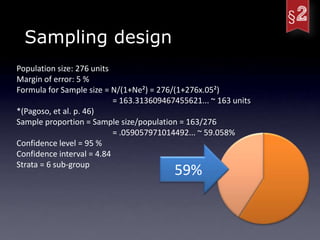
Population size: 276 units
Margin of error: 5 %
Formula for Sample size = N/(1+Ne²) = 276/(1+276x.05²)
                           = 163.313609467455621... ~ 163 units
*(Pagoso, et al. p. 46)
Sample proportion = Sample size/population = 163/276
                           = .059057971014492... ~ 59.058%
Confidence level = 95 %
Confidence interval = 4.84
Strata = 6 sub-group
                                          59%
Sampling design
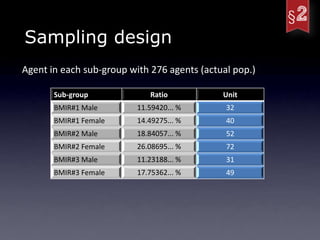
Agent in each sub-group with 276 agents (actual pop.)

       Sub-group             Ratio           Unit
       BMIR#1 Male        11.59420... %       32
       BMIR#1 Female      14.49275... %       40
       BMIR#2 Male        18.84057... %       52
       BMIR#2 Female      26.08695... %       72
       BMIR#3 Male        11.23188... %       31
       BMIR#3 Female      17.75362... %       49
Sampling design
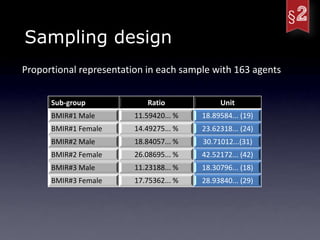
Proportional representation in each sample with 163 agents


      Sub-group             Ratio             Unit
      BMIR#1 Male        11.59420... %   18.89584... (19)
      BMIR#1 Female      14.49275... %   23.62318... (24)
      BMIR#2 Male        18.84057... %   30.71012...(31)
      BMIR#2 Female      26.08695... %   42.52172... (42)
      BMIR#3 Male        11.23188... %   18.30796... (18)
      BMIR#3 Female      17.75362... %   28.93840... (29)
Q1


Tools for data collection

     Hardware   Software
Questionnaire Demo
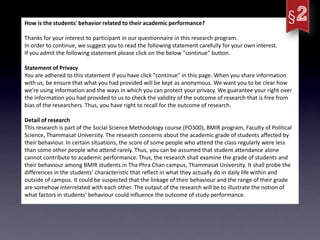
How is the students' behavior related to their academic performance?

Thanks for your interest to participant in our questionnaire in this research program.
In order to continue, we suggest you to read the following statement carefully for your own interest.
If you admit the following statement please click on the below "continue" button.

Statement of Privacy
You are adhered to this statement if you have click "continue" in this page. When you share information
with us, be ensure that what you had provided will be kept as anonymous. We want you to be clear how
we’re using information and the ways in which you can protect your privacy. We guarantee your right over
the information you had provided to us to check the validity of the outcome of research that is free from
bias of the researchers. Thus, you have right to recall for the outcome of research.

Detail of research
This research is part of the Social Science Methodology course (PO300), BMIR program, Faculty of Political
Science, Thammasat University. The research concerns about the academic grade of students affected by
their behaviour. In certain situations, the score of some people who attend the class regularly were less
than some other people who attend rarely. Thus, you can be assumed that student attendance alone
cannot contribute to academic performance. Thus, the research shall examine the grade of students and
their behaviour among BMIR students in Tha Phra Chan campus, Thammasat University. It shall probe the
differences in the students’ characteristic that reflect in what they actually do in daily life within and
outside of campus. It could be suspected that the linkage of their behaviour and the range of their grade
are somehow interrelated with each other. The output of the research will be to illustrate the notion of
what factors in students' behaviour could influence the outcome of study performance.
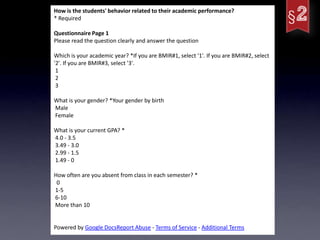
How is the students' behavior related to their academic performance?
* Required

Questionnaire Page 1
Please read the question clearly and answer the question

Which is your academic year? *If you are BMIR#1, select '1'. If you are BMIR#2, select
'2'. If you are BMIR#3, select '3'.
 1
 2
 3

What is your gender? *Your gender by birth
Male
Female

What is your current GPA? *
4.0 - 3.5
3.49 - 3.0
2.99 - 1.5
1.49 - 0

How often are you absent from class in each semester? *
 0
1-5
6-10
More than 10


Powered by Google DocsReport Abuse - Terms of Service - Additional Terms
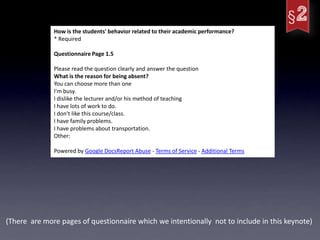
How is the students' behavior related to their academic performance?
              * Required

              Questionnaire Page 1.5

              Please read the question clearly and answer the question
              What is the reason for being absent?
              You can choose more than one
              I'm busy.
              I dislike the lecturer and/or his method of teaching
              I have lots of work to do.
              I don't like this course/class.
              I have family problems.
              I have problems about transportation.
              Other:

              Powered by Google DocsReport Abuse - Terms of Service - Additional Terms


(There are more pages of questionnaire which we intentionally not to include in this keynote)
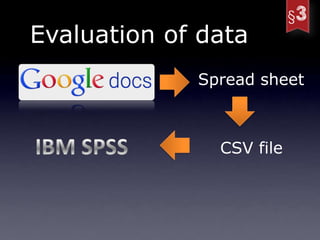
Evaluation of data
             Spread sheet


               CSV file
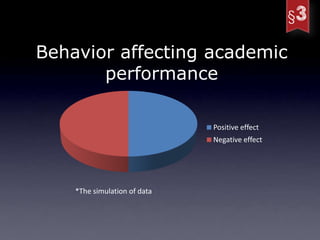
Behavior affecting academic
             Sales
       performance

                              Positive effect
                              Negative effect


    *The simulation of data
Difficulties of study

1. Time consuming lead to reduction of the validity of
source; there are few devices to gather the raw data.
2. The collaboration in the target survey [ Subjects may
give invalid information ]
3. The experience of subjects in BMIR life
4. Bias in the Data collecting process
5. Bias in Sampling Design.
6. The Error in evaluation process
Q&A
Thank you

Research Presentation keynote (not yet result)

  • 1.
    4 Web version Apr 2012 A study on student behavior and academic performance *not yet the result of study but the design of research with sampling design.
  • 2.
    Today’s outline Why thisstudy Research question Hypothesis Significant of study Literature reviews Research Methodology Sampling design Tools Questionnaire Evaluation of data & Difficulty of research and then… Q&A
  • 4.
  • 5.
  • 6.
  • 7.
    What our parentsthink we do?
  • 8.
  • 9.
  • 10.
    Research Question 1 In what way that students (in certain cases) who hardly or almost never attended the class have better grades than some students who had frequently attended class? Measurement variable: the number of attendances time of students and the result of grades 2 What are the differences of the daily time allocations for each activity of students with higher grades and others with lower grades do outside their studies? Measurement variable: time consuming on activities outside the classes
  • 11.
    Research Question (con.) 3 What are the factors/elements that make a student have high or lower grades? Measurement variable: times spending on reading books and attaining the classes, the perception levels on the courses 4 Does the positive relationship between a student and a professor lead the former to be more dedicated to the teachings of the latter and finally receive a better grade than others one who are otherwise? Measurement variable: the number of time spending on students’ conversation to the their instructors and their grade results
  • 12.
    Hypothesis There isa relationship between students’ behavior and academic performance. Academic performance = Positive behavioral factor . Negative behavioral factor
  • 13.
    Significant of Study •The research shall examine the grade of students and their behavior among BMIR students in Tha Phra Chan campus, Thammasat University. It shall probe the differences in the students’ characteristic that reflect in what they actually do in daily life within and outside of campus. • It could be suspected that the linkage of their behavior and the range of their grade are somehow interrelated with each other. The output of the research will be to illustrate the notion of what factors in students' behavior could influence the outcome of study performance.
  • 14.
    Significant of Study •This research is expected to help BMIR students to acknowledge what kind of learning behavior will enable them to enhance their full capacity of learning and their understanding of the lectures they attend. The research will examine if students can change their behavior self- influence. Thus, the results of this research may motivate BMIR students to attain higher capability to understand the details of their study.
  • 16.
    Research Methodology Methodology type:Quantitative Methodology Survey (Structural Questionnaire) Stratified Sample (6 strata*) BMIR1 Male BMIR1 Female BMIR2 Male BMIR2 Female BMIR3 Male BMIR3 Female
  • 17.
    Sampling design Target population:current BMIR students Parameters of interest: the linkage between students’ behavior and their education performance Sampling frame: current database of BMIR students with all academic year Sampling method: Probability Sampling (Stratified Sampling) Size of Sampling: not large number but it should represent the heterogeneous of population in order to observe the actual ratio and actual characteristic behavior of population via sample.
  • 18.
    Sampling design Population size:276 units Margin of error: 5 % Formula for Sample size = N/(1+Ne²) = 276/(1+276x.05²) = 163.313609467455621... ~ 163 units *(Pagoso, et al. p. 46) Sample proportion = Sample size/population = 163/276 = .059057971014492... ~ 59.058% Confidence level = 95 % Confidence interval = 4.84 Strata = 6 sub-group 59%
  • 19.
    Sampling design Agent ineach sub-group with 276 agents (actual pop.) Sub-group Ratio Unit BMIR#1 Male 11.59420... % 32 BMIR#1 Female 14.49275... % 40 BMIR#2 Male 18.84057... % 52 BMIR#2 Female 26.08695... % 72 BMIR#3 Male 11.23188... % 31 BMIR#3 Female 17.75362... % 49
  • 20.
    Sampling design Proportional representationin each sample with 163 agents Sub-group Ratio Unit BMIR#1 Male 11.59420... % 18.89584... (19) BMIR#1 Female 14.49275... % 23.62318... (24) BMIR#2 Male 18.84057... % 30.71012...(31) BMIR#2 Female 26.08695... % 42.52172... (42) BMIR#3 Male 11.23188... % 18.30796... (18) BMIR#3 Female 17.75362... % 28.93840... (29)
  • 21.
    Q1 Tools for datacollection Hardware Software
  • 22.
  • 23.
    How is thestudents' behavior related to their academic performance? Thanks for your interest to participant in our questionnaire in this research program. In order to continue, we suggest you to read the following statement carefully for your own interest. If you admit the following statement please click on the below "continue" button. Statement of Privacy You are adhered to this statement if you have click "continue" in this page. When you share information with us, be ensure that what you had provided will be kept as anonymous. We want you to be clear how we’re using information and the ways in which you can protect your privacy. We guarantee your right over the information you had provided to us to check the validity of the outcome of research that is free from bias of the researchers. Thus, you have right to recall for the outcome of research. Detail of research This research is part of the Social Science Methodology course (PO300), BMIR program, Faculty of Political Science, Thammasat University. The research concerns about the academic grade of students affected by their behaviour. In certain situations, the score of some people who attend the class regularly were less than some other people who attend rarely. Thus, you can be assumed that student attendance alone cannot contribute to academic performance. Thus, the research shall examine the grade of students and their behaviour among BMIR students in Tha Phra Chan campus, Thammasat University. It shall probe the differences in the students’ characteristic that reflect in what they actually do in daily life within and outside of campus. It could be suspected that the linkage of their behaviour and the range of their grade are somehow interrelated with each other. The output of the research will be to illustrate the notion of what factors in students' behaviour could influence the outcome of study performance.
  • 24.
    How is thestudents' behavior related to their academic performance? * Required Questionnaire Page 1 Please read the question clearly and answer the question Which is your academic year? *If you are BMIR#1, select '1'. If you are BMIR#2, select '2'. If you are BMIR#3, select '3'. 1 2 3 What is your gender? *Your gender by birth Male Female What is your current GPA? * 4.0 - 3.5 3.49 - 3.0 2.99 - 1.5 1.49 - 0 How often are you absent from class in each semester? * 0 1-5 6-10 More than 10 Powered by Google DocsReport Abuse - Terms of Service - Additional Terms
  • 25.
    How is thestudents' behavior related to their academic performance? * Required Questionnaire Page 1.5 Please read the question clearly and answer the question What is the reason for being absent? You can choose more than one I'm busy. I dislike the lecturer and/or his method of teaching I have lots of work to do. I don't like this course/class. I have family problems. I have problems about transportation. Other: Powered by Google DocsReport Abuse - Terms of Service - Additional Terms (There are more pages of questionnaire which we intentionally not to include in this keynote)
  • 27.
    Evaluation of data Spread sheet CSV file
  • 28.
    Behavior affecting academic Sales performance Positive effect Negative effect *The simulation of data
  • 29.
    Difficulties of study 1.Time consuming lead to reduction of the validity of source; there are few devices to gather the raw data. 2. The collaboration in the target survey [ Subjects may give invalid information ] 3. The experience of subjects in BMIR life 4. Bias in the Data collecting process 5. Bias in Sampling Design. 6. The Error in evaluation process
  • 30.
  • 31.