Assessments
 Early Identification of
Reading Ability is Critical
Focus on moving towards a PREVENTATIVE
model of intervention rather than a REMEDIAL
model of intervention.
“The ultimate goal of reading instruction is to
help children acquire the knowledge and skills
necessary to comprehend printed material at a
level that is consistent with their general
language comprehension skills.”
Torgesen (2000)
If students are not competent readers, they are at risk for
academic, behavioral, social, and emotional difficulties.
Some of these students may be identified as learning disabled.
Official National Definition
of Learning Disability
 At least average cognitive ability
 Impairments in:
 Language processing
 Phonological processing
 Visual spatial processing
 Processing speed
 Memory and attention
 Executive function
 Range in severity
Official National Definition of
Learning Disability
 Interferes with the acquisition of:
Oral language
Reading
Written language
Mathematics
Organization skills
Social skills
 Lifelong
 Genetic/Neurobiological
Official National Definition of
Learning Disability
IMPACT ON STUDENT
 Unexpected academic underachievement or
achievement which is maintained only by
unusually high levels of effort and support.
 Not due primarily to hearing and or vision
problems, socioeconomic factors, cultural or
linguistic differences, lack of motivation or
ineffective teaching.
Learning Disabilities
Reading
Disability
Written
Expression
Disorder
Handwriting
Disability
Math
Disability
Nonverbal
Learning
Disability
Reading
Difficulties
Spelling
Difficulties
Motor
Difficulties
Math
Difficulties
Visual-
Spatial
& Social
Difficulties
Writing
Difficulties
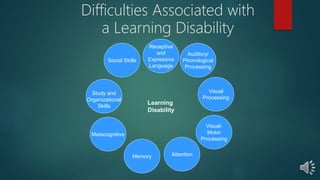
Learning
Disability
Receptive
and
Expressive
Language
Visual
Processing
Visual-
Motor
Processing
Attention
Social Skills
Study and
Organizational
Skills
Metacognitive
Memory
Difficulties Associated with
a Learning Disability
Auditory/
Phonological
Processing
Characteristics of
Struggling Readers
• Over reliance on guessing strategies
• May have low language skills
• Limited phonemic awareness
• Limited understanding of phonics
• Memory problems
• Read slowly and hesitantly, or not at all
• Limited understanding about the text they read
• Often become frustrated and avoid reading
Moats (1998)
Assessments in
Literacy
A FRAMEWORK FOR ASSESSMENT AND PROGRAM
PLANNING FOR STUDENTS WHO EXPERIENCE SIGNIFICANT
DIFFICULTIES IN READING
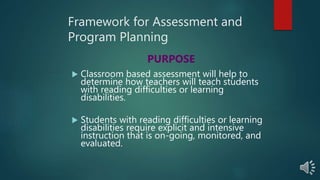
Framework for Assessment and
Program Planning
 Classroom based assessment will help to
determine how teachers will teach students
with reading difficulties or learning
disabilities.
 Students with reading difficulties or learning
disabilities require explicit and intensive
instruction that is on-going, monitored, and
evaluated.
PURPOSE
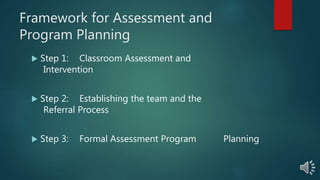
Framework for Assessment and
Program Planning
 Step 1: Classroom Assessment and
Intervention
 Step 2: Establishing the team and the
Referral Process
 Step 3: Formal Assessment Program Planning
Student continues to experience
difficulty.
Framework for Assessment and
Program Planning
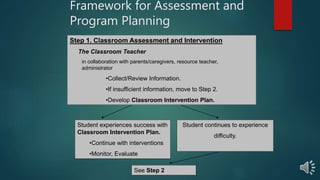
Step 1. Classroom Assessment and Intervention
The Classroom Teacher
in collaboration with parents/caregivers, resource teacher,
administrator
•Collect/Review Information.
•If insufficient information, move to Step 2.
•Develop Classroom Intervention Plan.
Student experiences success with
Classroom Intervention Plan.
•Continue with interventions
•Monitor, Evaluate
See Step 2
Framework for Assessment and
Program Planning
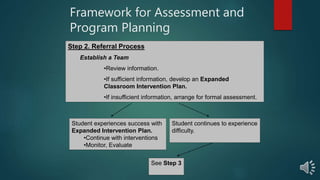
Step 2. Referral Process
Establish a Team
•Review information.
•If sufficient information, develop an Expanded
Classroom Intervention Plan.
•If insufficient information, arrange for formal assessment.
Student experiences success with
Expanded Intervention Plan.
•Continue with interventions
•Monitor, Evaluate
Student continues to experience
difficulty.
See Step 3
Framework for Assessment and
Program Planning
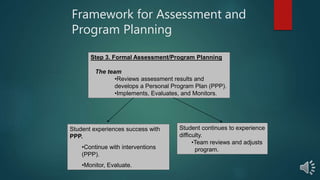
Step 3. Formal Assessment/Program Planning
The team
•Reviews assessment results and
develops a Personal Program Plan (PPP).
•Implements, Evaluates, and Monitors.
Student experiences success with
PPP.
•Continue with interventions
(PPP).
•Monitor, Evaluate.
Student continues to experience
difficulty.
•Team reviews and adjusts
program.

Assessments in literacy(voice)

  • 1.
    Assessments  Early Identificationof Reading Ability is Critical
  • 2.
    Focus on movingtowards a PREVENTATIVE model of intervention rather than a REMEDIAL model of intervention. “The ultimate goal of reading instruction is to help children acquire the knowledge and skills necessary to comprehend printed material at a level that is consistent with their general language comprehension skills.” Torgesen (2000)
  • 3.
    If students arenot competent readers, they are at risk for academic, behavioral, social, and emotional difficulties. Some of these students may be identified as learning disabled.
  • 4.
    Official National Definition ofLearning Disability  At least average cognitive ability  Impairments in:  Language processing  Phonological processing  Visual spatial processing  Processing speed  Memory and attention  Executive function  Range in severity
  • 5.
    Official National Definitionof Learning Disability  Interferes with the acquisition of: Oral language Reading Written language Mathematics Organization skills Social skills  Lifelong  Genetic/Neurobiological
  • 6.
    Official National Definitionof Learning Disability IMPACT ON STUDENT  Unexpected academic underachievement or achievement which is maintained only by unusually high levels of effort and support.  Not due primarily to hearing and or vision problems, socioeconomic factors, cultural or linguistic differences, lack of motivation or ineffective teaching.
  • 7.
  • 8.
  • 9.
    Characteristics of Struggling Readers •Over reliance on guessing strategies • May have low language skills • Limited phonemic awareness • Limited understanding of phonics • Memory problems • Read slowly and hesitantly, or not at all • Limited understanding about the text they read • Often become frustrated and avoid reading Moats (1998)
  • 10.
  • 11.
    A FRAMEWORK FORASSESSMENT AND PROGRAM PLANNING FOR STUDENTS WHO EXPERIENCE SIGNIFICANT DIFFICULTIES IN READING
  • 12.
    Framework for Assessmentand Program Planning  Classroom based assessment will help to determine how teachers will teach students with reading difficulties or learning disabilities.  Students with reading difficulties or learning disabilities require explicit and intensive instruction that is on-going, monitored, and evaluated. PURPOSE
  • 13.
    Framework for Assessmentand Program Planning  Step 1: Classroom Assessment and Intervention  Step 2: Establishing the team and the Referral Process  Step 3: Formal Assessment Program Planning
  • 14.
    Student continues toexperience difficulty. Framework for Assessment and Program Planning Step 1. Classroom Assessment and Intervention The Classroom Teacher in collaboration with parents/caregivers, resource teacher, administrator •Collect/Review Information. •If insufficient information, move to Step 2. •Develop Classroom Intervention Plan. Student experiences success with Classroom Intervention Plan. •Continue with interventions •Monitor, Evaluate See Step 2
  • 15.
    Framework for Assessmentand Program Planning Step 2. Referral Process Establish a Team •Review information. •If sufficient information, develop an Expanded Classroom Intervention Plan. •If insufficient information, arrange for formal assessment. Student experiences success with Expanded Intervention Plan. •Continue with interventions •Monitor, Evaluate Student continues to experience difficulty. See Step 3
  • 16.
    Framework for Assessmentand Program Planning Step 3. Formal Assessment/Program Planning The team •Reviews assessment results and develops a Personal Program Plan (PPP). •Implements, Evaluates, and Monitors. Student experiences success with PPP. •Continue with interventions (PPP). •Monitor, Evaluate. Student continues to experience difficulty. •Team reviews and adjusts program.