Reason and Bradbury (2008)
“a participatory process concerned with
developing practical knowing in the pursuit of
worthwhile human purposes 
 It seeks to bring
together action and reflection, theory and
practice, in participation with others, in the
pursuit of practical solutions to issues of pressing
concern to people.”
ï‚Ą According to Richard A. Schmuck (1997)
a model of professional development where
educators study student learning related to their
own teaching in a process that allows them to
learn about their own instructional practices and to
continue to monitor improved student learning.
ï‚Ą Action research is a form of investigation designed
for use by teachers to attempt to solve problems
and improve professional practices in their own
classrooms. (Parsons and Brown, 2002)
ï‚Ą Provides a framework that guides the energies of
teachers toward a better understanding of why,
when, and how students become better learners.
(Miller, 2007)
1.Teachers investigate their own practice in new ways,
looking deeper in what they and their students
actually do and fail to do.
2.Teachers develop a deeper understanding of
students, the teacher learning process and their role
in the education of both teachers and students.
3.Teachers are viewed as equal partners in deciding
what works best and what needs improvement in
their classroom or classrooms.
ï‚Ą Grounded in real life experience
ï‚Ą Developed in partnership
ï‚Ą Addresses significant needs
ï‚Ą Develops new ways of seeing/interpreting the world
ï‚Ą Uses methods that are appropriate to the audience
and participants at hand
ï‚Ą Develops needed structures to allow for follow up or
institutionalization of new practices
ï‚Ą Individual action research
ï‚Ą Collaborative action research
ï‚Ą School-wide action research
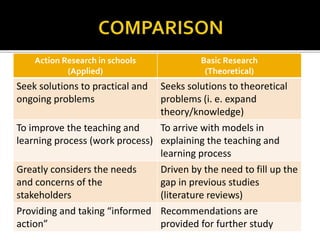
Action Research in schools
(Applied)
Basic Research
(Theoretical)
Seek solutions to practical and
ongoing problems
Seeks solutions to theoretical
problems (i. e. expand
theory/knowledge)
To improve the teaching and
learning process (work process)
To arrive with models in
explaining the teaching and
learning process
Greatly considers the needs
and concerns of the
stakeholders
Driven by the need to fill up the
gap in previous studies
(literature reviews)
Providing and taking “informed
action”
Recommendations are
provided for further study
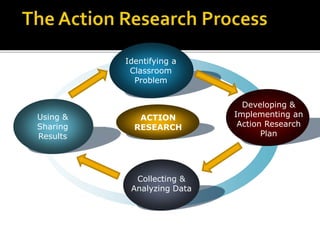
ACTION
RESEARCH
Identifying a
Classroom
Problem
Developing &
Implementing an
Action Research
Plan
Using &
Sharing
Results
Collecting &
Analyzing Data
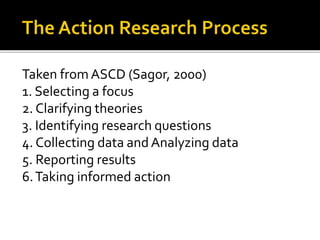
Taken from ASCD (Sagor, 2000)
1. Selecting a focus
2. Clarifying theories
3. Identifying research questions
4. Collecting data and Analyzing data
5. Reporting results
6.Taking informed action
Selecting a focus begins with the teacher
researcher or the team of action researchers
asking:
What element(s) of our practice or what
aspect of student learning do we wish to
investigate?
1. Selecting a focus
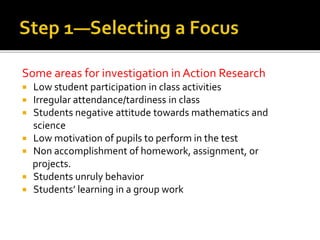
Some areas for investigation in Action Research
ï‚Ą Low student participation in class activities
ï‚Ą Irregular attendance/tardiness in class
ï‚Ą Students negative attitude towards mathematics and
science
ï‚Ą Low motivation of pupils to perform in the test
ï‚Ą Non accomplishment of homework, assignment, or
projects.
ï‚Ą Students unruly behavior
ï‚Ą Students’ learning in a group work
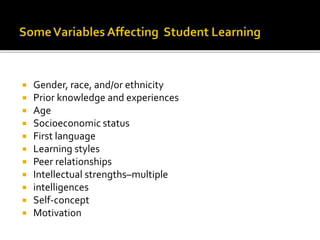
ï‚Ą Gender, race, and/or ethnicity
ï‚Ą Prior knowledge and experiences
ï‚Ą Age
ï‚Ą Socioeconomic status
ï‚Ą First language
ï‚Ą Learning styles
ï‚Ą Peer relationships
ï‚Ą Intellectual strengths–multiple
ï‚Ą intelligences
ï‚Ą Self-concept
ï‚Ą Motivation
ï‚Ą Size and configuration of classroom space
ï‚Ą Classroom pacing
ï‚Ą Temperature
ï‚Ą Emotional and affective climate
ï‚Ą Availability of curriculum
ï‚Ą Resources and learning materials
ï‚Ą Availability of computers and other instructional technology
ï‚Ą Class size: number of students
ï‚Ą Class schedule of learning activities
ï‚Ą Professional preparation
ï‚Ą Content knowledge
ï‚Ą Knowledge and understanding of children
ï‚Ą Philosophy of education
ï‚Ą Motivation to teach and commitment to teaching
ï‚Ą Knowledge of pedagogy
ï‚Ą Teaching style and specific instructional approaches
ï‚Ą Professional and personal confidence
ï‚Ą School culture
ï‚Ą Principal's leadership
ï‚Ą Parental involvement and ParentTeacher
association (PTA)
ï‚Ą School mission and academic programs
ï‚Ą Hidden curriculum
ï‚Ą Organization and structure
ï‚Ą Budget and resources
ï‚Ą Student culture
ï‚Ą Active Learning
ï‚Ą Adaptive Learning Environments Model
ï‚Ą Alternative to Recitation
ï‚Ą Buddy System
ï‚Ą Computer-Assisted Instruction
ï‚Ą Character Analysis
ï‚Ą Cloze Procedure
ï‚Ą Collaborative Learning
ï‚Ą Group Discussion
ï‚Ą DiscoveryTeaching
ï‚Ą Drawing
ï‚Ą Error Analysis
ï‚Ą Cooperative Dyads
ï‚Ą Experiential Learning
ï‚Ą Graphic Organizer
ï‚Ą Inductive Inquiry
ï‚Ą Logical Recitation
ï‚Ą Jumbled Summary
ï‚Ą Nutshelling
ï‚Ą Inside-Outside Circle
ï‚Ą Instant Messenger
This involves identifying the values, beliefs, and
theoretical perspectives the researchers hold
relating to their focus.
‱ Conduct search of literature reviews for the
theory needed.
‱ Example of theories:
– Self-determination theory
– Social cognitive theory
– Zone of Proximal Development
Step 2—Clarifying Theories
Generate a set of personally meaningful research
questions to guide the inquiry.
‱ Be specific with the independent, dependent,
mediating, moderating, and dependent variables
(outcomes).
e.g. Effectiveness of the Use of Activity Cards in
Improving the Ability of Grade V Pupils in Solving 1-
Step Problems
Step 3—Identifying Research Questions
ï‚Ą meaningful, compelling, and important
ï‚Ą manageable and within your sphere of
influence
ï‚Ą should be important for learners
ï‚Ą improving a teaching/learning situation, to
implementing actions that can make a
difference in the lives of students.
ï‚Ą Bad action research questions:
– What will improve critical thinking skills?(too broad, no
specific IV)
–Is the KPUP assessment effective in schools? (no idea on
what data will be collected)
– To what extent is the K to 12 program effective? (there are
several indicators of K to 12 to be considered , not outcome
specified)
– Is there a significant difference between principals
leadership styles and teachers attitude on teaching?
(Confused researcher: illogical to compare two different
variables)
Qualitative Action Research Questions:
–What are the difficulties of students in
answering mathematics word problem tasks?
–What are the general and subject specific
characteristics of an intelligent student as
perceived by grade 3 students?
–What metacognitive strategies are used by
Chinese students in comprehending their reading
of English books?
ï‚Ą What happens to the quality of student writing
when we implement peer editing throughout our
classes?
ï‚Ą How can I use small-group activities and “recorders”
to improve attentiveness during the presentation of
new information in a class of
students with behavioral problems?
ï‚Ą What happens to student attitudes about
mathematics when we daily emphasize functional
math in our classrooms?
In order to build a complete picture of learners’
learning abilities, data should be gathered from any
sources of information.
In research terminology, the process of collecting
multiple sources of data for every problem or issue
being studied is called triangulation. (Sagor 1992)
4. Collecting and Analyzing Data
Examples of classroom data collection tools include
but not limited to:
‱ Observation (checklists, anecdotal records,
charts/grid), interviews and conversations,
learners’ work, grades, reports cards, cumulative
records and test, experiment, survey, Focus
Group Discussions (FGD)
4. Collecting and Analyzing Data
‱ Quantitative
‱ Qualitative
‱ Both quantitative and qualitative
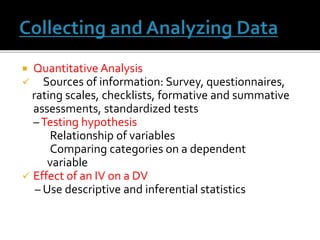
ï‚Ą Quantitative Analysis
 Sources of information: Survey, questionnaires,
rating scales, checklists, formative and summative
assessments, standardized tests
–Testing hypothesis
Relationship of variables
Comparing categories on a dependent
variable
 Effect of an IV on a DV
– Use descriptive and inferential statistics
ï‚Ą Qualitative data analysis
– Sources: interview transcripts, observational
notes, journal entries, audio and video
transcription, records, reports
5. Reporting Results
faculty meetings
teacher conferences
writing up the work for publication or reports
1. Title
2. Abstract (not more than 200 words)
3. Introduction ( including statement of the problem, scope and
delimitation, significance, definition of terms )
4. Brief review of literature (conceptual/theoretical framework)
5. Methodology and Research Design
6. Results and Discussion
7. Conclusions
8. References
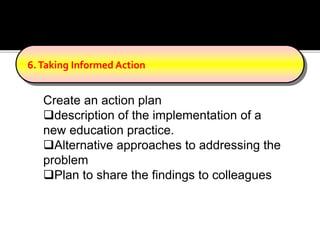
6.Taking Informed Action
Create an action plan
description of the implementation of a
new education practice.
Alternative approaches to addressing the
problem
Plan to share the findings to colleagues
ThankYou!

Action research - Basic concepts

  • 2.
    Reason and Bradbury(2008) “a participatory process concerned with developing practical knowing in the pursuit of worthwhile human purposes 
 It seeks to bring together action and reflection, theory and practice, in participation with others, in the pursuit of practical solutions to issues of pressing concern to people.”
  • 3.
    ï‚Ą According toRichard A. Schmuck (1997) a model of professional development where educators study student learning related to their own teaching in a process that allows them to learn about their own instructional practices and to continue to monitor improved student learning.
  • 4.
    ï‚Ą Action researchis a form of investigation designed for use by teachers to attempt to solve problems and improve professional practices in their own classrooms. (Parsons and Brown, 2002) ï‚Ą Provides a framework that guides the energies of teachers toward a better understanding of why, when, and how students become better learners. (Miller, 2007)
  • 5.
    1.Teachers investigate theirown practice in new ways, looking deeper in what they and their students actually do and fail to do. 2.Teachers develop a deeper understanding of students, the teacher learning process and their role in the education of both teachers and students. 3.Teachers are viewed as equal partners in deciding what works best and what needs improvement in their classroom or classrooms.
  • 6.
    ï‚Ą Grounded inreal life experience ï‚Ą Developed in partnership ï‚Ą Addresses significant needs ï‚Ą Develops new ways of seeing/interpreting the world ï‚Ą Uses methods that are appropriate to the audience and participants at hand ï‚Ą Develops needed structures to allow for follow up or institutionalization of new practices
  • 7.
    ï‚Ą Individual actionresearch ï‚Ą Collaborative action research ï‚Ą School-wide action research
  • 8.
    Action Research inschools (Applied) Basic Research (Theoretical) Seek solutions to practical and ongoing problems Seeks solutions to theoretical problems (i. e. expand theory/knowledge) To improve the teaching and learning process (work process) To arrive with models in explaining the teaching and learning process Greatly considers the needs and concerns of the stakeholders Driven by the need to fill up the gap in previous studies (literature reviews) Providing and taking “informed action” Recommendations are provided for further study
  • 9.
    ACTION RESEARCH Identifying a Classroom Problem Developing & Implementingan Action Research Plan Using & Sharing Results Collecting & Analyzing Data
  • 10.
    Taken from ASCD(Sagor, 2000) 1. Selecting a focus 2. Clarifying theories 3. Identifying research questions 4. Collecting data and Analyzing data 5. Reporting results 6.Taking informed action
  • 11.
    Selecting a focusbegins with the teacher researcher or the team of action researchers asking: What element(s) of our practice or what aspect of student learning do we wish to investigate? 1. Selecting a focus
  • 12.
    Some areas forinvestigation in Action Research ï‚Ą Low student participation in class activities ï‚Ą Irregular attendance/tardiness in class ï‚Ą Students negative attitude towards mathematics and science ï‚Ą Low motivation of pupils to perform in the test ï‚Ą Non accomplishment of homework, assignment, or projects. ï‚Ą Students unruly behavior ï‚Ą Students’ learning in a group work
  • 13.
    ï‚Ą Gender, race,and/or ethnicity ï‚Ą Prior knowledge and experiences ï‚Ą Age ï‚Ą Socioeconomic status ï‚Ą First language ï‚Ą Learning styles ï‚Ą Peer relationships ï‚Ą Intellectual strengths–multiple ï‚Ą intelligences ï‚Ą Self-concept ï‚Ą Motivation
  • 14.
    ï‚Ą Size andconfiguration of classroom space ï‚Ą Classroom pacing ï‚Ą Temperature ï‚Ą Emotional and affective climate ï‚Ą Availability of curriculum ï‚Ą Resources and learning materials ï‚Ą Availability of computers and other instructional technology ï‚Ą Class size: number of students ï‚Ą Class schedule of learning activities
  • 15.
    ï‚Ą Professional preparation ï‚ĄContent knowledge ï‚Ą Knowledge and understanding of children ï‚Ą Philosophy of education ï‚Ą Motivation to teach and commitment to teaching ï‚Ą Knowledge of pedagogy ï‚Ą Teaching style and specific instructional approaches ï‚Ą Professional and personal confidence
  • 16.
    ï‚Ą School culture ï‚ĄPrincipal's leadership ï‚Ą Parental involvement and ParentTeacher association (PTA) ï‚Ą School mission and academic programs ï‚Ą Hidden curriculum ï‚Ą Organization and structure ï‚Ą Budget and resources ï‚Ą Student culture
  • 17.
    ï‚Ą Active Learning ï‚ĄAdaptive Learning Environments Model ï‚Ą Alternative to Recitation ï‚Ą Buddy System ï‚Ą Computer-Assisted Instruction ï‚Ą Character Analysis ï‚Ą Cloze Procedure ï‚Ą Collaborative Learning ï‚Ą Group Discussion ï‚Ą DiscoveryTeaching
  • 18.
    ï‚Ą Drawing ï‚Ą ErrorAnalysis ï‚Ą Cooperative Dyads ï‚Ą Experiential Learning ï‚Ą Graphic Organizer ï‚Ą Inductive Inquiry ï‚Ą Logical Recitation ï‚Ą Jumbled Summary ï‚Ą Nutshelling ï‚Ą Inside-Outside Circle ï‚Ą Instant Messenger
  • 19.
    This involves identifyingthe values, beliefs, and theoretical perspectives the researchers hold relating to their focus. ‱ Conduct search of literature reviews for the theory needed. ‱ Example of theories: – Self-determination theory – Social cognitive theory – Zone of Proximal Development Step 2—Clarifying Theories
  • 20.
    Generate a setof personally meaningful research questions to guide the inquiry. ‱ Be specific with the independent, dependent, mediating, moderating, and dependent variables (outcomes). e.g. Effectiveness of the Use of Activity Cards in Improving the Ability of Grade V Pupils in Solving 1- Step Problems Step 3—Identifying Research Questions
  • 21.
    ï‚Ą meaningful, compelling,and important ï‚Ą manageable and within your sphere of influence ï‚Ą should be important for learners ï‚Ą improving a teaching/learning situation, to implementing actions that can make a difference in the lives of students.
  • 22.
    ï‚Ą Bad actionresearch questions: – What will improve critical thinking skills?(too broad, no specific IV) –Is the KPUP assessment effective in schools? (no idea on what data will be collected) – To what extent is the K to 12 program effective? (there are several indicators of K to 12 to be considered , not outcome specified) – Is there a significant difference between principals leadership styles and teachers attitude on teaching? (Confused researcher: illogical to compare two different variables)
  • 23.
    Qualitative Action ResearchQuestions: –What are the difficulties of students in answering mathematics word problem tasks? –What are the general and subject specific characteristics of an intelligent student as perceived by grade 3 students? –What metacognitive strategies are used by Chinese students in comprehending their reading of English books?
  • 24.
    ï‚Ą What happensto the quality of student writing when we implement peer editing throughout our classes? ï‚Ą How can I use small-group activities and “recorders” to improve attentiveness during the presentation of new information in a class of students with behavioral problems? ï‚Ą What happens to student attitudes about mathematics when we daily emphasize functional math in our classrooms?
  • 25.
    In order tobuild a complete picture of learners’ learning abilities, data should be gathered from any sources of information. In research terminology, the process of collecting multiple sources of data for every problem or issue being studied is called triangulation. (Sagor 1992) 4. Collecting and Analyzing Data
  • 26.
    Examples of classroomdata collection tools include but not limited to: ‱ Observation (checklists, anecdotal records, charts/grid), interviews and conversations, learners’ work, grades, reports cards, cumulative records and test, experiment, survey, Focus Group Discussions (FGD) 4. Collecting and Analyzing Data
  • 27.
    ‱ Quantitative ‱ Qualitative ‱Both quantitative and qualitative
  • 28.
    ï‚Ą Quantitative Analysis Sources of information: Survey, questionnaires, rating scales, checklists, formative and summative assessments, standardized tests –Testing hypothesis Relationship of variables Comparing categories on a dependent variable  Effect of an IV on a DV – Use descriptive and inferential statistics
  • 29.
    ï‚Ą Qualitative dataanalysis – Sources: interview transcripts, observational notes, journal entries, audio and video transcription, records, reports
  • 30.
    5. Reporting Results facultymeetings teacher conferences writing up the work for publication or reports
  • 31.
    1. Title 2. Abstract(not more than 200 words) 3. Introduction ( including statement of the problem, scope and delimitation, significance, definition of terms ) 4. Brief review of literature (conceptual/theoretical framework) 5. Methodology and Research Design 6. Results and Discussion 7. Conclusions 8. References
  • 32.
    6.Taking Informed Action Createan action plan description of the implementation of a new education practice. Alternative approaches to addressing the problem Plan to share the findings to colleagues
  • 33.