GRANDUER ONLINE RESEARCH
WRITING WORKSHOP
 Research
 Research Process
 Research Design
 Research Problem
 Variables and their
types
 Hypothesis and its
formulation
 Sampling
 Tools of data
collections
 Data analysis
 Interpretation of
Data
 Research Methods
 Research Proposal
COURSE OUTLINE
SCHEDULE OF ACTIVITIES
GRANDUER ONLINE RESEARCH WRITING WORKSHOP
CLASSES WILL START 8:30 PM EACH DAY
 Research 10/1/22
 Research Process 11/1/22
 Research Design 12/1/22
 Research Problem13/1/22
 Variables and their types
14/1/22
 Hypothesis and its formulation
15/1/22
 Sampling 16/1/22
 Tools of data collections
17/1/22
 Data analysis 18/1/22
 Interpretation of Data
19/1/22
 Research Methods
20/1/22
 Research Proposal 21/1/22
22-23 Evaluation
Introduction:
Research is an important and viable instrument
which leads man towards advancement. Little or no
progress would have been achieved without research.
Developed countries of the world are what they are
today because of the researches being carried out by
their citizens
Mention 2 importances of research
Definitions of Research
The word ‘Research’ comprises two
words namely Re+Search. It means
to search again.
A research work is a product of
systematic writing based on the
author’s original re-search work
on a valued
topic of interest and the analysis,
interpretation and publication of
research findings.
Adesola M. O. (2022)
Research may be defined as a
method of studying problems whose
solutions are to be derived partly or
wholly from facts.”
W.S. Monroes
Research comprises defining and redefining problems
,formulating hypothesis or suggested solutions, collecting
,organizing and evaluating
data, making deductions and reaching conclusions and at
last carefully testing the conclusions to determine whether
they fit the formulated
hypothesis.”
Clifford Woody
Attempt an original
definition of research
Purpose of Research:
Although every research study is aimed at finding the
truth by applying the scientific method there are still some
general objectives that apply to all. These are:
1. To become familiar with a phenomenon or gain more
understanding of it (Studies with this objective are called
exploratory or formative research studies).
For instance exploratory researches carried out at the onset of
the Corona-virus to gain insights into its true nature and
become familiar with it.
2. To accurately describe a particular individual,
situation or a group.(Studies with this objective
are called descriptive research studies).
For instance, a marketer trying to understand the
buying habits of potential customers before
introducing a new product.
3. To test a hypothesis of a causal relationship
between variables.(Such studies are called
hypothesis-testing research studies)
For instance, a researcher decides to investigate
the impact of maternal smoking on Intelligence
Quotient of children.
For instance a research is aimed at
investigating if men are more prone to
having migraine
4. To determine causes of problem and possible solutions to it. - Diagnostic
research studies.
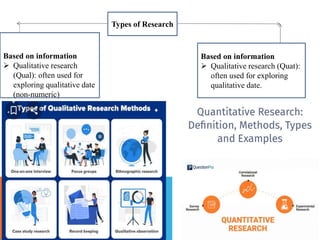
Types of Research
Types of Research
Based on information
 Qualitative research
(Qual): often used for
exploring qualitative date
(non-numeric)
Based on information
 Qualitative research (Quat):
often used for exploring
qualitative date.
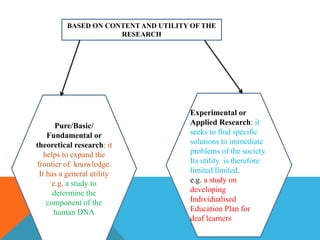
Pure/Basic/
Fundamental or
theoretical research: it
helps to expand the
frontier of knowledge.
It has a general utility
e.g, a study to
determine the
component of the
human DNA
BASED ON CONTENT AND UTILITY OF THE
RESEARCH
Experimental or
Applied Research: it
seeks to find specific
solutions to immediate
problems of the society.
Its utility is therefore
limited limited.
e.g. a study on
developing
Individualised
Education Plan for
deaf learners
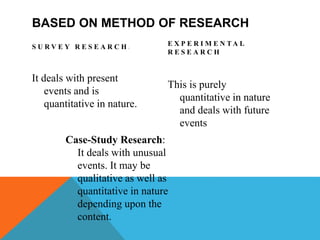
BASED ON METHOD OF RESEARCH
S U R V E Y R E S E A R C H :
It deals with present
events and is
quantitative in nature.
E X P E R I M E N T A L
R E S E A R C H
This is purely
quantitative in nature
and deals with future
events
Case-Study Research:
It deals with unusual
events. It may be
qualitative as well as
quantitative in nature
depending upon the
content.
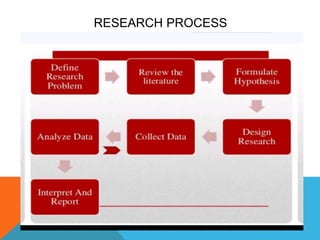
RESEARCH PROCESS
RESEARCH DESIGN
A research design is simply the framework or plan for a study that is used as a
guide in collecting and analyzing the data.
Research design is the blue print for collection measurement and analysis of
data.
William Zikmund opines that research design is a master plan specifying the
methods and procedures for collection and analysing the needed information.”
Summarily research design is the arrangement of condition for collection and
analysis of data in a manner that aims to generalize the findings of the sample on
the population.
WHAT IS THE PURPOSE OF RESEARCH DESIGN?
(i) It minimises expenditure by providing maximum
information with minimum spending of effort,
money and time by ensuring advance plan of a
research.
(ii)It allows for collection the relevant data and
technique
(iii)To provide blue print for plans which enables
smooth execution of research
(iv)To provide an overview to other experts
CHARACTERISTICS OF A GOOD RESEARCH DESIGN
A good research design that will serve the purposes identified must have the
following characteristics:
 Objectivity: a good research design should permit the use of measuring
instruments which every observer or judge scoring the performance must
precisely give the same score.
 Reliability: Furthermore, its instrument must exhibit consistency
throughout the series of measurements produced.
 Validity: Any measuring device or instrument of a research design should
measure what it was purported to measure. e.g an Intelligence test must
measure intelligence, not anything else.
iv) Generalizability: It refers to how best the data collected from the samples
of a research design can be applied for drawing certain generalisations
applicable to the population from which sample is drawn.
IDENTIFICATION OF PROBLEM
Identification of the problem is the first step in research. Below is how it is done:
Step I Determining the field of research in which a researcher is keen to do the
research work.
Step II The researcher should develop the mastery on the area or it should be the field
of his specialisation.
Step III He should review the research conducted in area to know the recent trend and
studies are being conducted in the area.
Step IV On the basis of review, he should consider the priority field of the study.
Step V He should draw an analogy and insight in identifying a problem or employ his
personal experience of the field in locating the problem. He may take help of supervisor
or expert of the field.
Step VI He should pin point specific aspect of the problem which is to be investigated.
STATEMENT OF THE PROBLEM
Kerlinger has identified following three criteria of good problem statements;
1. A problem should be concerned with relation between two or more variables.
2. It should be stated ‘clearly and unambiguously in question form’.
3. It should be amenable to empirical testing.
e.g The effect of long term use of Vitamin-D supplement on reading skills of
learners with learning disabilities
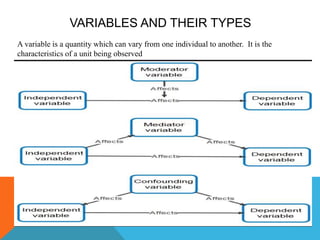
VARIABLES AND THEIR TYPES
A variable is a quantity which can vary from one individual to another. It is the
characteristics of a unit being observed
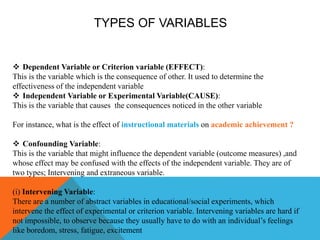
TYPES OF VARIABLES
 Dependent Variable or Criterion variable (EFFECT):
This is the variable which is the consequence of other. It used to determine the
effectiveness of the independent variable
 Independent Variable or Experimental Variable(CAUSE):
This is the variable that causes the consequences noticed in the other variable
For instance, what is the effect of instructional materials on academic achievement ?
 Confounding Variable:
This is the variable that might influence the dependent variable (outcome measures) ,and
whose effect may be confused with the effects of the independent variable. They are of
two types; Intervening and extraneous variable.
(i) Intervening Variable:
There are a number of abstract variables in educational/social experiments, which
intervene the effect of experimental or criterion variable. Intervening variables are hard if
not impossible, to observe because they usually have to do with an individual’s feelings
like boredom, stress, fatigue, excitement
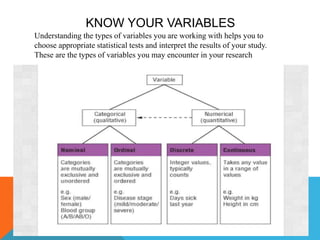
KNOW YOUR VARIABLES
Understanding the types of variables you are working with helps you to
choose appropriate statistical tests and interpret the results of your study.
These are the types of variables you may encounter in your research
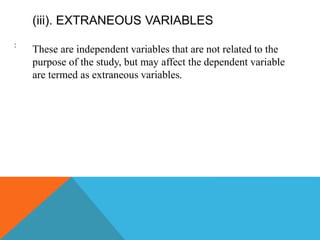
(iii). EXTRANEOUS VARIABLES
These are independent variables that are not related to the
purpose of the study, but may affect the dependent variable
are termed as extraneous variables.
:
FORMULATION OF HYPOTHESIS
The word hypothesis consists of two words –Hypo+Thesis. ‘Hypo’ means tentative or
subject to the verification while ‘Thesis’ means statement. Thus the literal meaning of
the term hypothesis is a tentative statement about the solution of the problem.
A research hypothesis is a specific, clear and testable proposition or predictive
statement about the possible outcome of a research.
Functions of Hypothesis
 It is a temporary solution of a problem
 It offers a basis in establishing the specifics of what to study
 It delimits field of the investigation.
 It sensitizes the researcher so that he should work selectively, and have very
realistic approach to the problem.
 It offers the simple means for collecting evidences for verification
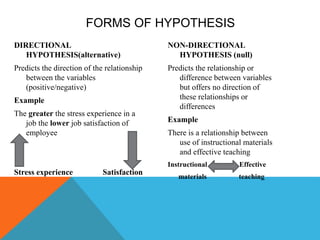
DIRECTIONAL
HYPOTHESIS(alternative)
Predicts the direction of the relationship
between the variables
(positive/negative)
Example
The greater the stress experience in a
job the lower job satisfaction of
employee
Stress experience Satisfaction
NON-DIRECTIONAL
HYPOTHESIS (null)
Predicts the relationship or
difference between variables
but offers no direction of
these relationships or
differences
Example
There is a relationship between
use of instructional materials
and effective teaching
Instructional Effective
materials teaching
FORMS OF HYPOTHESIS
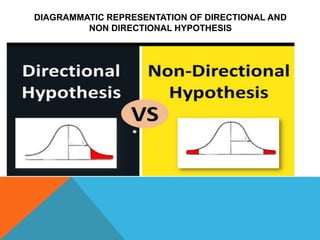
DIAGRAMMATIC REPRESENTATION OF DIRECTIONAL AND
NON DIRECTIONAL HYPOTHESIS
SAMPLING
A survey may be conducted by either of two methods:
1. Census Method or Parametric method and
2. Sampling method or Non-parametric method.
1. Census method:
It deals with the investigation of the entire population of participants in a research. This is
more accurate but quite expensive. Eg total number of students in classroom.
2. Sampling method:
This is a small group which is selected as representative of the population. Selecting 50
students from among the population in your classroom.
Sampling means selecting a given number of subjects from a defined population as
representative of that population.
Criteria for selecting a good sample
 Homogeneity: The units included in sample must be like other units.
 Adequacy: A sample having 10% of the whole data is adequate.
 Independence: Every unit should be free to be included in the sample.
 Representativeness: a sample should be a true representative of the population
corresponding to its properties.
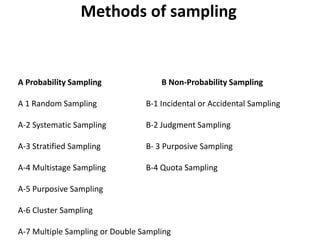
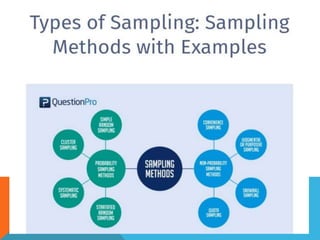
Methods of sampling
A Probability Sampling B Non-Probability Sampling
A 1 Random Sampling B-1 Incidental or Accidental Sampling
A-2 Systematic Sampling B-2 Judgment Sampling
A-3 Stratified Sampling B- 3 Purposive Sampling
A-4 Multistage Sampling B-4 Quota Sampling
A-5 Purposive Sampling
A-6 Cluster Sampling
A-7 Multiple Sampling or Double Sampling
PROBABILITY SAMPLING
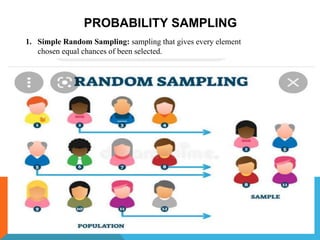
1. Simple Random Sampling: sampling that gives every element
chosen equal chances of been selected.
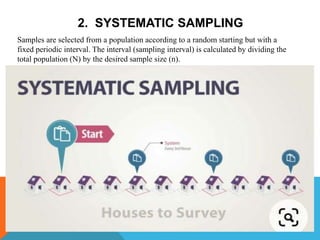
2. SYSTEMATIC SAMPLING
Samples are selected from a population according to a random starting but with a
fixed periodic interval. The interval (sampling interval) is calculated by dividing the
total population (N) by the desired sample size (n).
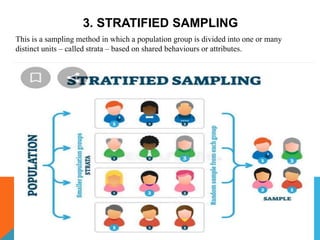
3. STRATIFIED SAMPLING
This is a sampling method in which a population group is divided into one or many
distinct units – called strata – based on shared behaviours or attributes.
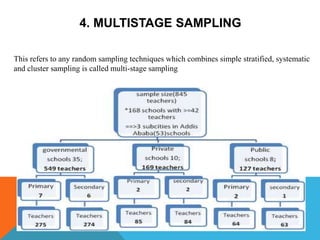
4. MULTISTAGE SAMPLING
This refers to any random sampling techniques which combines simple stratified, systematic
and cluster sampling is called multi-stage sampling
NON-PROBABILITY SAMPLING
1) Incidental or Accidental Sampling:
The term incidental or accidental sampling applies to those samples that are
taken because they are most readily available. It is most useful for pilot testing
For example opinion polls which are common in some countries at the time of
elections.
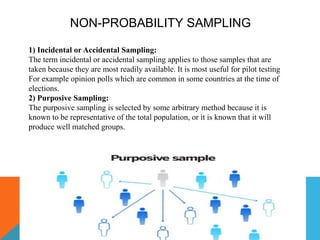
2) Purposive Sampling:
The purposive sampling is selected by some arbitrary method because it is
known to be representative of the total population, or it is known that it will
produce well matched groups.
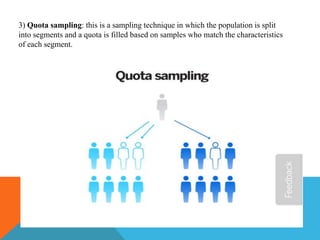
3) Quota sampling: this is a sampling technique in which the population is split
into segments and a quota is filled based on samples who match the characteristics
of each segment.
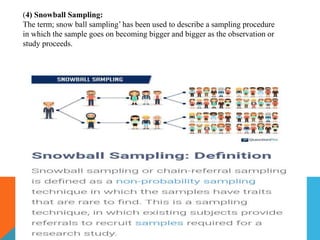
(4) Snowball Sampling:
The term; snow ball sampling’ has been used to describe a sampling procedure
in which the sample goes on becoming bigger and bigger as the observation or
study proceeds.
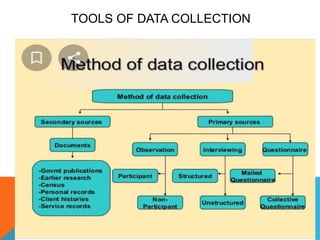
TOOLS OF DATA COLLECTION

Workshop on graduation attachment_085511.pptx

  • 1.
  • 2.
     Research  ResearchProcess  Research Design  Research Problem  Variables and their types  Hypothesis and its formulation  Sampling  Tools of data collections  Data analysis  Interpretation of Data  Research Methods  Research Proposal COURSE OUTLINE
  • 3.
    SCHEDULE OF ACTIVITIES GRANDUERONLINE RESEARCH WRITING WORKSHOP CLASSES WILL START 8:30 PM EACH DAY  Research 10/1/22  Research Process 11/1/22  Research Design 12/1/22  Research Problem13/1/22  Variables and their types 14/1/22  Hypothesis and its formulation 15/1/22  Sampling 16/1/22  Tools of data collections 17/1/22  Data analysis 18/1/22  Interpretation of Data 19/1/22  Research Methods 20/1/22  Research Proposal 21/1/22 22-23 Evaluation
  • 4.
    Introduction: Research is animportant and viable instrument which leads man towards advancement. Little or no progress would have been achieved without research. Developed countries of the world are what they are today because of the researches being carried out by their citizens Mention 2 importances of research
  • 5.
    Definitions of Research Theword ‘Research’ comprises two words namely Re+Search. It means to search again. A research work is a product of systematic writing based on the author’s original re-search work on a valued topic of interest and the analysis, interpretation and publication of research findings. Adesola M. O. (2022) Research may be defined as a method of studying problems whose solutions are to be derived partly or wholly from facts.” W.S. Monroes
  • 6.
    Research comprises definingand redefining problems ,formulating hypothesis or suggested solutions, collecting ,organizing and evaluating data, making deductions and reaching conclusions and at last carefully testing the conclusions to determine whether they fit the formulated hypothesis.” Clifford Woody Attempt an original definition of research
  • 7.
    Purpose of Research: Althoughevery research study is aimed at finding the truth by applying the scientific method there are still some general objectives that apply to all. These are: 1. To become familiar with a phenomenon or gain more understanding of it (Studies with this objective are called exploratory or formative research studies). For instance exploratory researches carried out at the onset of the Corona-virus to gain insights into its true nature and become familiar with it.
  • 8.
    2. To accuratelydescribe a particular individual, situation or a group.(Studies with this objective are called descriptive research studies). For instance, a marketer trying to understand the buying habits of potential customers before introducing a new product.
  • 9.
    3. To testa hypothesis of a causal relationship between variables.(Such studies are called hypothesis-testing research studies) For instance, a researcher decides to investigate the impact of maternal smoking on Intelligence Quotient of children.
  • 10.
    For instance aresearch is aimed at investigating if men are more prone to having migraine 4. To determine causes of problem and possible solutions to it. - Diagnostic research studies.
  • 11.
    Types of Research Typesof Research Based on information  Qualitative research (Qual): often used for exploring qualitative date (non-numeric) Based on information  Qualitative research (Quat): often used for exploring qualitative date.
  • 12.
    Pure/Basic/ Fundamental or theoretical research:it helps to expand the frontier of knowledge. It has a general utility e.g, a study to determine the component of the human DNA BASED ON CONTENT AND UTILITY OF THE RESEARCH Experimental or Applied Research: it seeks to find specific solutions to immediate problems of the society. Its utility is therefore limited limited. e.g. a study on developing Individualised Education Plan for deaf learners
  • 13.
    BASED ON METHODOF RESEARCH S U R V E Y R E S E A R C H : It deals with present events and is quantitative in nature. E X P E R I M E N T A L R E S E A R C H This is purely quantitative in nature and deals with future events Case-Study Research: It deals with unusual events. It may be qualitative as well as quantitative in nature depending upon the content.
  • 14.
  • 16.
    RESEARCH DESIGN A researchdesign is simply the framework or plan for a study that is used as a guide in collecting and analyzing the data. Research design is the blue print for collection measurement and analysis of data. William Zikmund opines that research design is a master plan specifying the methods and procedures for collection and analysing the needed information.” Summarily research design is the arrangement of condition for collection and analysis of data in a manner that aims to generalize the findings of the sample on the population.
  • 17.
    WHAT IS THEPURPOSE OF RESEARCH DESIGN? (i) It minimises expenditure by providing maximum information with minimum spending of effort, money and time by ensuring advance plan of a research. (ii)It allows for collection the relevant data and technique (iii)To provide blue print for plans which enables smooth execution of research (iv)To provide an overview to other experts
  • 18.
    CHARACTERISTICS OF AGOOD RESEARCH DESIGN A good research design that will serve the purposes identified must have the following characteristics:  Objectivity: a good research design should permit the use of measuring instruments which every observer or judge scoring the performance must precisely give the same score.  Reliability: Furthermore, its instrument must exhibit consistency throughout the series of measurements produced.  Validity: Any measuring device or instrument of a research design should measure what it was purported to measure. e.g an Intelligence test must measure intelligence, not anything else. iv) Generalizability: It refers to how best the data collected from the samples of a research design can be applied for drawing certain generalisations applicable to the population from which sample is drawn.
  • 19.
    IDENTIFICATION OF PROBLEM Identificationof the problem is the first step in research. Below is how it is done: Step I Determining the field of research in which a researcher is keen to do the research work. Step II The researcher should develop the mastery on the area or it should be the field of his specialisation. Step III He should review the research conducted in area to know the recent trend and studies are being conducted in the area. Step IV On the basis of review, he should consider the priority field of the study. Step V He should draw an analogy and insight in identifying a problem or employ his personal experience of the field in locating the problem. He may take help of supervisor or expert of the field. Step VI He should pin point specific aspect of the problem which is to be investigated.
  • 20.
    STATEMENT OF THEPROBLEM Kerlinger has identified following three criteria of good problem statements; 1. A problem should be concerned with relation between two or more variables. 2. It should be stated ‘clearly and unambiguously in question form’. 3. It should be amenable to empirical testing. e.g The effect of long term use of Vitamin-D supplement on reading skills of learners with learning disabilities
  • 21.
    VARIABLES AND THEIRTYPES A variable is a quantity which can vary from one individual to another. It is the characteristics of a unit being observed
  • 22.
    TYPES OF VARIABLES Dependent Variable or Criterion variable (EFFECT): This is the variable which is the consequence of other. It used to determine the effectiveness of the independent variable  Independent Variable or Experimental Variable(CAUSE): This is the variable that causes the consequences noticed in the other variable For instance, what is the effect of instructional materials on academic achievement ?  Confounding Variable: This is the variable that might influence the dependent variable (outcome measures) ,and whose effect may be confused with the effects of the independent variable. They are of two types; Intervening and extraneous variable. (i) Intervening Variable: There are a number of abstract variables in educational/social experiments, which intervene the effect of experimental or criterion variable. Intervening variables are hard if not impossible, to observe because they usually have to do with an individual’s feelings like boredom, stress, fatigue, excitement
  • 23.
    KNOW YOUR VARIABLES Understandingthe types of variables you are working with helps you to choose appropriate statistical tests and interpret the results of your study. These are the types of variables you may encounter in your research
  • 24.
    (iii). EXTRANEOUS VARIABLES Theseare independent variables that are not related to the purpose of the study, but may affect the dependent variable are termed as extraneous variables. :
  • 25.
    FORMULATION OF HYPOTHESIS Theword hypothesis consists of two words –Hypo+Thesis. ‘Hypo’ means tentative or subject to the verification while ‘Thesis’ means statement. Thus the literal meaning of the term hypothesis is a tentative statement about the solution of the problem. A research hypothesis is a specific, clear and testable proposition or predictive statement about the possible outcome of a research. Functions of Hypothesis  It is a temporary solution of a problem  It offers a basis in establishing the specifics of what to study  It delimits field of the investigation.  It sensitizes the researcher so that he should work selectively, and have very realistic approach to the problem.  It offers the simple means for collecting evidences for verification
  • 26.
    DIRECTIONAL HYPOTHESIS(alternative) Predicts the directionof the relationship between the variables (positive/negative) Example The greater the stress experience in a job the lower job satisfaction of employee Stress experience Satisfaction NON-DIRECTIONAL HYPOTHESIS (null) Predicts the relationship or difference between variables but offers no direction of these relationships or differences Example There is a relationship between use of instructional materials and effective teaching Instructional Effective materials teaching FORMS OF HYPOTHESIS
  • 27.
    DIAGRAMMATIC REPRESENTATION OFDIRECTIONAL AND NON DIRECTIONAL HYPOTHESIS
  • 28.
    SAMPLING A survey maybe conducted by either of two methods: 1. Census Method or Parametric method and 2. Sampling method or Non-parametric method. 1. Census method: It deals with the investigation of the entire population of participants in a research. This is more accurate but quite expensive. Eg total number of students in classroom. 2. Sampling method: This is a small group which is selected as representative of the population. Selecting 50 students from among the population in your classroom. Sampling means selecting a given number of subjects from a defined population as representative of that population. Criteria for selecting a good sample  Homogeneity: The units included in sample must be like other units.  Adequacy: A sample having 10% of the whole data is adequate.  Independence: Every unit should be free to be included in the sample.  Representativeness: a sample should be a true representative of the population corresponding to its properties.
  • 29.
    Methods of sampling AProbability Sampling B Non-Probability Sampling A 1 Random Sampling B-1 Incidental or Accidental Sampling A-2 Systematic Sampling B-2 Judgment Sampling A-3 Stratified Sampling B- 3 Purposive Sampling A-4 Multistage Sampling B-4 Quota Sampling A-5 Purposive Sampling A-6 Cluster Sampling A-7 Multiple Sampling or Double Sampling
  • 31.
    PROBABILITY SAMPLING 1. SimpleRandom Sampling: sampling that gives every element chosen equal chances of been selected.
  • 32.
    2. SYSTEMATIC SAMPLING Samplesare selected from a population according to a random starting but with a fixed periodic interval. The interval (sampling interval) is calculated by dividing the total population (N) by the desired sample size (n).
  • 33.
    3. STRATIFIED SAMPLING Thisis a sampling method in which a population group is divided into one or many distinct units – called strata – based on shared behaviours or attributes.
  • 34.
    4. MULTISTAGE SAMPLING Thisrefers to any random sampling techniques which combines simple stratified, systematic and cluster sampling is called multi-stage sampling
  • 35.
    NON-PROBABILITY SAMPLING 1) Incidentalor Accidental Sampling: The term incidental or accidental sampling applies to those samples that are taken because they are most readily available. It is most useful for pilot testing For example opinion polls which are common in some countries at the time of elections. 2) Purposive Sampling: The purposive sampling is selected by some arbitrary method because it is known to be representative of the total population, or it is known that it will produce well matched groups.
  • 36.
    3) Quota sampling:this is a sampling technique in which the population is split into segments and a quota is filled based on samples who match the characteristics of each segment.
  • 37.
    (4) Snowball Sampling: Theterm; snow ball sampling’ has been used to describe a sampling procedure in which the sample goes on becoming bigger and bigger as the observation or study proceeds.
  • 38.
    TOOLS OF DATACOLLECTION