SUBMITTED TO:RAVI.M.SAMBRANI
SUBMITTED BY :FAROOQKHAN
COURSE TITLE:EDUCATIONAL
PSYCOLOGY( AEX-101)
INTRUDUCTION
 Students academic gain and learning performance is affected by
numerous factor including gender, age, teaching faculty, students
schooling, father/guardian social economic status, residential area of
students, medium of instructions in schools, tuition trend, daily study
hour and accommodation as hostelries or day scholar. Many
researchers conducted detailed studies about the factors contributing
student performance at different study levels. Graetz (1995) suggested
“A student educational success contingent heavily on social status of
student’s parents/ guardians in the society. Considine and Zappala
(2002) noticed the same that parent’s income or social status positively
affects the student test score in examinationupon the academic
performance of graduate students. Durden and Ellis quoted Staffolani
and Bratti, (2002) observed that “the measurement of students
previous educational outcomes are the most important indicators of
students f

 . According to Minnesota (2007) “the higher education
performance is depending uture achievement, this
refers that as the higher previous appearance, better
the student’s academic performance in future
endeavours.
 Lot of studies have been conducted in the area of students
achievement and these studies identify and analyze the
number of factors that affect the academic performance of
the student at school, college and even at university level.
Their finding identify students’ effort, previous schooling,
parent’s educational background, family income, self
motivation of students, age of student, learning
preferences and entry qualification of students as
important factors that have effect on student’s academic
performance in different setting..
 It is generally assumed that the students who showed better or higher
performance in the starting classes of their studies also performed
better in future academic years at degree level. Everyone can be
surprised with this assumption if it could be proved scientifically. From
the last two decades it has been noticed significantly that there is great
addition in research literature and review material relating to
indicators of academic achievement with much emphasis on this
dialogue, whether traditional achievement measures of academic
performance are best determinants of future academic gain at
university or higher level or innovative measures. However, it is also
observed that many of the researchers are not agree with this view
point or statement. Reddy and Talcott (2006) looks disagree with these
assumptions that future academic gains are resolute by preceding
performance.

 It is also confirmed in the study of Oregon State University
(2003) on graduate admissions that normal measures of
educational potential and academic performance such as high
school GPA (Grade Point Average) scores showed only 30% of the
deviation in initial or starting (first) year at college. It is
important to note that even these studies do not agree with the
former studies who explored that previous achievement affect
the future performance of the students in studies, they
confirmed that the admission scores are related to academic
performance at university level but to a very minimal extent.
McDonald et.al (2001) also suggested that the scores of graduate
level studies still out perform any other single measure of
cognitive aptitude in predicting success at university level.
 Parent’s socio-economic condition, which includes parents’
academic and professional qualification, revenue and
occupational affiliation, is also associated with academic
gain of students. The results of many studies confirmed
that academic achievement of students is contingent upon
parent’s socio-economic condition. So the students
belonging from higher social economical backgrounds will
perform better than other students associated with low
social economic backgrounds. “Social and economical
status of student is generally determined by combining
parents’ qualification, occupation and income standard”
(Jeynes, 2002
 Graetz (1995) conducted a study on socio-economic status of the
parents of students and concluded that the socio economic
background has a great impact on student’s academic performance,
main source of educational imbalance among students and student’s
academic success contingent very strongly on parent’s socio economic
standard. Considine and Zappala (2002) also having the same views as
Graetz (1995), in their study on the influence of social and economic
disadvantage in the academic performance of school students noticed,
where the parents or guardians have social, educational and
economical advantage definitely strengthen the higher level success in
future. But it is also noted that these parents make available sufficient
psychological and emotional shore up to their children by providing
good educational and learning environment that produce confidence
and the improvement of skills needed for success.
 On other hand Pedrosa et.al (2006) in their study on social and
educational background pointed out those students who mostly
come from deprived socio-economic and educational
background performed relatively better than others coming from
higher socio-economic and educational area. They named this
phenomena educational elasticity. It is obvious and true that the
criteria for categorizing socio-economic standard in different
countries are different depending of their norms and values. The
criteria for low socio-economic status for developed country will
be different from the criteria of developing nations and same will
be in the case of developing and under developing countries.
 “The total income of families, monthly or annually and
their expenditures also put a great effect on the
learning and academic opportunities accessible to
youngsters and their chances of educational success.
Furthermore, he also pointed that due to residential
stratification and segregation, the students belonging
to low-income backgrounds usually attend schools
with lower funding levels, and this situation reduced
achievement motivation of the students and high risk
of educational malfnction in future life endeavors”
(Escarce, 2003).
 Considine & Zappala (2002) observed that children comes
from those families having low income make known more
subsequent models in terms of learning outcomes; low
literacy level, low retention rate, problems in school
behaviour and more difficulty in their studies and mostly
display negative attitude towards studies and school. The
view point of Considine and Zappala is more strengthen by
this statement of Eamon, According to Eamon (2005)
“Those students usually come out from low socio-economic
status or area show low performance in studies and
obtained low scores as compared to the other students or
their counter parts”.

 It is concluded that the type of schools in which students
studies greatly influence the educational performance and
academic achievement of the students. Miller and Birch
(2007) summarized the views of many researcher and
educationist in their study on the influence of high school
attended on university performance. This study let the
research scholars to hypothesize that the background to
the students positively correlates with the academic
attainment of graduate students.

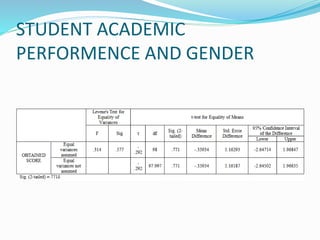
 . H = on average the academic performance of male and female
student are equal.
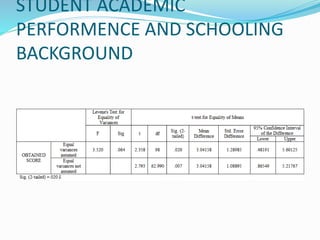
 2. H = on average the academic performance of graduate
students with respect to their schooling perspectives or
background (i.e. Government /Private) are equal.
 3. H = on average the academic performance of graduate
students with respect to their residential area (i.e. Urban /Rural)
are equal.
 4. H = on average the academic performance of graduate
students with respect to their medium of instruction in school
(i.e. English /Urdu) are equal.
 5. H = on average the academic performance of graduate
students with respect to their accommodation (i.e.
Hostelries/Day Scholar) are equal.
RESERCH METHADOLOGY
 In this study a linear model of graduate student
performance was designed. graduate student academic
performance was taken as a dependent variable and gender,
age, faculty of study, schooling, father/guardian social
economic status, residential area, medium of schooling,
tuition, study hour and accommodation as an independent
variables. All graduates students in Islamia University of
Bahawalpur Rahim Yar Khan Campus. The sample consist
of (n=100) graduate students of Islamia University of
Bahawalpur Rahim Yar Khan Campus.
 Simple random sampling technique was employed in the
selecting the sample from the targeted population. The
researcher personally went to the respondents and filled
out the questionnaires so that the true responses could be
obtained. The researcher use close ended questionnaires
because the population is literate and large and time for
collecting data is limited. Data from Questionnaires was
compiled, sorted, edited, classified and coded into the
coding sheet of SPSS 13.0 (version) and Microsoft Excel
2007.
 The regression functions to fit the linear regression.
For correlation analysis the correlation function built
in Microsoft Excel 2007. For testing the hypothesis
that the academic performance of graduate students of
Islamia University of Bahawalpur Rahim Yar Khan
Campus varies with gender using built in t-test
function in SPSS. Graphs are constructed using
Microsoft Excel 2007 graphical functions.
DISCUSSION AND RESULT
 Discussion and Results
 Table 1. Gender, School, Residential Area,
Medium of Instructions, Tuition Trend and
Accommodation Trend wise distribution of
participants
STUDENT ACADEMIC
PERFORMENCE AND GENDER
STUDENT ACADEMIC
PERFORMENCE AND SCHOOLING
BACKGROUND
CONCLUTION
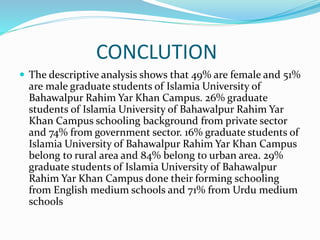
 The descriptive analysis shows that 49% are female and 51%
are male graduate students of Islamia University of
Bahawalpur Rahim Yar Khan Campus. 26% graduate
students of Islamia University of Bahawalpur Rahim Yar
Khan Campus schooling background from private sector
and 74% from government sector. 16% graduate students of
Islamia University of Bahawalpur Rahim Yar Khan Campus
belong to rural area and 84% belong to urban area. 29%
graduate students of Islamia University of Bahawalpur
Rahim Yar Khan Campus done their forming schooling
from English medium schools and 71% from Urdu medium
schools
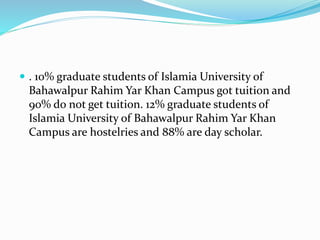
 . 10% graduate students of Islamia University of
Bahawalpur Rahim Yar Khan Campus got tuition and
90% do not get tuition. 12% graduate students of
Islamia University of Bahawalpur Rahim Yar Khan
Campus are hostelries and 88% are day scholar.

Academic performence and factors affecting it full 1

  • 2.
    SUBMITTED TO:RAVI.M.SAMBRANI SUBMITTED BY:FAROOQKHAN COURSE TITLE:EDUCATIONAL PSYCOLOGY( AEX-101)
  • 3.
    INTRUDUCTION  Students academicgain and learning performance is affected by numerous factor including gender, age, teaching faculty, students schooling, father/guardian social economic status, residential area of students, medium of instructions in schools, tuition trend, daily study hour and accommodation as hostelries or day scholar. Many researchers conducted detailed studies about the factors contributing student performance at different study levels. Graetz (1995) suggested “A student educational success contingent heavily on social status of student’s parents/ guardians in the society. Considine and Zappala (2002) noticed the same that parent’s income or social status positively affects the student test score in examinationupon the academic performance of graduate students. Durden and Ellis quoted Staffolani and Bratti, (2002) observed that “the measurement of students previous educational outcomes are the most important indicators of students f 
  • 4.
     . Accordingto Minnesota (2007) “the higher education performance is depending uture achievement, this refers that as the higher previous appearance, better the student’s academic performance in future endeavours.
  • 5.
     Lot ofstudies have been conducted in the area of students achievement and these studies identify and analyze the number of factors that affect the academic performance of the student at school, college and even at university level. Their finding identify students’ effort, previous schooling, parent’s educational background, family income, self motivation of students, age of student, learning preferences and entry qualification of students as important factors that have effect on student’s academic performance in different setting..
  • 6.
     It isgenerally assumed that the students who showed better or higher performance in the starting classes of their studies also performed better in future academic years at degree level. Everyone can be surprised with this assumption if it could be proved scientifically. From the last two decades it has been noticed significantly that there is great addition in research literature and review material relating to indicators of academic achievement with much emphasis on this dialogue, whether traditional achievement measures of academic performance are best determinants of future academic gain at university or higher level or innovative measures. However, it is also observed that many of the researchers are not agree with this view point or statement. Reddy and Talcott (2006) looks disagree with these assumptions that future academic gains are resolute by preceding performance. 
  • 7.
     It isalso confirmed in the study of Oregon State University (2003) on graduate admissions that normal measures of educational potential and academic performance such as high school GPA (Grade Point Average) scores showed only 30% of the deviation in initial or starting (first) year at college. It is important to note that even these studies do not agree with the former studies who explored that previous achievement affect the future performance of the students in studies, they confirmed that the admission scores are related to academic performance at university level but to a very minimal extent. McDonald et.al (2001) also suggested that the scores of graduate level studies still out perform any other single measure of cognitive aptitude in predicting success at university level.
  • 8.
     Parent’s socio-economiccondition, which includes parents’ academic and professional qualification, revenue and occupational affiliation, is also associated with academic gain of students. The results of many studies confirmed that academic achievement of students is contingent upon parent’s socio-economic condition. So the students belonging from higher social economical backgrounds will perform better than other students associated with low social economic backgrounds. “Social and economical status of student is generally determined by combining parents’ qualification, occupation and income standard” (Jeynes, 2002
  • 9.
     Graetz (1995)conducted a study on socio-economic status of the parents of students and concluded that the socio economic background has a great impact on student’s academic performance, main source of educational imbalance among students and student’s academic success contingent very strongly on parent’s socio economic standard. Considine and Zappala (2002) also having the same views as Graetz (1995), in their study on the influence of social and economic disadvantage in the academic performance of school students noticed, where the parents or guardians have social, educational and economical advantage definitely strengthen the higher level success in future. But it is also noted that these parents make available sufficient psychological and emotional shore up to their children by providing good educational and learning environment that produce confidence and the improvement of skills needed for success.
  • 10.
     On otherhand Pedrosa et.al (2006) in their study on social and educational background pointed out those students who mostly come from deprived socio-economic and educational background performed relatively better than others coming from higher socio-economic and educational area. They named this phenomena educational elasticity. It is obvious and true that the criteria for categorizing socio-economic standard in different countries are different depending of their norms and values. The criteria for low socio-economic status for developed country will be different from the criteria of developing nations and same will be in the case of developing and under developing countries.
  • 11.
     “The totalincome of families, monthly or annually and their expenditures also put a great effect on the learning and academic opportunities accessible to youngsters and their chances of educational success. Furthermore, he also pointed that due to residential stratification and segregation, the students belonging to low-income backgrounds usually attend schools with lower funding levels, and this situation reduced achievement motivation of the students and high risk of educational malfnction in future life endeavors” (Escarce, 2003).
  • 12.
     Considine &Zappala (2002) observed that children comes from those families having low income make known more subsequent models in terms of learning outcomes; low literacy level, low retention rate, problems in school behaviour and more difficulty in their studies and mostly display negative attitude towards studies and school. The view point of Considine and Zappala is more strengthen by this statement of Eamon, According to Eamon (2005) “Those students usually come out from low socio-economic status or area show low performance in studies and obtained low scores as compared to the other students or their counter parts”. 
  • 13.
     It isconcluded that the type of schools in which students studies greatly influence the educational performance and academic achievement of the students. Miller and Birch (2007) summarized the views of many researcher and educationist in their study on the influence of high school attended on university performance. This study let the research scholars to hypothesize that the background to the students positively correlates with the academic attainment of graduate students. 
  • 14.
     . H= on average the academic performance of male and female student are equal.  2. H = on average the academic performance of graduate students with respect to their schooling perspectives or background (i.e. Government /Private) are equal.  3. H = on average the academic performance of graduate students with respect to their residential area (i.e. Urban /Rural) are equal.  4. H = on average the academic performance of graduate students with respect to their medium of instruction in school (i.e. English /Urdu) are equal.  5. H = on average the academic performance of graduate students with respect to their accommodation (i.e. Hostelries/Day Scholar) are equal.
  • 15.
    RESERCH METHADOLOGY  Inthis study a linear model of graduate student performance was designed. graduate student academic performance was taken as a dependent variable and gender, age, faculty of study, schooling, father/guardian social economic status, residential area, medium of schooling, tuition, study hour and accommodation as an independent variables. All graduates students in Islamia University of Bahawalpur Rahim Yar Khan Campus. The sample consist of (n=100) graduate students of Islamia University of Bahawalpur Rahim Yar Khan Campus.
  • 16.
     Simple randomsampling technique was employed in the selecting the sample from the targeted population. The researcher personally went to the respondents and filled out the questionnaires so that the true responses could be obtained. The researcher use close ended questionnaires because the population is literate and large and time for collecting data is limited. Data from Questionnaires was compiled, sorted, edited, classified and coded into the coding sheet of SPSS 13.0 (version) and Microsoft Excel 2007.
  • 17.
     The regressionfunctions to fit the linear regression. For correlation analysis the correlation function built in Microsoft Excel 2007. For testing the hypothesis that the academic performance of graduate students of Islamia University of Bahawalpur Rahim Yar Khan Campus varies with gender using built in t-test function in SPSS. Graphs are constructed using Microsoft Excel 2007 graphical functions.
  • 18.
    DISCUSSION AND RESULT Discussion and Results  Table 1. Gender, School, Residential Area, Medium of Instructions, Tuition Trend and Accommodation Trend wise distribution of participants
  • 19.
  • 20.
  • 21.
    CONCLUTION  The descriptiveanalysis shows that 49% are female and 51% are male graduate students of Islamia University of Bahawalpur Rahim Yar Khan Campus. 26% graduate students of Islamia University of Bahawalpur Rahim Yar Khan Campus schooling background from private sector and 74% from government sector. 16% graduate students of Islamia University of Bahawalpur Rahim Yar Khan Campus belong to rural area and 84% belong to urban area. 29% graduate students of Islamia University of Bahawalpur Rahim Yar Khan Campus done their forming schooling from English medium schools and 71% from Urdu medium schools
  • 22.
     . 10%graduate students of Islamia University of Bahawalpur Rahim Yar Khan Campus got tuition and 90% do not get tuition. 12% graduate students of Islamia University of Bahawalpur Rahim Yar Khan Campus are hostelries and 88% are day scholar.