
CICE Hiroshima University, Journal of International Cooperation in Education, Vol.9, No.1, (2006) pp.111 ~ 122 
Analysis of Mathematics Performance of Grade Five Students 
in Thailand Using Newman Procedure 
Natcha Prakitipong and Satoshi Nakamura 
Graduate School for International Development and Cooperation 
Hiroshima University 
Abstract 
In spite of the voices to meet basic learning needs since the World Conference on 
Education for All in 1990, Thailand still faces the problems of low performance in 
mathematics at primary school level, especially in the area of ability in mathematical 
problem solving. This paper attempts to reveal the cause of students' low achievement 
through analysis of the levels of their abilities, which are classified into the five 
stages, i.e. reading, comprehension, transformation, process skills, and encoding. 
Comparison was made between students in Bangkok and Samutsakhon Province. 
There are five questions to interview forty Grade five students. The data suggested 
that most of students’ errors occurred at comprehension level for structured questions 
while the errors for multiple choice questions occurred at the transformation level. 
Good performers’ errors did not occur at reading level, but poor performers’ errors 
occurred mostly at comprehension level. 
- 111 - 
Introduction 
World Conference on Education for All in 1990 is one of the monumental landmarks 
in the educational development as it has led the world to work together towards realization 
of the ideal of universal primary education by appealing the importance of meeting basic 
learning needs in order for people to survive, to develop their full capacities to live and work 
in dignity, to participate fully in development, to improve the quality of their lives, to make 
informed decision, and to continue learning(UNESCO 1990). In the same conference, it 
was further declared that the basic learning needs comprise of both essential learning tools 
such as literacy, oral expression, numeracy, and problem solving and the basic learning 
contents such as knowledge, skills, values, and attitudes that are required by human beings. 
Considering the above in the context of mathematics education, nurturing ability of 
mathematics problem solving is an important task. 
When it comes to Thailand, Institute for the Promotion of Teaching Science and 
Technology (IPST) has also stated that studying mathematics plays a very important role in 
developing human thinking more creative, reasonable, and able to analyze problems and to 
forecast future. On the other hand, Thai education has been emphasizing the textbooks and 
its memorization rather than nurturing critical eyes for analysis. This trend is thought to 
obstruct students to develop mathematical problem solving skills. WHO (1990-2000) also
Natcha Prakitipong and Satoshi Nakamura 
reported that Thai education process in school has centered on memorizing textbook rather 
than developing problem solving skills and self learning abilities. Examination rely mostly 
on memorization of knowledge, and that results in drawbacks of students' low capability in 
thinking, analyzing, synthesizing, innovating, and problem solving. 
TIMSS 1995 results also reported that for the fourth grade Thai stood at the fifth from 
the bottom among 26 participating countries. They could perform relatively well in number, 
data analysis and probability, and geometry, but they hardly solve problems in algebra and 
relation pattern, fraction, measurement, and mathematics analysis/process. Furthermore, Thai 
students were neither good at problem solving nor could they answer questions, which 
required explanation. 
The Bureau of Education Testing, under the Office of the Basic Education Commission 
and the Office of the Higher Education Commission evaluated performance of students in 
Grades 3, 6, and 9 in 4 subjects: Thai, English, Mathematics and Science. Their results were 
not satisfactory in 2004 (Office of the National Education Council 2004, p.160) and the 
results in 2002 revealed that Grade Three students achieved an average of 15.7 points out of 
30 in Mathematics. The students in Bangkok got 16.5 points and those in provinces nearby 
Bangkok also got almost the same scores, but those in Samutsakon province got 14.2 points 
which was lower than the average score in the country. 
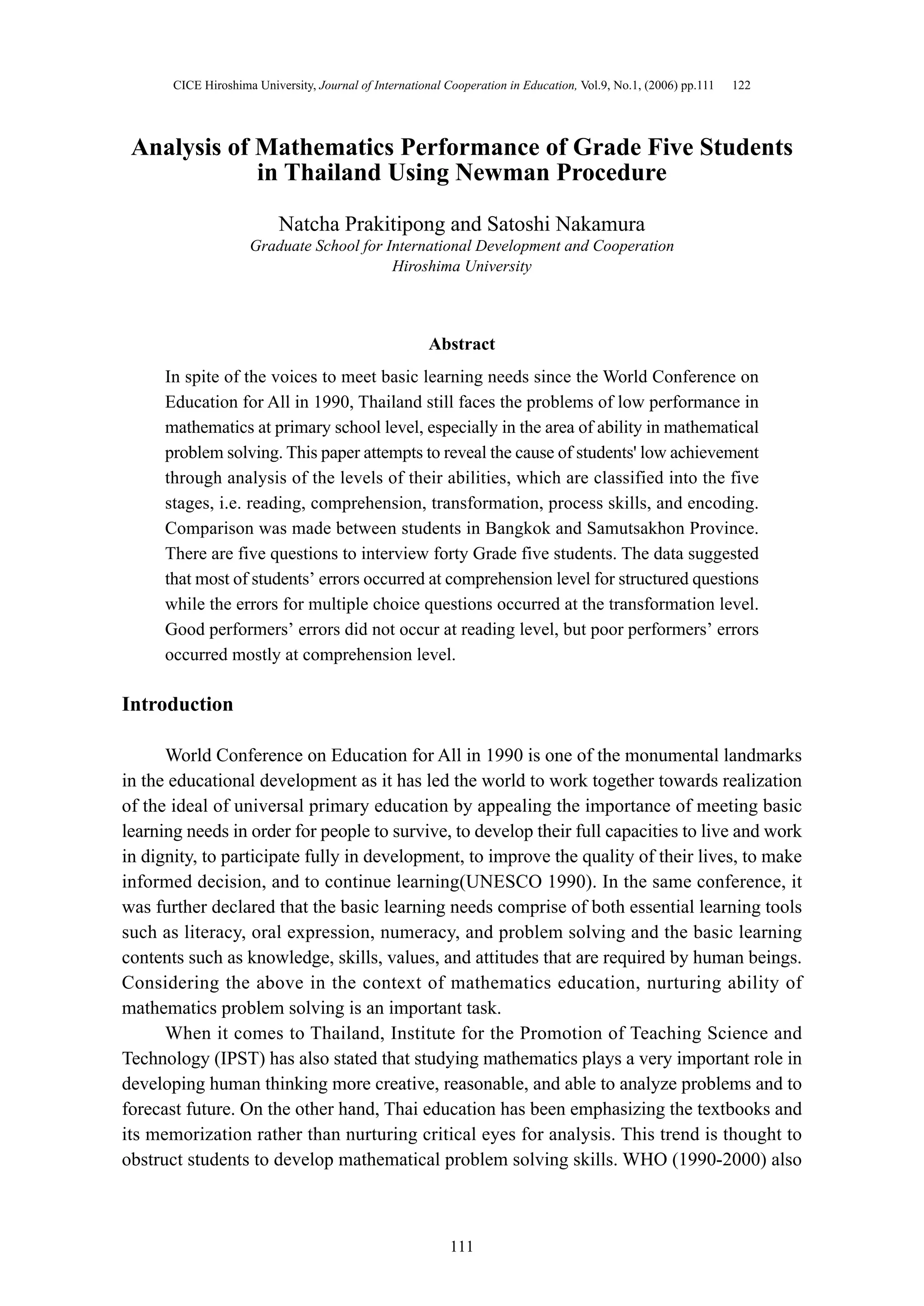
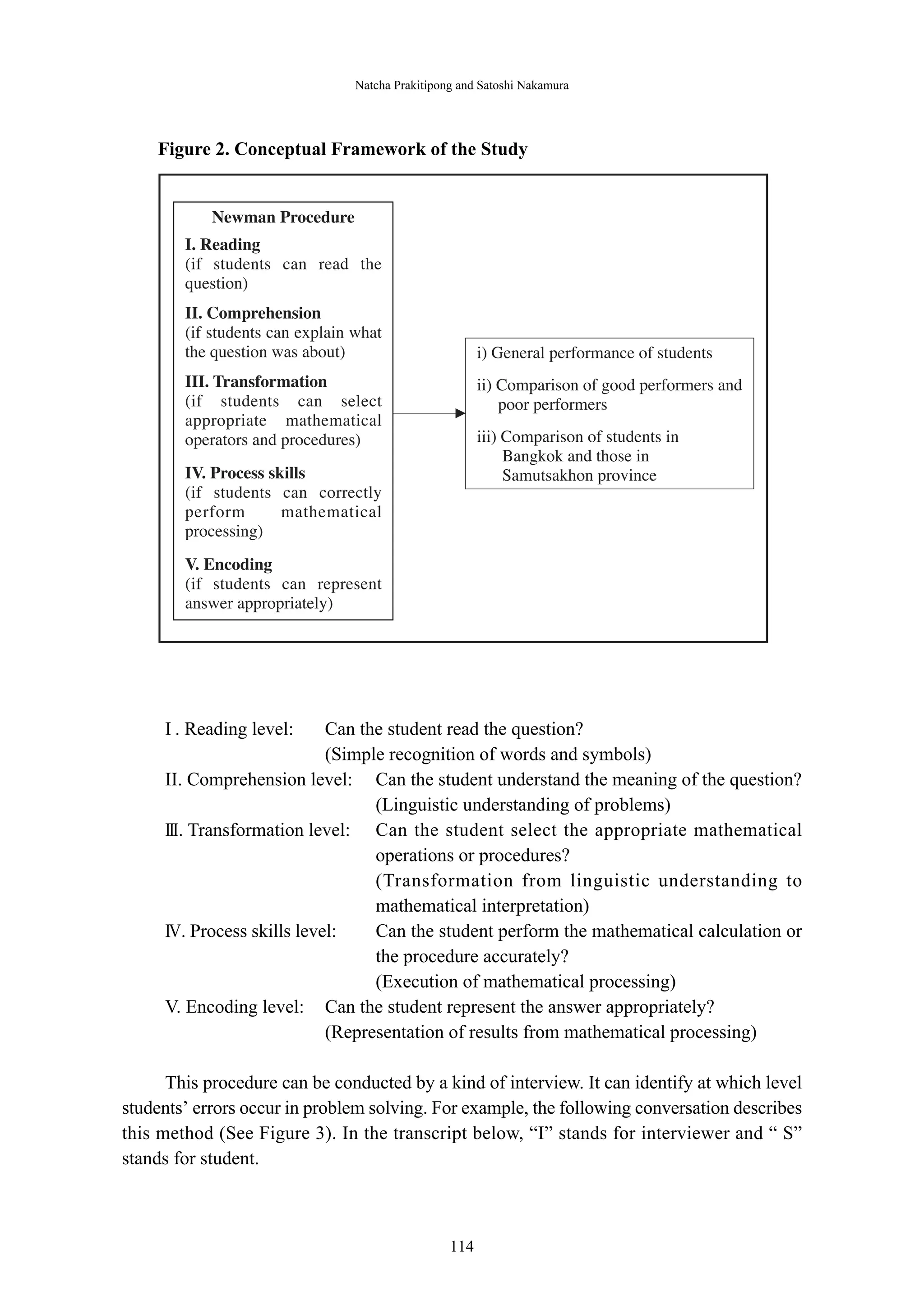
Geographic Information System Evaluation shows the level of mathematics 
achievement of GAT (General Achievement Test) per area (See Figure 1). Intermediate color 
describes good performance with 20-30 scores, light color describes middle performance 
with 11-19 scores, and dark color describes poor performance with 1-10 scores. According 
to Figure 1, students in Bangkok performed well and those in provinces around Bangkok 
also got performed well or at least at passable level. Only the students in Samutsakhon 
province, however, performed poorly. There is a disparity between Bangkok and Samutsakhon 
province in terms of performance. 
Considering the above situation, this paper is aimed at revealing the cause of students’ 
low achievement in mathematics at primary schools in Thailand. In order to fulfill this, the 
paper firstly analyzed the levels of students’ problem solving abilities from the view points 
of linguistic fluency, conceptual understanding and ability of mathematical processing by 
using Newman Procedure. Secondly, comparison was made between the group of good 
performers and that of poor performers. Finally, causes of regional disparity were examined 
by comparing the students’ achievement in a good-performing province with that in a poor-performing 
province, which are represented by Bangkok and Samutsakhon province 
respectively. In other words, the research questions are as follows: 
(1) At which level of problem solving do the students commit error/s in mathematics? 
(2) Is there any difference between the good performers and poor performers in terms 
- 112 - 
of error/s in problem solving? 
(3) Is there any difference between the students in good performing province and 
those in poor performing province in terms of committing error/s in mathematics?
Analysis of Mathematics Performance of Grade Five Students in Thailand Using Newman Procedure 
Figure 1. Level of Mathematics Achievement of General 
Achievement Test 2002 per Province 
Source: Bureau of Policy and Planning (2002) 
- 113 - 
Method of the Study 
The Newman Procedure 
The Newman Procedure is a method that analyzes errors in sentence problems. In the 
process of problem solving, there are many factors that support the students to arrive at a 
correct answer. This method supposes that in the process of problem solving there are two 
kinds of obstacles that hinder students from arriving at correct answers: 
(1) Problems in linguistic fluency and conceptual understanding that correspond with 
level of simple reading and understanding meaning of problems, and 
(2) Problems in mathematical processing that consists of transformation, process skills, 
and encoding answers. 
This classification implies that the students have to interpret the meaning of the question 
in mathematical context before they proceed to mathematical processing to obtain appropriate 
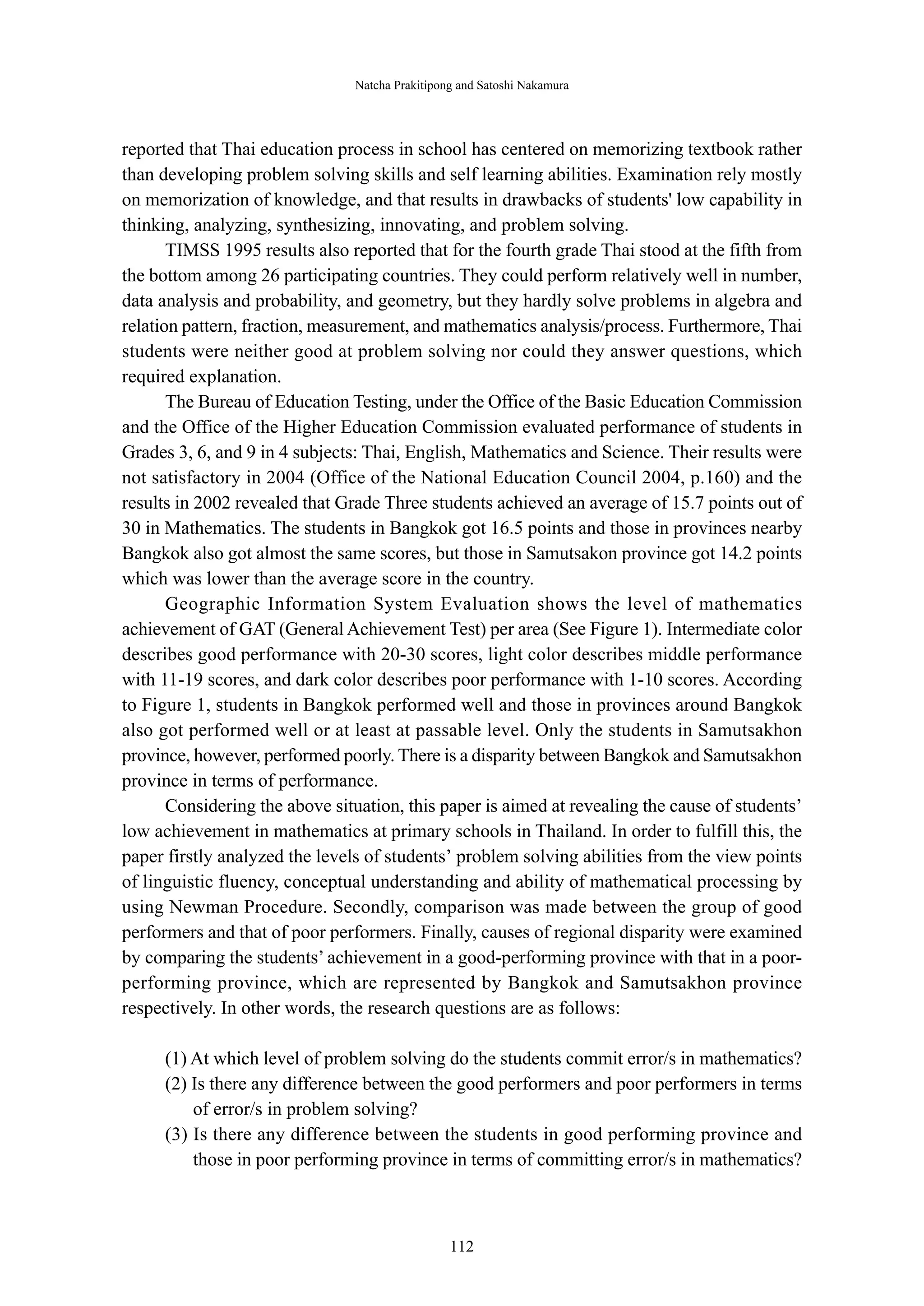
answer. In summary, Newman Procedure can be described as follows (See Figure 2):
Natcha Prakitipong and Satoshi Nakamura 
Figure 2. Conceptual Framework of the Study 
I . Reading level: Can the student read the question? 
(Simple recognition of words and symbols) 
II. Comprehension level: Can the student understand the meaning of the question? 
(Linguistic understanding of problems) 
III. Transformation level: Can the student select the appropriate mathematical 
operations or procedures? 
(Transformation from linguistic understanding to 
mathematical interpretation) 
IV. Process skills level: Can the student perform the mathematical calculation or 
the procedure accurately? 
(Execution of mathematical processing) 
V. Encoding level: Can the student represent the answer appropriately? 
(Representation of results from mathematical processing) 
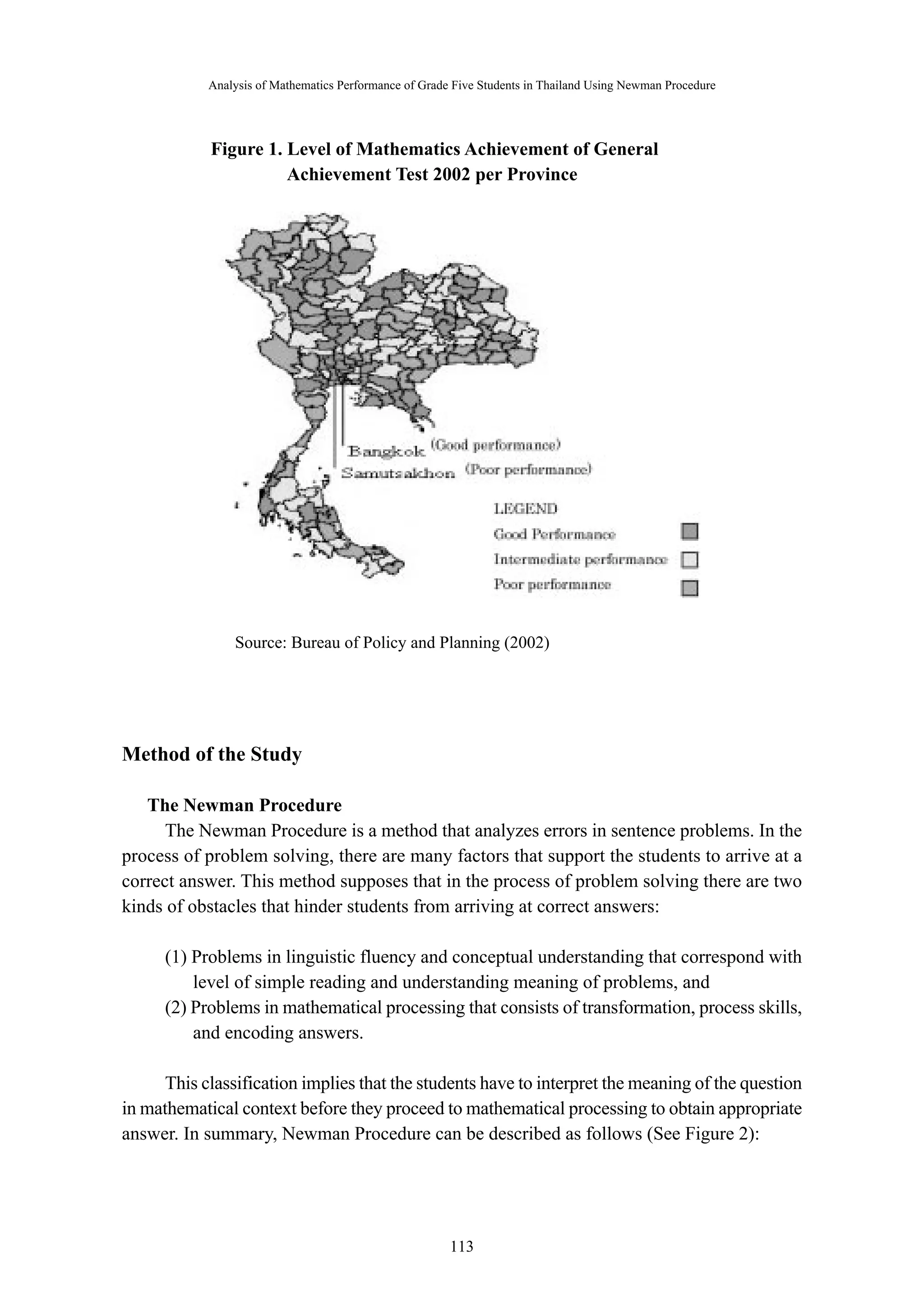
This procedure can be conducted by a kind of interview. It can identify at which level 
students’ errors occur in problem solving. For example, the following conversation describes 
this method (See Figure 3). In the transcript below, “I” stands for interviewer and “ S” 
stands for student. 
- 114 -
Analysis of Mathematics Performance of Grade Five Students in Thailand Using Newman Procedure 
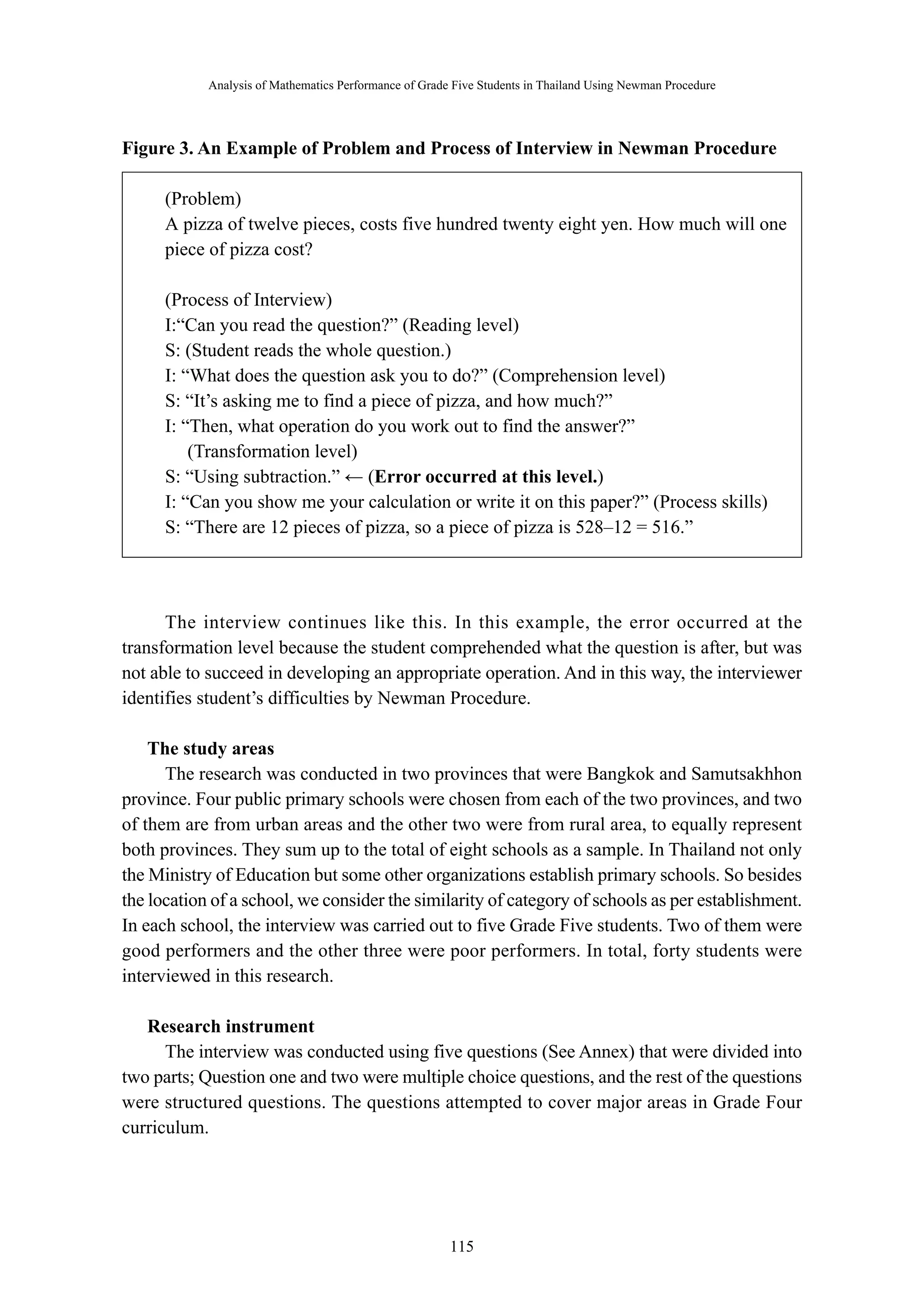
Figure 3. An Example of Problem and Process of Interview in Newman Procedure 
(Problem) 
A pizza of twelve pieces, costs five hundred twenty eight yen. How much will one 
piece of pizza cost? 
(Process of Interview) 
I:“Can you read the question?” (Reading level) 
S: (Student reads the whole question.) 
I: “What does the question ask you to do?” (Comprehension level) 
S: “It’s asking me to find a piece of pizza, and how much?” 
I: “Then, what operation do you work out to find the answer?” 
- 115 - 
(Transformation level) 
S: “Using subtraction.” ← (Error occurred at this level.) 
I: “Can you show me your calculation or write it on this paper?” (Process skills) 
S: “There are 12 pieces of pizza, so a piece of pizza is 528–12 = 516.” 
The interview continues like this. In this example, the error occurred at the 
transformation level because the student comprehended what the question is after, but was 
not able to succeed in developing an appropriate operation. And in this way, the interviewer 
identifies student’s difficulties by Newman Procedure. 
The study areas 
The research was conducted in two provinces that were Bangkok and Samutsakhhon 
province. Four public primary schools were chosen from each of the two provinces, and two 
of them are from urban areas and the other two were from rural area, to equally represent 
both provinces. They sum up to the total of eight schools as a sample. In Thailand not only 
the Ministry of Education but some other organizations establish primary schools. So besides 
the location of a school, we consider the similarity of category of schools as per establishment. 
In each school, the interview was carried out to five Grade Five students. Two of them were 
good performers and the other three were poor performers. In total, forty students were 
interviewed in this research. 
Research instrument 
The interview was conducted using five questions (See Annex) that were divided into 
two parts; Question one and two were multiple choice questions, and the rest of the questions 
were structured questions. The questions attempted to cover major areas in Grade Four 
curriculum.
Natcha Prakitipong and Satoshi Nakamura 
- 116 - 
Presentation and Analysis of Data 
The information collected by the interview was examined in terms of the following: 
(1) general performance of the students, 
(2) comparison of good performers and poor performers, and 
(3) comparison of students in Bangkok and those in Samutsakhon province. 
General performance of students 
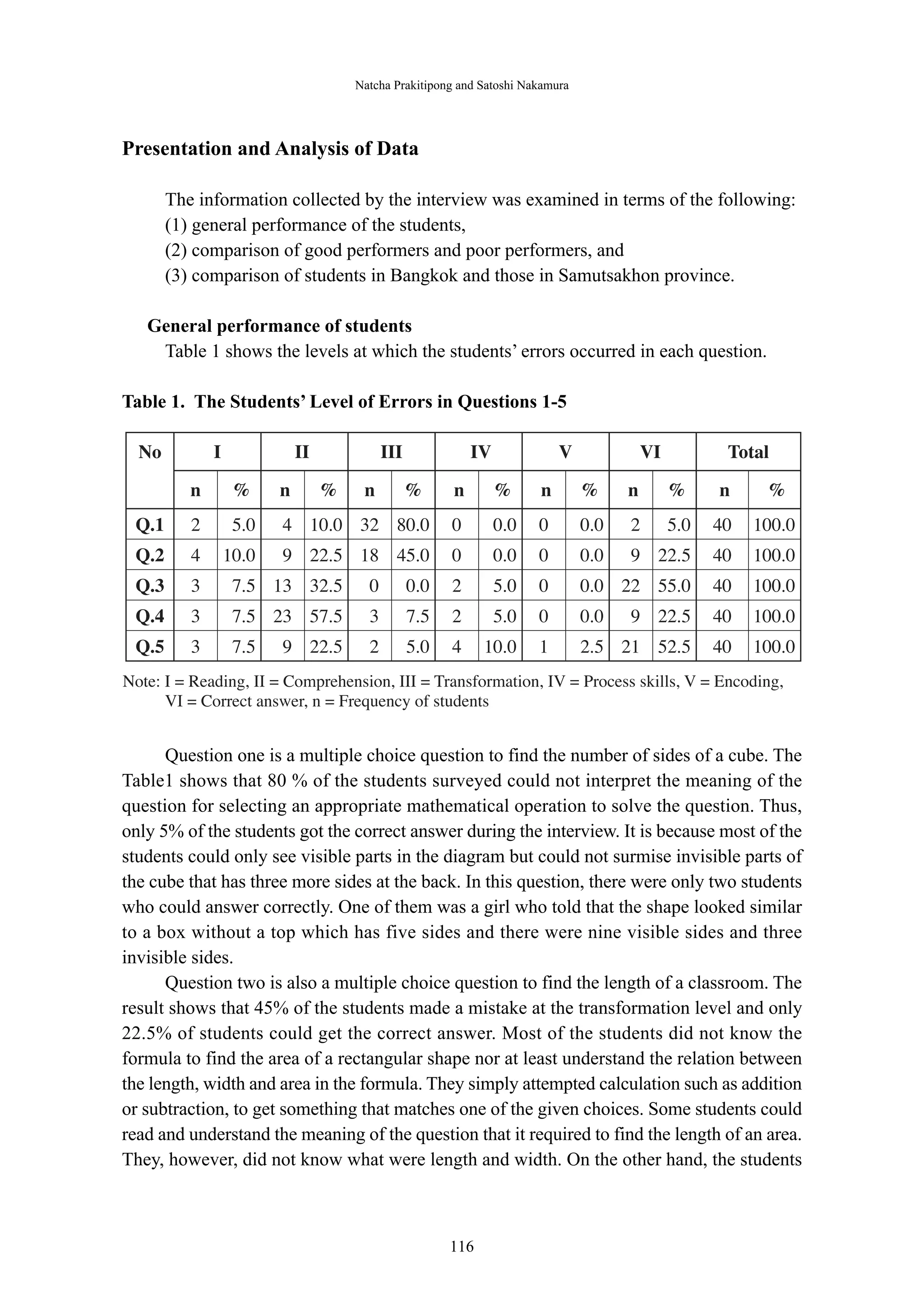
Table 1 shows the levels at which the students’ errors occurred in each question. 
Table 1. The Students’ Level of Errors in Questions 1-5 
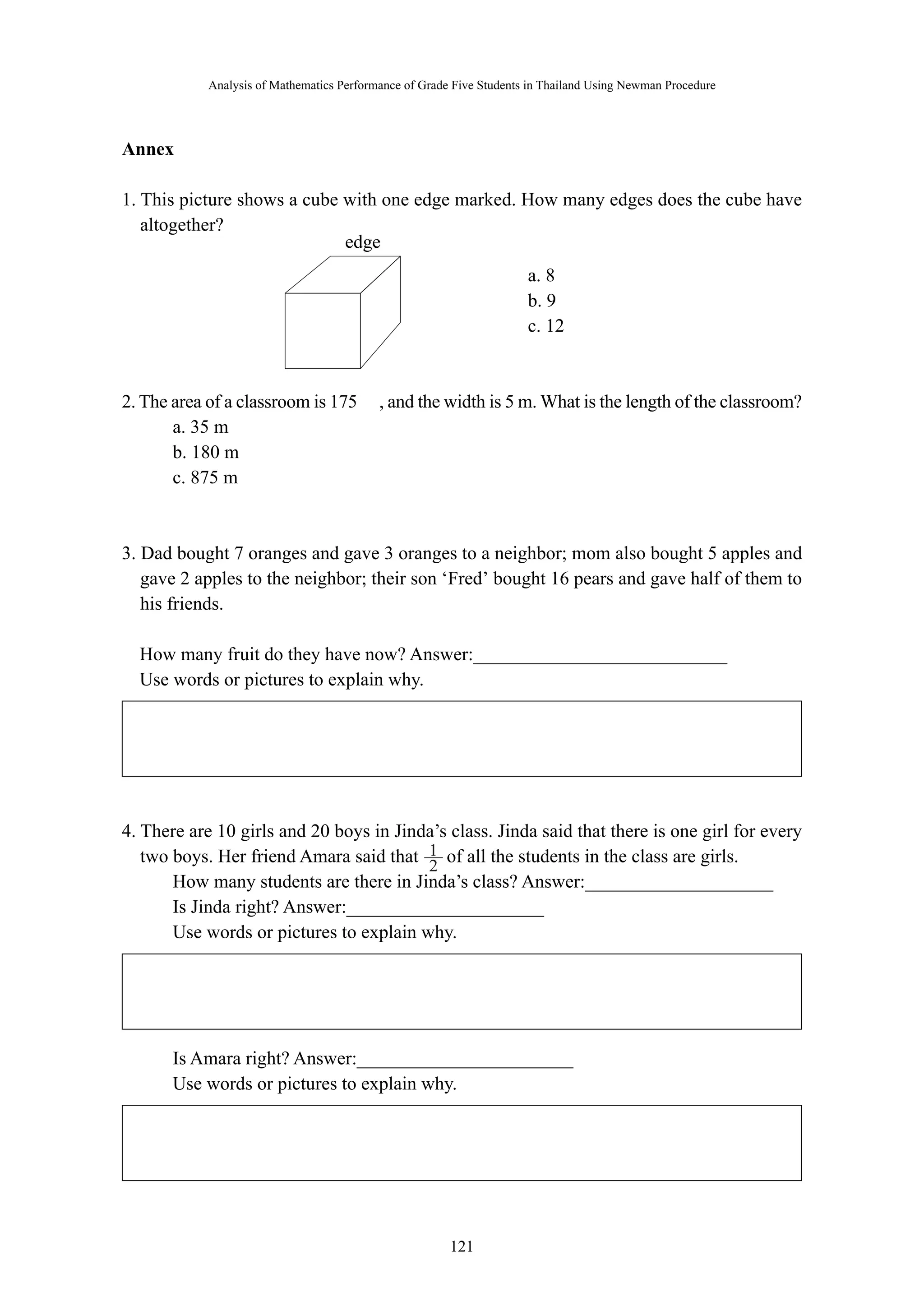
Question one is a multiple choice question to find the number of sides of a cube. The 
Table1 shows that 80 % of the students surveyed could not interpret the meaning of the 
question for selecting an appropriate mathematical operation to solve the question. Thus, 
only 5% of the students got the correct answer during the interview. It is because most of the 
students could only see visible parts in the diagram but could not surmise invisible parts of 
the cube that has three more sides at the back. In this question, there were only two students 
who could answer correctly. One of them was a girl who told that the shape looked similar 
to a box without a top which has five sides and there were nine visible sides and three 
invisible sides. 
Question two is also a multiple choice question to find the length of a classroom. The 
result shows that 45% of the students made a mistake at the transformation level and only 
22.5% of students could get the correct answer. Most of the students did not know the 
formula to find the area of a rectangular shape nor at least understand the relation between 
the length, width and area in the formula. They simply attempted calculation such as addition 
or subtraction, to get something that matches one of the given choices. Some students could 
read and understand the meaning of the question that it required to find the length of an area. 
They, however, did not know what were length and width. On the other hand, the students
Analysis of Mathematics Performance of Grade Five Students in Thailand Using Newman Procedure 
who could get the correct answer were able to recall the formula and apply it appropriately 
to get 175 ㎡ (5 × 35) of the area. 
Question three is a structured question that asks to find the number of fruits. The result 
shows that 32.5% of the students made mistakes at the comprehension level and 55.5% of 
the students got the correct answer. Students made a mistake because they could not 
understand the phrase ‘half of sixteen’ and were not able to proceed with solving the problem. 
And students, who met with problems at the process skills level, committed mistakes due to 
their carelessness during their summing. 
Question four is a structured question that asks to find the total number of students in 
a class, and the proportion of girls in the class. The result reveals that 57.5% of the students 
made errors at the comprehension level. It is because they could not understand the meaning 
of the question and they failed to determine whether it was an affirmative sentence or a 
question. Besides, they did not understand how to express their answer in proportion and 
fraction. Most of them obtained the answers by guessing and explained the process with 
pictures. In most cases, however, the explanations were found meaningless. They did not 
seem to understand the meaning of 1/2 either. 
Question five is a structured question that asks to estimate the number of cartons of 
milk in the given graph. The result reveals that 22.5% of the students made errors at the 
comprehension level while more than half of the students could get the correct answer. In 
this question, the structure of the sentence was simple and the only calculation necessary 
was addition. Therefore, most students did not have any difficulties. Some students who 
gave wrong answers did not seem to understand the word ‘a week’ while there are two types 
of expression for it in Thai language, that are ‘Neng Arthit’ and ‘Neng Sabada’. This resulted 
in some of the students’ getting confused over the meaning of the sentence. 
Comparison of the good performers and poor performers 
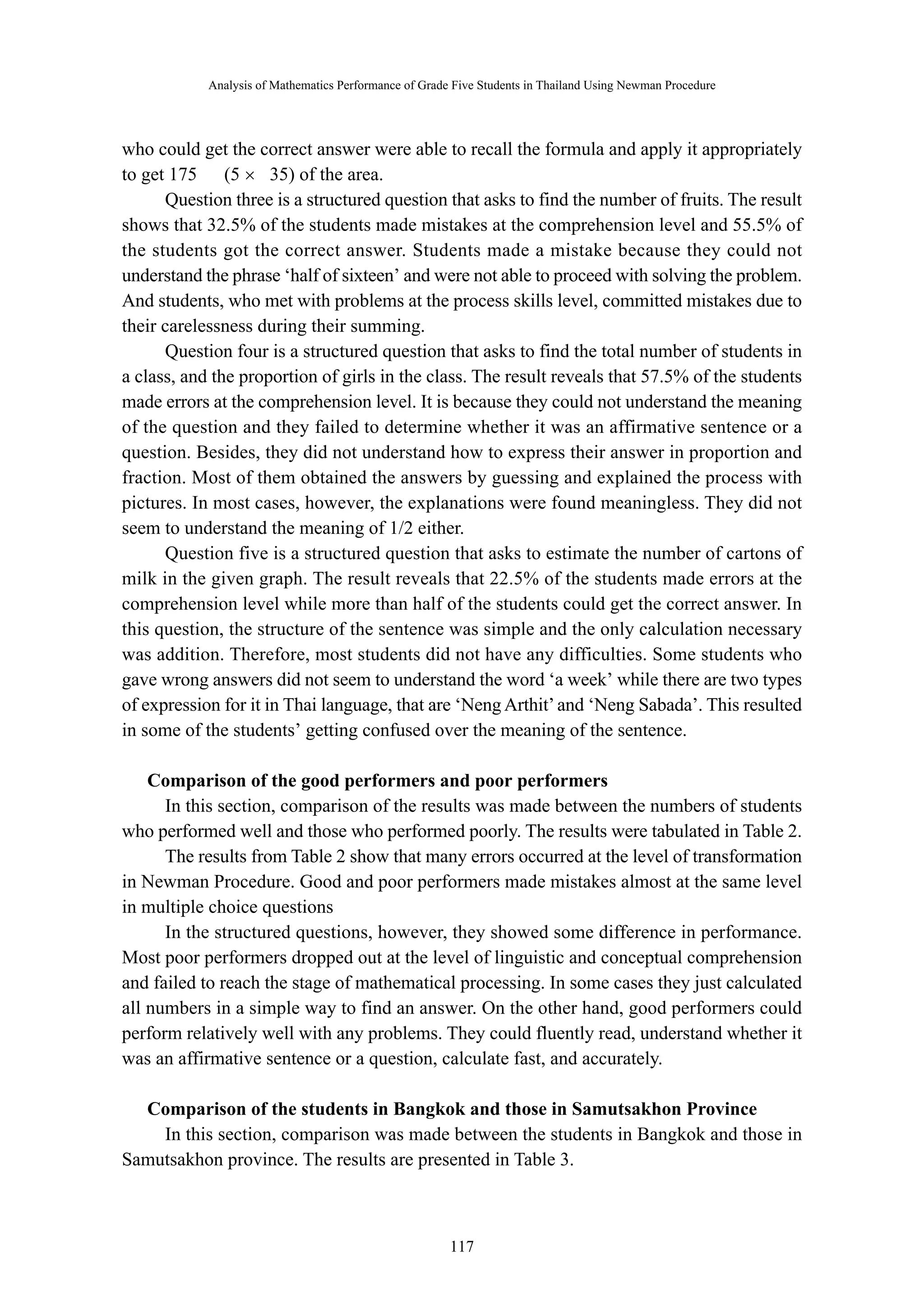
In this section, comparison of the results was made between the numbers of students 
who performed well and those who performed poorly. The results were tabulated in Table 2. 
The results from Table 2 show that many errors occurred at the level of transformation 
in Newman Procedure. Good and poor performers made mistakes almost at the same level 
in multiple choice questions 
In the structured questions, however, they showed some difference in performance. 
Most poor performers dropped out at the level of linguistic and conceptual comprehension 
and failed to reach the stage of mathematical processing. In some cases they just calculated 
all numbers in a simple way to find an answer. On the other hand, good performers could 
perform relatively well with any problems. They could fluently read, understand whether it 
was an affirmative sentence or a question, calculate fast, and accurately. 
Comparison of the students in Bangkok and those in Samutsakhon Province 
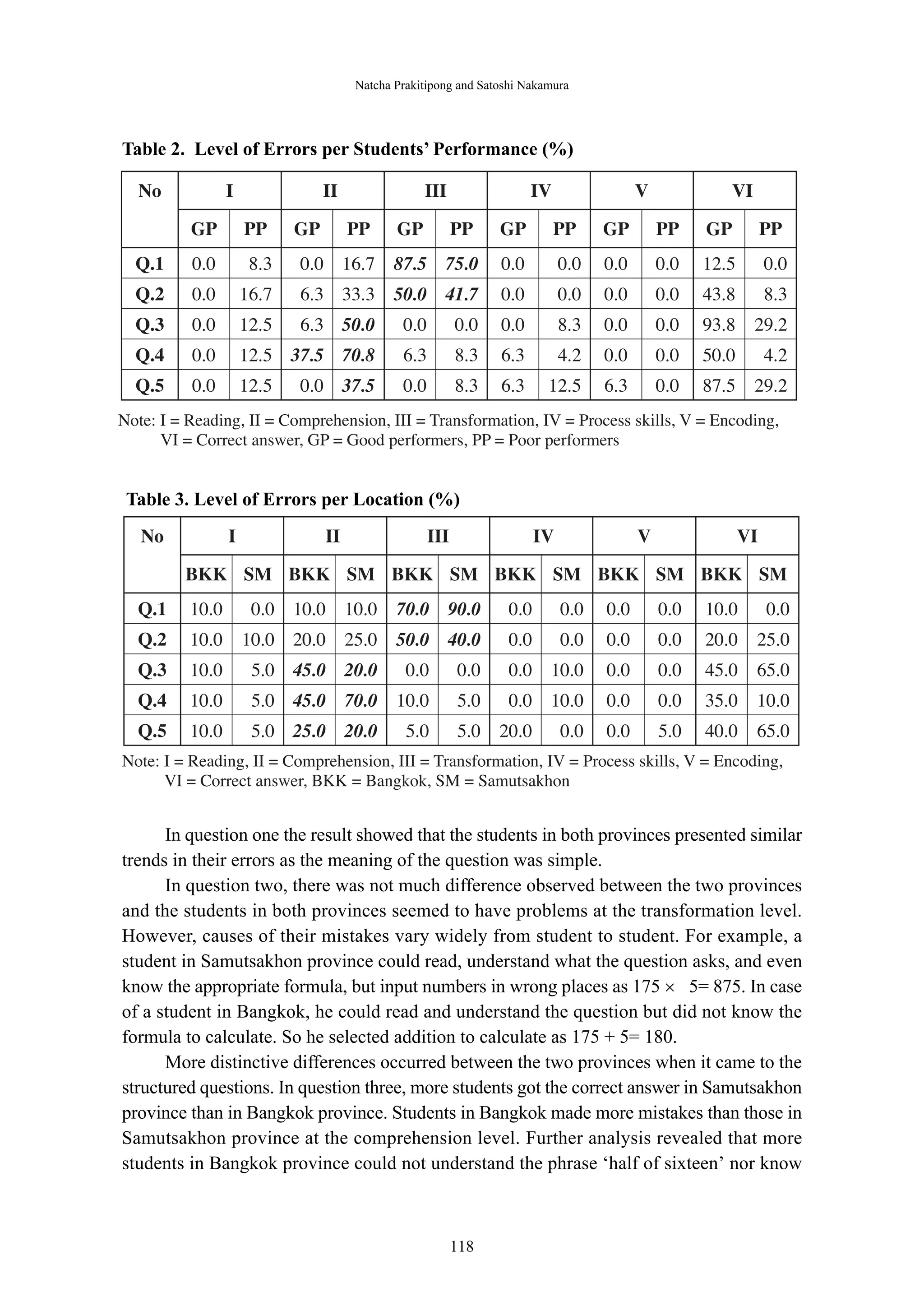
In this section, comparison was made between the students in Bangkok and those in 
Samutsakhon province. The results are presented in Table 3. 
- 117 -
Natcha Prakitipong and Satoshi Nakamura 
Table 2. Level of Errors per Students’ Performance (%) 
Table 3. Level of Errors per Location (%) 
In question one the result showed that the students in both provinces presented similar 
trends in their errors as the meaning of the question was simple. 
In question two, there was not much difference observed between the two provinces 
and the students in both provinces seemed to have problems at the transformation level. 
However, causes of their mistakes vary widely from student to student. For example, a 
student in Samutsakhon province could read, understand what the question asks, and even 
know the appropriate formula, but input numbers in wrong places as 175 × 5= 875. In case 
of a student in Bangkok, he could read and understand the question but did not know the 
formula to calculate. So he selected addition to calculate as 175 + 5= 180. 
More distinctive differences occurred between the two provinces when it came to the 
structured questions. In question three, more students got the correct answer in Samutsakhon 
province than in Bangkok province. Students in Bangkok made more mistakes than those in 
Samutsakhon province at the comprehension level. Further analysis revealed that more 
students in Bangkok province could not understand the phrase ‘half of sixteen’ nor know 
- 118 -
Analysis of Mathematics Performance of Grade Five Students in Thailand Using Newman Procedure 
how to find it. Some students thought it is equal to 15 or 13, and then did addition to get the 
answer of 22 (7-3= 4, 5-2= 3, 16-1= 15, ∴ 4+3+15 = 22) or 20 (7-3= 4, 5-2= 3, 16-3= 13, ∴ 
4+3+13 = 20). 
In question four the trend is similar to that in question three, but it is in an opposite 
manner this time. In this question, most of the students in Samutsakhon province could 
answer only the first part that required simple addition, but they could not understand meaning 
of 1/2 in the latter part. Thus, their explanation was not consistent to the question or 
meaningless in some cases. 
In question five the trend was a little bit different from the other two structured questions. 
In this question the difference was caused by errors at the process skills level only with the 
students in Bangkok. This is because they did not understand the Thai word ‘a week’ in the 
question. Otherwise, most of them could get the correct answer because it was an estimation 
and simple calculation. 
Summarizing the above, patterns of problem solving levels are often similar in both 
provinces despite the claim that Samutsakhon province is poorer than Bangkok in terms of 
mathematics performance. In the structured questions, the linguistic fluency and conceptual 
understanding cause differences to some extent. In some questions, students in Bangkok 
performed better and in other questions, the opposite is true. This may imply that achievement 
is determined not only by levels of linguistic ability but also by familiarity to the context of 
the students in each area. 
- 119 - 
Conclusion 
In this research, we have analyzed the mathematics performance of Grade Five students 
in Thailand by using Newman Procedure. And we have revealed that there are many stages 
that students need to go through in order to arrive at correct answers in the mathematical 
problems. The findings are as follows. 
(1) Students’ errors in multiple choice questions were mostly made at the stage of 
mathematical processing that comprises of transformation, process skills and 
encoding level, while those in structured questions were made at the stage of the 
comprehension level. They call for more attention to the importance of language 
factors in mathematics learning. 
(2) There were notable differences between good and poor performers. Good performers 
tended to have stronger comprehension ability than poor performers. However, if 
we consider the mathematical processing stage, similar patterns were found 
regardless of different performance. 
(3) Concerning difference in locality, the study found that there is no notable difference 
between both provinces. On the other hand, the difference in achievement level 
questioning structured question seemed to be caused not only by students' linguistic 
ability but also by familiarity to the context.
Natcha Prakitipong and Satoshi Nakamura 
As stated above, this paper results clearly showed poor performers had linguistic and 
conceptual comprehension problem. This is why Thai language teachers and mathematics 
teachers should collaborate in considering their appropriate teaching methods. In case of 
mathematics, the teachers should give clear explanation about mathematical concept to ensure 
that each student understands it. Students have different comprehension levels, and therefore, 
some activities may be employed to support poor performers’ understanding through working 
with good performers. And they learn how to interpret the mathematical problems from 
their peers. 
Finally, this paper also found the usefulness of Newman Procedure to examine the 
students’ level of problem solving skills. Our future issues are related to application of this 
method. They are to diagnose students’ level of errors, and to improve daily practice through 
these, which will result in improvement of students’ performance in the long run. 
Acknowledgements 
We are grateful to the schools in Thailand which kindly allowed us to collect data for 
- 120 - 
this research. 
References 
Bureau of Education Testing (2002). General Achievement Test 2002: Mathematics Grade 3. 
Retrieved March, 2004 from http://bet.obec.go.th/gat_sat/p3_45.pdf 
Bureau of Policy and Planning (2002). Geography of General Achievement Test 2002: 
Mathematics Grade 3. Retrieved February, 2005 from 
http://www.moe.go.th/webbpp/Achi2545/GAT2545/Gat45/gat13_02/index.html 
Institute for the Promotion of Teaching Science and Technology (1997). Report Research and 
Evaluation with The Third International Mathematics and Science Study. Education journal 
in 12 years, 2, 64-75. 
International Association for the Evaluation of Educational Achievement (1997). Mathematics 
Achievement in the Primary School Years. Boston College, Chestnut Hill, MA 02167, USA. 
Newman, M. A. (1977). An Analysis of Sixth-Grade Pupils’ Error on Written Mathematical 
Tasks. Victorian Institute for Educational Research Bulletin, 39, 31-43. 
Office of the National Education Council (2004). Education in Thailand 2004. Bangkok: Amarin 
Printing and Publishing Public Company Limited. 
UNESCO (1990). Meeting Basic Learning Needs. Retrieved March, 2004 from 
http://www.unesco.org/education/efa/ed_for_all/background/jomtien_declaration.shtma 
WHO (1999-2000). Thailand Health Profile-Ministry of Public Health. Retrieved March, 2004 
from http://w3.whosea.org/eip/thf/English/tex%20english_pdf/CHA4_2.pdf
Analysis of Mathematics Performance of Grade Five Students in Thailand Using Newman Procedure 
1 
2 
- 121 - 
edge 
Annex 
1. This picture shows a cube with one edge marked. How many edges does the cube have 
altogether? 
a. 8 
b. 9 
c. 12 
2. The area of a classroom is 175 ㎡, and the width is 5 m. What is the length of the classroom? 
a. 35 m 
b. 180 m 
c. 875 m 
3. Dad bought 7 oranges and gave 3 oranges to a neighbor; mom also bought 5 apples and 
gave 2 apples to the neighbor; their son ‘Fred’ bought 16 pears and gave half of them to 
his friends. 
How many fruit do they have now? Answer:___________________________ 
Use words or pictures to explain why. 
4. There are 10 girls and 20 boys in Jinda’s class. Jinda said that there is one girl for every 
two boys. Her friend Amara said that of all the students in the class are girls. 
How many students are there in Jinda’s class? Answer:____________________ 
Is Jinda right? Answer:_____________________ 
Use words or pictures to explain why. 
Is Amara right? Answer:_______________________ 
Use words or pictures to explain why.
Natcha Prakitipong and Satoshi Nakamura 
5. The graph shows the number of cartons of milk sold each day of a week at a school. 
How many cartons of milk did the school sell on Monday? 
Answer: __________________________ 
How many cartons of milk did the school sell that week? Show your work. 
- 122 -

Newman procedure

  • 1.
    CICE Hiroshima University,Journal of International Cooperation in Education, Vol.9, No.1, (2006) pp.111 ~ 122 Analysis of Mathematics Performance of Grade Five Students in Thailand Using Newman Procedure Natcha Prakitipong and Satoshi Nakamura Graduate School for International Development and Cooperation Hiroshima University Abstract In spite of the voices to meet basic learning needs since the World Conference on Education for All in 1990, Thailand still faces the problems of low performance in mathematics at primary school level, especially in the area of ability in mathematical problem solving. This paper attempts to reveal the cause of students' low achievement through analysis of the levels of their abilities, which are classified into the five stages, i.e. reading, comprehension, transformation, process skills, and encoding. Comparison was made between students in Bangkok and Samutsakhon Province. There are five questions to interview forty Grade five students. The data suggested that most of students’ errors occurred at comprehension level for structured questions while the errors for multiple choice questions occurred at the transformation level. Good performers’ errors did not occur at reading level, but poor performers’ errors occurred mostly at comprehension level. - 111 - Introduction World Conference on Education for All in 1990 is one of the monumental landmarks in the educational development as it has led the world to work together towards realization of the ideal of universal primary education by appealing the importance of meeting basic learning needs in order for people to survive, to develop their full capacities to live and work in dignity, to participate fully in development, to improve the quality of their lives, to make informed decision, and to continue learning(UNESCO 1990). In the same conference, it was further declared that the basic learning needs comprise of both essential learning tools such as literacy, oral expression, numeracy, and problem solving and the basic learning contents such as knowledge, skills, values, and attitudes that are required by human beings. Considering the above in the context of mathematics education, nurturing ability of mathematics problem solving is an important task. When it comes to Thailand, Institute for the Promotion of Teaching Science and Technology (IPST) has also stated that studying mathematics plays a very important role in developing human thinking more creative, reasonable, and able to analyze problems and to forecast future. On the other hand, Thai education has been emphasizing the textbooks and its memorization rather than nurturing critical eyes for analysis. This trend is thought to obstruct students to develop mathematical problem solving skills. WHO (1990-2000) also
  • 2.
    Natcha Prakitipong andSatoshi Nakamura reported that Thai education process in school has centered on memorizing textbook rather than developing problem solving skills and self learning abilities. Examination rely mostly on memorization of knowledge, and that results in drawbacks of students' low capability in thinking, analyzing, synthesizing, innovating, and problem solving. TIMSS 1995 results also reported that for the fourth grade Thai stood at the fifth from the bottom among 26 participating countries. They could perform relatively well in number, data analysis and probability, and geometry, but they hardly solve problems in algebra and relation pattern, fraction, measurement, and mathematics analysis/process. Furthermore, Thai students were neither good at problem solving nor could they answer questions, which required explanation. The Bureau of Education Testing, under the Office of the Basic Education Commission and the Office of the Higher Education Commission evaluated performance of students in Grades 3, 6, and 9 in 4 subjects: Thai, English, Mathematics and Science. Their results were not satisfactory in 2004 (Office of the National Education Council 2004, p.160) and the results in 2002 revealed that Grade Three students achieved an average of 15.7 points out of 30 in Mathematics. The students in Bangkok got 16.5 points and those in provinces nearby Bangkok also got almost the same scores, but those in Samutsakon province got 14.2 points which was lower than the average score in the country. Geographic Information System Evaluation shows the level of mathematics achievement of GAT (General Achievement Test) per area (See Figure 1). Intermediate color describes good performance with 20-30 scores, light color describes middle performance with 11-19 scores, and dark color describes poor performance with 1-10 scores. According to Figure 1, students in Bangkok performed well and those in provinces around Bangkok also got performed well or at least at passable level. Only the students in Samutsakhon province, however, performed poorly. There is a disparity between Bangkok and Samutsakhon province in terms of performance. Considering the above situation, this paper is aimed at revealing the cause of students’ low achievement in mathematics at primary schools in Thailand. In order to fulfill this, the paper firstly analyzed the levels of students’ problem solving abilities from the view points of linguistic fluency, conceptual understanding and ability of mathematical processing by using Newman Procedure. Secondly, comparison was made between the group of good performers and that of poor performers. Finally, causes of regional disparity were examined by comparing the students’ achievement in a good-performing province with that in a poor-performing province, which are represented by Bangkok and Samutsakhon province respectively. In other words, the research questions are as follows: (1) At which level of problem solving do the students commit error/s in mathematics? (2) Is there any difference between the good performers and poor performers in terms - 112 - of error/s in problem solving? (3) Is there any difference between the students in good performing province and those in poor performing province in terms of committing error/s in mathematics?
  • 3.
    Analysis of MathematicsPerformance of Grade Five Students in Thailand Using Newman Procedure Figure 1. Level of Mathematics Achievement of General Achievement Test 2002 per Province Source: Bureau of Policy and Planning (2002) - 113 - Method of the Study The Newman Procedure The Newman Procedure is a method that analyzes errors in sentence problems. In the process of problem solving, there are many factors that support the students to arrive at a correct answer. This method supposes that in the process of problem solving there are two kinds of obstacles that hinder students from arriving at correct answers: (1) Problems in linguistic fluency and conceptual understanding that correspond with level of simple reading and understanding meaning of problems, and (2) Problems in mathematical processing that consists of transformation, process skills, and encoding answers. This classification implies that the students have to interpret the meaning of the question in mathematical context before they proceed to mathematical processing to obtain appropriate answer. In summary, Newman Procedure can be described as follows (See Figure 2):
  • 4.
    Natcha Prakitipong andSatoshi Nakamura Figure 2. Conceptual Framework of the Study I . Reading level: Can the student read the question? (Simple recognition of words and symbols) II. Comprehension level: Can the student understand the meaning of the question? (Linguistic understanding of problems) III. Transformation level: Can the student select the appropriate mathematical operations or procedures? (Transformation from linguistic understanding to mathematical interpretation) IV. Process skills level: Can the student perform the mathematical calculation or the procedure accurately? (Execution of mathematical processing) V. Encoding level: Can the student represent the answer appropriately? (Representation of results from mathematical processing) This procedure can be conducted by a kind of interview. It can identify at which level students’ errors occur in problem solving. For example, the following conversation describes this method (See Figure 3). In the transcript below, “I” stands for interviewer and “ S” stands for student. - 114 -
  • 5.
    Analysis of MathematicsPerformance of Grade Five Students in Thailand Using Newman Procedure Figure 3. An Example of Problem and Process of Interview in Newman Procedure (Problem) A pizza of twelve pieces, costs five hundred twenty eight yen. How much will one piece of pizza cost? (Process of Interview) I:“Can you read the question?” (Reading level) S: (Student reads the whole question.) I: “What does the question ask you to do?” (Comprehension level) S: “It’s asking me to find a piece of pizza, and how much?” I: “Then, what operation do you work out to find the answer?” - 115 - (Transformation level) S: “Using subtraction.” ← (Error occurred at this level.) I: “Can you show me your calculation or write it on this paper?” (Process skills) S: “There are 12 pieces of pizza, so a piece of pizza is 528–12 = 516.” The interview continues like this. In this example, the error occurred at the transformation level because the student comprehended what the question is after, but was not able to succeed in developing an appropriate operation. And in this way, the interviewer identifies student’s difficulties by Newman Procedure. The study areas The research was conducted in two provinces that were Bangkok and Samutsakhhon province. Four public primary schools were chosen from each of the two provinces, and two of them are from urban areas and the other two were from rural area, to equally represent both provinces. They sum up to the total of eight schools as a sample. In Thailand not only the Ministry of Education but some other organizations establish primary schools. So besides the location of a school, we consider the similarity of category of schools as per establishment. In each school, the interview was carried out to five Grade Five students. Two of them were good performers and the other three were poor performers. In total, forty students were interviewed in this research. Research instrument The interview was conducted using five questions (See Annex) that were divided into two parts; Question one and two were multiple choice questions, and the rest of the questions were structured questions. The questions attempted to cover major areas in Grade Four curriculum.
  • 6.
    Natcha Prakitipong andSatoshi Nakamura - 116 - Presentation and Analysis of Data The information collected by the interview was examined in terms of the following: (1) general performance of the students, (2) comparison of good performers and poor performers, and (3) comparison of students in Bangkok and those in Samutsakhon province. General performance of students Table 1 shows the levels at which the students’ errors occurred in each question. Table 1. The Students’ Level of Errors in Questions 1-5 Question one is a multiple choice question to find the number of sides of a cube. The Table1 shows that 80 % of the students surveyed could not interpret the meaning of the question for selecting an appropriate mathematical operation to solve the question. Thus, only 5% of the students got the correct answer during the interview. It is because most of the students could only see visible parts in the diagram but could not surmise invisible parts of the cube that has three more sides at the back. In this question, there were only two students who could answer correctly. One of them was a girl who told that the shape looked similar to a box without a top which has five sides and there were nine visible sides and three invisible sides. Question two is also a multiple choice question to find the length of a classroom. The result shows that 45% of the students made a mistake at the transformation level and only 22.5% of students could get the correct answer. Most of the students did not know the formula to find the area of a rectangular shape nor at least understand the relation between the length, width and area in the formula. They simply attempted calculation such as addition or subtraction, to get something that matches one of the given choices. Some students could read and understand the meaning of the question that it required to find the length of an area. They, however, did not know what were length and width. On the other hand, the students
  • 7.
    Analysis of MathematicsPerformance of Grade Five Students in Thailand Using Newman Procedure who could get the correct answer were able to recall the formula and apply it appropriately to get 175 ㎡ (5 × 35) of the area. Question three is a structured question that asks to find the number of fruits. The result shows that 32.5% of the students made mistakes at the comprehension level and 55.5% of the students got the correct answer. Students made a mistake because they could not understand the phrase ‘half of sixteen’ and were not able to proceed with solving the problem. And students, who met with problems at the process skills level, committed mistakes due to their carelessness during their summing. Question four is a structured question that asks to find the total number of students in a class, and the proportion of girls in the class. The result reveals that 57.5% of the students made errors at the comprehension level. It is because they could not understand the meaning of the question and they failed to determine whether it was an affirmative sentence or a question. Besides, they did not understand how to express their answer in proportion and fraction. Most of them obtained the answers by guessing and explained the process with pictures. In most cases, however, the explanations were found meaningless. They did not seem to understand the meaning of 1/2 either. Question five is a structured question that asks to estimate the number of cartons of milk in the given graph. The result reveals that 22.5% of the students made errors at the comprehension level while more than half of the students could get the correct answer. In this question, the structure of the sentence was simple and the only calculation necessary was addition. Therefore, most students did not have any difficulties. Some students who gave wrong answers did not seem to understand the word ‘a week’ while there are two types of expression for it in Thai language, that are ‘Neng Arthit’ and ‘Neng Sabada’. This resulted in some of the students’ getting confused over the meaning of the sentence. Comparison of the good performers and poor performers In this section, comparison of the results was made between the numbers of students who performed well and those who performed poorly. The results were tabulated in Table 2. The results from Table 2 show that many errors occurred at the level of transformation in Newman Procedure. Good and poor performers made mistakes almost at the same level in multiple choice questions In the structured questions, however, they showed some difference in performance. Most poor performers dropped out at the level of linguistic and conceptual comprehension and failed to reach the stage of mathematical processing. In some cases they just calculated all numbers in a simple way to find an answer. On the other hand, good performers could perform relatively well with any problems. They could fluently read, understand whether it was an affirmative sentence or a question, calculate fast, and accurately. Comparison of the students in Bangkok and those in Samutsakhon Province In this section, comparison was made between the students in Bangkok and those in Samutsakhon province. The results are presented in Table 3. - 117 -
  • 8.
    Natcha Prakitipong andSatoshi Nakamura Table 2. Level of Errors per Students’ Performance (%) Table 3. Level of Errors per Location (%) In question one the result showed that the students in both provinces presented similar trends in their errors as the meaning of the question was simple. In question two, there was not much difference observed between the two provinces and the students in both provinces seemed to have problems at the transformation level. However, causes of their mistakes vary widely from student to student. For example, a student in Samutsakhon province could read, understand what the question asks, and even know the appropriate formula, but input numbers in wrong places as 175 × 5= 875. In case of a student in Bangkok, he could read and understand the question but did not know the formula to calculate. So he selected addition to calculate as 175 + 5= 180. More distinctive differences occurred between the two provinces when it came to the structured questions. In question three, more students got the correct answer in Samutsakhon province than in Bangkok province. Students in Bangkok made more mistakes than those in Samutsakhon province at the comprehension level. Further analysis revealed that more students in Bangkok province could not understand the phrase ‘half of sixteen’ nor know - 118 -
  • 9.
    Analysis of MathematicsPerformance of Grade Five Students in Thailand Using Newman Procedure how to find it. Some students thought it is equal to 15 or 13, and then did addition to get the answer of 22 (7-3= 4, 5-2= 3, 16-1= 15, ∴ 4+3+15 = 22) or 20 (7-3= 4, 5-2= 3, 16-3= 13, ∴ 4+3+13 = 20). In question four the trend is similar to that in question three, but it is in an opposite manner this time. In this question, most of the students in Samutsakhon province could answer only the first part that required simple addition, but they could not understand meaning of 1/2 in the latter part. Thus, their explanation was not consistent to the question or meaningless in some cases. In question five the trend was a little bit different from the other two structured questions. In this question the difference was caused by errors at the process skills level only with the students in Bangkok. This is because they did not understand the Thai word ‘a week’ in the question. Otherwise, most of them could get the correct answer because it was an estimation and simple calculation. Summarizing the above, patterns of problem solving levels are often similar in both provinces despite the claim that Samutsakhon province is poorer than Bangkok in terms of mathematics performance. In the structured questions, the linguistic fluency and conceptual understanding cause differences to some extent. In some questions, students in Bangkok performed better and in other questions, the opposite is true. This may imply that achievement is determined not only by levels of linguistic ability but also by familiarity to the context of the students in each area. - 119 - Conclusion In this research, we have analyzed the mathematics performance of Grade Five students in Thailand by using Newman Procedure. And we have revealed that there are many stages that students need to go through in order to arrive at correct answers in the mathematical problems. The findings are as follows. (1) Students’ errors in multiple choice questions were mostly made at the stage of mathematical processing that comprises of transformation, process skills and encoding level, while those in structured questions were made at the stage of the comprehension level. They call for more attention to the importance of language factors in mathematics learning. (2) There were notable differences between good and poor performers. Good performers tended to have stronger comprehension ability than poor performers. However, if we consider the mathematical processing stage, similar patterns were found regardless of different performance. (3) Concerning difference in locality, the study found that there is no notable difference between both provinces. On the other hand, the difference in achievement level questioning structured question seemed to be caused not only by students' linguistic ability but also by familiarity to the context.
  • 10.
    Natcha Prakitipong andSatoshi Nakamura As stated above, this paper results clearly showed poor performers had linguistic and conceptual comprehension problem. This is why Thai language teachers and mathematics teachers should collaborate in considering their appropriate teaching methods. In case of mathematics, the teachers should give clear explanation about mathematical concept to ensure that each student understands it. Students have different comprehension levels, and therefore, some activities may be employed to support poor performers’ understanding through working with good performers. And they learn how to interpret the mathematical problems from their peers. Finally, this paper also found the usefulness of Newman Procedure to examine the students’ level of problem solving skills. Our future issues are related to application of this method. They are to diagnose students’ level of errors, and to improve daily practice through these, which will result in improvement of students’ performance in the long run. Acknowledgements We are grateful to the schools in Thailand which kindly allowed us to collect data for - 120 - this research. References Bureau of Education Testing (2002). General Achievement Test 2002: Mathematics Grade 3. Retrieved March, 2004 from http://bet.obec.go.th/gat_sat/p3_45.pdf Bureau of Policy and Planning (2002). Geography of General Achievement Test 2002: Mathematics Grade 3. Retrieved February, 2005 from http://www.moe.go.th/webbpp/Achi2545/GAT2545/Gat45/gat13_02/index.html Institute for the Promotion of Teaching Science and Technology (1997). Report Research and Evaluation with The Third International Mathematics and Science Study. Education journal in 12 years, 2, 64-75. International Association for the Evaluation of Educational Achievement (1997). Mathematics Achievement in the Primary School Years. Boston College, Chestnut Hill, MA 02167, USA. Newman, M. A. (1977). An Analysis of Sixth-Grade Pupils’ Error on Written Mathematical Tasks. Victorian Institute for Educational Research Bulletin, 39, 31-43. Office of the National Education Council (2004). Education in Thailand 2004. Bangkok: Amarin Printing and Publishing Public Company Limited. UNESCO (1990). Meeting Basic Learning Needs. Retrieved March, 2004 from http://www.unesco.org/education/efa/ed_for_all/background/jomtien_declaration.shtma WHO (1999-2000). Thailand Health Profile-Ministry of Public Health. Retrieved March, 2004 from http://w3.whosea.org/eip/thf/English/tex%20english_pdf/CHA4_2.pdf
  • 11.
    Analysis of MathematicsPerformance of Grade Five Students in Thailand Using Newman Procedure 1 2 - 121 - edge Annex 1. This picture shows a cube with one edge marked. How many edges does the cube have altogether? a. 8 b. 9 c. 12 2. The area of a classroom is 175 ㎡, and the width is 5 m. What is the length of the classroom? a. 35 m b. 180 m c. 875 m 3. Dad bought 7 oranges and gave 3 oranges to a neighbor; mom also bought 5 apples and gave 2 apples to the neighbor; their son ‘Fred’ bought 16 pears and gave half of them to his friends. How many fruit do they have now? Answer:___________________________ Use words or pictures to explain why. 4. There are 10 girls and 20 boys in Jinda’s class. Jinda said that there is one girl for every two boys. Her friend Amara said that of all the students in the class are girls. How many students are there in Jinda’s class? Answer:____________________ Is Jinda right? Answer:_____________________ Use words or pictures to explain why. Is Amara right? Answer:_______________________ Use words or pictures to explain why.
  • 12.
    Natcha Prakitipong andSatoshi Nakamura 5. The graph shows the number of cartons of milk sold each day of a week at a school. How many cartons of milk did the school sell on Monday? Answer: __________________________ How many cartons of milk did the school sell that week? Show your work. - 122 -